

1 引言
人类适应环境需要不断地解决问题。Kahneman(2003)将问题解决视为在个体思维中寻找潜在变化的过程。面对不断变化的环境,个体需要灵活调整心理表征,以便在问题空间中找到可行的策略或方法,从最初的不知如何解决问题通达知晓问题解决方法的目标状态(Bartley et al., 2018; Knoblich et al., 1999; Öllinger et al., 2014; Shen et al., 2018)。其中,加法和减法变化被认为是转换问题表征从而实现问题解决的两大基本策略:前者涉及在已有材料基础上增加部件,后者涉及在已有材料基础上减少部件(Adams et al., 2021)。
那么,面对相同问题时,人们更倾向于选择加法还是减法策略来解决问题?Neldner等人(2019)认为将一个物体与另一个对象进行组合可能比简单地去除成分需要更多的认知资源。因为减法变化不需要想象一些还不存在的东西,所以应该更为简便(Meyvis & Yoon, 2021)。而Klotz(2021)认为在解决问题时,人们默认加法变化而忽视减法变化的可能性,正如Adams等人(2021)通过一系列实验所证明的那样。具体而言,他们通过多个实验来评估人们在问题解决的策略选择上是否忽略减法而倾向加法变化。实验包括使乐高积木塔稳定(实验1),改进微型高尔夫球场(实验2~4),创造对称的网格图形(实验5~8)。被试需要对原始材料添加或删除成分,当变化后的材料成分比原来更多时,被称为加法变化;比原来更少时,被称为减法变化。在这一系列实验中,研究者发现人们倾向于增加而不是减少成分。实验1~3操纵了问题解决环境中减法线索的存在,结果表明在没有减法提示的情况下,更多的参与者忽略了有利的减法变化。实验4研究了人们是否在不同任务目标中(使原始材料更好与更坏)都倾向加法变化。结果表明,加法倾向在两种任务情境中都存在。实验5操纵了被试参与正式实验前的练习机会(有和无)。结果显示,当被试有更多机会认识到加法策略的缺陷时,他们更可能想到有利的减法策略。实验6~8研究了当被试处于认知负荷(一种会增加对认知捷径依赖的状态)时,他们是否倾向于产生减法策略。结果表明,当被试有更多的注意力资源可用时,他们更可能想到有利的减法策略。同时,研究者还在不同文化群体中(包括美国、德国、日本)验证了加法倾向性。近来,Juvrud等人(2024)重复了上述研究中的乐高建筑任务和基于网格的对称任务,并引入了一种新的数字拼图任务。研究扩展了对儿童样本和两种文化(美国和瑞典)的减法忽视的调查,且结果也部分支持了Adams等人的结论。
然而,正如Fischer等人(2021)所指出的,Adams等人(2021)的研究存在不足。比如,使用有偏见的指令(只有“增加或减少”而无“减少或增加”、“make”和“do”在社会语境中同创造和增加相关)和空间不平衡的材料(网格任务中两种色块数量比例有差异)歪曲了基线结果,削弱了其结论的有效性。Fischer等人建议通过平衡指令和刺激设计来改进实验任务。此外,Adams等人的研究通过任务材料的设置来推定减法策略更有利,例如相较于加法策略,减法策略需要的步骤更少。但本研究认为这种推定并非是不言自明的,人们解决问题的步骤更多,也可能效率和成功率更高。鉴于此,有必要改善实验设计以进一步检验“加法倾向性”。
更进一步,尽管Adams等人(2021)基于不同任务发现了“加法倾向性”,即人们会忽视有利的减法策略而更多地倾向加法策略,但其背后原因尚不清楚。Adams等人认为,任何可被删减的成分必须先被理解为初始材料中可独立的一部分,才能继续被认为是初始材料的“可删去”部分,这可能使得减法变化不容易被考虑。鉴于此,本研究提出,导致加法倾向性(减法忽视)的一个原因可能是人们将初始材料及其部件知觉为彼此联系的整体。格式塔学派认为,人们在知觉事物时总会按照一定的格式塔组织法则把经验材料组织成有意义的整体。知觉的整体性是指人基于过去的经验把由多种属性构成的事物知觉为一个统一的整体。依照其中的相似律(similarity):颜色、大小、方向等物理属性相似的事物易被知觉为一个整体(Wagemans et al., 2012)。从Adams等人的研究材料中可见,乐高塔各部件材质相同 ,网格任务中目标网格颜色相同 。二者一致的部件特征增强了知觉上的整体性,使得人们更倾向于在此整体基础上选择添加而不是删除部件。相反地,低知觉整体性的部件更容易被知觉为“可删去”的部分。
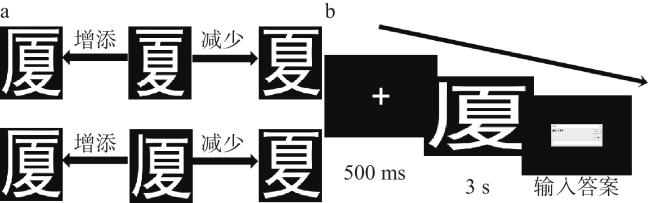
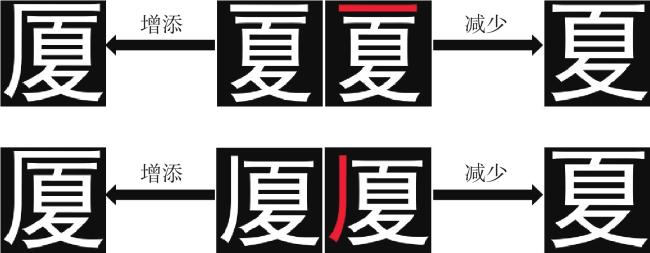
综上,本研究将使用组块破解(chunk decomposition)范式的变式检验问题解决中是否存在加法倾向性并探索其影响因素。其适恰性在于:第一,汉字组块破解任务常被用于顿悟问题解决领域(黄福荣 等, 2017; 张忠炉 等, 2019; Luo et al., 2006; Zhang et al., 2019; Zhang et al., 2015)。第二,组块破解是指将整体的组块打破并分解成更小的组件,再重组或生成新的组块,这包括了减法和加法变化即破解和组合过程(Wu et al., 2017)。第三,汉字由笔画构成,不仅可以对其进行增添和删减固定数量的笔画,而且可以控制变换的笔画为同一组材料(见图1a ),这避免了增添或删减材料的差异带来干扰。第四,加法倾向性是指人们会忽略有利的减法策略而倾向加法,因此在任务材料中减法策略需要具备优势。在组块破解中破解过程比组合过程成功率更高,解答时间更短(Wu et al., 2017),这表明汉字转换任务符合这一要求。同时本研究通过使用单一策略检验问题解决中存在的策略优势差异,避免了使用不中立的基线结果,随后通过单一策略和自由策略的比较对加法倾向性进行验证。任务中,“自由策略”条件要求将假字材料通过增添或删减笔画转换为一个真汉字,单一策略条件则要求对材料只进行加法或减法变化。本研究在自由策略条件中使用语序平衡的指导语,即各一半试次分别使用“增加或减少”与“减少或增加”的指导语。这将一定程度上改善Adams等人(2021)在实验设计中的不足。此外,汉字是一个整体的知觉组块(Luo et al., 2006),可在汉字上检验部件间的知觉整体性的影响。在减法变化中被删减笔画同剩余笔画在字体颜色上相同,依照相似律,颜色相近的事物易被知觉为一个整体(Wagemans et al., 2012)。所以可通过改变二者的颜色一致性,来操纵二者间的知觉整体性。实验2的材料中设置可被删减笔画同剩余笔画异色和同色两种条件(低知觉整体性和高知觉整体性),以探究加法倾向性是否受待移除部件与剩余部件之间的知觉整体性影响。
加法倾向性指忽略有利的减法策略而倾向加法,是一种认知倾向。而策略优势是问题解决中任务本身具备的一种属性。为了验证加法倾向性,需要先检验问题解决中存在减法策略优势,如果发现加法策略更受人们偏爱,才能证明加法倾向性的存在,故本研究进行以下实验。第一,在实验1中检验汉字转换任务中加法策略和减法策略的优势差异,然后在实验2中检验汉字转换任务中加法策略更受人们偏爱。鉴于此,两个实验缺一不可,方可共同验证加法倾向性。第二,实验2在验证加法倾向性的基础上进一步探讨知觉整体性对加法倾向性的影响。结合以上对Adams等人(2021)关于“加法倾向性”的假设性解释及格式塔心理学思想提出以下假设,第一,问题解决(组块破解领域)中存在加减法策略优势差异,在汉字转换任务中减法策略优于加法策略;第二,问题解决中,人们倾向于使用加法策略而忽略减法策略,在汉字转换任务中具有加法倾向性;第三,部件间的知觉整体性增强加法倾向性,可被删减笔画与剩余笔画同色条件下比异色条件下加法倾向性更强。
2 实验1:汉字转换任务中的加减法优势差异
实验1旨在比较汉字转换任务中加法和减法策略的优势差异。实验为单因素被试内设计,自变量为策略类型,分为加法与减法两种水平,因变量为正确解答频次与反应时。
2.1 研究方法
2.1.1 被试
实验1采用G*Power 3.1软件估计所需最小样本量,设置统计检验力(1−β)为0.8,显著性水平(α)为0.05,效应量(f)为0.25,基于重复测量方差分析(组内因素)计算需要被试样本量为34。广州大学36名大学生被试(平均年龄20.02±1.73岁;19位女性)参加本次实验。母语为汉语,右利手,视力或矫正视力正常。实验前签订了知情同意书,实验后获得恰当的报酬。实验得到广州大学教育学院伦理委员会批准。因为2名被试(1位女性19岁,1位男性25岁)未理解任务要求,故剔除其数据。
2.1.2 实验材料
本实验收集了38组配对假字(共76个汉字),配对条件为每组其中一个假字可通过增加或减少一个笔画得到一个真字,而对应假字则可以通过减少或增加同一个笔画得到相反策略下的目标字(如图1a 所示)。其中4组假字作为练习组。假字满足使其通过增加或减少一笔所得的真字均为唯一答案。增加与减少的笔画均与减法策略下得到的汉字在空间上为相接触或相离的关系,这一做法是为了平衡笔画间紧密度对加减法策略的难度影响(Zhang et al., 2015)。两个条件下的目标字在字频上没有显著差异(见表1 )。38组汉字均为黑底白字,并以167×167像素的图片形式呈现,电脑屏幕分辨率为2560×1600。
表1 加法和减法条件下目标字的平均字频及差异比较 |
| 加法 | 减法 | Mann-Whitney检验统计量 | p | |
| 目标字 | 281.53 | 294.55 | 551.00 | 0.741 |
注:单位为次/百万,参考现代汉语语料库的汉字字频表(http://www.chineselexicaldatabase.com)。 |
2.1.3 实验程序
被试在行为实验室中进行汉字转换任务,距离电脑屏幕大约36 cm。通过指导语要求被试只能增加(减少)一个笔画使呈现的假字成为真字,流程见图1b 。在一个500 ms的注视点之后首先呈现一个假字3 s,被试在想出答案后需要按下“ENTER”键进行作答。每种策略条件下呈现17个汉字(34组汉字中随机抽取且每组汉字只会抽取一次并呈现其中一个),共34个试次。加法与减法策略的呈现顺序在被试间进行平衡。实验用E-Prime 1.0进行编程,正式实验中有4个练习试次。
2.2 结果
加法策略的解答率为90.83%,减法策略的解答率为97.05%。加法条件中反应时与解答率的相关系数r=−0.35,p=0.043,减法条件中r=−0.28,p=0.109,在两种条件中均不存在显著正相关,说明没有出现速度−准确率权衡现象。对两种条件下正确解答中的解答频次进行重复测量方差分析,加法条件(M=15.44, SD=1.28)比减法条件(M=16.50, SD=0.86)更少,F(1, 33)=15.95,p<0.001,η2=0.195。对反应时进行重复测量方差分析,加法条件(M=1089 ms, SD=336 ms)同减法条件(M=1203 ms, SD=377 ms)无显著差异,F(1, 33)=1.73,p=0.193。
2.3 讨论
不同于Adams等人(2021)通过材料的设置来推定减法策略的优势,本研究选择通过单一策略的方法验证问题解决中存在减法策略优势。实验1发现汉字转换任务中加法策略解答频次低于减法策略,而两种策略的正确解答反应时无显著差异。这表明汉字转换任务中存在策略优势差异,即减法策略优于加法策略,支持了假设1。
3 实验2:汉字转换任务中的加法倾向性及部件间知觉整体性对其的影响
实验2旨在结合实验1检验汉字转换任务中的加法倾向性及部件间知觉整体性的影响。单因素两水平被试内设计,自变量为部件间知觉整体性,将实验1中配对假字在减法策略中可被删减的笔画和剩余笔画设置为同色(高知觉整体性)和异色(低知觉整体性)两个水平。因变量为加法和减法策略的正确解答频次与反应时。
3.1 研究方法
3.1.1 被试
广州大学36名大学生被试(平均年龄20.91±2.69岁;18位女性)参加本次实验。其他同实验1。因为1名被试(1位女性19岁)未理解任务要求,故剔除其数据。
3.1.2 实验材料
采用实验1中的38组假字,均以黑底的图片形式呈现。字体颜色有两种类型,一类为笔画颜色均是白色,另一类为笔画异色(可待删减的笔画呈现红色,见图2 )。其他同实验1。


3.1.3 实验程序
程序大致同实验1。不同的是,在实验1中被试对出现的假字只能增加或减少一个笔画使其成为一个真字,而在实验2中被试可自由选择对出现的假字增加或减少一个笔画。指导语中“增加或减少”的语序以及自变量两种水平的先后呈现顺序在被试间进行平衡。所有34个试次随机呈现,正式实验中有4个练习试次。
3.2 结果
高知觉整体性(笔画同色)条件的解答率为98.44%。正确答案中,加法和减法答案频次分别为517和52,期望频次均为284.5。经卡方拟合优度检验显示,实际频次和期望频次有显著差异,加法答案频次多于减法,χ2(1)=380.00,p<0.001,r=0.81。低知觉整体性(笔画异色)条件的解答率为98.62%。正确答案中,加法和减法答案频次分别为482和128,期望频次均为285。经卡方拟合优度检验显示,实际频次和期望频次有显著差异,加法答案频次多于减法,χ2(1)=143.50,p<0.001,r=0.50。
对两种条件的加法答案比例进行重复测量方差分析,笔画同色条件(M=91.00%, SD=13.58%)高于笔画异色条件(M=75.75%, SD=24.11%),F(1, 34)=10.57,p=0.002,η2=0.135。对反应时进行重复测量方差分析,笔画同色条件(M=765 ms, SD=233 ms)同笔画异色条件(M=782 ms, SD=239 ms)无显著差异,F(1, 34)=0.44,p=0.510。
3.3 讨论
实验1(单一策略条件)发现汉字转换任务中减法策略优于加法策略。如果被试在问题解决中不存在加法倾向,那么单一策略条件中减法策略优于加法策略的情况下,自由策略条件下减法答案应该多于加法答案。而实验2(自由策略条件)中笔画同色条件下的结果表明加法策略比减法有更高的答案频次,说明汉字转换任务中存在加法倾向性,与假设2一致。实验2的结果还表明笔画同色条件比异色条件有更高的加法答案比例,这说明降低待移除部件与剩余部件的知觉整体性会削弱加法倾向性。两种条件的反应时之间无显著差异则说明,笔画同色或异色的设置未对任务难度产生影响进而干扰加减法倾向。
4 总讨论
本研究重复验证了问题解决中的加法倾向性,并在以下几方面进行了拓展。第一,本研究所用的汉字转换任务不同于Adams等人(2021)中所用的任务,拓展了“加法倾向性”的适用范围。更进一步,所采用的汉字转换任务不完全同于以往的汉字破解任务,而是结合Adams等人关于“加法\减法策略”的思想,对汉字组块破解任务进行了灵活变化,比如让被试通过自由变动一笔(增加或减少、减少或增加)使假字转换成真字(实验2)。第二,从人群和文化角度看,本研究在集体主义文化下拓展了“加法倾向性”的适用范围。事实上,Adams等人的研究也提及“加法倾向性”的文化普适性,他们不仅在美国被试群体中发现了“加法倾向性”,而且在德国和日本被试群体验证了该结论。美国和德国同属个体主义文化,而中国和日本则同属集体主义文化(Triandis et al., 1988)。从这个角度看,本研究将“加法倾向性”拓展至集体主义文化的中国被试群体。
问题解决中为何会存在加法倾向性?Adams等人(2021)认为材料中可待删减部件不容易被认为是可独立的一部分,这可能削弱了减法倾向,增强加法倾向性。基于此,本研究提出并证实,部件间的知觉整体性(即从一开始部件就被知觉为整体的一部分)可能是导致加法倾向性的原因之一。具体而言,实验2的结果表明笔画同色条件下的加法答案比例高于异色条件,这支持了假设3,部件间知觉整体性增强加法倾向性,可待删减笔画与剩余笔画同色条件下比异色条件下加法倾向性更强。根据相似律(Wagemans et al., 2012),颜色相似的事物易被知觉为一个整体,笔画同色条件相较于异色条件有更高的知觉整体性。在低知觉整体性下,待移除部件更容易被视为原始材料的可删减部分,从而引起减法倾向的产生,高知觉整体性下则相反。所以部件间的知觉整体性增强了加法倾向。
实验2的结果还表明笔画异色条件下,即降低了加法倾向的情况下,加法答案频次仍然多于减法。这可能表明部件间的知觉整体性并非唯一影响因素。语言相对论认为,说话者之间的思想差异可能受到语言差异的影响(Bohnemeyer, 2020)。生活中的一种常见现象,即默认“先加后减”的语序对思维的影响可能增强加法倾向。损失厌恶理论认为,人们面对同样数量的收益和损失时,损失比收益更难以接受(Kahneman et al., 1991)。且存在偏差理论(existence bias)指出,人们的注意力和评价过程倾向于维持现状(Eidelman et al., 2009),这两者理论可能解释了人们为何具有“减法忽视”。鉴于此,未来研究还可以从上述思路进行检验。
5 结论
本研究采用汉字转换任务验证了问题解决(组块破解领域)中存在减法策略优势并具有加法倾向性,即人们容易忽视有利的减法策略而倾向于选择加法策略解决问题。同时,初步揭示了部件间知觉整体性对加法倾向性的影响,即高知觉整体性增强加法倾向性,低知觉整体性降低加法倾向性。