

1 引言
客体注意(object-based attention, OBA)是指个体对同一客体内的两个或多个特征的识别比对不同客体内的两个或多个特征的识别更快、更准确(Duncan, 1984)。双框线索范式(见图1 )是研究OBA使用最为广泛的范式(Chen, 2012; Shomstein, 2012)。在该范式中,通常情况下,被试对目标出现在线索化位置(valid, V)的反应快于对目标出现在线索所在客体的非线索化一端(即无效相同客体,same-object, SO)和另一客体中与线索距SO等距离的位置上(即无效不同客体,different-object, DO)的反应(即空间注意),对SO的反应快于对DO的反应(即OBA)。被试对DO与SO之间的反应时之差被称为“客体注意效应”(Egly et al., 1994)。
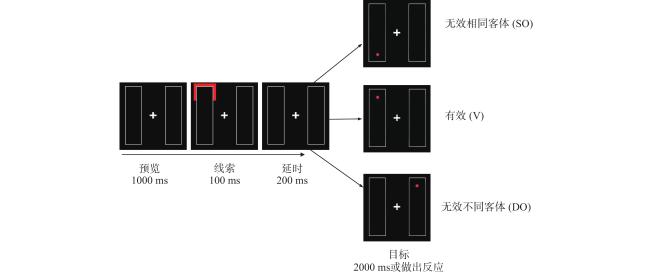
以往使用双框线索范式考察客体朝向是否影响OBA的研究结论并不一致。Egly等(1994)在水平与垂直客体上均发现了OBA,且效应量大小无差异,该结果也在其他研究中得到了重复(Li & Logan, 2008; Liu et al., 2011; Şentürk et al., 2016; Yuan & Fu, 2014)。然而,在另一些研究中,却仅在水平客体上发现了OBA,垂直客体上无OBA,甚至出现了OBA的反转(Al-Janabi & Greenberg, 2016; Hein et al., 2017; Hu et al., 2020; Roque & Boot, 2015)。有研究者指出此时所谓的“OBA”在更大程度上可能反映了水平优势,即被试对水平方向目标的反应优于垂直方向(Carrasco et al., 2001; Chen & Cave, 2019; Pilz et al., 2012; Thornton et al., 2021)。双框线索范式中,当客体水平时,线索与SO之间的关系是水平的,与DO之间的关系是垂直的(OBA与水平优势作用方向一致);当客体垂直时,情况相反(OBA与水平优势作用方向相反)。即,双框线索范式下计算的OBA效应量会混淆水平优势,表现为水平客体的OBA大于垂直客体的OBA(Al-Janabi & Greenberg, 2016; Hein et al., 2017)。
值得注意的是,前人涉及客体朝向影响OBA的研究均使用了辨别任务(Al-Janabi & Greenberg, 2016; Hein et al., 2017; Hu et al., 2020; Pilz et al., 2012; Roque & Boot, 2015),客体朝向不影响OBA的研究均使用了探测任务(Egly et al., 1994; Li & Logan, 2008; Liu et al., 2011; Şentürk et al., 2016; Yuan & Fu, 2014)。两种任务间的差异可能是前人研究结果分歧的关键因素。第一,两种任务类型不同。探测任务仅包括“觉察”和“反应”过程,辨别任务则多出了“辨别”和“反应选择”的过程。第二,两种任务难度不同。探测任务只需“捕获”目标,辨别任务需对刺激进行加工分辨并做出选择性反应,辨别任务加工水平高、难度大(王均 等, 2000)。有研究发现,当任务难度超过某一阈值时就会产生水平优势(Banich & Belger, 1990),且难度越大,水平优势越强(Carrasco et al., 2001; Kraft et al., 2005)。据此推测,以往研究之所以仅在辨别任务中发现了客体朝向对OBA的影响,是因为辨别任务下难度增加,产生了水平优势,导致水平客体产生更大的OBA。
本研究采用双框线索范式以任务难度(探测、简单辨别、困难辨别),有效性(V、SO、DO),客体朝向或线索−目标朝向(水平、垂直)作为自变量,以OBA和水平优势为因变量来验证上述问题。研究采用Hein等(2017)计算纯粹的OBA的方法:当线索−目标朝向垂直时,计算被试对水平客体DO与垂直客体SO之间反应时的差异,即剥离水平优势后垂直方向纯粹的OBA;当线索−目标朝向水平时,计算被试对垂直客体DO与水平客体SO之间反应时的差异,即剥离水平优势后水平方向纯粹的OBA(下文中纯粹的OBA即指剥离水平优势后的OBA,OBA则指经典算法下的OBA)。
2 实验1:探测任务与辨别任务下客体朝向对OBA的影响
2.1 研究方法
2.1.1 被试
实验前采用G*Power3.1软件估计样本量,设置效应量为0.25,统计检验力为0.90,α水平为0.05,计算所需样本量为16。随机选择24名大学生(男8名),平均年龄19.86岁,视力或矫正视力正常,无色盲,实验后获得一定的报酬。
2.1.2 实验材料与仪器
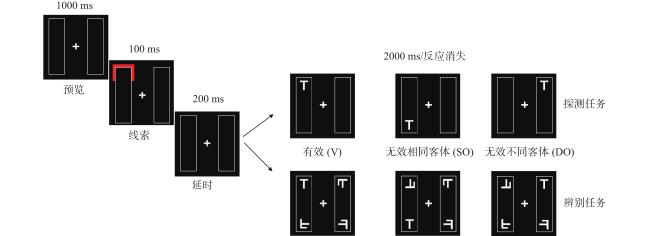
所有刺激的背景均为黑色。每个试次中央呈现0.3°×0.3°的中央注视点,两个1.3°×4.5°的矩形在注视点的上下或左右两侧,矩形之间的距离是1.9°。线索是用红色线条(RGB: 255, 0, 0)加粗矩形任意一端。探测任务下,矩形中只呈现0.9°×0.9°的目标刺激T或L,或没有目标的空白试次;辨别任务下,采用当前通用的方式,即矩形四个端点同时呈现目标(T或L)和干扰刺激(由不同角度呈现的T和L组成的似F的刺激)。
实验采用19英寸台式电脑,屏幕分辨率为1280×1024像素,刷新率为60 Hz。通过E-Prime2.0编程并记录被试的反应时和正确率。
2.1.3 实验设计
2(任务难度:探测、辨别)×2(客体朝向:水平、垂直)×3(有效性:V、SO、DO)的被试内实验设计,实验分两天进行,其中一半被试第一天完成探测任务,第二天完成辨别任务,另一半被试与之相反。两种任务均包含8个组块,每个组块的前两个试次作为“预热”不分析。辨别任务下进入分析的试次共608个(水平、垂直客体各占一半),其中V条件试次352个,SO条件和DO条件的试次均128个。探测任务下进入分析的试次共736个,其中空白试次128个,V、SO和DO条件的试次数与辨别任务相同。
2.1.4 实验流程
实验流程见图2 。探测任务下,要求一半被试看到目标(T或L)后就按“M”键反应,另一半被试按“Z”键反应,没有目标出现则不按键。辨别任务下,要求被试按“Z”键或“M”键对目标字母是T或L做出辨别反应,按键在被试间平衡。在正式实验前,被试需要完成20个试次的练习实验,当正确率达到90%以上才能进入正式实验。
2.1.5 数据分析
采用SPSS21.0进行数据统计分析,剔除两名被试的数据(一人只参加了一项任务,另一人在探测任务下错误率超过10%),进入分析的被试共22人。探测任务下,虚报率1.95%,目标试次击中率99.88%。删除反应时小于150 ms以及均值上下三个标准差以外的极端值共占总试次的0.40%。辨别任务下,删除错误反应占总试次的3.62%,删除均值上下三个标准差以外的极端值1.48%。由于本研究关注的是客体注意效应,所以在分析数据时,仅在实验1的有效性条件下包含了V条件,其余实验主要呈现SO和DO两种条件的结果。
2.2 结果
2.2.1 经典OBA
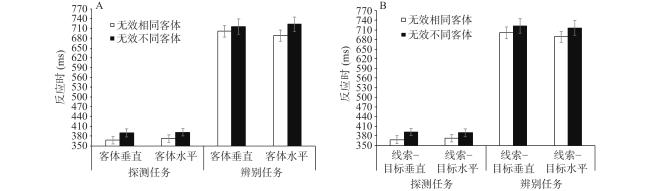
对反应时进行2(任务难度:探测、辨别)×2(客体朝向:水平、垂直)×3(有效性:V、SO、DO)重复测量方差分析,结果表明(见图3A ),任务难度主效应显著,F(1, 21)=309.59,p<0.001,η${_{\rm p}^2} $ =0.94,被试对探测任务的反应(375±53 ms)快于对辨别任务的反应(678±81 ms);有效性主效应显著,F(2, 42)=38.88,p<0.001,η${_{\rm p}^2} $ =0.65,被试对V条件的反应(492±61 ms)快于对SO条件(532±53 ms)和DO条件的反应(555±63 ms),且对SO条件的反应快于对DO条件的反应,ps<0.001,即产生了OBA效应。任务难度和有效性交互作用显著,F(2, 42)=16.18,p<0.001,η${_{\rm p}^2} $ =0.44;任务难度和客体朝向交互作用边缘显著,F(1, 21)=4.15,p=0.055,η${_{\rm p}^2} $ =0.17。任务难度、客体朝向与有效性三重交互作用显著,F(2, 42)=3.39,p=0.043,η${_{\rm p}^2} $ =0.14,简单简单效应分析发现:探测任务下,客体垂直时,被试对V条件的反应(365±54 ms)与对SO条件的反应(367±56 ms)无差异,且两者均快于对DO条件的反应(389±66 ms),F(2, 20)=57.75,p<0.001,η${_{\rm p}^2} $ =0.85;客体水平时,被试对V条件的反应(364±51 ms)与对SO条件的反应(372±52 ms)无差异,且两者也均快于对DO条件的反应(392±52 ms),F(2, 20)=44.42,p<0.001,η${_{\rm p}^2} $ =0.82,即水平、垂直客体均存在显著的OBA效应。辨别任务下,客体垂直时,被试对V条件的反应(623±86 ms)快于对SO条件(701±86 ms)和DO条件(716±107 ms)的反应,而对SO条件与DO条件的反应速度无差异,F(2, 20)=12.09,p<0.001,η${_{\rm p}^2} $ =0.55,即OBA效应消失;客体水平时,被试对V条件的反应(613±77 ms)快于对SO条件(688±82 ms)和DO条件(723±106 ms)的反应,且后两者之间的差异也显著,F(2, 20)=16.18,p<0.001,η${_{\rm p}^2} $ =0.62,即存在显著的OBA效应。
对正确率进行同样的方差分析发现,任务难度的主效应显著,F(1, 21)=40.82,p<0.001,η${_{\rm p}^2} $ =0.67,探测任务的正确率(99.89%±0.38%)高于辨别任务的正确率(96.00%±3.73%)。有效性主效应显著,F(2, 42)=11.01,p<0.001,η${_{\rm p}^2} $ =0.34,V条件(98.45%±2.16%)与SO条件(98.15%±2.91%)的正确率无差异,但均高于DO条件的正确率(97.23%±4.30%),ps<0.006。任务难度和有效性之间的交互作用显著,F(2, 42)=10.62,p<0.001,η${_{\rm p}^2} $ =0.34,简单效应分析发现,探测任务下,V条件(99.86%±0.42%)、SO条件(99.89%±0.39%)和DO条件(99.93%±0.33%)的正确率两两之间均无差异,p=0.533;辨别任务下,V条件(97.04%±2.29%)与SO条件(96.41%±3.27%)的正确率无差异,但均显著高于DO条件(94.53%±4.73%)的正确率,F(2, 20)=7.55,p=0.004,η${_{\rm p}^2} $ =0.43。
2.2.2 水平优势和剥离水平优势后纯粹的OBA
采用Hein等(2017)的方法,以线索−目标朝向作为自变量对反应时进行2(任务难度:探测、辨别)×2(线索−目标朝向:水平、垂直)×2(有效性:SO、DO)重复测量方差分析。线索−目标垂直与线索−目标水平之间反应时的差异是衡量水平优势的指标,SO与DO之间反应时的差异是衡量纯粹OBA的指标。结果见图3B ,任务难度主效应显著,F(1, 21)=236.10,p<0.001,η${_{\rm p}^2} $ =0.92。有效性主效应显著,F(1, 21)=34.18,p<0.001,η${_{\rm p}^2} $ =0.62。任务难度和线索−目标朝向之间交互作用显著,F(1, 21)=5.17,p=0.034,η${_{\rm p}^2} $ =0.20,简单效应分析发现:探测任务下,被试对线索−目标水平条件的反应(381±54 ms)与对线索−目标垂直条件的反应(380±54 ms)无差异,无水平优势;辨别任务下,被试对线索−目标水平条件的反应(702±94 ms)有快于线索−目标垂直条件的反应(712±95 ms)趋势,F(1, 21)=3.64,p=0.070,η${_{\rm p}^2} $ =0.15,水平优势边缘显著(效应量10 ms),其余效应均不显著,Fs<1.92,ps>0.180。有效性与任务难度、有效性与线索−目标朝向,以及有效性与任务难度和线索−目标朝向之间的交互作用均不显著,说明线索−目标朝向和任务难度均不影响纯粹的OBA。
2.3 讨论
在探究经典OBA效应时,发现探测任务下客体朝向不影响OBA;而辨别任务下,客体朝向影响OBA。当以线索−目标朝向作为自变量,探究水平优势和纯粹OBA时,发现探测任务下无水平优势,辨别任务下水平优势边缘显著,但所有条件下均可产生纯粹的OBA效应,且任务难度、线索−目标朝向均不影响纯粹的OBA。但实验1中探测任务和辨别任务不仅在任务难度上有差异,且任务类型也不同。为排除任务类型的混淆,实验2探究了简单辨别任务与困难辨别任务下客体朝向对OBA的影响。
3 实验2:简单和困难辨别任务下客体朝向对OBA的影响
3.1 研究方法
3.1.1 被试
计算被试数的方法与实验1一致,计算样本量为48。随机选择48名大学生(简单辨别任务24人,其中男5人;困难辨别任务24人,其中男4人),平均年龄19.35岁,视力或矫正视力正常,无色盲,实验后获得一定的报酬。
3.1.2 实验材料与仪器
困难辨别任务在实验1辨别任务的基础上加入掩蔽刺激,掩蔽刺激是能完全遮挡住目标和干扰刺激的“田”字形,其余与实验1相同。
3.1.3 实验设计与流程
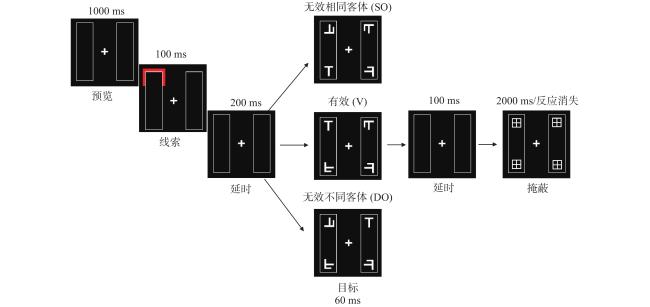
实验采用2(任务难度:简单辨别、困难辨别)×2(客体朝向:水平、垂直)×3(有效性:V、SO、DO)三因素混合实验设计,任务难度为被试间变量,其余为被试内变量。简单辨别任务与实验1辨别任务流程完全相同,困难辨别任务流程与简单辨别任务流程的不同之处在于目标呈现时间缩短为60 ms,且目标后有100 ms的延时,最后呈现掩蔽刺激(见图4 )。两个任务均由8个组块组成,各自均共896个试次(水平、垂直客体各占一半),其中,V条件试次512个,SO条件和DO条件的试次各为192个。正式实验前有28个练习试次,被试的正确率超过90%可进入正式实验。
3.1.4 数据分析
简单辨别任务下删除错误反应2.44%,删除均值上下三个标准差以外的极端值1.45%。困难辨别任务下删除错误反应3.68%,删除均值上下三个标准差以外的极端值1.61%。
3.2 结果
3.2.1 经典OBA
本研究采用E-Prime编程,简单辨别任务中,目标刺激持续呈现直到被试反应后消失,于目标屏呈现开始记录反应时;困难辨别任务中,目标刺激仅呈现60 ms后呈现100 ms的延时屏,然后出现掩蔽屏,于掩蔽屏呈现开始记录反应时。为统一计时起点(即目标刺激出现时刻),困难辨别任务下最终反应时的计算在收集到的数据基础上增加160 ms(目标刺激呈现时长与延时屏呈现时长之和),实验3困难辨别任务相同。
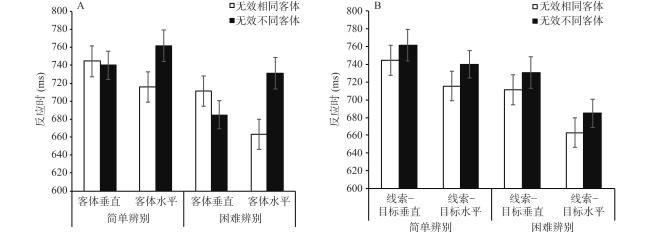
对反应时进行2(任务难度:简单辨别、困难辨别)×2(客体朝向:水平、垂直)×2(有效性:SO、DO)混合方差分析发现(见图5A ),任务难度的主效应边缘显著,F(1, 46)=3.45,p=0.070,η${_{\rm p}^2} $ =0.07,被试对简单辨别任务的反应(740±67 ms)有慢于困难辨别任务的反应(697±97 ms)趋势。有效性主效应显著,F(1, 46)=53.20,p<0.001,η${_{\rm p}^2} $ =0.54,被试对SO条件的反应(709±86 ms)快于对DO条件的反应(729±85 ms)。客体朝向和有效性之间的交互作用显著,F(1, 46)=94.86,p<0.001,η${_{\rm p}^2} $ =0.67。任务难度、客体朝向和有效性之间的三重交互作用显著,F(1, 46)=8.86,p=0.005,η${_{\rm p}^2} $ =0.16,简单简单效应分析发现:简单辨别任务下,客体垂直时,被试对SO条件的反应(745±59 ms)与对DO条件的反应(740±64 ms)无差异,F(1, 46)=0.48,p=0.492,即OBA效应消失;客体水平时,被试对SO条件的反应(716±70 ms)快于对DO条件的反应(761±65 ms),F(1, 46)=46.54,p<0.001,η${_{\rm p}^2} $ =0.50,即出现显著的OBA效应。困难辨别任务下,客体垂直时,被试对SO条件的反应(711±98 ms)慢于对DO条件的反应(685±85 ms),F(1, 46)=16.91,p<0.001,η${_{\rm p}^2} $ =0.27,即出现了OBA的反转;客体水平时,被试对SO条件的反应(663±90 ms)快于对DO条件的反应(731±100 ms),F(1, 46)=102.19,p<0.001,η${_{\rm p}^2} $ =0.69,即出现了OBA效应。
对正确率进行同样的分析发现,任务难度的主效应显著,F(1, 46)=13.12,p=0.001,η${_{\rm p}^2} $ =0.22,被试在简单辨别任务下的正确率(96.88%±2.52%)显著高于困难辨别任务下的正确率(94.14%±4.00%)。有效性和任务难度之间的交互作用显著,F(1, 46)=4.74,p=0.035,η${_{\rm p}^2} $ =0.09;客体朝向和有效性之间的交互作用显著,F(1, 46)=8.12,p=0.007,η${_{\rm p}^2} $ =0.15。客体朝向、有效性和任务难度之间的三重交互作用显著,F(1, 46)=4.43,p=0.041,η${_{\rm p}^2} $ =0.09,简单简单效应分析发现:简单辨别任务下,客体垂直时,被试在SO条件下的正确率(96.31%±3.04%)与DO条件下的正确率(96.96%±2.44%)无差异;客体水平时,SO条件(97.05%±2.44%)和DO条件(97.18%±1.98%)的正确率亦无差异。困难辨别任务下,客体垂直时,SO条件(94.18%±3.95%)和DO条件(94.79%±4.31%)的正确率无差异;客体水平时,SO条件的正确率(95.23%±2.75%)显著高于DO条件的正确率(92.36%±4.18%),F(1, 46)=15.32,p<0.001,η${_{\rm p}^2} $ =0.25。
3.2.2 水平优势和剥离水平优势后纯粹的OBA
以线索−目标朝向作为自变量对反应时进行2(任务难度:简单辨别、困难辨别)×2(线索−目标朝向:水平、垂直)×2(有效性:SO、DO)混合方差分析表明(见图5B ),任务难度的主效应边缘显著,F(1, 46)=3.45,p=0.070,η${_{\rm p}^2} $ =0.07。有效性的主效应显著,F(1, 46)=53.20,p<0.001,η${_{\rm p}^2} $ =0.54;线索−目标朝向的主效应显著,F(1, 46)=94.86,p<0.001,η${_{\rm p}^2} $ =0.67,被试对线索−目标垂直条件的反应(737±85 ms)慢于对线索−目标水平条件的反应(700±83 ms)。线索−目标朝向与任务难度之间的交互作用显著,F(1, 46)=8.86,p=0.005,η${_{\rm p}^2} $ =0.16,简单效应分析发现,简单辨别任务下,被试对线索−目标垂直条件的反应(753±63 ms)慢于对线索−目标水平条件的反应(728±68 ms),F(1, 46)=22.87,p<0.001,η${_{\rm p}^2} $ =0.33,即水平优势显著(25 ms);困难辨别任务下,被试对线索−目标垂直条件的反应(721±100 ms)慢于对线索−目标水平条件的反应(674±88 ms),F(1, 46)=80.85,p<0.001,η${_{\rm p}^2} $ =0.64,即水平优势显著(47 ms),也就是说,困难辨别任务下的水平优势大于简单辨别任务;其余效应均不显著,Fs<1.43,ps>0.238,即任务难度和线索−目标朝向未影响纯粹OBA效应。
3.3 讨论
实验2困难辨别任务下的水平优势大于简单辨别任务,且客体朝向对OBA的影响变大,证实了前人研究中客体朝向对OBA的影响争议是由于实验任务难度不同导致的。而当剥离水平优势后,任务难度、线索−目标朝向均不影响纯粹的OBA,这表明任务难度是通过影响水平优势,进而使得不同朝向客体间的OBA不同,而纯粹的OBA并无变化。被试对困难辨别任务的总反应时短于简单辨别任务,可能是由于困难辨别任务下目标呈现时间非常短,迫使被试提前进入高度警觉状态,并迅速定向至目标位置,因此困难辨别任务下的反应时缩短(O’Toole et al., 2011)。
4 实验3:简单和困难辨别任务下倾斜45°客体朝向对纯粹OBA的影响
为进一步探究任务难度对纯粹OBA的影响,实验3将矩形框倾斜至45°使线索与目标的位置关系不再是水平或垂直,从实验操作上排除了水平优势,探究此时任务难度与客体朝向对纯粹OBA的影响。
4.1 研究方法
4.1.1 被试
计算被试数的方法与实验2一致。随机选择48名大学生(简单辨别任务24人,其中男5人;困难辨别任务24人,其中男8人),平均年龄18.75岁,视力或矫正视力正常,无色盲,实验后获得一定的报酬。
4.1.2 实验材料与仪器
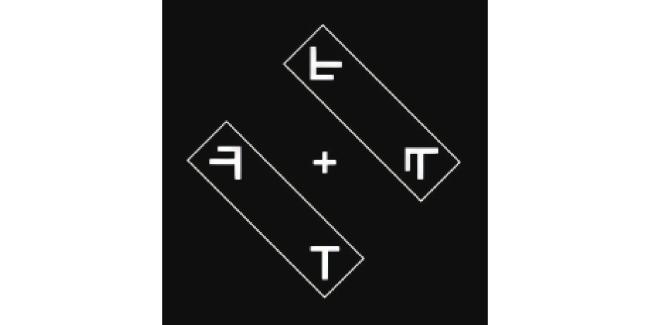
4.1.3 实验设计与流程
2(任务难度:简单辨别、困难辨别)×2(客体朝向:右倾、左倾)×3(有效性:V、SO、DO)混合实验设计。任务难度为被试间变量,其余为被试内变量,实验流程与实验2相同。
4.1.4 数据分析
简单辨别任务下删除错误反应2.29%,删除均值上下三个标准差以外的极端值1.43%。困难辨别任务下删除错误反应4.09%,删除均值上下三个标准差以外的极端值1.60%。
4.2 结果
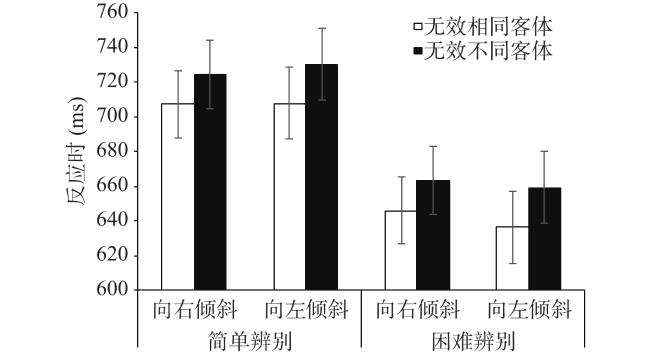
对反应时进行2(任务难度:简单辨别、困难辨别)×2(客体朝向:右倾、左倾)×2(有效性:SO、DO)三因素混合方差分析,结果发现(见图7 ),任务难度的主效应显著,F(1, 46)=5.59,p=0.022,η${_{\rm p}^2} $ =0.11,被试对困难辨别任务的反应(651±100 ms)快于对简单辨别任务的反应(718±94 ms)。有效性主效应显著,F(1, 46)=84.93,p<0.001,η${_{\rm p}^2} $ =0.65,被试对SO条件的反应(674±102 ms)快于对DO条件的反应(694±102 ms),即出现了纯粹OBA效应(20 ms)。其余效应均不显著,Fs<2.95,ps>0.093,即客体朝向、任务难度均未影响纯粹的OBA效应。


对正确率进行同样的方差分析发现,任务难度的主效应显著,F(1, 46)=11.72,p=0.001,η${_{\rm p}^2} $ =0.20,困难辨别任务下的正确率(94.00%±4.27%)低于简单辨别任务下的正确率(97.17%±3.49%)。有效性的主效应显著,F(1, 46)=11.29,p=0.002,η${_{\rm p}^2} $ =0.20,SO条件下的正确率(96.26%±3.78%)高于DO条件下的正确率(94.91%±4.49%)。其余效应均不显著,Fs<1.55,ps>0.219。
4.3 讨论
使用倾斜45°的矩形在实验方法上排除水平优势后,发现任务难度与客体朝向均不影响纯粹OBA,进一步验证了实验1、实验2的结果,排除水平优势后纯粹的OBA不受任务难度和客体朝向的影响。
5 总讨论
本研究目的在于考察任务难度对OBA和水平优势的影响。所有实验的结果一致表明,高难度任务下被试的正确率显著低于低难度任务,证明了难度操作有效。研究还发现任务难度越高,水平优势越强,客体朝向对OBA的影响越大,而剥离水平优势后纯粹的OBA不受任务难度与线索−目标朝向的影响(实验1、实验2)。实验3采用倾斜45°的矩形框在实验设计上排除水平优势后,进一步证实了纯粹的OBA不受任务难度与客体朝向的影响。研究解决了以往有关客体朝向对OBA影响结果不一的分歧。
有研究者指出,水平优势源于双侧半球优势(Greenberg et al., 2014; Sereno & Kosslyn, 1991)。Sereno和Kosslyn发现当刺激映射在不同的大脑半球(在双侧视野水平排列),相对映射在同一大脑半球(在单侧视野垂直排列)被试的反应更快,他们认为这是因为当两种刺激出现在同一个大脑半球时,可能会争夺资源;相反,当它们在不同半球时,会调动更多的资源,因此导致了“不同半球优势”。而本研究实验1在探测任务下并未发现水平优势,可能是因为该任务非常简单,单侧半球的注意资源足以处理该任务,因此未产生不同半球优势。随着任务难度的增加,被试双侧半球调动的注意资源均增加,不同半球优势作用进一步凸显,水平优势也增加。前人研究发现水平优势会随着任务难度的增加而变大(Banich & Belger, 1990; Carrasco et al., 2001; Kraft et al., 2005),本研究也发现困难辨别任务下的水平优势大于简单辨别任务。
重要的是,本研究发现任务难度只影响水平优势,在经典OBA算法中表现为客体朝向对OBA的影响,而通过数据处理剥离水平优势或采用倾斜45°的矩形框排除水平优势后纯粹的OBA并不受任务难度、线索−目标朝向以及客体朝向的影响。这与前人结果部分一致(Al-Janabi & Greenberg, 2016; Hein et al., 2017; Hu et al., 2020)。Al-Janabi和Greenberg研究发现,剥离水平优势后,在水平、垂直客体上均产生了纯粹的OBA。Hein等只在两客体不同时发现了纯粹的OBA,同客体上无纯粹的OBA,Hu等只在分析型认知风格个体上发现了纯粹的OBA,整体型认知风格个体上无。需要说明的是,Hein等的研究中操控了客体相似性,当客体不同时会增强客体不同的表征,而当两个客体相同时,被试可能会将两个相同的客体知觉为一个大客体的两部分,使得相同客体条件下纯粹的OBA消失。Hu等的研究中整体型认知风格个体倾向于将场景中的两个或多个对象组合成一个更大的客体,因此整体型认知风格个体上无法产生纯粹的OBA。诚然,OBA易受到如客体表征(李诸洋 等, 2022; Shomstein & Behrmann, 2008; Zhao et al., 2015)、目光线索(闫驰 等, 2022; Song et al., 2021)、奖赏(Lee & Shomstein, 2013; Shomstein & Johnson, 2013)等因素的影响,但本研究结果发现,双框线索范式下将水平优势剥离后得到的纯粹OBA是具有相对稳定性的。
据此,本研究的一个启示是,水平优势是一个容易混淆OBA的重要因素。Chen和Cave(2019)也指出,之前在视觉比较任务中发现的OBA效应,其实是水平优势(Chen & Cave, 2019; Chen et al., 2019)。本研究采用双框线索范式,在简单辨别和困难辨别任务下也发现了水平优势,而且任务难度会调节水平优势,并进而影响OBA。因此,未来研究若仍采用双框线索范式,且要考察纯粹的OBA特征,采用倾斜45°矩形框的方式排除水平优势是一个可行的选择。
6 结论
以往研究中客体朝向对OBA的影响分歧是因为双框线索范式下OBA算法中混淆了水平优势,且不同研究中所用任务的难度不同导致的。任务难度越大,水平优势越强,客体朝向对OBA的影响也越大,而排除水平优势后纯粹的OBA不受任务难度、线索−目标朝向和客体朝向的影响。即,任务难度仅影响水平优势而不影响纯粹的客体注意。