

1 前言
想象一下,当你要驾驶或者步行通过一个没有红绿灯的十字路口时,是否可以轻松地对不同方向的车流速度进行整体加工,从而安全、迅速地判断自己何时以及以何种速度前行。这一现象体现了整体知觉(ensemble perception)在生活中的普遍运用。整体知觉是指个体对刺激集合中统计信息(例如,均值)的提取(Chen & Zhou, 2018; Chong & Treisman, 2003; Yamanashi et al., 2020)。在上述例子中,车辆是刺激;多个车辆构成了刺激集合,集合数量即为车辆的数量;车辆的颜色、速度等属于刺激特征。
已有研究发现,整体知觉存在集合数量效应,即集合数量影响个体的整体知觉,但在作用方向上尚未得到一致结论。部分研究者认为,集合数量的增加会使得集合均值更接近总体均值,因而存在集合数量的增益效应,即整体知觉的表现随着集合数量增加而提高(Haberman & Whitney, 2009; Leib et al., 2014; Parkes et al., 2001; Robitaille & Harris, 2011; Sweeny et al., 2013)。但是,也有研究者发现集合数量的干扰效应,整体知觉表现随集合数量的增加而下降(Allik et al., 2013; Goldenberg, LaFollette, et al., 2022; Iakovlev & Utochkin, 2021; Lee et al., 2021; Marchant et al., 2013)。
目前,整体知觉中的集合数量效应表现为增益还是干扰仍不清楚。通过整理前人研究发现,结果不一致的原因可能是测量范式、评估方式以及凸显刺激的影响(Goldenberg, Schöne, et al., 2022; Iakovlev & Utochkin, 2021; Robitaille & Harris, 2011; Sweeny et al., 2013)。
第一,集合数量的增益效应可能来自于特定的测量范式和评估方式。以往研究通常采用迫选范式,并发现了增益效应(Kanaya et al., 2018; Robitaille & Harris, 2011)。该范式在集合呈现完毕后要求被试在判断屏进行迫选,即哪个选项更接近集合均值(Haberman & Whitney, 2009)。虽然该范式能获得个体的判断结果,但二择一的迫选方式无法直接反映出个体的整体知觉表现。即使随机选择,正确率也会在50%左右。因此集合数量增加后个体仍有优异表现。此外,研究者发现,当尽可能多地呈现集合所包含的刺激时,个体的整体知觉表现越好(Leib et al., 2016; Sweeny et al., 2013)。这一评估方式是在集合刺激确定的条件下,限制呈现的刺激数量,并非集合数量本身。
与迫选范式相比,调整范式要求个体通过移动鼠标或者按键,自主回答集合均值(Florey et al., 2017; Iakovlev & Utochkin, 2021; Utochkin & Vostrikov, 2017; Yildirim et al., 2018)。该范式可以直接反映出个体对刺激集合的评估,而不是简单地判断正确与否。但该范式通常以偏差(反应值与正确均值的差值)作为指标,容易忽略个体的系统性偏差。即个体倾向于低估或高估,在群组中系统偏差会相互抵消,进而无法准确反映出整体知觉表现。所以本研究使用调整范式,选择绝对偏差指标(偏差的绝对值),以更加灵敏的方式探讨整体知觉中的集合数量效应。
第二,集合数量的干扰效应可能与集合中的凸显刺激有关。前人研究忽略了凸显刺激在整体知觉中的作用。即使是同一特征(颜色),一些特殊的特征值(红色)往往更具有凸显性。例如,尺寸较大(de Fockert & Marchant, 2008; Kanaya et al., 2018; Semizer & Boduroglu, 2021)、情绪强度较高(Matsumoto & Hwang, 2014)的刺激。放大假说(amplification hypothesis)认为人们更容易被视觉上的凸显刺激吸引,在进行整体知觉时给予其较大权重;集合数量增大时,凸显刺激出现的概率随之增加,而个体只能加工集合中的部分刺激,所以集合数量的干扰效应更加明显(Goldenberg, LaFollette, et al., 2022; Iakovlev & Utochkin, 2021)。但也有研究并未发现凸显刺激对整体知觉表现的影响(Haberman & Whitney, 2010)。
凸显刺激的类型可能从中产生作用。任务相关凸显刺激是指研究者通过任务相关特征产生凸显刺激,任务无关凸显刺激则是通过任务无关特征产生凸显刺激。例如,对面孔情绪进行整体知觉时,集合中的极端情绪面孔为任务相关凸显刺激(Haberman & Whitney, 2010);集合中肤色较深的面孔则为任务无关凸显刺激(Goldenberg, LaFollette, et al., 2022)。目前尚未有研究者在整体知觉中对两种类型的凸显刺激进行直接比较。梳理凸显刺激对整体知觉的影响研究发现,个体会赋予任务无关凸显刺激较高的权重(Goldenberg et al., 2021; Iakovlev & Utochkin, 2021);倾向于忽略任务相关凸显刺激(Haberman & Whitney, 2010)。所以,凸显刺激类型也应该考虑到集合数量效应的影响因素中。
基于此,本研究采用调整范式,选择绝对偏差指标,全面考察凸显刺激的类型(相关特征、无关特征)和集合数量对整体知觉的影响。
2 实验1:凸显刺激类型对整体知觉中集合数量效应的影响
为了探究整体知觉中的集合数量效应,本研究对凸显刺激类型进行严格操纵。前人研究结果发现无关凸显刺激会捕获个体的注意(Goldenberg et al., 2021; Iakovlev & Utochkin, 2021);相关凸显刺激则不会(Haberman & Whitney, 2010)。基于此,本研究假设无关凸显刺激会吸引个体注意,并且表现出集合数量对整体知觉的干扰效应。
2.1 研究方法
2.1.1 被试
随机招募54名大学生(女生30人),年龄在19~30岁(M=21.37岁, SD=1.81岁),视力或矫正视力正常。本实验经天津师范大学伦理委员会审核通过。所有被试均详细阅读并签署了知情同意书,确保其了解并自愿参加本实验。实验结束后获得一定报酬。
2.1.2 实验设计
采用2(相关特征:凸显、不凸显)×2(无关特征:凸显、不凸显)×3(集合数量:4、8、16)的三因素被试内实验设计。因变量为绝对偏差。为了控制个体差异的混淆,采集了无凸显刺激的基线任务。
2.1.3 研究材料
本实验在灰色(RGB: 128, 128, 128)背景上同时呈现多个白色的三角形集合,当刺激集合消失后被试需要回答集合的朝向均值。具体方法为被试可以通过鼠标拖动白色滑块在黑色圆圈上的位置,使三角形的朝向发生变化。不同任务中三角形的设定如下。
基线任务:该任务中三角形的大小均为14×28像素,集合的朝向均值Mo在1~360°随机取整,集合中三角形的朝向则是在朝向均值的基础上由Mo±10°、Mo±30°组成。当集合数量为4、8、16时,意味着这些三角形会同时出现1、2、4次。不同集合数量下的三角形随机呈现在4×4的矩阵中,每个矩阵为120×120像素且矩阵的横纵坐标在±30像素中随机抖动。该任务共包含180个试次,每个集合数量条件下各有60个试次。
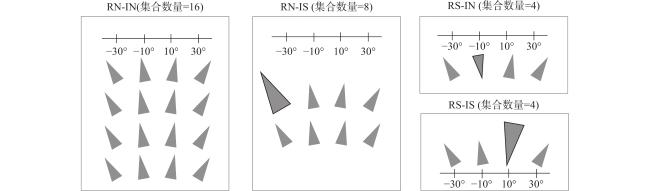
凸显任务:在该任务下会同时呈现多个朝向、大小不一的三角形。个体需要对三角形的朝向进行整体知觉,因此 “朝向”属于任务相关特征;“大小”则属于任务无关特征。如果依据任务无关特征产生凸显刺激,会增大三角形的尺寸;如果依据任务相关特征产生凸显刺激,则会增加三角形的朝向。具体而言,相关特征凸显−无关特征不凸显(RS-IN)条件共45个试次,不同集合数量下各15个试次。该条件是在1/4基线任务的基础上,在每个试次中随机选择一个三角形,使其朝向+180°。类似的,相关特征不凸显−无关特征凸显(RN-IS)条件是选择一个三角形,使其大小变为26×52像素;相关特征凸显−无关特征凸显(RS-IS)条件是选择一个三角形使其朝向、大小均发生变化;相关特征不凸显−无关特征不凸显(RN-IN)条件与基线任务中的1/4试次完全相同。凸显任务中发生变化的三角形均是通过伪随机的方式提前设定好的。实验材料举例见图1 。
2.1.4 实验仪器
使用2台笔记本电脑收集数据,电脑刷新率均为60 Hz,屏幕分辨率为1024×768像素,每个像素的视角约为0.03°。实验程序的编写和刺激呈现均采用PsychoPy 2021.2.3。
2.1.5 实验程序
每名被试在安静的环境中单独施测。实验共分为3个阶段。
练习阶段:为了保证被试能够准确理解实验任务,需要完成12个试次的练习。与正式实验唯一不同的是,被试提交答案后会有2 s的反馈。
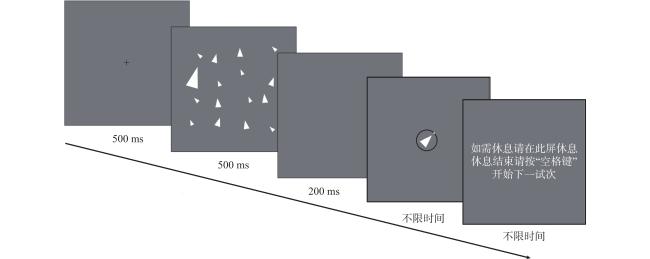
基线任务:共180个试次,每个试次的流程如下。首先在屏幕中央呈现黑色注视点500 ms,紧跟着呈现刺激集合500 ms,随后呈现空屏200 ms,最后屏幕上仅存在一个三角形,被试需要将该三角形的朝向调整到朝向均值处。该阶段无时间限制,调整结束后按“空格”键。每72个试次出现一次休息屏,休息结束按“空格”键继续。
凸显任务:共180个试次,除实验材料外,其他设置与基线任务相同。实验流程如图2 所示。
2.1.6 数据分析
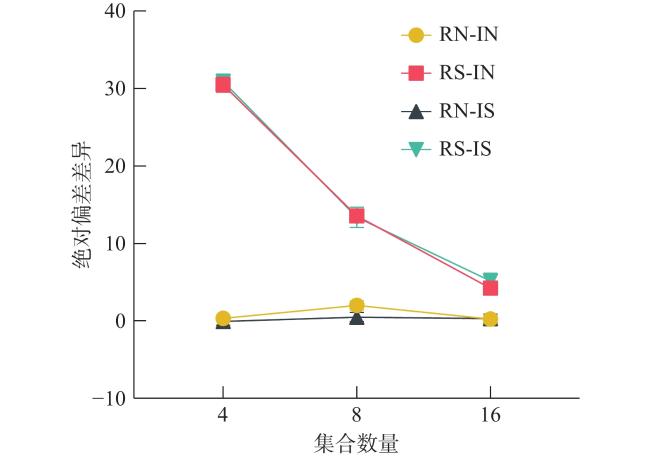
按照如下标准处理数据。(1)删除超出3个标准差的试次;(2)当某一被试的删除试次数超过总试次的30%时,则将该被试的所有数据进行删除。为控制个体差异,观察凸显刺激的纯粹影响。本研究计算了凸显任务与基线任务的绝对偏差差异,该指标也按照上述标准处理。按照该标准处理后,剩余有效被试54人。在基线任务中共删除93个试次,占总试次的0.95%。在凸显任务中共删除280个试次,占总试次的2.88%。在分析绝对偏差差异时,共删除269个试次,占总试次的2.76%。
使用R语言(4.1.2)的bruceR包对基线任务进行单因素方差分析,对凸显任务和去除个体差异后的绝对偏差差异进行重复测量方差分析,p<0.05视为显著。
2.2 结果
2.2.1 基线任务
集合数量主效应显著,F(2, 106)=4.87,p=0.009,η$ _{\mathrm{p}}^{2} $ =0.08;多重比较结果发现,集合数量为4时的绝对偏差(M=14.21)显著高于集合数量为16时(M=13.44) [t(53)=3.09, p=0.009, Cohen’s d=0.39];其余结果均不显著[ts(53)<2.31, ps>0.05]。
2.2.2 凸显任务
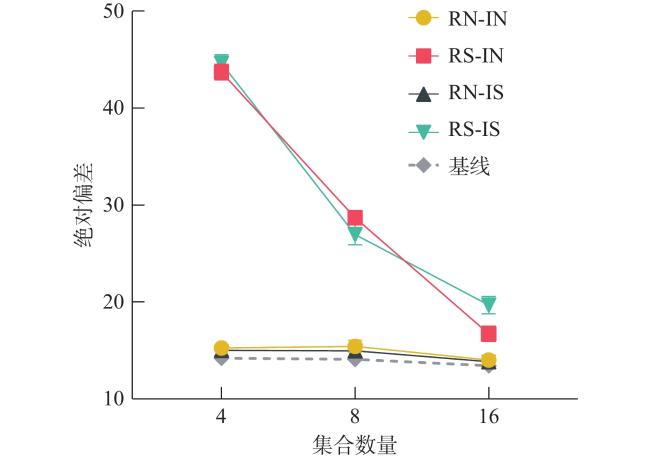
三者交互效应显著,F(2, 106)=3.87,p=0.024,η$ _{\mathrm{p}}^{2} $ =0.07。简单简单效应分析发现,在集合数量为4和8时,不论相关特征是否凸显,无关特征凸显和不凸显的差异均不显著[ts(53)<1.49, ps>0.05]。在集合数量为16,相关特征凸显时,无关特征凸显(M=19.69)和不凸显(M=16.74)的差异显著[t(53)=3.72, p=0.003, Cohen’s d=0.44];相关特征不凸显时,无关特征凸显(M=13.85)和不凸显(M=14.03)的差异不显著[t(53)=0.39, p>0.05]。具体结果见图3 。
2.2.3 凸显任务与基线任务的比较差异
2.3 讨论
实验1发现了集合数量增益效应,不论是基线任务还是凸显任务,随着集合数量的增加,绝对偏差逐渐下降。该结果与放大假说所认为的集合数量干扰效应不符。可能是因变量指标选择导致的,前人依据偏差指标发现个体表现随着集合数量增加而下降(Iakovlev & Utochkin, 2021)。在本研究中使用偏差指标分析时,同样发现了集合数量的干扰效应。鉴于偏差指标极易受个体本身反应倾向性的影响,而绝对偏差指标能更加精准地反映出个体表现的准确性。综上,随着集合数量的增加,凸显刺激的影响程度逐渐下降,这一结果更为可靠。
此外,还发现相关特征的主效应及其与集合数量的交互效应,未发现无关特征的显著作用。这表明凸显类型确实影响整体知觉的表现,与任务相关凸显刺激相比,任务无关凸显刺激对整体知觉无显著影响。该结果与前人研究不符,前人发现任务无关凸显刺激的作用,但未发现任务相关凸显刺激的作用(Goldenberg, LaFollette, et al., 2022; Goldenberg et al., 2021; Haberman & Whitney, 2010; Iakovlev & Utochkin, 2021)。前人研究未发现任务相关凸显刺激作用可能由于被试数量较少;本实验未发现无关凸显刺激作用可能由于凸显刺激数量较少。研究发现随着无关凸显刺激数量的占比增加,个体在整体知觉上的表现越发下降(Goldenberg, LaFollette, et al., 2022)。综上,有待在较大被试数量的基础上,继续增加无关凸显刺激的数量,进一步研究无关凸显刺激的影响。
3 实验2:无关凸显刺激的凸显分布与集合数量对整体知觉的影响
实验2中将凸显刺激的占比设定为集合数量的50%(Goldenberg, LaFollette, et al., 2022),考察增加数量后的无关凸显刺激对整体知觉中集合数量效应的调节。此外,放大假说认为凸显刺激会吸引个体注意,所以在实验2中详细操纵了凸显刺激的分布,对处于集合中不同位置的凸显刺激进行了控制。本研究推测,无关凸显刺激数量增加后会表现出影响。此外,结合实验1中发现的集合数量增益效应,推测集合数量增益效应的稳定存在。
3.1 研究方法
3.1.1 被试
随机招募了53名大学生(女生30人),年龄在19~26岁(M=20.84岁, SD=1.84岁)。所有被试视力或矫正视力正常。
3.1.2 实验设计
采用3(分布:凸显刺激单侧、凸显刺激对称、无凸显刺激)×3(集合数量:4、8、16)的两因素被试内实验设计。因变量与实验1相同。
3.1.3 研究材料
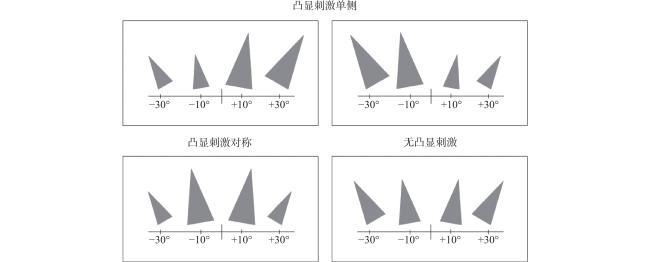
与实验1相同,实验2中同样需要对三角形的朝向进行整体知觉。唯一不同的是实验2只通过“大小”这一任务无关特征产生凸显刺激,并且凸显刺激的数量为集合数量的一半。集合中三角形的朝向仍为Mo±10°和Mo±30°,为了对凸显刺激在集合中所处位置进行更为详细的控制,本研究操纵了凸显刺激的分布。具体而言,在凸显刺激单侧条件下,凸显刺激的朝向为Mo+10°、Mo+30°或Mo−10°、Mo−30°;在凸显刺激对称条件下,凸显刺激的朝向设置为Mo−10°和Mo+10°。材料举例见图5 。
3.1.4 实验仪器
同实验1。
3.1.5 实验程序
共计600个试次,控制条件(无凸显刺激、凸显刺激对称)共300个试次,凸显条件(凸显刺激单侧)共300个试次。其余的实验程序与实验1相同。
3.1.6 数据分析
数据整理同实验1。共删除305个试次,占总试次的0.95%。此外,为了深入探索无关凸显刺激数量对整体知觉中集合数量效应的影响,将实验1中RN-IS条件和实验2中凸显刺激单侧分布下的数据整合。新增变量凸显数量(定量凸显、定比凸显)和凸显分布(偏大分布、偏小分布)。实验1仅有1个凸显刺激,属于定量凸显;实验2中凸显刺激数量为集合数量的一半,属于定比凸显;依据凸显刺激朝向与朝向均值的关系,将其编码为偏大(凸显刺激朝向大于朝向均值)和偏小(凸显刺激朝向小于朝向均值)分布。
数据分析同实验1,使用bruceR包进行重复测量方差分析。
3.2 结果
3.2.1 无关凸显刺激对整体知觉集合数量效应的影响
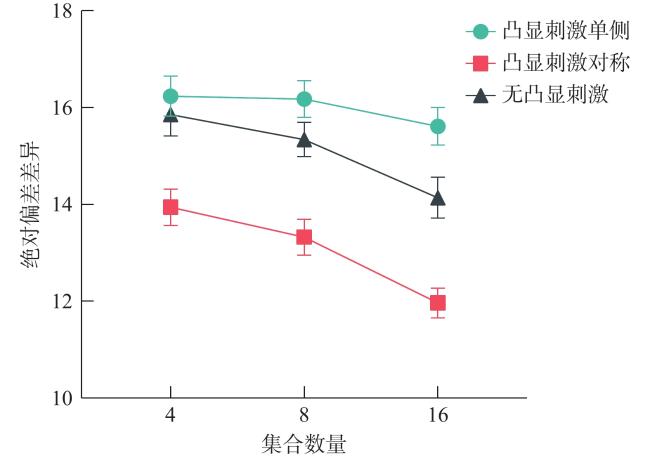
集合数量和分布的交互效应显著,F(4, 208)=2.81,p=0.027,η$_{\mathrm{p}}^{2} $ =0.05。简单效应检验发现,在集合数量为4时,单侧(M=16.24)和无凸显(M=15.86)条件下的绝对偏差均显著高于对称条件(M=13.94) [ts(52)>5.49, ps<0.001, Cohen’s ds>0.78];在集合数量为8和16时均发现,单侧(M8=16.18, M16=15.62)条件下的绝对偏差显著高于无凸显条件(M8=15.34, M16=14.14) [ts(52)>5.86, ps<0.001, Cohen’s ds>0.82],无凸显条件下的绝对偏差显著高于对称条件(M8=13.33, M16=11.97) [ts(52)>2.69, ps<0.05, Cohen’s ds>0.34]。具体结果见图6 。


3.2.2 无关凸显刺激数量(定量、定比)对整体知觉集合数量效应的影响
凸显数量主效应显著,F(1, 105)=8.24,p=0.005,η$_{\mathrm{p}}^{2} $ =0.07,定比凸显数量下的绝对偏差高于定量凸显数量;集合数量的主效应显著,F(2, 210)=6.44,p=0.002,η$ _{\mathrm{p}}^{2} $ =0.06,随着集合数量增加,绝对偏差逐渐下降。其他效应均不显著,Fs<3.03,ps>0.05。
3.3 讨论
实验2增加了无关凸显刺激的数量后,不仅发现了无关凸显刺激分布效应的存在,还发现其与集合数量效应的交互效应。即在所有实验条件下均发现了集合数量的增益效应,但相比于控制条件(无凸显和凸显刺激对称条件),凸显刺激单侧条件下个体整体知觉的绝对偏差更大。联合分析发现,凸显刺激数量的主效应显著,凸显刺激的数量越少,被试的表现越好;当凸显刺激数量固定后,整体知觉随着集合数量的增加而逐渐变好。
4 总讨论
本研究的目的是检验凸显刺激对整体知觉加工中集合数量效应的影响。在调整范式的基础上,引入绝对偏差指标,在不同凸显刺激数量下分阶段对此进行考察。结果发现不同类型的凸显刺激均对整体知觉表现及其集合数量效应产生影响,具体表现为绝对偏差的增加以及随着集合数量的增加绝对偏差逐渐下降;相比于无关凸显刺激,相关凸显刺激的影响作用更大;无关凸显刺激仅在增加凸显刺激数量后产生影响。
4.1 集合数量效应
本研究在无凸显刺激条件下均发现了稳定的集合数量增益效应,随着集合数量的增加,绝对偏差逐渐下降。不仅在本研究的不同群组得到相似结果;而且该结果与前人一致,整体知觉的表现随着集合数量的增加而提升,具体表现为阈值和偏差的下降(Haberman & Whitney, 2009; Robitaille & Harris, 2011)。集合数量的增益效应符合统计学角度的观点,样本数量越多,个体基于此对整体的推论也更加准确。增益效应的存在揭露出个体在进行整体知觉时并非仅依据集合中的部分刺激进行抽样加工,而是基于集合中的所有刺激进行的整体加工,因此才会表现出随着集合数量增多表现更优异的现象(Allik et al., 2013; Ariely, 2001; Baek & Chong, 2020; Chong & Treisman, 2005a; Robitaille & Harris, 2011)。
4.2 凸显刺激对集合数量效应的影响
刺激凸显性对集合数量效应的影响。与无凸显条件相比,凸显条件会引起较大的绝对偏差,而且绝对偏差随着集合数量的增加发生下降。该结果符合放大假说的部分观点,即凸显刺激会快速捕捉个体的注意,所以凸显条件下的表现会差于无凸显条件(Goldenberg, Schöne, et al., 2022; Goldenberg et al., 2021; Iakovlev & Utochkin, 2021)。但在集合数量效应上,放大假说认为个体的注意资源有限,随着集合数量的增多个体偏差越大,表现出集合数量的干扰效应。本研究发现即使集合中存在凸显刺激,随着集合数量增加个体表现随之提高。该结果得到了整体加工观点的支持,该观点认为对刺激集合中所有刺激的平行加工是整体知觉的产生机制(Chong & Treisman, 2005a, 2005b)。但是整体加工观点认为集合中所有刺激对整体知觉的影响相同,无法解释凸显条件下绝对偏差增加的结果。
凸显刺激类型对集合数量效应的影响。本研究发现凸显刺激的类型对整体知觉的集合效应产生不同影响。任务相关凸显刺激导致个体存在较高的绝对偏差,随着集合数量的增加整体知觉的绝对偏差逐渐下降;任务无关凸显刺激只有在其数量较高时才会影响整体知觉的表现(Goldenberg, LaFollette, et al., 2022; Goldenberg et al., 2021; Iakovlev & Utochkin, 2021)。具体而言,在无关凸显刺激单侧条件下集合数量的增益效应边缘显著,与之相比凸显刺激对称条件下的增益效应更为明显。该结果符合实验逻辑,凸显刺激会吸引个体注意,在凸显刺激单侧条件下注意力被快速引导到某个单一方向,这种偏侧的注意分配可能导致绝对偏差的增加,并且随着集合数量的增多并未得到显著的改善;与之相比,凸显刺激对称条件下注意力均匀分配在均值两侧,使得集合数量的增益效应更加明显。
凸显刺激数量对集合数量效应的影响。本研究发现无关凸显刺激数量的增加会导致个体绝对偏差的增大,即引起较大程度的偏差。而且并未发现凸显刺激数量和集合数量的交互,这说明集合数量的增加会导致绝对偏差下降,且下降程度在不同凸显刺激数量下相似。前人研究只是单纯地认为集合数量增多时,凸显刺激的数量也会增多,并未通过实验进行严格考察(Goldenberg, Schöne, et al., 2022; Goldenberg et al., 2021)。本研究通过将集合数量和凸显数量进行分离后发现,绝对偏差的增加是由集合中凸显刺激数量的增加导致的,而并非集合数量本身,实际上集合数量的增加反而会减少绝对偏差。
整体知觉的整体加工观点认为集合中的所有刺激具有相同的权重,具体表现为不受集合数量影响,甚至表现为集合数量的增益效应(Chong & Treisman, 2005a, 2005b);放大假说则认为个体仅依据部分刺激进行加工,凸显刺激具有更大的权重,并且表现出集合数量的干扰效应(Goldenberg, LaFollette, et al., 2022; Goldenberg et al., 2021; Iakovlev & Utochkin, 2021)。放大假说和整体加工观点分别建立在刺激集合中有、无凸显刺激的结果上,本研究进一步操纵了凸显刺激类型和数量对此进行了综合考察。结果发现,整体知觉具有更加灵活的产生机制,即凸显刺激确实会吸引个体更多的注意力,导致整体知觉表现的下降。但是集合数量的增加并不会恶化个体的表现,甚至随着集合数量增多表现逐渐优异;凸显刺激数量才是表现变差的根本原因。
综上,本研究提出整体放大假说,个体会赋予刺激集合中的凸显刺激较高权重,并依据集合中的所有刺激产生整体知觉。该观点将放大假说和整体加工相结合,不仅强调了整体知觉是基于集合中所有刺激产生的,还揭示了凸显刺激的作用机制。
5 结论
本研究使用调整范式探讨凸显刺激类型对整体知觉中集合数量效应的影响。实验结果表明,整体知觉过程是依赖于对集合中的所有刺激进行加工而产生的,但是会给予集合中的某些凸显刺激较高的权重;与相关凸显刺激相比,无关凸显刺激对整体知觉中集合数量效应的影响较小,受凸显刺激数量的调节。