?

The Relative Contributions of Word Frequency and Contextual Diversity in Chinese Word Identification: Evidence from an ERP Study

  • Kunying SONG 1 ,
  • Linlin FENG 1 ,
  • Zheng WANG 2, 3 ,
  • Xuejun BAI 1 ,
  • Feifei LIANG , *, 1
Expand
  • 1. Key Research Base of Humanities and Social Sciences of the Ministry of Education, Academy of Psychology and Behavior, Faculty of Psychology, Tianjin Social Science Laboratory of Students’ Mental Development and Learning, Tianjin Normal University, Tianjin 300387
  • 2. Inner Mongolia Mental Health Center, Inner Mongolia Brain Hospital (Third Hospital), Hohhot 010010
  • 3. School of Psychology, Inner Mongolia Normal University, Hohhot 010028

Received date: 2024-01-08

  Online published: 2024-12-12

Copyright

Copyright reserved © 2024.

Abstract

In the present study, we examined the relative contributions of word frequency and contextual diversity in Chinese lexical recognition by using the ERP technique. Word frequency effect and contextual diversity effect were examined in separated models, and both were observed between 300~800 ms, which suggests the two effects occur at later stages of lexical identification. However, when incorporated word frequency, contextual diversity, and the interaction into the model, word frequency effect decreased and occurred in 300~400 ms, whereas contextual diversity effect maintained from 300 ms to 700 ms. It suggests that contextual diversity plays a more significant role than word frequency in Chinese word recognition, which provides support for the “principle of likely need” rather than the “principle of repetition” in visual word recognition.

Cite this article

Kunying SONG , Linlin FENG , Zheng WANG , Xuejun BAI , Feifei LIANG . The Relative Contributions of Word Frequency and Contextual Diversity in Chinese Word Identification: Evidence from an ERP Study[J]. Studies of Psychology and Behavior, 2024 , 22(4) : 433 -441 . DOI: 10.12139/j.1672-0628.2024.04.001

1 引言

词频作为影响词汇识别三大因素之首(Clifton et al., 2016),反映了词汇组织的重复原则(principle of repetition),即某一个词汇重复出现会增加它在记忆中的强度或可用性,这有利于词汇通达,表现为高频词比低频词更容易识别,注视时间更短,更容易被跳读(Reichle & Drieghe, 2013; Yan et al., 2006)。词频效应稳定地存在于多种实验任务中,如语料库分析(Li et al., 2014; Yu et al., 2021)、词汇识别(王春茂, 彭聃龄, 1999; Bertram et al., 2000)和句子阅读(Cui et al., 2021; Cui et al., 2013; Ma & Li, 2015; Yan et al., 2006),且具有跨语言的稳定性(Clifton et al., 2016; Liversedge et al., 2016; Liversedge et al., 2024)。主流的阅读眼动控制模型,如基于拼音文字阅读的E-Z阅读者模型(Reichle, 2021; Reichle et al., 1998)、SWIFT模型(Engbert & Kliegl, 2011),以及基于中文阅读的CRM模型(Li & Pollatsek, 2020)均将词频作为重要的预测因子,用以检验模型的适用性。
然而,词频计算是基于整个语料库的原始计数,语料库样本越大,估计值就越接近该词“真实”频率的计数。从统计学上讲,使用尽可能大的样本是估计词频的最佳选择,但事实上只有最常见的1%词汇均匀分布在文本中,符合随机样本模型;而99%的词汇是以隐藏的语境变量为条件出现在文本中,这违反了独立性假设(Church & Gale, 1995a, 1995b; Jones et al., 2017),即词频与语境变量相关联,无法考察“真实”词频的作用。而在真实的语言环境下,如果仅考虑词频,会忽略在多种语境中出现n次的词汇和在单一语境中出现n次的词汇之间的区别。
为此,研究者对词频在词汇组织中的作用提出了质疑,并指出语境多样性(contextual diversity)是词汇组织的主要信息来源(Adelman et al., 2006; Bolger et al., 2008; Johns et al., 2012; Jones et al., 2017)。语境多样性通常被概念化为该词出现在不同语境中的频次。在文本分析中,语境多样性最直接的衡量标准是对给定词汇出现的不同文本数量的原始计数(Adelman et al., 2006)。它反映了可能需要原则(principle of likely need),即出现在多个语境的词汇更有可能在未知语境中需要,这更有助于个体将其纳入心理词典(Adelman et al., 2006; Anderson & Milson, 1989; Anderson & Schooler, 1991; Jones et al., 2017)。这符合词汇遗留假说(lexical legacy hypothesis)的主要观点,即阅读为读者提供了多种语境、情节和经验。随着读者阅读经验的增加,这些不同的语境、情节和经验将汇聚成读者的词汇数据库(Nation, 2017)。如果只是不断在阅读中重复呈现某个词,或在同样的语义中重复某个词,均无法刷新词典历史,而伴随语境的变化才会不断更新词汇表征,从而增强学习效果(贺斐, 2021; Nation, 2017)。因此,语境多样性可能更好地反映词汇组织原则。
研究者在多种行为实验任务中,就词频和语境多样性在心理语言学中的相对作用进行了系统考察,如词汇判断(Huang et al., 2021; Mak et al., 2021; Perea et al., 2013)、语义相关(Hoffman & Woollams, 2015; Rosa et al., 2017)、新词学习(Jones et al., 2012; Kachergis et al., 2009; Pagán & Nation, 2019)、句子阅读(Chen et al., 2017; Johns et al., 2016; Pagán et al., 2020; Plummer et al., 2014)、语料库分析等(Adelman et al., 2006; Johns et al., 2012)。结果一致发现,在控制词频后,语境多样性仍能预测词汇判断正确率、反应时以及词汇阅读时间;但控制语境多样性后,词汇识别中的词频效应消失。行为研究的结果似乎表明,语境多样性在词汇识别中的作用要大于词频。词频基于重复原则,而语境多样性依赖可能需要原则,两者从根本上反映了不同的学习机制(Jones et al., 2017):如果词汇识别对词频敏感,那么重复一个词有利于该词的识别,且每次重复的作用应是同等的;如果词汇识别依赖语境多样性,那么只有重复一个词汇且伴随语境的改变,才有利于该词的识别,只在同一语境中的简单重复,作用应该是有限的。
近些年来,研究者尝试从脑机制层面考察词频和语境多样性在词汇识别中的相对重要性。例如,Vergara-Martínez等人(2017)采用事件相关电位(ERP)技术,在词汇判断任务中比较控制词频后高、低语境多样性词汇诱发的N400波幅差异。结果发现,相较低语境多样性词汇,高语境多样性词汇反应速度更快,引起的N400波幅更大。这一结果与词频效应方向相反:高频词比低频词引起的N400振幅更小(Kutas & Federmeier, 2011; Vergara-Martínez et al., 2013; Wang et al., 2017)。这表明,虽然词频和语境多样性是两个高相关变量(Plummer et al., 2014),但作用于词汇识别的内在机制明显不同。因此,有必要在同一实验中系统探讨词频和语境多样性在词汇识别中的作用机制。
此外,前期研究惯于采用因子设计对词频和语境多样性在词汇识别中的作用进行研究。例如,研究者常构建HCD-HF(高语境多样性−高频词)、LCD-HF(低语境多样性−高频词)、LCD-LF(低语境多样性−低频词)三种条件(Chen et al., 2017; Huang et al., 2021; Pagán et al., 2020; Perea et al., 2013)考察词频和语境多样性的相对作用。这种实验操纵看似严格,却将词频、语境多样性两个连续变量作为二分变量处理,无法从连续性视角真实反映二者在词汇识别中的相对作用及加工时程。最近,Tsang和Zou(2022)基于中文词汇识别ERP语料库,从连续性视角考察词级变量(语境多样性、笔画数、具体性)和字符级变量(语境多样性、同音字数、语义透明性)的作用时程,结果发现首字语境多样性的早期效应(0~100 ms、400~700 ms),尾字语境多样性相对晚期效应(200~700 ms)以及整词语境多样性的晚期效应(300~900 ms)。该研究为从连续性视角考察各词汇特征在词汇识别中的作用时程提供了可能性。
为此,本研究借鉴Tsang和Zou(2022)的研究范式,采用词汇判断任务,首先将目标词词频和语境多样性分别纳入模型考察二者的作用时程,再以20%的标准将其词频、语境多样性分为高、低组考察二者对词汇加工的影响,最后将这两个连续变量同时纳入模型,分析词频和语境多样性发挥作用的时程及相对重要性。基于词汇遗留假说的观点,相较于词频的一味简单重复,语境多样性所带来的丰富语义更有助于将词汇纳入词典历史(lexical history),形成高质量的词汇表征,本研究预期,语境多样性在词汇识别中的作用大于词频,具体表现为语境多样性的作用时程更长。

2 研究方法

2.1 被试

天津师范大学54名大学生参与实验(27名男生,27名女生),平均年龄20.13±1.46岁。其中,8名被试EEG信号中运动伪迹过多(可用试次不足总试次的60%),在分析时被剔除,最终保留46名被试数据。所有参与者均为汉语母语者,右利手,无神经心理障碍史,视力或矫正视力正常。实验前征求每位被试的知情同意,实验结束后给予每位被试一定报酬。

2.2 实验材料

参照Tsang和Zou(2022)采用的Go/No-Go词汇判断任务,“是/否”选项的比例设为5∶1。基于SUBTLEX-CH语料库(Cai & Brysbaert, 2010),随机选择800个双字词(如“陛下”)作为目标词,并对这800个真词的特征(如,字频、笔画数、语境多样性等)进行统计;并构建160个双字假词作为“否”选项的目标词(如“视拓”),共960个项目。双字词特征的描述信息见表1
表1 双字词特征描述统计
最小值 最大值 平均值 标准差
首字频(次/百万) 0.00 39629.27 419.60 2346.46
log首字频 0.00 6.12 3.06 0.99
首字笔画数 1.00 23.00 8.33 3.33
尾字频(次/百万) 0.00 20543.44 334.67 1318.35
log尾字频 0.00 5.84 3.09 0.97
尾字笔画数 1.00 21.00 8.24 3.22
词频(次/百万) 0.03 7050.42 51.71 297.71
log词频 0.00 5.37 2.43 1.00
整词语境多样性(次/百万) 1.00 6224.00 592.23 863.71
整词log语境多样性 0.00 3.79 2.24 0.92
整词笔画数 4.00 33.00 16.57 4.58

2.3 实验程序

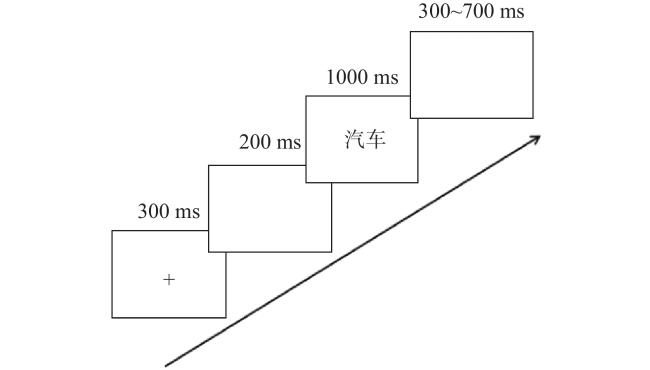
被试单独施测。采用Go/No-Go词汇判断任务,用E-Prime 3.0编程。刷新率为75 Hz,分辨率为1920×1080像素,目标词为黑色,背景为灰色。每个试次开始时,屏幕中央出现一个300 ms的注视点“+”,紧接着200 ms的空屏,随后目标刺激在屏幕中央呈现1000 ms,要求被试判断目标刺激是否是一个真词。当刺激是假词时,要求被试用左手食指尽可能快地按下“F”键;当刺激是真词时,要求被试不作反应。随机刺激间隔平均为500 ms(300~700ms)。告知被试在实验过程中尽量减少头部移动,在试次呈现过程中尽量避免眨眼。正式实验前有10个练习试次,以便被试熟悉该程序。在正式实验中,所有刺激分成五个组块,每个组块由160个真词和32个假词组成。每名被试需完成960个词汇判断。每个组块间的顺序和组块内的试次顺序随机。两个组块之间有3分钟休息时间。实验流程见图1

2.4 EEG记录及预处理

使用Neuroscan和curry8进行脑电数据的采集。使用国际10-20系统扩展的64导电极帽记录EEG。在采集过程中,参考电极为Ref,位于额−中央区,与FCz相邻,在进行离线分析时以双侧乳突平均作为参考。整个数据记录过程中,电极与头皮的电阻都降到10 KΩ以下,同时记录垂直眼电(VEOG)和水平眼电(HEOG),采样频率为500 Hz。脑电数据分析采用自定义的Matlab脚本运行,预处理使用EEGLAB(Delorme & Makeig, 2004)和ERPLAB(Lopez-Calderon & Luck, 2014)完成,使用FIR滤波器进行带通滤波(0.1~30 Hz),利用ICA去除坏成分,如眼动、肌电这种伪迹,并在分段和基线校正后排除错误反应以及波幅在±100 μV以外的伪迹信号。以刺激出现前200 ms(作为基线)到刺激出现后的1000 ms进行脑电分段。若原始数据剔除超过60%,则将该被试删除。

3 结果

真词的平均反应错误率为0.04(SD=0.12)。仅对反应正确的真词进行分析。一个真词(“夜大”)由于错误率过高(M=0.71)未进入分析。
将刺激出现后0~1000 ms的时间段分为十个100 ms的时间窗口,在十个窗口ERP的分析中划分六个电极区域,即左额叶LF(F1、F3、F5、FC1、FC3、FC5)、右额叶RF(F2、F4、F6、FC2、FC4、FC6)、左顶叶LC(C1、C3、C5、CP1、CP3、CP5)、右顶叶RC(C2、C4、C6、CP2、CP4、CP6)、左枕叶LP(P1、P3、P5、PO3、PO5、PO7)、右枕叶RP(P2、P4、P6、PO4、PO6、PO8)。并分别计算十个窗口下六个区域中电极数据的平均波幅值。
为探讨词频和语境多样性在词汇识别中的作用机制,进行一系列线性混合效应模型(linear mixed-effects modeling, LME)分析。因变量为每个真词在六个脑区中十个窗口下诱发的平均波幅。固定效应包括:对数转换后的整词词频、对数转换后的语境多样性以及二者的交互作用。随机效应包括被试和项目。采用JASP(版本0.18.1.0)进行分析。首先,将整词词频作为固定效应构建模型一;其次,将语境多样性作为固定效应构建模型二;最后,将整词词频、语境多样性及二者交互作用作为固定效应构建模型三,分析结果见表2。需要说明的是,由于本研究目的是探讨词频和语境多样性在词汇识别中的相对作用及加工时程,将呈现十个时间窗口下固定效应的效应量(β值),且重点关注显著效应所在时间窗口。此外,结合各个模型的AIC、BIC值,从模型优度来看,在0~100 ms仅纳入整词词频的模型最优;在100~500 ms仅纳入整词语境多样性的模型最优,在500~1000 ms同时纳入整词词频、语境多样性的模型最优。需要注意的是,虽然在0~100 ms仅纳入整词词频的模型最优;在100~300 ms仅纳入整词语境多样性的模型最优,但结合本研究所关注的词频和语境多样性的固定效应发现,在0~300 ms之间,三个模型所涉及到的固定效应均不显著,这表明词频和语境多样性效应没有发生在词汇加工的早期阶段(0~300 ms)。由表2可知,整词词频效应及语境多样性效应均发生在300~800 ms。该研究结果与Tsang和Zou(2022)在ERP语料库中观察到的效应一致,表明单独考虑词频和语境多样性时,二者均作用于中文词汇识别的晚期阶段。
表2 线性混合效应模型结果
TW1
0~100
TW2
100~200
TW3
200~300
TW4
300~400
TW5
400~500
TW6
500~600
TW7
600~700
TW8
700~800
TW9
800~900
TW10
900~1000
模型一
(将词频
纳入模型)
Intercept −0.16 0.95 2.97 1.70 3.08 5.40 6.71 6.69 6.11 5.33
logWF −0.06 0.04 0.10 0.60*** 1.41*** 1.59*** 0.86*** 0.29* 0.001 −0.18
模型二
(将语境多样性
纳入模型)
Intercept −0.15 0.95 2.93 1.62 2.97 5.30 6.61 6.61 6.05 5.26
logCD −0.07 0.05 0.12 0.69*** 1.58*** 1.77*** 0.98*** 0.35* 0.03 −0.16
ΔAIC1 7.18 −0.28 −0.99 −6.72 −12.31 −10.37 −5.05 −1.30 −0.21 0.35
ΔBIC1 7.18 −0.28 −1.00 −6.72 −12.32 −10.37 −5.05 −1.31 −0.21 0.34
模型三
(同时将词频、
语境多样性
及其交互作用
纳入模型)
Intercept −0.14 0.91 2.67 2.01 3.31 4.43 4.86 5.25 5.02 4.39
LogWF 0.04 −0.04 −0.12 −1.61** −1.45 0.45 1.39 0.98 0.53 0.16
LogCD −0.13 0.15 0.68 1.87*** 2.66*** 2.65*** 2.22** 1.42 1.08 1.05
LogWF×LogCD 0.01 −0.01 −0.11 0.14 0.12 −0.35** −0.70*** −0.54*** −0.41** −0.35**
ΔAIC2 17.24 8.46 1.94 −7.34 −10.35 −15.04 −32.40 −14.87 −6.32 −3.54
ΔBIC2 37.85 29.07 22.55 13.27 10.26 5.56 −11.80 5.73 14.29 17.07

  注:logWF、logCD分别为对数转换后的整词词频、语境多样性;TW为时间窗,单位为ms;ΔAIC1为模型二的AIC值与模型一的AIC值的差值,ΔAIC2为模型三的AIC值与模型一的AIC值的差值,ΔBIC1、ΔBIC2同理;*p<0.05,**p<0.01,***p<0.001。

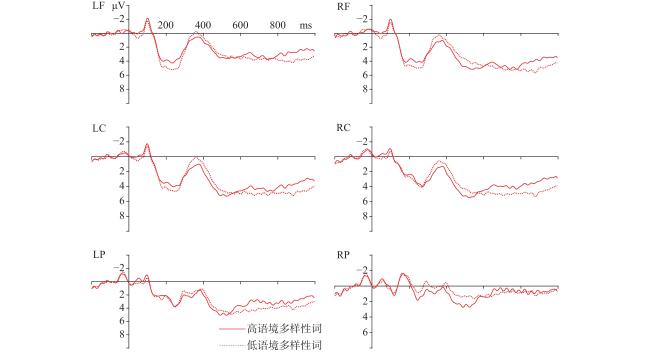
为了更细致地考察词频和语境多样性的作用,分别依据词频和语境多样性选取目标词中前20%的词汇作为高频组或高语境多样性组,后20%的词汇作为低频组或低语境多样性组,描绘高、低词频组和高、低语境多样性组在六个脑区中的平均ERP波形图(见图2图3)。以P200(200~300 ms)、N400(300~450 ms)、LPC(600~800 ms)为指标,分别对高、低组词频、语境多样性进行差异检验。就词频而言,在右枕叶区域发现P200效应(t=3.71, p<0.001)以及全脑的N400效应(ts>2.09, ps<0.05),表现为高频词诱发的P200波幅更大、N400波幅更小;就语境多样性而言,在右枕叶区域同样发现P200效应(t=3.53, p<0.001)、双侧顶叶N400效应(ts>2.12, ps<0.05)以及右顶叶、左枕叶LPC效应(ts>2.51, ps<0.05),表现为高语境多样性词诱发的P200波幅更大、N400波幅更小、LPC波幅更小。由此推断,词频、语境多样性在六个脑区引发的ERP以及作用位置不尽相同,但与前人研究发现类似(Huang & Lee, 2018; Tsang & Zou, 2022; Zhang et al., 2009),在刺激开始后的100 ms、200 ms、350~500 ms左右可以识别出几个明显的波峰:与低频词、低语境多样性词相比,高频词、高语境多样性词诱发了更大的P200波幅、更小的N400波幅。
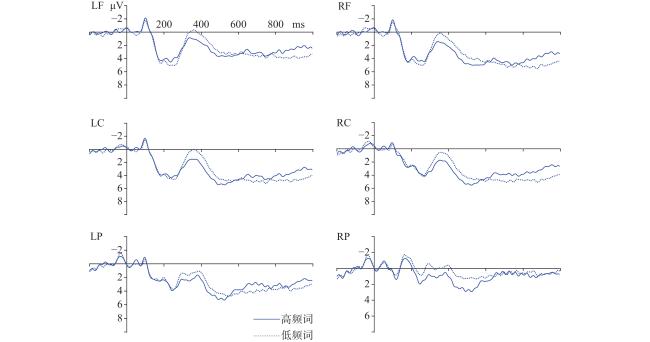
图2 六个脑区下高、低词频组的ERP平均波幅
图3 六个脑区下高、低语境多样性组的ERP平均波幅
模型三将词频、语境多样性同时纳入模型,结果发现:词频效应减弱,仅作用于300~400 ms;而语境多样性仍在300~700 ms保持稳定效应,表明语境多样性作用时程更长,效应更稳定。此外,在500~1000 ms,词频与语境多样性的交互作用显著,表明二者共同作用于词汇加工的晚期阶段。见表2

4 讨论

本研究采用词汇判断任务从脑机制层面考察词频、语境多样性在中文词汇识别中的相对重要性,结果发现:第一,词频与语境多样性的作用时程几乎相同,均发生在300~1000 ms,主要作用于词汇加工的相对晚期阶段。第二,相较于词频,语境多样性作用时程更长,更稳定,更能预测词汇识别。本研究结果对于理解词频、语境多样性在中文词汇识别中的作用机制有以下启示。
首先,词频与语境多样性均作用于词汇加工的相对晚期阶段,符合多层次交互激活模型(Taft & Forster, 1975)的基本观点,该模型认为视觉词汇识别过程中包含多个层次,强调自下而上的加工过程,即从视觉字母的识别开始,逐步激活更高层次的单元,直至词汇的识别。同时该模型也强调各层次加工单元之间的交互影响。词频、语境多样性属于高层次的词汇单元,激活相对较晚。但就词频、语境多样性诱发的ERP成分而言,与前人研究结果不尽相同。就词频而言,高频词引发的N400波幅小于低频词,这与前人研究结果相一致(Kutas & Federmeier, 2011; Vergara-Martínez et al., 2013; Wang et al., 2017),表明词频越高,词汇激活越容易,所需认知资源消耗越少,更易被识别;就语境多样性而言,本研究发现,高语境多样性词汇引发的N400波幅小于低语境多样性词汇,这与Vergara-Martínez等人(2017)的研究结果相反。原因可能和两项研究的实验操纵方式不同有关:Vergara-Martínez等人在严格控制词频的情况下,比较高、低语境多样性词汇引起的N400波幅差异。此时,语境多样性与词汇本身的结构信息(如词频、词长)相关较低,与语义因素(如语义具体性、语义关联数量、语义特征数)相关较高;而本研究并未严格操纵词频与语境多样性,只将高、低20%的语境多样性词汇进行比较,此时,两组目标词的语境多样性和词频相关程度较高(高语境多样性组,二者的相关系数为0.63;低语境多样性组,二者的相关系数为0.91),也就是说本研究中的语境多样性变量既包含了词汇结构方面的差异,也包含了语义特征上的差异,并没有将二者进行分离并分别操纵,目前无法回答语境多样性是通过词汇结构、语义特征还是二者共同作用于词汇识别。后续研究有必要在同一研究中将语境多样性所反映的词汇结构以及语义特征进行分离,从本质上揭示语境多样性在词汇识别中的作用,例如,是词汇结构,语义特征,抑或是二者共同反映了心理学中的“可能需要原则”。
其次,与词频相比,语境多样性在词汇识别中的相对作用更大(Adelman et al., 2006; Hoffman & Woollams, 2015; Huang et al., 2021; Mak et al., 2021)。这表明,语境多样性是一个比词频更重要的变量,这对当前的词汇识别模型提出挑战。目前主流的词汇识别模型(如双通路模型,见Coltheart et al., 2001)和阅读眼动控制模型(如E-Z阅读者模型,见Reichle et al., 1998; 中文阅读模型,见 Li & Pollatsek, 2020)均将词频纳入模型,以提升模型的检验力。本研究结果提示,相比于词频,语境多样性可能才是词汇识别更合适的预测因子。后续研究有必要用语境多样性代替词频,或将语境多样性同时纳入模型,用以提升模型的解释力。
那么,语境多样性如何作用于词汇识别?依据词汇遗留假说(Nation, 2017),如果读者在不同语境中学习同一词汇,那么该词汇将具有更灵活的、脱离语境意义的表征,从而能够将习得的语义表征更好地迁移到新的语境中,这类词汇也将拥有更准确的正字法表征,有利于词汇处理(如更快和更准确地识别词汇),这与语境多样性的内涵—可能需要原则相符;反之,如果在同一语境中学习同一词汇(类似于词频所反映的重复原则),可能有利于读者提取稳定的语义表征,但容易受语境限制,对后续词汇处理作用有限。由此推断,中文词汇识别遵循的是可能需要原则,而不是重复原则。系列词汇习得实验也表明(Jones et al., 2012; Pagán & Nation, 2019),在阅读中习得词汇时,读者会利用语境推断词汇的语义信息,并将获得的信息快速存储到语义记忆中(Borovsky et al., 2012; Borovsky et al., 2010; Chen et al., 2014; Mestres-Missé et al., 2007, 2010; Zhang et al., 2017)。相比于在重复语境中学习新词,当新词出现在不同语境时,读者能够快速、准确地推断新词语义(Bolger et al., 2008; Hills et al., 2010)。这可能归因于新词的多种语境提供了更多语义信息,促进了该词汇丰富的语义关联,包括内涵和外延的理解(Beck et al., 2013; Beck et al., 1983)。而当语义表征中涉及更多的语义单元时,能够在语义空间中为这些概念建立更强的表征,更有效地进行语义处理(Pexman et al., 2007)。

5 结论

本研究条件下得出如下结论:当分别考察词频、语境多样性在词汇识别中的作用时,二者均作用于词汇识别的晚期阶段;当同时考察二者的作用时,语境多样性在词汇识别中的作用时程更长,表明词汇识别更有可能遵循可能需要原则。
贺斐. (2021). 汉语新词词形信息在阅读伴随新词学习中的作用——基于眼动的证据 (博士学位论文). 天津师范大学.

王春茂, 彭聃龄. 合成词加工中的词频、词素频率及语义透明度. 心理学报, 1999, 31 (3): 266- 273.

Adelman, J. S., Brown, G. D. A., & Quesada, J. F. Contextual diversity, not word frequency, determines word-naming and lexical decision times. Psychological Science, 2006, 17 (9): 814- 823.

DOI

Anderson, J. R., & Milson, R. Human memory: An adaptive perspective. Psychological Review, 1989, 96 (4): 703- 719.

DOI

Anderson, J. R., & Schooler, L. J. Reflections of the environment in memory. Psychological Science, 1991, 2 (6): 396- 408.

DOI

Beck, I. L., McKeown, M. G., & Kucan, L. (2013). Bringing words to life: Robust vocabulary instruction (2nd ed.). New York: Guilford Press.

Beck, I. L., McKeown, M. G., & McCaslin, E. S. Vocabulary development: All contexts are not created equal. The Elementary School Journal, 1983, 83 (3): 177- 181.

DOI

Bertram, R., Schreuder, R., & Baayen, R. H. (2000). The balance of storage and computation in morphological processing: The role of word formation type, affixal homonymy, and productivity. Journal of Experimental Psychology: Learning, Memory, and Cognition, 26(2), 489–511.

Bolger, D. J., Balass, M., Landen, E., & Perfetti, C. A. Context variation and definitions in learning the meanings of words: An instance-based learning approach. Discourse Processes, 2008, 45 (2): 122- 159.

DOI

Borovsky, A., Elman, J. L., & Kutas, M. Once is enough: N400 indexes semantic integration of novel word meanings from a single exposure in context. Language Learning and Development, 2012, 8 (3): 278- 302.

DOI

Borovsky, A., Kutas, M., & Elman, J. Learning to use words: Event-related potentials index single-shot contextual word learning. Cognition, 2010, 116 (2): 289- 296.

DOI

Cai, Q., & Brysbaert, M. SUBTLEX-CH: Chinese word and character frequencies based on film subtitles. PLoS One, 2010, 5 (6): e10729.

DOI

Chen, Q. R., Huang, X., Bai, L., Xu, X. D., Yang, Y. M., & Tanenhaus, M. K. The effect of contextual diversity on eye movements in Chinese sentence reading. Psychonomic Bulletin & Review, 2017, 24 (2): 510- 518.

Chen, S., Wang, L., & Yang, Y. F. Acquiring concepts and features of novel words by two types of learning: Direct mapping and inference. Neuropsychologia, 2014, 56, 204- 218.

DOI

Church, K. W., & Gale, W. (1995a). Inverse document frequency (IDF): A measure of deviations from Poisson. In S. Armstrong, K. Church, P. Isabelle, S. Manzi, E. Tzoukermann, & D. Yarowsky (Eds.), Natural language processing using very large corpora (pp. 121–130). Dordrecht, Netherlands: Springer.

Church, K. W., & Gale, W. A. Poisson mixtures. Natural Language Engineering, 1995b, 1 (2): 163- 190.

DOI

Clifton, C., Ferreira, F., Henderson, J. M., Inhoff, A. W., Liversedge, S. P., Reichle, E. D., & Schotter, E. R. Eye movements in reading and information processing: Keith Rayner’s 40 year legacy. Journal of Memory and Language, 2016, 86, 1- 19.

DOI

Coltheart, M., Rastle, K., Perry, C., Langdon, R., & Ziegler, J. DRC: A dual route cascaded model of visual word recognition and reading aloud. Psychological Review, 2001, 108 (1): 204- 256.

DOI

Cui, L., Wang, J., Zhang, Y. L., Cong, F. J., Zhang, W. X., & Hyönä, J. Compound word frequency modifies the effect of character frequency in reading Chinese. Quarterly Journal of Experimental Psychology, 2021, 74 (4): 610- 633.

DOI

Cui, L., Yan, G. L., Bai, X. J., Hyönä, J., Wang, S. P., & Liversedge, S. P. Processing of compound-word characters in reading Chinese: An eye-movement-contingent display change study. Quarterly Journal of Experimental Psychology, 2013, 66 (3): 527- 547.

DOI

Delorme, A., & Makeig, S. EEGLAB: An open-source toolbox for analysis of single-trial EEG dynamics including independent component analysis. Journal of Neuroscience Methods, 2004, 134 (1): 9- 21.

DOI

Engbert, R. & Kliegl, R. (2011). Parallel graded attention models of reading. In S. P. Liversedge, I. D. Gilchrist, & S. Everling (Eds.), The Oxford handbook of eye movements (pp. 787–800). Oxford: Oxford University Press.

Hills, T. T., Maouene, J., Riordan, B., & Smith, L. B. The associative structure of language: Contextual diversity in early word learning. Journal of Memory and Language, 2010, 63 (3): 259- 273.

DOI

Hoffman, P., & Woollams, A. M. Opposing effects of semantic diversity in lexical and semantic relatedness decisions. Journal of Experimental Psychology: Human Perception and Performance, 2015, 41 (2): 385- 402.

DOI

Huang, H. W., & Lee, C. Y. Number of meanings and number of senses: An ERP study of sublexical ambiguities in reading Chinese disyllabic compounds. Frontiers in Psychology, 2018, 9, 324.

DOI

Huang, X., Lin, D., Yang, Y. M., Xu, Y. H., Chen, Q. R., & Tanenhaus, M. K. Effects of character and word contextual diversity in Chinese beginning readers. Scientific Studies of Reading, 2021, 25 (3): 251- 271.

DOI

Johns, B. T., Dye, M., & Jones, M. N. The influence of contextual diversity on word learning. Psychonomic Bulletin & Review, 2016, 23 (4): 1214- 1220.

Johns, B. T., Gruenenfelder, T. M., Pisoni, D. B., & Jones, M. N. Effects of word frequency, contextual diversity, and semantic distinctiveness on spoken word recognition. The Journal of the Acoustical Society of America, 2012, 132 (2): 74- 80.

DOI

Jones, M. N., Dye, M., & Johns, B. T. Context as an organizing principle of the lexicon. Psychology of Learning and Motivation, 2017, 67, 239- 283.

Jones, M. N., Johns, B. T., & Recchia, G. The role of semantic diversity in lexical organization. Canadian Journal of Experimental Psychology, 2012, 66 (2): 115- 124.

DOI

Kachergis, G., Shiffrin, R., & Yu, C. Frequency and contextual diversity effects in cross-situational word learning. Proceedings of the Annual Meeting of the Cognitive Science Society, 2009, 31 (31): 2220- 2225.

Kutas, M., & Federmeier, K. D. Thirty years and counting: Finding meaning in the N400 component of the event-related brain potential (ERP). Annual Review of Psychology, 2011, 62, 621- 647.

DOI

Li, X. S., Bicknell, K., Liu, P. P., Wei, W., & Rayner, K. Reading is fundamentally similar across disparate writing systems: A systematic characterization of how words and characters influence eye movements in Chinese reading. Journal of Experimental Psychology: General, 2014, 143 (2): 895- 913.

DOI

Li, X. S., & Pollatsek, A. An integrated model of word processing and eye-movement control during Chinese reading. Psychological Review, 2020, 127 (6): 1139- 1162.

DOI

Liversedge, S. P., Drieghe, D., Li, X., Yan, G. L., Bai, X. J., & Hyönä, J. Universality in eye movements and reading: A trilingual investigation. Cognition, 2016, 147, 1- 20.

DOI

Liversedge, S. P., Olkoniemi, H., Zang, C. L., Li, X., Yan, G. L., Bai, X. J., & Hyönä, J. Universality in eye movements and reading: A replication with increased power. Cognition, 2024, 242, 105636.

DOI

Lopez-Calderon, J., & Luck, S. J. ERPLAB: An open-source toolbox for the analysis of event-related potentials. Frontiers in Human Neuroscience, 2014, 8, 213.

Ma, G. J., & Li, X. S. How character complexity modulates eye movement control in Chinese reading. Reading and Writing, 2015, 28 (6): 747- 761.

DOI

Mak, M. H., Hsiao, Y., & Nation, K. Anchoring and contextual variation in the early stages of incidental word learning during reading. Journal of Memory and Language, 2021, 118, 104203.

DOI

Mestres-Missé, A., Rodriguez-Fornells, A., & Münte, T. F. Watching the brain during meaning acquisition. Cerebral Cortex, 2007, 17 (8): 1858- 1866.

DOI

Mestres-Missé, A., Rodriguez-Fornells, A., & Münte, T. F. Neural differences in the mapping of verb and noun concepts onto novel words. NeuroImage, 2010, 49 (3): 2826- 2835.

DOI

Nation, K. Nurturing a lexical legacy: Reading experience is critical for the development of word reading skill. NPJ Science of Learning, 2017, 2 (1): 3.

DOI

Pagán, A., Bird, M., Hsiao, Y., & Nation, K. Both semantic diversity and frequency influence children’s sentence reading. Scientific Studies of Reading, 2020, 24 (4): 356- 364.

DOI

Pagán, A., & Nation, K. Learning words via reading: Contextual diversity, spacing, and retrieval effects in adults. Cognitive Science, 2019, 43 (1): e12705.

DOI

Perea, M., Soares, A. P., & Comesaña, M. Contextual diversity is a main determinant of word identification times in young readers. Journal of Experimental Child Psychology, 2013, 116 (1): 37- 44.

DOI

Pexman, P. M., Hargreaves, I. S., Edwards, J. D., Henry, L. C., & Goodyear, B. G. The neural consequences of semantic richness. Psychological Science, 2007, 18 (5): 401- 406.

DOI

Plummer, P., Perea, M., & Rayner, K. (2014). The influence of contextual diversity on eye movements in reading. Journal of Experimental Psychology: Learning, Memory, and Cognition, 40(1), 275–283.

Reichle, E. D. (2021). Computational models of reading: A handbook. New York: Oxford University Press.

Reichle, E. D., & Drieghe, D. (2013). Using E-Z reader to examine word skipping during reading. Journal of Experimental Psychology: Learning, Memory, and Cognition, 39(4), 1311–132.

Reichle, E. D., Pollatsek, A., Fisher, D. L., & Rayner, K. Toward a model of eye movement control in reading. Psychological Review, 1998, 105 (1): 125- 157.

DOI

Rosa, E., Tapia, J. L., & Perea, M. Contextual diversity facilitates learning new words in the classroom. PLoS One, 2017, 12 (6): e0179004.

DOI

Taft, M., & Forster, K. I. Lexical storage and retrieval of prefixed words. Journal of Verbal Learning and Verbal Behavior, 1975, 14 (6): 638- 647.

DOI

Tsang, Y. K., & Zou, Y. An ERP megastudy of Chinese word recognition. Psychophysiology, 2022, 59 (11): e14111.

DOI

Vergara-Martínez, M., Comesaña, M., & Perea, M. (2017). The ERP signature of the contextual diversity effect in visual word recognition. Cognitive, Affective, & Behavioral Neuroscience, 17(3), 461–474.

Vergara-Martínez, M., Perea, M., Gómez, P., & Swaab, T. Y. ERP correlates of letter identity and letter position are modulated by lexical frequency. Brain and Language, 2013, 125 (1): 11- 27.

DOI

Wang, W. N., Lu, A. T., He, D. P., Zhang, B., & Zhang, J. X. ERP evidence for Chinese compound word recognition: Does morpheme work all the time. NeuroQuantology, 2017, 15 (3): 142- 152.

Yan, G. L., Tian, H. J., Bai, X. J., & Rayner, K. The effect of word and character frequency on the eye movements of Chinese readers. British Journal of Psychology, 2006, 97 (2): 259- 268.

DOI

Yu, L. L., Liu, Y. P., & Reichle, E. D. A corpus-based versus experimental examination of word- and character-frequency effects in Chinese reading: Theoretical implications for models of reading. Journal of Experimental Psychology: General, 2021, 150 (8): 1612- 1641.

DOI

Zhang, M. C., Chen, S., Wang, L., Yang, X. H., & Yang, Y. F. Episodic specificity in acquiring thematic knowledge of novel words from descriptive episodes. Frontiers in Psychology, 2017, 8, 488.

Zhang, Q., Zhang, J. X., & Kong, L. Y. An ERP study on the time course of phonological and semantic activation in Chinese word recognition. International Journal of Psychophysiology, 2009, 73 (3): 235- 245.

DOI

Outlines

/

Copyright © Editorial office of Studies of Psychology and Behavior
Tel: 022-23540231, 23541213 E-mail: psybeh@126.com