

1 引言
注意资源是有限的(Johnston & Dark, 1986),在记忆编码过程中的分散注意通常会降低随后的记忆成绩。然而后续研究发现实际情况并不一定如此(Lin et al., 2010; Swallow & Jiang, 2010)。这些研究采用双任务范式,要求被试在完成记忆编码任务的同时执行一项目标探测任务,即判断与记忆材料同时呈现的探测刺激(如颜色方块)是否为目标刺激,如果是目标刺激需进行按键反应,其它(即分心刺激)则忽略,只需进行记忆编码任务。随后对记忆材料进行再认测验,结果表明,伴随目标刺激出现的记忆材料随后的再认成绩优于伴随分心刺激出现的记忆材料,甚至在某些情况下会优于集中注意条件(只要求进行记忆编码任务),由此提出注意促进效应(attentional boost effect, ABE),即目标探测会促进同时呈现的记忆材料的编码,表现出记忆优势效应(Lin et al., 2010; Swallow & Jiang, 2010)。
随后研究者提出双任务交互作用模型(dual-task interaction model)来解释ABE的产生机制(Swallow et al., 2022; Swallow & Jiang, 2013)。该模型承认注意资源有限,并假设中央执行系统能灵活调节和分配有限的注意资源。一方面,同时完成目标探测任务和记忆任务会互相竞争注意资源,产生双任务干扰。另一方面,目标探测能产生短暂而广泛的知觉编码增强作用,并伴随蓝斑(locus ceruleus)释放去甲肾上腺素(norepinephrine),促进同时呈现的所有刺激的记忆编码加工。当这种促进作用超过竞争导致的干扰作用时,注意促进效应就会产生。因此,ABE是目标促进与干扰竞争共同作用的结果。
那么,这种促进作用的发生是否需要对记忆材料进行有意编码呢?以往研究对此进行了初步探讨但结论并不一致。Swallow和Jiang(2011)最早考察了无意编码下的ABE。实验中学习阶段要求被试忽略背景面孔,只须完成目标探测任务;测验阶段进行面孔再认。结果未发现显著ABE,由此认为对记忆材料的有意编码是产生ABE的必要条件。Hutmacher和Kuhbandner(2020)采用快速序列呈现范式(rapid serial visual presentation, RSVP)在以日常物品图片为记忆材料的实验中也得到类似结果。但Swallow和Jiang(2014a)采用日常物品图片为记忆材料,在有意编码和无意编码两种条件下都观察到显著ABE,只是无意编码条件下ABE更小;Broitman和Swallow(2020)以面孔为记忆材料的研究也发现同样结果。因此对背景信息的有意编码是否为ABE 产生的必要条件还值得进一步研究。
由于前述研究中记忆材料多为重复呈现(如10次),这可能导致被试有意记忆材料,从而混淆无意编码条件下的结果,因此黄思捷和孟迎芳(2021)控制了编码过程中记忆材料呈现次数(只呈现1次),同时在再认阶段增加“记得/知道”判断(“remember/know, R/K”)进一步探讨有意和无意编码下ABE的差异。结果显示,有意和无意编码下都发现了显著ABE,只是有意编码条件下目标探测的“R”判断明显高于分心拒绝;而无意编码条件下目标探测的“K”判断明显高于分心拒绝。“R/K”判断考察的是再认记忆中的回想(recollection)和熟悉性(familiarity)成分,其中“R”是回想成分的指标,反映了对已学项目具体信息的主动提取,依赖于对已学项目的精加工;“K”是熟悉性成分的指标,反映了在缺乏来源的信息条件下,测验项目与已学项目的整体相似性(Yonelinas, 2002)。由此研究者认为,有意编码条件下目标探测显著促进的是记忆材料的精细加工(林谷洋 等, 2020; 孟迎芳 等, 2021),而无意编码条件下目标探测主要促进的是记忆材料的知觉加工。
虽然黄思捷和孟迎芳(2021)的实验结果证实了无意编码条件下也可以产生显著ABE,但本研究认为,该实验设计中可能存在着“被动的有意编码”所产生的混淆。因为在编码阶段,同时将词汇和探测刺激呈现100 ms,探测刺激消失后再单独将词汇呈现400 ms。虽然无意编码条件下被试忽略词汇而只完成探测任务,但当探测刺激消失后,屏幕上只有词汇呈现。在这种情况下,被试很可能被动地对词汇进行意识加工。以往研究表明,无意编码也能引起不由被试控制的、自动的知觉加工(Debner & Jacoby, 1994; Merikle et al., 1995),且知觉负荷理论(Lavie, 1995, 2010)认为,知觉容量有限(早期选择),但它以一种自动的、强制的方式加工所有刺激,直到容量耗尽(后期选择);同时在黄思捷和孟迎芳的实验中,目标探测的平均反应时为294 ms,标准差为35 ms,所以当屏幕上只有词汇呈现时,多余的知觉容量会自动“溢出”到词汇加工上,导致无意编码“被动”变为有意编码,这或者也解释了为何无意编码条件下目标探测的“K”判断明显高于分心拒绝。
基于此,本研究拟探讨,如果去除了可能的注意资源“溢出”所导致的“被动的有意编码”,无意编码条件下是否还会产生显著ABE?实验1拟在黄思捷和孟迎芳实验的基础上,延长探测刺激呈现的时间为500 ms,使目标刺激一直保持与词汇同时呈现在屏幕上的状态,减少词汇单独呈现可能导致的“被动”加工可能,初步评估注意资源自动“溢出”可能带来的影响。尽管先前研究发现,在有意编码条件下,探测刺激与面孔记忆材料仅同时呈现100 ms就能产生显著ABE(Swallow & Jiang, 2014a),但考虑到人类在200 ms才能对词汇形成知觉记忆表征(Thorpe et al., 1996),因此实验2将学习阶段的探测刺激与词汇呈现的时间缩短为200 ms,以保证在这段时间内刚好只能形成词汇知觉记忆表征,而目标探测任务在这段时间内一直在进行中,从而探讨无意编码条件下是否还能产生显著注意促进效应。
2 实验1:有意编码和无意编码都能产生ABE
2.1 研究方法
2.1.1 被试
采用G*Power 3.1,设定先验效果量η${_{\rm p}^2} $ =0.25,Power=95%,α=0.05,计算得到每组样本量为18名。考虑样本充足性和被试流失因素,共招募55名右利手大学生被试(其中女生41名),年龄范围18~24岁,平均年龄20.30岁,标准差1.89岁。27名被试被随机分配到有意编码组,剩下28名被试被分配到无意编码组。所有被试不清楚实验目的,未参加过类似实验,自我报告身心健康。知情同意书在实验开始前签订,实验结束后被试获得适量报酬。该实验得到福建师范大学心理学院人类研究伦理委员会同意。
2.1.2 实验仪器和材料
用Presentation 0.71软件编制实验程序并在计算机上运行,显示器分辨率为1024×768像素,屏幕背景为黑色。被试双眼距屏幕约80 cm,在标准QWERTY键盘上做按键反应。
400个低频中性双字词从北京语言学院语言教学研究所编制的《现代汉语频率词典》(1986)中随机选择,平均词频4.15次/百万。其中,在学习阶段呈现200个词,100个为目标词,与红色圆圈(目标)配对;100个为分心词,与绿色圆圈(分心)配对。剩余200个词被用于测验阶段的新词,与旧词随机混合呈现。正式实验前有一个练习阶段,从《现代汉语频率词典》另外随机选取30个词。以白色60磅宋体呈现所有词汇,视角大约为1.03°×2.15°。圆圈直径为1 cm,视角为0.72°。
2.1.3 实验设计和程序
2(编码意向:有意、无意)×2(词汇类型:目标词、分心词)×2(判断类型:记得、知道)的混合设计。其中,编码意向为被试间变量,其余为被试内变量。因变量为测验阶段旧词的再认率。
整个实验共包括学习、分心作业和再认测验三个阶段。
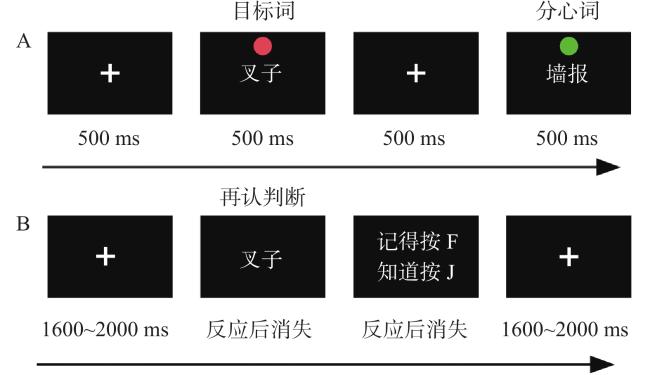
学习阶段程序见图1A 。200个词汇分10个组块伪随机呈现,圆圈位于词汇上方1 cm处。有意编码条件要求被试在记忆屏幕上的词汇的同时完成目标探测任务,红色圆圈(目标)需快速且准确地按空格键,绿色圆圈(分心)不做反应。无意编码组要求被试忽略词汇而仅完成目标探测任务。每个组块中目标刺激和分心刺激各半,不超过三个同一类型连续出现。被试在两个组块之间休息2500 ms。
分心阶段中,被试完成20道百位数以内的加减计算题。
再认阶段(图1B )中200个旧词和200个新词混合随机呈现于5个组块,每个组块中目标旧词、分心旧词和新词分别为20、20和40个。被试对词汇进行新旧再认判断,用左手食指对旧词按“F”键,用右手食指对新词按“J”键。若判断为旧词,继续做“记得”或“知道”判断。实验前向被试讲解“记得/知道”的含义,直到被试理解。“记得”指能回忆起学习阶段见过该词及具体细节,用左手食指按“F”键;“知道”指对该词有熟悉印象但不能回忆具体细节,用右手食指按“J”键。被试在每两个组块之间自行决定休息时间。两组被试的再认任务相同。
为排除被试在学习阶段对词汇进行了有意记忆的干扰,无意编码组被试最后须完成意识后测问卷。用9点评分对意识程度进行评价,其中“完全没有记忆”计1分,“对每个词都进行了有意记忆”计9分,并报告是否采取记忆策略。
2.2 结果
所有数据采用SPSS20.0软件分析。有意编码组中,剔除1名击中率在3个标准差之外的被试。无意编码组中,剔除3名后测问卷中报告了有意识记忆词汇的被试。
2.2.1 目标探测任务
独立样本t检验结果显示,有意编码组的目标击中率均值(99.38%)显著低于无意编码组(99.92%),t(49)=−2.73,p=0.009,Cohen’s d=0.77,且击中反应时均值(401 ms)显著长于无意编码组(361 ms),t(49)=3.66,p=0.001,Cohen’s d=1.02。由此可见,相对于无意编码组,有意编码组须同时完成两项任务,也表现出了记忆任务对目标探测任务的干扰作用(Craik et al., 1996)。
2.2.2 再认任务
对两组被试的词汇再认率(见图2 )实施2(编码意向:有意、无意)×2(词汇类型:目标词、分心词)×2(判断类型:记得、知道)的混合方差分析。为了控制事后检验中的多重比较问题,所有配对比较采用Bonferroni法校正p值(下同)。结果显示,编码意向主效应显著,F(1, 49)=9.34,p=0.004,η${_{\rm p}^2} $ =0.16;词汇类型主效应显著,F(1, 49)=32.99,p<0.001,η${_{\rm p}^2} $ =0.40;判断类型主效应显著,F(1, 49)=8.41,p=0.006,η${_{\rm p}^2} $ =0.15;编码意向与词汇类型交互作用显著,F(1, 49)=6.61,p=0.013,η${_{\rm p}^2} $ =0.12;编码意向与判断类型交互作用不显著,F(1, 49)=3.80,p=0.057;词汇类型与判断类型交互作用显著,F(1, 49)=21.55,p<0.001,η${_{\rm p}^2} $ =0.31;三者交互作用不显著,F(1, 49)=3.13,p=0.083。事后检验显示,两种编码意向下的目标词再认率都显著优于分心词(有意编码,p<0.001;无意编码,p=0.031),表现出显著的ABE;且在两种条件下,目标词的“记得”反应都显著多于分心词(有意编码,p<0.001;无意编码,p=0.003),但在“知道”反应上目标词与分心词均无显著差异(有意编码,p=0.977;无意编码,p=0.812)。
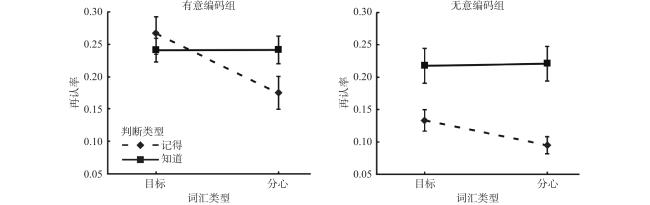
为进一步比较两种编码意向下的ABE是否存在差异,对两组被试的ABE大小(目标−分心)进行独立样本t检验。结果显示,有意编码组(8.73%)显著大于无意编码组(3.48%),t(49)=2.34,p=0.023,Cohen’s d=0.66。
2.3 讨论
实验1结果显示,两种编码条件都能产生显著ABE,但无意编码条件下的ABE明显小于有意编码条件,这与黄思捷和孟迎芳(2021)的研究结果一致。不同的是,在两种编码条件下,目标词与分心词的再认差异都表现在“记得”反应而非“知道”反应上,似乎表明不同编码意向下目标探测对记忆材料的促进加工都类似。对此,本研究将在总讨论中进行分析。
3 实验2:无意编码产生ABE的条件
3.1 研究方法
3.1.1 被试
被试样本量的选取方法同实验1。共招募50名右利手大学生被试(其中女生39名),年龄范围18~24岁,平均年龄19.59岁,标准差1.14岁。24名被试被随机分配到有意编码组,剩下26名被试被分配到无意编码组。其它均同实验1。
3.1.2 实验设计和程序
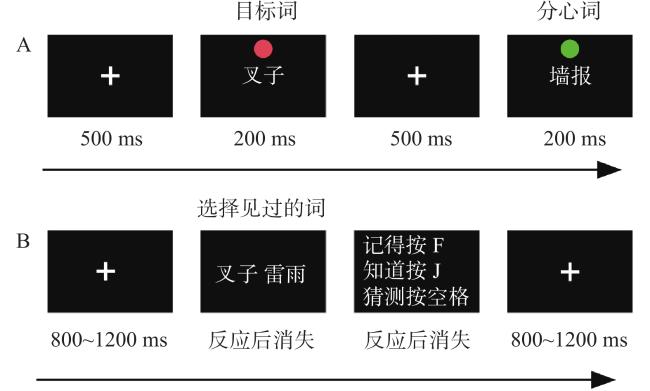
采用2(编码意向:有意、无意)×2(词汇类型:目标词、分心词)×3(判断类型:记得、知道、猜测)的混合设计。学习阶段与实验1相似,差别在于词汇与圆圈只呈现200 ms(见图3A )。考虑到实验2编码时间较短有可能出现天花板效应,因此测验阶段采用二选一的迫选再认测验,同时增加“记得/知道/猜测”判断,以便区分出由“猜测”成分所导致的再认。200个旧词(目标词和分心词各半)和200个新词两两随机配对呈现,新旧词左右位置在试次间平衡,这200个词对随机分为5个组块,每个组块共40个词对。测验阶段要求被试选出学习阶段见过的旧词,选择左边用左手食指按“F”键,右边用右手食指按“J”键。然后完成“记得/知道/猜测”判断(见图3B ),其中“猜测”指对两个词汇都没有记忆,只是迫于实验要求做出选择,用大拇指按空格键。
3.2 结果
分析方法同实验1。其中无意编码组中,剔除1名在学习阶段的分心虚报率高于3个标准差的被试,剩余25份有效数据。
3.2.1 目标探测任务
与实验1结果类似,有意编码组的平均击中率(97.54%)显著低于无意编码组(99.52%),t(47)=−3.29,p=0.002,Cohen’s d=0.94;平均击中反应时(389 ms)显著长于无意编码组(329 ms),t(47)=5.30,p<0.001,Cohen’s d=1.55,表明相对于无意编码组,有意编码组表现出记忆任务对目标探测任务的干扰作用。
3.2.2 再认任务
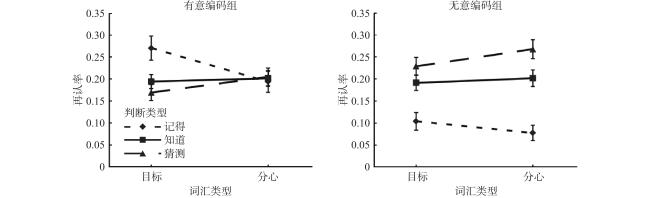
对两组被试的词汇再认率(见图4 )实施2(编码意向:有意、无意)×2(词汇类型:目标词、分心词)×3(判断类型:记得、知道、猜测)的混合方差分析。由于判断类型变量包含三个水平,所以需要实施球形检验(Mauchly’s test of sphericity),结果显示,判断类型条件下不违反球形假设,χ2=1.93,p=0.381,所以无需矫正自由度。方差分析结果显示,编码意向主效应显著,F(1, 47)=30.62,p<0.001,η${_{\rm p}^2} $ =0.39,编码意向与词汇类型交互作用显著,F(1, 47)=11.18,p=0.002,η${_{\rm p}^2} $ =0.19;编码意向与判断类型交互作用显著,F(2, 94)=10.02,p=0.001,η${_{\rm p}^2} $ =0.18;词汇类型与判断类型交互作用显著,F(2, 94)=24.02,p<0.001,η${_{\rm p}^2} $ =0.34。除此之外,无其它显著性结果,ps>0.05。事后多重比较的关键结果显示,有意编码组的目标词再认率显著大于分心词,p=0.007,表现出显著的ABE,且目标词的“记得”反应显著多于分心词,p<0.001,目标词的“猜测”反应显著少于分心词,p=0.002。无意编码组的目标词再认率和分心词再认率之间没有发现显著差异,p=0.062,即没有出现ABE。


3.3 讨论
实验2将词汇与探测刺激的呈现时间缩短为200 ms,结果在有意编码条件下发现了显著ABE,且与实验1类似,目标词的“记得”反应明显多于分心词,但在“知道”反应上没有表现出差异;在无意编码条件下并未发现显著ABE,即呈现时间缩短为200 ms的无意编码条件不会产生ABE。
4 总讨论
本研究在黄思捷和孟迎芳(2021)的基础上,通过设置探测刺激与词汇相同的呈现时长以减少无意编码条件下词汇单独呈现可能导致的“被动”意识加工,探讨有意编码是否为ABE产生的必要条件。实验1探测刺激与词汇同时呈现500 ms时在两种编码条件下都观察到显著ABE,但有意编码条件下的ABE明显大于无意编码条件;实验2将探测刺激与词汇同时呈现时间缩短至200 ms时,结果只在有意编码条件下发现显著ABE,无意编码条件下ABE不显著。由此可见,无意编码是否会产生ABE受到探测刺激与词汇的同时呈现时长的影响。
实验1当探测刺激和词汇共同呈现500 ms时,两种条件都产生了显著ABE,但有意编码条件下的ABE明显大于无意编码条件,这与以往研究结果是一致的(Broitman & Swallow, 2020; Swallow & Jiang, 2014a)。以往研究表明,无意编码也能引起不由被试控制的、自动的知觉加工(Debner & Jacoby, 1994; Merikle et al., 1995),但相比于有意编码条件,无意编码条件下只要求被试探测目标,忽略词汇,因此词汇得到的注意资源相对较少,目标探测对其产生的编码增强作用也就可能更弱,所以ABE显著更小(Swallow & Jiang, 2014a, 2014b)。虽然引言中曾提出,通过延长探测刺激的呈现时长,减少词汇单独呈现可能引起的“被动的有意编码”,但实验1在无意编码条件下仍发现了显著ABE,本研究推测,实验1将词汇和探测刺激共同呈现500 ms可能无法消除“被动的”意识加工。根据知觉负荷理论(Lavie, 1995, 2010),知觉容量有限(早期选择),但它以一种自动的、强制的方式加工所有刺激,直到容量耗尽(后期选择)。实验1无意编码条件下的目标探测平均反应时为361 ms,标准差为29 ms,即被试在400 ms以内就已经完成了目标探测任务,而此时词汇仍然保持在屏幕上,因此有可能目标探测任务并未耗尽所有知觉容量,所以多余的知觉容量仍会自动“溢出”到词汇的知觉编码加工上,导致目标词的再认记忆增强,产生ABE。
实验2将探测刺激与词汇的呈现时间缩短至200 ms,结果在无意编码条件下未发现显著ABE。这一结果与Hutmacher和Kuhbandner(2020)的实验结果是一致的。该研究采用快速序列呈现范式,学习阶段探测方块和背景图片也是同时呈现200 ms后消失,随后对图片进行二选一的迫选再认测验,结果在无意编码条件下也未发现显著ABE。研究表明,对词汇形成知觉记忆表征的时间不超过200 ms(Thorpe et al., 1996)。实验2的目标探测任务数据显示,无意编码条件下目标探测平均反应时为329 ms,标准差为36 ms,那么被试在300 ms左右才能完成目标探测任务,而词汇和探测刺激共同呈现的时间只有200 ms。根据知觉负荷理论(Lavie, 1995, 2010),在这200 ms内,由于目标探测任务占用了所有的知觉容量,没有多余的注意容量“溢出”到词汇加工上,那么目标探测引起的编码增强作用就不足以增强词汇编码加工,也就不足以产生显著ABE。
双任务交互作用模型曾提出,目标探测能增强与之同时呈现的所有刺激的加工(Swallow & Jiang, 2013),甚至当这些刺激未被有意注意(Swallow et al., 2022)。本研究结果进一步拓展了这一模型和解释,表明目标探测促进未被有意注意的刺激编码加工是有条件的,即在无意编码条件下观察到显著ABE可能依赖于可利用的知觉资源。在无意编码条件下,当有知觉资源能够被动“溢出”到背景刺激,引起对记忆材料自动的编码加工增强时,如实验1中记忆材料呈现时间较长,就会观察到显著的ABE;否则就不能观察到。
此外,本研究两个实验的结果一致显示,有意编码条件下目标词与分心词的差异主要表现在“R”判断上,即目标探测更多促进的是记忆材料的“记得”反应,这与先前研究结果一致(Leclercq et al., 2014; Meng et al., 2019)。“记得”反映的是对已学项目具体信息的主动提取,依赖于对已学项目的精加工(李岩松, 周仁来, 2008; Yonelinas, 2002)。而实验2进一步增加了“猜测”判断后也发现,有意编码条件下目标词的“猜测”成分也会显著少于分心词,这进一步说明,有意编码条件下目标探测所产生的注意增强能够促进对词汇的细节记忆,产生随后更多的“记得”反应。实验1还发现,无意编码条件下的ABE也主要表现在目标词“记得”反应上,但黄思捷和孟迎芳(2021)的研究发现,无意编码条件下的ABE主要体现在目标词“知道”反应上。在该研究中,探测刺激只呈现100 ms。但实验1将探测刺激呈现500 ms,除此之外,其它设计与他们的完全相同。因此,探测刺激呈现时间不同(500 ms vs. 100 ms)可能导致了结果的差异。在该实验中,探测刺激消失后,由于有知觉容量自动“溢出”到词汇知觉编码加工上,所以单独呈现的目标词可能导致更多知觉加工,从而对随后的“知道”反应起作用。而本研究实验1将探测刺激和词汇一起呈现,被试可能将两者作为一个整体加工,在完成目标探测任务后,由于探测刺激和词汇都一直呈现在屏幕上,并且有知觉容量自动“溢出”到词汇编码加工上,所以被试可能“被动的”对词汇的细节信息进行精加工,从而不会对随后的“知道”反应产生显著影响,而是影响“记得”反应。然而,这一推测还需要进一步证实。
5 结论
本研究结果显示,虽然有意编码条件下ABE是稳定的,但无意编码条件下是否能产生显著ABE是有条件的。当记忆材料得到“主动或被动”意识加工时,目标探测反应才会引发显著ABE。反之,如果记忆材料没有得到任何的注意资源,目标探测不会引发显著ABE。