?

Mindsets About Intelligence or Failure? The Mediating Mechanism and Gender Differences in How Teacher Mindsets Influence High School Students’ Everyday Academic Resilience

  • Xiaoyu JIA 1 ,
  • Qiqing TANG 2 ,
  • Ping LI 3 ,
  • Jing ZHAO 4 ,
  • Weijian LI , *, 5
Expand
  • 1. College of Teacher Education, Southwest University, Chongqing 400715
  • 2. School of History and Culture School of Ethnology, Southwest University, Chongqing 400715
  • 3. School of Education Science, Guangdong Polytechnic Normal University, Guangzhou 510665
  • 4. Jinhua Education Teaching Research Center, Jinhua 321017
  • 5. School of Psychology, Zhejiang Normal University, Jinhua 321004

Received date: 2023-03-19

  Online published: 2025-06-07

Copyright

Copyright reserved © 2025.

Abstract

This study investigated the relationship between high school students’ perceived teacher mindsets (intelligence and failure mindsets) and their everyday academic resilience, as well as the mediating role of perceived teachers’ classroom behaviors (autonomy support and teacher-student relationships) and the moderating role of students’ gender. The instruments included perceived teacher intelligence and failure mindsets, teacher autonomy support, teacher-student relationships, and everyday academic resilience. The results showed that: 1) Students’ perceived teacher failure-is-debilitating mindset negatively predicted their everyday academic resilience. 2) Perceived teacher classroom behaviors of autonomy support and teacher-student relationships mediated the relationship between perceived teacher failure mindset and everyday academic resilience. 3) The mediating role of perceived teacher classroom behaviors was moderated by students’ gender, as perceived teacher failure-is-debilitating mindset influenced girls’ everyday academic resilience through perceived teacher classroom behaviors.

Cite this article

Xiaoyu JIA , Qiqing TANG , Ping LI , Jing ZHAO , Weijian LI . Mindsets About Intelligence or Failure? The Mediating Mechanism and Gender Differences in How Teacher Mindsets Influence High School Students’ Everyday Academic Resilience[J]. Studies of Psychology and Behavior, 2025 , 23(2) : 193 -200 . DOI: 10.12139/j.1672-0628.2025.02.007

1 前言

随着积极心理学的发展,探讨如何帮助青少年建构日常学业压力下的积极适应机制受到广泛关注,其核心在于塑造日常性学业弹性。日常性学业弹性指青少年成功应对日常学业挫折和失败等的能力,是心理弹性在学业领域的反映(Martin & Marsh, 2008)。较高的日常性学业弹性不仅能够帮助青少年在逆境中维持良好的学业投入(Putwain et al., 2016),还有助于预防学业焦虑及躯体症状等风险(Hirvonen et al., 2019; Putwain et al., 2012)。动机的社会认知理论强调个体信念影响压力应对表现(Dweck & Yeager, 2019),个体对自身能力持有的可塑信念越多,其应对困境的心理弹性水平越高(宋淑娟, 许秀萍, 2019)。然而,个体感知重要他人(如教师)信念是否影响学业领域的心理弹性尚未可知。考虑到青少年时期个体与教师相处时间增多以及师生互动的动态特点(Mesler et al., 2021),深入探讨影响青少年日常性学业弹性的教师信念因素及内在机制,对塑造其良好的学业适应具有重要意义。
教师信念是一个融合了教师对学生主体、教学方式、教师道德及师生互动等内容的动机性态度系统(Liu et al., 2022),对学生的信念建构(Yu et al., 2022)、学科胜任感(Haataja et al., 2024)以及学业表现(Radišić et al., 2024)等具有预测作用。其中,两种近端的教师信念为教师能力观和失败观。教师能力观指教师对学生能力可塑−固化的态度(Richardson et al., 2020)。教师失败观指教师对学生失败的积极−消极态度(Muenks & Yan, 2022)。能力观和失败观虽然存在一定相关性,但二者在概念上具有本质区别(Richardson et al., 2020)。无论教师秉持能力固化观还是可塑观,均可能倾向于认为学生的学业失败具有消极影响。
根据线索模型,教师信念作为一种情境线索,会被学生觉察和感知(Murphy et al., 2007)。学生基于对教师信念的感知,对学业情境进行评估和应对(Eccles & Wigfield, 2002)。当学生感知到教师对其能力持有更多消极且固化的态度时,其心理弹性降低、学业投入减少及辍学意愿增强(Muenks et al., 2020; Vestad & Bru, 2024)。然而,尽管近年来大多数研究关注父母消极失败观对学生能力观建构(Liu et al., 2023; Tao et al., 2022)及学业表现的负向影响(Barger et al., 2022),但教师失败观在学生学业和心理适应中作用的相关研究较少。作为学生的重要他人,教师对学生学业失败的消极态度可能会激发学生对学业情境形成更多消极期望和评估,进而削弱其学业参与感和胜任感(Muenks & Yan, 2022)。此外,部分研究探讨父母能力观和失败观对学生适应的不同影响机制(Haimovitz & Dweck, 2016; Xie et al., 2022),但目前尚缺乏对教师能力观和失败观对学生学业和心理适应影响的同步对比研究。鉴于日常性学业弹性是一种积极的心理能力,与学生在学业失败中的动机和投入紧密相关(Putwain et al., 2016),学生对教师能力观和失败观的感知可能影响其日常性学业弹性。因此,本研究提出假设H1:学生感知的教师能力固化观和消极失败观负向预测其日常性学业弹性。
信念理论指出信念具有内隐的特点(Dweck & Yeager, 2019),教师的信念通过一系列课堂行为来反映(Jia, Li, Zhao, & Zhang, 2024; Yu et al., 2022)。课堂行为是一个涉及教师期望、教学反馈、自主支持及师生关系等内容的概念系统(Hoy et al., 2009)。以往研究发现教师信念与自主支持−控制式课堂行为相关(Vermote et al., 2020),对学生能力和失败持积极信念的教师倾向于建构支持性课堂以激发学生的内在成长动机,而持消极信念的教师倾向于建构控制性课堂以区别对待“天赋”和“普通”学生(Leroy et al., 2007),特别是对“普通”学生看似安慰的反馈(“没关系,并不是每个学生都擅长这门功课”)(Rattan et al., 2012)以及所传递的“犯错或失败是不可取的”信息(Muenks & Yan, 2022)会让学生体验到更少的教师支持。类似地,师生关系作为课堂中师生互动的重要行为(George & Richardson, 2019),以往研究发现对学生能力和失败经历持积极可塑态度的教师能够让学生体验到更加温暖和亲近的师生关系(Yu et al., 2022)。此外,自主支持、温暖积极的教师课堂行为能够增强学生的日常性学业弹性(Furrer et al., 2014; Pitzer & Skinner, 2017)。基于此,学生感知的教师课堂行为(如自主支持和师生关系)可能可以解释教师信念与学生日常性学业弹性之间的关系。当学生感知到教师持有能力可塑或积极失败的信念时,可能会体验到教师更多的课堂支持行为,并感受到更加温暖的师生关系,增强他们在面对学业挫折和困境时的自信,从而提升其日常性学业弹性。据此,本研究提出假设H2:感知教师课堂行为(自主支持和师生关系)在感知教师信念和学生日常性学业弹性间起中介作用。
在探讨学生对教师信念及课堂行为的感知时,性别是一个不可忽视的因素。研究表明,相较于男生,女生对教师信念的感知更加敏锐(Mesler et al., 2021)。感知教师对能力的消极信念更容易损害女生的能力自我概念(Eccles & Wigfield, 2020; Rattan et al., 2018)。而这种感知差异可能依赖于教师的一系列课堂行为线索(She, 2000)。根据性别角色的社会化理论,教师对男生和女生可能会有不同的期望和角色规范,影响着学生的认知方式和行为表现。研究发现,教师对男生要求更严格(Dweck et al., 1978),女生比男生更容易适应教师的期望(Hajovsky et al., 2017),能够获得来自教师更多的支持、鼓励和温暖(Baker, 2006; De Wit et al., 2010),进而影响其学业动机和心理适应(Oppermann et al., 2019)。例如,相比于男生,女生若感知到父母对其数学失败的消极信念越强烈,越容易体会到父母的成绩目标导向行为(如注重分数和能力比较),从而引发更强烈的焦虑情绪(Xie et al., 2022)。基于此,学生性别可能在感知教师信念通过感知课堂行为影响日常性学业弹性的中介路径中起调节作用。与男生相比,当女生感知到教师持有能力固化和消极失败观时,可能会体验到更少的自主支持和紧张的师生关系,从而降低日常性学业弹性。据此,本研究提出假设H3:学生性别能够调节感知教师信念,感知课堂行为与日常性学业弹性的关系。
班主任作为全面负责学生学习和生活的教育者,对待学生的态度和行为给其学业动机造成的影响更加深远。本研究以班主任作为教师考察对象。考虑到教师自我报告与学生感知间存在偏差(Muenks et al., 2020),而后者对学生的学业具有更强的预测作用(Lauermann & Berger, 2021),本研究拟从高中生视角出发,验证感知教师课堂行为(自主支持和师生关系)在感知教师信念(教师能力固化观和消极失败观)和日常性学业弹性间的中介作用以及性别的调节作用,为培养高中生应对日常学业压力的积极心态提供理论依据和实践参考。

2 研究方法

2.1 被试

采用整群抽样法抽取广东省深圳市某高中高一和高二共计28个班级,1096名学生作为研究对象,所有被试签署知情同意书。班主任统一组织学生在问卷星平台上完成测试。剔除规律性作答问卷后获得有效问卷1071份,回收率97.72%,其中高一年级567人(52.94%),高二年级504人(47.06%),男生533人(49.77%),女生538人(50.23%),平均年龄16.09±0.98岁。

2.2 研究工具

2.2.1 感知教师能力固化观

采用Dweck(1990)编制的能力观量表,共3题。本研究对原量表内容进行改编,如“我的班主任认为我的智力水平是一定的,无法做出改变”。采用6点计分,得分越高表明感知教师能力固化观越强烈。该量表已在中国青少年中进行过验证(Jia, Li, Zhao, & Zhang, 2024)。本研究中该量表的Cronbach’s α系数为0.96。

2.2.2 感知教师消极失败观

采用Haimovitz和Dweck(2016)编制的失败观量表,共3题。本研究对原量表内容进行改编,如“我的班主任认为经历失败会阻碍我的学习和成长”。采用6点计分,得分越高表明感知教师消极失败观越强烈。该量表已在中国青少年中进行过验证(Xie et al., 2022)。本研究中该量表的Cronbach’s α系数为0.94。

2.2.3 感知教师自主支持

采用刘桂荣(2010)修订的学习气氛问卷中的教师自主支持分量表,共14题。采用7点计分。第12题因子载荷过低(a=0.42),故删除。得分越高表明感知教师自主支持程度越高。本研究中该量表的Cronbach’s α系数为0.97。

2.2.4 感知师生关系

采用Bear等人(2011)编制的特拉华学校氛围量表(学生卷)中的师生关系分量表,共5题。采用4点计分,得分越高表明感知师生关系越积极。该量表在中国样本中具有稳定的内部一致性(Teng et al., 2020)。本研究中该量表的Cronbach’s α系数为0.93。

2.2.5 日常性学业弹性

采用Martin和Marsh(2008)编制的日常性学业弹性量表,共4题。采用5点计分,得分越高说明日常性学业弹性越好。该量表已在中国青少年中进行过验证(Jia, Li, & Xie, 2024)。本研究中该量表的Cronbach’s α系数为0.92。

2.3 数据分析与共同方法偏差检验

采用SPSS22.0和Mplus8.0对数据进行分析。为减少共同方法偏差,采用了强调保密性,加入测谎题等方式进行控制。固定一个因子对所有变量进行验证性因素分析发现模型拟合较差:χ2/df=41.64,CFI=0.56,TLI=0.52,RMSEA=0.20,SRMR=0.17,说明本研究不存在严重的共同方法偏差。

3 结果

3.1 描述统计及相关分析

表1所示,男生感知教师能力固化观(t=3.14, p<0.01, Cohen’s d=0.19),感知教师消极失败观(t=4.17, p<0.001, Cohen’s d=0.26),以及日常性学业弹性得分(t=4.11, p<0.001, Cohen’s d=0.25)均高于女生。年龄(p=0.544)、感知教师自主支持(p=0.445)和感知师生关系(p=0.626)则不存在显著的性别差异。相关分析发现,感知教师能力固化观与感知教师消极失败观呈显著正相关。感知教师能力固化观与感知教师消极失败观分别与感知教师自主支持、感知师生关系和日常性学业弹性呈显著负相关。感知教师自主支持、感知师生关系与日常性学业弹性呈显著正相关。
表1 各变量的平均值、标准差和相关系数
变量男生(M±SD)女生(M±SD)12345
1.年龄16.11±1.1416.11±0.78
2.感知教师能力固化观2.83±1.272.61±1.050.11**
3.感知教师消极失败观2.81±1.212.53±0.980.09**0.88**
4.感知教师自主支持3.83±0.693.80±0.68−0.03−0.33**−0.33**
5.感知师生关系3.13±0.513.15±0.45−0.02−0.31**−0.34**0.64**
6.日常性学业弹性3.51±0.923.27±0.94−0.02−0.22**−0.24**0.40**0.30**

  注:**p<0.01,***p<0.001,以下同。

3.2 中介效应检验

以感知教师能力固化观、感知教师消极失败观为预测变量,日常性学业弹性为结果变量,检验直接效应,模型拟合良好,χ2/df=3.54,CFI=1.00,TLI=1.00,RMSEA=0.00,SRMR=0.00。感知教师消极失败观负向预测学生日常性学业弹性(β=−0.21, p<0.01),而感知教师能力固化观对学生日常性学业弹性的预测作用不显著(β=−0.01, p=0.891)。
对感知教师课堂行为(由感知教师自主支持和感知师生关系均分构建而成)的中介效应进行检验,同时将年龄和性别作为控制变量。结果显示(见图1),模型拟合良好,χ2/df=20.63,CFI=0.98,TLI=0.96,RMSEA=0.05,SRMR=0.02。感知教师能力固化观对感知教师课堂行为(β=−0.14, p=0.107)和日常性学业弹性(β=0.04, p=0.125)的预测作用均不显著,而感知教师消极失败观能够显著负向预测感知教师课堂行为(β=−0.29, p<0.001),但对日常性学业弹性的预测作用不显著(β=−0.10, p=0.125)。感知教师课堂行为能够显著正向预测日常性学业弹性(β=0.36, p<0.001)。采用偏差校正的非参数百分位Bootstrap法(随机抽样1000次)检验感知教师课堂行为的中介作用。结果表明,感知教师课堂行为在感知教师消极失败观与青少年日常性学业弹性间的中介效应显著,中介效应值为−0.10,95%CI=[−0.16, −0.04]。
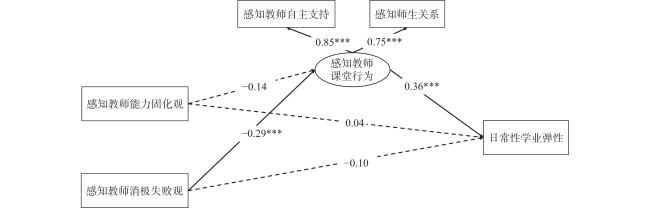
图1 感知教师课堂行为在感知教师信念与学生日常性学业弹性间的中介作用

3.3 调节效应检验

使用Mplus8.0中的多组分析检验性别的调节作用。对图1中主要的路径系数进行检验,结果显示(图2),对男生而言,感知教师消极失败观对感知教师课堂行为的预测作用不显著(β=−0.11, p=0.102),但感知教师课堂行为能够显著正向预测日常性学业弹性(β=0.34, p<0.001)。对女生而言,感知教师消极失败观能够显著负向预测感知教师课堂行为(β=−0.31, p<0.001),感知教师课堂行为能够显著正向预测日常性学业弹性(β=0.38, p<0.001),感知教师课堂行为在感知教师消极失败观与女生日常性学业弹性间的中介效应显著,中介效应值为−0.12,95%CI=[−0.14, −0.04],ΔCFI=0.01,ΔTLI=0.02,ΔRMSEA=0.01,ΔSRMR=0.01。
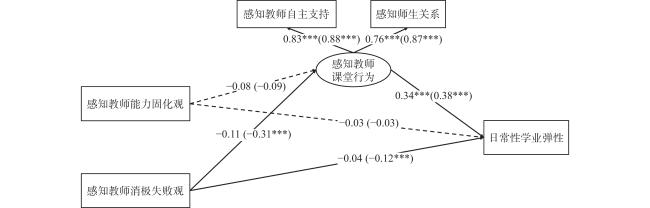
图2 不同性别学生的多群组模型

注:括号外为男生组路径系数,括号内为女生组路径系数。

4 讨论

本研究探索感知教师信念(能力固化观和消极失败观)与学生日常性学业弹性的关系,结果发现仅感知教师消极失败观的负向预测作用显著,这与以往研究结果一致(Haimovitz & Dweck, 2016; Muenks & Yan, 2022)。相较于能力观的内隐和抽象性,教师对待失败的态度更容易通过一些外显的语言或行为信号被学生准确感知(Haimovitz & Dweck, 2016, 2017)。譬如“失败是成功之母”或“通往成功的道路上需要做到万无一失”等言语,或者对学生的失败经历给予安慰鼓励或失望批评等行为反馈。而学生将感知到的教师失败观作为对学业挫折的成功预期和价值评估的关键线索,影响着日常性学业弹性,符合线索模型(Murphy et al., 2007)和期望价值理论(Eccles & Wigfield, 2020)。究其原因,学生感知到教师对失败的态度正向积极,会对学业挫折产生更多的积极期望和主控感,表现出更多的积极情感反应和适应性压力应对行为(Urdan & Midgley, 2003),有利于日常性学业弹性的累加(Rattan et al., 2018)。而学生感知到教师对失败的态度负面消极,会视学业挫折为威胁和能力极限,滋生出更多悲观预期和回避失败的消极动机(Tao et al., 2022),阻碍其日常性学业弹性的发展(Martin et al., 2013)。
本研究未发现感知教师能力固化观对学生日常性学业弹性的预测作用。重要他人的能力观与学生学业动机和表现的关系一直备受争议(Haimovitz & Dweck, 2016)。教师对学生能力的看法与其教学行为间可能存在脱节(Haimovitz & Dweck, 2017),如有些持能力可塑观的教师仍习惯性地表扬学生的天赋而非努力,导致学生无法准确知觉教师对待他们的能力态度,这种感知偏差会削弱学生学业动机和表现(Schiefele & Schaffner, 2015)。此外,能力观具有领域一般和特异性之分(Zhu et al., 2020),教师对学生“一般能力”和“应对日常学业挫折的能力”的信念可能存在差异,未来应对此进行细致探究。
感知教师消极失败观通过感知教师自主支持和感知师生关系影响学生的日常性学业弹性,与以往研究结果一致(Prast et al., 2018; Reeve & Cheon, 2021),符合信念理论(Dweck & Yeager, 2019)。教师失败观影响以掌握−成绩课堂目标为核心的一系列教师课堂行为(Urdan & Kaplan, 2020)。持“失败有益成长”的教师注重学生的个人成长,鼓励学生在课堂中自主探索、大胆质疑和自我调节学习,他们倾向于以“成长而非成败”评价学生,引导学生不惧学业失败并帮助寻找失败的积极价值(Schiffrin et al., 2019),如此,学生体验到的课堂环境和师生氛围更加包容和温暖(Muenks & Yan, 2022)。反之,持“失败阻碍成长”的教师倾向于建构竞争性的课堂环境(Haimovitz & Dweck, 2016),以“成败论英雄”的评价标准使得他们对学生的学业失败流露出更多的担忧和不满(Schiffrin et al., 2019),学生体验到的课堂环境更加紧张和矛盾。进一步,支持和温暖的课堂环境能够帮助学生在学业挫折中形成掌握性动机,提升学业坚持和基本心理需求满足感(Granziera et al., 2022),有利于日常性学业弹性的发展,而缺乏自主和温暖的课堂环境会导致学生产生一系列诸如回避失败、自卑自怜和消极应对等低日常性学业弹性表现(Pitzer & Skinner, 2017)。
感知教师课堂行为在感知教师消极失败观与日常性学业弹性中的中介效应仅出现在女生中。女生感知到教师对失败的态度越负面消极,会体验到更少的自主支持和更紧张的师生关系,从而降低日常性学业弹性。首先,女生在态度感知和理解反应上具有优势(Mesler et al., 2021),她们倾向于对教师信念与课堂行为的一致性进行细腻觉察与反复推敲,产生的感知偏差更少。而男生对教师课堂行为的感知更容易受到教师信念之外的因素影响(Rattan et al., 2018),他们在很大程度上依赖自身参与课堂的兴趣、胜任力等做出对感知课堂环境的感知与评价(Samuelsson & Samuelsson, 2016),这种依赖性导致感知教师消极失败观对感知课堂行为的预测作用在男生群体中不显著。其次,女生更在意重要他人的态度和评价(Eccles & Wigfield, 2002),且对这些态度和评价的内化程度更高(李蓓蕾 等, 2022)。当教师持有“失败有益成长”信念时,倾向于建构掌握目标导向(如给予学生更多的支持和鼓励)的课堂行为(Muenks & Yan, 2022),感知这些积极课堂行为的女生会提升对学业困境的胜任知觉和成功预期,做出更多的学业努力(Smith et al., 2002),从而形成更高的学业弹性(Way et al., 2007)。然而,当女生感知到教师持有“失败阻碍成长”的信念时,这些积极的课堂行为线索缺失,导致其学业弹性降低。
未来应充分发挥教师在学生日常性学业弹性培育中的重要作用。首先,教师应避免向学生传递对其学业失败的消极信念,要引导学生寻求失败的积极价值;其次,教师在课堂中应给予学生更多的支持和鼓励,建构和谐的师生关系,有助于学生累积应对学业压力的积极心理资源;最后,教师应关注到男女生在态度感知与动机反应等方面的差异,在传递对男、女生的学业期待与能力态度时应做到清晰明确与知行合一。
本研究存在一些不足。首先,研究样本仅局限于某省地区,未来可扩大样本的地域范围,以增强研究结果的普遍性和代表性。其次,研究数据均出自学生自我报告,未来可以从教师和学生双视角收集变量数据以进一步探索。再次,虽然能力观和失败观属于两个不同的概念(Richardson et al., 2020),但本研究中二者的高相关反映出测量工具可能存在潜在局限,未来研究可以尝试优化量表题目以增强区分效度。最后,未来研究可以同时探究不同来源(如父母、教师和学生)信念对青少年学业和心理适应的影响。

5 结论

(1) 高中生感知教师消极失败观显著负向预测日常性学业弹性。(2)感知教师课堂行为(自主支持和师生关系)在感知教师消极失败观与日常性学业弹性间起中介作用。(3)感知教师课堂行为的中介效应受到性别调节。女生感知的教师消极失败观通过感知教师课堂行为影响其日常性学业弹性。
李蓓蕾, 高婷, 张莉莉, 周楠, 邓林园. 学生感知的教师欺凌态度与学生欺凌行为的关系——学生欺凌态度的中介作用及其性别的调节作用. 心理发展与教育, 2022, 38 (3): 348- 357.

刘桂荣. (2010). 自主支持和因果定向对创造力的影响(硕士学位论文). 山东师范大学, 济南.

宋淑娟, 许秀萍. 思维模式对留守经历大学生心理韧性的影响. 中国特殊教育, 2019, (11): 64- 68.

Baker, J. A. Contributions of teacher-child relationships to positive school adjustment during elementary school. Journal of School Psychology, 2006, 44 (3): 211- 229.

DOI

Barger, M. M., Wu, J. W., Xiong, Y., Oh, D. D., Cimpian, A., & Pomerantz, E. M. Parents’ responses to children’s math performance in early elementary school: Links with parents’ math beliefs and children’s math adjustment. Child Development, 2022, 93 (6): e639- e655.

Bear, G. G., Gaskins, C., Blank, J., & Chen, F. F. Delaware School Climate Survey—Student: Its factor structure, concurrent validity, and reliability. Journal of School Psychology, 2011, 49 (2): 157- 174.

DOI

De Wit, D. J., Karioja, K., & Rye, B. J. Student perceptions of diminished teacher and classmate support following the transition to high school: Are they related to declining attendance. School Effectiveness and School Improvement, 2010, 21 (4): 451- 472.

DOI

Dweck, C. S. Self-theories and goals: Their role in motivation, personality, and development. Nebraska Symposium on Motivation, 1990, 38, 199- 235.

Dweck, C. S., Davidson, W., Nelson, S., & Enna, B. Sex differences in learned helplessness: II. The contingencies of evaluative feedback in the classroom and III. An experimental analysis. Developmental Psychology, 1978, 14 (3): 268- 276.

DOI

Dweck, C. S., & Yeager, D. S. Mindsets: A view from two eras. Perspectives on Psychological Science, 2019, 14 (3): 481- 496.

DOI

Eccles, J. S., & Wigfield, A. Motivational beliefs, values, and goals. Annual Review of Psychology, 2002, 53, 109- 132.

DOI

Eccles, J. S., & Wigfield, A. From expectancy-value theory to situated expectancy-value theory: A developmental, social cognitive, and sociocultural perspective on motivation. Contemporary Educational Psychology, 2020, 61, 101859.

DOI

Furrer, C. J., Skinner, E. A., & Pitzer, J. R. The influence of teacher and peer relationships on students’ classroom engagement and everyday motivational resilience. Teachers College Record, 2014, 116 (13): 101- 123.

DOI

George, S. V., & Richardson, P. W. Teachers’ goal orientations as predictors of their self-reported classroom behaviours: An achievement goal theoretical perspective. International Journal of Educational Research, 2019, 98, 345- 355.

DOI

Granziera, H., Liem, G. A. D., Chong, W. H., Martin, A. J., Collie, R. J., Bishop, M., & Tynan, L. The role of teachers’ instrumental and emotional support in students’ academic buoyancy, engagement, and academic skills: A study of high school and elementary school students in different national contexts. Learning and Instruction, 2022, 80, 101619.

DOI

Haataja, E. S. H., Niemivirta, M., Holm, M. E., Ilomanni, P., & Laine, A. Students’ socioeconomic status and teacher beliefs about learning as predictors of students’ mathematical competence. European Journal of Psychology of Education, 2024, 39 (2): 1615- 1636.

DOI

Haimovitz, K., & Dweck, C. S. Parents’ views of failure predict children’s fixed and growth intelligence mind-sets. Psychological Science, 2016, 27 (6): 859- 869.

DOI

Haimovitz, K., & Dweck, C. S. The origins of children’s growth and fixed mindsets: New research and a new proposal. Child Development, 2017, 88 (6): 1849- 1859.

DOI

Hajovsky, D. B., Mason, B. A., & McCune, L. A. Teacher-student relationship quality and academic achievement in elementary school: A longitudinal examination of gender differences. Journal of School Psychology, 2017, 63, 119- 133.

DOI

Hirvonen, R., Yli-Kivistö, L., Putwain, D. W., Ahonen, T., & Kiuru, N. School-related stress among sixth-grade students: Associations with academic buoyancy and temperament. Learning and Individual Differences, 2019, 70, 100- 108.

DOI

Hoy, A. W., Hoy, W. K., & Davis, H. A. (2009). Teachers’ self-efficacy beliefs. In K. R. Wenzel & A. Wigfield (Eds.), Handbook of motivation at school (pp. 627–653). New York: Routledge.

Jia, X. Y., Li, P., & Xie, Y. T. Longitudinal effect of the parent-child relationship in home quarantine on internalizing and externalizing problems after school reopening for students in boarding high school: A chain mediation model. Psychology in the Schools, 2024, 61 (6): 2338- 2358.

DOI

Jia, X. Y., Li, P., Zhao, J., & Zhang, Y. C. How adolescents’ perceived teachers’ mindset beliefs influence school engagement in China: Roles of perceived classroom goal structures and adolescents’ mindset beliefs. School Psychology International, 2024, 45 (5): 465- 494.

DOI

Lauermann, F., & Berger, J. L. Linking teacher self-efficacy and responsibility with teachers’ self-reported and student-reported motivating styles and student engagement. Learning and Instruction, 2021, 76, 101441.

DOI

Leroy, N., Bressoux, P., Sarrazin, P., & Trouilloud, D. Impact of teachers’ implicit theories and perceived pressures on the establishment of an autonomy supportive climate. European Journal of Psychology of Education, 2007, 22 (4): 529- 545.

DOI

Liu, G. F., Su, Q., & Han, Y. L. The power of trust: How does parents’ failure mindset affect children’s intelligence mindset. Personality and Individual Differences, 2023, 206, 112139.

DOI

Liu, M., Zwart, R., Bronkhorst, L., & Wubbels, T. Chinese student teachers’ beliefs and the role of teaching experiences in the development of their beliefs. Teaching and Teacher Education, 2022, 109, 103525.

DOI

Martin, A. J., Ginns, P., Brackett, M. A., Malmberg, L. E., & Hall, J. Academic buoyancy and psychological risk: Exploring reciprocal relationships. Learning and Individual Differences, 2013, 27, 128- 133.

DOI

Martin, A. J., & Marsh, H. W. Academic buoyancy: Towards an understanding of students’ everyday academic resilience. Journal of School Psychology, 2008, 46 (1): 53- 83.

DOI

Mesler, R. M., Corbin, C. M., & Martin, B. H. Teacher mindset is associated with development of students’ growth mindset. Journal of Applied Developmental Psychology, 2021, 76, 101299.

DOI

Muenks, K., Canning, E. A., LaCosse, J., Green, D. J., Zirkel, S., Garcia, J. A., & Murphy, M. C. Does my professor think my ability can change? Students’ perceptions of their STEM professors’ mindset beliefs predict their psychological vulnerability, engagement, and performance in class. Journal of Experimental Psychology: General, 2020, 149 (11): 2119- 2144.

DOI

Muenks, K., & Yan, V. X. University STEM instructors with stronger failure-as-debilitating mindsets are perceived to engage in fewer mastery-oriented teaching practices by their students: An exploratory study. Social Psychology of Education, 2022, 25 (5): 1205- 1219.

DOI

Murphy, M. C., Steele, C. M., & Gross, J. J. Signaling threat: How situational cues affect women in math, science, and engineering settings. Psychological Science, 2007, 18 (10): 879- 885.

DOI

Oppermann, E., Brunner, M., & Anders, Y. The interplay between preschool teachers’ science self-efficacy beliefs, their teaching practices, and girls’ and boys’ early science motivation. Learning and Individual Differences, 2019, 70, 86- 99.

DOI

Pitzer, J., & Skinner, E. Predictors of changes in students’ motivational resilience over the school year: The roles of teacher support, self-appraisals, and emotional reactivity. International Journal of Behavioral Development, 2017, 41 (1): 15- 29.

DOI

Prast, E. J., van de Weijer-Bergsma, E., Kroesbergen, E. H., & van Luit, J. E. H. Differentiated instruction in primary mathematics: Effects of teacher professional development on student achievement. Learning and Instruction, 2018, 54, 22- 34.

DOI

Putwain, D. W., Connors, L., Symes, W., & Douglas-Osborn, E. (2012). Is academic buoyancy anything more than adaptive coping? Anxiety, Stress, & Coping, 25(3), 349–358.

Putwain, D. W., Daly, A. L., Chamberlain, S., & Sadreddini, S. “‘Sink or swim’: Buoyancy and coping in the cognitive test anxiety-academic performance relationship”. Educational Psychology, 2016, 36 (10): 1807- 1825.

DOI

Radišić, J., Buchholtz, N., Yang-Hansen, K., Liu, X., & Kaarstein, H. Do teachers’ beliefs about the nature and learning of mathematics affect students’ motivation and enjoyment of mathematics? Examining differences between boys and girls across six countries. European Journal of Psychology of Education, 2024, 39 (2): 1587- 1613.

DOI

Rattan, A., Good, C., & Dweck, C. S. “It’s OK—Not everyone can be good at math”: Instructors with an entity theory comfort (and demotivate) students. Journal of Experimental Social Psychology, 2012, 48 (3): 731- 737.

DOI

Rattan, A., Savani, K., Komarraju, M., Morrison, M. M., Boggs, C., & Ambady, N. Meta-lay theories of scientific potential drive underrepresented students’ sense of belonging to science, technology, engineering, and mathematics (STEM). Journal of Personality and Social Psychology, 2018, 115 (1): 54- 75.

DOI

Reeve, J., & Cheon, S. H. Autonomy-supportive teaching: Its malleability, benefits, and potential to improve educational practice. Educational Psychologist, 2021, 56 (1): 54- 77.

DOI

Richardson, D. S., Bledsoe, R. S., & Cortez, Z. Mindset, motivation, and teaching practice: Psychology applied to understanding teaching and learning in STEM disciplines. CBE—Life Sciences Education, 2020, 19 (3): ar46.

Samuelsson, M., & Samuelsson, J. Gender differences in boys’ and girls’ perception of teaching and learning mathematics. Open Review of Educational Research, 2016, 3 (1): 18- 34.

DOI

Schiefele, U., & Schaffner, E. Teacher interests, mastery goals, and self-efficacy as predictors of instructional practices and student motivation. Contemporary Educational Psychology, 2015, 42, 159- 171.

DOI

Schiffrin, H. H., Yost, J. C., Power, V., Saldanha, E. R., & Sendrick, E. Examining the relationship between helicopter parenting and emerging adults’ mindsets using the consolidated helicopter parenting scale. Journal of Child and Family Studies, 2019, 28 (5): 1207- 1219.

DOI

She, H. C. The interplay of a biology teacher’s beliefs, teaching practices and gender-based student-teacher classroom interaction. Educational Research, 2000, 42 (1): 100- 111.

DOI

Smith, L., Sinclair, K. E., & Chapman, E. S. Students’ goals, self-efficacy, self-handicapping, and negative affective responses: An Australian senior school student study. Contemporary Educational Psychology, 2002, 27 (3): 471- 485.

DOI

Tao, V. Y. K., Li, Y., & Wu, A. M. S. Do not despise failures: Students’ failure mindset, perception of parents’ failure mindset, and implicit theory of intelligence. European Journal of Psychology of Education, 2022, 37 (2): 375- 389.

DOI

Teng, Z. J., Bear, G. G., Yang, C. Y., Nie, Q., & Guo, C. Moral disengagement and bullying perpetration: A longitudinal study of the moderating effect of school climate. School Psychology, 2020, 35 (1): 99- 109.

DOI

Urdan, T., & Kaplan, A. The origins, evolution, and future directions of achievement goal theory. Contemporary Educational Psychology, 2020, 61, 101862.

DOI

Urdan, T., & Midgley, C. Changes in the perceived classroom goal structure and pattern of adaptive learning during early adolescence. Contemporary Educational Psychology, 2003, 28 (4): 524- 551.

DOI

Vermote, B., Aelterman, N., Beyers, W., Aper, L., Buysschaert, F., & Vansteenkiste, M. The role of teachers’ motivation and mindsets in predicting a (de)motivating teaching style in higher education: A circumplex approach. Motivation and Emotion, 2020, 44 (2): 270- 294.

DOI

Vestad, L., & Bru, E. Teachers’ support for growth mindset and its links with students’ growth mindset, academic engagement, and achievements in lower secondary school. Social Psychology of Education, 2024, 27 (4): 1431- 1454.

DOI

Way, N., Reddy, R., & Rhodes, J. Students’ perceptions of school climate during the middle school years: Associations with trajectories of psychological and behavioral adjustment. American Journal of Community Psychology, 2007, 40 (3–4): 194- 213.

DOI

Xie, F., Duan, X. F., Ni, X. L., Li, L. N., & Zhang, L. B. The impact of parents’ intelligence mindset on math anxiety of boys and girls and the role of parents’ failure beliefs and evaluation of child’s math performance as mediators. Frontiers in Psychology, 2022, 13, 687136.

DOI

Yu, J. L., Kreijkes, P., & Salmela-Aro, K. Students’ growth mindset: Relation to teacher beliefs, teaching practices, and school climate. Learning and Instruction, 2022, 80, 101616.

DOI

Zhu, S. M., Zhuang, Y. Q., & Cheung, S. H. Domain specificity or generality: Assessing the Chinese Implicit Theories Scale of six fundamental psychological attributes. Frontiers in Psychology, 2020, 11, 142.

DOI

Outlines

/

Copyright © Editorial office of Studies of Psychology and Behavior
Tel: 022-23540231, 23541213 E-mail: psybeh@126.com