

1 引言
情绪感染是指因暴露于情绪表达者的情绪表现(如面部表情、言语、行为动作等)中,使自身情绪变得与情绪表达者更加相似的过程(Goldenberg & Gross, 2020)。通过情绪感染,情绪表达者与情绪接收者能够更好地实现相互理解与协调适应(Hari et al., 2015),如集体仪式促进群体情绪感染(刘春晓 等, 2022),进而有助于良好社会关系的建立与保持(Bizzego et al., 2019)。
情绪感染能够通过模仿−反馈机制实现(Hatfield et al., 1993)。模仿−反馈机制认为,情绪感染是一个自下而上的过程,包括模仿、反馈、感染三个阶段。情绪表达者的情绪表现能够引起情绪接收者对其面部表情的模仿,这些模仿行为能够作为反馈信息,使情绪接收者产生与情绪表达者相似的情绪体验,实现情绪感染(张奇勇 等, 2016; Hatfield et al., 1993; Prochazkova & Kret, 2017)。詹姆斯−兰格理论(James-Lange theory)强调情绪体验是个体对自身生理变化或身体变化觉知的副产物(James, 1894)。模仿−反馈机制引发的情绪感染符合詹姆斯−兰格理论,当一个人模仿他人的情绪表达(例如微笑或皱眉),这种模仿会触发其自身的生理或身体变化(如心跳加快、肌肉收缩),这些生理和身体变化的反馈会促使个体产生和他人相似的情绪体验,即发生了情绪感染。也有研究揭示了面部模仿和情绪感染之间的关系(Olszanowski et al., 2020)。前人研究证实,情绪接收者对于面部表情的模仿能够改变血容量(blood volume pulsation, BVP)幅度等生理指标,为个体提供具有情绪意义的生理反馈,进而产生与表达者情绪相一致的情绪体验(张奇勇 等, 2016)。模仿−反馈机制引发的情绪感染也是人际情绪互动双方在情绪体验上的一种同步性,体现了双方在情绪状态上的一种协同变化或共同调节模式,而生理同步性旨在捕捉个体之间在生理活动上的耦合或协同变化(Coutinho et al., 2021; Mayo et al., 2021),这也代表互动双方协同调节过程。研究发现夫妻在进行积极性话题互动讨论时,比冲突性话题互动讨论引发更高的生理同步性(Shimshock et al., 2025)。成功的人际情绪调节也会引发双方的心率同步性和心率变异同步性增加(Wang & Shi, 2024)。最近也有实证证据表明,情绪感染可能引发情绪互动双方的生理同步性(Lin et al., 2024; Parkinson, 2021)。
情绪感染的认知神经模型(neurocognitive model of emotional contagion)认为,情绪感染中的情绪表达者、情绪接收者在神经生理活动上具有同步性(Prochazkova & Kret, 2017)。情绪表达者产生情绪的过程中,下丘脑−垂体−肾上腺轴(HPA)得到激活,导致血液中促肾上腺皮质激素等激素水平升高,进而出现心率、心率变异性、呼吸频率等生理指标的变化。同时,模仿产生的生理反馈信息能够自动地通过上丘−枕部通路激活杏仁核和脑干中的蓝斑部分,进而激活情绪表达者的HPA轴,产生情绪状态的趋同和相似的神经生理变化。抑制对他人表情模仿的训练有助于提高自我和他人的区分,进而提高情绪调节能力(Oliveros et al., 2025),表明模仿他人表情可能会增加和他人情绪体验的相似性。研究者还提出了社会互动视角下的有意识情绪感染理论,现实生活中动态的、即时回应的人际交流过程中,个体会表达、知觉彼此的情绪信息,若两互动个体出现情绪聚合的现象,则发生了情绪感染(魏艳秋 等, 2023)。
观察他人的情绪表情会引发情绪感染,并伴随更高的心率或心率变异性的同步性、面部表情同步性(王丹 等, 2024; Lin et al., 2024),情绪感染更可能出现在合作情境中(王丹 等, 2024)。聆听声音表情也会引发情绪感染(Vilaverde et al., 2024)。这可能反映了情绪感染是一种自下而上的无意识过程。有意识模仿他人的情绪表情是否也能引发情绪感染呢?即情绪感染是否也可能是一种自上而下的有意识过程呢?Park等人(2019)要求情绪表达者模仿一张标准化静态表情图片并保持一定时间,同时情绪接收者模仿情绪表达者的面部表情。结果发现,模仿条件下情绪表达者、情绪接收者间发生了情绪感染,同时,双方的心脏节律模式同步性显著提升。但在这项研究中,实验者要求情绪表达者参照标准化的表情图片做出静态情绪表情并保持,这种静态面部表情是实验室人为生成的,而非现实生活中因真实情绪体验引发的情绪表情,这种长时间的模仿伪装的静态面部表情并不能反映情绪感染的真实过程,并且现实生活中的情绪表达者的感受和表情是由具体情绪事件(如观看情绪性视频、听到幽默的笑话)引发的,情绪表达者的情绪表情是一个从无到有、由弱到强的动态过程,且情绪表达者的表情强度,以及在观看视频的过程中出现的频率会因人而异(Zane et al., 2019),动态面孔表情与静态面孔表情在呈现过程、识别过程、生态效度等方面均有差异(Sarkheil et al., 2013)。因而若能观测到由情绪表达者的真实动态情绪表情引发情绪感染,则研究结果将更有生态效度和内部效度。近来,有研究者指出应考察基于自然情境的“发送者−接收者”模式下的有意识情绪感染及其对脑间或生理同步机制的影响(魏艳秋 等, 2023)。因此,本研究基于自然情境的“发送者−接收者”模式,考察情绪接收者对情绪表达者的动态面部表情的模仿是否能够导致情绪感染,并在此基础上探究由此引发的情绪感染是否会导致情绪表达者、情绪接收者双方间的生理同步。
心率、心率变异性是衡量情绪状态的敏感生理指标。较高的心率通常与较高的情绪唤醒度相关,心率变异性能够反映个体情绪的愉悦度(McCraty & Zayas, 2014),个体在积极情绪条件下通常表现出较高的心率变异性,在消极情绪条件下的心率变异性则更低(Balog, 2018)。对他人痛苦的共情反应也会增强双方的生理同步性(Qaiser et al., 2023),因此心率同步性、心率变异同步性可能反映情绪感染过程中情绪表达者和情绪接收者在情绪愉悦度、唤醒度上与时间相关的趋同程度(Coutinho et al., 2021),在生理层面上体现情绪感染对双方的影响。
综上,本研究主要探究动态表情模仿中的情绪感染及其生理同步,具体探究以下两个问题:(1)基于自然情境的“发送者−接收者”模式,考察实验室中情绪接收者实时动态模仿情绪表达者的真实情绪体验引发的面部表情,是否能够导致情绪接收者的情绪感染?(2)这种高生态效度的基于自然情境的情绪互动导致的情绪感染,是否能够引起情绪表达者、情绪接收者间的生理同步?研究采用积极、消极情绪视频诱发情绪表达者的情绪,记录面部肌电EMG,作为模仿任务操纵有效性的指标;采用多导生理仪,记录心电ECG,选用心率(heart rate, HR; 单位: 次/分)和正常心跳周期标准差(standard deviation of normal to normal, SDNN; 单位: ms)分别作为心率、心率变异性的指标。前人研究发现与男性相比,女性的面部表情更加丰富而外露,同时更加擅长模仿、评估和理解他人所展现的非言语情绪线索(Magen & Konasewich, 2011)。因此,参考前人研究(Smirnov et al., 2019),本研究的被试均为女性。研究假设如下:(1)对情绪表达者动态面孔表情的模仿能够导致情绪接收者的情绪感染;(2)由动态面孔表情模仿导致的情绪感染能够引起情绪表达者、情绪接收者间的生理同步。
2 研究方法
2.1 被试
参考前人的相关研究(Park et al., 2019),并采用G*Power(Faul et al., 2007)计算所需样本量。设置显著性水平α=0.05,统计检验力为0.8,评估一个中等大小的2×2交互作用的效应量(f=0.25),计算至少所需样本量为24人。最终实验招募60名女性大学生为被试(年龄范围18~28岁,平均年龄20.10±1.98岁),被试随机分为30对。每一对被试均互为陌生人,随机指定1人为情绪表达者,另1人为情绪接收者。所有被试视力或矫正视力正常,均无精神类疾病、心血管疾病相关病史。本研究已获得华东师范大学伦理委员会批准。
2.2 实验材料
主观情绪自评量表(Self-Assessment Manikin, SAM)是研究者在实验室中用于评估被试的情绪状态最广泛使用的测评工具(Cuthbert et al., 2000; Smykovskyi et al., 2024)。该量表具有简洁性、普适性的优点,不易受到文化和价值观的影响(Iturregui-Gallardo & Méndez-Ulrich, 2020)。因此在本研究中采用主观情绪自评量表评估被试情绪的愉悦度和唤醒度,该量表为9点计分(1表示“非常不愉快”或“非常平静”,9表示“非常愉快”或“非常兴奋”)。
情绪性视频片段选取参考三个标准:(1)时长(length):视频时长控制在3~5分钟之内;(2)易懂度(intelligibility):视频内容无需解释,观看即可理解;(3)离散性(discreteness):视频旨在诱发的目标情绪(如积极情绪)应与其他情绪(如消极情绪)具有显著差异(Gross & Levenson, 1995)。6名情绪研究的专业人员在“易懂度”和“离散性”这两个标准上,分别采用1道题目的7点Likert量表(1表示“完全不符合”,7表示“完全符合”)进行评估,选取评分者一致性信度最高的4段情绪性视频(积极、消极情绪视频各2段)作为情绪表达者的情绪诱发材料,Cronbach’s α范围为0.65~0.84。积极情绪视频片段分别为:电影《憨豆先生》节选(4分50秒)和喜剧相声片段(5分10秒)。消极情绪视频片段分别为:电影《唐山大地震》节选(5分钟)和电影《南京!南京!》节选(4分50秒)。正式实验前,研究者招募了80名大学生被试(女性48人,平均年龄20.75±1.90岁)评估所有视频片段的愉悦度和唤醒度。积极情绪视频的效价(6.97±1.19)显著高于消极情绪视频(2.05±1.01),t(79)=27.33,p<0.001,Cohen’s d=3.06。消极情绪视频的唤醒度(6.50±1.63)显著高于积极情绪视频(5.68±1.17),t(79)=3.62,p<0.01,Cohen’s d=0.41。表明选取的4段情绪视频能够有效诱发积极、消极情绪。
2.3 实验设计
本研究采用2(任务类型:模仿任务、对照任务)×2(情绪类型:积极情绪、消极情绪)的被试内实验设计,两个变量均为被试内变量。
2.4 实验程序
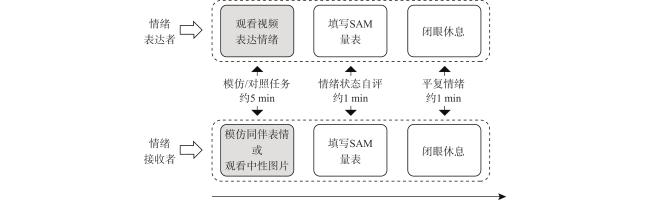
每对被试到达实验室后,面对面坐下,主试为两名被试佩戴生理测量装置后,开始正式实验。实验任务分为模仿任务和对照任务。在两种类型的实验任务中,情绪表达者的任务内容均为认真观看情绪视频,并在观看视频的过程中尽可能完整地展现出面部表情。播放情绪诱发视频的电脑仅朝向情绪表达者,视频的声音通过情绪表达者所佩戴的耳机播放。在模仿任务中,情绪接收者被要求对情绪表达者的面部表情进行模仿。根据Jennings等人(1992)的建议,对照任务应当满足低难度、保证注意唤起、避免情绪唤起等条件。因此,本研究的对照任务中,情绪接收者被要求集中注意观看一组中性表情图片。每完成一次模仿或对照任务,两名被试均需对自己当前的情绪状态进行自我报告,随后闭眼休息1分钟,开始下一个组块的任务,每个组块对应一种情绪视频,共计4个组块。每位被试均完成模仿任务和对照任务,每个任务中均包含积极情绪和消极情绪各1个组块。积极情绪和消极情绪、模仿任务和对照任务的先后顺序均在被试间采用拉丁方平衡,并且在两种情绪之间有2分钟的休息时间,以避免不同情绪之间的影响(实验流程参见图1 )。
2.5 生理数据采集与预处理
本实验采用美国BIOPAC公司生产的MP150多导生理记录仪EMG、ECG模块分别对面部肌电、心电信号进行采集,通过连接安装有AcqKnowledge4.0软件的电脑,对数据进行储存。测量肌电的电极贴片分别置于被试的面部颧肌(积极情绪)和额头皱眉肌(消极情绪),以判断情绪接收者是否对情绪表达者的面部表情进行了模仿。测量心电的电极贴片置于被试右侧前臂手腕上方以及双腿内侧脚踝上方。
对于心电数据,采用美国MindWare公司生产的HRV3.1.5软件对收集的ECG数据进行离线分析,将被试在每种实验条件下的ECG按照时间进行分段,每10 s为一段(每次任务约被分为30段),计算HR、SDNN数值。检查错误标记的R点,并进行手动修正,以获得更加准确的HR、SDNN值。分别计算各个实验条件下每对被试的心率(HR)和心率变异性(SDNN)的皮尔逊相关系数,使用Fisher-z转换进行标准化处理,作为心率同步性、心率变异同步性的指标。
3 结果
3.1 操纵性检验
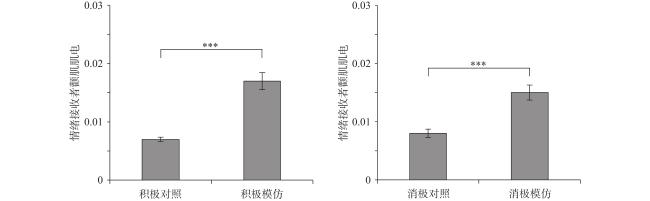
为了检验情绪接收者完成模仿任务的有效性,对情绪接收者在不同实验条件下的肌电水平进行差异检验。结果显示,情绪接收者在积极模仿条件(M=0.017, SD=0.008)下的颧肌肌电显著高于积极对照条件(M=0.007, SD=0.002),t(29)=7.17,p<0.001,Cohen’s d=2.66,在消极模仿条件(M=0.015, SD=0.007)下的皱眉肌肌电显著高于消极对照条件(M=0.008, SD=0.004),t(29)=6.38,p<0.001,Cohen’s d=2.37(图2 )。表明情绪接收者对情绪表达者的面部表情进行了相应模仿。
3.2 情绪感染的主观报告结果
为检验情绪表达者、情绪接收者主观情绪体验的相似性,为情绪感染提供主观报告层面的证据,分别对情绪表达者、情绪接收者的情绪愉悦度、唤醒度评分进行2(任务类型:模仿任务、对照任务)×2(情绪类型:积极情绪、消极情绪)的重复测量方差分析(图3 )。
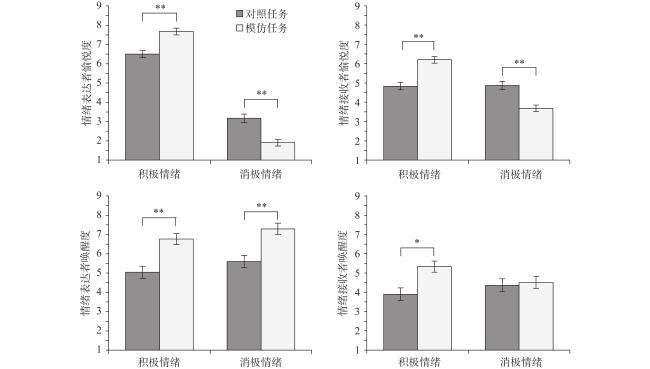
对于情绪表达者的愉悦度评分,任务类型和情绪类型的交互作用显著,F(1, 29)=43.89,p<0.001,η${_{\rm p}^2} $ =0.60,积极模仿条件下的愉悦度(M=7.67, SD=0.96)显著高于积极对照条件(M=6.50, SD=1.01),t(29)=3.19,p<0.01,Cohen’s d=1.19;消极模仿条件下的愉悦度(M=1.90, SD=0.92)显著低于消极对照条件(M=3.17, SD=1.18),t(29)=−3.23,p<0.01,Cohen’s d=−1.20。对于情绪接收者的愉悦度评分,任务类型和情绪类型的交互作用显著,F(1, 29)=56.13,p<0.001,η${_{\rm p}^2} $ =0.66,积极模仿条件下的愉悦度(M=6.20, SD=1.19)显著高于积极对照条件(M=4.83, SD=0.87),t(29)=3.54,p<0.01,Cohen’s d=1.31,消极模仿条件下的愉悦度(M=3.70, SD=1.15)显著低于消极对照条件(M=4.87, SD=0.94),t(29)=−2.99,p<0.01,Cohen’s d=−1.11。
对于情绪表达者的唤醒度评分,任务类型主效应显著,F(1, 29)=45.51,p<0.001,η${_{\rm p}^2} $ =0.61,模仿任务下的唤醒度(M=7.03, SD=1.57)显著高于对照任务(M=5.32, SD=1.75);情绪类型的主效应、任务类型和情绪类型的交互效应均不显著,Fs<3.40,ps>0.05。对于情绪接收者的唤醒度评分,任务类型的主效应显著,F(1, 29)=11.27,p<0.01,η${_{\rm p}^2} $ =0.28,模仿任务下的唤醒度(M=4.90, SD=1.68)显著高于对照任务(M=4.13, SD=1.82);任务类型和情绪类型的交互作用显著,F(1, 29)=11.27,p<0.01,η${_{\rm p}^2} $ =0.28,积极模仿任务条件下的唤醒度(M=5.30, SD=1.60)显著高于积极对照条件(M=3.90, SD=1.79),t(29)=2.21,p<0.05,Cohen’s d=0.82;消极模仿条件下的唤醒度与消极对照条件之间无显著差异。
对4种实验条件下的情绪表达者、情绪接收者的主观报告愉悦度、唤醒度分别进行相关分析发现,在积极模仿条件下,双方的愉悦度呈边缘显著正相关(r=0.33, p=0.072),唤醒度相关不显著(r=0.05, p=0.814);在消极模仿条件下,双方的愉悦度呈显著正相关(r=0.39, p<0.05),唤醒度相关不显著(r=0.08, p=0.689);积极对照、消极对照条件下,双方的愉悦度、唤醒度相关均不显著(ps>0.05)。
以上结果说明,模仿任务导致了情绪接收者在情绪愉悦度、唤醒度的变化,且情绪互动双方主观报告愉悦度之间存在显著正相关,为情绪感染提供了主观报告层面上的证据。
3.3 情绪感染的生理同步性结果
为探究由于模仿动态面孔表情是否会引起情绪表达者、情绪接收者间的心率(HR)同步性、心率变异性(SDNN)同步性,对互动双方的HR同步性、SDNN同步性指标分别进行2(任务类型:模仿任务、对照任务)×2(情绪类型:积极情绪、消极情绪)的重复测量方差分析(图4 )。
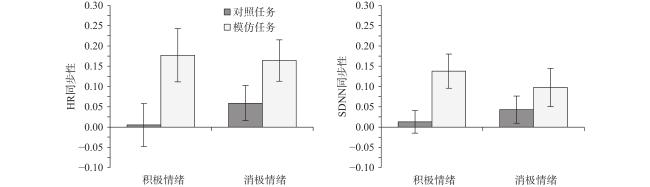
HR同步性分析结果表明,任务类型的主效应显著,F(1, 29)=7.94,p<0.01,η${_{\rm p}^2} $ =0.22,模仿任务中的HR同步性(M=0.17, SD=0.32)显著高于对照任务(M=0.03, SD=0.26),t(29)=1.30,p<0.05,Cohen’s d=0.48;情绪类型的主效应、情绪类型和任务类型的交互作用均不显著(Fs<0.16, ps>0.05)。SDNN同步性分析结果表明,任务类型的主效应显著,F(1, 29)=4.63,p<0.05,η${_{\rm p}^2} $ =0.14,模仿任务中的SDNN同步性(M=0.12, SD=0.24)显著高于对照任务(M=0.03, SD=0.17),t(29)=1.01,p<0.05,Cohen’s d=0.36;情绪类型的主效应、情绪类型和任务类型的交互效应均不显著(Fs<1.13, ps>0.05)。
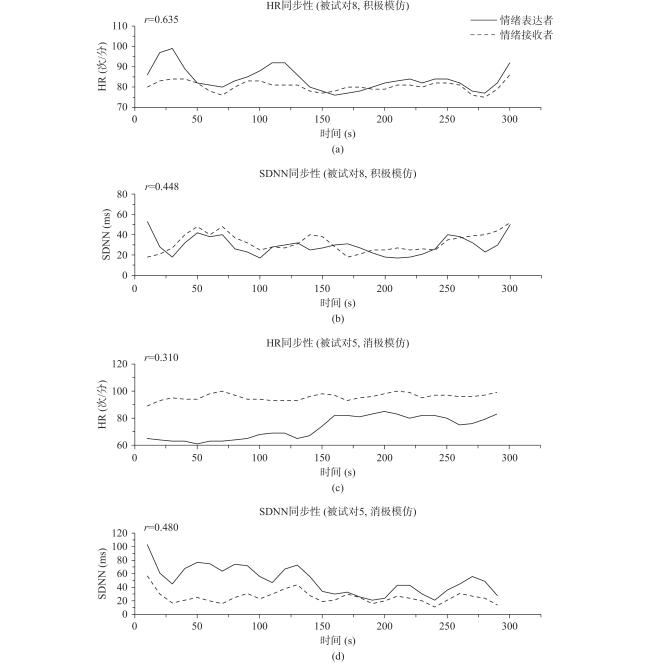
以上结果说明,在模仿任务中,情绪表达者、情绪接收者产生了更高的生理同步性(参见图5 ),情绪类型不影响双方在模仿任务中的生理同步性。


4 讨论
本研究发现,情绪接收者对情绪表达者动态面孔表情的模仿,能够导致情绪感染。在这一过程中,情绪表达者、情绪接收者间存在生理同步。本研究的结果扩展了前人(Park et al., 2019)以静态表情图片为材料引发情绪感染后发现的生理同步性结果,进一步证明了由模仿−反馈机制导致的情绪感染能够引起情绪表达者、情绪接收者生理活动间的同步性。相较于标准化的静态面部表情,动态面部表情与真实社会互动中的情绪感染更为相似(Zane et al., 2019)。因此,本研究的模仿任务操控能更加真实地反映日常生活中的情绪感染以及相关的生理同步性(Lin et al., 2024)。
作为衡量情绪状态的敏感指标,心率、心率变异性能够综合反映个体当前情绪的愉悦度与唤醒度。因此,情绪感染过程中的生理同步性不仅反映了情绪表达者、情绪接收者两个个体的生理信号在时间上的相互关联,更能够体现人际互动过程中的双方在情绪多个维度上的互相趋同(王丹 等, 2024; Woltering et al., 2015),为情绪感染的发生提供生理层面上的证据。外周神经生理活动上的同步往往能够促进双方关系的融洽与和谐(Bizzego et al., 2019; Golland et al., 2015)。因此,生理同步性不仅可以作为情绪感染发生的标志,同时也可能是情绪表达者、情绪接收者促进情感联系、保持良好关系的有效途径。相较于面部表情和主观体验的同步,生理同步性能够反映出情绪感染中的双方更加深入的交互,这有可能促进更加复杂的、与情绪相关的亲社会行为的发生(DiGiovanni et al., 2024; Shimshoc et al., 2025; Woltering et al., 2015)。
情绪表达者和情绪接收者在愉悦度上存在显著正相关,但在唤醒度上相关不显著,这可能是因为在本研究中,相比于情绪唤醒度,情绪愉悦度是情绪感染的一个更为灵敏的指标。另外,在情绪表达者和情绪接收者在消极情绪条件下的愉悦度为显著正相关,但在积极情绪条件下的愉悦度为边缘显著的正相关,这可能表明在陌生人之间,消极情绪感染发生的可能性比积极情绪感染更高,或者效果更好。近期的一项研究也表明消极情绪感染的强度高于积极情绪感染(Park et al., 2019)。这可能是由于负性偏向,或者由于消极情绪感染比积极情绪感染对于人类而言具有更强的生存意义和进化功能,个体需要更快地识别到周围他人所表现出的消极情绪,并发生消极情绪感染,其有助于个体回避危险、维系生存(Ito et al., 1998; Öhman & Mineka, 2001)。当然,本研究的样本量有限,每种类型的情绪感染也只有1个组块,因而本研究结果的解释力仍有很大局限性,这些结果有待未来研究进一步验证。
本研究的一个有趣的结果是发现任务类型(模仿任务vs.对照任务)对情绪表达者的愉悦度也产生了影响,即情绪表达者在积极模仿条件下的愉悦度高于积极对照条件下的愉悦度,消极模仿条件下的愉悦度低于消极对照条件下的愉悦度。研究推测这一结果可能是由于在模仿条件下,情绪表达者做出相应的情绪表情(积极或消极表情),情绪接收者接收到情绪表达者的表情后,会进一步增强情绪表达者的相应情绪感受,即情绪感染可能是情绪互动双方相互作用的。
本研究也存在一些不足。第一,本研究的生理指标仅关注了心率(HR)和心率变异性(SDNN),未关注其他生理指标,如呼吸变化、皮肤电活动等。第二,本研究仅测量了颧肌和皱眉肌两个部位的肌电活动,但动态表情涉及多肌肉群协同变化。第三,本研究的对照任务和模仿任务在注意力需求和任务复杂度上存在差异,未来研究需要进一步改进对照组的实验控制,进一步检验研究假设。
5 结论
本研究表明,对动态表情的模仿能够导致情绪感染,并在情绪表达者、情绪接收者之间引发生理同步,积极情绪或消极情绪类型不影响动态表情模仿情绪感染中的生理同步。