

1 引言
在日常生活和工作中,人们经常需要在不同的认知活动间转换,这一过程通常被称为任务转换(魏勇刚, 李红, 2005; Wu et al., 2022)。已有任务转换研究多采用1∶1线索−任务转换范式(简称1∶1范式)。在这种范式中,当前(N)试次与N−1试次的线索相同时任务重复,线索不同时任务转换。因此任务转换永远伴随线索变化,无法观察线索不变时单纯的任务转换过程。为了分离线索加工和任务转换的过程,研究者采用2∶1线索−任务转换范式(Logan & Bundesen, 2003; Mayr & Kliegl, 2003; Schmidt & Liefooghe, 2016)。在该范式中,两个线索对应一个任务,可以考察线索改变而任务重复的行为反应。Mayr和Kliegl使用此范式发现在重复试次中,线索改变试次的反应时明显长于线索不变试次,体现出线索不匹配代价。Schmidt和Liefooghe不仅发现了线索不匹配代价,还发现当控制了刺激与反应重复之后,纯粹的任务转换代价大大减少。因此研究者认为线索不匹配代价可能占据了转换代价的大部分比重。然而,在2∶1范式中,依然无法分离线索处理与任务转换,只要任务转换,线索必定发生改变。因此转换代价势必包括线索不匹配代价和任务转换代价两种成分。尽管Schmidt和Liefooghe试图比较任务转换与“线索改变−任务重复”的绩效差异,揭示纯粹的任务转换代价,但在他们的研究中,诱发任务转换的线索变化在本质上与“线索改变−任务重复”条件中的线索改变并不相同。前者是任务相关概念类别间的改变,而后者是概念类别内的改变。因此他们的“纯粹代价”并不纯粹,在任务重复与任务转换之间依然包含了不同的线索加工过程,至少包含了线索改变的知觉加工。为解决线索转换和任务转换的捆绑问题,Forstmann等(2005)采用了语义“转换”线索,如单词“转换”或“重复”指示的任务转换范式,当线索为“重复”单词时,被试重复前一试次的任务;当线索为“转换”单词时,被试执行另一个任务。这样的设计可以把线索和任务解绑,产生出线索不变任务转换的条件(Schneider & Logan, 2007)。但是,这种用词语线索指示的任务转换范式与传统的线索任务转换范式的认知过程明显不同:传统的线索任务转换中每个(或每两个)线索对应一个任务,被试可直接根据线索来提取任务相关的信息,而在语义“转换”线索任务转换中则需要被试记住上个试次执行的任务,再结合当前试次的线索指示的内容才可确定当前试次应该执行何种任务。因此,这种线索并非执行何种任务的线索,只是任务是否改变的指示。
关于转换代价的来源主要有惯性论(task-set inertia)(Allport et al., 1994)、任务设置重构论(task-set reconfiguration)(Rogers & Monsell, 1995)、刺激−反应联结竞争论(associative retrieval)(Wylie et al., 2003)几种解释。随着研究的不断深入,研究者发现转换代价可能是工作记忆更新、抑制控制、冲突监测和解决等多种认知控制过程共同作用的结果(付美玲 等, 2022)。任务转换(task switching)是研究认知控制的重要范式(史艺荃, 周晓琳, 2004),转换代价则是衡量这些认知控制过程的一个外显指标。如果这个指标不够纯粹,那么所反映的认知过程就不够纯粹。纵观任务转换范式各种变体发展的历史,其实也就是转换代价不断“提纯”的历史。
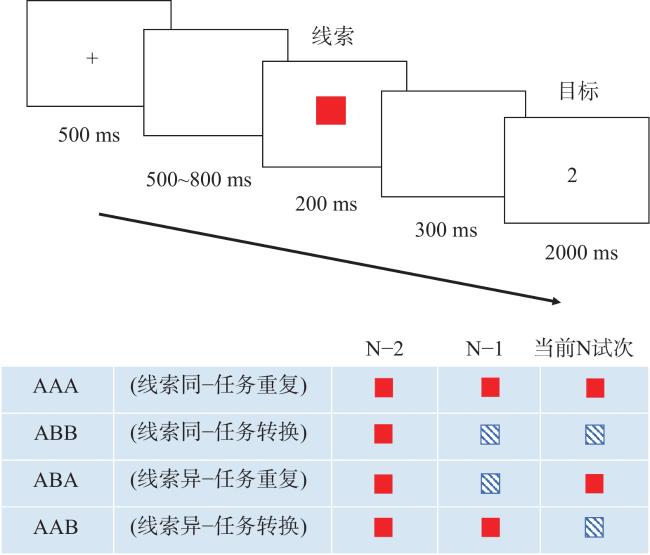
本研究的目的是在传统的1∶1范式基础上采用新的实验设计以分离线索变化与任务转换,考察不依赖于线索变化的任务转换代价。为实现此目标,本研究设计了连续线索匹配任务转换范式,通过三试次线索关联分离线索变化与任务转换效应。实验要求被试根据当前线索与前一试次线索的匹配性选择任务(匹配时执行大小判断,不匹配执行奇偶判断),需通过连续三试次线索判断任务状态。基于线索变化(匹配/不匹配)与任务转换(重复/转换)形成四类条件:(1)AAA:线索匹配−任务重复(三试次线索相同);(2)ABB:线索匹配−任务转换(后两个试次线索相同但任务不同);(3)ABA:线索不匹配−任务重复(当前与前一线索不同但任务相同);(4)AAB:线索不匹配−任务转换(后两个试次线索不同且任务不同)。该范式通过下划线标记N−1与N试次线索(如ABB),重点考察N试次任务转换独立于线索变化的转换代价。
本研究预期如下。第一,根据以往研究(Schmidt & Liefooghe, 2016)与线索变化情形下的任务转换代价(AAB与AAA之差)相比,线索不变情形下纯粹的任务转换的代价(ABB与AAA之差)可能略小。第二,ABB与AAB都是任务转换条件,但因为在ABB条件下,任务转换时没有伴随线索改变,而AAB条件下的任务转换伴随了线索改变。根据以往研究(Heikoop et al., 2016; Mayr & Kliegl, 2003),线索变化也会产生线索不匹配代价。因此,本研究期望与ABB相比,AAB的反应时更长,正确率更低。第三,在ABA条件下,尽管前后两试次的线索发生改变,但N试次的任务却与N−1试次的任务相同。与之相比,在AAB条件下,线索改变的同时任务也发生了转换。因此本研究预期与ABA相比,AAB的反应时更长,正确率更低。另外,以往研究表明线索与目标间的时间间隔(cue-target interval, CTI)的长短会影响任务转换代价(Rogers & Monsell, 1995; Schneider, 2016),体现主动性控制的作用,因此本研究预期在线索连续匹配任务中转换代价也会受到CTI长短的影响。
2 实验1:短间隔线索匹配任务转换
2.1 研究方法
2.1.1 被试
24名大学生被试(10名男生)参加本实验,平均年龄19.77±1.66岁。所有被试均为右利手,无精神病史,视力正常或矫正后正常,无色盲色弱。采用G*Power软件计算,设置效果量β$ = $ 0.25,Power为0.80,α水平为0.05,计算至少需要的被试样本量为24,因此实际样本量符合要求。被试参加实验前均签署知情同意书,并在实验完成后获得一定报酬。
2.1.2 实验材料与任务
线索刺激为红色或蓝色的方块。目标刺激为阿拉伯数字(1~9,5除外)。要求被试根据前后两个试次线索的异同对目标数字执行不同的任务(即对目标数字进行大小判断或奇偶判断)。如在某一组块中,告诉被试,如果N试次线索与N−1试次线索颜色相同,则对目标数字做大小判断(与5比较),如果不同则对目标数字做奇偶判断。所有材料均采用E-Prime 2.0呈现。
2.1.3 实验设计与程序
采用2(线索:匹配、不匹配)×2(任务:重复、转换)的被试内设计,即根据当前试次和N−1试次线索是否相同、任务是否转换,分为以下四种条件:(1)AAA,线索同−任务重复;(2)ABB,线索同−任务转换;(3)ABA,线索异−任务重复;(4)AAB,线索异−任务转换。因变量为反应时和正确率。
实验分为两个部分,第一部分刺激反应规则是“若当前试次线索与N−1试次线索匹配就做大小判断,若当N试次线索与N−1试次线索不匹配则做奇偶判断”,第二部分任务规则反之。正式实验共有800个试次,保证每种实验条件200±10试次。在被试间做按键平衡。
为了避免前规则对后规则带来的认知冲突,实验两部分之间给被试充分的休息时间。并且每部分的正式实验前,都有一个规则学习测试程序,正确率达到90%以上,被试才能进入正式实验阶段。对于规则顺序在被试间做平衡,一半被试先做规则1(相同大小判断,不同奇偶判断),另一半被试先做规则2(相同奇偶判断,不同大小判断)。
一个试次的程序如图1 所示。首先呈现注视点“+”500 ms,之后跟随一个500~800 ms的空屏,而后呈现线索。线索呈现200 ms之后跟随一个300 ms的空屏。然后呈现目标数字2000 ms。要求被试根据N试次线索颜色与N−1试次线索颜色是否相同对目标数字做大小判断或奇偶判断。
2.1.4 数据记录与分析
使用E-Prime 2.0软件呈现刺激并收集数据。分析反应时之前剔除错误试次以及错误试次后一个试次,同时剔除单个被试平均反应时±3个标准差以外的数据。计算所有试次正确率数据。使用SPSS 22.0软件对有效数据进行分析。
2.2 结果
各条件的反应时和正确率如图2 所示。对反应时进行2(线索:匹配、不匹配)×2(任务:重复、转换)重复测量方差分析,结果显示,线索主效应显著,F(1, 23)=69.51,p<0.001,η$ {}_{\mathrm{p}}^{2} $ =0.75,即线索匹配条件下的反应时快于线索不匹配条件;任务主效应显著,F(1, 23)=35.34,p<0.001,η$ {}_{\mathrm{p}}^{2} $ =0.61,即任务重复条件的反应时快于任务转换条件。线索和任务的交互作用显著,F(1, 23)=138.19,p<0.001,η$ {}_{\mathrm{p}}^{2} $ =0.86。简单效应分析发现,在线索匹配条件下,任务转换(ABB)比任务重复(AAA)的反应时更长(p<0.001);在线索不匹配条件下,任务转换(AAB)和任务重复(ABA)的反应时无显著差异(p=0.518)。在任务重复条件下,线索不匹配(ABA)比线索匹配(AAA)的反应时更长(p<0.001)。在任务转换条件下,线索匹配(ABB)和线索不匹配(AAB)的反应时无显著差异(p=0.217)。
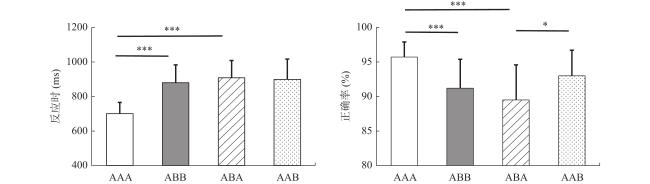
对正确率进行2(线索:匹配、不匹配)×2(任务:重复、转换)重复测量方差分析,结果显示,线索主效应显著,F(1, 23)=18.59,p<0.001,η$ {}_{\mathrm{p}}^{2} $ =0.45,即线索匹配条件下的正确率高于线索不匹配条件;任务主效应显著,F(1, 23)=13.44,p<0.001,η$ {}_{\mathrm{p}}^{2} $ =0.37,即任务重复条件下的正确率高于任务转换条件。线索和任务的交互作用显著,F(1, 23)=37.35,p<0.001,η$ {}_{\mathrm{p}}^{2} $ =0.62。简单效应分析发现,在线索匹配条件下,任务转换(ABB)比任务重复(AAA)的正确率更低(p<0.001);在线索不匹配条件下,任务转换(AAB)比任务重复(ABA)的正确率更高(p=0.015)。在任务重复条件下,线索匹配(AAA)比线索不匹配(ABA)的正确率更高(p<0.001)。在任务转换条件下,线索匹配(ABB)和线索不匹配(AAB)的正确率无显著差异(p=0.174)。
2.3 讨论
实验1采用连续线索匹配的任务转换范式,考察线索匹配对任务转换的影响。线索同−任务重复条件(AAA)可视为已有1∶1范式中的任务重复条件,线索异−任务转换条件(AAB)即为1∶1范式中的任务转换条件。实验1的结果表明,无论反应时还是正确率,AAB相比 AAA的表现都更差,表现出典型的转换代价,这与已有研究结论一致(Allport et al., 1994)。另外,任务转换条件下,AAB的反应时比ABB的反应时略高(20 ms),反映了线索不匹配代价(Heikoop et al., 2016; Mayr & Kliegl, 2003)。对比AAA与ABB这两个条件,线索相同,AAA为任务重复,ABB为任务转换。两条件的差异为线索匹配下的任务转换。结果表明,无论是反应时还是正确率,在线索匹配条件下,仅由任务转换引发的“纯粹”的转换代价是存在的,其反应时转换代价为179 ms,正确率转换代价为5.3%。这一结果揭示了不依赖线索变化的任务转换代价。对比AAA与AAB这两个条件的反应时和正确率,二者反应时转换代价为199 ms,略大于AAA与ABB间的反应时之差,可能反映了额外的线索不匹配代价。然而,实验1在正确率上并未出现这一额外的线索不匹配代价,因为AAB的正确率比ABB略高。由此,实验1表明,从反应时来看,线索不匹配代价(20 ms)远远小于不依赖于线索变化的纯粹的任务转换代价(179 ms)。出乎意料的是,实验1发现了线索匹配与任务转换的交互作用。从反应时来看,在线索匹配的情况下,出现了明显的任务转换代价,但在线索不匹配的情况下,转换代价消失,且任务重复(ABA)的反应时比任务转换(AAB)略长(9 ms)。从正确率来看,也有类似的结果,即在线索匹配条件下存在明显的任务转换代价,但在线索不匹配条件下,任务重复的错误率竟然比任务转换的错误率更高,即出现了转换代价的反转。这一转换代价的反转与已有研究不一致,也与本研究预期相悖。
实验1的意外结果可能源于较短的CTI,即被试对复杂线索加工不充分导致对线索加工的主动性控制不足,进而导致不匹配条件下转换代价消失。如果将CTI时间延长,让被试有较充分的时间处理线索匹配的问题,实验1中的意外结果是否不再出现?另外,延长CTI后,被试有更多的时间对新任务进行准备,那么线索知觉不匹配代价和纯粹的任务转换代价是否都会变小?实验2将通过增长CTI来回答这些问题。
3 实验2:长间隔线索匹配任务转换
3.1 研究方法
3.1.1 被试
24名大学生(13名男生)参加实验,平均年龄20.13±1.45岁。被试筛选标准同实验1。
3.1.2 实验设计、材料与流程
与实验1相同,CTI由300 ms延长为1000 ms。
3.2 结果
各条件的平均反应时和正确率如图3 所示。对反应时进行2(线索:匹配、不匹配)×2(任务:重复、转换)重复测量方差分析。结果显示,线索主效应显著,F(1, 23)=27.57,p<0.001,η$ {}_{\mathrm{p}}^{2} $ =0.55,即线索匹配条件下的反应时快于线索不匹配条件;任务主效应显著,F(1, 23)=13.01,p<0.001,η$ {}_{\mathrm{p}}^{2} $ =0.36,即任务重复条件下的反应时快于任务转换条件,转换代价为43 ms。线索和任务的交互作用显著,F(1, 23)=44.47,p<0.001,η$ {}_{\mathrm{p}}^{2} $ =0.66。简单效应分析发现,在线索匹配条件下,任务转换(ABB)比任务重复(AAA)的反应时更长(p<0.001);在线索不匹配条件下,任务转换(AAB)和任务重复(ABA)的反应时无显著差异(p=0.432)。在任务重复条件下,线索不匹配(ABA)比线索匹配(AAA)的反应时更长(p<0.001)。在任务转换条件下,线索匹配(ABB)和线索不匹配(AAB)的反应时无显著差异(p=0.715)。
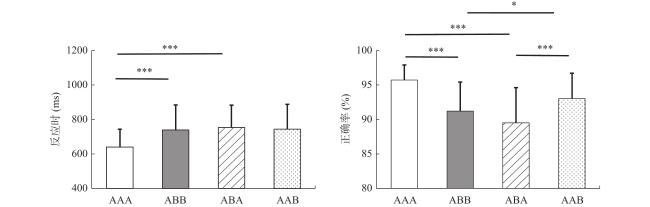


对正确率进行2(线索:匹配、不匹配)×2(任务:重复、转换)重复测量方差分析。结果显示,线索主效应显著,F(1, 23)=11.81,p=0.002,η$ {}_{\mathrm{p}}^{2} $ =0.34,即线索匹配条件的正确率高于线索不匹配条件;任务主效应不显著。线索和任务的交互作用显著,F(1, 23)=72.51,p<0.001,η$ {}_{\mathrm{p}}^{2} $ =0.76。简单效应分析发现,在线索匹配条件下,任务转换(ABB)比任务重复(AAA)的正确率更低(p<0.001);在线索不匹配条件下,任务重复(ABA)却比任务转换(AAB)的正确率低(p<0.001)。在任务重复条件下,线索不匹配(ABA)比线索匹配(AAA)的正确率更低(p<0.001);在任务转换条件下,线索不匹配(AAB)的正确率比线索匹配(ABB)更高(p=0.022)。
3.3 讨论
与实验1的结果相比,延长CTI后使得实验2平均反应时减少,平均正确率提高。延长CTI也导致转换代价减小,如AAB与AAA间的反应时差异由实验1的199 ms减少至实验2的103 ms。这一结果与已有结论一致(Kiesel et al., 2010; Meiran, 1996, 2000)。需要注意的是,相比实验1,实验2转换代价的减小体现于线索不匹配代价与线索匹配的任务转换代价。前者由实验1的20 ms减少至实验2的5 ms;后者由实验1的179 ms减少至实验2的98 ms。
延长CTI后依然出现了和实验1几乎相同的线索匹配与任务转换的交互作用。从反应时来看,在线索匹配条件下存在显著的转换代价,但在线索不匹配条件下转换代价消失。从正确率来看,也有类似的结果,即在线索匹配条件下存在显著的任务转换代价,但在线索不匹配条件下,任务转换的正确率竟然显著高于任务重复的正确率。这说明并非是CTI较短,被试对线索加工不充分导致任务转换代价的消失或反转。
此外,在实验1中,AAB与ABB的正确率并无显著差异,尽管后者的正确率略低。然而,实验2出人意料地发现AAB与ABB之间正确率存在显著差异。AAB与ABB都是任务转换条件,区别是AAB是线索不匹配的任务转换,而ABB是线索匹配的任务转换。根据以往研究结论,线索不匹配时会诱发额外的代价(Mayr & Kliegl, 2003),本研究预期AAB的正确率应该低于ABB,但实验2的正确率结果发现AAB的正确率明显高于ABB。可能的原因是当线索不匹配时,被试更倾向做出任务转换的任务准备,而在线索匹配时,被试在做出任务转换的准备时更容易失误。换言之,被试将线索与任务进行了关联性的整体加工,线索变化(即不匹配)则产生任务转换的预期,线索匹配则可能产生任务不变的预期。
总之,实验1与实验2的结果表明,无论线索加工的时间长或短,前后两试次的线索匹配情况所形成的抽象关系(即相同与不同)都会影响任务转换代价,在线索匹配时出现了经典的任务转换代价,但线索不匹配时转换代价消失甚至反转。
4 总讨论
已有研究多采用2∶1范式将线索处理过程和任务转换过程分离(Logan & Bundesen, 2003; Mayr & Kliegl, 2003)。此类范式的研究表明线索匹配的过程对任务转换代价具有重要作用,线索不匹配时会产生不匹配代价(Bindra et al., 1965; Rabbitt & Vyas, 1974; Schmidt & Liefooghe, 2016)。但是,当任务转换时,线索一定发生变化。因此,在2∶1范式中依然无法考察完全不依赖于线索变化的任务转换。采用“转换”线索(如单词“转换”)看似可以把线索变化过程和任务转换过程彻底解绑,但词语线索只指示任务是否发生改变,并不能确定当前试次应该执行何种任务,导致在加工线索时需要在工作记忆中提取上一试次执行的任务类型,最终导致这一范式下的转换代价明显大于传统的线索任务转换范式的转换代价(van Loy et al., 2010)。
本研究在传统的1∶1范式的基础上采用复杂的抽象线索,即前后两试次的线索刺激的知觉异同作为任务选择的依据。在两个实验中,本研究将N试次线索和N−1试次线索的关系(匹配或不匹配)作为不同任务的线索,则可以形成一种特殊的实验条件,即线索匹配但任务发生转换(如ABB)。以此将线索变化(即不匹配)引发的代价分离出来。在两个实验中,本研究发现了AAA和ABB之间的绩效差异,揭示了纯粹的任务转换代价,而且从转换代价的大小来看,三个实验中纯粹的任务转换代价与一般的任务转换(即线索变化前提下的任务转换)代价相当,这表明,尽管前后两试次的线索匹配结果是任务选择的依据,但线索不匹配的代价微乎其微。与2∶1范式相比,本研究中线索不匹配代价在整个转换代价中所占比重如此小可能是由于本实验采用的范式需要回忆N−1试次的线索,并根据规则决定N试次采用什么任务。所需的认知过程较复杂,因而线索不匹配代价在其中所占比重较小。
尽管线索不匹配代价的绝对值较小,但其对任务转换的影响却十分明显。两个实验均出现了线索匹配与任务转换的交互作用。具体来说,如果N试次的线索与N−1试次的线索相同,任务转换比任务重复的反应时更长,正确率更低。这与经典的任务转换实验结果一致。但是在前后两试次线索不匹配的情况下,任务重复(ABA)竟然比任务转换(AAB)的反应时更长。正确率的结果也出现相同模式。两个实验一致表明,在线索不匹配的条件下,任务转换比任务重复的正确率更高。这一结果出乎研究者预料,也与经典的任务转换的研究结论不一致(Allport et al., 1994; Han et al., 2019; Li et al., 2019; Rogert & Monsell, 1995)。一种可能的解释是线索知觉失匹配假说,即在ABA条件下虽然任务是重复的,但连续出现了两次线索不匹配,这一线索连续不匹配的代价可能远大于任务转换的代价。这一解释与Schmidt和Liefooghe(2016)的观点一致,他们的实验也发现线索不匹配代价(152 ms)大于任务转换代价(121 ms)。
另一种可能的解释是ABA条件下线索不匹配但N试次的任务却与N−1试次相同,这就造成了内部认知冲突。这一认知冲突可能导致其反应变慢,正确率变低。内部认知冲突假说也可以解释实验2中AAB与ABB之间的正确率差异。在ABB条件下,前后两试次线索保持不变,被试可能预期任务也不会转变。但实际要求却是转换任务,这与被试的预期不符,导致被试难以做出转换任务的决定,从而导致ABB的正确率比AAB更低。这种基于预期的内部认知冲突的解释与刺激−反应联结竞争论一致(Abrahamse et al., 2016; Schmidt & Liefooghe, 2016; Wylie et al., 2003)。该理论强调联结学习的作用。在ABA条件下,无论是线索还是任务都需要考虑前后两试次。线索加工的结果是“不同”,但任务却是“相同”。这两种信息产生的冲突影响工作记忆对任务相关信息的提取,从而导致反应变慢。
线索匹配与任务转换预期的认知冲突也表明个体在线索任务切换中对线索与任务采用了整体关联性加工的认知策略,即个体倾向于将线索与任务作为相互关联的任务集(Allport et al., 1994; Wu et al., 2022)。这一整体关联加工的假说也可以解释实验2关于AAB与ABB这两个条件间的正确率差异。AAB与ABB都是任务转换条件,区别是AAB是线索不匹配的任务转换,而ABB是线索匹配的任务转换。线索不匹配时(线索变化但任务重复)会引发线索不匹配代价,因此可预期AAB的正确率低于ABB,但实验2的结果却发现AAB的正确率反而明显高于ABB的正确率。可能的原因是当线索不匹配时,被试更倾向做出任务转换的任务准备,而在线索匹配时,被试在做出任务转换的准备时更容易失误。换言之,被试将线索与任务进行了关联性的整体加工,即线索变化则倾向于预期任务转换,线索匹配则倾向于预期任务不变。
另外,本研究发现延长CTI使得转换代价显著减少(Meiran, 2000),验证了Rogers和Monsell(1995)提出的任务转换重构理论,即转换比重复多了任务设置重构过程,当CTI延长后,重构时间充足,从而导致转换代价减小。该理论强调自上而下的认知控制在任务转换过程中的作用,其主要观点认为任务转换需要进行内源性的自上而下的控制,包括注意转移,提取任务目的和规则到工作记忆中以改变反应规则等,即抑制之前的任务设置和激活当前的任务设置(付美玲 等, 2022)。然而,需要注意的是,本研究发现延长CTI并没有影响到线索匹配对任务转换的交互作用。这表明,CTI长短所带来的主动性控制的变化虽然会改变任务转换的代价,但这仅仅限于线索匹配的前提下,线索不匹配时的任务转换并不受CTI影响。
尽管本研究首次采用复杂抽象线索将线索加工与任务转换进行分离,考察了线索加工在任务转换中的作用,发现了线索与任务加工的关联整体性效应,证明了代表主动性控制的预期在任务转换中的作用,但本研究也存在如下局限。第一,本研究采用的线索连续匹配的任务转换范式建立于前后两试次的线索知觉比较的基础上,知觉比较的过程与不同结果对任务目标的选择与转换究竟有何影响并不清楚。第二,本研究仅从行为指标(如反应时与正确率)考察了线索连续匹配对任务转换的影响,虽然发现了线索加工与任务转换的交互作用,但产生这一交互作用的神经机制并不清楚,后续的研究可结合脑电、功能磁共振成像等技术手段获得更多指标,探索复杂线索加工指引的任务转换的脑机制。
5 结论
本研究采用连续线索匹配任务范式成功地分离了线索加工和任务转换,得出以下结论。第一,首次发现了不依赖于线索变化的“纯粹”转换代价。第二,无论是任务重复还是任务转换,都存在线索不匹配代价。但和“纯粹”的任务转换代价相比,线索不匹配代价非常小。第三,发现线索匹配与任务转换的交互作用。在线索匹配时,无论是反应时还是正确率,转换代价的模式都与已有研究一致;但在线索不匹配时,反应时转换代价消失,正确率转换代价反转,这可能与线索连续不匹配代价有关,也可能与基于线索预期而产生的“内部认知冲突”有关。