
心理与行为研究 ›› 2024, Vol. 22 ›› Issue (5): 713-720.DOI: 10.12139/j.1672-0628.2024.05.018
• 应用心理学 • 上一篇
杭宁1, 管健*,2( )
)
收稿日期:2024-02-08
出版日期:2024-09-20
发布日期:2024-09-20
通讯作者:
管健
基金资助:
Ning HANG1, Jian GUAN*,2()
Received:2024-02-08
Online:2024-09-20
Published:2024-09-20
Contact:
Jian GUAN
摘要:
再分类模型在认知一致性的基础上,探讨当个体的群体身份发生变化时,新身份融入自我形成群体认同,影响群体态度的过程。该模型将自我、属性、旧群体身份、新群体身份四者放入一个关系框架,系统阐释了自我与共享属性的群体如何通过认知一致性原则产生联结,进而形成自我概念、群体刻板印象和群体认同。当群体身份变换后,对新身份的认同程度以及新旧群体之间的群际态度取决于群体相容性水平。该模型拓展了多重身份认同研究范畴,将单一再分类、双重再分类拓展到身份转变再分类,为减少群际偏见提供了新的实践路径,有助于促进和谐群际关系。今后研究应提供更多群体身份变换有效性的实证证据,丰富身份转变再分类的边界条件。
杭宁, 管健. 群体身份变换对群体认同、群际态度的影响:基于认知一致性的再分类模型[J]. 心理与行为研究, 2024, 22(5): 713-720.
Ning HANG, Jian GUAN. The Impact of Group Identity Shifting on Group Identity and Intergroup Attitudes: A Recategorization Model Based on Cognitive Consistency[J]. Studies of Psychology and Behavior, 2024, 22(5): 713-720.
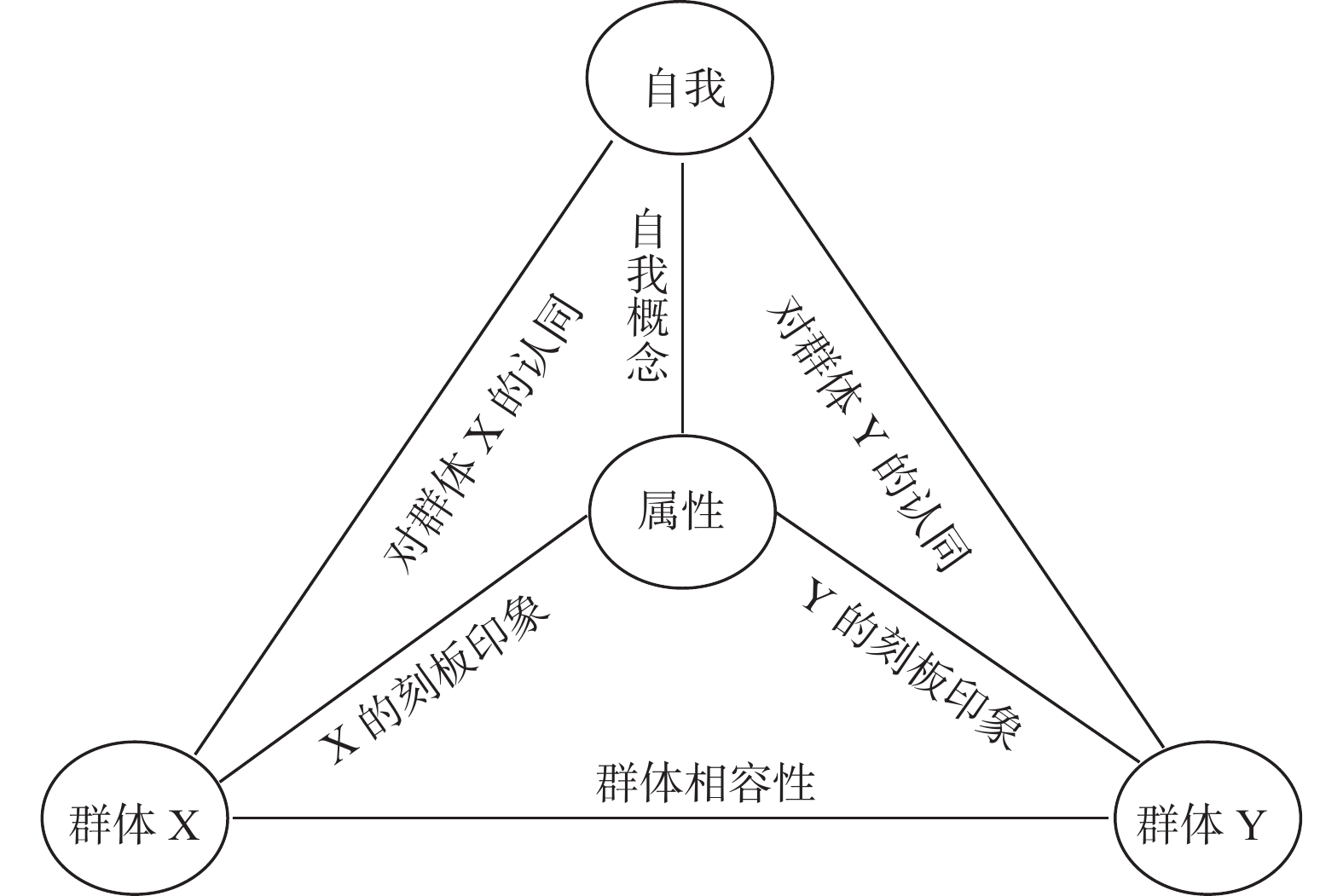
图1 基于认知一致性的再分类模型(Roth et al., 2018)
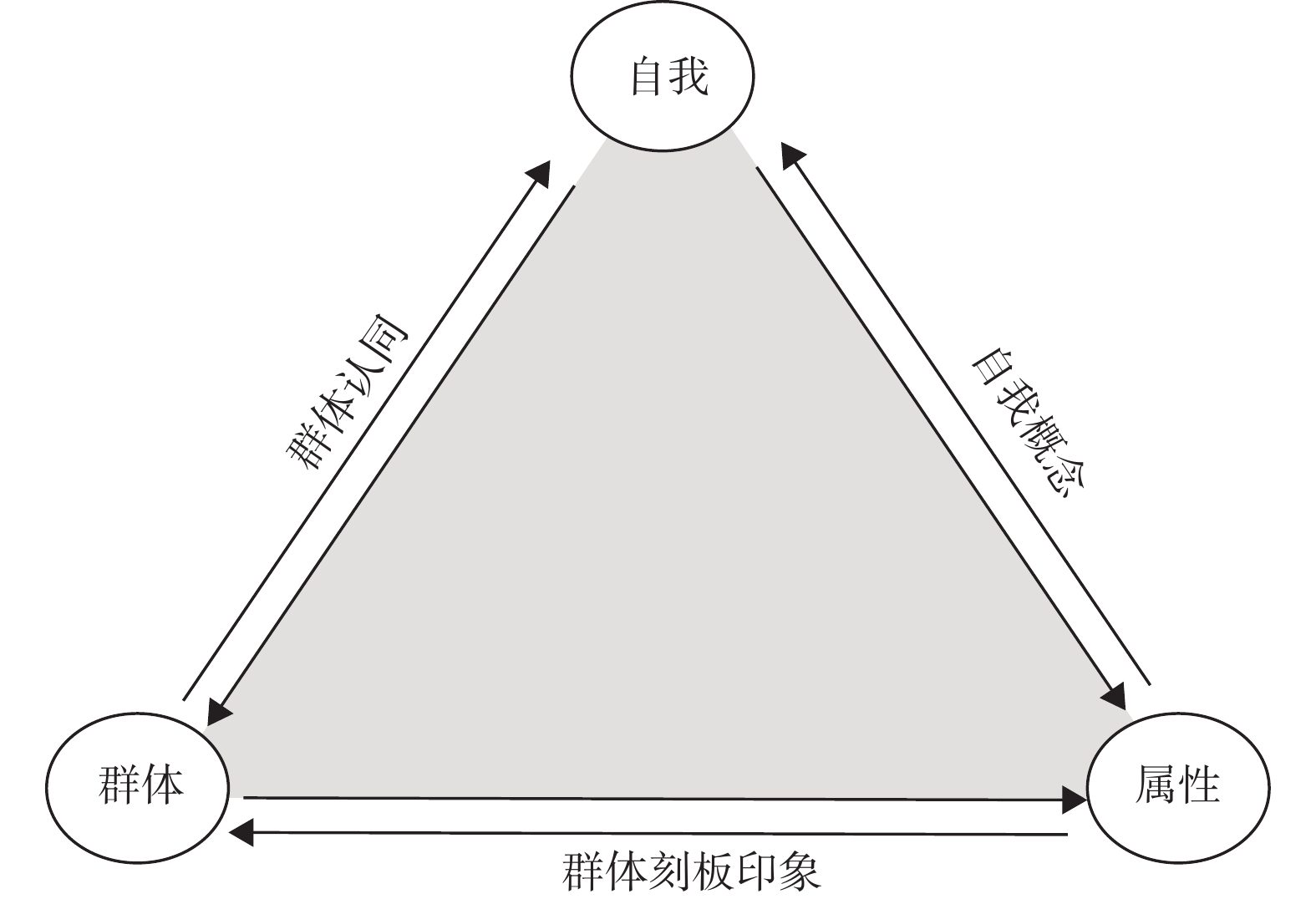
图2 基于认知一致性的再分类模型中自我、群体、属性的联结
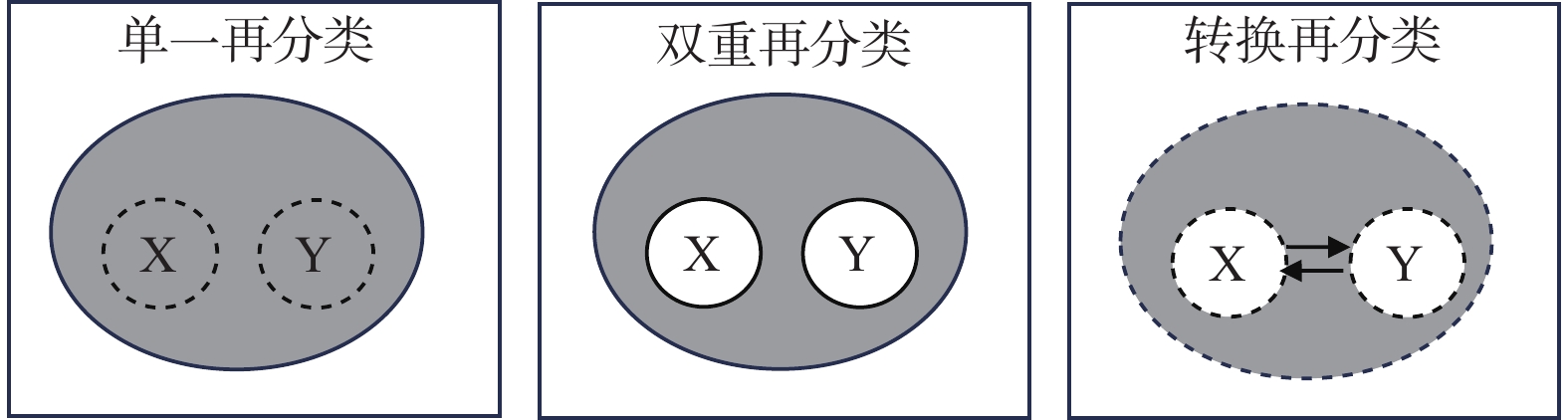
图3 群体相容的三种方式
|
贾磊, 罗俊龙, 肖宵, 张庆林. 刻板印象的认知神经机制. 心理科学进展, 2010, 18 (12): 1909- 1918.
|
|
|
凯歌. (2020). 经济生活变迁与职业身份转换问题研究——以明花乡裕固族社区为例(硕士学位论文). 西北民族大学, 兰州.
|
|
|
温芳芳, 柯文琳, 何赛飞, 佐斌, 李兰心, 马书瀚, 王晶. 群体身份变换性对老年人印象更新的影响: 共同内群体认同的中介作用. 心理学报, 2022, 54 (9): 1059- 1075.
|
|
|
温芳芳, 佐斌. 最简群体范式的操作、心理机制及新应用. 心理科学, 2018, 41 (3): 713- 719.
|
|
|
向洲, 严磊, 张艳红, 胡修银, 吴博文, 陈婉仪, … 杨林川. 社会认同形成的认知过程: 社会认同整合模型. 心理技术与应用, 2020, 8 (7): 431- 439.
|
|
|
严磊, 佐斌, 张艳红, 吴漾, 杨林川. 交叉分类及其对刻板印象的影响. 心理科学进展, 2018, 26 (7): 1272- 1283.
|
|
|
Amiot, C. E., de la Sablonniere, R., Smith, L. G. E., & Smith, J. R. Capturing changes in social identities over time and how they become part of the self-concept. Social and Personality Psychology Compass, 2015, 9 (4): 171- 187.
DOI |
|
|
Amiot, C. E., de la Sablonniere, R., Terry, D. J., & Smith, J. R. Integration of social identities in the self: Toward a cognitive-developmental model. Personality and Social Psychology Review, 2007, 11 (4): 364- 388.
DOI |
|
|
Benet-Martínez, V. (2012). Multiculturalism: Cultural, social, and personality processes. In K. Deaux & M. Snyder (Eds.), The Oxford handbook of personality and social psychology (pp. 623–648). Oxford: Oxford University Press.
|
|
|
Benet-Martínez, V., & Haritatos, J. Bicultural identity integration (BII): Components and psychosocial antecedents. Journal of Personality, 2005, 73 (4): 1015- 1050.
DOI |
|
|
Bliuc, A. M., McGarty, C., Reynolds, K., & Muntele, D. Opinion-based group membership as a predictor of commitment to political action. European Journal of Social Psychology, 2007, 37 (1): 19- 32.
DOI |
|
|
Čehajić-Clancy, S., Janković, A., Opačin, N., & Bilewicz, M. The process of becoming ‘we’ in an intergroup conflict context: How enhancing intergroup moral similarities leads to common-ingroup identity. British Journal of Social Psychology, 2023, 62 (3): 1251- 1270.
DOI |
|
|
Cheng, C. Y., & Lee, F. Multiracial identity integration: Perceptions of conflict and distance among multiracial individuals. Journal of Social Issues, 2009, 65 (1): 51- 68.
DOI |
|
|
Cikara, M., & van Bavel, J. J. The neuroscience of intergroup relations: An integrative review. Perspectives on Psychological Science, 2014, 9 (3): 245- 274.
DOI |
|
|
Clement, R. W., & Krueger, J. Social categorization moderates social projection. Journal of Experimental Social Psychology, 2002, 38 (3): 219- 231.
DOI |
|
|
Cocco, V. M., Vezzali, L., Kola-Daisi, T. I., & Çakal, H. The role of common ingroup identity in promoting social change among tribes in Nigeria. Group Processes & Intergroup Relations, 2023, 27 (1): 142- 157.
|
|
|
Crisp, R. J., & Beck, S. R. Reducing intergroup bias: The moderating role of ingroup identification. Group Processes & Intergroup Relations, 2005, 8 (2): 173- 185.
|
|
|
Davies, K., Tropp, L. R., Aron, A., Pettigrew, T. F., & Wright, S. C. Cross-group friendships and intergroup attitudes: A meta-analytic review. Personality and Social Psychology Review, 2011, 15 (4): 332- 351.
DOI |
|
|
Dovidio, J. F., & Gaertner, S. L. (2010). Intergroup bias. In S. T. Fiske, D. T. Gilbert, & G. Lindzey (Eds.), Handbook of social psychology (5th ed., pp. 1084–1121). Hoboken, NJ: John Wiley & Sons.
|
|
|
Eckel, C. C., Wilson, R. K., & Youn, S. In-group favoritism in natural and minimal groups. Economics Letters, 2022, 219, 110794.
DOI |
|
|
Goldenberg, A., Sweeny, T. D., Shpigel, E., & Gross, J. J. Is this my group or not? The role of ensemble coding of emotional expressions in group categorization. Journal of Experimental Psychology: General, 2020, 149 (3): 445- 460.
DOI |
|
|
Gonzalez-Saenz de Tejada, M., Bilbao, A., Baré, M., Briones, E., Sarasqueta, C., Quintana, J. M., … CARESS-CCR Group. Association between social support, functional status, and change in health-related quality of life and changes in anxiety and depression in colorectal cancer patients. Psycho-Oncology, 2017, 26 (9): 1263- 1269.
DOI |
|
|
Greenwald, A. G., Banaji, M. R., Rudman, L. A., Farnham, S. D., Nosek, B. A., & Mellott, D. S. A unified theory of implicit attitudes, stereotypes, self-esteem, and self-concept. Psychological Review, 2002, 109 (1): 3- 25.
DOI |
|
|
Hogg, M. A., Abrams, D., Otten, S., & Hinkle, S. The social identity perspective: Intergroup relations, self-conception, and small groups. Small Group Research, 2004, 35 (3): 246- 276.
DOI |
|
|
Husnu, S., & Crisp, R. J. Elaboration enhances the imagined contact effect. Journal of Experimental Social Psychology, 2010, 46 (6): 943- 950.
DOI |
|
|
Jackson, R. L. Cultural contracts theory: Toward an understanding of identity negotiation. Communication Quarterly, 2002, 50 (3–4): 359- 367.
DOI |
|
|
Jetten, J., & Hutchison, P. When groups have a lot to lose: Historical continuity enhances resistance to a merger. European Journal of Social Psychology, 2011, 41 (3): 335- 343.
DOI |
|
|
Jones, J. M., & Jetten, J. Recovering from strain and enduring pain: Multiple group memberships promote resilience in the face of physical challenges. Social Psychological and Personality Science, 2011, 2 (3): 239- 244.
DOI |
|
|
Kawakami, K., Amodio, D. M., & Hugenberg, K. (2017). Intergroup perception and cognition: An integrative framework for understanding the causes and consequences of social categorization. In J. M. Olson (Ed.), Advances in experimental social psychology (Vol. 55, pp. 1–80). New York: Academic Press.
|
|
|
Li, S. X. (2020). Group identity, ingroup favoritism, and discrimination. In K. F. Zimmermann (Ed.), Handbook of labor, human resources and population economics (pp. 1–28). Cham, Switzerland: Springer.
|
|
|
Libby, L. K., Shaeffer, E. M., Eibach, R. P., & Slemmer, J. A. Picture yourself at the polls: Visual perspective in mental imagery affects self-perception and behavior. Psychological Science, 2007, 18 (3): 199- 203.
DOI |
|
|
Livingstone, A. G., Windeatt, S., Nesbitt, L., Kerry, J., Barr, S. A., Ashman, L., … Wu, J. C. Do you get us? A multi-experiment, meta-analytic test of the effect of felt understanding in intergroup relations. Journal of Experimental Social Psychology, 2020, 91, 104028.
DOI |
|
|
Loughnane, J. (2024). A cognitive consistency approach to understanding multiple group identification and intergroup attitudes (Unpublished doctorial dissertation). University of Limerick, Ireland.
|
|
|
Loughnane, J., Roth, J., Rauner, M., & Strack, F. From student to employee: Group compatibility predicts group identification and intergroup attitudes. Identity, 2021, 21 (2): 131- 143.
DOI |
|
|
Loughnane, J., Roth, J., & van Tilburg, W. A cognitive balance approach to understanding intergroup attitudes in post-Brexit Northern Ireland. British Journal of Social Psychology, 2023, 62 (4): 1798- 1816.
DOI |
|
|
Matschke, C., & Fehr, J. Does identity incompatibility lead to disidentification? Internal motivation to be a group member acts as buffer for sojourners from independent cultures, Whereas external motivation acts as buffer for sojourners from interdependent cultures. Frontiers in Psychology, 2017, 8, 335.
|
|
|
Morris, R. C. Identity salience and identity importance in identity theory. Current Research in Social Psychology, 2013, 21 (8): 23- 36.
|
|
|
Moss, S. M. “Country first, politics later” reasons for dual recategorization in Zanzibari narratives. Peace and Conflict: Journal of Peace Psychology, 2016, 22 (4): 318- 328.
DOI |
|
|
Otten, S., & Epstude, K. Overlapping mental representations of self, ingroup, and outgroup: Unraveling self-stereotyping and self-anchoring. Personality and Social Psychology Bulletin, 2006, 32 (7): 957- 969.
DOI |
|
|
Otten, S., & Moskowitz, G. B. Evidence for implicit evaluative in-group bias: Affect-biased spontaneous trait inference in a minimal group paradigm. Journal of Experimental Social Psychology, 2000, 36 (1): 77- 89.
DOI |
|
|
Oyserman, D., Lewis, N. A., Yan, V. X., Fisher, O., O’Donnell, S. C., & Horowitz, E. An identity-based motivation framework for self-regulation. Psychological Inquiry, 2017, 28 (2–3): 139- 147.
DOI |
|
|
Roth, J., Steffens, M. C., & Vignoles, V. L. Group membership, group change, and intergroup attitudes: A recategorization model based on cognitive consistency principles. Frontiers in Psychology, 2018, 9, 479.
DOI |
|
|
Sanchez, A. K., Zogmaister, C., & Arcuri, L. When “they” becomes “we”: Multiple contrasting identities in mixed status groups. Self and Identity, 2007, 6 (2–3): 154- 172.
DOI |
|
|
Sassenberg, K., & Matschke, C. The impact of exchange programs on the integration of the hostgroup into the self-concept. European Journal of Social Psychology, 2010, 40 (1): 148- 159.
DOI |
|
|
Sassenberg, K., & Wieber, F. Don’t ignore the other half: The impact of ingroup identification on implicit measures of prejudice. European Journal of Social Psychology, 2005, 35 (5): 621- 632.
DOI |
|
|
Sherif, M., & Sherif, C. W. (1953). Groups in harmony and tension: An integration of studies of intergroup relations. New York: Harper & Brothers.
|
|
|
Skinner, T. C., Joensen, L., & Parkin, T. Twenty-five years of diabetes distress research. Diabetic Medicine, 2020, 37 (3): 393- 400.
DOI |
|
|
Szeto, S. S. (2021). Identity motives: Influences of multiple motives on cognitive and behavioural dimensions of Facebook identity construction (Unpublished doctorial dissertation). University of Salford, United Kingdom.
|
|
|
van Veelen, R., Otten, S., Cadinu, M., & Hansen, N. An integrative model of social identification: Self-stereotyping and self-anchoring as two cognitive pathways. Personality and Social Psychology Review, 2016, 20 (1): 3- 26.
DOI |
|
|
Vezzali, L., & Stathi, S. (2021). Using intergroup contact to fight prejudice and negative attitudes: Psychological perspectives. London: Routledge.
|
|
|
Vignoles, V. L. (2011). Identity motives. In S. J. Schwartz, K. Luyckx, & V. L. Vignoles (Eds.), Handbook of identity theory and research (pp. 403–432). New York: Springer.
|
|
|
Xiao, Y. J., Coppin, G., & van Bavel, J. J. Perceiving the world through group-colored glasses: A perceptual model of intergroup relations. Psychological Inquiry, 2016, 27 (4): 255- 274.
DOI |
|
|
Yamaguchi, S., Greenwald, A. G., Banaji, M. R., Murakami, F., Chen, D., Shiomura, K., … Krendl, A. Apparent universality of positive implicit self-esteem. Psychological Science, 2007, 18 (6): 498- 500.
DOI |
|
|
Yan, L., Chen, W. Y., Xiang, Z., Zhou, J. H., Yang, L. C., & Zhang, Y. H. Self-stereotyping and self-anchoring affect social identification: Self-esteem as a moderator. Social Behavior and Personality: An International Journal, 2022, 50 (1): e10821.
|
| No related articles found! |
| 阅读次数 | ||||||
|
全文 |
|
|||||
|
摘要 |
|
|||||
