
心理与行为研究 ›› 2025, Vol. 23 ›› Issue (3): 415-422.DOI: 10.12139/j.1672-0628.2025.03.017
马露露1,2, 王悦1,3, 马红宇*,1,3( ), 涂艳1,3, 孙琛1,3, 战祥平1,3
收稿日期:2023-07-21
出版日期:2025-05-20
发布日期:2025-05-20
通讯作者:
马红宇
基金资助:
Lulu MA1,2, Yue WANG1,3, Hongyu MA*,1,3(), Yan TU1,3, Chen SUN1,3, Xiangping ZHAN1,3
Received:2023-07-21
Online:2025-05-20
Published:2025-05-20
Contact:
Hongyu MA
摘要:
本研究基于压力认知评价理论探讨问题解决要求影响工作投入的中介机制,并尝试从个体应对策略以及领导行为两方面揭示其中的调节机制。采用问题解决要求、压力认知评价、工作投入、SOC策略、教练型领导量表对某国企职员进行两时点施测,有效匹配227份。结果表明:(1)问题解决要求通过挑战性评价对工作投入产生正向间接影响,通过阻碍性评价对工作投入产生负向间接影响;(2)SOC策略强化问题解决要求通过挑战性评价对工作投入的间接正向影响,当SOC策略水平较高时,会增强员工对问题解决要求的挑战性评价,进而增强对工作投入的正向影响;(3)教练型领导缓解问题解决要求通过阻碍性评价对工作投入的负向间接影响,当教练型领导水平较高时,会缓解员工对问题解决要求的阻碍性评价,进而缓解对工作投入的负向影响。
马露露, 王悦, 马红宇, 涂艳, 孙琛, 战祥平. 问题解决要求对工作投入的作用机制—基于压力认知评价理论视角[J]. 心理与行为研究, 2025, 23(3): 415-422.
Lulu MA, Yue WANG, Hongyu MA, Yan TU, Chen SUN, Xiangping ZHAN. The Mechanism of Problem Solving Demands on Work Engagement: Based on the Perspective of Cognitive Appraisal Theory of Stress[J]. Studies of Psychology and Behavior, 2025, 23(3): 415-422.
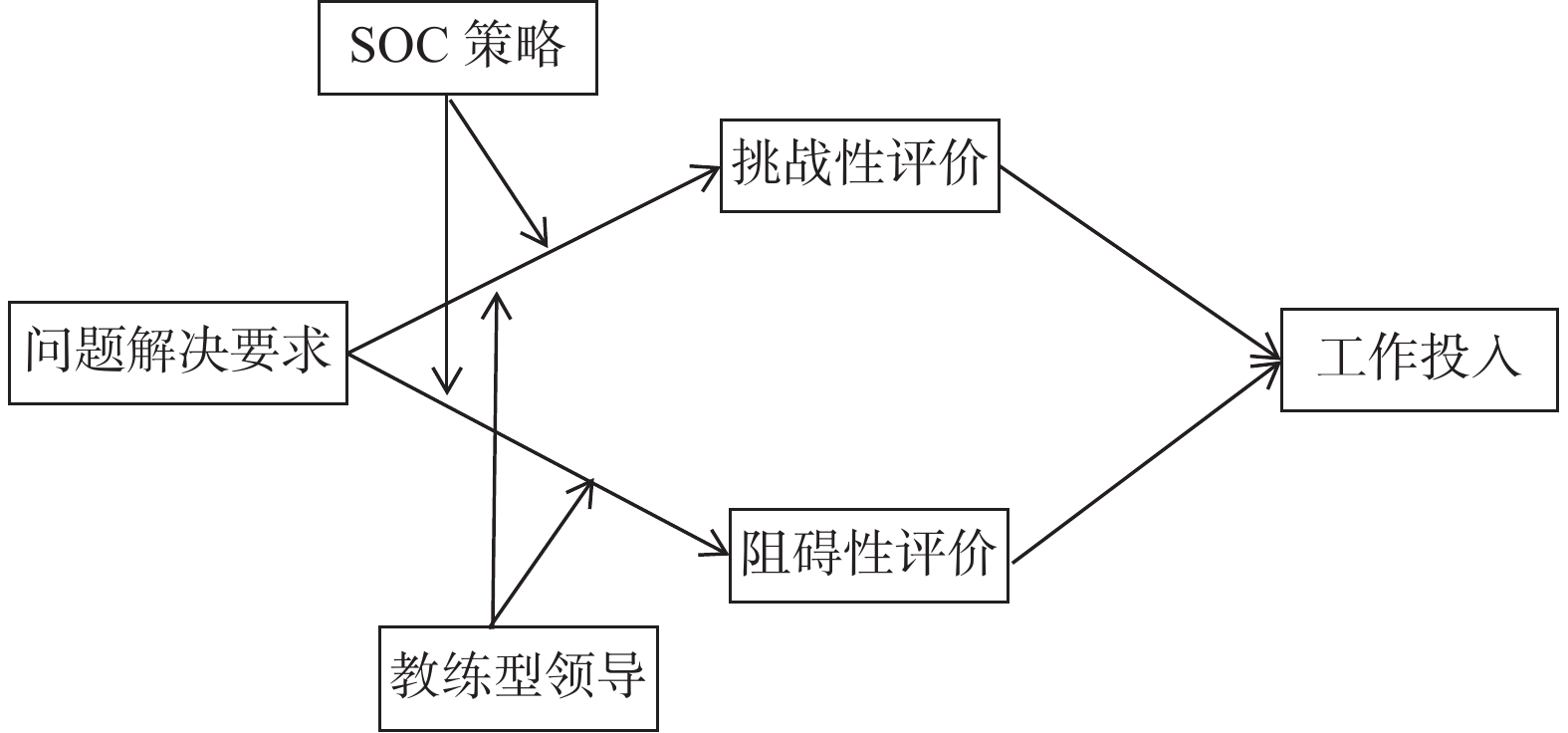
图1 研究模型
| 模型 | χ2 | df | χ2/df | CFI | TLI | RMSEA | SRMR |
| 无方法潜因子(六因子) | 1305.00 | 687 | 1.90 | 0.85 | 0.84 | 0.06 | 0.08 |
| 有方法潜因子(六因子+方法因子) | 1196.00 | 683 | 1.75 | 0.88 | 0.87 | 0.06 | 0.07 |
表1 共同方法偏差检验结果
| 模型 | χ2 | df | χ2/df | CFI | TLI | RMSEA | SRMR |
| 无方法潜因子(六因子) | 1305.00 | 687 | 1.90 | 0.85 | 0.84 | 0.06 | 0.08 |
| 有方法潜因子(六因子+方法因子) | 1196.00 | 683 | 1.75 | 0.88 | 0.87 | 0.06 | 0.07 |
| 变量 | M | SD | 1 | 2 | 3 | 4 | 5 | 6 | 7 | 8 | 9 | 10 |
| 1.问题解决要求 | 3.57 | 0.65 | ||||||||||
| 2.挑战性评价 | 4.19 | 0.61 | 0.26** | |||||||||
| 3.阻碍性评价 | 2.56 | 1.17 | 0.27** | −0.26** | ||||||||
| 4.工作投入 | 3.81 | 0.87 | 0.25** | 0.57** | −0.23** | |||||||
| 5.SOC策略 | 4.02 | 0.48 | 0.50** | 0.63** | −0.01 | 0.52** | ||||||
| 6.教练型领导 | 4.14 | 0.61 | 0.30** | 0.63** | −0.22** | 0.61** | 0.61** | |||||
| 7.性别 | 65.64a | 0.02 | −0.16* | 0.02 | −0.21** | −0.13* | −0.21** | |||||
| 8.年龄 | 25.30 | 3.86 | 0.06 | 0.20** | −0.13 | 0.29** | 0.22** | 0.21** | −0.20** | |||
| 9.教育水平 | 2.64 | 0.53 | 0.07 | 0.18** | −0.16* | 0.42** | 0.20** | 0.26** | −0.28** | 0.32** | ||
| 10.组织任期 | 17.84 | 17.32 | 0.14* | 0.30** | 0.03 | 0.38** | 0.31** | 0.27** | −0.01 | 0.50** | 0.19** | |
| 11.工作时长 | 52.23 | 13.25 | 0.09 | −0.23** | 0.29** | −0.16* | −0.05 | −0.14* | −0.01 | 0.00 | −0.13 | −0.02 |
表2 核心变量的描述统计和相关分析结果(n=227)
| 变量 | M | SD | 1 | 2 | 3 | 4 | 5 | 6 | 7 | 8 | 9 | 10 |
| 1.问题解决要求 | 3.57 | 0.65 | ||||||||||
| 2.挑战性评价 | 4.19 | 0.61 | 0.26** | |||||||||
| 3.阻碍性评价 | 2.56 | 1.17 | 0.27** | −0.26** | ||||||||
| 4.工作投入 | 3.81 | 0.87 | 0.25** | 0.57** | −0.23** | |||||||
| 5.SOC策略 | 4.02 | 0.48 | 0.50** | 0.63** | −0.01 | 0.52** | ||||||
| 6.教练型领导 | 4.14 | 0.61 | 0.30** | 0.63** | −0.22** | 0.61** | 0.61** | |||||
| 7.性别 | 65.64a | 0.02 | −0.16* | 0.02 | −0.21** | −0.13* | −0.21** | |||||
| 8.年龄 | 25.30 | 3.86 | 0.06 | 0.20** | −0.13 | 0.29** | 0.22** | 0.21** | −0.20** | |||
| 9.教育水平 | 2.64 | 0.53 | 0.07 | 0.18** | −0.16* | 0.42** | 0.20** | 0.26** | −0.28** | 0.32** | ||
| 10.组织任期 | 17.84 | 17.32 | 0.14* | 0.30** | 0.03 | 0.38** | 0.31** | 0.27** | −0.01 | 0.50** | 0.19** | |
| 11.工作时长 | 52.23 | 13.25 | 0.09 | −0.23** | 0.29** | −0.16* | −0.05 | −0.14* | −0.01 | 0.00 | −0.13 | −0.02 |
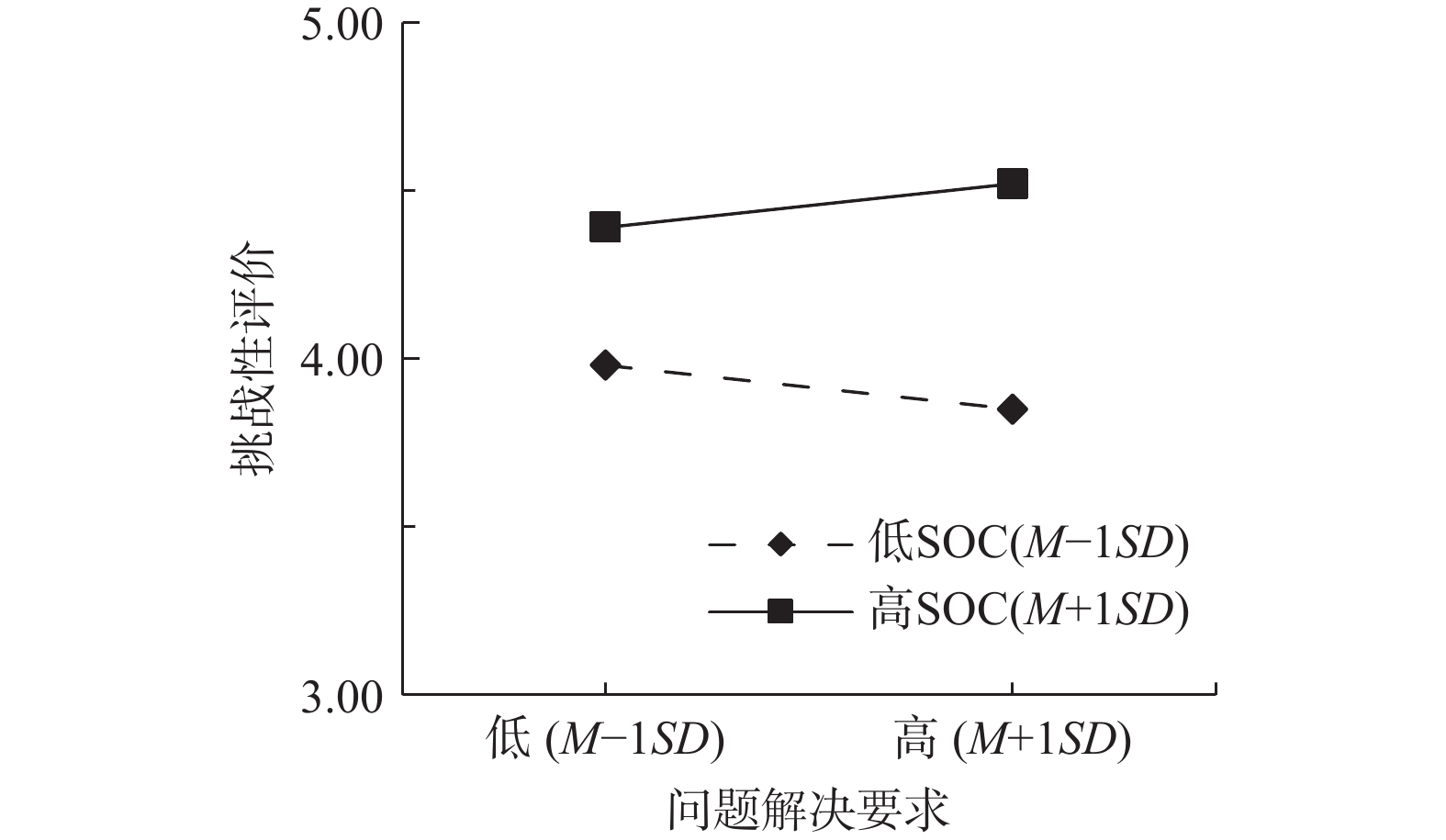
图2 SOC策略对问题解决要求与挑战性评价之间关系的调节效应
| 效应关系 | 效应值 | LLCI | ULCI | |
| 总效应 | 0.28 | 0.13 | 0.42 | |
| PSD→工作投入 | 0.21 | 0.06 | 0.35 | |
| 间接效应 | ||||
| PSD→挑战性评价→工作投入 | 0.12 | 0.05 | 0.20 | |
| PSD→阻碍性评价→工作投入 | −0.05 | −0.10 | −0.01 | |
| SOC策略的调节效应 | ||||
| PSD→挑战性评价 | SOC策略(M+1SD) | 0.10 | 0.01 | 0.25 |
| SOC策略(M−1SD) | −0.20 | −0.22 | −0.02 | |
| PSD→挑战性评价→工作投入 | SOC策略(M+1SD) | 0.06 | 0.01 | 0.14 |
| SOC策略(M−1SD) | −0.06 | −0.14 | −0.07 | |
| 教练型领导的调节效应 | ||||
| PSD→阻碍性评价 | 教练型领导(M+1SD) | 0.29 | −0.06 | 0.64 |
| 教练型领导(M−1SD) | 1.10 | 0.63 | 1.58 | |
| PSD→阻碍性评价→工作投入 | 教练型领导(M+1SD) | −0.06 | −0.14 | 0.03 |
| 教练型领导(M−1SD) | −0.21 | −0.37 | −0.11 | |
表3 路径分析结果
| 效应关系 | 效应值 | LLCI | ULCI | |
| 总效应 | 0.28 | 0.13 | 0.42 | |
| PSD→工作投入 | 0.21 | 0.06 | 0.35 | |
| 间接效应 | ||||
| PSD→挑战性评价→工作投入 | 0.12 | 0.05 | 0.20 | |
| PSD→阻碍性评价→工作投入 | −0.05 | −0.10 | −0.01 | |
| SOC策略的调节效应 | ||||
| PSD→挑战性评价 | SOC策略(M+1SD) | 0.10 | 0.01 | 0.25 |
| SOC策略(M−1SD) | −0.20 | −0.22 | −0.02 | |
| PSD→挑战性评价→工作投入 | SOC策略(M+1SD) | 0.06 | 0.01 | 0.14 |
| SOC策略(M−1SD) | −0.06 | −0.14 | −0.07 | |
| 教练型领导的调节效应 | ||||
| PSD→阻碍性评价 | 教练型领导(M+1SD) | 0.29 | −0.06 | 0.64 |
| 教练型领导(M−1SD) | 1.10 | 0.63 | 1.58 | |
| PSD→阻碍性评价→工作投入 | 教练型领导(M+1SD) | −0.06 | −0.14 | 0.03 |
| 教练型领导(M−1SD) | −0.21 | −0.37 | −0.11 | |
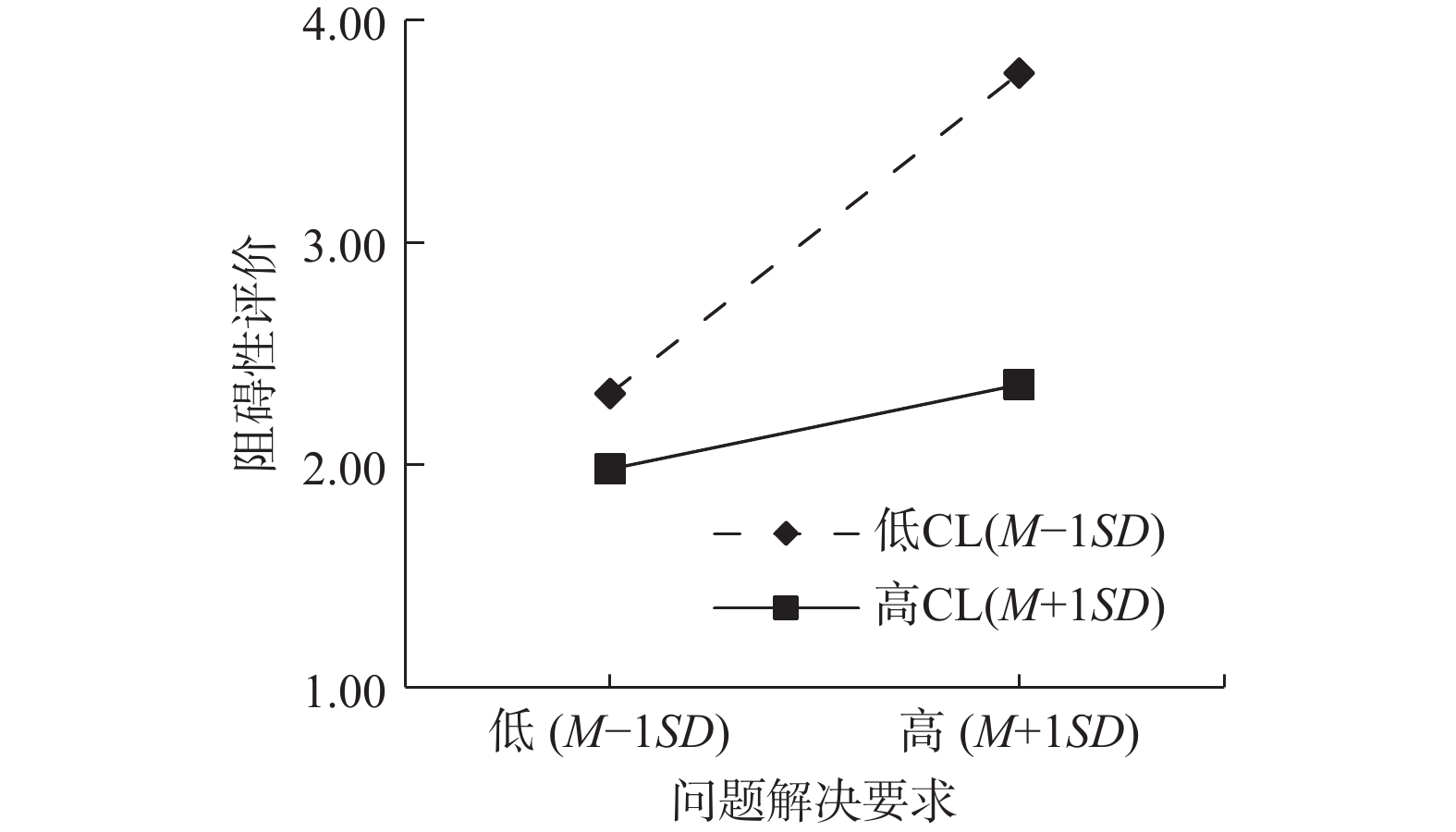
图3 教练型领导对问题解决要求与阻碍性评价之间关系的调节效应
|
姜福斌, 王震. 压力认知评价理论在管理心理学中的应用: 场景、方式与迷思. 心理科学进展, 2022, 30 (12): 2825- 2845.
DOI |
|
|
汤丹丹, 温忠麟. 共同方法偏差检验: 问题与建议. 心理科学, 2020, 43 (1): 215- 223.
|
|
|
Bajor, J. K., & Baltes, B. B. The relationship between selection optimization with compensation, conscientiousness, motivation, and performance. Journal of Vocational Behavior, 2003, 63 (3): 347- 367.
DOI |
|
|
Baumeister, R. F., & Vohs, K. D. Self-regulation, ego depletion, and motivation. Social and Personality Psychology Compass, 2007, 1 (1): 115- 128.
DOI |
|
|
Crawford, E. R., LePine, J. A., & Rich, B. L. Linking job demands and resources to employee engagement and burnout: A theoretical extension and meta-analytic test. Journal of Applied Psychology, 2010, 95 (5): 834- 848.
DOI |
|
|
Cullinane, S. J., Bosak, J., Flood, P. C., & Demerouti, E. Job design under lean manufacturing and the quality of working life: A job demands and resources perspective. The International Journal of Human Resource Management, 2014, 25 (21): 2996- 3015.
DOI |
|
|
Daniels, K., Wimalasiri, V., Beesley, N., & Cheyne, A. Affective well-being and within-day beliefs about job demands’ influence on work performance: An experience sampling study. Journal of Occupational and Organizational Psychology, 2012, 85 (4): 666- 674.
DOI |
|
|
Di Fabio, A., & Bucci, O. Green positive guidance and green positive life counseling for decent work and decent lives: Some empirical results. Frontiers in Psychology, 2016, 7, 261.
|
|
|
Ellinger, A. D., Ellinger, A. E., Bachrach, D. G., Wang, Y. L., & Elmadağ Baş, A. B. Organizational investments in social capital, managerial coaching, and employee work-related performance. Management Learning, 2011, 42 (1): 67- 85.
DOI |
|
|
Espedido, A., & Searle, B. J. (2020). Daily proactive problem-solving and next day stress appraisals: The moderating role of behavioral activation. Anxiety, Stress, & Coping, 33(4), 416–428.
|
|
|
Espedido, A., & Searle, B. J. Proactivity, stress appraisals, and problem-solving: A cross-level moderated mediation model. Work & Stress, 2021, 35 (2): 132- 152.
|
|
|
Espedido, A., Searle, B. J., & Griffin, B. Peers, proactivity, and problem-solving: A multilevel study of team impacts on stress appraisals of problem-solving demands. Work & Stress, 2020, 34 (3): 219- 237.
|
|
|
Freund, A. M., & Baltes, P. B. Life-management strategies of selection, optimization and compensation: Measurement by self-report and construct validity. Journal of Personality and Social Psychology, 2002, 82 (4): 642- 662.
DOI |
|
|
Grant, A. M. Leading with meaning: Beneficiary contact, prosocial impact, and the performance effects of transformational leadership. Academy of Management Journal, 2012, 55 (2): 458- 476.
DOI |
|
|
Gutnick, D., Walter, F., Nijstad, B. A., & de Dreu, C. K. W. Creative performance under pressure: An integrative conceptual framework. Organizational Psychology Review, 2012, 2 (3): 189- 207.
DOI |
|
|
Hackman, J. R., & Oldham, G. R. Motivation through the design of work: Test of a theory. Organizational Behavior and Human Performance, 1976, 16 (2): 250- 279.
DOI |
|
|
Hayes, A. F. (2013). Introduction to mediation, moderation, and conditional process analysis: A regression-based approach. New York: The Guilford Press.
|
|
|
Huo, M. L., & Boxall, P. Are all aspects of lean production bad for workers? An analysis of how problem-solving demands affect employee well-being. Human Resource Management Journal, 2018, 28 (4): 569- 584.
DOI |
|
|
Kim, B. J. The influence of coaching leadership on safety behavior: The mediating effect of psychological safety and moderating effect of perspective taking. Journal of Digital Convergence, 2022, 20 (5): 443- 451.
|
|
|
Kim, S., Egan, T. M., Kim, W., & Kim, J. The impact of managerial coaching behavior on employee work-related reactions. Journal of Business and Psychology, 2013, 28 (3): 315- 330.
DOI |
|
|
Lazarus, R. S., & Folkman, S. (1984). Stress, appraisal, and coping. New York: Springer.
|
|
|
LePine, M. A., Zhang, Y. W., Crawford, E. R., & Rich, B. L. Turning their pain to gain: Charismatic leader influence on follower stress appraisal and job performance. Academy of Management Journal, 2016, 59 (3): 1036- 1059.
DOI |
|
|
Lian, H. W., Yam, K. C., Ferris, D. L., & Brown, D. Self-control at work. The Academy of Management Annals, 2017, 11 (2): 703- 732.
DOI |
|
|
Ma, J., Peng, Y. S., & Wu, B. Challenging or hindering? The roles of goal orientation and cognitive appraisal in stressor-performance relationships. Journal of Organizational Behavior, 2021, 42 (3): 388- 406.
DOI |
|
|
Ma, L. L., Ma, H. Y., Zhan, X. P., & Wang, Y. How do problem-solving demands influence employees’ thriving at work: An explanation based on cognitive appraisal. Sustainability, 2023, 15 (20): 14879.
DOI |
|
|
Madrid, H. P., Patterson, M. G., & Leiva, P. I. Negative core affect and employee silence: How differences in activation, cognitive rumination, and problem-solving demands matter. Journal of Applied Psychology, 2015, 100 (6): 1887- 1898.
DOI |
|
|
Malinowska, D., & Tokarz, A. The moderating role of self determination theory’s general causality orientations in the relationship between the job resources and work engagement of outsourcing sector employees. Personality and Individual Differences, 2020, 153, 109638.
DOI |
|
|
Mitchell, M. S., Greenbaum, R. L., Vogel, R. M., Mawritz, M. B., & Keating, D. J. Can you handle the pressure? The effect of performance pressure on stress appraisals, self-regulation, and behavior. Academy of Management Journal, 2019, 62 (2): 531- 552.
DOI |
|
|
Moghimi, D., Zacher, H., Scheibe, S., & van Yperen, N. W. The selection, optimization, and compensation model in the work context: A systematic review and meta-analysis of two decades of research. Journal of Organizational Behavior, 2017, 38 (2): 247- 275.
DOI |
|
|
Morgeson, F. P., & Humphrey, S. E. The Work Design Questionnaire (WDQ): Developing and validating a comprehensive measure for assessing job design and the nature of work. Journal of Applied Psychology, 2006, 91 (6): 1321- 1339.
DOI |
|
|
Peng, Z. L., Gao, B., & Zhao, H. D. Coaching leadership and subordinates’ career success: The mediating role of leader-member exchange. Social Behavior and Personality: An International Journal, 2019, 47 (11): 1- 8.
|
|
|
Petrou, A. P., Hadjielias, E., Thanos, I. C., & Dimitratos, P. Strategic decision-making processes, international environmental munificence and the accelerated internationalization of SMEs. International Business Review, 2020, 29 (5): 101735.
DOI |
|
|
Romão, S., Ribeiro, N., Gomes, D. R., & Singh, S. The impact of leaders’ coaching skills on employees’ happiness and turnover intention. Administrative Sciences, 2022, 12 (3): 84.
DOI |
|
|
Schaufeli, W. B., Bakker, A. B., & Salanova, M. The measurement of work engagement with a short questionnaire: A cross-national study. Educational and Psychological Measurement, 2006, 66 (4): 701- 716.
DOI |
|
|
Schmitt, A., Zacher, H., & Frese, M. The buffering effect of selection, optimization, and compensation strategy use on the relationship between problem solving demands and occupational well-being: A daily diary study. Journal of Occupational Health Psychology, 2012, 17 (2): 139- 149.
DOI |
|
|
Searle, B. J., & Auton, J. C. (2015). The merits of measuring challenge and hindrance appraisals. Anxiety, Stress, and Coping, 28(2), 121–143.
|
|
|
Wall, T. D., Corbett, J. M., Clegg, C. W., Jackson, P. R., & Martin, R. Advanced manufacturing technology and work design: Towards a theoretical framework. Journal of Organizational Behavior, 1990, 11 (3): 201- 219.
DOI |
|
|
Wall, T. D., Jackson, P. R., & Mullarkey, S. Further evidence on some new measures of job control, cognitive demand and production responsibility. Journal of Organizational Behavior, 1995, 16 (5): 431- 455.
DOI |
|
|
Wang, X. H., Wang, M., & Xu, F. From problem-solving demands to employee creativity: Bidirectional support. Social Behavior and Personality: An International Journal, 2022, 50 (7): 1- 13.
|
|
|
Zacher, H., & Frese, M. Maintaining a focus on opportunities at work: The interplay between age, job complexity, and the use of selection, optimization, and compensation strategies. Journal of Organizational Behavior, 2011, 32 (2): 291- 318.
DOI |
|
|
Zhou, Q., Hirst, G., & Shipton, H. Promoting creativity at work: The role of problem-solving demand. Applied Psychology, 2012, 61 (1): 56- 80.
DOI |
| [1] | 古美乔, 王骞, 郭莎莎, 邢增华, 丁桂凤. 主管与下属工作−家庭中心一致性对下属工作投入的影响:基于多项式回归与响应面的分析[J]. 心理与行为研究, 2026, 24(2): 281-288. |
| [2] | 张岚, 侯金芹, 陈祉妍. 员工主动性人格对工作幸福感的影响:一个跨层有调节的中介模型[J]. 心理与行为研究, 2023, 21(5): 698-704. |
| [3] | 王嘉莹, 姚梅林, 刘红瑞. 成就目标与教师效能感、焦虑、工作投入的关系:基于变量中心和个体中心的视角[J]. 心理与行为研究, 2022, 20(1): 122-129. |
| [4] | 杨槐, 龚少英, 苗天长, 李伟贺. 工作-非工作边界管理一致性与高校辅导员工作满意度的关系:工作投入的中介作用[J]. 心理与行为研究, 2021, 19(6): 853-860. |
| [5] | 窦运来, 沈伊默. 参与式领导如何影响团队成员的工作表现?—有调节的中介效应[J]. 心理与行为研究, 2021, 19(6): 845-852. |
| [6] | 李永占. 真实型领导对员工创新行为的影响:工作投入的中介效应[J]. 心理与行为研究, 2019, 17(6): 854-860. |
| [7] | 曾练平, 何明远, 潘运, 赵守盈. 工作家庭平衡双构面视角下社会支持对农村教师工作投入的影响:一个多重中介模型[J]. 心理与行为研究, 2018, 16(4): 518-524. |
| [8] | 李永占. 特殊教育教师工作家庭冲突、情绪智力与工作投入的关系[J]. 心理与行为研究, 2018, 16(1): 103-110. |
| [9] | 吴国强, 郭亚宁, 黄杰, 鲍旭辉, 李越. 挑战性-阻碍性压力源对工作投入和工作倦怠的影响:应对策略的中介作用[J]. 心理与行为研究, 2017, 15(6): 853-859. |
| [10] | 王晓庄,骆皓爽,张永翠,吴捷. 工作-家庭中心性与延迟退休态度的关系研究[J]. 心理与行为研究, 2016, 14(3): 390-398. |
| [11] | 柯江林, 吴丹, 孙健敏. 心理资本对工作投入、主观幸福感与沉默行为的影响:交互效应与效应比较*[J]. 心理与行为研究, 2015, 13(6): 804-810. |
| [12] | 张敏,张萍,卢家楣. 感戴情绪的发生条件:认知评价的作用*[J]. 心理与行为研究, 2015, 13(3): 380-384. |
| [13] | 陈丽君. 大学生问题发现过程的元认知特点研究[J]. , 2012, 10(5): 366-372. |
| [14] | 魏蕾,时勘. 家长式领导与员工工作投入:心理授权的中介作用[J]. 心理与行为研究, 2010, 8(2): 88-93. |
| [15] | 杨阿丽, 方晓义 涂翠平 李红菊. 父母冲突、青少年的认知评价及其与青少年社会适应的关系[J]. , 2007, 5(2): 127-134. |
| 阅读次数 | ||||||
|
全文 |
|
|||||
|
摘要 |
|
|||||
