

1 引言
共同注意(joint attention, JA)是指在个体与他人交往的过程中,通过观察他人的视线、姿势、动作等信息,与他人共同关注二者之外的物体或人物的社会认知能力,被认为是幼儿最早的交流形式之一(Jones & Carr, 2004; Mundy & Newell, 2007)。共同注意包括响应性共同注意(responding joint attention, RJA),即跟随他人的社会线索转移视觉注意力;以及主动性共同注意(initiating joint attention, IJA),即个体使用凝视或指向等方式,主动地引起他人对其感兴趣的物体或人的注意。而RJA缺陷是孤独症谱系障碍(autism spectrum disorder, ASD; 以下简称“孤独症”)的核心问题之一,并与社会功能障碍和语言发育迟缓等不良结果相关(徐云, 张潘, 2020; Charman, 2003)。
RJA主要包括两个心理过程(张智君 等, 2011; Teufel et al., 2010),即注视知觉(gaze perception),对他人注视方向和物体的感知与识别;以及注视追随(gaze following),自动地追随他人的视线,将自己的注意转向他人所注视的方向上(赵晓宁 等, 2019)。目前学界对孤独症儿童RJA心理过程的发展仍存在争议。首先,在注视知觉方面,有不少研究认为,孤独症儿童的注视知觉无明显缺陷(Castelhano et al., 2007; Kylliäinen & Hietanen, 2004)。如Greene等人(2011)发现在社会线索条件和非社会线索条件下,孤独症儿童均能够有效捕捉眼睛注视线索,并意识到他人的注视方向。但也有部分研究者持不同观点(Senju et al., 2003)。如Riby等人(2013)使用眼动追踪技术,以静态图片为实验材料来探究孤独症儿童能否注意并解释社交场景中的人眼注视线索,结果发现相比于正常发育儿童,孤独症儿童将注意分配到面部和眼睛区域的时间都更少。此外,在注视追随能力方面,有部分研究表明,孤独症儿童的注视追随存在明显缺陷(McParland et al., 2021; Vivanti et al., 2017)。如Rozga等人(2011)的研究发现,在12个月大时,被诊断患有孤独症的幼儿较少跟随成年人的凝视方向,看向成年人所注视的书中图像的时间更少。但也有不少研究发现,其注视追随能力无明显缺陷(Billeci et al., 2017; Leekam et al., 1998; Rutherford & Krysko, 2008)。如Bedford等人(2012)利用眼动追踪实验,发现7个月和13个月大的孤独症幼儿都可以进行注视追随。
以往研究更多关注实验刺激材料如眼动素材的选取,较少将社交情境因素单独区分出来进行探究,而包含复杂信息的社交情境因素如情境人数、社交互动状态(Fletcher-Watson et al., 2009),确实可能成为孤独症儿童的RJA心理过程的关键影响因素,有必要对其进行单独研究。因此,本研究将社交情境类型分为人−物社交情境与人际社交情境两类,前者涉及较少的社会互动信息,仅有情境人数的差异,不包含社会互动状态,更易于剥离其他影响因素,而后者涉及更多的真实社交场景中人与人之间的互动,既有情境人数的区别,又有社会互动状态的影响,更贴近真实的社会互动。
对于社交情境中隐含的社交信息,首先,情境人数会影响儿童的注视行为(Shi et al., 2015)。有研究发现,当社交情境中人数增多时,孤独症儿童对眼睛区域的注视时间和注视次数会明显减少,表现出对眼睛区域的回避(魏玲 等, 2017; Freeth et al., 2010)。部分采用单人场景图片的研究发现,孤独症儿童与正常发育儿童对人物眼睛区域的注视时间无显著差异,但当图片中包含2人或2人以上的社会互动时,孤独症儿童更少地注视图片中人的面孔及眼睛区域,更难将注意力转移至情境中人所注视的方向或物体上(Bird et al., 2011)。其次,社交互动状态也会对儿童的注意情况产生影响(Ambrose et al., 2020)。Birmingham等人(2008)采用多人互动图片对正常人进行眼动追踪,发现当情境人数为3人时,情境中的社交互动状态会影响人们对眼睛区域的注意。Robain等人(2021)通过平行游戏和社交互动游戏来操纵社交信息的复杂强度,发现相比于无互动的简单社交场景,孤独症儿童在复杂的社交互动场景中的视线转移频率更高。
因此,本研究旨在探究不同社交情境类型对孤独症儿童响应性共同注意心理过程的影响及变化情况。将真实儿童室内动态视频作为实验刺激材料,改变情境人数(1人/2人/3人)来操纵人−物社交情境中的社交信息强度,改变情境人数(2人/3人)与社交互动状态(互动/非互动)来操纵人际社交情境中的社交信息强度。利用眼动追踪技术,通过对比孤独症儿童和正常发育儿童的注视时间比、视线转移次数两种眼动指标,从而探索儿童在不同社交场景下的注意模式的差异,并对其内在加工机制进行探讨,即孤独症儿童的注视知觉和注视追随能力是否存在缺陷,同时也为未来在干预训练中改变社交情境类型能否提高共同注意提供了参考。
2 研究1:人−物社交情境中的社交信息强度对孤独症儿童响应性共同注意的影响
2.1 研究方法
2.1.1 被试
孤独症儿童参与者共40名(女生6名),年龄在3~6岁之间,均来自于天津市的孤独症儿童康复机构。有8名儿童被眼动仪捕捉到的注视点有效率低于80%,因此其数据被视为无效数据而删除,剩余32名儿童数据(女生4名),月龄为52.06±7.56月。所有孤独症儿童均具有三甲医院的主任医师出具的专业诊断报告,符合DSM-5界定的孤独症诊断标准。此外,通过C-PEP-3(孤独症谱系及相关发育障碍儿童评估用心理教育量表中文修订三版)对儿童进行测量,孤独症儿童认知表现年龄水平为47.78±12.21月,口语认知年龄水平为44.56±9.73月。
正常发育儿童参与者共40名(女生16名),月龄为49.18±6.04月,于天津市的幼儿园招募,所有儿童被眼动仪捕捉到的注视点有效率均高于80%。两组儿童视力均处于正常水平,无色盲、色弱,无其他神经系统器质性疾病。在实验开展前所有儿童家长均签署了知情同意书。本研究通过南开大学医学伦理委员会批准(NKLUIRB2021060)。
由于孤独症儿童个体之间存在较大的异质性,即相同年龄下不同孤独症儿童的智力水平差异较大,因此仅对两组儿童的生理年龄进行匹配(t=1.80, p=0.076)。
2.1.2 实验仪器和材料
本实验采用Tobii TX300非头戴式眼动仪进行眼动追踪,允许参与者自由移动头部,更有利于对存在智力障碍、孤独症或年龄较小的参与者进行实验。利用联想ThinkBook 14进行眼动程序操作,刺激材料呈现于Tobii TX300显示器(23英寸,1024×768像素)。
考虑到研究的生态效度和现实意义,有研究发现场景的年龄特征会影响孤独症儿童的注视模式,表现为对儿童场景的注视偏好(魏玲 等, 2020),因此本实验采用与研究对象同龄的正常发育儿童的真实动态视频作为实验刺激材料。真实动态视频均为研究者自行录制并剪辑,经儿童家长同意,邀请3位均为4岁的正常发育儿童参与视频拍摄,实验人员辅助儿童进行拍摄姿势讲解,经后期制作剪辑使每段动态视频时长均为5秒。视频内容为:单人人−物社交情境(1人看向桌子上的1个玩具);双人人−物社交情境(2人同时看桌子上的1个玩具);三人人−物社交情境(3人同时看桌子上的1个玩具)。
2.1.3 实验设计
2(被试类型:孤独症儿童、正常发育儿童)×3(情境人数:1人、2人、3人)的混合实验设计,被试类型为被试间变量,情境人数为被试内变量。
2.1.4 眼动指标
(1)线索人物眼睛注视时间比:本实验采用自由观看任务,虽然在实验过程中每段实验刺激材料所呈现的时间均为5 s,但仍难以保证每个参与者对实验刺激材料的总注视时间相同,尤其考虑到孤独症儿童存在注意易分散特点。如果以原始眼动数据指标为依据进行分析,较难对儿童的注意情况进行客观的评价,因此本实验采用注视时间比进行分析(Birmingham et al., 2008),即线索人物眼睛注视时间占全图总注视时间的比例。
(2)视线转移次数:指参与者的注视点从线索人物眼睛区域转向目标物体的次数。参与者的注视点中央位置从进入线索人物眼睛兴趣区到转移至目标物体兴趣区,即为一次视线转移。
2.2 结果
2.2.1 线索人物眼睛注视时间比
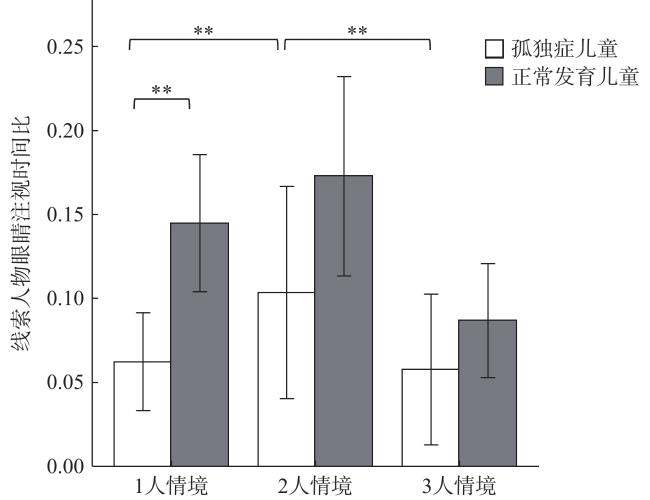
对两组儿童线索人物眼睛注视时间比进行重复测量方差分析。结果显示,被试类型的主效应显著,F(1, 210)=10.08,p=0.002,η${_{\rm p}^2} $ =0.05,情境人数的主效应显著,F(2, 210)=12.83,p<0.001,η${_{\rm p}^2} $ =0.04,被试类型和情境人数的交互作用显著,F(2, 210)=8.34,p=0.013,η${_{\rm p}^2} $ =0.02。简单效应分析结果显示,当为1人情境时,孤独症儿童的线索人物眼睛注视时间比显著低于正常发育儿童,F=5.72,p=0.001;当为2人或3人情境时,两组儿童的线索人物眼睛注视时间比无显著性差异,F=0.36,p=0.111;F=0.69,p=0.286。见图1 。
2.2.2 视线转移次数
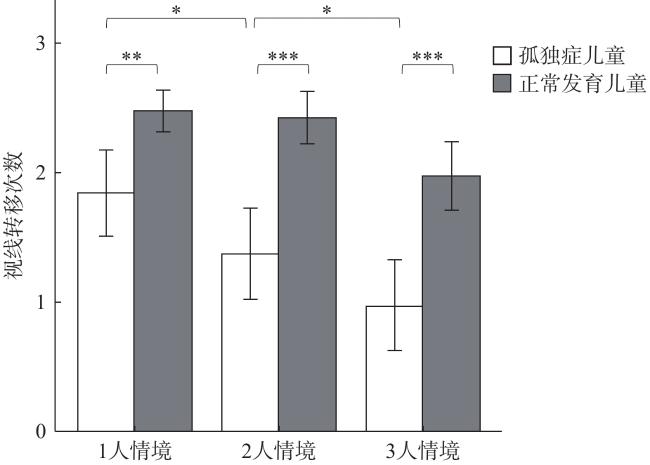
对两组儿童注视点从线索人物眼睛区域转向目标物体的视线转移次数进行重复测量方差分析。结果显示,被试类型的主效应显著,F(2, 210)=64.47,p<0.001,η${_{\rm p}^2} $ =0.24;情境人数的主效应显著,F(2, 210)=12.91,p<0.001,η${_{\rm p}^2} $ =0.11;被试类型和情境人数的交互作用显著,F(2, 210)=6.42,p=0.044,η${_{\rm p}^2} $ =0.10。简单效应分析结果显示,无论情境中人数为1人或2人或3人,孤独症儿童视线转移次数(M=1.84, SD=0.92; M=1.38, SD=0.98; M=0.97, SD=0.99)均显著少于正常发育儿童(M=2.48, SD=0.51; M=2.42, SD=0.64; M=1.98, SD=0.83),ps<0.01。见图2 。
3 研究2:人际社交情境中的社交信息强度对孤独症儿童响应性共同注意的影响
3.1 研究方法
3.1.1 被试
与实验1为同一批被试。
3.1.2 实验材料与设计
实验材料。同为对实验1中三位正常发育儿童进行视频拍摄,内容为:双人人际社交情境(无社会互动:2人静坐;有社会互动:1人看向另一人)、三人人际社交情境(无社会互动:3人静坐;有社会互动:3人中有2人同时看向一个人)。
2(被试类型:孤独症儿童、正常发育儿童)×2(情境人数:2人、3人)×2(社交状态:有社会互动、无社会互动)的混合实验设计,被试类型为被试间变量,情境人数和社交状态为被试内变量。
3.1.3 眼动指标
同实验1。
3.2 结果
3.2.1 线索人物眼睛注视时间比
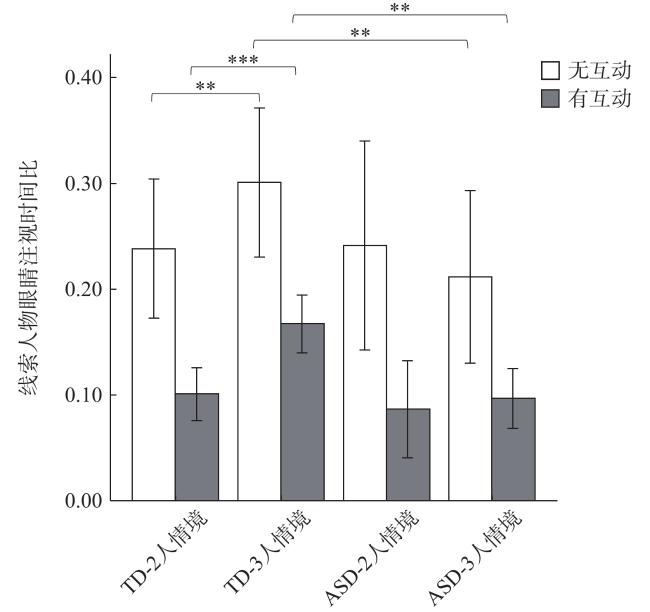
对线索人物眼睛注视时间比进行重复测量方差分析。结果显示,被试类型的主效应显著,F(1, 280)=15.89,p<0.001,η${_{\rm p}^2} $ =0.05,情境人数呈主效应显著,F(1, 280)=11.12,p=0.001,η${_{\rm p}^2} $ =0.04,社交状态的主效应显著,F(1, 280)=16.07,p<0.001,η${_{\rm p}^2} $ =0.05,被试类型与情境人数的交互作用显著,F(1, 280)=8.45,p=0.004,η${_{\rm p}^2} $ =0.03,其余交互作用不显著。在2人情境中,无论有无社交互动,孤独症儿童线索人物眼睛注视时间比与正常发育儿童均无显著性差异(p=0.702, p=0.397),而在3人情境中,孤独症儿童线索人物眼睛注视时间比均显著低于正常发育儿童(ps<0.01)。见图3 。
3.2.2 视线转移次数
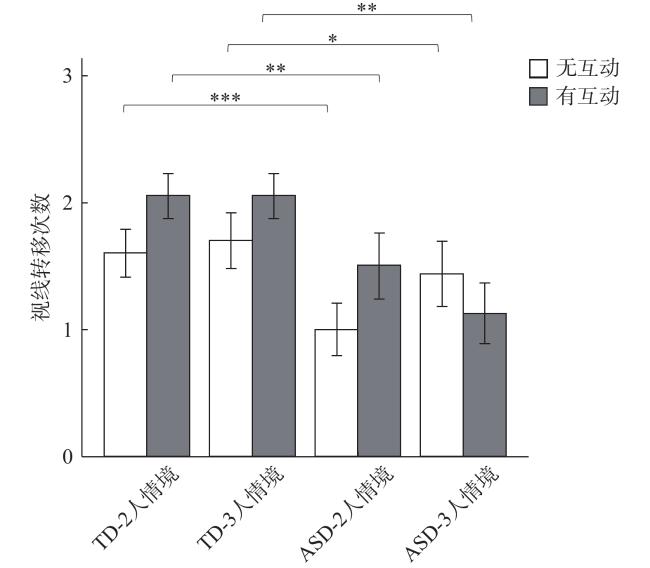
对两组儿童注视点从线索人物眼睛区域转向目标人物的视线转移次数进行重复测量方差分析。结果显示,被试类型、情境人数与社交状态三者交互作用显著,F(1, 280)=5.96,p=0.017,η${_{\rm p}^2} $ =0.08。简单效应分析结果显示,在有社交互动的人际社交情境中,无论为2人或3人情境,孤独症儿童的视线转移次数(M=1.50, SD=0.72; M=1.13, SD=0.66)均显著少于正常发育儿童(M=2.05, SD=0.55; M=2.08, SD=0.83),ps<0.01,孤独症儿童的视线转移次数随情境人数增加而显著减少(p=0.021)。在无社交互动的人际社交情境中,无论情境中人数为2人或3人,孤独症儿童的视线转移次数(M=1.00, SD=0.57; M=1.44, SD=0.72)均显著少于正常发育儿童(M=1.60, SD=0.59; M=1.70, SD=0.69),p<0.001,p=0.018,孤独症儿童的视线转移次数随情境人数增加而显著增加(p=0.011)。见图4 。


4 讨论
本研究通过改变人−物社交情境中的社交信息强度(情境人数),以及人际社交情境中的社交信息强度(情境人数、社会互动状态),探讨了不同社交情境中孤独症儿童RJA的心理过程(注视知觉、注视追随)是否存在明显缺陷,以及情境中社交信息强度对孤独症儿童RJA不同心理过程的影响。
4.1 孤独症儿童注视知觉的特异性表现
在本研究中,注视知觉由儿童对线索人物的眼睛注视时间比体现。本研究发现不能笼统地认为孤独症儿童注视知觉存在缺陷。因为在根据社交信息强度将社交场景进行细分后,在部分情况下,如情境人数为两人时,孤独症儿童的注视知觉无明显缺陷。但当情境人数增多时,其注视知觉缺陷逐渐显现出来。
第一,在人−物社交情境中,发现仅在一人情境下,孤独症儿童的注视知觉能力存在明显缺陷,而当情境人数为两人或三人时,孤独症儿童能够意识到社交情境下他人注视线索的重要性,并表现出一定的注视知觉能力。这与前人的研究结果存在相似之处(Billeci et al., 2017; Castelhano et al., 2007; Greene et al., 2011)。但也存在不同之处,即孤独症儿童在基于不同情境人数细分的社交情境中,表现出不同的注视知觉能力(Wang et al., 2020)。
第二,在人际社交情境中,两人情境下,无论情境中人物是否有互动,孤独症儿童均表现出一定的注视知觉能力,这与Greene等人(2011)的研究结果相似,即在简单社交场景中,无论社会线索是否存在,孤独症儿童均能注意到眼睛线索,识别注视方向。而当存在三人及以上更为复杂的多人社交场景时,孤独症儿童对眼睛及面部的注意力明显减少,这与Robain等人(2021)的研究结果相似。孤独症儿童在复杂社交情境中的总体注视持续时间较短,更少地注视他人的面部或眼睛区域,更快地转移注意力,而不像正常发育儿童那样在一个区域停留较长时间,这可能是因为复杂情境中社交信息内容过多、社交信息强度过强,内容过于繁杂,孤独症儿童在社交互动中缺乏兴趣或难以维持注意力。且孤独症儿童可能在复杂社交互动中缺乏对面部表情和眼睛注视的敏感性,从而导致他们注视他人的面部区域较少。而一人情境中,社交信息强度较弱,孤独症儿童较难对情境中的社交信息进行捕捉和注意。只有当情境人数为两人时,孤独症儿童最容易获得线索提示,并有助于其响应性共同注意。
孤独症儿童表现出上述特异性的注视知觉,可能与孤独症儿童的社交认知和交流困难有关。通过深入研究孤独症儿童的注视知觉特异性,可以更好地理解他们的社交认知特点,并为设计干预和支持措施提供指导。例如,通过训练注视追随能力和增强面部表情的敏感性,可以帮助孤独症儿童改善社交互动和交流能力。此外,注视知觉的研究还可以为早期筛查和诊断孤独症提供有用的线索。
4.2 孤独症儿童注视追随能力存在明显缺陷
注视追随主要由孤独症儿童及正常发育儿童的视线转移次数体现。研究发现,不论如何变化人−物情境中的社交信息强度(情境人数)以及人际社交情境中的社交信息强度(情境人数、社会互动状态),孤独症儿童的注视追随能力明显弱于正常发育儿童。这与Ishizaki等人(2021)的研究结果一致,该研究对比高功能孤独症学龄前儿童与正常发育儿童在学校场景中的眼睛注视差异,发现患有孤独症的学龄前儿童在注视教师所指向的物体上的时间更少。Vivanti等人(2017)也发现孤独症儿童无法准确地追随他人的视线,其注视追随存在困难。张雅如等人(2022)的研究发现在眼睛线索条件下,孤独症儿童的注视准确率相比于正常发育儿童明显更差,以上研究结果都与本研究所发现结果相似。
在人−物社交情境中,孤独症儿童的注视追随能力随情境人数的增加而降低,这与前人的研究结果相似(Ambrose et al., 2020; Freeth et al., 2010)。这可能是因为对于孤独症儿童来说,当情境人数为一人时,其对社交信息内容的理解和加工情况更好。而当社交信息强度增加时,即情境人数增加,孤独症儿童对社交信息的加工能力和程度下降,注视追随能力降低。
相比之下,在复杂人际社交情境中,孤独症儿童的注视追随能力可能更为受限。人际社交情境通常包含多个目标或多个注视方向,例如群体讨论或多人对话。孤独症儿童可能难以同时追随多个人的注视方向,从而导致他们在理解和参与社交互动中遇到困难。本研究发现在人际社交情境中,无论情境中是否存在社交互动,孤独症儿童的注视追随能力均明显弱于正常发育儿童,且随社交信息强度的变化而发生显著改变。当情境人数为两人时,有互动状态下孤独症儿童注视追随能力更好,但当情境人数为三人时,有无社会互动不影响孤独症儿童注视追随能力。而对于正常发育儿童来说,有互动状态下注视追随能力更佳,不受情境人数的影响。
根据注视追随理论(张智君 等, 2011),人类具有一种天生的倾向,能够观察和模仿他人的注视行为。在本研究中,孤独症儿童注视追随的准确性较低,较难准确地跟随他人的注视方向,会出现错误的注视目标或延迟的反应,这可能与孤独症儿童在社交互动和注意控制方面存在困难有关。其次,孤独症儿童注视追随的反应时间较长,他们需要更长的时间来观察和理解他人的注视方向,从而调整自己的注意力,这可能与孤独症儿童在社交认知和理解他人意图方面存在困难有关。此外,孤独症儿童在注视追随任务中可能更倾向于注视物体而非人的面部特征,这可能与孤独症儿童在社交互动中对面部表情和眼睛注视的敏感性较低有关。
本研究存在一定的局限性。首先,被试数量有限,可能会影响一些结果的分析,未来研究可以考虑扩大样本量。其次,本研究对于影响因素的考虑并不是十分全面,未来可以将儿童的年龄、性别、智力水平等纳入影响因素考虑并进行纵向追踪调查,探索共同注意能力是否会随着孤独症儿童的发展而变化。再次,由于孤独症儿童群体内部存在较大的异质性,且部分儿童语言发展延迟,难以理解智力测验的规则,因此本研究未对孤独症儿童与正常发育儿童进行智力匹配,仅进行了生理年龄匹配。最后,在眼动指标的选取上,未来的研究可以考虑在已有眼动研究范式的基础上,增加表征注视知觉与注视追随两个心理过程的眼动指标,如首次注视时长、注视转移时间等等。
5 结论
孤独症儿童响应性共同注意的注视知觉能力在人−物和人际社交情境中人数为两人时无明显缺陷,而当社会信息强度变化时,其注视知觉存在明显缺陷。此外,孤独症儿童响应性共同注意的注视追随能力在两类社交情境中均存在明显缺陷。