发展与教育心理学

青少年特质焦虑与情绪调节灵活性、痛苦忍受性之间的关系:一项交叉滞后分析

  • 姚雨佳 1 ,
  • 林慧慧 1 ,
  • 徐舵 , *, 2
展开
  • 1. 浙江工业大学教育学院,杭州 310023
  • 2. 浙江工业大学化学工程学院,杭州 310014
徐 舵,E-mail:

收稿日期: 2024-08-13

  网络出版日期: 2025-03-29

基金资助

国家社会科学基金一般项目(23BSH133)。

版权

版权所有,未经授权,不得转载、摘编本刊文章,不得使用本刊的版式设计。

The Relationship Between Trait Anxiety, Distress Tolerance and Emotional Regulation Flexibility in Adolescents: A Cross-Lagged Analysis

  • Yujia YAO 1 ,
  • Huihui LIN 1 ,
  • Duo XU , *, 2
Expand
  • 1. College of Education, Zhejiang University of Technology, Hangzhou 310023
  • 2. College of Chemical Engineering, Zhejiang University of Technology, Hangzhou 310014

Received date: 2024-08-13

  Online published: 2025-03-29

Copyright

Copyright reserved © 2024.

摘要

以往研究多将情绪调节灵活性与痛苦忍受性作为情绪调节能力进行研究,发现二者能够分别预测特质焦虑。但近年来,不同研究对二者与特质焦虑的关系存在不同看法。因此,本研究对407名青少年进行为期6个月的纵向追踪问卷调查,以探讨青少年特质焦虑与情绪调节灵活性、痛苦忍受性之间的预测关系。结果表明:(1)青少年特质焦虑分别与情绪调节灵活性、痛苦忍受性总分呈显著负相关关系;(2)T1情绪调节灵活性对T2特质焦虑有预测作用,但T1特质焦虑对T2情绪调节灵活性预测作用不显著;(3)T1特质焦虑对T2痛苦忍受性有预测作用,但T1痛苦忍受性对T2特质焦虑预测作用不显著。本研究解释了特质焦虑与情绪调节灵活性、痛苦忍受性之间的关系,对预防和改善青少年焦虑有一定的实践意义。

本文引用格式

姚雨佳 , 林慧慧 , 徐舵 . 青少年特质焦虑与情绪调节灵活性、痛苦忍受性之间的关系:一项交叉滞后分析[J]. 心理与行为研究, 2024 , 22(6) : 761 -768 . DOI: 10.12139/j.1672-0628.2024.06.006

Abstract

Previous studies have primarily examined the relationship between emotional regulation flexibility and distress tolerance, both of which were treated as indicators of emotional regulation ability and could predict trait anxiety. However, there were different claims on the relationship among these two variables and trait anxiety. Therefore, this study employed a longitudinal questionnaire survey of 407 adolescents over a period of 6 months to investigate the predictive relationship between adolescent trait anxiety and emotional regulation flexibility, distress tolerance. The results showed that: 1) Adolescent trait anxiety was negatively correlated with total scores of emotional regulation flexibility and distress tolerance. 2) T1 emotional regulation flexibility had a predictive effect on T2 trait anxiety, but T1 trait anxiety had no significant predictive effect on T2 emotional regulation flexibility. 3) T1 trait anxiety had a predictive effect on T2 distress tolerance, but T1 distress tolerance had no significant predictive effect on T2 trait anxiety. This study reveals the relationship between trait anxiety and emotional regulation flexibility, distress tolerance, and has certain practical significance for preventing and improving adolescent anxiety.

1 引言

特质焦虑是焦虑障碍的脆弱因素,指个体以导致焦虑的方式评估内部刺激或外部事件的倾向性(姚雨佳 等, 2019)。高特质焦虑的青少年可能出现自伤、自杀等危险行为(Soleimani et al., 2019),如不及时干预,甚至可能延续至成年(孙丽萍 等, 2018)。
以往研究多将情绪调节灵活性与痛苦忍受性作为情绪调节能力进行研究(Tull & Aldao, 2015),且发现情绪调节灵活性与痛苦忍受性能够分别预测特质焦虑(Conroy et al., 2020),但近年来有研究者认为二者可能是独立的,分属于不同的认知系统(Heinrichs, 2020)。情绪调节灵活性是个体在不同情境下灵活转换多种情绪调节方式的能力(黄敏儿 等, 2014),强调个体能敏感觉察情景变换,灵活转换多种策略以达到情绪调节目标(Bonanno & Burton, 2013),被认为是认知功能的重要部分(Mecha et al., 2024; Rabner et al., 2024)。而痛苦忍受性则是个体是否愿意面对或参与让自己感到不适的经历或情境,忍受当前情境所带来的负面影响(Sifat et al., 2024),涉及其对痛苦的评价和态度,属于认知内容范畴(Slee et al., 2008)。以往研究发现,消极的认知内容会导致个体更容易产生高特质焦虑(Nicol et al., 2020),而高特质焦虑会导致个体认知功能受损(Reynolds et al., 2024)。这与以往情绪调节灵活性、痛苦忍受性与特质焦虑研究的结果不同。情绪调节灵活性、痛苦忍受性与特质焦虑之间的关系仍存在争论,还需要进一步深入探究。因此,本研究在此基础上研究情绪调节灵活性和痛苦忍受性与青少年特质焦虑之间的因果关系。
脆弱性理论认为,认知功能不足是导致焦虑产生和维持的重要因素(Riskind, 2024; Zainal & Newman, 2022)。如前所述,情绪调节灵活性是认知功能的重要部分,低情绪调节灵活性同样会导致特质焦虑的维持或加剧(Hemi et al., 2024; Pruessner et al., 2020)。当个体倾向于使用单一策略来调节所有情绪(王小琴, 2021),或调节策略使用不当(Amstadter, 2008),便会致其难以根本解决焦虑情绪,最终加剧特质焦虑(Mennin et al., 2002)。而情绪调节灵活性高则意味着长期、有效的情绪调节,有助于减少焦虑情绪的困扰,防止焦虑情绪的积累(Conroy et al., 2020; Mennin, 2004)。因此,本研究推测情绪调节灵活性可能是特质焦虑的保护性因素,并提出假设H1a:情绪调节灵活性可以负向预测未来的特质焦虑。
同时,也有研究认为,特质焦虑可能会降低个体的情绪调节灵活性。首先,特质焦虑伴随的注意控制困难会损害个体的情绪调节灵活性(Bardeen et al., 2015; Sanchez-Lopez, 2021)。高特质焦虑个体对威胁信息高度警惕,无法注意到环境中能应对威胁的安全线索,因此往往存在注意控制困难的情况(Goodhew & Edwards, 2024)。而注意控制是适应性情绪调节的核心(Gross & Thompson, 2007),注意控制困难会导致个体难以根据情境采用恰当的情绪调节策略(Bardeen et al., 2015; Shangguan et al., 2024)。其次,高特质焦虑个体在情绪理解、感知方面存在缺陷,容易误解一般的情绪反应,从而影响情绪调节策略的选择使用(Hofmann et al., 2012; Kim, 2020)。最后,高特质焦虑个体更注重社会性适应结果,会花费更多的精力管理自己的情绪,因此容易过度依赖某种情绪调节策略。例如,高特质焦虑个体会习惯性地采用抑制或反刍等策略,而较少使用其他策略(杨振华 等, 2016; Goodman et al., 2021)。因此,提出假设H1b:特质焦虑可以负向预测未来的情绪调节灵活性。
认知内容特异性假设认为,焦虑有其独特的认知内容,是个体指向未来的对心理或生理的担忧,认为未来极有可能会有负面事件(Miranda et al., 2008)。如前所述,痛苦忍受性是认知内容的重要部分,被证实与焦虑密切相关(Aguirre et al., 2024)。有研究发现,焦虑敏感性和痛苦忍受性存在相互影响,会加强彼此对不良心理功能的影响(Allan et al., 2014; Kraemer et al., 2013)。焦虑敏感性高的个体更有可能将躯体症状解释为厌恶或危险,因此对疼痛感觉做出更消极或灾难性的解释(Ocañez et al., 2010),而焦虑敏感性与特质焦虑有类似的反应机制(Lilienfeld, 1996)。Chowdhury等人(2018)认为,个体经历负面情绪的频率较高,可能导致其承受这些负面情绪状态的感知能力水平较低。因此,特质焦虑可能是痛苦忍受性的预测因子。本研究提出假设H2a:特质焦虑可以负向预测未来的痛苦忍受性。
然而,也有研究发现,痛苦忍受性可能是焦虑的预测因子(Reitzel et al., 2017)。当个体认为面对的痛苦是无法控制的且试图回避痛苦时,不仅会抑制其管理焦虑能力的发展,还会强化其消极信念,导致焦虑症状的发展(Michel et al., 2016)。痛苦忍受性低的个体更倾向于将压力评估为具有高威胁性,这种消极认知风格会进一步增加其压力,消耗更多资源,导致特质焦虑的风险增加(French et al., 2022; Lee et al., 2018)。另一方面,痛苦忍受性低的个体存在注意控制困难,容易沉浸在焦虑情绪中,导致焦虑的维持或加剧(Ranney et al., 2022)。有研究发现,相较于高痛苦忍受性个体,低痛苦忍受性个体更期望能避免消极情况的发生,更加厌恶消极情绪,因此可能会更倾向于使自己保持焦虑、担忧的状态,以避免负面情绪的升级。低痛苦忍受性能预测个体未来病理性担忧的增加(Unbrin et al., 2024)。因此,本研究提出假设H2b:痛苦忍受性可以负向预测未来的特质焦虑。
经过对以往文献的梳理发现,先前研究者对特质焦虑分别与情绪调节灵活性、痛苦忍受性的关系进行研究时普遍采用横断研究设计,本研究则采取交叉滞后分析,通过间隔6个月的2次调查研究来探讨特质焦虑与情绪调节灵活性、痛苦忍受性之间的关系。

2 研究方法

2.1 被试

采取整群抽样法,选取杭州市某中学初一、初二年级共13个班级的424名学生,在获得被试及其监护人知情同意后展开团体施测的问卷调查。由主试与班主任一同施测,测试时间为10分钟。第一次施测于2021年12月(T1),获得有效被试424名(包含195名女生,平均年龄13.14±0.71岁)。于第6个月进行第二次施测(2022年5月,T2),有19名被试因故未跟踪到(流失率为4.48%),最终获得有效被试407名(包含186名女生,平均年龄13.14±0.70岁)。

2.2 研究工具

2.2.1 特质焦虑分量表

采用李文利和钱铭怡(1995)修订的状态−特质焦虑量表的特质焦虑分量表。量表要求被试对每一个项目进行1~4级评分(1=几乎没有,4=几乎总是如此),正性情绪项目均反向计分。总分越高,反映被试特质焦虑程度越高(郑晓华, 李延知, 1997)。在本研究第一次测量中,特质焦虑量表的Cronbach’s α系数为0.86,第二次测量Cronbach’s α系数为0.85。

2.2.2 情绪调节灵活性问卷

采用黄敏儿等人(2014)编制的情绪调节灵活性问卷,问卷分为表达灵活性和评价灵活性两个子维度,共10个项目。两个子维度均从正、负向情绪入手进行测量,无反向计分。采用7点计分(1=完全不符合,7=完全符合)。得分越高,表明情绪调节灵活性越好。在本研究第一次测量中,情绪调节灵活性量表的Cronbach’s α系数为0.88,第二次测量Cronbach’s α系数为0.90。

2.2.3 痛苦忍受性量表

采用You和Leung(2012)修订的中文版痛苦忍受性量表。量表共15个项目,分为四个维度:忍受、沉浸、评价和调节。量表采用5点计分(1=完全同意,5=完全不同意),其中第6题为反向计分。痛苦忍受性得分为反向计分完成后的所有题目的平均分,得分越高,表示痛苦忍受性越强(王碧瑶 等, 2015)。在本研究第一次测量中,痛苦忍受性量表的Cronbach’s α系数为0.87,第二次测量Cronbach’s α系数为0.87。

2.3 数据处理

使用SPSS25.0 软件进行描述统计和相关分析,Amos24.0软件进行交叉滞后模型分析。

3 结果

3.1 共同方法偏差检验

由于本研究均采用问卷调查法评估各变量,为避免因采用自我报告法而可能产生的共同方法偏差,采用Harman单因素法检验存在的共同方法偏差(周浩, 龙立荣, 2004)。结果显示,特征值大于1的因素共有19个,其中第一个因素解释的变异量为24.91%,小于40%的临界值,因此本研究的数据结果显示共同方法偏差不明显。

3.2 描述统计及相关分析

初中生的特质焦虑、痛苦忍受性和情绪调节灵活性的描述统计和相关分析见表1。使用皮尔逊相关系数对在T1和T2特质焦虑、痛苦忍受性、情绪调节灵活性得分进行相关分析,结果发现T1、T2特质焦虑、T1、T2痛苦忍受性和T1、T2情绪调节灵活性六个变量均呈现两两显著相关。另外,性别仅与T2特质焦虑显著正相关,但与其他变量皆不相关,年龄与T1、T2特质焦虑、痛苦忍受性、情绪调节灵活性皆不相关,因此后续不纳入分析。
表1 描述统计和相关分析结果(n=407)
变量 M SD 1 2 3 4 5 6 7
1.T1特质焦虑 39.45 8.63
2.T1痛苦忍受性 3.57 0.67 −0.56***
3.T1情绪调节灵活性 5.10 0.97 −0.57*** 0.44**
4.T2特质焦虑 39.85 9.01 0.69*** −0.43*** −0.46***
5.T2痛苦忍受性 3.57 0.60 −0.46*** 0.56*** 0.32*** −0.55***
6.T2情绪调节灵活性 5.01 0.99 −0.41*** 0.35*** 0.53*** −0.55*** 0.82***
7.年龄 13.14 0.71 0.06 −0.07 −0.02 0.00 −0.07 −0.02
8.性别 0.46 0.50 −0.08 −0.06 −0.08 0.10* −0.06 −0.03 0.02

  注:性别,0=男,1=女;*p<0.05,**p<0.01,***p<0.001,以下同。

3.3 特质焦虑、情绪调节灵活性与痛苦忍受性交叉滞后模型检验

为了进一步了解特质焦虑、情绪调节灵活性和痛苦忍受性的纵向关系,研究对其进行交叉滞后模型检验,结果显示该模型的拟合指数良好:χ2/df=3.88,CFI=0.95,TLI=0.93,RMSEA=0.08,SRMR=0.06。交叉滞后模型路径系数如图1所示,T1至T2特质焦虑(β=0.56, p<0.01)、情绪调节灵活性(β=0.58, p<0.01)以及痛苦忍受性(β=0.57, p<0.01)自回归系数路径均显著。这说明在这6个月中,特质焦虑、痛苦忍受性以及情绪调节灵活性存在一定程度的稳定性。T1情绪调节灵活性对T2特质焦虑的预测作用显著(β=−0.16, p<0.01),T1特质焦虑对T2痛苦忍受性预测作用显著(β=−0.15, p<0.01),其余路径不显著(ps>0.05)。
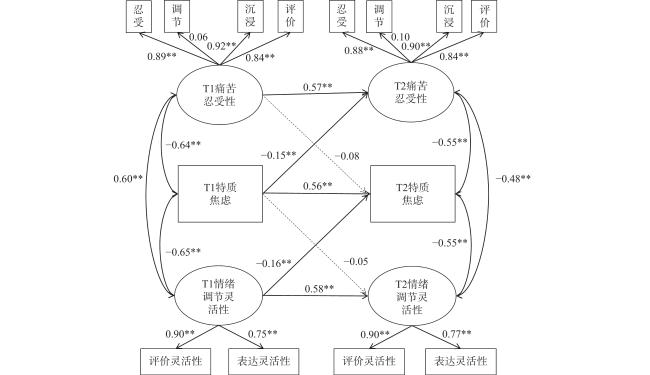
图1 交叉滞后模型分析结果

4 讨论

本研究发现,情绪调节灵活性、痛苦忍受性与特质焦虑之间的预测关系存在差异:情绪调节灵活性能够预测未来的特质焦虑,但特质焦虑无法预测未来的情绪调节灵活性;特质焦虑能够预测未来的痛苦忍受性,但痛苦忍受性无法预测未来的特质焦虑。这证实了情绪调节灵活性与痛苦忍受性相互独立,分别属于认知功能与认知内容范畴。

4.1 特质焦虑与情绪调节灵活性的关系

交叉滞后模型检验结果发现,T1情绪调节灵活性能够显著预测T2特质焦虑,而T1特质焦虑不能显著预测T2情绪调节灵活性。这表明随着时间的推移,情绪调节灵活性水平低的个体,其特质焦虑水平会升高,而个体的特质焦虑水平无法预测其情绪调节灵活性的水平。这符合脆弱性理论的观点:如果个体不能够充分考虑信息,做出更好的决策,长期使用无效的解决策略或情绪调节策略会导致特质焦虑的发生或发展(Zainal & Newman, 2022)。持久性的认知功能脆弱是导致特质焦虑恶化的重要因素(Williams et al., 2017)。这可能是因为认知功能不足会导致个体沉浸在消极信息中,难以考虑到新信息以采取更优的认知决策,个体难以对压力事件做出最佳决策,而采取非适应性应对策略,导致个体难以从压力事件中脱离出来,加剧个体的特质焦虑(Grimm et al., 2021)。
Hofmann等人(2012)提出的情绪失调模型认为,当外界的刺激与个体易感性相互作用时,会唤起个体的积极或消极的情绪反应,而唤起的情绪结果取决于个体的情感风格(affective style),代表高情绪调节灵活性的调整风格(adjusting style)往往更少地出现焦虑情绪(Cheng, 2001)。因为高情绪调节灵活性的个体能够根据当前情境选择恰当的情绪调节策略或根据情境的变化灵活转换不同的策略,获取更多的积极情绪,有效减少焦虑的产生(Specker & Nickerson, 2024)。有研究也证实,在长期的压力环境下,个体根据情境和情绪强度切换情绪调节策略,更能够有效降低焦虑情绪(王小琴, 2021)。不仅如此,根据情境需求灵活转换各种情绪调节策略,这意味着更有效的情绪调节和长期的、较少的情绪困扰,有利于防止焦虑情绪的积累,降低特质焦虑加剧的风险(Conroy et al., 2020)。但低情绪调节灵活性的个体则因为缺乏情绪调节的技能,存在单一的情绪调节倾向,情绪调节效果不佳,这可能会使个体关注到先前未被关注的情绪信息,对当前情绪体验更加厌恶或者产生意想不到的情绪,因此,个体需要用担忧或不适当的行为策略来控制情绪,导致特质焦虑的维持或加剧(Mennin et al., 2002)。情绪调节灵活性还能够帮助个体在面对压力事件时,表现出更多的适应性行为,减弱压力反应,减少负性情绪的持续时间,缓冲压力事件所带来的伤害,减少焦虑的产生(Krkovic et al., 2018; Zhu & Deng, 2023)。

4.2 特质焦虑与痛苦忍受性的关系

交叉滞后模型检验结果发现,T1特质焦虑纵向预测T2痛苦忍受性显著,而T1痛苦忍受性不能显著预测T2特质焦虑。这表明随着时间的推移,特质焦虑水平高的个体,其痛苦忍受性会下降,而个体的痛苦忍受性水平无法预测其特质焦虑的水平。
这与以往的研究结果相似:对情绪(包括但不限于焦虑)更敏感的人会更强烈地经历痛苦,使得忍受痛苦变得更加困难(Nock et al., 2008);高特质焦虑的个体会频繁地经历焦虑,这使得个体的痛苦忍受性下降(Gallego et al., 2020)。这是因为特质焦虑作为一种稳定的人格特质,对个体的信念和态度等认知内容形成具有稳定的倾向性的推动作用(Gundogdu et al., 2017),痛苦忍受性是个体对痛苦感受的态度,同样受人格特质的影响。一方面,高特质焦虑的个体更多地以导致焦虑的方式评估事件(姚雨佳 等, 2019),因此会经历更多焦虑情绪,更频繁地调节情绪。其情绪调节的执行和调节效果还会因为特质焦虑所引起的认知偏向所降低(Franklin et al., 2018; Gilbert, 2012)。并且一段时间内频繁的消极情绪以及情绪管理都会消耗个体的自我资源,自我管理能力以及自我管理努力都会下降(Muraven & Baumeister, 2000; Veilleux et al., 2022),个体管理痛苦的自我效能感会降低,导致高特质焦虑的个体会更倾向于将痛苦评价为“难以忍受”(Veilleux, 2019)。另一方面高特质焦虑个体在面对消极情境,将注意力从任务转移到威胁信息上,导致注意力偏离(Puliafico & Kendall, 2006)。这种注意偏离可能是由于个体对威胁信息的注意定向加速,以及在注意解除上的困难(张禹 等, 2014),因此在面对消极情境时难以调整自己的行为、情绪和认知反应以适应痛苦(Wang et al., 2019)。

4.3 研究不足与展望

本研究还存在以下不足:第一,本研究的测量时间间隔为6个月,仅在两个时间点进行了追踪。由于时间间隔较短,调查次数较少,可能无法有效观察到学生在特质焦虑、情绪调节灵活性和痛苦忍受性方面的变化过程。未来的研究可以通过延长时间间隔或增加更多时间点,以更深入地探讨特质焦虑分别与情绪调节灵活性、痛苦忍受性之间的关系。第二,本研究仅采用了状态−特质焦虑量表的特质焦虑分量表作为测量工具,未能考虑到状态焦虑作为个体在特定情境下的情绪体验,其波动性可能会影响被试的问卷填写。未来的研究可加入状态焦虑的测量数据进行控制,以更准确地分析特质焦虑分别与情绪调节灵活性、痛苦忍受性之间的关系。第三,本研究采用群体抽样的招募方式,选取样本的代表性不具有广泛性,且来自同一群体的个体可能具有相似的特征,这可能会影响统计分析的结果。因此未来研究可以在样本群体的选择上,使用其他抽样方法招募被试,使得研究结果的推广性得到提升。

5 结论

本研究通过交叉滞后模型分析发现:(1)情绪调节灵活性低会导致负性情绪的保持或加剧,从而致使特质焦虑加剧。(2)高特质焦虑的个体会更多地关注消极信息,感知到更多的痛苦,且在频繁地管理情绪后,自我资源不足,导致其会认为自己管理痛苦的能力下降,痛苦忍受性降低。
黄敏儿, 唐淦琦, 易晓敏, 孙莎莎. 中庸致和: 情绪调节灵活性的作用. 中国社会心理学评论, 2014, (2): 88- 112.

李文利, 钱铭怡. 状态特质焦虑量表中国大学生常模修订. 北京大学学报(自然科学版), 1995, 31 (1): 108- 112.

孙丽萍, 鞠佳雯, 蒋柳青, 边玉芳. 父母心理控制与青少年焦虑的关系: 一项交叉滞后研究. 心理发展与教育, 2018, 34 (6): 758- 768.

王碧瑶, 张敏强, 张洁婷, 胡俊, 攸佳宁, 梁耀坚. 青少年自我伤害行为的潜在转变分析: 一项纵向研究. 心理科学, 2015, 38 (6): 1368- 1376.

王小琴. (2021). 负性情绪调节灵活性的适应性及其认知神经基础(博士学位论文), 西南大学, 重庆.

杨振华, 焦世元, 董薇, 肖婕, 蔡文鹏, 田彬, 严进. 高、低特质焦虑军校学员的认知情绪调节策略、应对方式和焦虑的现况调查. 第三军医大学学报, 2016, 38 (20): 2215- 2218.

姚雨佳, 宣雨阳, 齐常辉, 桑标. 自动化情绪调节策略对特质焦虑大学生应激反应的影响. 心理科学, 2019, 42 (1): 209- 215.

张禹, 罗禹, 赵守盈, 陈维, 李红. 对威胁刺激的注意偏向: 注意定向加速还是注意解除困难. 心理科学进展, 2014, 22 (7): 1129- 1138.

郑晓华, 李延知. 状态-特质焦虑问卷. 中国心理卫生杂志, 1997, 11 (4): 219- 220.

DOI

周浩, 龙立荣. 共同方法偏差的统计检验与控制方法. 心理科学进展, 2004, 12 (6): 942- 950.

DOI

Aguirre, P., Michelini, Y., Bravo, A. J., Pautassi, R. M., & Pilatti, A. Association between personality traits and symptoms of depression and anxiety via emotional regulation and distress tolerance. PLoS One, 2024, 19 (7): e0306146.

DOI

Allan, N. P., Macatee, R. J., Norr, A. M., & Schmidt, N. B. Direct and interactive effects of distress tolerance and anxiety sensitivity on generalized anxiety and depression. Cognitive Therapy and Research, 2014, 38 (5): 530- 540.

DOI

Amstadter, A. Emotion regulation and anxiety disorders. Journal of Anxiety Disorders, 2008, 22 (2): 211- 221.

DOI

Bardeen, J. R., Tull, M. T., Dixon-Gordon, K. L., Stevens, E. N., & Gratz, K. L. Attentional control as a moderator of the relationship between difficulties accessing effective emotion regulation strategies and distress tolerance. Journal of Psychopathology and Behavioral Assessment, 2015, 37 (1): 79- 84.

DOI

Bonanno, G. A., & Burton, C. L. Regulatory flexibility: An individual differences perspective on coping and emotion regulation. Perspectives on Psychological Science, 2013, 8 (6): 591- 612.

DOI

Cheng, C. Assessing coping flexibility in real-life and laboratory settings: A multimethod approach. Journal of Personality and Social Psychology, 2001, 80 (5): 814- 833.

DOI

Chowdhury, N., Kevorkian, S., Hawn, S. E., Amstadter, A. B., Dick, D., Kendler, K. S., & Berenz, E. C. Associations between personality and distress tolerance among trauma-exposed young adults. Personality and Individual Differences, 2018, 120, 166- 170.

DOI

Conroy, K., Curtiss, J. E., Barthel, A. L., Lubin, R., Wieman, S., Bui, E., … Hofmann, S. G. Emotion regulation flexibility in generalized anxiety disorder. Journal of Psychopathology and Behavioral Assessment, 2020, 42 (1): 93- 100.

DOI

Franklin, P., Tsujimoto, K. C., Lewis, M. E., Tekok-Kilic, A., & Frijters, J. C. Sex differences in self-regulatory executive functions are amplified by trait anxiety: The case of students at risk for academic failure. Personality and Individual Differences, 2018, 129, 131- 137.

DOI

French, N. J., Eberle, J. W., & Teachman, B. A. (2022). Anxiety sensitivity, distress intolerance, and negative interpretation bias strengthen the relationship between trait anxiety and depersonalization. Anxiety, Stress, & Coping, 35(4), 395–408.

Gallego, A., McHugh, L., Villatte, M., & Lappalainen, R. Examining the relationship between public speaking anxiety, distress tolerance and psychological flexibility. Journal of Contextual Behavioral Science, 2020, 16, 128- 133.

DOI

Gilbert, K. E. The neglected role of positive emotion in adolescent psychopathology. Clinical Psychology Review, 2012, 32 (6): 467- 481.

DOI

Goodhew, S. C., & Edwards, M. Elevated cognitive failures in trait anxiety. Personality and Individual Differences, 2024, 216, 112418.

DOI

Goodman, F. R., Daniel, K. E., Eldesouky, L., Brown, B. A., & Kneeland, E. T. How do people with social anxiety disorder manage daily stressors? Deconstructing emotion regulation flexibility in daily life. Journal of Affective Disorders Reports, 2021, 6, 100210.

DOI

Grimm, E., Agrigoroaei, S., Rohleder, N., & Becker, L. Executive functioning as a predictor of physiological and subjective acute stress responses in non-clinical adult populations: A systematic literature review and meta-analysis. Neuroscience & Biobehavioral Reviews, 2021, 131, 1096- 1115.

Gross, J. J., & Thompson, R. A. (2007). Emotion regulation: Conceptual foundations. In J. J. Gross (Ed.), Handbook of emotion regulation (pp. 3–24). New York: Guilford Press.

Gundogdu, D., Finnerty, A. N., Staiano, J., Teso, S., Passerini, A., Pianesi, F., & Lepri, B. Investigating the association between social interactions and personality states dynamics. Royal Society Open Science, 2017, 4 (9): 170194.

DOI

Heinrichs, R. W. The duality of human cognition: Operations and intentionality in mental life and illness. Neuroscience & Biobehavioral Reviews, 2020, 108, 139- 148.

Hemi, A., Sopp, M. R., Bonanno, G., Michael, T., McGiffin, J., & Levy-Gigi, E. (2024). Flexibility predicts chronic anxiety and depression during the first year of the COVID-19 pandemic—A longitudinal investigation of mental health trajectories. Psychological Trauma: Theory, Research, Practice, and Policy, 16(6), 961–970.

Hofmann, S. G., Sawyer, A. T., Fang, A., & Asnaani, A. Emotion dysregulation model of mood and anxiety disorders. Depression and Anxiety, 2012, 29 (5): 409- 416.

DOI

Kim, M. S. Psychiatric symptoms and emotion regulation strategies among the unemployed people in Korea: A latent profile analysis. PLoS One, 2020, 15 (8): e0236937.

DOI

Kraemer K. M., Luberto C. M., & McLeish A. C. (2013). The moderating role of distress tolerance in the association between anxiety sensitivity physical concerns and panic and PTSD-related re-experiencing symptoms. Anxiety, Stress, and Coping, 26(3), 330–342.

Krkovic, K., Clamor, A., & Lincoln, T. M. Emotion regulation as a predictor of the endocrine, autonomic, affective, and symptomatic stress response and recovery. Psychoneuroendocrinology, 2018, 94, 112- 120.

DOI

Lee, S. Y., Park, C. L., & Russell, B. S. Does distress tolerance interact with trait anxiety to predict challenge or threat appraisals. Personality and Individual Differences, 2018, 132, 14- 19.

DOI

Lilienfeld, S. O. (1996). Anxiety sensitivity is not distinct from trait anxiety. In R.M. Rapee (Ed.), Current Controversies in the Anxiety Disorders (pp. 228–244). New York: Guilford Press.

Mecha, P., Rodriguez‐Morales, M., & Sanchez‐Lopez, A. Components of hot and cold executive functions and their relations to different forms of stress resilience: A systematic review. Stress and Health, 2024, 40 (5): e3439.

DOI

Mennin, D. S. Emotion regulation therapy for generalized anxiety disorder. Clinical Psychology & Psychotherapy: An International Journal of Theory & Practice, 2004, 11 (1): 17- 29.

Mennin, D. S., Heimberg, R. G., Turk, C. L., & Fresco, D. M. Applying an emotion regulation framework to integrative approaches to generalized anxiety disorder. Clinical Psychology: Science and Practice, 2002, 9 (1): 85- 90.

DOI

Michel, N. M., Rowa, K., Young, L., & McCabe, R. E. Emotional distress tolerance across anxiety disorders. Journal of Anxiety Disorders, 2016, 40, 94- 103.

DOI

Miranda, R., Fontes, M., & Marroquín, B. Cognitive content-specificity in future expectancies: Role of hopelessness and intolerance of uncertainty in depression and GAD symptoms. Behaviour Research and Therapy, 2008, 46 (10): 1151- 1159.

DOI

Muraven, M., & Baumeister, R. F. Self-regulation and depletion of limited resources: Does self-control resemble a muscle. Psychological Bulletin, 2000, 126 (2): 247- 259.

DOI

Nicol, A., Mak, A. S., Murray, K., Walker, I., & Buckmaster, D. The relationships between early maladaptive schemas and youth mental health: A systematic review. Cognitive Therapy and Research, 2020, 44 (4): 715- 751.

DOI

Nock, M. K., Wedig, M. M., Holmberg, E. B., & Hooley, J. M. The Emotion Reactivity Scale: Development, evaluation, and relation to self-injurious thoughts and behaviors. Behavior Therapy, 2008, 39 (2): 107- 116.

DOI

Ocañez, K. L. S., McHugh, R. K., & Otto, M. W. A meta-analytic review of the association between anxiety sensitivity and pain. Depression and Anxiety, 2010, 27 (8): 760- 767.

DOI

Pruessner, L., Barnow, S., Holt, D. V., Joormann, J., & Schulze, K. A cognitive control framework for understanding emotion regulation flexibility. Emotion, 2020, 20 (1): 21- 29.

DOI

Puliafico, A. C., & Kendall, P. C. Threat-related attentional bias in anxious youth: A review. Clinical Child and Family Psychology Review, 2006, 9 (3–4): 162- 180.

DOI

Rabner, J. C., Ney, J. S., & Kendall, P. C. Cognitive functioning in youth with anxiety disorders: A systematic review. Clinical Child and Family Psychology Review, 2024, 27 (2): 357- 380.

DOI

Ranney, R. M., Berenz, E., Rappaport, L. M., Amstadter, A., Dick, D., & Spit for Science Working Group. Anxiety sensitivity and distress tolerance predict changes in internalizing symptoms in individuals exposed to interpersonal trauma. Cognitive Therapy and Research, 2022, 46 (1): 217- 231.

DOI

Reitzel, L. R., Smith, N. G., Obasi, E. M., Forney, M., & Leventhal, A. M. Perceived distress tolerance accounts for the covariance between discrimination experiences and anxiety symptoms among sexual minority adults. Journal of Anxiety Disorders, 2017, 48, 22- 27.

DOI

Reynolds, A., MacLeod, C., & Grafton, B. The role of expectancies and selective interrogation of information in trait anxiety-linked affect when approaching potentially stressful future events. Behaviour Research and Therapy, 2024, 179, 104568.

DOI

Riskind, J. H. Unscrambling the dynamics of danger: Scientific foundations and evidence for the looming vulnerability model and looming cognitive style in anxiety. Cognitive Therapy and Research, 2024, 48 (5): 808- 832.

DOI

Sanchez-Lopez, A. How flexible are we in regulating our emotions? A discussion on current conceptual frameworks of emotion regulation flexibility, requirements for future research and potential practical implications. The Spanish Journal of Psychology, 2021, 24, e31.

DOI

Shangguan, C. Y., Wang, Y. L., Wang, X., Zhang, L. H., & Zhou, B. P. The more anxious, the less flexible? Association of trait anxiety with expressive flexibility and the mediating role of emotion regulation strategies. Current Psychology, 2024, 43 (32): 26121- 26133.

DOI

Sifat, M. S., Ehlke, S. J., Ogunsanya, M., Frank-Pearce, S. G., Boozary, L. K., Alexander, A. C., ... Kendzor, D. E. Greater discrimination frequency and lower distress tolerance are associated with mental health problems among racially privileged and minoritized adults accessing an urban day shelter. Journal of Racial and Ethnic Health Disparities, 2024, 11 (1): 45- 61.

DOI

Slee, N., Garnefski, N., Spinhoven, P., & Arensman, E. The influence of cognitive emotion regulation strategies and depression severity on deliberate self-harm. Suicide and Life-Threatening Behavior, 2008, 38 (3): 274- 286.

DOI

Soleimani, M. A., Pahlevan Sharif, S., Bahrami, N., Yaghoobzadeh, A., Allen, K. A., & Mohammadi, S. The relationship between anxiety, depression and risk behaviors in adolescents. International Journal of Adolescent Medicine and Health, 2019, 31 (2): 20160148.

Specker, P., & Nickerson, A. (2024). Investigating the effectiveness of instructing emotion regulation flexibility to individuals with low and high anxiety. Anxiety, Stress, & Coping, 37(1), 143–156.

Tull, M. T., & Aldao, A. Editorial overview: New directions in the science of emotion regulation. Current Opinion in Psychology, 2015, 3, iv- x.

DOI

Unbrin, A., Khanum, S., Shahzadi, M., & Imtiaz, M. Associates of distress tolerance among adolescents: Role of anger, worry and sadness. Pakistan Journal of Humanities and Social Sciences, 2024, 12 (1): 79- 86.

Veilleux, J. C. The relationship between distress tolerance and cigarette smoking: A systematic review and synthesis. Clinical Psychology Review, 2019, 71, 78- 89.

DOI

Veilleux, J. C., Hyde, K. C., & Clift, J. B. When is your distress harder to tolerate? A qualitative analysis of situations in which distress tolerance is impaired and strengthened. Journal of Contextual Behavioral Science, 2022, 23, 85- 91.

DOI

Wang, T., Li, M., Xu, S., Liu, B. T., Wu, T., Lu, F., ... Wang, J. Relations between trait anxiety and depression: A mediated moderation model. Journal of Affective Disorders, 2019, 244, 217- 222.

DOI

Williams, D. P., Feeling, N. R., Hill, L. K., Spangler, D. P., Koenig, J., & Thayer, J. F. Resting heart rate variability, facets of rumination and trait anxiety: Implications for the perseverative cognition hypothesis. Frontiers in Human Neuroscience, 2017, 11, 520.

DOI

You, J. N., & Leung, F. A Chinese adaptation of the distress tolerance scale among adolescents: Factor structure and psychometric properties. Journal of Psychopathology and Behavioral Assessment, 2012, 34 (1): 136- 144.

DOI

Zainal, N. H., & Newman, M. G. Executive functioning constructs in anxiety, obsessive-compulsive, post-traumatic stress, and related disorders. Current Psychiatry Reports, 2022, 24 (12): 871- 880.

DOI

Zhu, Y. T., & Deng, W. Moderating the link between discrimination and adverse mental health outcomes: Examining the protective effects of cognitive flexibility and emotion regulation. PLoS One, 2023, 18 (10): e0282220.

DOI

文章导航

/


版权所有 © 《心理与行为研究》编辑部
地址:天津市西青区宾水西道393号,天津师范大学106#邮箱 邮编:300387
电话:022-23540231, 23541213 E-mail:psybeh@126.com
本系统由北京玛格泰克科技发展有限公司设计开发