

1 引言
睡眠在知识学习和记忆巩固中扮演重要角色。研究表明,相较于清醒状态,睡眠有助于增强新词表征及其语义网络的整合,这一现象被称为睡眠依赖性记忆巩固(sleep-associated memory consolidation, 简称睡眠巩固)(Davis & Gaskell, 2009; Stickgold, 2005)。早期理论认为,睡眠主要通过减少外界干扰,对新编码但尚不稳定的记忆起到被动保护作用(Yonelinas et al., 2019)。之后研究通过考察其潜在神经机制,提出睡眠的主动巩固作用(complementary learning systems, CLS),认为在慢波睡眠期间,海马体可重放入睡前所学信息,并通过与新皮层的交互,将信息从海马的临时存储转移至皮层的长期存储系统,从而实现新词的整合(Davis & Gaskell, 2009)。已有新词学习研究支持CLS理论(Henderson et al., 2012),但也并未否定睡眠在防止干扰方面的被动保护作用(Mak & Gaskell, 2023; Payne et al., 2012)。然而,针对汉语这一独特的“拼义”文字系统(张学新, 2011),相关的睡眠巩固研究仍较为缺乏。
已有大量证据表明,在拼音文字母语者中,睡眠稳定促进新词词形的记忆巩固。在外显回忆任务中,睡眠后的回忆成绩显著提高,而清醒状态下同等时间间隔的成绩无显著差异,证明学习后睡眠对词形学习的促进作用(Dumay & Gaskell, 2007)。同时,睡眠还能促进新词与已有词汇系统的整合。例如通过修改真词末尾字母创建假词(如将“cathedral”改为“cathedruke”),采用检测词内是否存在停顿的范式,发现被试在睡眠后检测原词“cathedral”时反应时间变慢,表明新词在睡眠中被整合进了词汇系统,增强了词间竞争效应(Dumay & Gaskell, 2007)。此外,睡眠对词形记忆巩固的促进作用也在不同年龄群体和二语学习者中得到验证(彭芝琳 等, 2024; Henderson et al., 2012; James et al., 2020)。
关于睡眠对新词语义学习的影响,尽管已有研究通过不同学习材料和任务发现睡眠前后的语义表征提升优于相同间隔清醒的条件(Fletcher et al., 2020; Tham et al., 2015),但睡眠是否促进新词语义整合仍缺乏一致证据。例如,Hulme和Rodd(2023)通过将熟词赋予新义进行学习,并在语义相关性判断任务中评估其是否整合进原有语义网络,结果未发现睡眠对语义整合有明显促进作用,可能因任务敏感度不足或附带性词汇学习深度不够所致。因此,相较于已被广泛验证的词形学习,睡眠对新词语义整合的促进效应仍需借助更敏感的任务深入探究。
同时,现有研究多聚焦于学习后立即入睡的巩固效应,而对更常见的学习后延迟入睡的情境关注较少。James等(2020)比较了夜晚学习后立即睡眠(睡眠−清醒组)与清晨学习后延迟睡眠(清醒−睡眠组)对新词记忆的影响,其中所有被试在学习后分别进行立即、延迟12h和延迟24h的三次测试。结果显示立即睡眠可显著提升12h后的记忆表现,而期间保持清醒组无显著变化;同时24h后(vs.12h)测试中也观察到延迟睡眠的部分巩固效应,但不如立即睡眠影响广泛。此外,在1~2个月的更长延迟测试中,立即睡眠的优势仍然明显。该研究提示睡眠时机对巩固效果具有一定影响,但由于研究集中在记忆外显任务,尚缺乏对语义整合等内隐机制的探讨。
综上所述,现有研究主要集中在拼音文字系统,对于汉语这一独特书写系统下的新词睡眠巩固效应尚缺乏有力证据。汉语作为一种拼义符号系统文字(张学新, 2011),在新符号创造和概念形成的构词方法上,以不同于拼音语言的方式影响包括记忆和学习在内的认知过程(McBride, 2016)。其中汉语常通过将两个或多个现有语素结合起来,基于它们之间的语义关联,通过组合或比拟等手段来直指或喻指事物的方式等创造新词的含义(邵敬敏, 2016)。因此,学习者可以利用先验字词语义知识来促进对新词及其语义的掌握。有研究表明,先验知识经验的丰富程度是影响新词睡眠巩固效应的重要因素(James et al., 2019)。因此,本研究旨在考察汉语新词语义学习中的睡眠巩固效应。
尽管在汉语领域已有研究探讨不同认知任务或人群的睡眠巩固效应(彭芝琳 等, 2024; 孙鹏 等, 2022),但针对汉语新词学习的证据仍有限。董聪聪(2022)研究发现,学习12h后睡眠组在部分测试中表现优于清醒组,但因未设置学习后立即测试,难以排除初始学习差异的影响。此外,其通过判断图片或词语是否构成同一主题的学习方式,难以确保新词语义掌握,限制了结果在更普遍的有意识且语义明确的新词学习情境中的推广。
为此,当前研究采用睡眠−清醒组和清醒−睡眠组的研究范式,通过设置立即、延迟12h和24h的三次测试,考察汉语新词语义学习中的立即睡眠和延迟睡眠的巩固效应。使用动物古代雅称的罕见真词为学习材料,以提高学习内容的生态效度;并采用接近日常词语学习的方式,明确学习中形−音−义的连接。在记忆测试中,采用传统测量新词识别回忆的外显测试任务(如定义任务和图片命名任务),考察睡眠对新词语义表征的作用;同时采用内隐的动物体型大小判断任务,旨在评估睡眠对新词语义整合到长时语义系统中的影响。该任务基于以下假设:如果学习者能将新学的动物雅称整合进已有语义网络,那么在判断两个体型相近的动物时,会比判断体型差异较大的动物更困难,表现为反应时间更长、正确率更低,即出现语义距离效应。这一效应已被证实能够在大小判断时自动激活语义信息,因此可以作为衡量新词语义整合程度的指标(Moyer, 1973; Rubinsten & Henik, 2002)。
本研究预期,如汉语新词语义学习存在睡眠巩固效应,则睡眠−清醒组在12h测试中(相较立即测试)因夜间睡眠,将比同等时间间隔保持清醒的清醒−睡眠组表现出更大的记忆提升,即立即睡眠巩固;清醒−睡眠组在24h测试中(相较12h)也应因睡眠,比期间保持清醒的睡眠−清醒组表现出更大受益,即延迟睡眠巩固。更重要的是,基于主动巩固观点预测:学习后立即入睡有助于稳定记忆痕迹,增强其抵抗后续干扰的能力,因此24h后睡眠−清醒组应优于清醒−睡眠组(Payne et al., 2012);而被动保护理论则认为两组在清醒和睡眠总量相当的情况下应无显著差异,即立即睡眠巩固效应在24h后消失(Antony & Paller, 2018)。
2 研究方法
2.1 被试
共44名天津师范大学非心理学专业的在校生参加本实验,其中3名被试未能按流程完成完整的实验,最终睡眠−清醒组22人、清醒−睡眠组19人。在R语言环境中,使用SIMR包进行线性混合模型power的模拟计算(Green & MacLeod, 2016)。以预实验中10名被试在不同测试任务的正确率数据模拟分析,显示当每组被试数量达到12人时,可以在至少80%的power下检测到关键指标的显著性效应,当前被试数量满足要求。所有被试母语均为汉语,视力或者矫正视力正常,无精神疾病和睡眠障碍且睡眠习惯良好,均不知晓实验目的。完成实验后被试得到适当报酬。本研究得到天津师范大学科学研究伦理委员会的批准(批准号:2023092803)。
2.2 实验材料
选取古籍记载的9种动物雅称作为新词材料,分别对应:元贵(螃蟹)、河海(青蛙)、银玉(蝴蝶)、明视(兔子)、日山(鸡)、福孙(狗)、白义(马)、吉品(羊)、汉云(牛)。为赋予这些新词独特新意,并使后续测试能精确探究语义整合,每个雅称都指向其类别中具有独特特征的一种动物,例如,“明视”指大耳朵垂耳兔,“元贵”指一只钳子大一只钳子小的招潮蟹。每个雅称都配有一张代表动物的图片,明确显示该动物唯一显著的特征,如图1 所示。
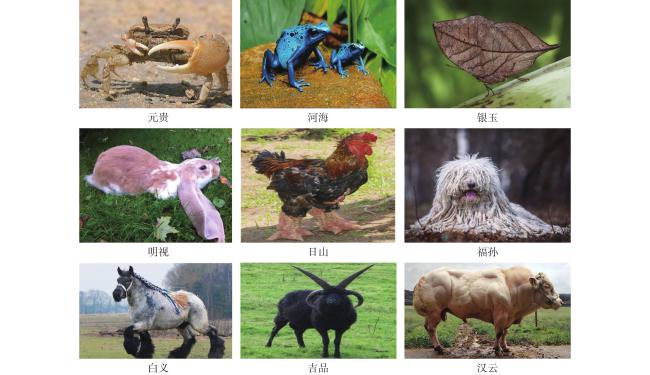
为确保被试对选定的9个动物雅称均不熟悉,由38名未参与正式实验的被试进行线上材料评估。被试在查看动物图片时,需回答图中是什么动物、其最显著的特征是什么,以及是否知道该动物在中国古代的雅称(若知道,需填写名称)。结果显示所有被试均能正确识别动物及其显著特征,但不知道其对应的古代雅称。另外考虑到大小判断任务要求被试基于动物的体型进行判断,研究之前将9种动物划分为小、中、大三类,并通过10点评估(1代表“最小”,10代表“最大”),统计结果表明小、中、大分类存在显著差异[F(2, 35)=4.97, p=0.003]。大小判断任务分为大语义距离和小语义距离判断两类条件,其中大语义距离指大体型与小体型动物之间的比较;小语义距离则指大/小体型与中体型动物的比较。
2.3 实验程序
实验程序分为学习和测试两个阶段,详见图2 。
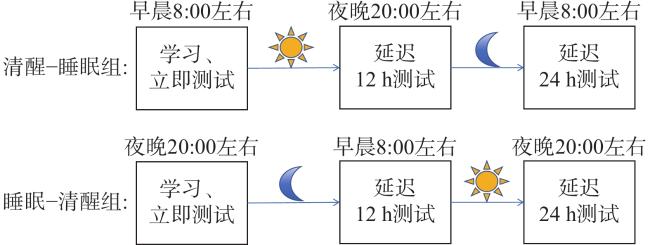
学习阶段:两组被试分别在睡前和醒后学习9个动物雅称。每个雅称重复学习12次,首两次呈现时,动物雅称词形在屏幕上显示五秒,同时播放对应的音频,要求被试跟读两次,随后呈现相应动物图片。接下来的两次,仅呈现词形五秒,要求被试大声读出,然后再呈现动物图片。在随后的八次学习中,被试需进行图词匹配任务,四次为从两张动物图片中选择与给定词形匹配的图片;另四次为从两个词形中选择与给定图片匹配的词形。学习阶段约需15分钟。
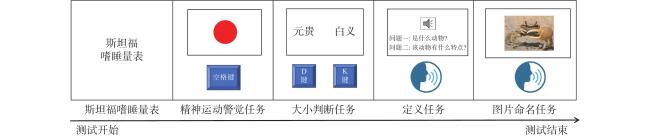
测试阶段包括五项任务,评估主观和客观清醒度的斯坦福嗜睡量表(Hoddes et al., 1973)和精神运动警觉任务(Basner et al., 2011),以及新词语义整合的大小判断任务、测试新词表征的定义任务和快速命名任务(Fletcher et al., 2020)。具体如下:(1)斯坦福嗜睡量表:要求被试在测试开始时填写纸质斯坦福嗜睡量表,以测量主观警觉性,持续约1分钟。(2)精神运动警觉任务:要求被试对屏幕不定时出现的红色圆形尽快按下空格键,测量客观警觉性,持续约3分钟。(3)大小判断任务:在屏幕上呈现一对动物名称,被试需要选择其中体型较大的动物,任务持续约5分钟。(4)定义任务:通过屏幕呈现音频和问题,测试被试对新词和特征信息的记忆,持续约3分钟,答案由主试手动记录。(5)图片命名任务:屏幕呈现动物图片,要求被试说出相应的雅称,记录正确率,持续约3分钟。测试任务呈现顺序如图3 所示。其中斯坦福嗜睡量表为纸笔测验,其余任务均在E-Prime3.0中完成。另外选取9种熟悉动物名称(以下简称熟悉词)作为大小判断任务的填充材料,填充材料通过线上问卷评定动物体型大小,同样划分成小、中、大三个等级。
2.4 数据分析
数据分析采用线性混合效应模型(linear mixed model, LMM),基于R语言环境下的lme4包提供的lmer函数进行分析(Bates et al., 2023)。对连续变量的数据进行log转换,采用LMM模型,对二分变量数据则使用GLMM进行分析。针对每个因变量构建一个模型,使用MASS包中的contr.sdif函数(Venables & Ripley, 2002)对因子水平进行对比编码。具体在定义任务和图片命名任务中,将组别、测试阶段以及各因素交互作用作为固定效应分析,指定被试和项目作为交叉随机效应;在大小判断任务中,将组别、测试阶段、语义距离以及各因素交互作用作为固定因素进行分析,指定被试和项目作为交叉随机效应。由于研究主要关注新词语义整合中的睡眠作用,结果部分主要报告语义距离的主效应,以及语义距离与组别和阶段的交互作用。所有模型先采用最大化随机效应结构模型,当模型出现不拟合时,首先去除因子之间的相关性,然后是项目的交互作用及被试的交互作用,最后是斜率,逐级递减直到拟合为止(Liu et al., 2021)。所有因变量指标都进行三个标准差的极端值处理,此外大小判断任务中的反应时分析排除了错误反应试次。
3 结果
为考察被试在不同时间点是否存在觉醒状态的差异,以斯坦福嗜睡量表得分和精神运动警觉任务反应时间作为因变量,采用2(组别:睡眠−清醒组、清醒−睡眠组)×3(测试时段:立即、延迟12h、延迟24h)的重复测量方差分析。结果显示,在精神运动警觉任务反应时间上存在显著的测试时段主效应[F(2, 38)=3.47, p<0.05],具体表现为立即测试的反应时与延迟12h存在显著差异(t=−2.76, p<0.01),而立即测试与延迟24h(t=−0.69, p>0.05),以及延迟12h与延迟24h(t=1.90, p>0.05)均不存在显著差异;其他效应均不显著(Fs<2.25, ps>0.05)。而在斯坦福嗜睡量表得分上各效应无显著差异(Fs<0.85, ps>0.05)。同时鉴于Blatter和Cajochen(2007)发现觉醒度会影响认知和学习效率,后续分析将精神运动警觉任务反应时间作为协变量,对其进行控制。
3.1 定义任务结果
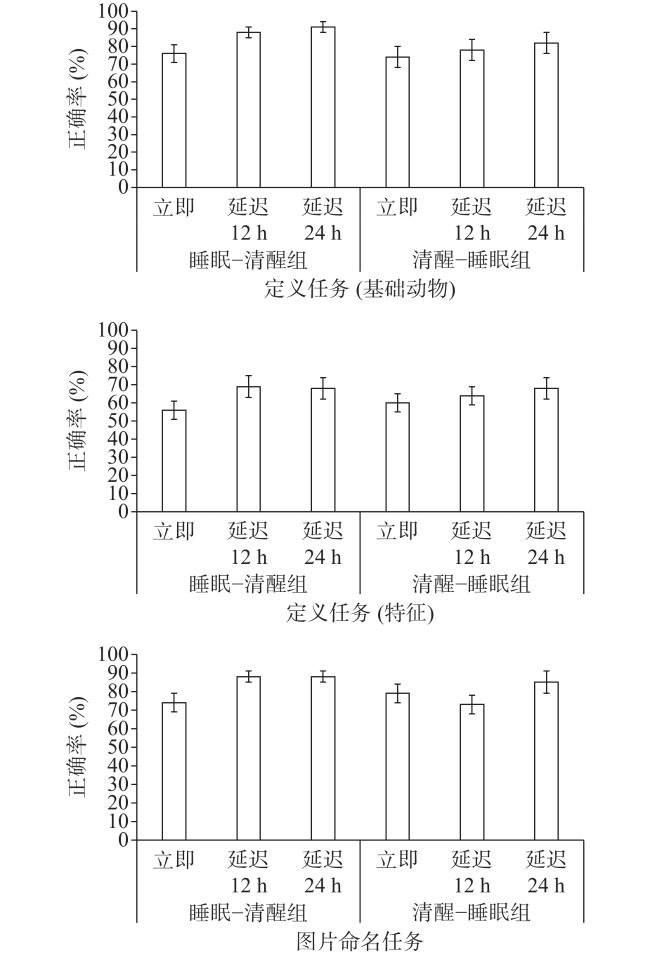
在基础动物正确率和特征正确率指标上得到相似的结果模式(见图4 )。测试阶段主效应显著,表现为延迟12 h和24 h都比立即测试具有显著更高的正确率(zs>3.26, ps<0.001)。测试立即vs.延迟12 h和组别的交互作用边缘显著(zs>1.69, ps<0.10),测试立即vs.延迟24 h和组别的交互作用显著(zs>1.92, ps<0.05)。简单效应分析显示,睡眠−清醒组比清醒−睡眠组在延迟12h后的测试上(相比立即测试)变化程度更大,具体表现为睡眠−清醒组的成绩显著提升(zs<−3.52, ps<0.01),而清醒−睡眠组则无显著变化(zs<−1.06, ps>0.05);同样睡眠−清醒组比清醒−睡眠组在延迟24 h后(相比立即测试)的表现变化程度更大,具体表现为睡眠−清醒组的表现显著提升(zs<−3.11, ps<0.01),而清醒−睡眠组则均无显著提升(zs<−1.72, ps>0.05)。测试延迟12 h vs. 延迟24 h和组别交互作用不显著(zs<0.84, ps>0.05),表明两组在延迟12 h和24 h记忆同等程度变化。
3.2 图片命名任务结果
结果显示(见图4 ):测试阶段主效应显著,表现为延迟12 h和24 h测试比立即测试都具有显著更高的正确率(|z|s>2.02, ps<0.05),而延迟24 h比12 h也具有显著更高的正确率(z=2.04, p<0.05)。测试阶段和组别的交互作用显著(组别×测试立即vs.延迟12 h: z=−4.05, p<0.001; 组别×测试延迟12 h vs.延迟24 h: z=2.19, p<0.05)。简单效应分析显示,睡眠−清醒组比清醒−睡眠组在延迟12 h后的测试上(相比立即测试)变化程度更大,具体表现为睡眠−清醒组的成绩显著提升(z=−4.25, p<0.001),而清醒−睡眠组则无显著变化(z=1.42, p>0.05);清醒−睡眠组比睡眠−清醒组在延迟24 h后测试上(相比延迟12 h)的变化程度更大,具体表现为清醒−睡眠组的表现显著提升(z=−3.01, p<0.05),而睡眠−清醒组没有显著变化(z=0.10, p>0.05)。测试立即vs.延迟24 h和组别交互作用不显著(组别×测试立即vs.延迟24 h: z=−1.59, p>0.05),表明两组在延迟24 h后的成绩(相比立即测试)变化程度相当。
3.3 大小判断任务结果
(1)正确率结果显示(见图5 ):语义距离主效应显著,表现为大语义距离的正确率显著大于小语义距离(z=−7.35, p<0.001)。语义距离与组别和测试的三重交互作用显著,首先结果显示语义距离×组别×测试立即vs.延迟24 h三者交互作用显著(z=4.45, p<0.001),表现为清醒−睡眠组比睡眠−清醒组在延迟24 h后的测试上(相比立即测试)语义距离效应变化程度更大,具体分析显示在睡眠−清醒组中,立即测试和延迟24 h测试的语义距离主效应显著(zs>4.31, ps<0.001),但立即测试的语义距离(7%)与延迟24 h测试的语义距离(8%)无显著差异(z=1.02, p>0.05),表明睡眠−清醒组从立即至延迟24 h语义整合程度无显著变化;在清醒−睡眠组中,立即测试和延迟24 h测试的语义距离效应也均显著(zs>4.56, ps<0.001),且立即测试的语义距离(14%)显著大于延迟24 h的语义距离(5%)(z=4.25, p<0.001),表明从立即至延迟24 h语义整合程度增加。同样结果显示语义距离×组别×测试延迟12 h vs.延迟24 h三者交互作用显著(z=3.36, p<0.001),表现为清醒−睡眠组比睡眠−清醒组在延迟24 h后的测试上(相比延迟12 h),语义距离效应变化程度更大,具体分析显示睡眠−清醒组在延迟12 h到24 h期间保持清醒状态后语义整合程度无显著变化(延迟12 h的语义距离为6%,延迟24 h的语义距离为8%)(z=1.32, p>0.05),清醒−睡眠组在延迟12 h到24 h期间保持睡眠状态后语义整合程度显著增加(延迟12 h的语义距离为11%,延迟24 h的语义距离为5%)(z=3.79, p<0.001),表明延迟睡眠促进了语义整合,特别是表现在对小语义距离条件下的判断正确率升高程度更大。其他效应均不显著。
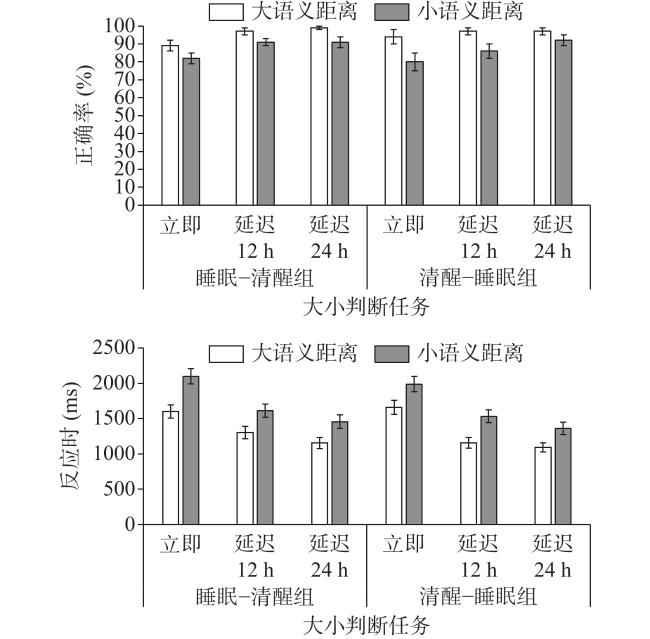


(2)反应时结果显示(见图5 ):语义距离主效应显著,表现为大语义距离的反应时显著短于小语义距离(t=12.30, p<0.001)。语义距离与组别和测试阶段的三重交互作用显著(语义距离×组别×测试立即vs.延迟12 h: t=2.97, p<0.001),表现为睡眠−清醒组比清醒−睡眠组在延迟12 h后的测试上(相比立即)语义距离效应变化程度更大,具体分析显示在睡眠−清醒组中,立即测试和延迟12 h测试的语义距离主效应分别都显著(ts>5.60, ps<0.001),表明新词独立表征在学习后可以快速被整合进语义系统,同时立即测试的语义距离效应(501 ms)显著大于延迟12 h测试的语义距离效应(310 ms)(t=3.29, p<0.001),表明睡眠−清醒组在立即至延迟12 h期间维持睡眠状态后语义整合程度增加,特别是表现在小语义距离条件下反应速度的提高;在清醒−睡眠组中,立即测试和延迟12 h测试的语义距离主效应均显著(ts>7.93, ps<0.001),但是立即测试的语义距离效应(332 ms)和延迟12 h测试的语义距离效应(377 ms)无显著差异(t=0.31, p>0.05),表明清醒−睡眠在立即至延迟12 h期间维持清醒状态后语义整合程度无显著变化。其他效应均不显著。
总之,大小判断任务结果显示,立即和延迟睡眠能够促进新词语义整合。然而,仅在能够正确识记的项目中观察到显著的立即睡眠巩固效应,但这一效应未能显著延迟至24小时后。
4 讨论
本研究采用睡眠−清醒组和清醒−睡眠组范式,设置学习后立即、延迟12 h和24 h三次测试,探讨睡眠在汉语新词语义学习中的记忆巩固效应及其作用机制。结果显示,立即睡眠与延迟睡眠均能促进新词学习,但睡眠的巩固具有显著的任务依赖性,且通过主动巩固与被动保护双重机制实现。在定义任务中,学习后迅速进入睡眠所带来的巩固效应在24 h后依然显著,支持睡眠的主动巩固假设;在图片命名任务中不仅存在立即睡眠巩固,还观察到延迟睡眠巩固,但立即睡眠优势未能维持至24 h,更契合被动保护理论;在内隐大小判断任务中,立即与延迟睡眠均促进了语义整合,但同样缺乏能延续至24 h后的显著优势,这也更倾向于睡眠通过被动保护发挥作用。
本研究在汉语新词语义学习中不仅验证了经典的立即睡眠巩固效应,还发现延迟睡眠巩固效应。表现为无论是在学习后立即入睡(睡眠−清醒组)还是延迟12h后再睡(清醒−睡眠组),睡眠均能显著提升新词记忆表现。这表明在学习后一定时间范围内(至少12h内)的睡眠对词汇学习均产生了一定程度的促进作用。根据CLS理论模型,海马在编码新词时快速形成记忆痕迹,而为避免干扰大脑中已知词汇,新皮层系统则需在睡眠等“离线状态”中进行一个较慢的巩固过程。其中睡眠中的神经振荡活动能够促进词汇的积极整合与记忆保持(Davis et al., 2009);同时睡眠还通过减少外界干扰起到被动保护作用(Yonelinas et al., 2019)。
两种理论都能解释睡眠巩固现象,但对立即睡眠巩固及其延迟效应具有不同预测。主动巩固理论认为立即睡眠应带来更持久的优势;而被动保护理论则预测两组在24 h后无显著差异。研究发现,在定义任务中睡眠−清醒组在12 h和24 h后表现持续优于清醒−睡眠组,支持主动巩固;但在图片命名任务中两组表现相似,更符合被动保护解释;而在内隐大小判断任务中,虽然立即睡眠提升了反应速度,但24 h后该优势消失,亦更接近被动保护。该结果与Hulme和Rodd(2023)的发现一致:睡眠−清醒组和清醒−睡眠组在语义整合上无差异,说明立即睡眠可能主要提供了短期的干扰隔离。此外,研究指出,主动巩固更易作用于与先验知识相关、编码较弱或具有情绪意义的记忆,而被动保护则广泛适用于各类记忆(Mak & Gaskell, 2023)。本研究不同任务中睡眠效应的差异,揭示了睡眠既能在特定条件下强化整合(优先巩固),也普遍减少干扰(被动保护)的双重机制。
关于睡眠巩固的任务依赖性,已有研究也有佐证。Lipinska等(2019)对31项研究的元分析发现,睡眠对情绪图片的识别和自由回忆任务中的巩固效应更明显,并提出这可能与任务依赖的神经机制有关:自由回忆依赖海马活动,而基于识别的检索可能更多依赖额叶−皮层下通路。Cordi和Rasch(2021)指出,部分支持睡眠巩固的研究结果难以重复或只在特定条件下产生,可能因其效应小、对任务敏感。在本研究中,三类任务对睡眠巩固的依赖程度亦存在差异。定义任务要求被试根据词形回答所属动物类别及其典型特征,涉及复杂语义加工和网络整合,较易受到慢波睡眠中主动巩固机制影响;而图片命名任务依赖词图联结的稳定性,睡眠主要起到减少干扰的被动保护作用,故24h后由于两组的日间活动和夜间睡眠时间大致相同,组间差异消失。大小判断任务虽测量语义整合,但可能在学习后即已通过皮层快速完成整合(McClelland, 2013),体现在立即测试时便已观察到大小距离效应,削弱了对睡眠巩固的依赖。这与CLS理论预测一致:编码强度高或语义透明的新信息可被新皮层快速整合,减少对睡眠海马的依赖。同时也提示汉语拼义特性可能加速语义整合,缩短睡眠作用窗口。综上,任务类型影响睡眠巩固机制的表现。未来研究可通过操控语义加工深度、知识关联性或编码强度,进一步厘清主动巩固与被动保护的边界条件,并结合脑成像和生理指标(如慢波时长、纺锤波−慢振荡耦合强度等)开展跨任务比较,以更全面理解睡眠的双重巩固机制。
本研究还显示,在探讨汉语新词学习中的睡眠巩固效应时,需控制昼夜节律的影响。当前研究同时采用主观(斯坦福嗜睡量表)与客观(精神运动警觉任务)双重评估,结果显示昼夜节律对睡眠巩固效应存在一定影响,并在统计分析中得以控制。尽管已有研究(Fletcher et al., 2020; Hulme & Rodd, 2023)未发现昼夜节律的显著影响,但本研究中不同时间段被试觉醒状态确实存在差异,可能影响认知效率,提示未来需谨慎监测并纳入控制变量。此外,本研究采用与动物体型相关的大小判断任务评估语义整合,使用具有文化特色的动物古代雅称作为新词材料,证明了汉语新词学习存在显著睡眠巩固效应。根据Moyer(1973)的模型,体型相近动物表征相似判断更困难,表现为反应变慢、准确率下降;而语义差异大时判断更快和更准。本研究结果与Tham等(2015)和Fletcher等(2020)关于拼音文字和孤独症儿童的相关研究一致,支持该任务有效反映语义整合过程。尽管古代雅称提升了生态效度,但仍需考虑汉语语言构词特点和潜在记忆策略对睡眠巩固的影响。未来研究可比较人造假词与真词或操控语义透明性,以进一步验证汉语背景下睡眠巩固的独特性。
5 结论
在当前实验条件下,以汉语为母语的群体中发现新词语义学习中既存在立即睡眠巩固也存在延迟睡眠巩固,且该效应受任务类型、个体觉醒状态和记忆内容等因素影响。