

1 引言
定向遗忘(directed forgetting, DF)是个体指向性地并有意地遗忘信息的过程(王梦颖 等, 2021; Bjork, 1972)。常用范式是项目法定向遗忘范式。在学习阶段相继呈现学习项目和线索,要求被试根据线索对该项目进行记忆或遗忘。测试阶段进行回忆或再认,记忆项目的记忆成绩显著优于遗忘项目,即产生定向遗忘效应(Fellner et al., 2020)。情绪贬值(emotional devaluation)最早在选择性注意研究中被发现,指个体对干扰项目的情绪评价低于目标项目(Raymond et al., 2003; Raymond et al., 2005)。在认知抑制、反应抑制和压抑遗忘中被抑制的刺激也会产生情绪贬值(Clancy et al., 2019; De Vito & Fenske, 2017; Martiny-Huenger et al., 2014)。为考察定向遗忘中不同线索下项目的情绪评价差异,Vivas等人(2016)在项目法定向遗忘范式的线索呈现后要求被试评价学习项目。遗忘项目的评价低于记忆项目,即产生定向遗忘情绪贬值。
对于情绪贬值的形成原因,抑制贬值理论认为干扰物的情绪贬值是由于情绪评价重新激活了大脑对干扰物的注意抑制过程(Fenske & Raymond, 2006)。研究者通过比较干扰物与新项目的评价差异来考察干扰物的情绪贬值是否由抑制导致。具体地,呈现两个图案(目标和干扰物),要求被试判断目标的位置,之后对目标、干扰物或未呈现过的新图案进行情绪评分。对干扰物的评价小于目标,表明产生情绪贬值;对干扰物的评价小于新项目,表明贬值由注意抑制导致。Vivas等人(2016)认为,与注意抑制引起贬值类似,定向遗忘情绪贬值可能是个体对遗忘项目进行主动抑制导致。然而,该研究缺少遗忘项目与新项目的情绪评价比较,遗忘项目的情绪贬值是否由受到抑制导致尚不清楚。
与抑制贬值理论一致,情绪贬值与抑制强度有关:在Flanker任务中目标汉字和干扰物汉字的对称性不同(高干扰)比相同(低干扰)时,对干扰物的情绪评价更低(Martiny-Huenger et al., 2014)。然而,Vivas等人(2021)发现抑制能力较差的青少年和成人的定向遗忘情绪贬值效应无差异,认为贬值可能不完全由抑制驱动。与选择性注意不同,定向遗忘中的信息与不同线索联结,评价差异可能与线索有关。研究发现,给予目标刺激不同情感标签将导致不同的评价。Dittrich和Klauer(2012)在实验前告知被试目标图案是被印刷厂接受或拒绝的图案,随后进行目标搜索任务。当目标被接受,对干扰物的评价低于目标和新项目;当目标被拒绝,对目标的评价低于干扰物和新项目。定向遗忘中遗忘项目的情绪贬值是否由不同线索赋予中性信息不同属性导致仍不清楚。
本研究考察定向遗忘如何导致情绪贬值。实验1a在评价阶段增加新项目作为基线,通过比较遗忘项目和新项目的评价,考察遗忘项目的情绪贬值是否由抑制导致。如果遗忘项目评价小于新项目,表明抑制引起情绪贬值。实验1b在学习阶段增设无线索条件作为基线,通过比较记忆线索、遗忘线索和无线索条件下的评价,考察情绪贬值的产生是否由不同线索导致。如果无线索项目的评价低于记忆项目并高于遗忘项目,表明线索引起情绪贬值。
抑制贬值理论基于选择性注意提出(Raymond et al., 2003; Raymond et al., 2005)。实验1中项目法定向遗忘范式不包含注意选择过程,记忆和遗忘项目分别作为要求记忆和遗忘的目标相继并独立呈现。当记忆和遗忘项目同时呈现时,选择性注意能否促进定向遗忘情绪贬值尚不清楚。Tan等人(2020)提出选择性定向遗忘范式,在同时呈现两个项目后呈现两个线索:单一线索(R+R/F+F)同时记忆或同时遗忘两个项目,混合线索(R+F/F+R)记忆一个项目并遗忘另一个。相比单一线索,混合线索增加了注意选择过程。因此,实验2采用选择性定向遗忘范式,考察当记忆和遗忘项目存在注意资源竞争时,选择性注意是否促进定向遗忘的情绪贬值。
2 实验1a:项目法定向遗忘中的情绪贬值
2.1 研究方法
2.1.1 被试
使用G*Power3.1软件(Faul et al., 2007)计算样本量。使用2×3两因素重复测量实验设计,保证两因素交互效应量中等(f=0.25),设置α=0.05,至少需要28名被试才能达到95%的统计检验力(1−β)(De Vito et al., 2017)。选取33名在校大学生,视力或矫正视力正常。其中1名被试因虚报率过高(大于50%)被剔除。最终,32名被试(女21名,男11名;平均年龄21.16±1.97岁)的数据纳入分析。本研究经辽宁师范大学研究伦理委员会批准。所有被试自愿参加且签署知情同意书,实验结束后获得报酬。
2.1.2 实验设计和材料
从《现代汉语频率词典》频率最高的前8000个词中选取336个中性词语(平均频率为15.9‰±3.5‰,平均笔画数为15.20±6.47),分为14组,每组24个词语。正式实验前选取20名大学生对词语的效价、唤醒度、熟悉度进行9点评分,组间差异不显著。选取6组作为学习阶段的学习项目,2组作为学习阶段的新项目,剩余6组作为测试阶段的新项目。
采用2(线索:记忆、遗忘)×3(评价:重复评价、新项目评价、无评价)被试内实验设计。实验包括学习和评价阶段、测试阶段。在学习阶段,词语后呈现记忆线索(绿色“RRR”)或遗忘线索(红色“FFF”),要求被试依据线索记住或忘记该词语。在评价阶段,“重复评价”对先前呈现的项目做评价,“新项目评价”对未出现过的新项目做评价,“无评价”无需对任何项目进行评价。测试阶段进行再认测试,对呈现过的词语做“旧”反应,对没有呈现过的做“新”反应。
2.1.3 实验程序
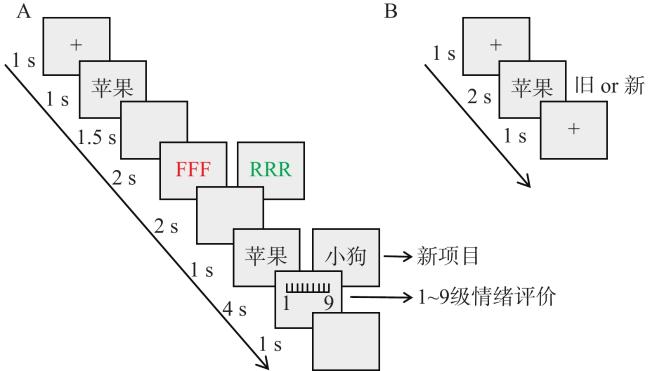
学习和评价阶段(图1A ):注视点(1 s)后呈现词语(1 s),空屏(1.5 s)后呈现线索(2 s)。2 s空屏后,再次呈现该词语(重复评价)或一个新词(新项目评价)1 s,对其进行9级的情绪评价(1=“非常不愉快”, 9=“非常愉快”);或直接进入下一试次(无评价)。评价不超过4 s。学习和评价阶段共144个试次,每种条件下24个试次。结束后进行干扰任务(加减法数学运算)3分钟。最后进行测试阶段(图1B ):注视点(1 s)后呈现词语(2 s),要求被试按“F”或“J”键表示词语的“旧”或“新”。记录再认正确率和再认反应时。
2.1.4 数据分析
对再认正确率和再认反应时进行2(线索:记忆、遗忘)×3(评价:重复评价、新项目评价、无评价)重复测量方差分析。对评价进行2(线索:记忆、遗忘)×2(评价:重复评价、新项目评价)重复测量方差分析。将记忆和遗忘线索下的新项目合并,对记忆项目、遗忘项目和新项目评价进行单因素重复测量方差分析。对于反应时数据,排除错误反应试次和偏离反应时平均值三个标准差的试次(Dunn, 2021),约0.77%的试次(24个)被剔除。数据分析使用IBM SPSS Statistics 19.0。对于方差分析,在违反球形检验时使用Greenhouse-Geisser校正。
2.2 结果
2.2.1 测试阶段
正确率结果显示(图2A ),线索和评价交互作用显著,F(2, 62)=12.58,p<0.001,η${_{\rm p}^2} $ =0.29。简单效应分析结果表明:(1)在三种评价类型中,记忆项目的正确率均显著高于遗忘项目,ps<0.01。(2)记忆线索下,重复评价的正确率显著高于新项目评价和无评价,ps<0.001,新项目评价和无评价正确率无显著差异,p=0.797;遗忘线索下,重复评价的正确率显著高于新项目评价和无评价,ps<0.001,无评价的正确率显著高于新项目评价,p=0.003。
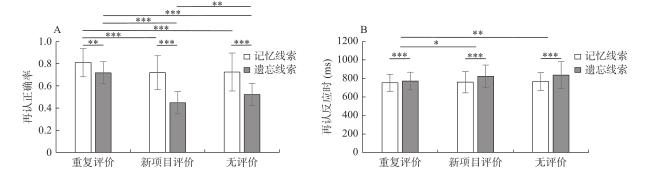
反应时结果显示(图2B ),线索主效应显著,F(1, 31)=24.70,p<0.001,η${_{\rm p}^2} $ =0.44,记忆项目的反应时显著快于遗忘项目。评价主效应显著,F(2, 62)=5.60,p=0.006,η${_{\rm p}^2} $ =0.15,重复评价项目的反应时快于新项目评价和无评价,ps<0.05,新项目评价和无评价项目的反应时差异不显著,p=1.000。线索和评价交互作用不显著,F(2, 62)=2.87,p=0.064。
2.2.2 评价阶段
单因素重复测量方差分析结果显示(图3A ):记忆项目、遗忘项目和新项目的情绪评价差异显著,F(2, 62)=12.10,p<0.001,η${_{\rm p}^2} $ =0.28。记忆项目的情绪评价显著大于遗忘项目和新项目,ps<0.01。遗忘项目与新项目的情绪评价差异不显著,p=1.000。
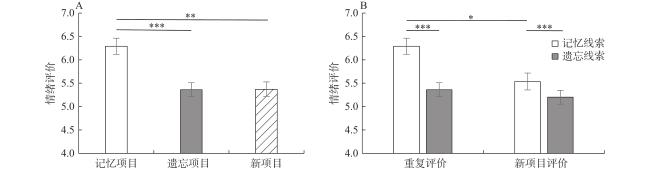
两因素重复测量方差分析结果显示(图3B ):线索和评价交互作用显著,F(1, 31)=4.54,p=0.041,η${_{\rm p}^2} $ =0.13。简单效应分析结果表明:(1)重复评价条件下,记忆项目的情绪评价显著高于遗忘项目,p<0.001;在新项目评价条件下,记忆线索后新项目的情绪评价显著高于遗忘线索后新项目,p<0.001。(2)在记忆线索条件下,对重复评价项目的情绪评价显著高于新项目评价,p=0.015;在遗忘线索条件下,对重复评价项目的情绪评价与新项目评价差异不显著,p=0.269。
2.3 讨论
三类评价下记忆项目的再认成绩(正确率更高、反应时更短)均优于遗忘项目,表明产生定向遗忘效应(杨丽娴 等, 2019)。记忆项目评价显著高于遗忘项目,表明产生定向遗忘情绪贬值效应(Vivas et al., 2021; Vivas et al., 2016)。无论是合并后的新项目还是遗忘线索下的新项目,与遗忘项目的评价均差异不显著,表明遗忘项目的情绪贬值并非抑制导致。选择性注意中新项目在视觉注意任务后呈现,本实验新项目在线索后呈现,评价可能受线索影响。
无论是重复评价还是新项目评价,记忆线索下的项目评价均高于遗忘线索下,可能是不同线索诱发了不同的加工情境。研究发现,记忆线索促进个体对信息进行深入加工,遗忘线索导致大脑对学习信息产生抑制作用(Jing et al., 2019)。本实验中记忆和遗忘线索可能分别诱发积极趋近和消极回避的加工情境,进而提高和降低项目评价。记忆线索下重复评价高于新项目评价,可能表明记忆线索下的积极趋近情境不仅提高记忆项目本身的评价,还加强新项目的积极情感属性。实验1a表明遗忘项目的情绪贬值并非由抑制导致,其可能依赖于线索诱发的加工情境。
3 实验1b:项目法定向遗忘中线索指令对情绪贬值的影响
3.1 研究方法
3.1.1 被试
样本量计算与被试筛选标准同实验1a。选取34名在校大学生,1人因虚报率偏过高(大于50%)被剔除,1人因数据不全被剔除,4人因评价阶段的平均反应时低于200 ms被剔除。最终28名被试(女19名,男9名;平均年龄20.80±2.08岁)的数据纳入分析。
3.1.2 实验设计和材料
采用3(线索:记忆、遗忘、无线索)×2(评价:重复评价、新项目评价)被试内实验设计。在项目法定向遗忘中增设无线索条件作为基线,去除评价阶段的无评价条件。材料筛选标准同实验1a,选取360个词语,其中144个作为学习项目,72个作为评价阶段的新项目,剩余144个作为测试阶段的新项目。
3.1.3 实验程序
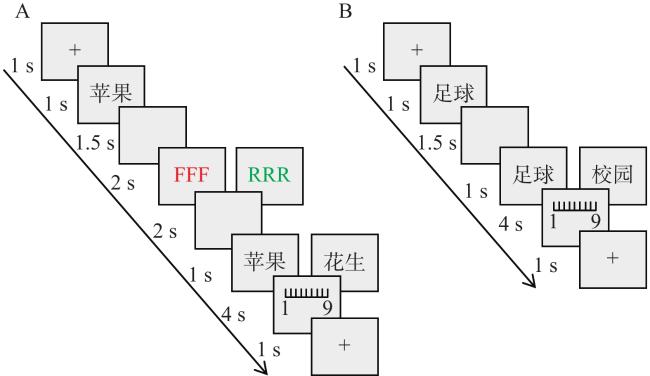
记忆和遗忘条件的实验流程(图4A)同实验1a。实验1b增加无线索条件作为基线(图4B ),注视点(1 s)后呈现词语(1 s),之后不呈现记忆或遗忘线索。空屏(1.5 s)后再次呈现该词语或一个新词语(1 s),进行情绪评价。学习和评价阶段共144个试次,平均分为3个组块,每个组块中记忆、遗忘、无线索条件各16个试次,两种评价类型平均且随机分配。干扰任务和测试阶段同实验1a。
3.1.4 数据分析
对再认正确率、再认反应时和评价进行3(线索:记忆、遗忘、无线索)×2(评价:重复评价、新项目评价)重复测量方差分析。反应时数据的剔除标准同实验1a,约0.79%的试次(21个)被剔除。数据分析校正方法同实验1a。
3.2 结果
3.2.1 测试阶段
正确率结果显示(图5A ):线索主效应显著,F(2, 54)=33.09,p<0.001,η${_{\rm p}^2} $ =0.55,记忆项目正确率显著高于遗忘和无线索项目,ps<0.001,无线索项目正确率显著高于遗忘项目,p=0.035。评价主效应显著,F(1, 27)=39.29,p<0.001,η${_{\rm p}^2} $ =0.59,重复评价的正确率显著高于新项目。线索和评价的交互作用不显著,F(2, 54)=0.87,p=0.427。
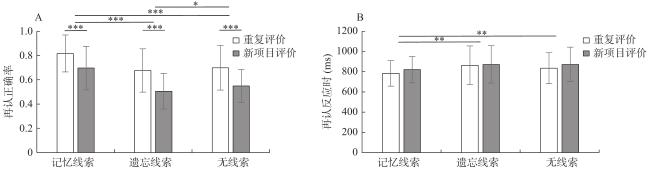
反应时结果显示(图5B ):线索主效应显著,F(2, 54)=10.28,p<0.001,η${_{\rm p}^2} $ =0.28。记忆项目的反应时显著快于遗忘项目(p=0.001)和无线索项目(p=0.002),遗忘项目与无线索项目的反应时无显著差异,p=0.306。评价主效应、线索和评价的交互作用均不显著,Fs<2.46,ps>0.05。
3.2.2 评价阶段
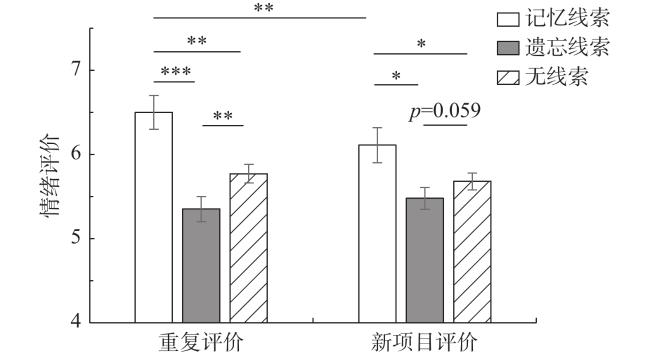
评价结果显示,线索主效应显著,F(2, 54)=14.55,p<0.001,η${_{\rm p}^2} $ =0.35。记忆项目评价高于遗忘项目(p<0.001)和无线索项目(p=0.004),无线索项目评价高于遗忘项目,p=0.002。评价主效应显著,F(1, 27)=5.07,p=0.033,η${_{\rm p}^2} $ =0.15,重复评价高于新项目评价。
线索和评价的交互作用显著(图6 ),F(2, 54)=6.61,p=0.005,η${_{\rm p}^2} $ =0.19。简单效应分析结果表明:(1)重复评价下,记忆项目的情绪评价显著高于遗忘项目(p<0.001)和无线索项目(p=0.001),无线索项目评价显著高于遗忘项目,p=0.001;对于新项目评价,记忆线索下新项目评价显著高于遗忘线索(p=0.010)和无线索(p=0.046),无线索下新项目评价(边缘)显著高于遗忘线索,p=0.059。(2)记忆线索下,重复评价显著高于新项目评价,p=0.003;遗忘和无线索下,重复评价和新项目评价差异均不显著,ps>0.05。
3.3 讨论
记忆项目的再认成绩(正确率高、反应时短)均优于遗忘项目,表明产生定向遗忘效应(Fawcett & Taylor, 2008)。记忆项目的情绪评价显著高于遗忘项目,表明产生情绪贬值效应(Vivas et al., 2021; Vivas et al., 2016)。遗忘线索下重复评价与新项目评价差异不显著,与实验1a一致,表明遗忘项目的情绪贬值并非由抑制作用导致。
在重复评价下,记忆项目、无线索项目和遗忘项目的评价依次降低,可能表明定向遗忘情绪贬值由不同线索导致。与Dittrich和Klauer(2012)的研究结果相似,本研究学习项目的情绪评价可能受到线索影响:相比无线索条件,记忆线索赋予学习项目积极情感内涵,而遗忘线索赋予学习项目消极情感内涵。
对于新项目评价,记忆线索下、无线索下、遗忘线索下的新项目评价依次降低,可能表明记忆线索产生的积极趋近加工情境增强新项目的积极情感属性,遗忘线索产生的消极回避加工情境导致新项目情绪贬值。实验1b表明定向遗忘情绪贬值效应由不同线索导致,记忆和遗忘线索不仅给学习项目带来积极和消极情感内涵,还使同一加工情境下的新信息也产生相似的情感属性。
4 实验2:选择性定向遗忘中的情绪贬值
4.1 研究方法
4.1.1 被试
使用G*Power3.1软件计算样本量(参数设置同实验1a),使用2×2×2三因素重复测量实验设计,至少需要23名被试才能达到95%的统计检验力。选取35名在校大学生,2人因虚报率过高(大于50%)被剔除。最终33名被试(女21名,男12名;平均年龄20.52±2.40岁)的数据纳入分析。被试筛选标准同实验1a。
4.1.2 实验设计和材料
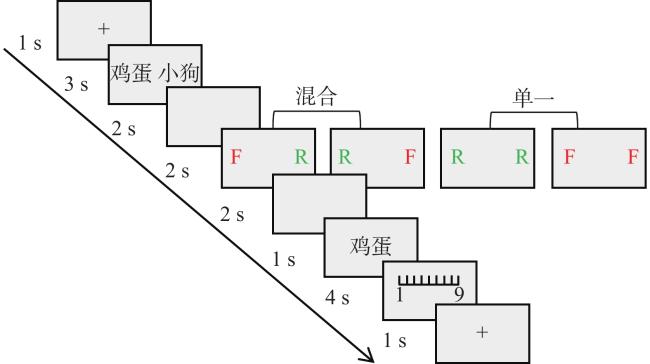
采用2(线索:记忆、遗忘)×2(组合:混合、单一)×2(评价:重复评价、无评价)被试内实验设计。混合条件同时呈现两个不同线索(“F+R”和“R+F”),如果“F”在左边,即忘记左边的词语,同时记住右边。单一条件同时呈现两个相同线索(“R+R”和“F+F”),即同时记住或忘记两个词语(图7 )。实验材料筛选标准同实验1a,选取256个词语,其中128个词语用于学习阶段(64个用于评价,两种评价类型平均且随机分配),剩余128个词语作为测试阶段的新项目。
4.1.3 实验程序
学习和评价阶段,注视点(1 s)后呈现两个词语(3 s),空屏(2 s)后呈现线索(2 s)。2 s空屏后呈现其中一个词语(1 s),对其进行评价(4 s内)。学习和评价阶段共64个试次,分为4个组块。四种条件(混合记忆、混合遗忘、单一记忆、单一遗忘)各16个试次,在每个组块中随机分布,同一条件的刺激连续出现不超过三次。干扰任务和测试阶段同实验1a。
4.1.4 数据分析
对再认正确率和再认反应时进行2(线索:记忆、遗忘)×2(组合:混合、单一)×2(评价:重复评价、无评价)重复测量方差分析。对评价进行2(线索:记忆、遗忘)×2(组合:混合、单一)重复测量方差分析。记忆与遗忘项目评价差值在混合条件下为选择性定向遗忘情绪贬值效应,单一条件下为无选择性定向遗忘情绪贬值效应。对两种情绪贬值效应进行配对样本t检验。反应时数据的剔除标准同实验1a,约0.14%的试次(4个)被剔除。数据分析校正方法同实验1a。
4.2 结果
4.2.1 测试阶段
正确率结果显示(图8A ),线索主效应显著,F(1, 32)=14.56,p<0.001,η${_{\rm p}^2} $ =0.31,记忆项目的正确率显著高于遗忘项目。组合主效应显著,F(1, 32)=5.00,p=0.032,η${_{\rm p}^2} $ =0.14,混合项目的正确率显著高于单一项目。评价主效应显著,F(1, 32)=97.56,p<0.001,η${_{\rm p}^2} $ =0.75,重复评价项目的正确率显著高于无评价项目。所有交互作用均不显著,Fs<3.47,ps>0.05。
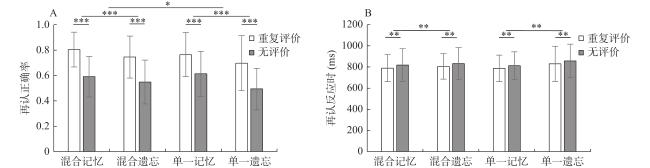
反应时结果显示(图8B ),线索主效应显著,F(1, 32)=8.57,p=0.006,η${_{\rm p}^2} $ =0.21,记忆项目的反应时显著快于遗忘项目。评价主效应显著,F(1, 32)=8.11,p=0.008,η${_{\rm p}^2} $ =0.20,重复评价项目的反应时显著快于无评价项目。组合主效应以及所有交互作用均不显著,Fs<2.76,ps>0.05。
4.2.2 评价阶段
评价结果显示(图9A ):线索和组合交互作用显著,F(1, 32)=16.50,p<0.001,η${_{\rm p}^2} $ =0.34。简单效应分析结果发现:(1)对于记忆项目,混合条件下的评价显著高于单一条件下,p=0.002;对于遗忘项目,混合条件下的评价显著低于单一条件下,p=0.012。(2)混合和单一条件下,记忆项目的评价均显著高于遗忘项目,ps<0.05。线索主效应显著,F(1, 32)=29.23,p<0.001,η${_{\rm p}^2} $ =0.48,记忆项目评价显著高于遗忘项目。组合主效应不显著,F(1, 32)=0.01,p=0.929。
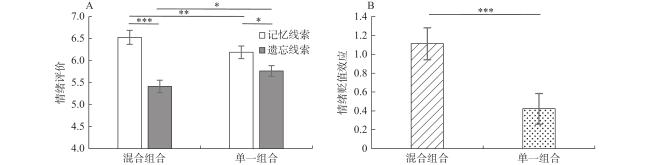


情绪贬值效应结果显示(图9B ),混合条件下的(选择性定向遗忘)情绪贬值效应显著大于单一条件下的(无选择性定向遗忘)情绪贬值效应,t(32)=4.06,p<0.001,d=0.71。
4.3 讨论
记忆项目的再认成绩(正确率更高、反应时更短)显著优于遗忘项目,表明产生定向遗忘效应(Tan et al., 2020)。单一线索下遗忘项目的情绪评价小于记忆项目,与实验1结果一致,表明记忆和遗忘线索分别赋予学习项目积极和消极的情感内涵(Dittrich & Klauer, 2012)。混合和单一线索下,遗忘项目评价均低于记忆项目,表明无论是否存在选择性注意,均产生定向遗忘情绪贬值效应。单一条件下的遗忘项目作为需要遗忘的目标刺激出现,混合条件下的遗忘项目同时作为需要遗忘的目标刺激和被忽视的干扰刺激。遗忘项目在混合条件下的情绪评价低于单一条件,表明选择性注意能够增强遗忘项目的情绪贬值。
与遗忘项目相反,记忆项目在混合条件下的评价高于单一条件。这可能是由于混合条件下记忆和遗忘线索的同时存在产生对比效应,扩大了记忆和遗忘项目的情感属性差异。研究发现,先前暴露于对比性情绪刺激会增强个体对情绪刺激的情感体验(Manstead et al., 1983)。本研究的学习项目虽然为中性信息,但混合条件下对比性线索的同时呈现,可能导致记忆和遗忘项目分别被赋予更积极和更消极的情感编码。同时,组合类型对记忆和遗忘项目评价的相反作用导致选择性定向遗忘情绪贬值效应大于无选择性,表明选择性注意通过提高记忆项目评价并降低遗忘项目评价,促进定向遗忘的情绪贬值。
5 总讨论
5.1 定向遗忘情绪贬值并非抑制导致
实验1发现新项目和遗忘项目评价无显著差异,表明定向遗忘情绪贬值并非抑制导致,不同于选择性注意中的抑制贬值机制(Raymond et al., 2003; Raymond et al., 2005)。抑制贬值理论认为个体对需要抑制的干扰物的情绪评价降低,而定向遗忘依据线索将中性信息分为要求遗忘和要求记忆的两种目标信息,不包含干扰信息。本研究表明,当中性信息与遗忘指令相联结,即便该信息成为目标刺激仍然会产生情绪贬值。
5.2 线索赋予中性信息情感属性
本研究发现定向遗忘情绪贬值由记忆和遗忘线索共同作用:记忆和遗忘线索分别使中性信息情绪评价提高和降低。Richter和Gast(2025)发现,对中性刺激的评价受到与其同时或相继呈现的刺激效价的影响:当中性刺激与积极刺激配对时其评价更积极,与消极刺激配对时其评价更消极。本研究中,与无线索项目相比,中性信息与记忆线索匹配时评价提高;与遗忘线索匹配时评价降低。这可能表明记忆和遗忘线索的性质不同,分别产生积极和消极的情感内涵。中性信息与不同线索匹配使其被赋予不同的情感属性,继而产生不同的情绪评价。
5.3 情绪贬值依赖于线索加工情境
创设不同情绪的文本情境会影响对后续中性材料的情绪评价:相比无文本或中性情境,积极情境下对中性信息评价更高(积极),消极情境下更低(Liu et al., 2013; Schwarz et al., 2013; Song et al., 2024; Wieser et al., 2014)。本研究记忆和遗忘线索可能分别诱发积极趋近和消极回避的加工情境,当再次出现该项目时,提高对记忆项目的评价,降低对遗忘项目的评价。新项目评价与重复评价表现出同样的规律,表明记忆和遗忘线索不仅赋予了目标信息情感属性,也改变了该线索情境下新信息的情感属性。本研究表明定向遗忘情绪贬值具有情境依赖性。
5.4 选择性注意促进定向遗忘情绪贬值
Quandt等人(2019)采用线索化Go/Nogo任务发现注意引导对食物吸引力的贬值具有增强作用:与无线索(被忽视)条件相比,线索化(被注意)条件将提高Go刺激的吸引力并降低Nogo刺激的吸引力,表明选择性注意增大了Nogo贬值效应。类似地,本研究中选择性定向遗忘相比无选择性表现出记忆项目的评价提高和遗忘项目的评价降低,表明当记忆和遗忘项目存在注意资源竞争时,选择性注意促进定向遗忘情绪贬值。
本研究发现遗忘指令促进了中性信息的情绪贬值,这对不良行为习惯的矫正具有一定启示意义。例如,通过将遗忘指令与游戏信息、成瘾药物联结降低其情绪评价,减少相关成瘾行为。本研究的不足是未在学习阶段开始和结束位置设置缓冲项目,不能排除首因和近因效应的混淆作用。
6 结论
(1)定向遗忘促进中性信息的情绪贬值,记忆和遗忘指令赋予中性信息积极和消极的情感内涵,并导致新信息的情绪评价产生情境依赖性。(2)选择性注意增强定向遗忘情绪贬值,通过提高记忆项目的评价并降低遗忘项目的评价增大情绪贬值效应。