发展与教育心理学

父爱缺失对青少年非自杀性自伤的影响:自我控制和手机成瘾的纵向中介作用

  • 向燕辉 , *, 1, 2, 3, 4 ,
  • 周李卓瑶 2, 3, 4
展开
  • 1. 湖南师范大学教育部人文社会科学重点研究基地中华伦理文明研究中心,长沙 410081
  • 2. 认知与人类行为湖南省重点实验室,长沙 410081
  • 3. 湖南省心理健康教育研究基地,长沙 410081
  • 4. 湖南师范大学教育科学学院心理系,长沙 410081
向燕辉,E-mail:

收稿日期: 2024-04-22

  网络出版日期: 2025-07-18

基金资助

国家社会科学基金(23BSH144)。

版权

版权所有,未经授权,不得转载、摘编本刊文章,不得使用本刊的版式设计。

The Effect of Father Love Absence on Non-Suicidal Self-Injury in Adolescents: Longitudinal Mediation of Self-Control and Smartphone Addiction

  • Yanhui XIANG , *, 1, 2, 3, 4 ,
  • Lizhuoyao ZHOU 2, 3, 4
Expand
  • 1. Chinese Ethical Civilization Research Center, Key Research Base of the Humanities and Social Sciences of the Ministry of Education, Hunan Normal University, Changsha 410081
  • 2. Cognition and Human Behavior Key Laboratory of Hunan Province, Changsha 410081
  • 3. China Research Center for Mental Health Education of Hunan Province, Changsha 410081
  • 4. Department of Psychology, School of Educational Science, Hunan Normal University, Changsha 410081

Received date: 2024-04-22

  Online published: 2025-07-18

Copyright

Copyright reserved © 2025.

摘要

为了探讨自我控制和手机成瘾在父爱缺失和非自杀性自伤(NSSI)之间的纵向中介作用,选取中国湖南省某中学共1252名学生,开展为期半年的2次纵向追踪。结果表明:父爱缺失对自我控制和手机成瘾的预测作用显著;自我控制对手机成瘾、NSSI也有较好的预测作用。同时结果支持了自我控制以及“自我控制→手机成瘾”这条链式中介在父爱缺失和NSSI之间的纵向中介效应。这些结果不仅拓展了对父爱缺失影响的研究,还增加了对父爱缺失和NSSI之间关系的潜在机制的理解,从而为预防和减少青少年NSSI行为,降低自杀风险提供了更多理论支持。

本文引用格式

向燕辉 , 周李卓瑶 . 父爱缺失对青少年非自杀性自伤的影响:自我控制和手机成瘾的纵向中介作用[J]. 心理与行为研究, 2025 , 23(3) : 369 -376 . DOI: 10.12139/j.1672-0628.2025.03.011

Abstract

To explore the longitudinal mediating role of self-control and smartphone addiction between father love absence and non-suicidal self-injury(NSSI), a total of 1252 students from a middle school in Hunan province, China, were selected for a 2-way longitudinal follow-up over a six-month period. The results showed that father love absence was a significant predictor of self-control and smartphone addiction; self-control was also a good predictor of smartphone addiction and NSSI. The results also supported the longitudinal mediating effect of self-control and the chain mediator “self-control→smartphone addiction” between father love absence and NSSI. These results not only expand the research on the effects of father love absence, but also increase the understanding of the underlying mechanisms of the relationship between father love absence and NSSI, thus providing more theoretical support for the prevention and reduction of adolescents’ NSSI behaviors and the reduction of the risk of suicide.

1 前言

父亲对青少年的身体、心理以及社会发展和调整等起着深远且不可替代的作用(Culpin et al., 2013; East et al., 2006; Xiang & Zhou, 2023)。这种积极影响甚至独立于母亲以及其他家庭和社会因素。父爱缺失可能会导致各种问题行为的出现,例如适应不良(East et al., 2006)、成瘾(Wibiharto et al., 2021)甚至是危及生命的行为。如,非自杀性自伤(NSSI)(Zhou et al., 2024)。其中,自我控制和手机成瘾可能解释两者之间的关系。手机成瘾作为青少年群体中频发的问题,与自我控制能力密切相关(Zhang et al., 2020);长期缺乏父亲示范和约束也会削弱青少年自我控制能力(Hofmann et al., 2009);依恋理论进一步揭示,父亲作为家庭“安全基地”,其功能缺失会阻碍个体形成安全型依恋(Bowlby, 1988),当家庭情感支持功能被削弱,青少年则可能通过沉迷手机进行虚拟补偿,或借助NSSI实现现实宣泄。基于此,本研究基于依恋理论和自我控制理论,期望从纵向的视角去探究父爱缺失如何影响青少年的NSSI行为,并探讨自我控制和手机成瘾在两者间的中介作用。

1.1 父爱缺失和非自杀性自伤

在儒家父权文化的影响下,中国家庭普遍存在“男主外,女主内”的模式。母亲通常是照顾和养育的提供者,而父亲作为严厉的教育者,纪律和道德的榜样,通常与孩子保持距离且较少表达明确的温暖(Li & Lamb, 2015),这可能导致孩子心理上感觉父亲缺失。在之前的研究中,父亲缺失通常被分为身体缺席(如死亡、离婚、被监禁等)和心理缺失(如缺乏兴趣或因工作忽视子女养育等)(East et al., 2006; Rakotomanana et al., 2021; Trivedi & Bose, 2020)。而本研究中的父亲缺失更多地被认为是心理的缺失,所以将之称为父爱缺失。本研究中的父爱缺失是指个体在童年期其父亲“在其位而不谋其职”的状态,是一个综合性概念,涉及父亲在情感、行为、认知与意志等多方面的缺位(Xiang & Zhou, 2023)。
NSSI作为一种功能失调的情绪调节策略(Han et al., 2024),是指故意重复性的自我伤害,包括割伤、烧伤或划伤皮肤,击打、撞击墙壁或药物过量等行为,但没有自杀的意图(Wang et al., 2022)。与非自伤者相比,有自伤行为的青少年更可能经历不良的家庭背景,例如不安全依恋、童年期分离、较低的亲子关系质量等(Woo et al., 2022; Xu et al., 2023)。依恋理论指出,个体最早通过依赖照顾者来调节或减轻负面情绪,并根据照顾者的示范、鼓励和肯定的情感表达,逐渐发展出自己的调节能力(Bowlby, 1969, 1973; Schore, 2001),所以未能形成安全型依恋的个体难以发展出足够的情绪调节能力。父爱缺失作为一种早期不良家庭环境因素,容易导致个体处于没有支持和被忽视的环境中(Zhou et al., 2024),从而形成不安全的依恋。也即父爱缺失增加青少年通过伤害自己来缓解不安全感、痛苦和自我怀疑的风险和可能性(Nock & Favazza, 2009)。此外,实证研究也支持了父爱缺失是NSSI行为发生的重要促成因素。例如,父亲的高度拒绝和较低的情感温暖与NSSI显著相关(Liu et al., 2020)。综合已有研究,父爱缺失有可能成为预测子女NSSI行为的重要风险因素之一。

1.2 自我控制的中介作用

自我控制被视为个体适应、调整自我以优化与外界配合的能力(Rothbaum et al., 1982)。自我控制理论认为,孩子自我控制能力的主要来源是有效的父母教养,要培养高度自我控制感的孩子,父母必须监督、识别并及时纠正或惩罚孩子的异常行为(Gottfredson & Hirschi, 1990)。父亲通常比母亲更严厉地管教子女(Ningsih, 2022),在纪律教育上更具坚定性和一致性(Anggraini et al., 2022)。故制定规则、监督及管教子女的问题行为多由父亲负责(East et al., 2006)。而父爱缺失的家庭中,父亲未承担监督、纠正及引导孩子的责任,这可能导致个体自控能力下降。此外,已有研究强调了自我控制对NSSI的潜在重要性(Glenn & Klonsky, 2010; Mancinelli et al., 2022)。NSSI被认为与冲动控制相关(Cassels et al., 2022),因其无需太多计划和准备即可实施(Nock, 2010)。而自我控制能力强的青少年擅长调节自己的行为、情绪和注意力冲动(Duckworth, 2011),对于负面情绪的管理有更积极的信念,易助其摆脱负面情绪的困扰(Chow et al., 2015),采取更好的应对策略而非是NSSI。因此,父爱缺失可能通过抑制自我控制能力增加青少年的NSSI行为。基于此,本研究提出假设1:自我控制在父爱缺失与NSSI之间起纵向中介作用。

1.3 手机成瘾的中介作用

对智能手机的过度使用或无法调节被定义为智能手机成瘾(Mun & Lee, 2020)。亲子关系对青少年手机成瘾起着关键作用(Qiu et al., 2022)。依恋理论指出,依恋对象的及时回应有助于个体形成积极的内部工作模式,促进个体形成健康的人际关系,并获取到足够的社会支持(Bowlby, 1973)。而父爱缺失家庭中的父亲长期忽视情感表达与孩子需求;较少地参与孩子的教育和生活(Xiang & Zhou, 2023),所以经历过父爱缺失的青少年,更容易形成不安全的内部工作模式。前人研究也证实,父爱缺失会减少青少年获得社会支持的机会(Su et al., 2024)。当青少年无法得到足够的支持时,他们会倾向于在虚拟世界中寻求社会支持以满足社交需求(Ding et al., 2022)。而智能手机作为一种满足个体基本心理需求的补偿性工具(Wang et al., 2018),更容易被父爱缺失的孩子过度使用以寻求情感上的温暖和支持(Wang et al., 2021)。基于此,父爱缺失可能增加个体的手机成瘾的风险。智能手机成瘾又显著增加了青少年实施NSSI的可能(Rong et al., 2023)。前人研究发现,手机成瘾会触发负面情绪并降低情绪调节能力(Zhang et al., 2024),所以手机成瘾的个体需要额外的支持来减轻他们的心理情绪困扰(Lin et al., 2025)。而NSSI又被视为一种对痛苦情绪经历的调节策略(Han et al., 2024; Nock, 2009),给手机成瘾的青少年提供强烈的身体感觉,使他们的注意力从内部情绪痛苦转移到外部身体体验,从而导致NSSI(Horwood & Anglim, 2021)。即父爱缺失有可能通过导致手机成瘾从而增加NSSI发生的风险。因此本研究提出假设2:手机成瘾在父爱缺失和NSSI之间起着纵向中介作用。

1.4 自我控制和手机成瘾的链式中介

自我控制被认为是调节情绪、思想和行动,刺激适当行为、抑制不当行为的一种能力(de Ridder et al., 2012)。一般来说,控制不了自己的人通常也无法控制对智能手机的使用(Billieux et al., 2008)。且青少年对追求快乐的冲动的自控能力相对较差(Steinbeis et al., 2016),故更易导致手机成瘾。已有研究也证实自我控制与情绪和行为的调节密切相关(Zhang et al., 2020),所以高自控力的人会更理性地使用智能手机。基于此本研究提出假设3:“自我控制→手机成瘾”这条链式路径在父爱缺失和NSSI之间起着纵向中介作用。
综上所述,本研究采用半纵向中介的设计方法,来测试具有两个时间点的中介,通过检验自我控制和手机成瘾的纵向中介作用来探索父爱缺失对青少年NSSI行为影响的潜在机制。

2 研究方法

2.1 被试

本研究采用整群抽样,选取湖南省某中学学生为被试,开展为期半年的两次纵向追踪,第一次施测时间为2022年11月,共1468名青少年参加(791名女生,677名男生),平均年龄15.90±0.93岁。第二次施测时间为2023年5月,共收集到1252名有效样本(685名女生,567名男生),平均年龄16.42±0.88岁。从T1到T2,由于请假、转学等原因流失216人,流失率为14.71%。根据Pan和Zhan(2020)和Babbie(1976)关于纵向研究中样本量的观点,40%的流失率在纵向研究中仍是可以接受的,因此本研究T1至T2样本流失率(14.71%)可被接受。

2.2 研究工具

2.2.1 父爱缺失

采用Xiang和Zhou(2023)编制的父爱缺失量表评估个体的父爱缺失程度。量表包含情绪、认知、行为、意志缺失四个分量表,共18个项目。采用5点计分,从1“完全不符”到5“完全符合”,分数越高表明父爱缺失的程度越大。本研究中,该量表在两次测试中的Cronbach’s α系数分别为0.90和0.91。

2.2.2 自我控制

采用Kendall和Wilcox(1979)编制的自我控制量表测量个体的自我控制水平。量表包括6个项目。采用5点计分,从1“非常不同意”到5“非常同意”,分数越高表示自制力越强。本研究中,该量表在两次测试中Cronbach’s α系数均为0.87。

2.2.3 手机成瘾

采用Csibi等(2016)编制的手机成瘾量表来评定个体对手机的依赖程度。量表有6道题目。采用6点计分,从1“完全不同意”到6“完全同意”,分数越高表明对手机的依赖程度越强。本研究中,该量表在两次测试中Cronbach’s α系数分别为0.82和0.80。

2.2.4 非自杀性自伤

采用You等(2016)开发的非自杀性自伤量表测量青少年的NSSI行为,问卷包括12个题目。根据前人研究,并考虑到原量表中两种行为在中国青少年群体中的不常见性,将其剔除(Zhou et al., 2024),其余10项被使用。采用4点计分,从1“0次”到4“超过6次”,分数越高表明NSSI在过去一年中发生频率越高。本研究中,该量表在两次测试中的Cronbach’s α系数均为0.90。

2.3 数据分析

首先,在SPSS25.0中采用Harman单因子检验法检验共同方法偏差,并对主要变量进行描述性统计和Pearson相关分析。然后在Amos23.0中建立测量模型,以检验指标对潜在变量的预测能力。将测量父爱缺失的18题根据量表维度打包为四个因子,采用项目−结构平衡法(Little et al., 2002),将测量自我控制6题、手机成瘾6题以及NSSI的10题分别打包为三个因子。如果测量模型合适,则将进一步构建结构模型。
一般来讲,至少需要三个时间点的数据来测试纵向中介作用,但Cole和Maxwell(2003)已证明两波数据的半纵向中介模型,能提供与三波数据的纵向中介模型相似的估计值。由于本研究的参与者只填写了两个时间点的问卷,因此本研究参照半纵向中介对数据进行建模(Cole & Maxwell, 2003),来研究自我控制和手机成瘾在父爱缺失与自伤行为关系中的纵向中介作用。
此外,模型拟合度检验采用卡方检验,以近似误差均方根(RMSEA)小于或等于0.08,标准化均方残差(SRMR)小于或等于0.08,比较拟合指数(CFI)大于或等于0.90为标准(Byrne, 2001)。最后,采用Bootstrap法(2000次抽样)得到的95%的置信区间来检验中介效应显著性,若置信区间不包含0,即表明中介作用显著,这个方法被认为是检验中介模型间接效应的有效方法(Preacher & Hayes, 2008; Williams & Mackinnon, 2008)。

3 结果

3.1 共同方法偏差检验

本研究所有数据均采用自我报告方法进行收集,可能会存在共同方法偏差的问题,因此采用Harman单因子检验法进行统计控制,结果显示,共提取了14个因子,特征根均大于1,首因子解释率为19.6%,小于临界值40%,即本研究数据不存在严重的共同方法偏差。

3.2 描述性统计和相关性分析

表1列出了T1和T2所有变量之间的描述性和相关性结果,具体而言,T1父爱缺失、T2父爱缺失与T1手机成瘾、T2手机成瘾、T1NSSI、T2NSSI呈显著正相关;与T1自我控制、T2自我控制呈显著负相关。同时T1自我控制、T2自我控制与T1手机成瘾、T2手机成瘾、T1NSSI、T2NSSI呈显著负相关。
表1 各变量的描述性统计及相关分析
变量 M±SD 1 2 3 4 5 6 7
1.T1父爱缺失 46.35±14.28
2.T2父爱缺失 46.80±14.32 0.63**
3.T1自我控制 20.84±4.72 −0.33** −0.27**
4.T2自我控制 20.48±4.55 −0.23** −0.30** 0.43**
5.T1手机成瘾 20.78±6.46 0.30** 0.22** −0.24** −0.22**
6.T2手机成瘾 21.00±6.05 0.24** 0.35** −0.22** −0.25** 0.44**
7.T1NSSI 11.60±3.73 0.23** 0.20** −0.19** −0.20** 0.13** 0.19**
8.T2NSSI 11.42±3.31 0.21** 0.23** −0.17** −0.20** 0.14** 0.17** 0.48**

  注:*p<0.05,**p<0.01,***p<0.001,以下同。

3.3 半纵向中介模型

测量模型中包括8个潜在变量和26个观测变量。结果表明该数据与模型拟合度较好[χ2(271, 1252)=2009.80, p<0.001; RMSEA=0.07, SRMR=0.07, CFI=0.90, AIC=2169.80, ECVI=1.73]。此外,所有潜在变量的因子负荷均与其呈显著相关,这表明潜在变量可以很好地代表观测变量。
在此基础上进一步构建半纵向中介模型如图1所示,根据结果所示,该模型具有较好的拟合度[χ2(278, 1252)=2053.30, p<0.001; RMSEA=0.07, SRMR=0.07, CFI=0.90, AIC=2199.30, ECVI=1.76]。在自回归模型中,所有变量的稳定性均显著,说明自我控制、手机成瘾和非自杀性自伤从T1到T2是稳定的(如表2图1所示)。在交叉滞后模型中,T1父爱缺失显著负向预测T2自我控制(β=−0.09, p<0.01)、显著正向预测T2手机成瘾(β=0.08, p<0.05)。T1自我控制显著负向预测T2手机成瘾(β=−0.10, p<0.01)和T2NSSI(β=−0.07, p<0.05)。而T1手机成瘾对T2NSSI的预测作用不显著(β=0.05, p>0.05)。最后,再检验自我控制和手机成瘾在父爱缺失和NSSI之间的中介作用,结果表明自我控制(β=0.002, 95%CI=[0.000, 0.005], p<0.05)在父爱缺失和自伤之间的纵向中介作用显著,手机成瘾(β=0.001, 95%CI=[−0.000, 0.005], p>0.05)在父爱缺失和自伤之间的纵向中介作用不显著,“自我控制→手机成瘾”(β=0.0001, 95%CI=[0.000, 0.000], p<0.05)的链式中介在父爱缺失和自伤之间的纵向中介作用显著。
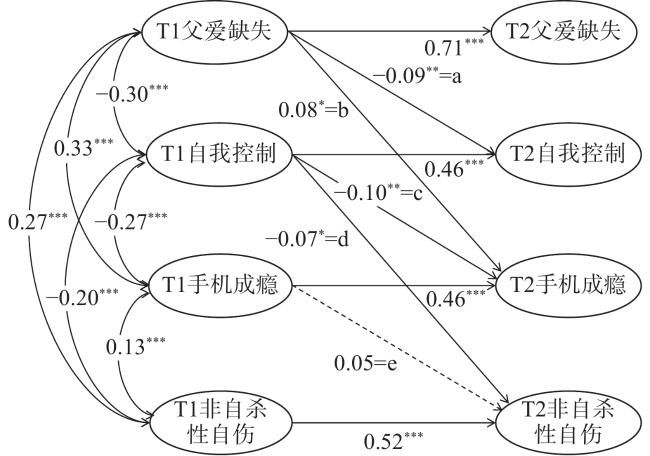
图1 半纵向设计的交叉滞后面板总模型

注:图中路径系数均为标准化后的值,虚线表示路径不显著;该模型检验了自我控制和手机成瘾在父爱缺失和非自杀性自伤之间的中介作用;自我控制作为中介时路径为a和c,手机成瘾作为中介时路径为b和e,自我控制→手机成瘾作为链式中介时路径为a、c和e。

表2 父爱缺失、自我控制、手机成瘾和NSSI之间的纵向关系表
路径 b(95%CI) SE β p
自回归路径
T1父爱缺失→T2父爱缺失 3.25[2.94, 3.57] 0.15 0.71 <0.001
T1自我控制→T2自我控制 0.34[0.28, 0.39] 0.03 0.46 <0.001
T1手机成瘾→T2手机成瘾 0.43[0.35, 0.51] 0.03 0.46 <0.001
T1NSSI→T2NSSI 0.18[0.13, 0.23] 0.01 0.52 <0.001
交叉滞后路径
T1父爱缺失→T2自我控制 −0.07[−0.12, −0.02] 0.02 −0.09 0.003
T1父爱缺失→T2手机成瘾 0.08[0.01, 0.14] 0.03 0.08 0.015
T1自我控制→T2手机成瘾 −0.09[−0.15, −0.03] 0.03 −0.10 0.001
T1自我控制→T2NSSI −0.02[−0.05, 0.00] 0.01 −0.07 0.018
T1手机成瘾→T2NSSI 0.02[−0.00, 0.04] 0.01 0.05 0.094

4 讨论

本研究基于依恋理论和自我控制理论,探讨了自我控制、手机成瘾在父爱缺失和NSSI之间的作用机制。研究结果表明,父爱缺失可以显著预测自我控制和手机成瘾;自我控制对手机成瘾、NSSI也有较好的预测作用。此外,结果还支持了自我控制在父爱缺失和NSSI之间的纵向中介效应,以及“自我控制→手机成瘾”的链式纵向中介作用。这些发现不仅对父爱缺失的作用和重要性有了更多的认识,还补充了对父爱缺失和NSSI之间内在机制的理解,也为预防和干预青少年的NSSI行为提供了更多的理论依据。
首先,研究验证了假设1,父爱缺失通过抑制青少年的自我控制能力的发展,增加其NSSI行为。父爱缺失对个体的自我控制能力有负向预测作用,与前人研究一致,即父亲功能的缺失会导致孩子自控力低下(Situmorang et al., 2018)。该结果契合自我控制理论,该理论认为自我控制力低下的主要原因是父母无效的育儿(Gottfredson & Hirschi, 1990)。父爱缺失的个体,其父亲未积极参与家庭养育活动,且个体感受到父亲的疏远和拒绝(Xiang & Zhou, 2023)。在拒绝、严厉惩罚等养育方式下长大的儿童,冲动性得分较高,自我控制水平较低(Pan et al., 2021),同时实证研究也指出,父亲可帮助孩子心理上脱离母亲,并教会他们控制冲动的方法和规则(Qureshi, 2014),从而提高自我控制能力。因此,父爱缺失可能导致孩子缺乏引导和支持,使其自我控制能力难以得到很好地培养。此外,本研究也发现自我控制能力能够负向预测青少年的NSSI行为。这与Zhu等(2021)的研究结果相似,他们通过纵向研究发现,较低的自我控制能力会增加焦虑的青少年在6个月后实施NSSI行为的可能。NSSI常被认为是对痛苦情绪经历的调节策略(Han et al., 2024; Nock, 2009),高自制力则是一种保护性因素,能够帮助青少年抑制采用NSSI作为调节负面情绪策略的冲动(Zhu et al., 2021)。因为自制力高的个体通常拥有更好的观点采择能力(Tangney et al., 2018),更容易采取适应性的应对策略(Glenn & Klonsky, 2010),所以自控能力更高的青少年参与NSSI的可能性更低。因此,父爱缺失的个体因自我控制能力较低,更容易参与NSSI行为。
其次,结果显示假设2不成立。即手机成瘾在父爱缺失与NSSI间的纵向中介作用未成立,T1手机成瘾对T2NSSI的预测作用并不显著。通常来讲,成瘾行为会诱发NSSI。尽管两者的高相关性得到了许多证明(陈慧, 周建松, 2022; Zhang et al., 2024),但也有研究指出成瘾行为与NSSI无直接联系,需通过中介变量联结。如Mészáros等(2020)发现网络成瘾和NSSI之间在没有中介变量(如病理性的精神障碍)时并不存在直接的相关关系。故在本研究中,手机成瘾与NSSI之间的关系可能也需要某个中介变量进行联结。此外,对该结果的另一种可能的解释是,与一些会更直接影响NSSI的近端因素(如抑郁、焦虑)相比,手机成瘾是一种远端因素。尽管手机成瘾会损害个体调节负面情绪的能力,导致心理和情绪困扰(Zhang et al., 2024),但仅凭这些痛苦可能不足以直接导致青少年实施NSSI(Lin et al., 2025)。这一解释也得到了实证研究的支持,一项关于手机成瘾和NSSI的网络分析发现,手机成瘾在网络中位于边缘位置,这也证明了它是影响NSSI的远端因素(Mancinelli et al., 2022)。
除此之外,中介检验的结果显示,假设3成立。虽然父爱缺失无法通过手机成瘾影响到NSSI,但是“自我控制→手机成瘾”的链式中介路径在两者之间的纵向关系中发挥了重要的作用,也就是说父爱缺失可以通过抑制个体的自我控制能力的发展,从而导致个体更多的手机成瘾行为并最终增加NSSI行为发生的风险。自我控制水平可以显著负向预测手机成瘾,这与前人的研究结果一致(Adiyatma et al., 2020)。高自制力的个体能够抵制不符合社会规范的欲望或行为冲动,所以他们对智能手机的依赖度较低(Zhang et al., 2020);而自制力低的个体难以集中注意力,行为的任意性较强(Adiyatma et al., 2020),对即时满足和奖励很敏感,因此,他们更有可能沉迷于虚拟世界(Peng et al., 2022)。所以自我控制能力差的青少年在面对虚拟世界的刺激和诱惑时,可能会过度使用手机,并增加手机成瘾的可能(Zhang et al., 2020)。而智能手机的过度使用又可能会破坏青少年正常的社会功能,降低警觉性并引发恐惧等情绪,最终导致冲动控制障碍,从而增加NSSI发生的风险(Memon et al., 2018)。因此,父爱缺失可以通过“自我控制→手机成瘾”的链式中介路径影响青少年NSSI的发生。
本研究仍存在以下局限,首先,研究采用自我报告的方法进行数据的收集,可能会存在社会赞许偏差。未来研究应拓展数据的来源,采取更多元的方法。其次,仅开展两次短期追踪调查,难以揭示变量之间的长期效应,这也可能是造成手机成瘾和NSSI之间关系不稳定的原因。未来可采用实验研究或延长追踪时间、增加次数,深入探讨手机成瘾、NSSI和父爱缺失之间的关系以及内在作用机制。最后,不同类型的父爱缺失对青少年NSSI的影响可能不同,未来研究应区分具体类型,以更加系统全面地揭示父爱缺失对青少年NSSI问题的影响机制。

5 结论

(1)父爱缺失对自我控制和手机成瘾的预测作用显著;(2)自我控制对手机成瘾和NSSI的预测作用显著;(3)自我控制在父爱缺失和NSSI之间具有纵向中介作用;(4)“自我控制→手机成瘾”这条链式中介在父爱缺失和NSSI之间具有纵向中介作用。
陈慧, 周建松. 非自杀性自伤行为的成瘾特征研究进展. 中华精神科杂志, 2022, 55 (1): 64- 68.

DOI

Adiyatma, R., Mudjiran, M., & Afdal, A. The contribution of self-control towards student smartphone addiction. SCHOULID: Indonesian Journal of School Counseling, 2020, 5 (1): 45- 49.

DOI

Anggraini, V., Priyanto, A., & Yulsyofriend, Y. (2022). Fathers’ role in developing child emotional development. Paper presented at the 6th International Conference of Early Childhood Education (ICECE-6 2021), Padang, Indonesia.

Babbie, E. R. The practice of social research. Contemporary Sociology, 1976, 5 (2): 163- 164.

Billieux, J., van der Linden, M., & Rochat, L. The role of impulsivity in actual and problematic use of the mobile phone. Applied Cognitive Psychology, 2008, 22 (9): 1195- 1210.

DOI

Bowlby, J. (1969). Attachment and loss: Vol. 1: Attachment. London: Hogarth Press and Institute of Psycho-Analysis.

Bowlby, J. (1973). Attachment and loss: Vol. 2: Separation, anxiety and anger. London: Hogarth Press and Institute of Psycho-Analysis.

Bowlby, J. (1988). A secure base: Parent-child attachment and healthy human development. New York: Basic Books.

Byrne, B. M. Structural equation modeling with AMOS, EQS, and LISREL: Comparative approaches to testing for the factorial validity of a measuring instrument. International Journal of Testing, 2001, 1 (1): 55- 86.

DOI

Cassels, M., Neufeld, S., van Harmelen, A. L., Goodyer, I., & Wilkinson, P. Prospective pathways from impulsivity to non-suicidal self-injury among youth. Archives of Suicide Research, 2022, 26 (2): 534- 547.

DOI

Chow, J. T., Hui, C. M., & Lau, S. A depleted mind feels inefficacious: Ego-depletion reduces self-efficacy to exert further self-control. European Journal of Social Psychology, 2015, 45 (6): 754- 768.

DOI

Cole, D. A., & Maxwell, S. E. Testing mediational models with longitudinal data: Questions and tips in the use of structural equation modeling. Journal of Abnormal Psychology, 2003, 112 (4): 558- 577.

DOI

Csibi, S., Demetrovics, Z., & Szabó, A. Development and psychometric validation of the Brief Smartphone Addiction Scale (BSAS) with schoolchidren. Psychiatria Hungarica: A Magyar Pszichiatriai Tarsasag Tudomanyos Folyoirata, 2016, 31 (1): 71- 77.

Culpin, I., Heron, J., Araya, R., Melotti, R., & Joinson, C. Father absence and depressive symptoms in adolescence: Findings from a UK cohort. Psychological Medicine, 2013, 43 (12): 2615- 2626.

DOI

de Ridder, D. T. D., Lensvelt-Mulders, G., Finkenauer, C., Stok, F. M., & Baumeister, R. F. Taking stock of self-control: A meta-analysis of how trait self-control relates to a wide range of behaviors. Personality and Social Psychology Review, 2012, 16 (1): 76- 99.

DOI

Ding, Y. M., Wan, X., Lu, G. L., Huang, H. T., Liang, Y. P., Yu, J. F., & Chen, C. R. The associations between smartphone addiction and self-esteem, self-control, and social support among Chinese adolescents: A meta-analysis. Frontiers in Psychology, 2022, 13, 1029323.

DOI

Duckworth, A. L. The significance of self-control. Proceedings of the National Academy of Sciences of the United States of America, 2011, 108 (7): 2639- 2640.

East, L., Jackson, D., & O’Brien, L. Father absence and adolescent development: A review of the literature. Journal of Child Health Care, 2006, 10 (4): 283- 295.

DOI

Glenn, C. R., & Klonsky, E. D. A multimethod analysis of impulsivity in nonsuicidal self-injury. Personality Disorders, 2010, 1 (1): 67- 75.

DOI

Gottfredson, M. R., & Hirschi, T. (1990). A general theory of crime (pp. 97). Stanford, CA: Stanford University Press.

Han, X. Y., Zhang, Y. H., Chen, D., Sun, J. Y., Di, Z. X., Yang, Z., & He, H. C. The impact of negative cognitive bias on NSSI: Mediating non-adaptive cognitive emotion regulation strategies. BMC Nursing, 2024, 23 (1): 358.

DOI

Hofmann, W., Friese, M., & Strack, F. Impulse and self-control from a dual-systems perspective. Perspectives on Psychological Science, 2009, 4 (2): 162- 176.

DOI

Horwood, S., & Anglim, J. (2021). Emotion regulation difficulties, personality, and problematic smartphone use. Cyberpsychology, Behavior, and Social Networking, 24(4), 275–281.

Kendall, P. C., & Wilcox, L. E. Self-control in children: Development of a rating scale. Journal of Consulting and Clinical Psychology, 1979, 47 (6): 1020- 1029.

DOI

Li, X., & Lamb, M. E. (2015). Fathering in Chinese culture: Traditions and transitions. In J. L. Roopnarine (Ed.), Fathers across cultures: The importance, roles, and diverse practices of dads (pp. 273–306). Santa Barbara, CA: Praeger/ABC–CLIO.

Lin, S., Li, Y. J., Sheng, J., Chen, L. J., Zhang, Y. Z., & Chen, J. Non-suicidal self-injury in Chinese adolescents with problematic smartphone use: A one-year longitudinal study. Children and Youth Services Review, 2025, 169, 108101.

DOI

Little, T. D., Cunningham, W. A., Shahar, G., & Widaman, K. F. To parcel or not to parcel: Exploring the question, weighing the merits. Structural Equation Modeling, 2002, 9 (2): 151- 173.

DOI

Liu, Y., Xiao, Y. Y., Ran, H. L., He, X. T., Jiang, L. L., Wang, T. L., … Lu, J. Association between parenting and non-suicidal self-injury among adolescents in Yunnan, China: A cross-sectional survey. PeerJ, 2020, 8, e10493.

DOI

Mancinelli, E., Ruocco, E., Napolitano, S., & Salcuni, S. A network analysis on self-harming and problematic smartphone use: The role of self-control, internalizing and externalizing problems in a sample of self-harming adolescents. Comprehensive Psychiatry, 2022, 112, 152285.

DOI

Memon, A. M., Sharma, S. G., Mohite, S. S., & Jain, S. The role of online social networking on deliberate self-harm and suicidality in adolescents: A systematized review of literature. Indian Journal of Psychiatry, 2018, 60 (4): 384- 392.

DOI

Mészáros, G., Győri, D., Horváth, L. O., Szentiványi, D., & Balázs, J. Nonsuicidal self-injury: Its associations with pathological internet use and psychopathology among adolescents. Frontiers in Psychiatry, 2020, 11, 814.

DOI

Mun, I. B., & Lee, S. (2020). How does parental smartphone addiction affect adolescent smartphone addiction?: Testing the mediating roles of parental rejection and adolescent depression. Cyberpsychology, Behavior, and Social Networking, 24(6), 399–406.

Ningsih, Y. S. Dominasi ayah atau ibu? Analisis peranan orang tua dalam pendidikan anak di lingkungan keluarga. FITRAH: International Islamic Education Journal, 2022, 4 (1): 77- 98.

DOI

Nock, M. K. Why do people hurt themselves. Current Directions in Psychological Science, 2009, 18 (2): 78- 83.

DOI

Nock, M. K. Self-injury. Annual Review of Clinical Psychology, 2010, 6, 339- 363.

DOI

Nock, M. K., & Favazza, A. R. (2009). Nonsuicidal self-injury: Definition and classification. In M. K. Nock (Ed.), Understanding nonsuicidal self-injury: Origins, assessment, and treatment (pp. 9–18). Washington, D.C.: American Psychological Association.

Pan, W. G., Gao, B. X., Long, Y. H., Teng, Y., & Yue, T. Effect of caregivers’ parenting styles on the emotional and behavioral problems of left-behind children: The parallel mediating role of self-control. International Journal of Environmental Research and Public Health, 2021, 18 (23): 12714.

DOI

Pan, Y. F., & Zhan, P. D. The impact of sample attrition on longitudinal learning diagnosis: A prolog. Frontiers in Psychology, 2020, 11, 1051.

DOI

Peng, Y., Wang, Y. L., Liu, S. Z., & Hu, X. Z. Parenting and mobile phone addiction tendency of Chinese adolescents: The roles of self-control and future time perspective. Frontiers in Psychology, 2022, 13, 985608.

DOI

Preacher, K. J., & Hayes, A. F. Asymptotic and resampling strategies for assessing and comparing indirect effects in multiple mediator models. Behavior Research Methods, 2008, 40 (3): 879- 891.

DOI

Qiu, C. X., Li, R. J., Luo, H. C., Li, S. N., & Nie, Y. G. Parent-child relationship and smartphone addiction among Chinese adolescents: A longitudinal moderated mediation model. Addictive Behaviors, 2022, 130, 107304.

DOI

Qureshi, M. S. (2014). Effects of father absence on children’s academic performance. Journal of Educational, Health and Community Psychology, 3(1), 1–6.

Rakotomanana, H., Walters, C. N., Komakech, J. J., Hildebrand, D., Gates, G. E., Thomas, D. G., … Stoecker, B. J. Fathers’ involvement in child care activities: Qualitative findings from the highlands of Madagascar. PLoS One, 2021, 16 (3): e0247112.

DOI

Rong, F. J., Wang, M. N., Peng, C., Cheng, J. H., Ding, H. L., Wang, Y., & Yu, Y. Z. Association between problematic smartphone use, chronotype and nonsuicidal self-injury among adolescents: A large-scale study in China. Addictive Behaviors, 2023, 144, 107725.

DOI

Rothbaum, F., Weisz, J. R., & Snyder, S. S. Changing the world and changing the self: A two-process model of perceived control. Journal of Personality and Social Psychology, 1982, 42 (1): 5- 37.

DOI

Schore, A. N. Effects of a secure attachment relationship on right brain development, affect regulation, and infant mental health. Infant Mental Health Journal, 2001, 22 (1–2): 7- 66.

DOI

Situmorang, N. Z., Pratiwi, Y., & Agung R, D. P. (2018). Peran ayah dan kontrol diri sebagai preditor kecenderungan perilaku agresif remaja. Jurnal Muara Ilmu Sosial, Humaniora, dan Seni, 2(1), 115–126.

Steinbeis, N., Haushofer, J., Fehr, E., & Singer, T. Development of behavioral control and associated vmPFC-DLPFC connectivity explains children’s increased resistance to temptation in intertemporal choice. Cerebral Cortex, 2016, 26 (1): 32- 42.

DOI

Su, J. L., Xiang, Y. H., & Wang, L. (2024). The relationship between father absence and benign/malicious envy: The mediating role of social support and core self-evaluation. Deviant Behavior. Advance online publication. https://doi.org/10.1080/01639625.2024.2435911

Tangney, J. P., Boone, A. L., & Baumeister, R. F. (2018). High self-control predicts good adjustment, less pathology, better grades, and interpersonal success. In R. Baumeister (Ed.), Self-regulation and self-control (pp. 173–212). London: Routledge.

Trivedi, S., & Bose, K. Fatherhood and roles of father in children’s upbringing in Botswana: Fathers’ perspectives. Journal of Family Studies, 2020, 26 (4): 550- 563.

DOI

Wang, L. X., Dou, K., Li, J. B., Zhang, M. C., & Guan, J. Y. The association between interparental conflict and problematic internet use among Chinese adolescents: Testing a moderated mediation model. Computers in Human Behavior, 2021, 122, 106832.

DOI

Wang, R., Yang, R. X., Ran, H. L., Xu, X. F., Yang, G. Y., Wang, T. L., … Xiao, Y. Y. Mobile phone addiction and non-suicidal self-injury among adolescents in China. PeerJ: Life & Environment, 2022, 10, e14057.

Wang, W., Li, D. P., Li, X., Wang, Y. H., Sun, W. Q., Zhao, L. Y., & Qiu, L. L. Parent-adolescent relationship and adolescent internet addiction: A moderated mediation model. Addictive Behaviors, 2018, 84, 171- 177.

DOI

Wibiharto, B. M. Y., Setiadi, R., & Widyaningsih, Y. Relationship pattern of fatherless impacts to internet addiction, suicidal tendencies and learning difficulties for students at SMAN ABC Jakarta. Society, 2021, 9 (1): 264- 276.

DOI

Williams, J., & Mackinnon, D. P. Resampling and distribution of the product methods for testing indirect effects in complex models. Structural Equation Modeling: A Multidisciplinary Journal, 2008, 15 (1): 23- 51.

DOI

Woo, J., Wrath, A. J., & Adams, G. C. The relationship between attachment and self-injurious behaviors in the child and adolescent population: A systematic review of the literature. Archives of Suicide Research, 2022, 26 (2): 406- 427.

DOI

Xiang, Y. H., & Zhou, Y. Development and validation of the Father-Love Absence Scale for adolescents. Behavioral Sciences, 2023, 13 (5): 435.

DOI

Xu, H. Q., Xiao, W., Xie, Y., Xu, S. J., Wan, Y. H., & Tao, F. B. Association of parent-child relationship quality and problematic mobile phone use with non-suicidal self-injury among adolescents. BMC Psychiatry, 2023, 23 (1): 304.

DOI

You, J. N., Lin, M. P., Xu, S. A., & Hu, W. H. Big Five personality traits in the occurrence and repetition of nonsuicidal self-injury among adolescents: The mediating effects of depressive symptoms. Personality and Individual Differences, 2016, 101, 227- 231.

DOI

Zhang, L., Wang, W. H., Wang, X., Yuan, X. X., Luo, Y., Wu, M. Y., & Ma, L. The relationship between mobile phone addiction and non-suicidal self-injury: Findings from six universities in Shaanxi province, China. Journal of Affective Disorders, 2024, 349, 472- 478.

DOI

Zhang, Y., Tan, D. L., & Lei, T. T. Parental attachment and problematic smartphone use among Chinese young adults: A moderated mediation model of interpersonal adaptation and self-control. Journal of Adult Development, 2020, 27 (1): 49- 57.

DOI

Zhou, Y. H., Li, X. J., & Xiang, Y. H. The relationship between father-love absence and non-suicidal self-injury: Based on Nock’s integrated theoretical model of NSSI. International Journal of Mental Health Promotion, 2024, 26 (1): 31- 38.

DOI

Zhu, J. J., Chen, Y. Y., Su, B. Y., & Zhang, W. Anxiety symptoms mediates the influence of cybervictimization on adolescent non-suicidal self-injury: The moderating effect of self-control. Journal of Affective Disorders, 2021, 285, 144- 151.

DOI

文章导航

/


版权所有 © 《心理与行为研究》编辑部
地址:天津市西青区宾水西道393号,天津师范大学106#邮箱 邮编:300387
电话:022-23540231, 23541213 E-mail:psybeh@126.com
本系统由北京玛格泰克科技发展有限公司设计开发