

1 前言
内感受是感知和解释身体内部状态的过程,是对身体内部及内脏器官传入大脑信号的心理表征,发生在身体的主要生物系统中,如心血管、胃肠道和体温调节系统(Critchley & Garfinkel, 2017; Tsakiris & Critchley, 2016)。对身体内部信号有更精确探测能力的个体能更强烈地体验情绪,也能更好地处理这些信号,并对它们进行调节。内感受是适应性行为的基本组成部分,对自我调节的生理、认知和情感方面都具有重要的意义(Khalsa et al., 2018)。以往研究表明,内感受会受到身体活动等因素的自下而上的调节,还会受到注意等因素自上而下的影响(Wallman-Jones et al., 2021)。深入理解内感受与身体活动之间的动态关系,有助于更好地设计干预措施,促进个体的自我调节、健康发展与幸福体验。本文将首先对身体活动和内感受的动态关系及相互作用进行综述,阐释相关的神经生理机制;其次,发展出聚焦于这种关联关系的交互作用理论模型,该模型假设身体活动与内感受通过自主神经、中枢神经形成双向调节环路,动态影响行为决策与生理适应;再次,介绍身体活动和内感受动态关系在毕生发展和功能修复两方面的应用研究;最后,对目前此领域研究的局限性,以及未来研究如何有针对性地应用于不同类型的人群进行总结和展望。
2 身体活动和内感受的交互作用
体育锻炼是一种旨在提高或保持身体健康的有计划、有结构、具有重复性的身体活动形式,也是通常提到身体活动时最常指代的形式,但由于本文涉及的实证研究不仅包括体育锻炼,还包括其他身体活动形式,如家务、娱乐等,尤其是针对一些不便于进行体育锻炼的临床患者。因此,本文采用广义身体活动概念,即任何由骨骼肌产生的导致能量消耗的躯体运动(Caspersen et al., 1985)。身体活动过程中,个体需要对各躯体部分进行感知,并加工各种内部信号,以实现躯体的协同运作,这一过程会影响内感受的感知(Almarcha et al., 2022)。比如,在运动过程中,氧气摄入和二氧化碳排放的比值显著变化的点称为气体交换通气阈值(ventilatory threshold, VT)。当运动强度接近或超过VT时,乳酸积累和呼吸急促等内感受信号增强,常引发不适感,从而影响运动坚持性(Lee et al., 2016)。反过来,内感受提供了身体生理状态的表征,运动时中枢神经系统和外周神经系统之间的相互影响成为可能(Wallman-Jones et al., 2021)。从这一过程上看,内感受同时也会影响身体活动的表现和自我调节。因此,内感受与身体活动之间存在双向影响的关系。
目前,内感受信号加工存在多个模型,包括三维结构模型、预测编码模型、贝叶斯计算模型、主动推理模型。三维结构模型认为内感受包括内感受准确性、敏感性和意识三个重要维度(Garfinkel et al., 2015);预测编码模型认为大脑基于预测误差不断调整对内感受信号的感知(Owens et al., 2018);贝叶斯计算模型强调个体根据先验信念和信号精确度估计来整合内感受信息(Smith et al., 2020);主动推理模型结合预测编码与行为调节,能解释多种精神疾病的内感受异常(Paulus et al., 2019)。其中,内感受三维结构模型中的内感受准确性(interoceptive accuracy, IAcc)反映了个体正确探测和追踪身体内部感觉的能力,可以通过直接测量来评估,如心跳检测任务;内感受敏感性(interoceptive sensibility, IS)是对个体如何体验内在身体感觉的自我评估,常用自我知觉问卷测量;内感受意识(interoceptive awareness, IA)构成个体内感受的元认知意识,可用参与者认为自己的内感受能力(即内感受敏感性)的精确程度与其实际能力(即内感受准确性)之间的比值来衡量(Garfinkel et al., 2015)。该模型通过多维度量化个体内感受能力,为理解心理疾病、优化运动表现及设计个性化干预策略提供了重要的理论框架和应用价值。
2.1 身体活动对内感受加工的影响
以往研究一致发现,身体活动会通过急剧增加传入信号的显著性以及增加注意能力等一系列神经化学和行为水平的变化,调节内感受过程。比如,内感受可在单次急性运动后发生变化,即在生理唤醒后,状态性的IAcc立即增强(Wallman-Jones et al., 2022)。其原因可能是身体活动时,进入内感受系统的传入信号得以放大,从而使内感受信号的感知得到增强。另一种解释是身体活动使得对内感受线索的注意能力和注意调节增加,从而提高了感知的准确性。如,急性生理唤醒可能会缩小注意范围,并倾向于注意与任务相关的刺激,从而提高了对特定感官通道的感知准确性(Schulz & Vögele, 2015)。尽管大多数研究结果支持身体活动能提高IAcc,最近的一项研究却未能发现相比于休息,20分钟有氧运动对内感受性提高有任何益处(Schillings et al., 2021)。可能原因是该研究使用轻、中度有氧运动不能与更剧烈强度的运动进行比较,即不足以提高内感受性线索的显著性,进而不足以产生对内感受性影响的急性效应。因此,未来更标准化的研究需要考虑个性化的身体活动强度来检验身体活动对内感受影响的效力(Wallman-Jones et al., 2022)。
身体活动的长时干预研究也表明,反复的内感受性暴露可以改善参与者的IAcc,其效果在干预后能持续3个月(Quadt et al., 2021)。这些发现与IAcc和身体活动、健康指数之间的正相关性相辅相成,进一步支持了身体活动所具有的长期益处。该影响可能与心血管适应性有关,能作用于外周,改变了内脏传入信号的传递强度,增强传入信号的效果,增加外周灵敏度,并集中注意资源(Schulz & Vögele, 2015)。与长期运动相反,久坐行为会减少大脑和身体的交流,导致身体的实际状态和感知状态之间不匹配,最终反映在不准确和不健康的信念上。一些久坐不动的超重人群在准确感知内部生理方面似乎存在困难(Robinson et al., 2021)。近年来,Wallman-Jones等人(2023)的研究采用动态评估法,应用运动触发的电子日记提示来评估身体活动和久坐行为对日常生活中自我报告的内感受的影响。结果发现,短暂的体育活动与自我报告的内感受性增强有关,相反,久坐行为与内感受性的减弱有关。然而,近期也出现了较为不一致的结果,在一项首次以心脏诱发电位(heartbeat-evoked potential, HEP)作为内感受的测量指标的研究中,并未发现长期运动组和对照组在心脏内感受任务和橡胶手错觉任务中存在显著差异,即该结果并没有提供令人信服的证据,支持有规律的体育锻炼与增强心脏内感受之间的关联(Yoris et al., 2024)。其原因可能是该研究样本量较小,且研究中使用的工具可能没有完全捕捉到组间心脏内感受的差异。未来还需通过多样化的测量指标去验证身体活动对内感受的影响。总体而言,身体活动通过生理唤醒和注意调节增强内感受加工,但这种影响受运动强度等参数的调节。不同强度水平下的内感受体验可能表现出不同的心理−生理耦合特征。
Ekkekakis(2003)讨论了运动强度在情绪反应中的关键作用。高强度运动往往因身体压力增大而引发不适和不悦感,而适度强度的运动通常会引发更多的积极情绪反应。根据Ekkekakis提出的运动情感的双模式概念模型,运动情感反应是认知过程和内感受线索两种因素相互作用的结果,在健康个体中,多数运动强度范围内,认知因素对情感反应的影响占主导,这使得个体间情感反应差异较大;当运动强度威胁到生理稳态时,特别是接近通气阈VT时,内感受线索成为主要影响因素。运动结束后的短时间内,内感受线索的影响仍较突出,此时个体间情感反应差异也较小。该理论模型强调了在身体活动中,运动强度这一因素对内感受和运动情感的重要影响。
2.2 内感受促进运动中的自我调节
内感受对运动中自我调节的影响包括感知疲劳强度、运动强度、情绪体验和运动表现等(曾仁杰 等, 2024; Pageaux et al., 2015; Tabor et al., 2019)。以往研究发现,内感受在身体耐力表现的中枢调节中起重要作用(Greenhouse-Tucknott et al., 2022)。有意识地观察和评估内感受线索,可以更有效地监控自身的身体资源,以适应相应的运动节奏(McMorris et al., 2018)。在恒定负荷下,虽然内感受准确性的个体差异不会影响外部规定的运动耐受性,但会影响个体自我节奏运动的调节(Butterworth et al., 2025)。例如,研究发现,在自定节奏的自行车运动中,尽管报告的感知疲劳强度相同,但静息心跳准确性较高的个体会比准确性较低的个体以更低的速率骑车(Herbert et al., 2007)。若感知疲劳状态升高,会损害随后的身体耐力表现,并影响任务的努力程度和愉悦程度。此外,内感受状态的高阶表征—内感受意识或称为内感受的元认知被证明可以预测在体育活动中的感知疲劳程度(Greenhouse-Tucknott et al., 2022)。由此,高水平的内感受性使运动者能精准感知生理状态,进而能更有效地调控运动强度。总体而言,运动者通过内感受反馈实现自我调控,既防止过度疲劳,又能保持适宜的训练刺激,这种机制为长期、持续且科学合理的运动训练提供了有力保障。
在运动过程中,内感受能力的提高还有助于个体更好地监测和调节情绪状态。内感受的准确性和意识水平会影响个体对情绪的识别和调节能力(Zamariola et al., 2019)。这主要是由于内感受和情绪体验可能共享相同的神经功能架构,如前岛叶(anterior insular cortex)和前扣带回(anterior cingulate cortex, ACC)等脑区,这些区域在情绪体验和内感受过程中表现出相似的活动模式(Critchley & Garfinkel, 2017; Zaki et al., 2012)。运动可以通过增强生理唤醒来影响内感受系统的输入,从而优化情感反应的整合。Yu等人(2021)的研究显示,在运动中,内感受的变化(如心率增加)能显著影响情绪体验,尤其是在处理与运动状态一致的情绪内容时更为明显。
内感受能力可通过运动中的自我调节、情绪管理等机制,进一步影响运动表现。例如,Mizuno和Masaki(2023)发现在高压力条件下,内感受能力较强的运动员能够更好地维持运动表现,这是由于较高的内感受敏感性预示着专注于运动时的表现更好,可以防止由于注意焦点投入到运动上导致的运动表现衰退。内感受对运动表现的影响在射击或射箭等精准运动中尤为明显。Helin等人(1987)的研究观察到,心脏意识较强的运动员能够在心脏周期的时刻扣动扳机,因为心脏在收缩期间会引起几乎难以察觉的振动,这可能会影响子弹的轨迹。此外,不同项目运动员对内感受能力的需求存在差异。例如,与长跑运动员相比,短跑运动员的内感受能力更强,对内在感觉的注意力有更强的情感意识和更好的自我调节(Hirao et al., 2020; Seabury et al., 2023)。最新的一项实证研究通过应用内感受三维结构模型探讨运动员个体差异对内感受能力的影响,结果发现运动经验水平与性别差异可能导致内感受准确性、敏感性及意识的分化。内感受能力可能是运动表现的经验依赖性特质,提示了通过针对性提升内感受能力优化运动表现的潜在路径(Zeng et al., 2025)。
根据躯体标记假说(somatic marker hypothesis, SMH),内感受能帮助个体更敏锐地感知身体状态,这种生理信号可能通过躯体标记(somatic markers)影响认知处理效率,即通过情绪和身体反应提供“直觉”,从而帮助大脑快速判断当前选项的潜在后果,提高决策准确性(Damasio, 1996; Spence, 1995)。Amaya等人(2021)的研究发现基线状态时内感受能力更强的个体,信息处理速度和工作记忆更优。但研究发现,相比于对照组,仅在运动组发现中等强度有氧运动后内感受的增强,但未发现运动后认知功能的改善。该结果仅能推测运动诱导的内感受提升可能通过改善认知功能来促进运动维持。但目前有关内感受有助于提升运动中的认知和决策的直接证据比较缺乏,未来还需进一步通过实验来论证相关的结论,并了解其中的机制。
3 身体活动和内感受交互作用的机制
3.1 神经生理机制
首先,从中枢神经系统的整合角度来看,身体活动和内感受的交互作用涉及共同的神经生理基础。功能性磁共振成像研究表明了在参与体育活动(Williamson et al., 2003)和内感受任务(Pollatos et al., 2007)时前岛叶和前扣带回皮层均激活。岛叶活动的增加与运动强度的递增成正比(Williamson et al., 1999),两者之间存在一种强度依赖关系。其中,岛叶接收来自自主神经系统的内脏传入信号,参与表征个体内感受过程,且被认为是血流动力学的控制中心,在脑−心交流中起着关键作用,与运动中的生理调节密切相关(Chouchou et al., 2019)。而前扣带回皮层与岛叶密切相关,被认为是内感受系统的输出区(Craig, 2009; Medford & Critchley, 2010)。研究不仅证明了岛叶和前扣带回皮层对身体活动的调节作用,还支持了身体活动和内感受加工之间存在交互作用的可能性。岛叶、前扣带回与背外侧前额皮质相连,而前额皮质在执行功能中起着关键作用,岛叶接收到的输入决定了运动过程中的行为和决策(McMorris et al., 2018)。
其次,从自主神经系统的调节角度而言,在身体活动过程中,人体会产生如心率增加、呼吸加快、出汗等各种自主神经系统的变化,这些反映体内环境的信号以及皮肤感受器信号传递至脊髓通路,再传至脑干和下丘脑(Saper, 2002)。在此过程中,脑干和下丘脑一方面可自动调节身体内部环境,另一方面,将这些信号传递至包括岛叶在内的多个内感受皮层区域进行初级的认知信息加工,大脑进而获得感知。而体力消耗的调节是在中枢神经系统的持续控制下进行的,内感受机制监测身体的生理状况,以实现内稳态并影响目标导向的行为(Craig, 2006)。
3.2 理论构想
为系统描述身体活动与内感受的交互作用,结合前文中的实证研究结果以及神经生理机制,本研究可以构建一个整合中枢神经系统、自主神经系统、内分泌调节和心理调控的身体活动−内感受双向交互模型(bidirectional physical activity - interoception loop, BPIL)。该模型假设身体活动与内感受通过自主神经、中枢神经及体液通路形成双向调节环路,动态影响行为决策与生理适应。
如图1 所示,模型环路的正向路径为身体活动对内感受的影响,运动激活交感神经,增强岛叶对生理信号的敏感性从而提升内感受精度,进而优化运动中的自我调节。长期运动通过脑源性神经营养因子(BDNF)和增强岛叶−前额叶皮层连接促进内感受与认知的整合,进而能提升情绪调节能力。反向路径为内感受对身体活动的影响,高内感受个体能更准确识别身体极限,避免过度训练,选择适应性运动模式并促进长期运动坚持性。内感受影响运动中的情绪体验,内感受觉察较强的个体可能更善于调节压力和焦虑,从而提高运动耐受性。内感受异常(如心跳感知偏差)通过ACC-岛叶环路触发运动回避行为(如焦虑相关久坐)。双向调节环路的主要调节因素包括身体活动类型,例如有氧运动、阻力训练、身心结合运动等;个体差异,例如年龄、性别、运动项目类型、训练经验等;情境因素,例如压力、情绪状态对内感受和运动表现的调节作用。当BPIL维持平衡稳态时,个体处于健康状态,但当个体内感受处于损伤状态时可能会导致病理失衡状态,适当的身体活动能起到一定的干预作用。
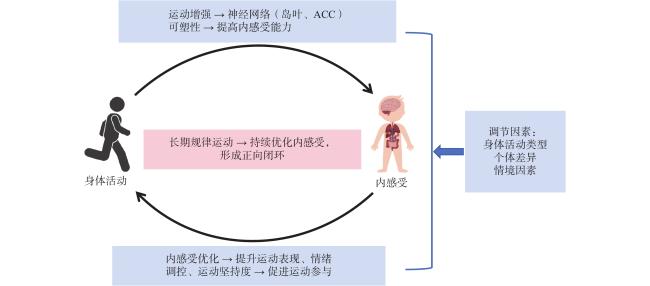


以往的内感受模型(如三维结构模型、预测编码模型、主动推理模型等)多聚焦于内感受加工的静态结构或认知层面,而BPIL模型将身体活动作为动态输入变量,整合多层级环路,突出身体活动与内感受之间的双向动态循环机制。该模型还为预测编码框架提供了可验证的应用路径,即通过调控运动强度或注意方式,检验身体活动对内感受预测与反馈过程的动态调节,从而为理解运动情境下的内感受机制提供新的整合视角。下面将在上文总结的内容的基础上进一步讨论应用方面的研究,主要从毕生发展和功能修复两个角度展开。
4 身体活动和内感受关联关系的应用领域
4.1 毕生发展:一般人群的内感受优化
内感受及其相关过程是毕生发展的心理健康的重要机制。儿童的内感受性和成年人特征相似但总体能力更弱,处于动态发展的过程。从儿童内感受性的几个维度来看,儿童内感受准确性与情绪功能、适应性之间都存在正相关关系(Koch & Pollatos, 2014)。Georgiou等人(2015)的研究发现高内感受敏感性(IS)的儿童在体力表现任务中成绩更好,且IS与儿童的身体活动程度呈正相关。近来还有研究通过父母报告的方式对儿童多种感觉域的内感受性进行了测评,结果发现身体活动水平较高的儿童具有更好的情绪和身体能量的内感受敏感性,从而帮助儿童更准确地调整疾病(例如,喉咙痛、身体发冷)和如厕需求的内感受信号(Wengrovius et al., 2022)。
此外,当儿童的内感受加工受到干扰时可能会导致食物摄入过量,逐渐成为肥胖儿童。Mölbert等人(2016)的研究发现肥胖儿童通过体育锻炼、认知行为疗法和均衡饮食的减肥计划后体重减轻,不仅饮食问题得到改善,而且在减肥过程中心跳检测的准确性也有所提高,这表明包含体育锻炼的减肥计划诱导了内感受加工的改善,对肥胖儿童未来健康行为的自我调节有促进作用。以上研究均表明了儿童身体活动和内感受能力发展的交互作用,通过适应性身体活动能促进儿童内感受的优化整合,从而支持儿童的生理、认知和社会功能发展。
目前尚没有身体活动对老年人内感受影响的实证研究。然而,已有多项研究表明,身体活动对老年人的身心健康具有积极影响(Wong et al., 2023)。身体活动可能通过神经可塑性、自主神经调节和情绪改善等机制,间接增强老年人的内感受能力。未来研究应进一步探讨不同类型的运动干预对老年人内感受的具体影响,为健康老龄化提供新的干预手段。
4.2 功能修复:内感受受损人群的干预路径
内感受被广泛认为是反映个体固定特质的稳定指标,与此同时,内感受也被认为是一种与心理状况相互作用的状态指数。对于多种身心疾病类型的临床患者,已有部分研究着手讨论患者的内感受能力和身体活动之间的关系。下面将主要围绕几种类型的内感受受损人群展开评述,对于这些内感受受损群体而言,身体活动不仅是一种生理调节工具,更是一种重塑内感受加工模式的心理干预媒介。
物质使用障碍(substance use disorders, SUDs)是使用精神活性物质之后产生的成瘾性精神障碍的统称。对于SUD患者,体育锻炼被认为是一种无需药物、成本效益高的辅助治疗手段,能帮助SUD患者更好地解码与体内平衡或不平衡状态相关的身体信号,同时减弱对那些会增加消耗冲动的应激源的反应,并产生对奖赏系统的响应,从而替代成瘾行为。体育锻炼可以被重新定义为“内感受助推器”,帮助个体区分由体育锻炼引起的感觉和由寻求奖赏引起的感觉,即提高了内感受性的辨别能力(Brevers et al., 2024)。因此,患有成瘾性疾病的人可以从行为调整和内感受性辨别训练中受益。Thal等人(2023)认为,通过在锻炼时对患者进行更多指导,如指导患者如何监测心率,能更好地帮助患者管理由体力消耗引发的负面影响,从而帮助患者在锻炼时调节自己的行为。
慢性心力衰竭(chronic heart failure, CHF)患者的特点是在休息或体力消耗时出现症状,如呼吸短促、心动过速、胸痛和疲劳。患者在身体活动之后反复出现的躯体症状会导致两者之间的联想学习(van Diest, 2019)。患者对这些症状的评价可能进一步导致症状窘迫,并对运动的负面后果(如身体症状)担忧,该现象被称为身体活动恐惧(fear of physical activity, FoPA)。根据当前治疗指南的建议,FoPA可能会对涉及中等水平身体活动的心力衰竭治疗结果产生负面影响。Hoffmann等人(2023)的研究发现,FoPA高的患者比FoPA低的患者对自己心跳的感知更不准确,内感受性缺乏损害身体活动和心脏信号之间的联想学习,使患者无法充分地将身体感觉情境化。患者不准确的内感受和症状窘迫与对身体活动的较高恐惧相关,而与心力衰竭严重程度无关。因此,在体育活动中对心脏唤醒和症状的感知和评估值得进一步关注,以制定干预措施来减少心力衰竭患者对体育活动的恐惧。
慢性肌肉骨骼疼痛(chronic musculoskeletal pain, CMP)是慢性疼痛的一个亚类(持续或复发性疼痛,持续时间超过3个月),除了疼痛本身,它还会导致许多问题,包括身体活动减少、生活质量下降和医疗成本增加。由内感受准确性受损导致的述情障碍可能影响CMP患者在日常生活中感知身体活动的能力。通过心跳跟踪任务发现,CMP患者对于内感受的准确评估与身体活动水平自我报告的准确性有关(Shizuma et al., 2021)。因此,未来应尝试采用正念等针对CMP患者述情障碍和内感受的行为干预来改善患者的自我监测能力。类似地,在纤维肌痛症的女性患者身上也发现了内感受性意识受损。内感受意识和幸福感的下降与身体活动水平密切相关。有规律的锻炼和适宜的体育活动可以增加纤维肌痛患者的内感受性意识并改善生活质量(Pasin & Karatekin, 2023)。
对于创伤后应激障碍(posttraumatic stress disorder, PTSD)患者,一项实验开发整合了基于正念训练的有氧−抗阻联合运动方案,实验参与者为创伤后应激障碍的退伍军人,经过12周干预后,实验组不仅表现出PTSD症状强度降低和生活质量提升的临床效度,更在内感受性身体意识、正念水平及积极心理状态方面都有了显著的改善(Mehling et al., 2018)。该研究特别强调引导参与者将内感受身体意识的感知焦点从思考身体感觉转移到立即感受身体感觉,这种模式有效减少了认知反刍,进而改善创伤后应激障碍患者的身心状态。
5 总结与展望
本文回顾了身体活动和内感受关系的各领域研究,梳理了身体活动和内感受之间动态关系的多重证据,即身体活动支持身体内部信号的加工,影响个体内感受能力,反之,内感受过程有助于调节身体活动期间的消耗并影响运动表现。然而,该领域的实证研究还较为缺乏,比如包含身体活动的内感受训练还比较少,导致在自我调节缺陷(如情绪障碍)个体中还未开展类似临床研究。此外,目前大量研究仍聚焦两者相关关系的探究,缺乏有因果关系证据的实验研究。
未来研究可以从以下几个方面展开。首先,由于身体活动这种生理唤醒引起的内感受变化属于一种状态依赖性的波动,个体差异较大,理解个体差异如何影响内感受信号的更高水平加工,对于身体活动和内感受关系的整体理解至关重要。未来应基于个体内感受特征(如心跳感知准确性、疼痛敏感度)制定分层运动方案,并模拟不同运动方案对内感受−行为环路的影响,优化干预策略。
其次,目前的应用研究更多还是通过心跳计数、心跳辨别等指标来反映内感受性,然而内感受研究实际包含了身体系统(如心脏、呼吸、胃)的不同水平,包括传入信号的神经表征、内感受准确性、洞察力和主观报告测量(Nord & Garfinkel, 2022)。未来研究需要优化测试来评估内感受系统的不同测评维度,以确定不同临床群体的普遍和特定变化,以便更好地结合身体活动干预措施对其进行治疗。技术方面可以开发可穿戴设备的多模态传感器(如“肌电+心率变异性+呼吸节律”),实时捕捉运动中的内感受信号变化,并建立个性化基线数据库来调节内感受与运动表现的交互,为运动强度分级提供依据。对于内感受功能受损的患者,可以实时预警患者内感受失调状态,从而更安全有效地实施合理的身体活动干预方案。
最后,应拓展目前的应用场景。例如,在公共健康与教育场景中,可以尝试将内感受训练融入体育课程,提升学生的自我调节能力,在职场健康管理中推广“微运动”策略(如5分钟动态拉伸),通过调节内感受性缓解慢性疲劳。
总体而言,内感受加工与身体、认知和情绪健康的关系具有重要的临床意义。从身体活动如何在基本生理水平上与内感受过程相互作用,到理解个体差异如何影响内感受传入信号的更高水平加工,对于建立整体理解至关重要。未来研究需结合个体差异因素、更全面的内感受性测评维度对身体活动和内感受的关联进行更深入的机制探究,并将研究成果更有针对性地运用于不同类型的人群。