
心理与行为研究 ›› 2025, Vol. 23 ›› Issue (6): 789-797.DOI: 10.12139/j.1672-0628.2025.06.009
杨昕珠1, 王腾飞2, 郑晓龙*,2( )
)
收稿日期:2025-06-16
出版日期:2025-11-20
发布日期:2025-11-20
通讯作者:
郑晓龙
基金资助:
Xinzhu YANG1, Tengfei WANG2, Xiaolong ZHENG*,2()
Received:2025-06-16
Online:2025-11-20
Published:2025-11-20
Contact:
Xiaolong ZHENG
摘要:
在“双减”政策背景下,提升学生的社会情感能力与缓解学业倦怠已成为关键教育议题。为探究两者间的双向预测作用及性别差异,本研究对740名初一学生进行三次追踪调查,采用交叉滞后模型对数据进行分析。结果发现:(1)社会情感能力随时间逐渐下降,学业倦怠随时间逐渐上升,且男生的社会情感能力显著高于女生;(2)社会情感能力与学业倦怠存在显著的双向负向预测作用;(3)社会情感能力与学业倦怠间的相互预测作用存在性别差异:在男生中呈现双向预测,而在女生中仅表现为学业倦怠对社会情感能力的单向预测。本研究通过纵向设计揭示了初中生社会情感能力与学业倦怠之间的动态交互作用及性别差异特征,提示教育实践应重视通过培养社会情感能力来缓解学业倦怠,并采取性别差异化干预策略。
杨昕珠, 王腾飞, 郑晓龙. 青少年社会情感能力与学业倦怠的双向预测作用:一项交叉滞后研究[J]. 心理与行为研究, 2025, 23(6): 789-797.
Xinzhu YANG, Tengfei WANG, Xiaolong ZHENG. Bidirectional Relationship Between Social-Emotional Competence and Academic Burnout in Adolescence: A Cross-Lagged Study[J]. Studies of Psychology and Behavior, 2025, 23(6): 789-797.
| 1 | 2 | 3 | 4 | 5 | 6 | 7 | 8 | |
| 1.性别 | ||||||||
| 2.年龄 | −0.08* | |||||||
| 3.社会情感能力T1 | −0.12** | 0.01 | ||||||
| 4.社会情感能力T2 | −0.17*** | 0.05 | 0.67*** | |||||
| 5.社会情感能力T3 | −0.15*** | −0.02 | 0.61*** | 0.72*** | ||||
| 6.学业倦怠T1 | 0.00 | −0.03 | −0.71*** | −0.52*** | −0.51*** | |||
| 7.学业倦怠T2 | 0.01 | −0.06 | −0.57*** | −0.73*** | −0.59*** | 0.67*** | ||
| 8.学业倦怠T3 | 0.03 | −0.03 | −0.51*** | −0.56*** | −0.73*** | 0.61*** | 0.68*** | |
| M | 0.47 | 12.52 | 4.05 | 4.02 | 3.99 | 2.47 | 2.44 | 2.49 |
| SD | 0.50 | 0.59 | 0.66 | 0.65 | 0.66 | 1.06 | 1.03 | 1.01 |
表1 描述性统计和相关分析
| 1 | 2 | 3 | 4 | 5 | 6 | 7 | 8 | |
| 1.性别 | ||||||||
| 2.年龄 | −0.08* | |||||||
| 3.社会情感能力T1 | −0.12** | 0.01 | ||||||
| 4.社会情感能力T2 | −0.17*** | 0.05 | 0.67*** | |||||
| 5.社会情感能力T3 | −0.15*** | −0.02 | 0.61*** | 0.72*** | ||||
| 6.学业倦怠T1 | 0.00 | −0.03 | −0.71*** | −0.52*** | −0.51*** | |||
| 7.学业倦怠T2 | 0.01 | −0.06 | −0.57*** | −0.73*** | −0.59*** | 0.67*** | ||
| 8.学业倦怠T3 | 0.03 | −0.03 | −0.51*** | −0.56*** | −0.73*** | 0.61*** | 0.68*** | |
| M | 0.47 | 12.52 | 4.05 | 4.02 | 3.99 | 2.47 | 2.44 | 2.49 |
| SD | 0.50 | 0.59 | 0.66 | 0.65 | 0.66 | 1.06 | 1.03 | 1.01 |
| 模型 | χ2(df) | CFI | TLI | RMSEA | 模型比较 | Δχ2SB(Δdf) | p | ΔCFI | ΔRMSEA |
| 社会情感能力 | |||||||||
| M1:形态等值 | 2100.287(882) | 0.912 | 0.901 | 0.043 | |||||
| M2:弱等值 | 2160.379(910) | 0.910 | 0.902 | 0.043 | M2−M1 | 60.406(28) | <0.001 | −0.002 | 0.000 |
| M3:强等值 | 2333.929(940) | 0.900 | 0.894 | 0.045 | M3−M2 | 210.929(30) | <0.001 | −0.010 | 0.002 |
| 学业倦怠 | |||||||||
| M1:形态等值 | 1857.433(888) | 0.922 | 0.913 | 0.038 | |||||
| M2:弱等值 | 1886.419(916) | 0.922 | 0.916 | 0.038 | M2−M1 | 27.452(28) | 0.494 | 0.000 | 0.000 |
| M3:强等值 | 1939.631(946) | 0.920 | 0.916 | 0.038 | M3−M2 | 50.891(30) | 0.010 | −0.002 | 0.000 |
表2 各变量在3个时间点的测量等值性检验
| 模型 | χ2(df) | CFI | TLI | RMSEA | 模型比较 | Δχ2SB(Δdf) | p | ΔCFI | ΔRMSEA |
| 社会情感能力 | |||||||||
| M1:形态等值 | 2100.287(882) | 0.912 | 0.901 | 0.043 | |||||
| M2:弱等值 | 2160.379(910) | 0.910 | 0.902 | 0.043 | M2−M1 | 60.406(28) | <0.001 | −0.002 | 0.000 |
| M3:强等值 | 2333.929(940) | 0.900 | 0.894 | 0.045 | M3−M2 | 210.929(30) | <0.001 | −0.010 | 0.002 |
| 学业倦怠 | |||||||||
| M1:形态等值 | 1857.433(888) | 0.922 | 0.913 | 0.038 | |||||
| M2:弱等值 | 1886.419(916) | 0.922 | 0.916 | 0.038 | M2−M1 | 27.452(28) | 0.494 | 0.000 | 0.000 |
| M3:强等值 | 1939.631(946) | 0.920 | 0.916 | 0.038 | M3−M2 | 50.891(30) | 0.010 | −0.002 | 0.000 |
| 模型 | χ2(df) | CFI | TLI | RMSEA | 模型比较 | Δχ2SB(Δdf) | p | ΔCFI | ΔRMSEA |
| 社会情感能力与学业倦怠的交叉滞后模型 | |||||||||
| M1.1:自由估计 | 4.585(2) | 0.999 | 0.987 | 0.042 | |||||
| M1.2:限定相邻时间点自回归路径相等 | 7.874(4) | 0.998 | 0.990 | 0.036 | M1.2-M1.1 | 3.199(2) | 0.202 | −0.001 | −0.006 |
| M1.3:限定相邻时间点交叉滞后路径相等 | 7.130(4) | 0.998 | 0.992 | 0.033 | M1.3-M1.1 | 2.507(2) | 0.286 | −0.001 | −0.009 |
| M1.4:限定相邻时间点自回归和交叉滞后路径相等 | 14.226(6) | 0.996 | 0.986 | 0.043 | M1.4-M1.1 | 9.658(4) | 0.047 | −0.003 | 0.001 |
| 社会情感能力与学业倦怠的交叉滞后模型:男生 | |||||||||
| M2.1:自由估计 | 1.597(2) | 1.000 | 1.000 | 0.000 | |||||
| M2.2:限定相邻时间点自回归路径相等 | 4.762(4) | 0.999 | 0.996 | 0.022 | M2.2-M2.1 | 3.262(2) | 0.196 | −0.001 | 0.022 |
| M2.3:限定相邻时间点交叉滞后路径相等 | 6.145(4) | 0.997 | 0.990 | 0.037 | M2.3-M2.1 | 4.691(2) | 0.096 | −0.003 | 0.037 |
| M2.4:限定相邻时间点自回归和交叉滞后路径相等 | 13.032(4) | 0.990 | 0.977 | 0.055 | M2.4-M2.1 | 11.790(4) | 0.019 | −0.010 | 0.055 |
| 社会情感能力与学业倦怠的交叉滞后模型:女生 | |||||||||
| M3.1:自由估计 | 6.649(2) | 0.995 | 0.962 | 0.082 | |||||
| M3.2:限定相邻时间点自回归路径相等 | 8.292(4) | 0.995 | 0.982 | 0.056 | M3.2-M3.1 | 1.473(2) | 0.479 | 0.000 | −0.026 |
| M3.3:限定相邻时间点交叉滞后路径相等 | 8.230(4) | 0.995 | 0.983 | 0.055 | M3.3-M3.1 | 1.472(2) | 0.479 | 0.000 | −0.027 |
| M3.4:限定相邻时间点自回归和交叉滞后路径相等 | 9.751(6) | 0.996 | 0.990 | 0.042 | M3.4-M3.1 | 2.679(4) | 0.613 | 0.001 | −0.040 |
表3 交叉滞后模型的拟合指数
| 模型 | χ2(df) | CFI | TLI | RMSEA | 模型比较 | Δχ2SB(Δdf) | p | ΔCFI | ΔRMSEA |
| 社会情感能力与学业倦怠的交叉滞后模型 | |||||||||
| M1.1:自由估计 | 4.585(2) | 0.999 | 0.987 | 0.042 | |||||
| M1.2:限定相邻时间点自回归路径相等 | 7.874(4) | 0.998 | 0.990 | 0.036 | M1.2-M1.1 | 3.199(2) | 0.202 | −0.001 | −0.006 |
| M1.3:限定相邻时间点交叉滞后路径相等 | 7.130(4) | 0.998 | 0.992 | 0.033 | M1.3-M1.1 | 2.507(2) | 0.286 | −0.001 | −0.009 |
| M1.4:限定相邻时间点自回归和交叉滞后路径相等 | 14.226(6) | 0.996 | 0.986 | 0.043 | M1.4-M1.1 | 9.658(4) | 0.047 | −0.003 | 0.001 |
| 社会情感能力与学业倦怠的交叉滞后模型:男生 | |||||||||
| M2.1:自由估计 | 1.597(2) | 1.000 | 1.000 | 0.000 | |||||
| M2.2:限定相邻时间点自回归路径相等 | 4.762(4) | 0.999 | 0.996 | 0.022 | M2.2-M2.1 | 3.262(2) | 0.196 | −0.001 | 0.022 |
| M2.3:限定相邻时间点交叉滞后路径相等 | 6.145(4) | 0.997 | 0.990 | 0.037 | M2.3-M2.1 | 4.691(2) | 0.096 | −0.003 | 0.037 |
| M2.4:限定相邻时间点自回归和交叉滞后路径相等 | 13.032(4) | 0.990 | 0.977 | 0.055 | M2.4-M2.1 | 11.790(4) | 0.019 | −0.010 | 0.055 |
| 社会情感能力与学业倦怠的交叉滞后模型:女生 | |||||||||
| M3.1:自由估计 | 6.649(2) | 0.995 | 0.962 | 0.082 | |||||
| M3.2:限定相邻时间点自回归路径相等 | 8.292(4) | 0.995 | 0.982 | 0.056 | M3.2-M3.1 | 1.473(2) | 0.479 | 0.000 | −0.026 |
| M3.3:限定相邻时间点交叉滞后路径相等 | 8.230(4) | 0.995 | 0.983 | 0.055 | M3.3-M3.1 | 1.472(2) | 0.479 | 0.000 | −0.027 |
| M3.4:限定相邻时间点自回归和交叉滞后路径相等 | 9.751(6) | 0.996 | 0.990 | 0.042 | M3.4-M3.1 | 2.679(4) | 0.613 | 0.001 | −0.040 |
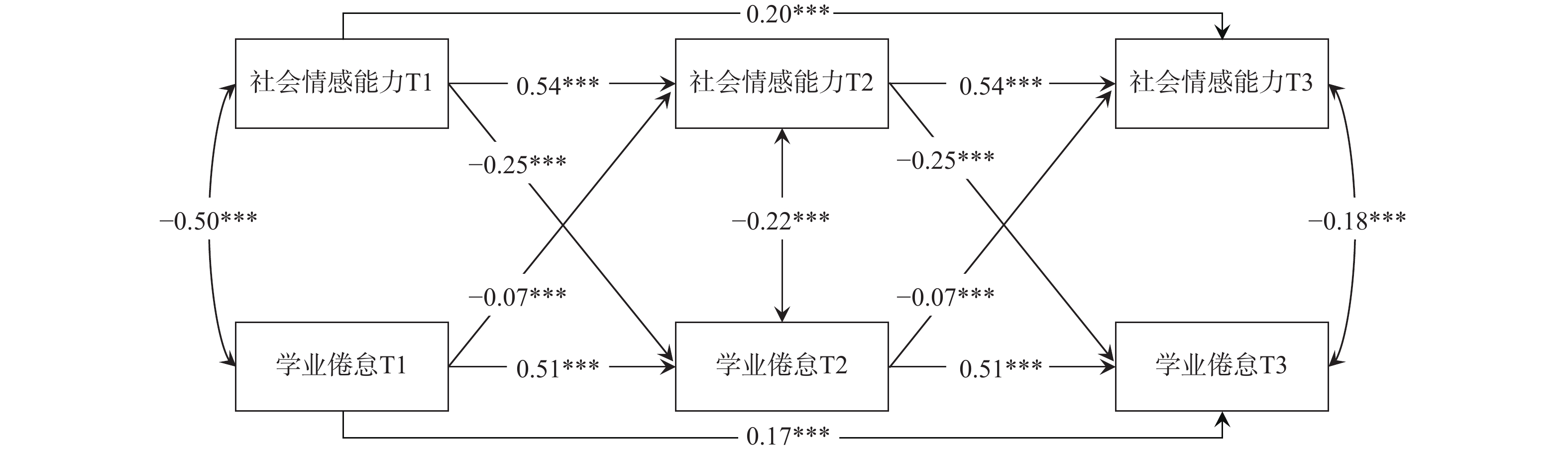
图1 社会情感能力与学业倦怠的交叉滞后模型 注:图中所标注的系数为非标准化路径系数,以下同。
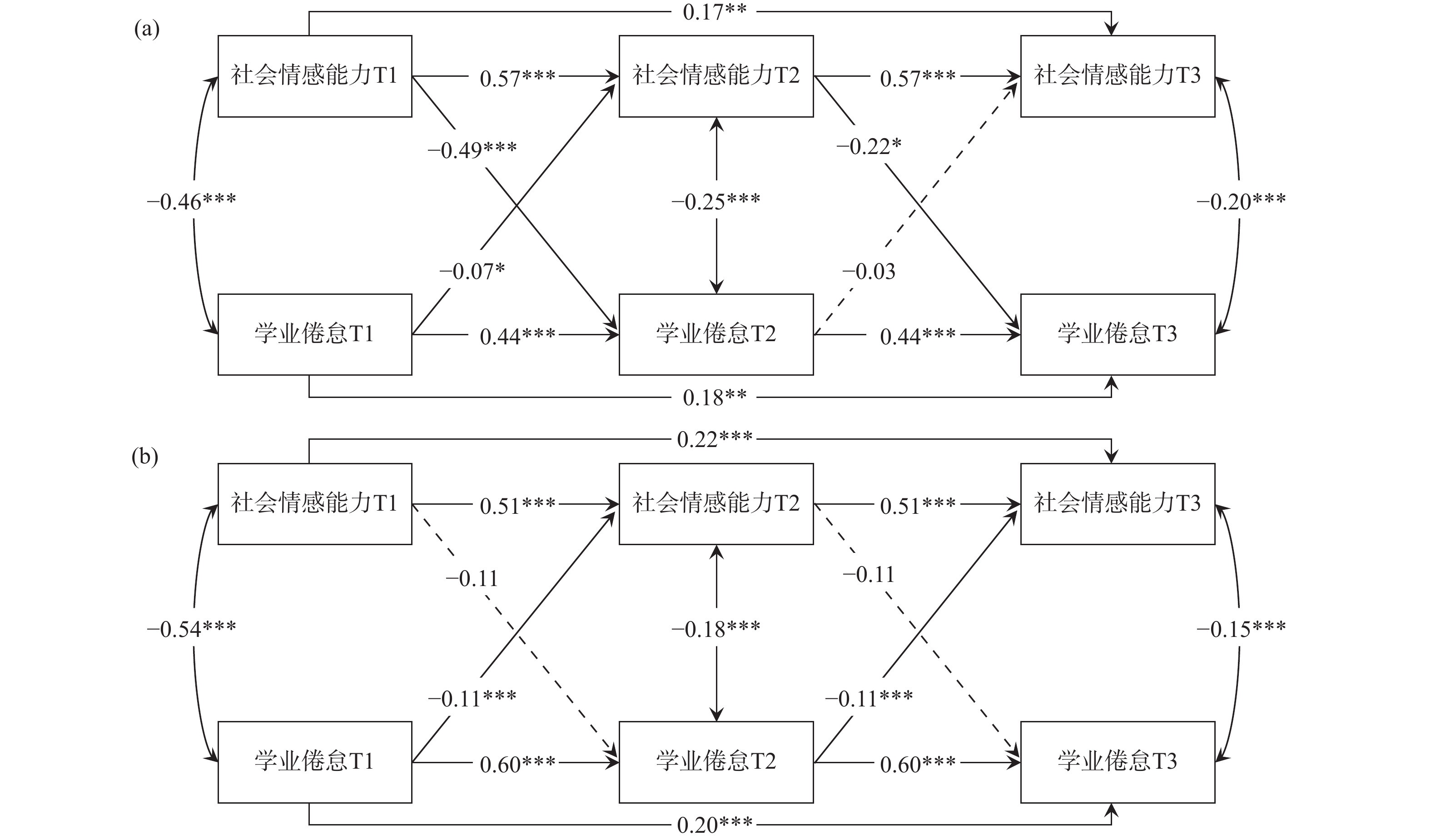
图2 不同性别社会情感能力与学业倦怠的交叉滞后模型 注:图2a为男生模型,图2b为女生模型。
|
邓宇泽, 杨佳奇, 朱芷滢, 王烨晖. 小学生社会情感能力、师生关系和同伴关系:一项交叉滞后研究. 心理发展与教育, 2025, 41 (3): 322- 331.
|
|
|
韩宪国, 金国敏, 李丹, 刘世宏, 吴琴, 刘俊升, 陈欣银. 父母温暖与儿童晚期亲社会行为的关系:集体取向的作用. 心理学报, 2025, 57 (4): 614- 630.
|
|
|
李若璇, 朱文龙, 刘红瑞, 姚梅林. 家长教育期望对学业倦怠的影响:家长投入的中介及家庭功能的调节. 心理发展与教育, 2018, 34 (4): 489- 496.
|
|
|
汤丹丹, 温忠麟. 共同方法偏差检验:问题与建议. 心理科学, 2020, 43 (1): 215- 223.
|
|
|
袁振国, 黄忠敬, 李婧娟, 张静. (2021). 中国青少年社会与情感能力发展水平报告. 华东师范大学学报(教育科学版), 39(9), 1–32.
|
|
|
袁振国, 黄忠敬, 王纮, 王翔宇, 张静. 中国青少年社会与情感能力发展水平报告——基于第二轮SSES测评数据. 华东师范大学学报(教育科学版), 2024, 42 (5): 1- 32.
|
|
|
周浩, 龙立荣. 共同方法偏差的统计检验与控制方法. 心理科学进展, 2004, 12 (6): 942- 950.
|
|
|
Basu, S., Zuo, X. Y., Lou, C. H., Acharya, R., & Lundgren, R. (2017). Learning to be gendered: Gender socialization in early adolescence among urban poor in delhi, India, and shanghai, China. Journal of Adolescent Health, 61(4 Suppl), S24–S29.
|
|
|
Brown, M., Blanchard, T., & McGrath, R. E. Differences in self-reported character strengths across adolescence. Journal of Adolescence, 2020, 79 (1): 1- 10.
DOI |
|
|
Chaplin, T. M. Gender and emotion expression: A developmental contextual perspective. Emotion Review: Journal of the International Society for Research on Emotion, 2015, 7 (1): 14- 21.
|
|
|
Chernyshenko, O. S., Kankaraš, M., & Drasgow, F. (2018). Social and emotional skills for student success and well-being: Conceptual framework for the OECD study on social and emotional skills (OECD Education Working Papers No. 173). Paris: OECD.
|
|
|
Gavelin, H. M., Domellöf, M. E., Åström, E., Nelson, A., Launder, N. H., Neely, A. S., & Lampit, A. Cognitive function in clinical burnout: A systematic review and meta-analysis. Work & Stress, 2022, 36 (1): 86- 104.
|
|
|
Graham, J. W. Missing data analysis: Making it work in the real world. Annual Review of Psychology, 2009, 60 (1): 549- 576.
DOI |
|
|
Guo, J. S., Tang, X., Marsh, H. W., Parker, P., Basarkod, G., Sahdra, B., ... Salmela-Aro, K. The roles of social-emotional skills in students’ academic and life success: A multi-informant and multicohort perspective. Journal of Personality and Social Psychology, 2023, 124 (5): 1079- 1110.
DOI |
|
|
Hampel, P., & Petermann, F. Age and gender effects on coping in children and adolescents. Journal of Youth and Adolescence, 2005, 34 (2): 73- 83.
DOI |
|
|
Hu, L. T., & Bentler, P. M. Cutoff criteria for fit indexes in covariance structure analysis: Conventional criteria versus new alternatives. Structural Equation Modeling: A Multidisciplinary Journal, 1999, 6 (1): 1- 55.
DOI |
|
|
Huttunen, I., Upadyaya, K., & Salmela-Aro, K. Longitudinal associations between adolescents’ social-emotional skills, school engagement, and school burnout. Learning and Individual Differences, 2024, 115, 102537.
DOI |
|
|
Kankaraš, M., & Suarez-Alvarez, J. (2019). Assessment framework of the OECD study on social and emotional skills (OECD Education Working Papers No. 207). Paris: OECD.
|
|
|
Lee, J., Wang, C. X., & Lui, I. D. (2025). Exploring gender differences in multidimensional social-emotional competence from developmental and cross-cultural perspectives. Social and Emotional Learning: Research, Practice, and Policy, 6, 100137.
|
|
|
Little, T. D. (2013). Longitudinal structural equation modeling. New York: The Guilford Press.
|
|
|
Liu, W. Q., Zhang, R. Y., Wang, H., Rule, A., Wang, M., Abbey, C., ... Tong, L. Association between anxiety, depression symptoms, and academic burnout among Chinese students: The mediating role of resilience and self-efficacy. BMC Psychology, 2024, 12 (1): 335.
DOI |
|
|
Liu, Z. P., Guo, J. S., Huang, H. Y., & Tang, X. Which social-emotional skills are most important for students’ learning and well-being? An international comparison among China, USA and Finland. Learning and Individual Differences, 2025, 121, 102703.
DOI |
|
|
Marsh, H. W., Pekrun, R., Murayama, K., Arens, A. K., Parker, P. D., Guo, J., & Dicke, T. An integrated model of academic self-concept development: Academic self-concept, grades, test scores, and tracking over 6 years. Developmental Psychology, 2018, 54 (2): 263- 280.
DOI |
|
|
May, R. W., Bauer, K. N., & Fincham, F. D. School burnout: Diminished academic and cognitive performance. Learning and Individual Differences, 2015, 42, 126- 131.
DOI |
|
|
Putnick, D. L., & Bornstein, M. H. Measurement invariance conventions and reporting: The state of the art and future directions for psychological research. Developmental Review, 2016, 41, 71- 90.
DOI |
|
|
Ross, K. M., Kim, H., Tolan, P. H., & Jennings, P. A. An exploration of normative social and emotional skill growth trajectories during adolescence. Journal of Applied Developmental Psychology, 2019, 62, 102- 115.
DOI |
|
|
Salmela-Aro, K., Tang, X., & Upadyaya, K. (2022). Study demands-resources model of student engagement and burnout. In A. L. Reschly & S. L. Christenson (Eds.), Handbook of Research on Student Engagement (pp. 77–93). Cham, Switzerland: Springer International Publishing.
|
|
|
Salmela-Aro, K., & Upadyaya, K. School burnout and engagement in the context of demands-resources model. The British Journal of Educational Psychology, 2014, 84 (1): 137- 151.
DOI |
|
|
Salmela-Aro, K., & Upadyaya, K. School engagement and school burnout profiles during high school—The role of socio-emotional skills. European Journal of Developmental Psychology, 2020, 17 (6): 943- 964.
DOI |
|
|
Salmela-Aro, K., Upadyaya, K., Vinni-Laakso, J., & Hietajärvi, L. Adolescents’ longitudinal school engagement and burnout before and during COVID-19—The role of socio-emotional skills. Journal of Research on Adolescence, 2021, 31 (3): 796- 807.
DOI |
|
|
Schaufeli, W. B., Martínez, I. M., Pinto, A. M., Salanova, M., & Bakker, A. B. Burnout and engagement in university students: A cross-national study. Journal of Cross-Cultural Psychology, 2002, 33 (5): 464- 481.
DOI |
|
|
Sebastian, C., Burnett, S., & Blakemore, S.J. Development of the self-concept during adolescence. Trends in Cognitive Sciences, 2008, 12 (11): 441- 446.
DOI |
|
|
Tang, X., Upadyaya, K., & Salmela-Aro, K. School burnout and psychosocial problems among adolescents: Grit as a resilience factor. Journal of Adolescence, 2021, 86 (1): 77- 89.
DOI |
|
|
Van den Akker, A. L., Deković, M., Asscher, J., & Prinzie, P. Mean-level personality development across childhood and adolescence: A temporary defiance of the maturity principle and bidirectional associations with parenting. Journal of Personality and Social Psychology, 2014, 107 (4): 736- 750.
DOI |
|
|
Von Stumm, S., Hell, B., & Chamorro-Premuzic, T. The hungry mind: Intellectual curiosity is the third pillar of academic performance. Perspectives on Psychological Science, 2011, 6 (6): 574- 588.
DOI |
|
|
Wang, F. M., Zeng, L. M., & King, R. B. Teacher support for basic needs is associated with socio-emotional skills: A self-determination theory perspective. Social Psychology of Education, 2025, 28 (1): 76.
DOI |
|
|
Weissberg, R. P., Durlak, J. A., Domitrovich, C. E., & Gullotta, T. P. (2015). Social and emotional learning: Past, present, and future. In J. A. Durlak, C. E. Domitrovich, R. P. Weissberg, & T. P. Gullotta (Eds.), Handbook of social and emotional learning: Research and practice (pp. 3–19). New York: The Guilford Press.
|
|
|
Yang, L., Shrestha, S., Zhan, S. Q., & Cheng, F. Q. Parents’ education anxiety and adolescents’ academic burnout: The role of parenting style and academic self-efficacy. Personality and Individual Differences, 2025, 238, 113082.
DOI |
|
|
Zhu, Q. Y., Cheong, Y., Wang, C. X., & Tong, J. J. The impact of maternal and paternal parenting styles and parental involvement on Chinese adolescents’ academic engagement and burnout. Current Psychology, 2023, 42 (4): 2827- 2840.
DOI |
| [1] | 王丹云, 王玉龙, 唐卓. 青少年运动习惯与自尊、心理韧性的动态关系:基于交叉滞后与随机截距交叉滞后模型的分析[J]. 心理与行为研究, 2026, 24(2): 178-186. |
| [2] | 王惠惠, 唐慎佩, 赵双祐, 黄向圆, 兰松. 内在自我与外界眼光:自我评价与反射性评价一致性对青少年心理健康问题的影响[J]. 心理与行为研究, 2026, 24(2): 187-194. |
| [3] | 樊雪戎, 段依凡, 邢晓沛. 温暖的亲子感知差异与青少年内化问题的关系:基于二项式回归的响应面分析[J]. 心理与行为研究, 2026, 24(2): 195-203. |
| [4] | 赵聪, 张镇, 赵怡霖, 金东艳. 父母社会情感能力与儿童社会情感能力:亲子沟通的中介作用和家庭氛围的调节作用[J]. 心理与行为研究, 2026, 24(2): 234-241. |
| [5] | 张一林, 牛更枫, 白旭青, 辛素飞, 孙晓军. 社会逆境感知与青少年社交媒体成瘾的双向关系:控制感的作用[J]. 心理与行为研究, 2026, 24(2): 258-264. |
| [6] | 张野, 刘致宏, 赵丽云. 青少年网络社会排斥、敌意归因偏向与网络偏差行为的关系:一项纵向研究[J]. 心理与行为研究, 2026, 24(1): 60-68. |
| [7] | 曾子豪, 何震, 袁言云, 赵纤, 印利红, 谭嵘, 常梦梦, 胡义秋. HPA轴系统多基因−亲子关系交互对青少年抑郁发展影响及性别差异[J]. 心理与行为研究, 2026, 24(1): 78-86. |
| [8] | 谷莉, 黄晓彤, 梁广华, 蔡頠, 郭丰波. 核心自我评价与青少年自伤行为的关系:有调节的中介模型[J]. 心理与行为研究, 2025, 23(6): 798-805. |
| [9] | 黄爽, 凌感, 安平. 社会情感能力与幼儿园教师职业倦怠的关系:心理授权和积极应对方式的链式中介作用[J]. 心理与行为研究, 2025, 23(6): 847-853. |
| [10] | 张春妹, 骆玉冰, 温冬雪, 郑航. 青少年逆反心理与偏差行为的关系:偏差同伴联系和偏差群体同一性的链式中介作用[J]. 心理与行为研究, 2025, 23(5): 645-652. |
| [11] | 刘鑫, 刘衍玲, 曾晋逸. 心理需要挫折与青少年抑郁症状的纵向联系:心理素质的调节作用[J]. 心理与行为研究, 2025, 23(4): 496-503. |
| [12] | 鲍振宙, 刘花, 于明申. 青少年校园欺凌旁观行为与焦虑抑郁症状的关系:基于纵向网络分析法[J]. 心理与行为研究, 2025, 23(4): 504-512. |
| [13] | 刘佳, 高培晋, 李楠, 孙敏, 白学军. 社会变化程度感知对青少年社会公平感的影响[J]. 心理与行为研究, 2025, 23(4): 551-559. |
| [14] | 张庆吉, 郭丰波, 涂叶满, 卿再花, 宋凤. 劳动价值观对青少年心理健康潜在类别及其转换的影响:双因素模型视角[J]. 心理与行为研究, 2025, 23(4): 569-576. |
| [15] | 张阔, 李珮瑜, 赵晋娥, 贾绪计. 二分还是多重?青少年成长型思维动机框架的异质性及其与学业适应的关系[J]. 心理与行为研究, 2025, 23(3): 346-353. |
| 阅读次数 | ||||||
|
全文 |
|
|||||
|
摘要 |
|
|||||
