

1 前言
1.1 面孔情绪统计概要表征
面孔情绪是日常非言语交流的重要组成部分,识别同事、朋友和家人的面孔情绪是成功社交中至关重要的一环(Faghel-Soubeyrand et al., 2024)。面孔情绪加工的两阶段模型认为面孔表情识别过程是一个由低级视觉加工(位置、形状、大小)逐渐过渡到高级情绪加工的过程(Russell & Bullock, 1985)。这意味着对面孔情绪加工受到面孔特征因素和情绪效价的影响。例如,研究发现面孔的大小会影响个体对于情绪的判断(Wang, 2018);相较于消极情绪,个体对积极情绪面孔的反应速度更快(Kosonogov & Titova, 2019)。然而目前研究者主要将注意力集中在单一面孔情绪的识别上。在现实生活中,个体常常需要对多个刺激进行整体加工,并提取统计信息,这一过程被称为统计概要表征(仝可 等, 2015; Neumann et al., 2018)。
另外,与单一面孔的情绪识别不同,统计概要表征需要对多张面孔情绪进行整体加工。整体加工理论认为,统计概要表征的形成有赖于观察者对集合中的所有刺激进行加工(Attarha & Moore, 2015; Chong & Treisman, 2003);但抽样加工理论认为仅需对部分刺激进行加工(Allik et al., 2013; Lee et al., 2021)。这两种理论在凸显刺激的存在是否会影响个体在统计概要表征中的表现上存在不同的预期。近期研究者在观察者完成统计概要表征任务后,意外地进行视觉搜索或记忆测验。结果发现,观察者对凸显刺激(例如,较大或情绪较强的刺激)搜索得更快、记忆更好(Goldenberg, LaFollette, et al., 2022; Goldenberg, Schöne, et al., 2022)。这些间接证据表明,观察者在统计概要表征中的表现可能受凸显刺激的影响(Kanaya et al., 2018)。
1.2 凸显刺激对统计概要表征的影响
尽管已有研究提示凸显刺激可能影响个体在统计概要表征中的表现,但是未能明确揭示凸显刺激在统计概要表征中的具体作用机制。Kanaya等人(2018)创新性地通过多特征刺激考察凸显刺激对低级视觉信息的影响。实验中同时呈现多个圆形,这些圆形的大小和闪烁频率会发生变化,观察者要对这些圆形的大小或闪烁频率进行统计概要表征。其中,在对圆形的大小进行统计概要表征时,闪烁频率高的圆形为凸显刺激;在对闪烁频率进行统计概要表征时,较大的圆形为凸显刺激。结果发现随着集合数量的增加,凸显刺激对统计概要表征的干扰效应逐渐增大。研究者基于此提出了放大假说,认为观察者仅依据集合中的部分刺激形成统计概要表征,赋予凸显刺激较大权重。然而,放大假说迄今仅在低级视觉中得到验证(赵冰洁 等, 2024; Iakovlev & Utochkin, 2021)。但在高级视觉(面孔情绪)中,凸显刺激的作用机制尚不明确。基于此,本研究提出假设1:凸显刺激会干扰个体在面孔情绪统计概要表征上的表现,并且随着集合数量的增加干扰效应逐渐增强。
此外,凸显刺激对面孔情绪统计概要表征的干扰作用,可能受到情绪效价(积极或消极情绪)的影响。目前关于情绪面孔的注意偏向存在两种相互冲突的假说(许茜如 等, 2019)。一种是愤怒优势效应,该理论认为,相较于积极的快乐面孔,消极的愤怒面孔更容易吸引个体的注意(Soroka et al., 2019)。因此,当集合中包含消极的凸显刺激时,它可能引发更强的注意偏向,这种注意偏向可能会进一步增强凸显刺激的加工权重,从而对统计概要表征造成更大的干扰。另一种是快乐优势效应,该理论认为,相较于消极情绪,积极情绪更具注意捕获效应(Kosonogov & Titova, 2019)。这意味着当凸显刺激为快乐面孔时,其对统计概要表征的干扰可能更为显著。基于此,本研究提出假设2:不同情绪效价的凸显刺激对统计概要表征的干扰程度存在差异。
然而,对面孔情绪的加工是因人而异的,对情绪更敏感的人可能会对面孔统计概要表征中的情绪凸显刺激赋予更多的权重。Goldenberg,Schöne等人(2022)发现高神经质个体对情绪更加敏感,当凸显刺激存在时表现出较大的偏差。然而,如何有效减少这种偏差仍有待进一步研究。双加工理论认为,个体存在慢速严谨的分析思维和快速自动的直觉思维(Evans & Stanovich, 2013; Kahneman, 2003)。高神经质个体基于情绪快速产生的直觉思维可能会被分析思维所压制,在分析思维的控制下,个体对行为的情境和结果进行仔细考虑和逻辑分析,从而产生非情绪化的理性行为(Alaybek et al., 2022)。因此分析思维可能负向调节神经质对统计概要表征的影响。基于此,本研究提出假设3:分析思维较高的个体通常能够有逻辑地处理信息,因此其能够减弱神经质所带来的情绪反应,减少干扰产生。
综上,放大假说在面孔情绪统计概要表征中的适应性尚未得到验证,其干扰程度是否受情绪效价和个体差异的调节,也缺乏直接证据。因此,本研究通过两个实验进行验证。实验1操纵凸显刺激的有无和集合数量,考察凸显刺激对面孔情绪统计概要表征的干扰效应,并分析该效应是否随着集合数量增加而增强。实验2在增加凸显刺激数量后,详细探讨凸显刺激分布和情绪效价对干扰效应的影响,并收集个体差异数据考察其调节作用。此研究将深化对面孔情绪统计概要表征内在加工机制的理解,并为放大假说提供新的验证与扩展。
2 实验1:凸显刺激在面孔情绪统计概要表征中的作用
2.1 研究方法
2.1.1 被试
使用G*Power 3.1.9.7(Faul et al., 2009),根据Cohen(1992)设定的效应量标准(f=0.25, α=0.05, 1−β=0.80),得出先验分析估算所需的总样本量为13人。本实验随机招募了51名大学生(平均年龄为21.96±2.72岁,女生28人)。所有被试均签署了知情同意书,实验结束后给予相应报酬。
2.1.2 实验设计
采用2(凸显刺激:有、无)×3(集合数量:4、8、16)的两因素被试内实验设计。在本实验中被试需要对面孔情绪进行统计概要表征,并按照前人的方法,使用大小特征创设凸显刺激(Iakovlev & Utochkin, 2021)。
2.1.3 研究材料
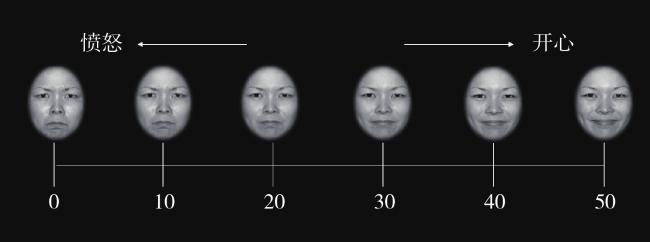
前人研究发现,对于面孔情绪的感知取决于个体的文化背景,个体更善于识别本族的面孔表情(Horry et al., 2015)。基于此,本实验选择了包含多个种族情绪图片的NimStim数据库,具体包括编号为16F、18F、45M的亚裔面孔(Tottenham et al., 2009)。选择他们开心和愤怒的情绪图作为基础实验材料(Goldenberg, Schöne, et al., 2022),通过MATLAB的SHINE工具箱(Willenbockel et al., 2010)对图片进行统一的亮度、灰阶处理。紧接着,使用FantaMorph变形软件(Abrosoft Software Corporation),对每个面孔生成其愤怒(0)到开心(50)的51张序列变化的情绪图。面孔材料示例见图1 。
本实验在黑色背景上呈现同一个体的多张情绪图,当刺激消失后被试需要回答情绪均值。不同任务下刺激的设定如下。
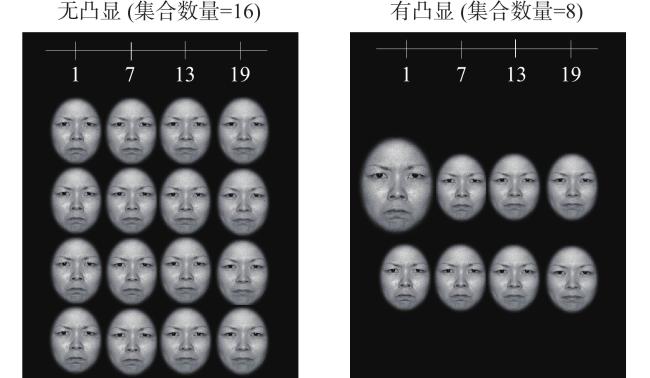
基线任务:该任务中情绪图的大小均为92×118像素,情绪均值(ME)在9~41随机取整,集合中的面孔情绪强度分别由ME±3和ME±9组成。当集合数量为8或16时,表示这些面孔同时出现2次或4次,并随机呈现在4×4的矩阵中。每个矩阵的像素为145×186,位置在横纵坐标±30像素范围内随机抖动。
凸显任务:在有凸显刺激条件下,刺激是在基线任务的基础上随机选择集合中的某个情绪图,并将其大小调整为145×186像素。在无凸显刺激条件下,刺激与基线任务完全相同。通过伪随机的方式设定凸显任务中发生变化的面孔情绪图。实验材料示例见图2 。
2.1.4 实验仪器
本实验使用PsychoPy 2021.2.3设计,显示器的分辨率为1024×768,刷新率为60 Hz。
2.1.5 实验程序
练习阶段:被试需完成12个试次的练习,以确保准确理解实验任务。任务与正式实验相同,即告知被试屏幕上会同时呈现同一个体不同情绪强度的面孔,任务是判断所有面孔的情绪均值。但是,此阶段被试提交答案后有3 s的反馈屏,即屏幕左侧呈现的是自己调整的情绪均值面孔,右侧是正确的情绪均值。
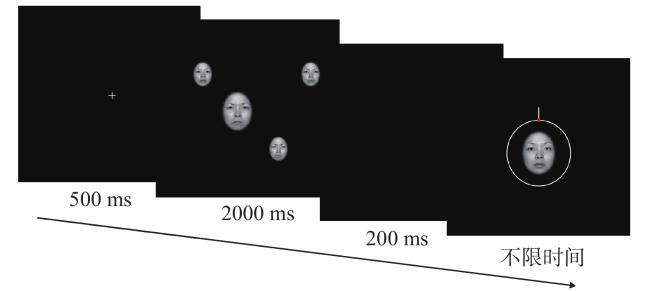
基线任务:共包含96个试次。实验流程如下:首先,在屏幕中央显示白色注视点,持续500 ms;接着呈现集合刺激,持续2000 ms,然后显示空白屏幕200 ms,最后屏幕上只剩一个面孔,该面孔被一个带有红色滑块的白色圆圈包围。被试需要通过鼠标拖动滑块,从而改变面孔的情绪,使其与平均情绪相匹配。此阶段没有时间限制,调整完成后按“空格”键。每80个试次后,出现休息屏。
凸显任务:共包含96个试次,实验流程与基线任务一致(见图3 )。
2.1.6 数据分析
数据整理:删除超过3个标准差的试次。因变量为凸显任务与基线任务的偏差差异(偏差等于估计值与真实值之差值),反映了去除个体的反应倾向外,凸显刺激引起的变化。最终共删除29个试次,占总试次的0.29%。
数据分析:按照情绪强度拆分数据,情绪值>25定义为积极情绪,<25为消极情绪。使用R语言中的bruceR包,分别对两种情绪效价的结果进行重复测量方差分析。在事后两两比较中,使用Bonferroni对p值进行校正,p<0.05视为显著。
2.2 结果
2.2.1 积极情绪
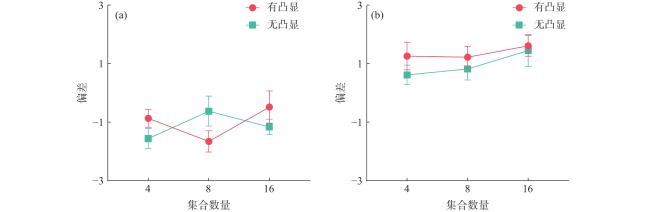
集合数量与凸显刺激的交互效应显著,F(2, 100)=4.32,p=0.016,η$ _{\mathrm{p}}^{2} $ =0.08。简单效应检验发现,在集合数量为4时,无凸显刺激条件下的偏差(M=−1.56)边缘低于有凸显刺激条件(M=−0.87)[t(50)=1.75, p=0.087, Cohen’s d=0.18];在集合数量为8时,无凸显条件下的偏差(M=−0.62)边缘高于凸显条件(M=−1.66)[t(50)=1.86, p=0.069, Cohen’s d=0.27];在集合数量为16时,凸显刺激的效应不显著[t(50)=1.22, p=0.228]。在有、无凸显刺激条件下,均未发现集合数量效应[ts(50)<1.76, ps>0.254]。其余效应均不显著,Fs<0.49,ps>0.612。结果见图4a 。
2.2.2 消极情绪
未发现显著结果,Fs<1.33,ps>0.254。结果见图4b 。
2.3 讨论
本实验仅在积极情绪下发现凸显刺激与集合数量存在显著的交互效应。该结果首先说明,与消极情绪相比,凸显的积极情绪更能捕获注意(Kosonogov & Titova, 2019),支持快乐优势效应。个体对消极情绪的加工较为稳定,较少受凸显刺激的影响。其次,在集合数量上,不论凸显刺激有无,均未发现集合数量效应。即在无凸显刺激条件下,不同集合数量下的偏差相似。这说明被试可能加工了集合中的全部刺激以形成统计概要表征。在有凸显刺激时的结果相似。这说明,与集合数量相比,凸显刺激对统计概要表征的影响更大。最后,本实验发现了显著的凸显刺激效应,即与无凸显刺激相比,有凸显刺激时的偏差更大。该结果表明凸显刺激会导致个体高估集合的情绪均值,干扰个体在情绪统计概要表征中的表现(Iakovlev & Utochkin, 2021; Kanaya et al., 2018)。但是凸显刺激的干扰效应并不稳定,与前人研究发现的偏差随着集合数量增加而随之增加不符。可能是本实验中凸显刺激固定为一个,当集合数量较少时,凸显刺激占比较高,其干扰效应更为明显。上述前人研究中凸显刺激占集合数量的一半,且研究发现随着凸显刺激的占比增加,个体在统计概要表征上的表现变差(Goldenberg, LaFollette, et al., 2022)。综上,仍需在增加凸显刺激的占比后,研究凸显刺激对不同效价面孔情绪统计概要表征的影响。
3 实验2:凸显刺激在不同效价面孔情绪统计概要表征中的作用
实验2中凸显刺激的占比为集合数量的一半(Goldenberg, LaFollette, et al., 2022),进一步考察凸显刺激在面孔情绪统计概要表征中的作用。此外,为了进一步验证放大假说,详细操纵了凸显刺激在集合中所处的位置,探究凸显刺激对偏差方向性的影响。最后,实验1中的情绪效价划分依据是通过变形软件生成的物理情绪强度。然而,由于心理物理差异的存在,物理强度处于中间的面孔其在感知上可能并不为中性(Vikhanova et al., 2022)。基于此,实验2在增加凸显刺激数量后,考察其在不同效价面孔情绪统计概要表征中的具体作用。
3.1 研究方法
3.1.1 被试
本实验随机招募52名大学生(平均年龄为21.56±2.23岁,女生28人)。
3.1.2 实验设计
采用5(分布:凸显刺激偏大、凸显刺激偏小、凸显刺激对称偏大、凸显刺激对称偏小、无凸显刺激)×3(集合数量:4、8、16)×2(情绪效价:积极、消极)的三因素被试内实验设计。
3.1.3 研究材料
(1)面孔材料
每个面孔分别生成中性(1)−开心(50)、中性(1)−愤怒(50)的序列变化面孔情绪图各50张。除凸显刺激数量外,其余设定与实验1相同。
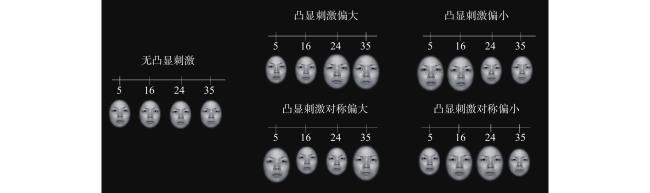
在凸显刺激偏大条件下对强度高于情绪均值的面孔进行凸显,即放大情绪值为ME+4和ME+15的面孔尺寸;在凸显刺激偏小条件下对低于情绪均值的面孔进行凸显,即放大情绪值为ME−4和ME−15的面孔尺寸;在凸显刺激对称偏大条件下凸显远离均值的面孔,放大情绪值为ME−15和ME+15的面孔尺寸;在凸显刺激对称偏小条件下凸显接近均值的面孔,放大情绪值为ME−4和ME+4的面孔尺寸。实验材料示例见图5 。
(2)问卷
采用Yang等人(1999)修订的中文版大五人格量表中的神经质维度,评估个体的神经质。该维度包含焦虑、愤怒敌意、抑郁、自我意识、冲动性、脆弱性共六个特质分量表。每个分量表有8个项目,均为李克特5点计分(0代表“最不赞同”,4代表“非常赞同”)。分数越高表示神经质倾向越高(戴晓阳 等, 2004)。量表的Cronbach’s α系数为0.87。
采用Frederick(2005)编制的认知反思测验,评估个体的分析思维,该测验共包含3个题目,答对得1分,答错不得分。例如,“一个球和一个球拍共花费110元,球拍比球贵100元,请问球多少钱?”正确答案为5元。测验得分越高,表明个体在思维过程中更倾向于抑制直觉反应,从而进行更深入的分析思维(Pennycook et al., 2016)。
3.1.4 实验仪器
同实验1。
3.1.5 实验程序
依照情绪效价分为2个组块,每个组块包含180个试次,组块间随机。每个条件各72个试次,其余均与实验1相同。
3.1.6 数据分析
在考察刺激属性对统计概要表征的影响时,分析方法同实验1。共删除99个试次,占总试次的0.53%。在考察个体差异对干扰效应的影响时,使用SPSS PROCESS 4.2插件进行调节效应分析。将神经质中分量表得分作为预测变量,分析思维作为调节变量,凸显刺激的干扰程度(干扰程度=|偏差偏大|−|偏差无凸显|+|偏差偏小|−|偏差无凸显|)为因变量,并在被试群体中随机抽取5000个样本对效应的95%置信区间进行估计。
3.2 结果
3.2.1 刺激属性分析
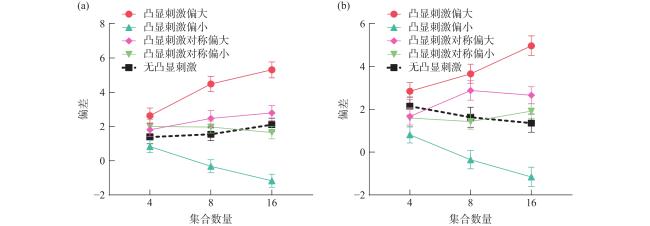
分布的主效应显著,F(4, 204)=73.08,p<0.001,η$ _{\mathrm{p}}^{2} $ =0.59。凸显刺激偏大条件下的偏差显著高于其余条件;其余条件下的偏差显著高于凸显刺激偏小条件。其余主效应均不显著,Fs<1.78,ps>0.175。
集合数量和分布的交互效应显著,F(8, 408)=18.20,p<0.001,η$ _{\mathrm{p}}^{2} $ =0.26。简单效应检验发现,凸显刺激偏大条件下,偏差随着集合数量的增大而增加,集合数量为4时(M=2.74)的偏差显著低于集合数量为8(M=4.08)和16时(M=5.14)、集合数量为8时的偏差显著低于集合数量为16时[ts(51)>3.68, ps<0.002, Cohen’s ds>0.32]。凸显刺激偏小条件下,偏差随着集合数量的增大而增加,集合数量为4时(M=0.82)的偏差显著高于集合数量为8(M=−0.34)和16时(M=−1.16)、集合数量为8时的偏差显著高于集合数量为16时[ts(51)>3.06, ps<0.010, Cohen’s ds>0.24]。在凸显刺激对称偏大条件下,偏差随着集合数量的增大而增加,集合数量为4时(M=1.74)的偏差显著低于集合数量为8(M=2.67)和16时(M=2.72)[ts(51)>3.19, ps<0.007, Cohen’s ds>0.28]。在凸显刺激对称偏小和无凸显刺激条件下,不同集合数量下的偏差无显著差异[ts(51)<0.51, ps>0.999]。
三者交互效应显著,F(8, 408)=1.99,p=0.046,η$ _{\mathrm{p}}^{2} $ =0.04。简单简单效应检验发现,凸显刺激偏大和凸显刺激偏小条件下的集合数量效应,在积极和消极情绪下均存在;而凸显刺激对称偏大条件下的集合数量效应,仅在消极情绪下存在。结果见图6 。
3.2.2 个体差异分析
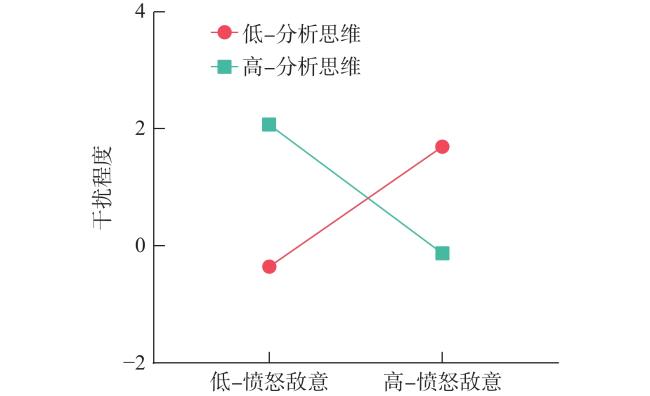
分析思维在愤怒敌意与干扰程度之间的调节作用显著,F(1, 48)=8.46,p=0.005,模型的解释R2为0.15。具体表现为愤怒敌意能正向预测干扰程度(β=0.43, p=0.015),置信区间为[−0.01, 0.84];分析思维能正向预测干扰程度(β=3.45, p=0.007),置信区间为[0.74, 5.99];愤怒敌意与分析思维的交互项对干扰程度有显著的负向预测作用(β=−0.24, p=0.005),置信区间为[−0.40, −0.05]。
简单斜率检验表明,当个体在神经质的愤怒敌意维度中得分较高时,分析思维得分的增加会减少干扰程度,即高分析思维的个体能够更好地调节由愤怒敌意引起的偏差,从而降低偏差的产生。当个体在神经质的愤怒敌意维度中得分较低时,分析思维得分的增加会增加干扰程度,从而导致偏差的产生(见图7 )。


3.3 讨论
实验2发现了稳定的凸显刺激效应及其与集合数量的交互效应。即相比于无凸显刺激和凸显刺激对称偏小条件,个体在凸显刺激偏大和偏小条件下的偏差更大。具体表现为凸显刺激偏大时,个体倾向于高估集合的情绪均值,凸显刺激偏小时,个体倾向于低估集合的情绪均值。而且随着集合数量的增加,凸显刺激产生的干扰效应也逐渐增大;凸显刺激对两种情绪效价产生的干扰相似,仅在凸显刺激对称偏大条件存在细微差异。此外,在个人差异方面,分析思维在高愤怒敌意个体中对干扰程度的预测起负向调节作用;在低愤怒敌意个体中对干扰程度的预测起正向调节作用。
4 总讨论
本研究通过两个实验,严格操纵凸显刺激的数量、分布位置、情绪效价,以直观的方式检验凸显刺激影响面孔情绪统计概要表征的方式。结果发现,凸显刺激的存在会干扰个体在统计概要表征中的表现;其影响受凸显刺激的数量、情绪效价以及个体愤怒敌意特质、分析思维能力的调节。
首先,和前人结果一致,本研究发现了较为稳定的凸显刺激干扰效应,即与无凸显刺激相比,有凸显刺激时个体的偏差较大。具体影响方式为当凸显刺激偏小时,个体倾向于低估情绪均值;反之,当凸显刺激偏大时,个体倾向于高估情绪均值(Goldenberg, Schöne, et al., 2022; Iakovlev & Utochkin, 2021)。结果支持了放大假说,说明凸显刺激确实会捕捉个体的注意,在进行情绪统计概要表征时给予其较高的权重,在估计情绪均值时向凸显刺激所在位置偏移,导致其表现下降。
其次,本研究揭示了凸显刺激占比在凸显刺激影响情绪统计概要表征中的调节作用。实验1中有凸显刺激条件下未发现显著的集合数量效应,实验2中随着集合数量的增加,偏差逐渐增大。实验1中只有一个凸显刺激,且随着集合数量的增加,凸显刺激占比逐渐下降。此时,个体能够更加清晰地识别出凸显刺激的存在,并采取更多的控制策略来减少对凸显刺激的过度反应,从而降低偏差。这一发现与前人研究一致,表明群体中个体化成员的影响力随着成员数量的增加而减弱(Capozzi et al., 2018; Ristic & Capozzi, 2022)。在实验2中,凸显刺激的占比固定为50%。这表明,凸显刺激占比较高时会占据更多的认知资源和注意,导致个体忽视其他信息,从而致使偏差的增加。整体加工理论认为集合中所有刺激对统计概要表征的形成具有相同的影响,无法解释凸显刺激存在导致偏差增大的结果;而放大假说则不能解释凸显刺激占比较少时个体对其进行抑制的结果。这提示个体在加工统计概要表征时不仅依赖于凸显刺激,还受到非凸显刺激的微弱影响,其影响程度受凸显刺激占比的调节。
再次,本研究发现了凸显刺激效价在凸显刺激影响情绪统计概要表征中的调节作用。当凸显刺激数量较少时,仅在积极情绪下存在凸显刺激的干扰效应。该结果反映了与消极情绪相比,积极情绪捕获个体注意的能力更强(Kosonogov & Titova, 2019)。该结果符合快乐优势效应,当凸显刺激为快乐面孔时,其对统计概要表征的干扰可能更为显著。增加凸显刺激的数量后,在两种情绪下均存在凸显刺激的干扰效应,甚至在凸显刺激对称偏大时,仅在愤怒情绪下存在干扰效应。这一结果符合注意偏向的适应性表现,个体更倾向于关注积极情绪,因为这有助于个体的情绪调节,因此当集合中只有一个凸显面孔时,积极凸显面孔的作用更大(许茜如 等, 2019; Chaisilprungraung et al., 2024)。但是当注意资源有限时,个体才表现出对消极情绪的偏向,因为消极信息与生存息息相关。因此当集合中包含多个凸显面孔时,凸显消极情绪面孔的影响更为显现,表现出愤怒优势效应(Anderson & Phelps, 2001; Goldenberg, Schöne, et al., 2022)。
最后,刺激属性影响情绪统计概要表征的表现外,个体的分析思维和神经质也会调节凸显刺激的干扰效应。高神经质个体对刺激的感知更为敏感(Norris, 2021),因此容易受到凸显刺激的影响,表现出较大的偏差。然而,随着分析思维能力的增强,个体能够更好地通过逻辑分析来减少由神经质引起的偏差。对于低神经质个体而言,凸显刺激产生较小的注意偏向,但随着分析思维能力的提高,对凸显情绪的深入加工反而增强了个体的情绪反应,从而导致干扰效应的增加。这提示在制定干预策略时需要考虑到个体差异的存在,有针对性地优化个体在面对凸显情绪刺激时的决策表现,减少干扰效应。
综上,本研究提出选择性加权假说,即在进行统计概要表征时,刺激的物理属性(如占比、情绪效价)以及个体差异(神经质、分析思维)共同决定了加工时的优先级。本假说结合了整体加工理论和放大假说的观点,但不仅仅局限于“加工所有刺激”或“只加工凸显刺激”这两个极端,而是一种动态的权重分配过程。在这一过程中,凸显刺激确实能获得更高的权重,但其影响程度受到刺激特征和个体差异的共同调节。
本研究仍存在一些不足。第一,本研究通过外在行为指标推测统计概要表征的加工过程,但这种方法存在局限,未来可采用眼动追踪技术更直观地探讨凸显刺激的作用。第二,本研究未对面孔情绪强度进行主观评价。考虑到个体差异,未来需关注软件生成的情绪强度与个体主观感知之间的一致性。第三,相关研究主要从视觉通道考察统计概要表征的加工,有必要探索不同感觉通道中该机制是否一致。
5 结论
面孔情绪的统计概要表征是通过对集合中所有刺激的处理形成的,但在这一过程中,凸显刺激会被赋予更大的权重。具体表现为,凸显刺激的存在会导致较大偏差,随着凸显刺激数量的增多,凸显刺激的干扰作用逐渐增强。此外,凸显刺激的权重并非固定不变,受刺激属性和个体差异的动态调节。