

1 引言
在我国网络文明建设中,网络亲社会行为(online prosocial behavior)意义重大。它是指个体在网络环境中为使网友受益或促进与网友的关系而不期望获得回报的自愿行为(Erreygers et al., 2018)。以往基于传统理论研究大学生网络亲社会行为发生机制,未重视网络技术带来的社会临场感,难以揭示本质。当今社会是数字化时代,3D体验和网络直播等为用户提供了深度交互的网络环境,使网友能够一起“面对面”交流交互,带来了高水平的社会临场感(Oh et al., 2018; Wang & Zhang, 2022),其对网络亲社会行为的影响有待深入探讨。
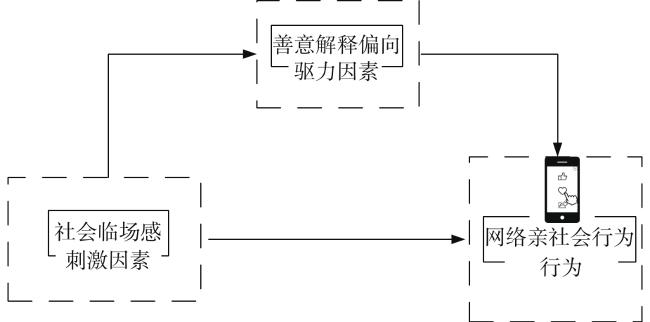
I3模型(I3 model)认为个体在特定情境下促进行为表达的因素为刺激因素和驱力因素,前者指激起个体对某对象产生行为的场景或线索,后者指个体在特定情境下体验到实施行为的强度或倾向性(Finkel, 2014)。此模型作为行为领域阐释个体行为内在机理的综合性架构,能够精准揭示行为及其背后成因的关联,为网络环境中亲社会行为的发生机制给予理论指引(张璐 等, 2021)。本研究依据此模型推测刺激因素(社会临场感)和驱力因素(善意解释偏向)促进网络亲社会行为,通过3个研究探究其内在机制,为网络文明建设提供实证依据。
社会临场感(social presence)指个体在网络沟通交流中感知他人真实存在的主观感受(Short et al., 1976),影响从众消费、参与使用行为等(谢莹 等, 2021; Haines, 2021)。以往研究主要探讨其对亲社会态度或意愿的影响(Ma, 2020; Pimentel et al., 2021),未充分重视其与网络亲社会行为的联系。根据社会临场感理论,社会临场感提高了人们对所处环境的参与程度,是最关键的在线交流或互动的指标之一(Short et al., 1976)。在网络环境中,网络亲社会行为具有积极正向的社会意义(黄丽娜, 2022),社会临场感可能对大学生网络亲社会行为有一定的促进作用。
网络环境中的亲社会行为有点赞、关注、分享等(贺寨平, 金宇星, 2019; Pimentel et al., 2021)。过往研究多聚焦单一行为,如分享行为(Jiang et al., 2022)、点赞行为(Dhir et al., 2019),未充分考虑网络求助情境下多种亲社会行为并存的特点,存在一定局限。此外,以往研究虽然发现社会临场感增加了网友知识共享行为、点赞行为等(Catyanadika & Rajasekera, 2022; Dhir et al., 2019),但未从亲社会视角探究其与网络亲社会行为的联系。依据黄金法则具身化范式,社会临场感水平越高,个体越能从某个具体的角度真实地看到和听到发生了什么,有利于增强亲社会行为(Slater & Banakou, 2021)。结合I3模型,行为的刺激因素涉及直接的环境线索(Finkel, 2014),而社会临场感作为网络环境或社交媒体本身自带的属性(Short et al., 1976),可作为大学生对网络求助信息产生网络亲社会行为的外在刺激。故提出假设1:社会临场感促进大学生对网络求助信息的点赞、关注和分享行为。
善意解释偏向(benign interpretation bias)指个体将信息以积极方式进行理解的认知反应倾向(Beck et al., 2005),可直接有效改善心理和行为问题(AlMoghrabi et al., 2018; Jopling et al., 2020)。不确定性减少理论认为,个体遇到新信息时主要的关注点是收集周围的信息线索来减少相关的不确定性,其常见的积极策略包括积极理解或解释周围环境(Berger, 1979)。在网络环境中,3D技术、网络直播等带来强社会临场感(Wang & Zhang, 2022),促使个体收集到更多的环境信息线索,进而使个体以善意的方式理解他人(Srivastava & Chandra, 2018)。以往研究显示,社会临场感能推动换位思考,可改善个体对特定信息的积极解释(Ventura et al., 2020)。因此,作为刺激因素的社会临场感有可能以积极的方式促进大学生对网络求助信息的解释。
根据认知−行为理论,个体对信息的理解会影响后续行为(Davis, 2001),如大学生善意解释偏向与旨在帮助他人和减轻其不幸的反应有关,能促进益于他人的行为(倪宇蕾,2019)。但目前研究未厘清善意解释偏向与网络亲社会行为的因果联系。仅少数研究表明,善意解释偏向作为一种认知加工偏向,在外界刺激与行为反应间起关键驱动作用(Miers et al., 2020)。由I3模型可知,行为的驱力因素包含认知模式、个体特质、喜好等(Finkel, 2014),善意解释偏向作为个体面对网络求助信息时所展现出的内在积极认知特性,突出表现为个体更倾向于以积极视角解读这类信息,进而有力增加大学生网络亲社会行为,担当起关键驱力角色。据此提出假设2:大学生善意解释偏向中介了社会临场感对网络亲社会行为的影响。
若假设2得以成立,在高社会临场感情境下,通过训练增强善意解释偏向,可以显著提升大学生网络亲社会行为的正向效应。当前,针对各类心理问题(如焦虑、抑郁等)的善意解释偏向训练已获广泛探究(Chu & Fung, 2021),但面向大学生网络亲社会行为改善的相关训练研究尚显不足。正如Jopling等(2020)所指出的,聚焦善意解释偏向训练,有助于探寻激发积极情感与行为的有效策略。故提出假设3:在高社会临场感情境中,提高善意解释偏向水平可有效加强大学生网络亲社会行为。
综上所述,本研究基于I3模型(图1 ),聚焦刺激、驱力两大促进行为的积极因素,设计3个实验,剖析大学生网络亲社会行为的发生机制。
2 实验1:社会临场感对大学生网络亲社会行为的影响
2.1 研究方法
2.1.1 被试
运用方便取样法,剔除未通过检测题(未选择指定选项)的4名被试后,有效数据为66人(31名男生),且均签署知情同意书。经G*Power3.1以独立样本t检验估算,α=0.05时,实验1被试量以89.26%效力获得0.8效应量(d),样本量充足。
2.1.2 实验设计
采用单因素两水平(高、低社会临场感组)组间设计,每组33人。自变量是社会临场感,因变量是网络亲社会行为,其具体指标是对同一网络求助信息的点赞、关注和分享图标的选择。
2.1.3 预实验
采用便携头戴式VR眼镜一体机,屏幕分辨率3840×2160像素,视角场100°,尺寸177 mm×133 mm×107 mm,兼容眼镜、自适应瞳距调节。社会临场感操作性定义是感知他人存在或面对面而产生的主观感受(Ogara et al., 2014),两组360°视频用含有盲童的《盲界》和无盲童的《水下珊瑚》,视频长度一致。在材料选取上,借鉴前人范例(张宝山 等, 2022),《盲界》展现盲童校园及其心理世界;《水下珊瑚》启动中性条件,记录水下珊瑚景色。操纵视频人物的出现,是对社会临场感本身的有效操纵,既能诱发高社会临场感组被试的社会临场感,又能减少对低社会临场感组的无关干扰(Pimentel et al., 2021)。
材料正式评定中,将被试(8名男生和4名女生)随机分两组,观看视频后评估社会临场感和情绪体验(吴鹏 等, 2017)。截选Gao等(2017)的社会临场感量表,Cronbach’s α系数为0.97。独立样本t检验显示,社会临场感差异显著[t(10)=5.42, p<0.001, Cohen’s d=3.13];积极情绪体验[t(10)=1.13, p=0.284]和消极情绪体验[t(10)=−1.99, p=0.074]无显著差异。
2.1.4 正式实验
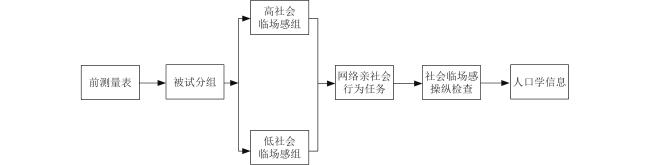
实验流程如图2 所示。首先,被试完成网络人际信任(丁道群, 沈模卫, 2005)和特质积极共情前测量表(岳童, 2016),排除个体固有特征对网络亲社会行为的干扰。其次,随机分组观看评估过的视频(同预实验)。再次,被试完成网络亲社会行为任务,即“当您看到有关盲童视频时,您会$\cdots\cdots $ ”。被试从点赞、关注、分享和关闭图标中选择,可单选或多选。这些图标源于社交媒体常见且具有亲社会性,代表真实网络行为。最后,由于自变量操纵检验可能影响因变量(张宝山 等, 2022),故在完成网络亲社会行为任务后,进行社会临场感操纵有效性的检验和人口学信息填写。
2.2 结果
2.2.1 社会临场感操纵的有效性检验
独立样本t检验发现,社会临场感的操纵有效,高社会临场感组(M=3.73, SD=0.63)显著高于低社会临场感组[M=2.51, SD=0.97; t(64)=6.05, p<0.001, Cohen’s d=1.05]。两组被试在性别[χ2(1, 66)=2.98, p=0.084]、年龄[t(64)=0.70, p=0.488]、网络人际信任[t(64)=−0.28, p=0.777]、特质积极共情[t(64)=−0.08, p=0.939]上无显著差异,排除了被试固有特征对实验结果的干扰。
2.2.2 社会临场感对大学生网络亲社会行为的影响检验
2.3 讨论
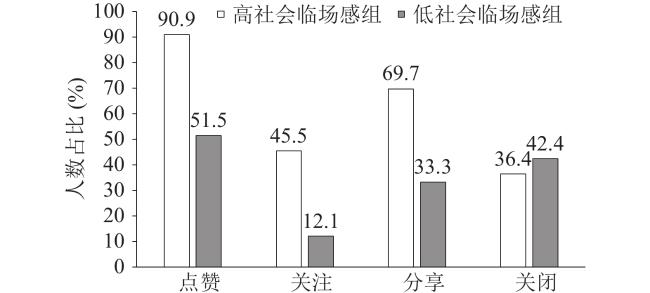
实验1发现大学生对求助视频的点赞最多,其次是分享和关注。从网络社交特性看,点赞行为是便捷且投入少的无言社交模式(Gan, 2017),有助于维持信息热度。分享行为因涉及第三方互动(私密网友或公开朋友圈),投入的互动成本高于点赞。而关注行为不仅占用网络空间资源,还因大数据推送使同类型信息不断出现,需耗费个体注意力或时间等稀缺资源(Jiang et al., 2019),故而选择比例相对较低。此外,社会临场感显著正向影响大学生网络亲社会行为,有力地支持了假设1,这意味着社会临场感可增加大学生对网友求助信息的热度、传播广度和关注度。
3 实验2:大学生善意解释偏向的中介作用
为进一步增强实验1结果的稳健性,实验2以网络直播的主流社交方式为研究载体。通过呈现包含求助者与不包含求助者的网络直播视频,实现对不同水平社会临场感的有效操控。在此基础上,深入检验善意解释偏向在社会临场感与网络亲社会行为间的中介作用。
3.1 研究方法
3.1.1 被试
运用方便取样法,剔除未通过检测题的3名被试,有效数据为27人(10名男生),且均签署知情同意书。经G*Power3.1以配对样本t检验估算,α=0.05时,实验2被试量以97.93%效力获得0.8效应量(d),样本量足够。
3.1.2 实验设计
采用两水平(高、低社会临场感组)被试内中介实验设计,以善意解释偏向为中介变量,网络亲社会行为为因变量,用ABBA法平衡顺序效应。
3.1.3 视频材料
高社会临场感组视频含求助者及其家庭场景,选用直播间视频。该直播间主要是病儿父母为患SMA(脊髓性肌萎缩症,特征为肌无力和肌肉萎缩)的孩子筹医疗费,希望为直播间点赞、关注与分享。低社会临场感组视频仅呈现家庭场景,该直播间主要是病儿父母为患罕见病(免疫功能丧失,急需骨髓移植治疗)的孩子筹集医疗费,希望帮忙点赞、关注和分享。两组视频均为时长6分钟、在线人数相近(<100人)的录播视频。
为检验视频有效性,招募26名大学生(15名男生)并随机分组。呈现直播间情况(如主页、病种、现状等)后,被试观看不同组视频,再评估社会临场感和情绪体验(同实验1)。独立样本t检验发现,两组社会临场感差异显著[t(24)=2.40, p=0.024, Cohen’s d=0.91];积极情绪体验[t(24)=1.73, p=0.097]和消极情绪体验[t(24)=−1.70, p=0.102]差异不显著,说明视频合理且无明显情绪差异。
3.1.4 实验流程与测验材料
实验流程如图4 所示。善意解释偏向情景测验依据两个直播视频求助信息编制,含A、B两平行版本,5点计分(1=“完全不符合”,5=“非常符合”)。共选出4个有代表性且共有的求助信息,如停留直播间、留意关注、点赞支持和分享转发。为进一步检验内容效度,请20名大学生(9名男生)对4个善意解释发生的可能性(如坚强而努力、自力更生、有意义的、有价值的)进行5级评估(1=“可能性非常低”,5=“可能性非常高”)。结果发现,大部分被试选择了“可能性非常高”和“可能性比较高”的选项,卡方检验差异显著,χ2(4)值范围为14.0~36.0,p<0.01。

为避免前次处理对被试的影响及疲劳问题,在高/低社会临场感组处理后,被试转至另一实验室休息10分钟,再进行低/高社会临场感组处理,这样有助于缓解自我损耗所带来的疲劳。网络亲社会行为任务A和B同质,既能避免被试对同一任务产生抵触,又可防止因图片差异大导致作答反应差异大而混淆研究结果。
3.2 结果
3.2.1 社会临场感操纵的有效性检验
配对样本t检验发现,社会临场感操纵有效,高社会临场感组(M=3.69, SD=0.91)显著高于低社会临场感组[M=2.42, SD=0.91, t(26)=4.63, p<0.001, Cohen’s d=1.40]。
3.2.2 大学生善意解释偏向的中介效应检验
各组选图标人数比例如图5 所示。对选择点赞、关注与分享图标的编码为1,未选则编码为0。第一步,以社会临场感为自变量,分别以各图标选择作因变量进行二元Logistic回归分析:相较于低社会临场感组,高社会临场感组大学生更倾向于选择点赞图标[B=0.66, Wald χ2=4.37, Exp(B)=1.93, p=0.037]、关注图标[B=0.78, Wald χ2=6.41, Exp(B)=2.19, p=0.011]、分享图标[B=0.65, Wald χ2=5.29, Exp(B)=1.92, p=0.021],证实了假设 1。
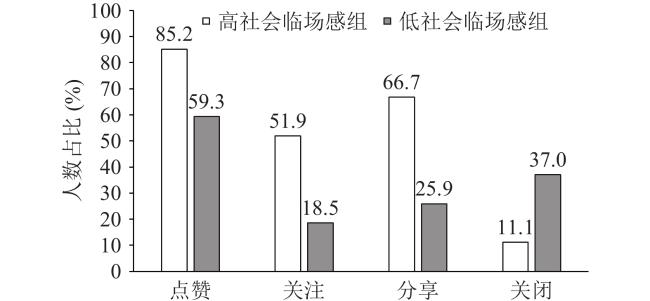
第二步,以社会临场感为自变量,善意解释偏向为因变量进行回归分析,结果显示前者对后者有显著正向预测作用(β=0.43, t=3.39, p=0.001)。再以此二者为自变量,各图标选择分别为因变量做二元Logistic回归分析发现:善意解释偏向对选择点赞图标[B=1.55, Wald χ2=5.90, Exp(B)=4.69, p=0.015]、关注图标[B=1.24, Wald χ2=4.51, Exp(B)=3.46, p=0.034]、分享图标[B=1.31, Wald χ2=5.62, Exp(B)=3.71, p=0.018]影响显著,但社会临场感对选择点赞图标[B=0.33, Wald χ2=0.94, Exp(B)=1.39, p=0.332]、关注图标[B=0.57, Wald χ2=2.71, Exp(B)=1.76, p=0.100]、分享图标[B=0.39, Wald χ2=1.52, Exp(B)=1.47, p=0.218]影响不显著。这说明善意解释偏向在社会临场感与网络亲社会行为间起显著中介作用,假设2得到验证。
3.3 讨论
对大学生来说,网络直播使得他们不再与求助者是彼此隔离的“孤岛”,融入与网友共观、与求助者互动的“真实”情境(谢莹 等, 2021),赋予强烈的与主播面对面或在一起的感觉。此外,实验2发现大学生善意解释偏向中介了社会临场感对网络亲社会行为的影响。高社会临场感会提升大学生善意解释偏向,进而促使其更多选择网络求助信息的点赞、关注和分享图标。即在高社会临场感的网络社交环境里,个体与他人面对面或在一起的紧密联系会被输入认知系统,激发积极偏向加工,倾向善意解读求助信息,最终引发大学生对求助信息的网络亲社会行为。
4 实验3:大学生善意解释偏向提升训练对网络亲社会行为的影响
为验证善意解释偏向中介作用的可靠和稳定,在实验2明确社会临场感对大学生善意解释偏向有显著影响后,实验3依据因果链实验设计中介效应检验方法(张宝山 等, 2022),检验善意解释偏向对大学生网络亲社会行为的影响。鉴于既往研究显示,引导个体善意解释偏向并及时反馈是有效善意解释偏向训练范式(Steinman et al., 2021),故实验3依此对大学生善意解释偏向开展反馈训练。
4.1 研究方法
4.1.1 被试
运用方便取样法,剔除未通过检测题的1名被试,有效数据为50人(27名男生),且均签署知情同意书。经G*Power3.1以卡方检验估算,α=0.05时,实验3被试量以94.24%效力获得0.5效应量(d),样本量足够。
4.1.2 实验设计
采用单因素两水平(反馈组、控制组)组间实验设计,每组25人。自变量是实验组别,因变量是网络亲社会行为,高社会临场感为控制变量。
4.1.3 实验流程和材料
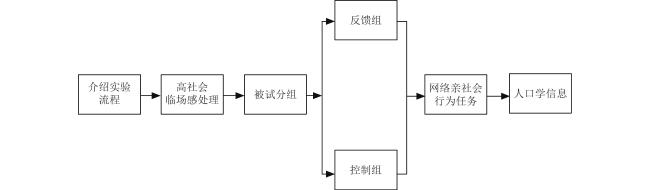
所有被试接受高社会临场感处理,同实验2。实验流程如图6 所示。结合以往善意解释偏向训练方式,引入改编的词语句子相关范式,让被试通过按键反应来判断句子与词语(或短语)的相关程度并提供反馈训练(Beard & Amir, 2008)。依据实验2梳理出高社会临场感直播间高频次的23个求助信息,从网络直播评论和相关文献中提取善意解释短语。求助信息与短语匹配后,邀请20名心理学硕博生(男女各半)评定内容效度(1为“是”,2为“否”),结果均选“是”。这表明求助信息与善意解释短语匹配,词语句子相关范式所呈现的材料是可靠的。反馈组训练程序如下:第一,呈现注视点“+”500 ms后,呈现善意解释短语500 ms(如“关注有意义”)。第二,呈现求助信息句子(如“大家没点关注的点下关注”)和直播场景图片,被试看完按空格键结束。第三,被试评估短语和句子的相关程度(有关/无关)。第四,若被试选“有关”,会得到积极反馈(“您的理解正确”);若选“无关”,则向被试呈现句子和短语的关联描述(如“大家没点关注的点下关注,我认为我的关注是有意义的”),以此引导个体善意解释偏向并给予反馈。反馈组含5个练习试次与23个正式试次。控制组的操作流程与反馈组的前三步相同,但没有第四步操作。依据既往范式计算方式,选“有关”和“无关”的数量比值作为善意解释偏向指标,比值越高表示善意解释偏向越强。
4.2 结果
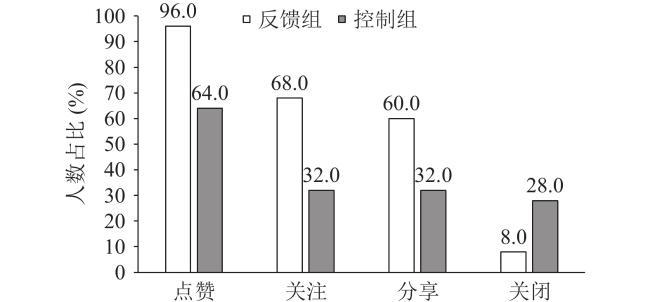
独立样本t检验发现,反馈组善意解释偏向显著高于控制组[t(48)=7.50, p<0.001, Cohen’s d=2.16]。卡方检验发现,反馈组大学生选择点赞图标[χ2(1, 50)=8.00, p=0.005]、关注图标[χ2(1, 50)=6.48 , p=0.011]、分享图标[χ2(1, 50)=3.95, p=0.047]均显著高于控制组,见图7 。


4.3 讨论
实验3结果支持了假设3。在高社会临场感情境中,善意解释偏向升高能显著提升大学生的网络亲社会行为,该结果表明对善意解释偏向进行有效的反馈训练会对个体后续的行为反应产生积极的作用,这与以往的研究相呼应(AlMoghrabi et al., 2018)。在高社会临场感情境中,输入的信息会影响个体内在的认知解释状态,由于外在信息是偏向积极信息的变量,个体的认知系统会激活大学生的亲社会图式,将他人网络求助信息进行善意的编码,进而促进网络亲社会行为。
5 总讨论
5.1 社会临场感与网络亲社会行为间的关系
实验1发现,社会临场感可有效推动和提升大学生网络亲社会行为,补充和验证了社会临场感理论(Short et al., 1976)。在多元化的新媒体背景下,3D技术和线上直播平台等新媒体创建了更为可信、更开放的交互模式,赋予网络社交情境更强的社会临场感。在个体通过头戴式VR观看360°视频,或者在直播场景中实时看到网友生活状态的模式下,个体不再与网友完全隔离,而是处在一种与网友虚拟在场的“真实”情境中。这种高社会临场感的网络社交情境作为一种外部诱因,由外而内地作用于个体网络亲社会行为,是个体网络亲社会行为产生的“唤醒源”。在实践意义上,随着新媒体技术的爆炸式发展和互联网普及率的逐步上升,大学生的行为或决策愈渐频繁地展现在网络环境中的电子设备(如手机、平板或电脑)上(Gao et al., 2017)。高校在推广学生文明上网、网络公益活动方面,可考虑增加大学生对网络信息的社会临场感,比如加大社会临场感属性高的公益360°视频或实时互动的网络直播在大学生中的传播力度、覆盖面和关注度,从而促使大学生真正成为网络亲社会行为的建设者和发扬者。
5.2 善意解释偏向在社会临场感与网络亲社会行为间的中介作用
研究发现,善意解释偏向在社会临场感与网络亲社会行为间起到中介作用。根据I3模型,个体行为的产生与刺激因素和驱力因素的共同促进作用有关(Finkel, 2014)。除了社会临场感的“唤醒源”外,作为内部驱力因素的善意解释偏向在网络亲社会行为的心理发生机制中起着主导地位。善意解释偏向强调的是增加个体在网络情境中实施网络亲社会行为的倾向性或强度,是加速个体网络亲社会行为产生的“催醒剂”。在虚拟网络环境中,当个体沉浸在高水平社会临场感的网络社交情境时,这些感知与他人互动过程中产生的密切或真实联系则会进一步输入到认知加工系统中(Cummings et al., 2022),从而促进或引发认知系统的偏向加工,激发积极行为的认知图式,即将虚拟场景中的信息偏向于以积极的方式进行分析,从而导致诱发网络亲社会行为。由此,善意解释偏向作为个体本身所具有的驱力因素,在网络环境刺激与个体行为反应之间起着关键性的作用。此外,虽然社会临场感、善意解释偏向之间是相互联系且相互制约的,但是,从网络亲社会行为的发生过程来看,善意解释偏向的作用是不容忽视、不可替代的,能成为直接启动个体网络亲社会行为的快速通道。也就是说,可以固化和调整个体对刺激情境的善意解释偏向,增加个体社会信息处理的积极偏向的自动化加工,从而进一步增进个体网络亲社会行为。同时,以上结果提示,在改善大学生网络亲社会行为的实践方面,除了外在刺激的数字技术层面增加社会临场感属性外,妥当使用善意解释偏向训练对增强网络亲社会行为有积极效果。
5.3 不足与展望
首先,当前研究尚未明晰社会临场感影响网络亲社会行为是否有其他驱力因素、边界条件,后续可进一步探究。其次,不同网络亲社会行为图标组合如何影响个体行为及图标选择比例,有待深入探索。最后,个体层面结论能否推广至大学生群体存疑,未来宜从群体文化视角横向拓展,增进对其网络亲社会行为的理解广度。
6 结论
(1)社会临场感正向预测大学生网络亲社会行为。(2)善意解释偏向在社会临场感对大学生网络亲社会行为的影响中起中介作用。(3)在高社会临场感情境中,提高善意解释偏向水平可有效加强大学生网络亲社会行为。