
Studies of Psychology and Behavior ›› 2026, Vol. 24 ›› Issue (1): 138-144.DOI: 10.12139/j.1672-0628.2026.01.016
• ? • Previous Articles
Hui JIN1, Xue ZHANG1,2, Yuepeng WANG1,2, Weijie MENG*,1,2( )
)
Received:2024-11-25
Online:2026-01-20
Published:2026-01-20
Contact:
Weijie MENG
金慧1, 张雪1,2, 王跃鹏1,2, 孟维杰*,1,2()
通讯作者:
孟维杰
基金资助:Hui JIN, Xue ZHANG, Yuepeng WANG, Weijie MENG. The Influence of School Moral Atmosphere on Junior High School Students’ Cheating Intention: Mediating Effect of Moral Disengagement[J]. Studies of Psychology and Behavior, 2026, 24(1): 138-144.
金慧, 张雪, 王跃鹏, 孟维杰. 学校道德氛围对初中生作弊行为意向的影响:道德推脱的中介作用[J]. 心理与行为研究, 2026, 24(1): 138-144.
Add to citation manager EndNote|Ris|BibTeX
URL: https://psybeh.tjnu.edu.cn/EN/10.12139/j.1672-0628.2026.01.016
| 变量 | M±SD | 1 | 2 | 3 | 4 | 5 | 6 | 7 | 8 |
| 1.学校道德氛围 | 4.14±0.56 | ||||||||
| 2.道德推脱 | 1.81±0.49 | −0.38** | |||||||
| 3.道德合理化 | 1.83±0.79 | −0.18** | 0.73** | ||||||
| 4.责任分散 | 2.97±1.06 | 0.06 | 0.42** | 0.23** | |||||
| 5.有利对比 | 1.35±0.59 | −0.31** | 0.58** | 0.35** | −0.10* | ||||
| 6.非人性化 | 1.47±0.75 | −0.34** | 0.70** | 0.41** | −0.03 | 0.50** | |||
| 7.结果歪曲 | 1.55±0.74 | −0.38** | 0.69** | 0.41** | 0.06 | 0.42** | 0.46** | ||
| 8.责任转移 | 1.68±0.77 | −0.41** | 0.65** | 0.34** | 0.01 | 0.35** | 0.48** | 0.40** | |
| 9.作弊行为意向 | 4.30±0.53 | 0.57** | −0.41** | −0.26** | 0.05 | −0.39** | −0.37** | −0.39** | −0.33** |
| 变量 | M±SD | 1 | 2 | 3 | 4 | 5 | 6 | 7 | 8 |
| 1.学校道德氛围 | 4.14±0.56 | ||||||||
| 2.道德推脱 | 1.81±0.49 | −0.38** | |||||||
| 3.道德合理化 | 1.83±0.79 | −0.18** | 0.73** | ||||||
| 4.责任分散 | 2.97±1.06 | 0.06 | 0.42** | 0.23** | |||||
| 5.有利对比 | 1.35±0.59 | −0.31** | 0.58** | 0.35** | −0.10* | ||||
| 6.非人性化 | 1.47±0.75 | −0.34** | 0.70** | 0.41** | −0.03 | 0.50** | |||
| 7.结果歪曲 | 1.55±0.74 | −0.38** | 0.69** | 0.41** | 0.06 | 0.42** | 0.46** | ||
| 8.责任转移 | 1.68±0.77 | −0.41** | 0.65** | 0.34** | 0.01 | 0.35** | 0.48** | 0.40** | |
| 9.作弊行为意向 | 4.30±0.53 | 0.57** | −0.41** | −0.26** | 0.05 | −0.39** | −0.37** | −0.39** | −0.33** |
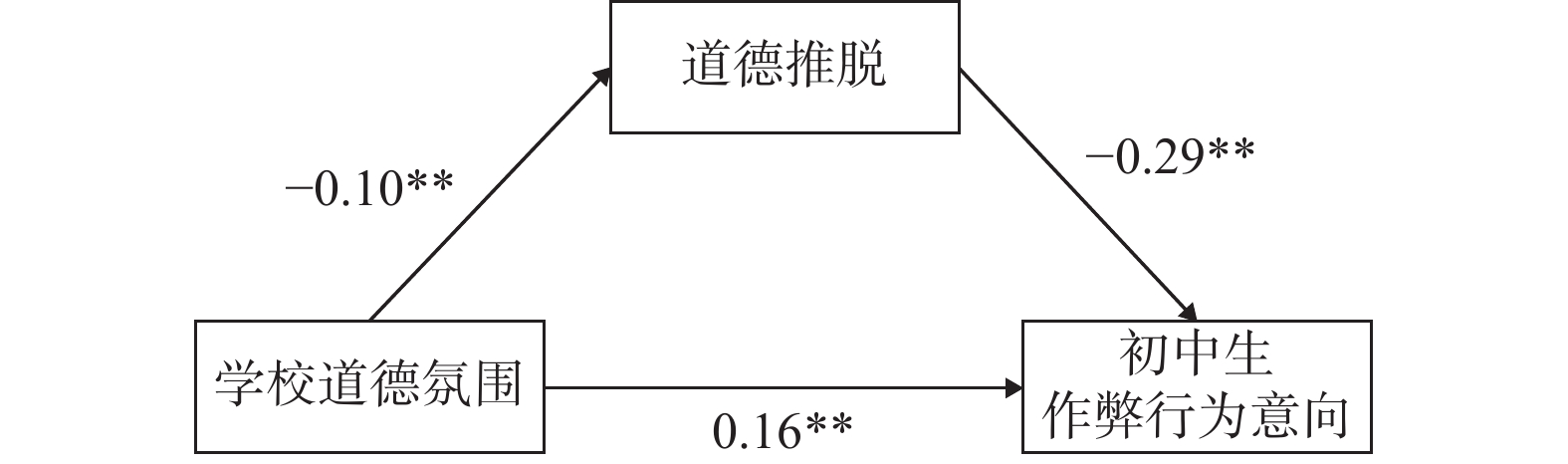
| 效应值 | Boot SE | Boot LLCI | Boot ULCI | 相对效应值(%) | |
| 总效应 | 0.19 | 0.01 | 0.16 | 0.21 | |
| 直接效应 | 0.16 | 0.01 | 0.13 | 0.19 | 84.95 |
| 间接效应 | 0.03 | 0.01 | 0.01 | 0.05 | 15.05 |
| 效应值 | Boot SE | Boot LLCI | Boot ULCI | 相对效应值(%) | |
| 总效应 | 0.19 | 0.01 | 0.16 | 0.21 | |
| 直接效应 | 0.16 | 0.01 | 0.13 | 0.19 | 84.95 |
| 间接效应 | 0.03 | 0.01 | 0.01 | 0.05 | 15.05 |
| 变量 | 1 | 2 | 3 | 4 | 5 | 6 | 7 | 8 | 9 |
| 1.学校道德氛围 | |||||||||
| 2.道德推脱 | −0.69** | ||||||||
| 3.道德合理化 | −0.35** | 0.70** | |||||||
| 4.责任分散 | −0.59** | 0.57** | 0.20* | ||||||
| 5.有利对比 | −0.47** | 0.70** | 0.36** | 0.15 | |||||
| 6.非人性化 | −0.59** | 0.78** | 0.44** | 0.32** | 0.59** | ||||
| 7.结果歪曲 | −0.44** | 0.72** | 0.49** | 0.22** | 0.43** | 0.52** | |||
| 8.责任转移 | −0.37** | 0.73** | 0.49** | 0.23** | 0.54** | 0.49** | 0.44** | ||
| 9.主动寻求作弊 | −0.64** | 0.59** | 0.36** | 0.44** | 0.35** | 0.51** | 0.41** | 0.35** | |
| 10.协助他人作弊 | −0.63** | 0.67** | 0.46** | 0.44** | 0.50** | 0.52** | 0.44** | 0.43** | 0.85** |
| 变量 | 1 | 2 | 3 | 4 | 5 | 6 | 7 | 8 | 9 |
| 1.学校道德氛围 | |||||||||
| 2.道德推脱 | −0.69** | ||||||||
| 3.道德合理化 | −0.35** | 0.70** | |||||||
| 4.责任分散 | −0.59** | 0.57** | 0.20* | ||||||
| 5.有利对比 | −0.47** | 0.70** | 0.36** | 0.15 | |||||
| 6.非人性化 | −0.59** | 0.78** | 0.44** | 0.32** | 0.59** | ||||
| 7.结果歪曲 | −0.44** | 0.72** | 0.49** | 0.22** | 0.43** | 0.52** | |||
| 8.责任转移 | −0.37** | 0.73** | 0.49** | 0.23** | 0.54** | 0.49** | 0.44** | ||
| 9.主动寻求作弊 | −0.64** | 0.59** | 0.36** | 0.44** | 0.35** | 0.51** | 0.41** | 0.35** | |
| 10.协助他人作弊 | −0.63** | 0.67** | 0.46** | 0.44** | 0.50** | 0.52** | 0.44** | 0.43** | 0.85** |
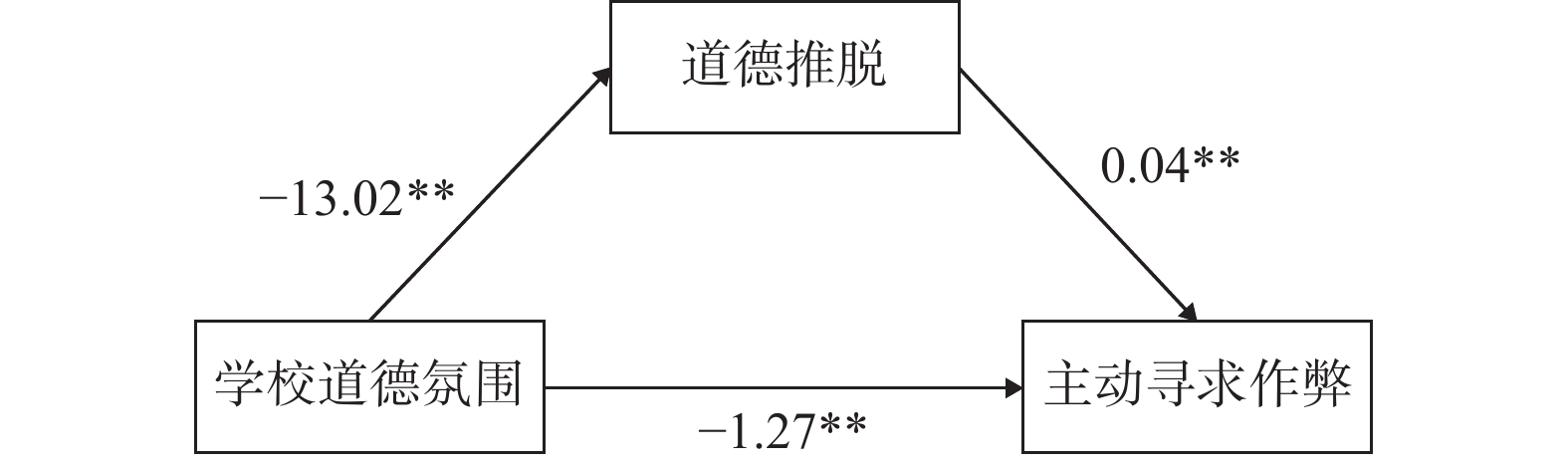
| 效应值 | Boot SE | Boot LLCI | Boot ULCI | 相对效应值(%) | |
| 总效应 | −1.81 | 0.18 | −2.16 | −1.46 | |
| 直接效应 | −1.27 | 0.23 | −1.71 | −0.82 | 70.06 |
| 间接效应 | −0.54 | 0.15 | −0.83 | −0.25 | 29.94 |
| 效应值 | Boot SE | Boot LLCI | Boot ULCI | 相对效应值(%) | |
| 总效应 | −1.81 | 0.18 | −2.16 | −1.46 | |
| 直接效应 | −1.27 | 0.23 | −1.71 | −0.82 | 70.06 |
| 间接效应 | −0.54 | 0.15 | −0.83 | −0.25 | 29.94 |
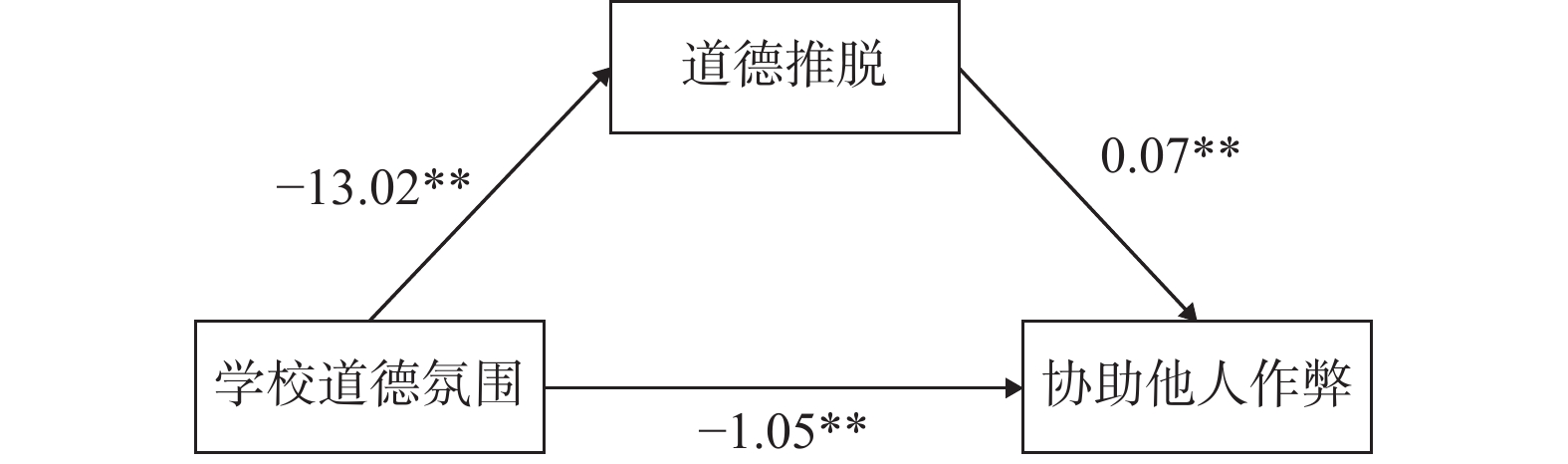
| 效应值 | Boot SE | Boot LLCI | Boot ULCI | 相对效应值(%) | |
| 总效应 | −1.97 | 0.20 | −2.36 | −1.58 | |
| 直接效应 | −1.05 | 0.24 | −1.51 | −0.59 | 53.25 |
| 间接效应 | −0.92 | 0.17 | −1.25 | −0.59 | 46.75 |
| 效应值 | Boot SE | Boot LLCI | Boot ULCI | 相对效应值(%) | |
| 总效应 | −1.97 | 0.20 | −2.36 | −1.58 | |
| 直接效应 | −1.05 | 0.24 | −1.51 | −0.59 | 53.25 |
| 间接效应 | −0.92 | 0.17 | −1.25 | −0.59 | 46.75 |
|
鲍振宙, 储怡佳, 王帆, 柳希希. 校园欺凌中的“袖手旁观”: 校园氛围、学校联结和道德推脱的作用. 心理发展与教育, 2023, 39 (4): 580- 589.
DOI |
|
|
陈海德, 张宇晗, 赵博强, 姚静静, 李伟健. 主观规范与吸烟者戒烟行动计划: 戒烟意向和关系导向特征的作用. 心理科学, 2024, 47 (4): 973- 980.
DOI |
|
|
杜金, 向娟, 朱鸿, 徐云. 大学生考试作弊行为意向问卷初步编制. 中国健康心理学杂志, 2011, 19 (9): 1124- 1126.
DOI |
|
|
杜秀莲, 高静. 初中生学校道德氛围与亲社会行为的关系: 道德认同的中介作用. 中国特殊教育, 2019 (8): 82- 87.
DOI |
|
|
段文婷, 江光荣. 计划行为理论述评. 心理科学进展, 2008, 16 (2): 315- 320.
DOI |
|
|
胡佳琪, 黄美薇, 骆方. 考试作弊甄别技术的研究进展: 个体作弊的甄别. 中国考试, 2020 (11): 32- 36.
DOI |
|
|
胡颖慧. (2010). 学校道德氛围量表的编制及应用(硕士学位论文). 华东师范大学, 上海.
|
|
|
李伟强. (2007). 学校道德氛围心理学研究(博士学位论文). 上海师范大学, 上海.
|
|
|
潘超, 李胜豪, 杨新莉, 高冬东. 相对剥夺感对网络欺负的影响: 反刍思维和道德推脱的作用. 心理研究, 2024, 17 (4): 367- 374.
DOI |
|
|
潘清泉, 周宗奎. 儿童道德脱离量表的初步修订. 中国临床心理学杂志, 2010, 18 (2): 165- 167.
DOI |
|
|
舒首立, 杨沈龙, 白洁, 郭永玉. 他人作弊与自己作弊: 社会损失的中介作用和自尊的调节作用. 心理学探新, 2017, 37 (1): 48- 53.
|
|
|
王小凤, 燕良轼, 丁道群, 邱小艳. 学校道德氛围感知对中学生冷漠旁观行为的影响: 一个有调节的中介模型. 中国临床心理学杂志, 2023, 31 (2): 396- 401.
DOI |
|
|
徐云. 基于计划行为理论及学习倦怠感的考试作弊行为. 中国健康心理学杂志, 2012, 20 (11): 1741- 1743.
DOI |
|
|
杨继平, 王兴超, 陆丽君, 张力维. 道德推脱与大学生学术欺骗行为的关系研究. 心理发展与教育, 2010, 26 (4): 364- 370.
DOI |
|
|
杨文登, 梁爽. 班杜拉的道德推脱理论综述. 心理研究, 2022, 15 (2): 121- 125.
DOI |
|
|
Ajzen, I. The theory of planned behavior: Frequently asked questions. Human Behavior and Emerging Technologies, 2020, 2 (4): 314- 324.
DOI |
|
|
Bandura, A. Moral disengagement in the perpetration of inhumanities. Personality and Social Psychology Review, 1999, 3 (3): 193- 209.
DOI |
|
|
Bandura, A. Selective moral disengagement in the exercise of moral agency. Journal of Moral Education, 2002, 31 (2): 101- 119.
DOI |
|
|
Błachnio, A., & Weremko, M. Academic cheating is contagious: The influence of the presence of others on honesty. A study report. International Journal of Applied Psychology, 2012, 1 (1): 14- 19.
DOI |
|
|
Eisenberg, J. To cheat or not to cheat: Effects of moral perspective and situational variables on students’ attitudes. Journal of Moral Education, 2004, 33 (2): 163- 178.
DOI |
|
|
Gini, G., Thornberg, R., & Pozzoli, T. Individual moral disengagement and bystander behavior in bullying: The role of moral distress and collective moral disengagement. Psychology of Violence, 2020, 10 (1): 38- 47.
DOI |
|
|
Hayes, A. F. Beyond Baron and Kenny: Statistical mediation analysis in the new millennium. Communication Monographs, 2009, 76 (4): 408- 420.
DOI |
|
|
Jenkins, B. D., Golding, J. M., Le Grand, A. M., Levi, M. M., & Pals, A. M. When opportunity knocks: College students’ cheating amid the COVID-19 pandemic. Teaching of Psychology, 2023, 50 (4): 407- 419.
DOI |
|
|
Kohlberg, L. (1971). From is to ought: How to commit the naturalistic fallacy and get away with it in the study of moral development. In T. Mischel (Ed.), Cognitive development and epistemology (pp. 151–235). New York: Academic Press.
|
|
|
Lingán-Huamán, S. K., Dominguez-Lara, S., & Carranza Esteban, R. F. Gender-based differences in the impact of dark triad traits on academic dishonesty: The mediating role of moral disengagement in college students. Heliyon, 2024, 10 (1): e23322.
DOI |
|
|
Mathes, E. W. An evolutionary perspective on Kohlberg’s theory of moral development. Current Psychology, 2021, 40 (8): 3908- 3921.
DOI |
|
|
Ramberg, J., & Modin, B. School effectiveness and student cheating: Do students’ grades and moral standards matter for this relationship?. Social Psychology of Education, 2019, 22 (3): 517- 538.
DOI |
|
|
Stoesz, B. M., Quesnel, M., & De Jaeger, A. E. Student perceptions of academic misconduct amongst their peers during the rapid transition to remote instruction. International Journal for Educational Integrity, 2023, 19 (1): 14.
DOI |
|
|
Waltzer, T., DeBernardi, F. C., & Dahl, A. Student and teacher views on cheating in high school: Perceptions, evaluations, and decisions. Journal of Research on Adolescence, 2023, 33 (1): 108- 126.
DOI |
|
|
Zhao, L., Hong, M. J., & Lee, K. Role of moral judgments and persistence in elementary school students’ academic cheating. Journal of Applied Developmental Psychology, 2024, 93, 101676.
DOI |
|
|
Zhao, L., Peng, J. J., Dong, L. D., Compton, B. J., Zhong, Z. G., Li, Y. X., … Lee, K. Academic cheating interferes with learning among middle school children. Journal of Experimental Child Psychology, 2023, 226, 105566.
DOI |
| Viewed | ||||||
|
Full text |
|
|||||
|
Abstract |
|
|||||
