
Studies of Psychology and Behavior ›› 2026, Vol. 24 ›› Issue (3): 359-366.DOI: 10.12139/j.1672-0628.2026.03.010
• ? • Previous Articles Next Articles
Qin WU1, Xianguo HAN2, Liying CUI3, Wen HE*,3( )
)
Received:2025-05-07
Online:2026-05-20
Published:2026-05-20
Contact:
Wen HE
吴琴1, 韩宪国2, 崔丽莹3, 贺雯*,3()
通讯作者:
贺雯
基金资助:CLC Number:
Qin WU, Xianguo HAN, Liying CUI, Wen HE. The Promotion of Adolescent Cooperative Behavior by Awe with Different Valences: The Roles of Need for Accommodation and Quiet Ego[J]. Studies of Psychology and Behavior, 2026, 24(3): 359-366.
吴琴, 韩宪国, 崔丽莹, 贺雯. 不同效价敬畏促进青少年合作行为:顺应需要和安静自我的作用[J]. 心理与行为研究, 2026, 24(3): 359-366.
Add to citation manager EndNote|Ris|BibTeX
URL: https://psybeh.tjnu.edu.cn/EN/10.12139/j.1672-0628.2026.03.010
| 积极敬畏组 (n=58) | 消极敬畏组 (n=53) | 中性情绪组 (n=56) | F | |
| 生气 | 1.28±0.93 | 2.34±1.73 | 1.27±0.88 | 13.61*** |
| 难过 | 1.59±1.17 | 3.91±1.89 | 1.21±0.78 | 63.41*** |
| 开心 | 3.98±2.49 | 1.87±1.56 | 3.84±2.25 | 16.45*** |
| 害怕 | 1.76±1.63 | 3.66±2.32 | 1.18±0.72 | 32.64*** |
| 敬畏 | 4.40±2.34 | 3.94±1.91 | 1.75±1.55 | 29.20*** |
| 公共物品投资额 | 61.45±30.55 | 68.09±22.97 | 47.29±28.73 | 6.34** |
| 积极敬畏组 (n=58) | 消极敬畏组 (n=53) | 中性情绪组 (n=56) | F | |
| 生气 | 1.28±0.93 | 2.34±1.73 | 1.27±0.88 | 13.61*** |
| 难过 | 1.59±1.17 | 3.91±1.89 | 1.21±0.78 | 63.41*** |
| 开心 | 3.98±2.49 | 1.87±1.56 | 3.84±2.25 | 16.45*** |
| 害怕 | 1.76±1.63 | 3.66±2.32 | 1.18±0.72 | 32.64*** |
| 敬畏 | 4.40±2.34 | 3.94±1.91 | 1.75±1.55 | 29.20*** |
| 公共物品投资额 | 61.45±30.55 | 68.09±22.97 | 47.29±28.73 | 6.34** |
| 积极敬畏组 (n=131) | 消极敬畏组 (n=114) | 中性情绪组 (n=113) | F | |
| 生气 | 1.16±0.71 | 2.20±1.49 | 1.36±1.12 | 28.12*** |
| 难过 | 1.81±1.52 | 3.35±2.01 | 1.43±1.19 | 45.98*** |
| 开心 | 4.29±2.17 | 1.68±1.40 | 3.30±2.15 | 55.24*** |
| 害怕 | 1.57±1.32 | 3.52±2.12 | 1.42±1.20 | 62.95*** |
| 敬畏 | 4.69±2.25 | 4.09±1.95 | 2.00±1.75 | 58.33*** |
| 顺应需要 | 5.19±1.57 | 5.07±1.52 | 4.03±1.83 | 17.21*** |
| 安静自我 | 3.67±0.49 | 3.42±0.49 | 3.39±0.55 | 11.94*** |
| 公共物品投资额 | 64.32±26.14 | 62.99±23.59 | 48.78±28.53 | 13.07*** |
| 积极敬畏组 (n=131) | 消极敬畏组 (n=114) | 中性情绪组 (n=113) | F | |
| 生气 | 1.16±0.71 | 2.20±1.49 | 1.36±1.12 | 28.12*** |
| 难过 | 1.81±1.52 | 3.35±2.01 | 1.43±1.19 | 45.98*** |
| 开心 | 4.29±2.17 | 1.68±1.40 | 3.30±2.15 | 55.24*** |
| 害怕 | 1.57±1.32 | 3.52±2.12 | 1.42±1.20 | 62.95*** |
| 敬畏 | 4.69±2.25 | 4.09±1.95 | 2.00±1.75 | 58.33*** |
| 顺应需要 | 5.19±1.57 | 5.07±1.52 | 4.03±1.83 | 17.21*** |
| 安静自我 | 3.67±0.49 | 3.42±0.49 | 3.39±0.55 | 11.94*** |
| 公共物品投资额 | 64.32±26.14 | 62.99±23.59 | 48.78±28.53 | 13.07*** |
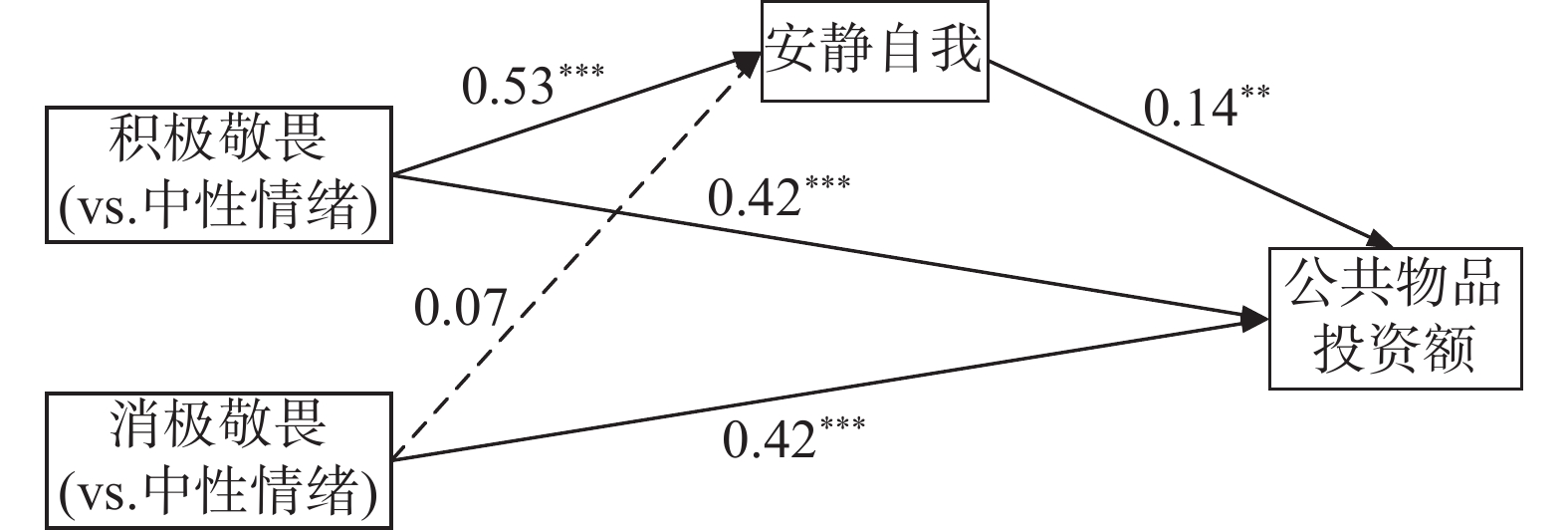
| 结果变量 | 预测变量 | β | SE | t | 95% CI |
| 安静自我 | |||||
| 性别 | 0.05 | 0.10 | 0.54 | [–0.14, 0.25] | |
| 年龄 | –0.19 | 0.05 | –3.84*** | [–0.29, –0.09] | |
| 他人合作预期 | 0.16 | 0.05 | 3.20** | [0.06, 0.26] | |
| 积极敬畏 (vs. 中性情绪) | 0.53 | 0.12 | 4.37*** | [0.29, 0.77] | |
| 消极敬畏 (vs. 中性情绪) | 0.07 | 0.13 | 0.56 | [–0.17, 0.32] | |
| 公共物品投资额 | |||||
| 性别 | –0.05 | 0.09 | –0.55 | [–0.21, 0.12] | |
| 年龄 | –0.01 | 0.04 | –0.17 | [–0.09, 0.08] | |
| 他人合作预期 | 0.52 | 0.04 | 11.96*** | [0.43, 0.60] | |
| 安静自我 | 0.14 | 0.05 | 3.13** | [0.05, 0.23] | |
| 积极敬畏 (vs. 中性情绪) | 0.42 | 0.11 | 4.01*** | [0.22, 0.63] | |
| 消极敬畏 (vs. 中性情绪) | 0.42 | 0.11 | 3.97*** | [0.21, 0.63] |
| 结果变量 | 预测变量 | β | SE | t | 95% CI |
| 安静自我 | |||||
| 性别 | 0.05 | 0.10 | 0.54 | [–0.14, 0.25] | |
| 年龄 | –0.19 | 0.05 | –3.84*** | [–0.29, –0.09] | |
| 他人合作预期 | 0.16 | 0.05 | 3.20** | [0.06, 0.26] | |
| 积极敬畏 (vs. 中性情绪) | 0.53 | 0.12 | 4.37*** | [0.29, 0.77] | |
| 消极敬畏 (vs. 中性情绪) | 0.07 | 0.13 | 0.56 | [–0.17, 0.32] | |
| 公共物品投资额 | |||||
| 性别 | –0.05 | 0.09 | –0.55 | [–0.21, 0.12] | |
| 年龄 | –0.01 | 0.04 | –0.17 | [–0.09, 0.08] | |
| 他人合作预期 | 0.52 | 0.04 | 11.96*** | [0.43, 0.60] | |
| 安静自我 | 0.14 | 0.05 | 3.13** | [0.05, 0.23] | |
| 积极敬畏 (vs. 中性情绪) | 0.42 | 0.11 | 4.01*** | [0.22, 0.63] | |
| 消极敬畏 (vs. 中性情绪) | 0.42 | 0.11 | 3.97*** | [0.21, 0.63] |
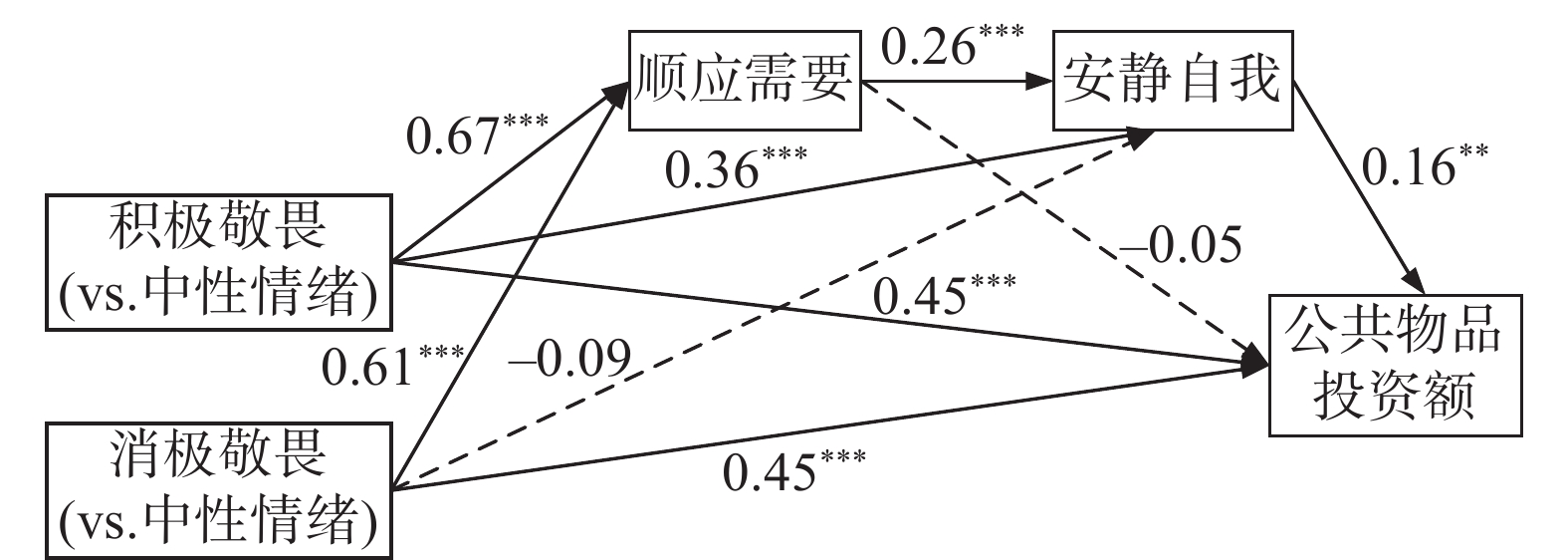
| 结果变量 | 预测变量 | β | SE | t | 95%CI |
| 顺应需要 | |||||
| 性别 | 0.07 | 0.10 | 0.69 | [−0.13, 0.27] | |
| 年龄 | 0.02 | 0.05 | 0.39 | [−0.08, 0.12] | |
| 他人合作预期 | 0.04 | 0.05 | 0.75 | [−0.06, 0.14] | |
| 积极敬畏 (vs. 中性情绪) | 0.67 | 0.12 | 5.44*** | [0.43, 0.91] | |
| 消极敬畏 (vs. 中性情绪) | 0.61 | 0.13 | 4.74*** | [0.35, 0.86] | |
| 安静自我 | |||||
| 性别 | 0.04 | 0.10 | 0.37 | [−0.16, 0.23] | |
| 年龄 | −0.20 | 0.05 | −4.08*** | [−0.29, −0.10] | |
| 他人合作预期 | 0.15 | 0.05 | 3.11** | [0.06, 0.25] | |
| 顺应需要 | 0.26 | 0.05 | 5.10*** | [0.16, 0.36] | |
| 积极敬畏 (vs. 中性情绪) | 0.36 | 0.12 | 2.93** | [0.12, 0.60] | |
| 消极敬畏 (vs. 中性情绪) | −0.09 | 0.13 | −0.69 | [−0.33, 0.16] | |
| 公共物品投资额 | |||||
| 性别 | −0.04 | 0.09 | −0.51 | [−0.21, 0.12] | |
| 年龄 | −0.003 | 0.04 | −0.08 | [−0.09, 0.08] | |
| 他人合作预期 | 0.52 | 0.04 | 11.96*** | [0.43, 0.60] | |
| 安静自我 | 0.16 | 0.05 | 3.33** | [0.06, 0.25] | |
| 顺应需要 | −0.05 | 0.05 | −1.16 | [−0.14, 0.04] | |
| 积极敬畏 (vs. 中性情绪) | 0.45 | 0.11 | 4.17*** | [0.24, 0.66] | |
| 消极敬畏 (vs. 中性情绪) | 0.45 | 0.11 | 4.14*** | [0.24, 0.67] |
| 结果变量 | 预测变量 | β | SE | t | 95%CI |
| 顺应需要 | |||||
| 性别 | 0.07 | 0.10 | 0.69 | [−0.13, 0.27] | |
| 年龄 | 0.02 | 0.05 | 0.39 | [−0.08, 0.12] | |
| 他人合作预期 | 0.04 | 0.05 | 0.75 | [−0.06, 0.14] | |
| 积极敬畏 (vs. 中性情绪) | 0.67 | 0.12 | 5.44*** | [0.43, 0.91] | |
| 消极敬畏 (vs. 中性情绪) | 0.61 | 0.13 | 4.74*** | [0.35, 0.86] | |
| 安静自我 | |||||
| 性别 | 0.04 | 0.10 | 0.37 | [−0.16, 0.23] | |
| 年龄 | −0.20 | 0.05 | −4.08*** | [−0.29, −0.10] | |
| 他人合作预期 | 0.15 | 0.05 | 3.11** | [0.06, 0.25] | |
| 顺应需要 | 0.26 | 0.05 | 5.10*** | [0.16, 0.36] | |
| 积极敬畏 (vs. 中性情绪) | 0.36 | 0.12 | 2.93** | [0.12, 0.60] | |
| 消极敬畏 (vs. 中性情绪) | −0.09 | 0.13 | −0.69 | [−0.33, 0.16] | |
| 公共物品投资额 | |||||
| 性别 | −0.04 | 0.09 | −0.51 | [−0.21, 0.12] | |
| 年龄 | −0.003 | 0.04 | −0.08 | [−0.09, 0.08] | |
| 他人合作预期 | 0.52 | 0.04 | 11.96*** | [0.43, 0.60] | |
| 安静自我 | 0.16 | 0.05 | 3.33** | [0.06, 0.25] | |
| 顺应需要 | −0.05 | 0.05 | −1.16 | [−0.14, 0.04] | |
| 积极敬畏 (vs. 中性情绪) | 0.45 | 0.11 | 4.17*** | [0.24, 0.66] | |
| 消极敬畏 (vs. 中性情绪) | 0.45 | 0.11 | 4.14*** | [0.24, 0.67] |
|
崔丽莹, 卜炜玮, 高权丽, 吴琴, 黄瑶, 韩宪国, 罗俊龙. 歧视知觉对初中生的合作倾向与行为的影响. 心理学报, 2022, 54 (3): 259- 269.
|
|
|
董蕊, 彭凯平, 喻丰. 积极情绪之敬畏. 心理科学进展, 2013, 21 (11): 1996- 2005.
|
|
|
李涛, 李永红, 宋慧, 高冉, 冯菲. 焦虑中的安全行为及其影响. 心理科学进展, 2022, 30 (9): 2067- 2077.
|
|
|
林荣茂, 余巧华, 胡添祥, 张九妹, 叶玉珊, 连榕. 敬畏感与亲社会行为关系的三水平和结构方程模型元分析. 心理学报, 2025, 57 (4): 631- 651.
|
|
|
刘国华. 安静自我量表(QES)中文版适用性初探. 中国健康心理学杂志, 2018, 26 (7): 1091- 1093.
|
|
|
王笑笑, 王伊萌, 汪凤炎. 敬畏与智慧推理: 正负效价的分离机制. 心理与行为研究, 2025, 23 (1): 17- 24.
DOI |
|
|
熊承清, 许佳颖, 马丹阳, 刘永芳. 囚徒困境博弈中对手面部表情对合作行为的影响及其作用机制. 心理学报, 2021, 53 (8): 919- 932.
|
|
|
张丽, 潘霈霖, 牛梓瑜, 马敏. 安静自我: 基于平衡和成长视角的理解. 心理发展与教育, 2024, 40 (2): 288- 297.
|
|
|
赵小红, 童薇, 陈桃林, 吴冬梅, 张蕾, 陈正举, … 唐小蓉. 敬畏的心理模型及其认知神经机制. 心理科学进展, 2021, 29 (3): 520- 530.
|
|
|
赵越, 胡小勇, 马佳馨. 敬畏的亲社会效应: 小我与真我的作用. 心理科学进展, 2023, 31 (11): 2171- 2182.
DOI |
|
|
Balliet, D., Wu, J. H., & De Dreu, C. K. W. Ingroup favoritism in cooperation: A meta-analysis. Psychological Bulletin, 2014, 140 (6): 1556- 1581.
DOI |
|
|
Bauer, J. J., & Wayment, H. A. (2008). The psychology of the quiet ego. In H. A. Wayment & J. J. Bauer (Eds.), Transcending self-interest: Psychological explorations of the quiet ego. Washington, DC: American Psychological Association.
|
|
|
Bauer, J. J., & Weatherbie, K. J. The quiet ego and human flourishing. Journal of Happiness Studies, 2023, 24 (8): 2499- 2530.
DOI |
|
|
Block, J. Assimilation, accommodation, and the dynamics of personality development. Child Development, 1982, 53 (2): 281- 295.
DOI |
|
|
Bosch, J. A., de Geus, E. J. C., Carroll, D., Goedhart, A. D., Anane, L. A., Veldhuizen van Zanten, J. J., … Edwards, K. M. A general enhancement of autonomic and cortisol responses during social evaluative threat. Psychosomatic Medicine, 2009, 71 (8): 877- 885.
DOI |
|
|
Chaudhury, S. H., Garg, N., & Jiang, Z. The curious case of threat-awe: A theoretical and empirical reconceptualization. Emotion, 2022, 22 (7): 1653- 1669.
DOI |
|
|
Danvers, A. F., & Shiota, M. N. Going off script: Effects of awe on memory for script-typical and -irrelevant narrative detail. Emotion, 2017, 17 (6): 938- 952.
DOI |
|
|
Faul, F., Erdfelder, E., Lang, A. G., & Buchner, A. G*Power 3: A flexible statistical power analysis program for the social, behavioral, and biomedical sciences. Behavior Research Methods, 2007, 39 (2): 175- 191.
DOI |
|
|
Frankenberger, K. D. Adolescent egocentrism: A comparison among adolescents and adults. Journal of Adolescence, 2000, 23 (3): 343- 354.
DOI |
|
|
Fritsche, I., Jonas, E., Ablasser, C., Beyer, M., Kuban, J., Manger, A. M., & Schultz, M. The power of we: Evidence for group-based control. Journal of Experimental Social Psychology, 2013, 49 (1): 19- 32.
DOI |
|
|
Gordon, A. M., Stellar, J. E., Anderson, C. L., McNeil, G. D., Loew, D., & Keltner, D. The dark side of the sublime: Distinguishing a threat-based variant of awe. Journal of Personality and Social Psychology, 2017, 113 (2): 310- 328.
DOI |
|
|
Keltner, D., & Haidt, J. Approaching awe, a moral, spiritual, and aesthetic emotion. Cognition and Emotion, 2003, 17 (2): 297- 314.
DOI |
|
|
Lilgendahl, J. P., Helson, R., & John, O. P. Does ego development increase during midlife? The effects of openness and accommodative processing of difficult events. Journal of Personality, 2013, 81 (4): 403- 416.
DOI |
|
|
Liu, C. J., & Hao, F. Changes in cooperative behaviour and belief in finitely repeated social dilemmas. Asian Journal of Social Psychology, 2015, 18 (3): 246- 251.
DOI |
|
|
Liu, G. Y., Isbell, L. M., & Leidner, B. How does the quiet ego relate to happiness? A path model investigation of the relations between the quiet ego, self-concept clarity, and well-being. Journal of Happiness Studies, 2022, 23 (3): 1007- 1020.
DOI |
|
|
McAdams, D. P. The psychological self as actor, agent, and author. Perspectives on Psychological Science, 2013, 8 (3): 272- 295.
DOI |
|
|
Perlin, J. D., & Li, L. Why does awe have prosocial effects? New perspectives on awe and the small self. Perspectives on Psychological Science, 2020, 15 (2): 291- 308.
DOI |
|
|
Piff, P. K., Dietze, P., Feinberg, M., Stancato, D. M., & Keltner, D. Awe, the small self, and prosocial behavior. Journal of Personality and Social Psychology, 2015, 108 (6): 883- 899.
|
|
|
Reischer, H. N., Roth, L. J., Villarreal, J. A., & McAdams, D. P. Self-transcendence and life stories of humanistic growth among late-midlife adults. Journal of Personality, 2021, 89 (2): 305- 324.
DOI |
|
|
Rogawski, M., Simonsmeier, B. A., & Buecker, S. The quiet ego: A meta-analytical review. Journal of Happiness Studies, 2025, 26 (7): 112.
DOI |
|
|
Seo, M., Yang, S. Y., & Laurent, S. M. No one is an island: Awe encourages global citizenship identification. Emotion, 2023, 23 (3): 601- 612.
DOI |
|
|
Septianto, F., Seo, Y., & Paramita, W. The role of implicit theories in motivating donations in response to threat-based awe. Journal of Public Policy & Marketing, 2022, 41 (1): 72- 88.
DOI |
|
|
Shiota, M. N., Keltner, D., & John, O. P. Positive emotion dispositions differentially associated with Big Five personality and attachment style. The Journal of Positive Psychology, 2006, 1 (2): 61- 71.
DOI |
|
|
Shiota, M. N., Keltner, D., & Mossman, A. The nature of awe: Elicitors, appraisals, and effects on self-concept. Cognition and Emotion, 2007, 21 (5): 944- 963.
DOI |
|
|
Stellar, J. E. Awe helps us remember why it is important to forget the self. Annals of the New York Academy of Sciences, 2021, 1501 (1): 81- 84.
DOI |
|
|
Stellar, J. E., Gordon, A., Anderson, C. L., Piff, P. K., McNeil, G. D., & Keltner, D. Awe and humility. Journal of Personality and Social Psychology, 2018, 114 (2): 258- 269.
|
|
|
Tomasello, M. (2019). Becoming human: A theory of ontogeny. Cambridge, MA: Belknap Press.
|
|
|
Tyson, C., Hornsey, M. J., & Barlow, F. K. What does it mean to feel small? Three dimensions of the small self. Self and Identity, 2022, 21 (4): 387- 405.
DOI |
|
|
Valdesolo, P., & Graham, J. Awe, uncertainty, and agency detection. Psychological Science, 2014, 25 (1): 170- 178.
DOI |
|
|
Wang, M. Z., Qu, X. Q., Guo, C. L., & Wang, J. Awe elicited by natural disasters and willingness to help people in afflicted areas: A meditational model. Current Psychology, 2023, 42 (24): 20883- 20889.
DOI |
|
|
Wayment, H. A., & Bauer, J. J. The quiet ego: Motives for self-other balance and growth in relation to well-being. Journal of Happiness Studies, 2018, 19 (3): 881- 896.
DOI |
|
|
Wayment, H. A., Bauer, J. J., & Sylaska, K. The Quiet Ego Scale: Measuring the compassionate self-identity. Journal of Happiness Studies, 2015, 16 (4): 999- 1033.
DOI |
|
|
Wu, Q., Cui, L. Y., Han, X. G., Wu, Y. X., & He, W. Facilitative effect of awe on cooperation: The role of the small-self and self-other inclusion. PsyCh Journal, 2024, 13 (4): 552- 565.
DOI |
|
|
Zhang, J. L., Chang, B. R., & Fang, J. D. Awe influences prosocial behavior and subjective well-being through the quiet ego. Journal of Happiness Studies, 2025, 26 (1): 2.
DOI |
| [1] | CHANG Baorui, GUO Jianing, AO Yuechen. The Influence of Awe on Creativity: The Chain Mediating Effect of Cognitive Flexibility and Creative Self-Efficacy [J]. Studies of Psychology and Behavior, 2026, 24(3): 367-374. |
| [2] | Yuhan ZHANG, Fengqin DING. Awe and Prosocial Behavior in Junior High School Students: The Mediating Role of Meaning in Life [J]. Studies of Psychology and Behavior, 2026, 24(1): 130-137. |
| [3] | Yifeng WU, Xin LI, Huili CHEN, Tong DING, Juan HOU. Feel the Connection, Spread the Word: How Self-Relevance in News Sparks Sharing [J]. Studies of Psychology and Behavior, 2025, 23(2): 249-256. |
| [4] | Xiaoxiao WANG, Yimeng WANG, Fengyan WANG. Awe and Wise Reasoning: The Differential Mechanism of Positive and Negative Valence [J]. Studies of Psychology and Behavior, 2025, 23(1): 17-24. |
| [5] | Hua JIN, Chao WANG, Xiaojuan YIN, Lina JIA, Xuying WANG. Effects of Misinformation Valence on Continued Influence Effect: The Mediating Role of Misinformation Belief [J]. Studies of Psychology and Behavior, 2024, 22(5): 690-696. |
| [6] | Chengjia ZHAO, Xiaoxiao HUANG, Guoliang YU. A Meta-Analysis of the Prevalence of Mental Health Problems Among Preschool Teachers in Chinese Mainland: 2000~2022 [J]. Studies of Psychology and Behavior, 2024, 22(2): 145-153. |
| [7] | Xiaoxiao HUANG, Juanjuan JIN, Guoliang YU. A Meta-Analysis of the Prevalence of Mental Health Problems Among Primary School Teachers in Chinese Mainland: 2000~2022 [J]. Studies of Psychology and Behavior, 2024, 22(2): 154-162. |
| [8] | Xiaoqi YU, Xiaoxiao HUANG, Guoliang YU. A Meta-Analysis of the Prevalence of Mental Health Problems Among Secondary School Teachers in Chinese Mainland: 2000~2022 [J]. Studies of Psychology and Behavior, 2024, 22(2): 163-172. |
| [9] | Lei SHAO, Xiaoxiao HUANG, Guoliang YU. A Meta-Analysis of the Prevalence of Mental Health Problems Among University Teachers in Chinese Mainland: 2000~2022 [J]. Studies of Psychology and Behavior, 2024, 22(2): 173-182. |
| [10] | Shuying XU, Shuguang CAI, Tingyong FENG. The Effect of Episodic Future Thinking on Delay Discounting: The Malleability of Episodic Prospective Ability [J]. Studies of Psychology and Behavior, 2023, 21(5): 592-599. |
| [11] | Zheng ZHANG, Xuexin LI. Fear of Negative Evaluation and Compulsive Buying: Materialism as a Mediator and Dispositional Awe as a Moderator [J]. Studies of Psychology and Behavior, 2023, 21(4): 541-548. |
| [12] | Xiaofei LIU, Xiaoyan LIANG, Ziqiang XIN. The Combined Effect of Two Types Reputation Information of Charity on Donation Intention [J]. Studies of Psychology and Behavior, 2022, 20(6): 813-820. |
| [13] | Qian SUN, Jun ZHOU, Yongfang LIU. Effects of Self-Social Value Orientation and Other’s Social Value Orientation on Cooperative Behavior and Its Underlying Mechanisms [J]. Studies of Psychology and Behavior, 2022, 20(6): 821-827. |
| [14] | LUO Li, YANG Dong, CHEN Shengdong, GAO Wei, CHEN Yongqiang, YUAN Jiajin. Dispositional Awe Positively Predicts Prosocial Tendencies: Multiple Mediation Effects of Self-Transcendence and Empathy [J]. Studies of Psychology and Behavior, 2022, 20(3): 390-396. |
| [15] | ZHOU Aibao, ZHAO Haiyan, XIA Ruixue, YUAN Yue, JIA Tingting, XIE Pei. The Impact of Reference Styles, Emotional Valence, and Personality-Trait Assessment at Different Semantic Levels on Memory [J]. Studies of Psychology and Behavior, 2022, 20(2): 145-152. |
| Viewed | ||||||
|
Full text |
|
|||||
|
Abstract |
|
|||||
