
Studies of Psychology and Behavior ›› 2026, Vol. 24 ›› Issue (3): 384-392.DOI: 10.12139/j.1672-0628.2026.03.013
• ? • Previous Articles Next Articles
Xuejiao DU*( ), Zifan MENG, Yao LI, Chuwen WANG, Yinghong DONG
Received:2025-04-11
Online:2026-05-20
Published:2026-05-20
Contact:
Xuejiao DU
杜雪娇*(), 孟子凡, 李瑶, 王楚雯, 董颖红
通讯作者:
杜雪娇
基金资助:CLC Number:
Xuejiao DU, Zifan MENG, Yao LI, Chuwen WANG, Yinghong DONG. Effects of Pedagogical Agents’ Language Styles and Their AI-Generated Approach on the Video Learning for Pupils with Different Cognitive Styles[J]. Studies of Psychology and Behavior, 2026, 24(3): 384-392.
杜雪娇, 孟子凡, 李瑶, 王楚雯, 董颖红. 教学代理语言风格及AI生成方式对不同认知风格小学生视频学习的影响[J]. 心理与行为研究, 2026, 24(3): 384-392.
Add to citation manager EndNote|Ris|BibTeX
URL: https://psybeh.tjnu.edu.cn/EN/10.12139/j.1672-0628.2026.03.013
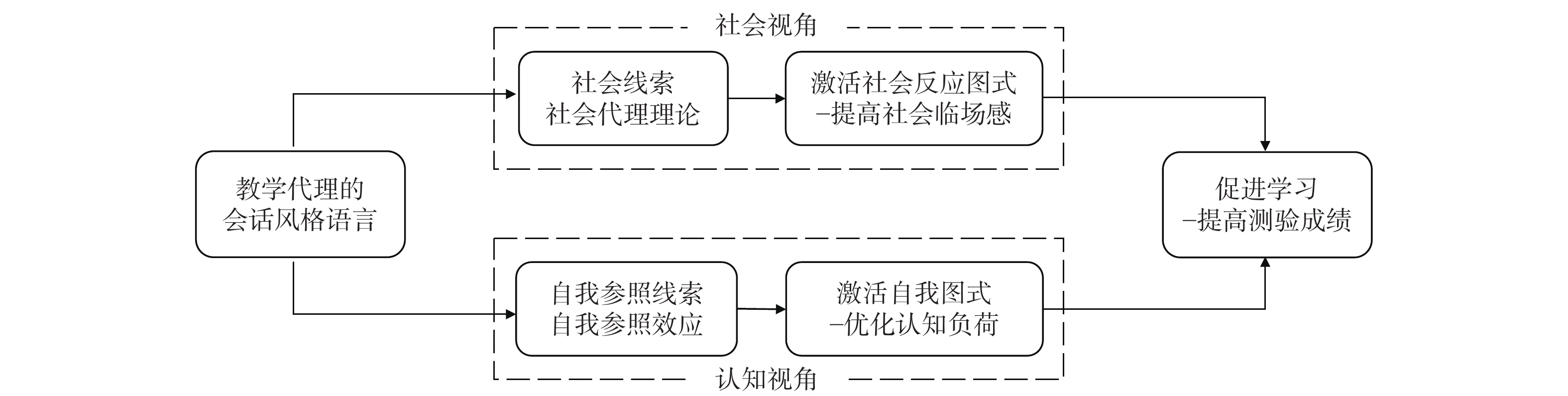
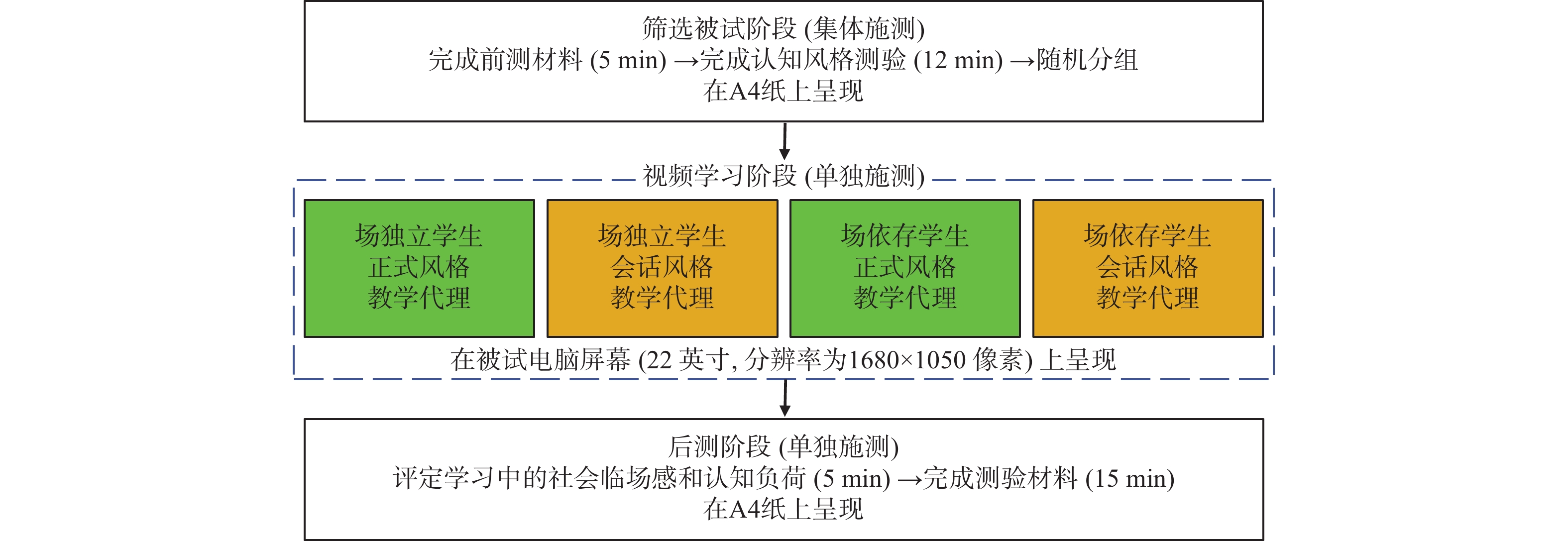
| 教学代理语言风格 | 学生认知风格 | 测验成绩 | 社会临场感 | 心理努力 | 任务难度 | |||||||
| M | SD | M | SD | M | SD | M | SD | |||||
| 正式风格 | 场独立 | 1.06 | 0.91 | 16.69 | 2.51 | 4.09 | 2.26 | 4.53 | 1.80 | |||
| 会话风格 | 场独立 | 0.88 | 0.71 | 17.66 | 3.68 | 4.31 | 2.09 | 4.78 | 2.03 | |||
| 正式风格 | 场依存 | 0.34 | 0.60 | 15.25 | 3.85 | 4.41 | 2.00 | 4.47 | 2.00 | |||
| 会话风格 | 场依存 | 0.91 | 0.86 | 19.31 | 4.24 | 5.06 | 1.78 | 5.28 | 1.51 | |||
| 教学代理语言风格 | 学生认知风格 | 测验成绩 | 社会临场感 | 心理努力 | 任务难度 | |||||||
| M | SD | M | SD | M | SD | M | SD | |||||
| 正式风格 | 场独立 | 1.06 | 0.91 | 16.69 | 2.51 | 4.09 | 2.26 | 4.53 | 1.80 | |||
| 会话风格 | 场独立 | 0.88 | 0.71 | 17.66 | 3.68 | 4.31 | 2.09 | 4.78 | 2.03 | |||
| 正式风格 | 场依存 | 0.34 | 0.60 | 15.25 | 3.85 | 4.41 | 2.00 | 4.47 | 2.00 | |||
| 会话风格 | 场依存 | 0.91 | 0.86 | 19.31 | 4.24 | 5.06 | 1.78 | 5.28 | 1.51 | |||
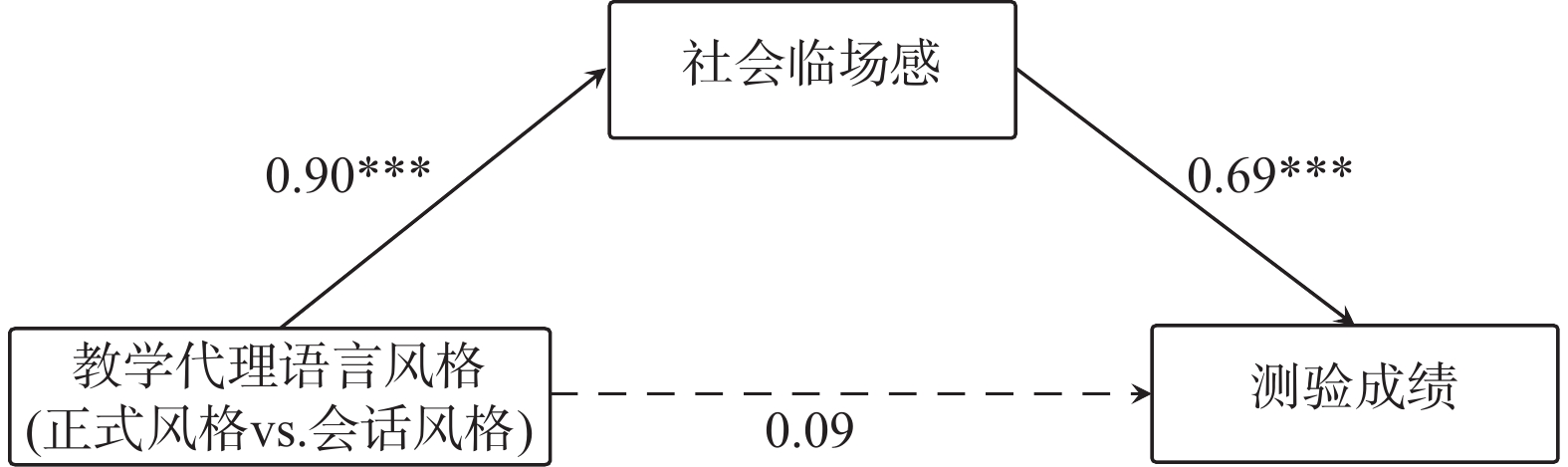
| 结果变量 | 预测变量 | β | SE | t | p | R | R2 | F | p |
| 测验成绩 | 教学代理语言风格 | 0.71 | 0.24 | 3.04 | 0.004 | 0.36 | 0.13 | 9.25 | 0.004 |
| 社会临场感 | 教学代理语言风格 | 0.90 | 0.22 | 4.01 | <0.001 | 0.45 | 0.21 | 16.10 | <0.001 |
| 测验成绩 | 教学代理语言风格 | 0.09 | 0.20 | 0.45 | 0.650 | 0.72 | 0.51 | 32.06 | <0.001 |
| 社会临场感 | 0.69 | 0.10 | 6.92 | <0.001 |
| 结果变量 | 预测变量 | β | SE | t | p | R | R2 | F | p |
| 测验成绩 | 教学代理语言风格 | 0.71 | 0.24 | 3.04 | 0.004 | 0.36 | 0.13 | 9.25 | 0.004 |
| 社会临场感 | 教学代理语言风格 | 0.90 | 0.22 | 4.01 | <0.001 | 0.45 | 0.21 | 16.10 | <0.001 |
| 测验成绩 | 教学代理语言风格 | 0.09 | 0.20 | 0.45 | 0.650 | 0.72 | 0.51 | 32.06 | <0.001 |
| 社会临场感 | 0.69 | 0.10 | 6.92 | <0.001 |
| 效应值 | Boot标准误 | Boot CI下限 | Boot CI上限 | |
| 直接效应 | 0.09 | 0.18 | −0.27 | 0.44 |
| 中介效应 | 0.62 | 0.19 | 0.29 | 1.03 |
| 总效应 | 0.71 | 0.23 | 0.27 | 1.18 |
| 效应值 | Boot标准误 | Boot CI下限 | Boot CI上限 | |
| 直接效应 | 0.09 | 0.18 | −0.27 | 0.44 |
| 中介效应 | 0.62 | 0.19 | 0.29 | 1.03 |
| 总效应 | 0.71 | 0.23 | 0.27 | 1.18 |
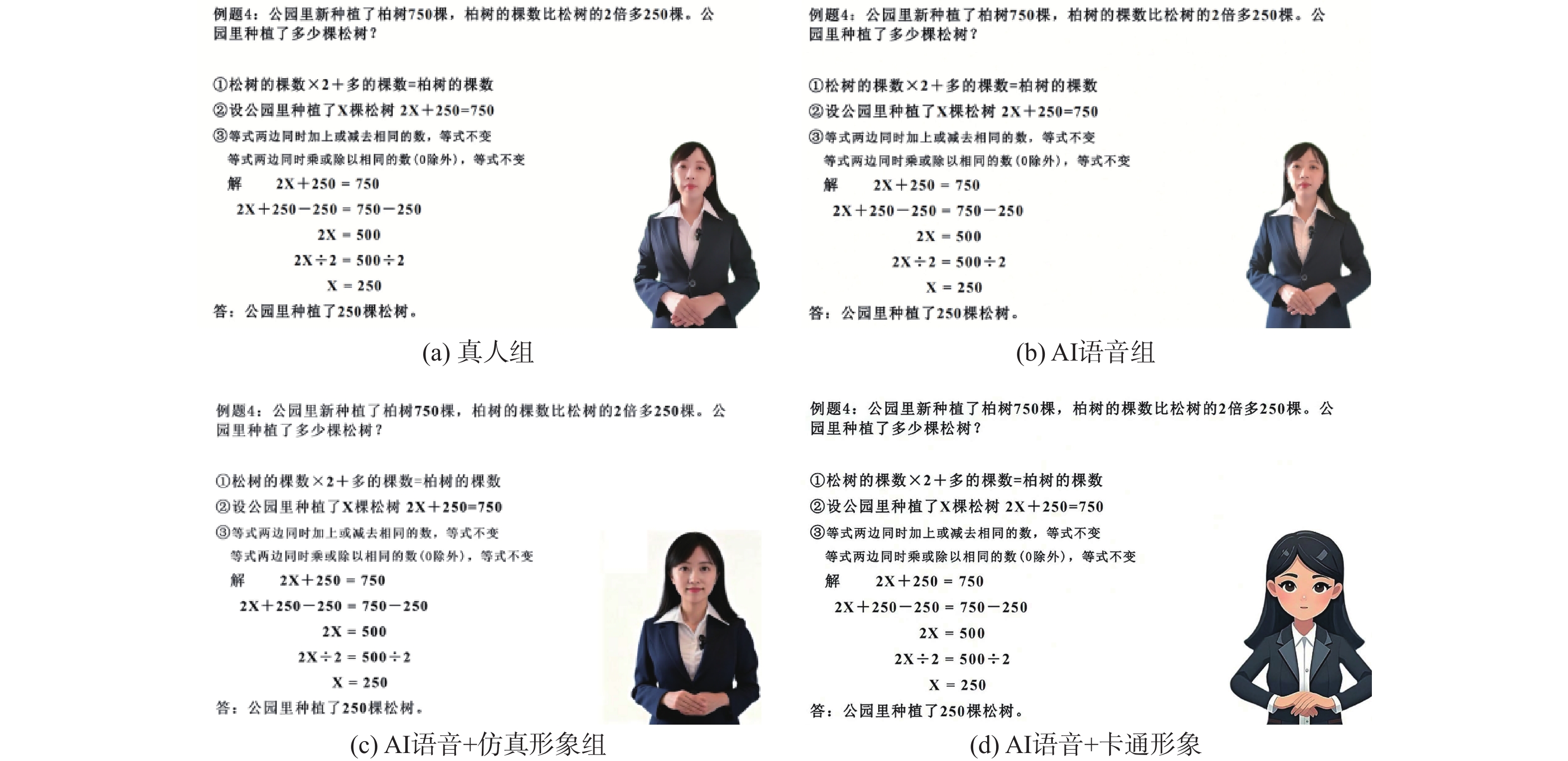
| 会话风格教学代理的AI生成方式 | 测验成绩 | 社会临场感 | 心理努力 | 任务难度 | |||||||
| M | SD | M | SD | M | SD | M | SD | ||||
| 真人组 | 0.91 | 0.79 | 19.29 | 4.15 | 5.07 | 1.66 | 5.33 | 1.43 | |||
| AI语音组 | 0.98 | 0.72 | 18.00 | 3.95 | 4.87 | 1.53 | 4.82 | 1.67 | |||
| AI语音+仿真形象组 | 0.96 | 0.77 | 18.40 | 4.47 | 5.04 | 1.41 | 4.98 | 1.29 | |||
| AI语音+卡通形象组 | 1.40 | 0.75 | 18.44 | 3.98 | 4.62 | 1.67 | 4.91 | 1.41 | |||
| 会话风格教学代理的AI生成方式 | 测验成绩 | 社会临场感 | 心理努力 | 任务难度 | |||||||
| M | SD | M | SD | M | SD | M | SD | ||||
| 真人组 | 0.91 | 0.79 | 19.29 | 4.15 | 5.07 | 1.66 | 5.33 | 1.43 | |||
| AI语音组 | 0.98 | 0.72 | 18.00 | 3.95 | 4.87 | 1.53 | 4.82 | 1.67 | |||
| AI语音+仿真形象组 | 0.96 | 0.77 | 18.40 | 4.47 | 5.04 | 1.41 | 4.98 | 1.29 | |||
| AI语音+卡通形象组 | 1.40 | 0.75 | 18.44 | 3.98 | 4.62 | 1.67 | 4.91 | 1.41 | |||
|
李艳芬, 赵宁宁, 周铁民. 不同内隐学习任务在不同认知风格个体上的成绩差异. 心理与行为研究, 2017, 15 (5): 606- 612.
DOI |
|
|
吕馨, 刘景瑶, 魏柳青, 张学民. 目标数量与运动框架旋转角度对不同场认知风格个体多目标追踪表现的影响. 心理学报, 2019, 51 (1): 24- 35.
|
|
|
宋合义. (1988). 认知方式图形测验的编制与修订说明. 见 谢斯骏, 张厚粲 (编), 认知方式 一个人格维度的实验研究 (pp. 261–276). 北京: 北京师范大学出版社.
|
|
|
宋淑娟, 刘华山. 数学-性别刻板印象对女生的威胁效应: 场认知风格的调节作用. 心理与行为研究, 2015, 13 (3): 302- 305, 319.
|
|
|
王福兴, 李文静, 谢和平, 刘华山. 多媒体学习中教学代理有利于学习吗?——一项元分析研究. 心理科学进展, 2017, 25 (1): 12- 28.
DOI |
|
|
Almeida, L. M. C. G., Münzer, S., & Kühl, T. More personal, but not better: The personalization effect in learning neutral and aversive health information. Journal of Computer Assisted Learning, 2024, 40 (5): 2248- 2260.
DOI |
|
|
Bai, J., Cheng, X. L., Zhang, H., Qin, Y. H., Xu, T., & Zhou, Y. Can AI-generated pedagogical agents (AIPA) replace human teacher in picture book videos? The effects of appearance and voice of AIPA on children’s learning. Education and Information Technologies, 2025, 30 (9): 12267- 12287.
DOI |
|
|
Castro-Alonso, J. C., Wong, R. M., Adesope, O. O., & Paas, F. Effectiveness of multimedia pedagogical agents predicted by diverse theories: A meta-analysis. Educational Psychology Review, 2021, 33 (3): 989- 1015.
DOI |
|
|
Chen, C. M., Li, M. C., & Chen, Y. T. The effects of web-based inquiry learning mode with the support of collaborative digital reading annotation system on information literacy instruction. Computers & Education, 2022, 179, 104428.
DOI |
|
|
Du, X. J., Chen, C., & Lin, H. X. The impact of working memory capacity on collaborative learning in elementary school students. Frontiers in Psychology, 2022, 13, 1027523.
DOI |
|
|
Evans, C., Richardson, J. T. E., & Waring, M. Field independence: Reviewing the evidence. British Journal of Educational Psychology, 2013, 83 (2): 210- 224.
DOI |
|
|
Fynes-Clinton, S., Marstaller, L., & Burianová, H. Differentiation of functional networks during long-term memory retrieval in children and adolescents. NeuroImage, 2019, 191, 93- 103.
DOI |
|
|
Ginns, P., Martin, A. J., & Marsh, H. W. Designing instructional text in a conversational style: A meta-analysis. Educational Psychology Review, 2013, 25 (4): 445- 472.
DOI |
|
|
Kühl, T., & Münzer, S. Learning about a serious disease: When a personalized message is harmful unless you are happy. Journal of Computer Assisted Learning, 2021, 37 (5): 1312- 1323.
DOI |
|
|
Li, H. Y., & Graesser, A. C. The impact of conversational agents’ language on summary writing. Journal of Research on Technology in Education, 2021, 53 (1): 44- 66.
DOI |
|
|
Li, J., Kizilcec, R., Bailenson, J., & Ju, W. Social robots and virtual agents as lecturers for video instruction. Computers in Human Behavior, 2016, 55, 1222- 1230.
DOI |
|
|
Li, W. J., Wang, F. X., & Mayer, R. E. Increasing the realism of on-screen embodied instructors creates more looking but less learning. British Journal of Educational Psychology, 2024, 94 (3): 759- 776.
DOI |
|
|
Lin, L. J., Ginns, P., Wang, T. H., & Zhang, P. L. Using a pedagogical agent to deliver conversational style instruction: What benefits can you obtain. Computers & Education, 2020, 143, 103658.
DOI |
|
|
Lin, L. J., Lin, X., Zhang, X. F., & Ginns, P. The personalized learning by interest effect on interest, cognitive load, retention, and transfer: A meta-analysis. Educational Psychology Review, 2024, 36 (3): 88.
DOI |
|
|
Moreno, R., & Mayer, R. E. Engaging students in active learning: The case for personalized multimedia messages. Journal of Educational Psychology, 2000, 92 (4): 724- 733.
DOI |
|
|
Netland, T., von Dzengelevski, O., Tesch, K., & Kwasnitschka, D. Comparing human-made and AI-generated teaching videos: An experimental study on learning effects. Computers & Education, 2025, 224, 105164.
DOI |
|
|
Nightingale, S. J., & Farid, H. AI-synthesized faces are indistinguishable from real faces and more trustworthy. Proceedings of the National Academy of Sciences of the United States of America, 2022, 119 (8): e2120481119.
DOI |
|
|
Paas, F. G. Training strategies for attaining transfer of problem-solving skill in statistics: A cognitive-load approach. Journal of Educational Psychology, 1992, 84 (4): 429- 434.
DOI |
|
|
Pataranutaporn, P., Danry, V., Leong, J., Punpongsanon, P., Novy, D., Maes, P. & Sra, M. AI-generated characters for supporting personalized learning and well-being. Nature Machine Intelligence, 2021, 3 (12): 1013- 1022.
DOI |
|
|
Pi, Z. L., Deng, L. X., Wang, X., Guo, P. R., Xu, T., & Zhou, Y. The influences of a virtual instructor’s voice and appearance on learning from video lectures. Journal of Computer Assisted Learning, 2022, 38 (6): 1703- 1713.
DOI |
|
|
Piaget, J. (1952). The origins of intelligence in children (M. Cook, Trans.). New York: W. W. Norton & Company.
|
|
|
Polat, H., Taş, N., Kaban, A., Kayaduman, H., & Battal, A. Human or humanoid animated pedagogical avatars in video lectures: The impact of the knowledge type on learning outcomes. International Journal of Human-Computer Interaction, 2025, 41 (14): 8912- 8927.
DOI |
|
|
Reichelt, M., Kämmerer, F., Niegemann, H. M., & Zander, S. Talk to me personally: Personalization of language style in computer-based learning. Computers in Human Behavior, 2014, 35, 199- 210.
DOI |
|
|
Sikström, P., Valentini, C., Sivunen, A., & Kärkkäinen, T. How pedagogical agents communicate with students: A two-phase systematic review. Computers & Education, 2022, 188, 104564.
DOI |
|
|
Stiller, K. D., & Jedlicka, R. A kind of expertise reversal effect: Personalisation effect can depend on domain-specific prior knowledge. Australasian Journal of Educational Technology, 2010, 26 (1): 133- 149.
|
|
|
Tinajero, C., Castelo, A. M., Guisande, M. A., & Páramo, M. F. Self-regulated learning in female students with different cognitive styles: An exploratory study. Perceptual and Motor Skills, 2010, 111 (1): 31- 44.
DOI |
|
|
Xu, T., Liu, Y., Jin, Y. R., Qu, Y. Y., Bai, J., Zhang, W. L., & Zhou, Y. From recorded to AI-generated instructional videos: A comparison of learning performance and experience. British Journal of Educational Technology, 2025, 56 (4): 1463- 1487.
DOI |
|
|
Zhao, F. Z. & Mayer, R. E. Improving multimedia learning with emotional design: Depicting key elements with positive features. Journal of Computer Assisted Learning, 2025, 41 (3): e70028.
DOI |
| Viewed | ||||||
|
Full text |
|
|||||
|
Abstract |
|
|||||
