
Studies of Psychology and Behavior ›› 2026, Vol. 24 ›› Issue (4): 491-499.DOI: 10.12139/j.1672-0628.2026.04.008
• ? • Previous Articles Next Articles
Xiaofei QIAO1, Wei GAO2, Zilin WANG1, Jingyuan YANG1, Li LEI*,1( )
)
Received:2025-08-23
Online:2026-07-21
Published:2026-07-20
Contact:
Li LEI
乔小飞1, 高伟2, 王紫琳1, 杨靖渊1, 雷雳*,1()
通讯作者:
雷雳
基金资助:CLC Number:
Xiaofei QIAO, Wei GAO, Zilin WANG, Jingyuan YANG, Li LEI. The Relationship Between Bullying Victimization and Internet Gaming Disorder Among Adolescents: The Moderating Role of Self-Esteem and Social Support[J]. Studies of Psychology and Behavior, 2026, 24(4): 491-499.
乔小飞, 高伟, 王紫琳, 杨靖渊, 雷雳. 青少年受欺负与网络游戏障碍的关系:自尊与社会支持的调节作用[J]. 心理与行为研究, 2026, 24(4): 491-499.
Add to citation manager EndNote|Ris|BibTeX
URL: https://psybeh.tjnu.edu.cn/EN/10.12139/j.1672-0628.2026.04.008
| 人口学变量 | 类别 | 人数 | 百分比(%) |
| 性别 | 男 | 1527 | 59.63 |
| 女 | 1034 | 40.37 | |
| 父亲文化水平 | 小学及以下 | 227 | 8.86 |
| 初中 | 995 | 38.85 | |
| 高中或中专 | 515 | 20.11 | |
| 大专或本科及以上 | 824 | 32.18 | |
| 母亲文化水平 | 小学及以下 | 433 | 16.91 |
| 初中 | 837 | 32.68 | |
| 高中或中专 | 514 | 20.07 | |
| 大专或本科及以上 | 777 | 30.34 | |
| 每日网络游戏时长 | 少于1小时 | 2025 | 79.07 |
| 1到2小时 | 472 | 18.43 | |
| 3到4小时 | 36 | 1.41 | |
| 5小时及以上 | 28 | 1.09 |
| 人口学变量 | 类别 | 人数 | 百分比(%) |
| 性别 | 男 | 1527 | 59.63 |
| 女 | 1034 | 40.37 | |
| 父亲文化水平 | 小学及以下 | 227 | 8.86 |
| 初中 | 995 | 38.85 | |
| 高中或中专 | 515 | 20.11 | |
| 大专或本科及以上 | 824 | 32.18 | |
| 母亲文化水平 | 小学及以下 | 433 | 16.91 |
| 初中 | 837 | 32.68 | |
| 高中或中专 | 514 | 20.07 | |
| 大专或本科及以上 | 777 | 30.34 | |
| 每日网络游戏时长 | 少于1小时 | 2025 | 79.07 |
| 1到2小时 | 472 | 18.43 | |
| 3到4小时 | 36 | 1.41 | |
| 5小时及以上 | 28 | 1.09 |
| 变量 | M | SD | 1 | 2 | 3 | 4 | 5 |
| 1.传统受欺负 | 1.34 | 0.56 | |||||
| 2.网络受欺负 | 1.10 | 0.47 | 0.50*** | ||||
| 3.自尊 | 3.07 | 0.58 | −0.24*** | −0.18*** | |||
| 4.家庭支持 | 5.79 | 1.38 | −0.23*** | −0.19*** | 0.32*** | ||
| 5.同伴支持 | 5.53 | 1.31 | −0.23*** | −0.14*** | 0.28*** | 0.66*** | |
| 6.网络游戏障碍 | 1.35 | 0.60 | 0.42*** | 0.30*** | −0.21*** | −0.19*** | −0.21*** |
| 变量 | M | SD | 1 | 2 | 3 | 4 | 5 |
| 1.传统受欺负 | 1.34 | 0.56 | |||||
| 2.网络受欺负 | 1.10 | 0.47 | 0.50*** | ||||
| 3.自尊 | 3.07 | 0.58 | −0.24*** | −0.18*** | |||
| 4.家庭支持 | 5.79 | 1.38 | −0.23*** | −0.19*** | 0.32*** | ||
| 5.同伴支持 | 5.53 | 1.31 | −0.23*** | −0.14*** | 0.28*** | 0.66*** | |
| 6.网络游戏障碍 | 1.35 | 0.60 | 0.42*** | 0.30*** | −0.21*** | −0.19*** | −0.21*** |
| 预测变量 | 网络游戏障碍 | |||
| β | SE | t | 95%CI | |
| 传统受欺负 | 0.35 | 0.02 | 16.84*** | [0.31, 0.39] |
| 自尊 | −0.09 | 0.02 | −4.71*** | [−0.12, −0.05] |
| 传统受欺负×自尊 | −0.02 | 0.02 | −0.87 | [−0.06, 0.02] |
| 家庭支持 | −0.07 | 0.02 | −3.82*** | [−0.11, −0.04] |
| 传统受欺负×家庭支持 | −0.05 | 0.02 | −2.81** | [−0.09, −0.02] |
| 自尊×家庭支持 | −0.01 | 0.02 | −0.40 | [−0.04, 0.03] |
| 传统受欺负×自尊×家庭支持 | −0.08 | 0.02 | −4.87*** | [−0.11, −0.05] |
| R2 | 0.31 | |||
| F | 95.95*** | |||
| 传统受欺负 | 0.33 | 0.02 | 16.22*** | [0.29, 0.37] |
| 自尊 | −0.08 | 0.02 | −4.54*** | [−0.12, −0.05] |
| 传统受欺负×自尊 | −0.02 | 0.02 | −1.08 | [−0.06, 0.02] |
| 同伴支持 | −0.10 | 0.02 | −5.26*** | [−0.13, −0.07] |
| 传统受欺负×同伴支持 | −0.03 | 0.02 | −1.93 | [−0.07, 0.001] |
| 自尊×同伴支持 | 0.001 | 0.02 | 0.07 | [−0.03, 0.04] |
| 传统受欺负×自尊×同伴支持 | −0.06 | 0.02 | −3.87*** | [−0.09, −0.03] |
| R2 | 0.31 | |||
| F | 96.53*** | |||
| 网络受欺负 | 0.27 | 0.04 | 7.42*** | [0.20, 0.35] |
| 自尊 | −0.11 | 0.02 | −5.42*** | [−0.14, −0.07] |
| 网络受欺负×自尊 | 0.01 | 0.03 | 0.37 | [−0.05, 0.08] |
| 家庭支持 | −0.09 | 0.02 | −4.59*** | [−0.13, −0.05] |
| 网络受欺负×家庭支持 | 0.03 | 0.02 | 1.46 | [−0.01, 0.08] |
| 自尊×家庭支持 | 0.01 | 0.02 | 0.62 | [−0.03, 0.05] |
| 网络受欺负×自尊×家庭支持 | −0.03 | 0.02 | −1.40 | [−0.06, 0.01] |
| R2 | 0.25 | |||
| F | 70.57*** | |||
| 网络受欺负 | 0.22 | 0.04 | 6.24*** | [0.15, 0.29] |
| 自尊 | −0.11 | 0.02 | −5.51*** | [−0.14, −0.07] |
| 网络受欺负×自尊 | −0.001 | 0.03 | −0.04 | [−0.06, 0.06] |
| 同伴支持 | −0.13 | 0.02 | −6.93*** | [−0.17, −0.09] |
| 网络受欺负×同伴支持 | −0.01 | 0.02 | −0.59 | [−0.05, 0.03] |
| 自尊×同伴支持 | 0.02 | 0.02 | 0.94 | [−0.02, 0.05] |
| 网络受欺负×自尊×同伴支持 | −0.04 | 0.01 | −2.52* | [−0.07, −0.01] |
| R2 | 0.25 | |||
| F | 72.27*** | |||
| 预测变量 | 网络游戏障碍 | |||
| β | SE | t | 95%CI | |
| 传统受欺负 | 0.35 | 0.02 | 16.84*** | [0.31, 0.39] |
| 自尊 | −0.09 | 0.02 | −4.71*** | [−0.12, −0.05] |
| 传统受欺负×自尊 | −0.02 | 0.02 | −0.87 | [−0.06, 0.02] |
| 家庭支持 | −0.07 | 0.02 | −3.82*** | [−0.11, −0.04] |
| 传统受欺负×家庭支持 | −0.05 | 0.02 | −2.81** | [−0.09, −0.02] |
| 自尊×家庭支持 | −0.01 | 0.02 | −0.40 | [−0.04, 0.03] |
| 传统受欺负×自尊×家庭支持 | −0.08 | 0.02 | −4.87*** | [−0.11, −0.05] |
| R2 | 0.31 | |||
| F | 95.95*** | |||
| 传统受欺负 | 0.33 | 0.02 | 16.22*** | [0.29, 0.37] |
| 自尊 | −0.08 | 0.02 | −4.54*** | [−0.12, −0.05] |
| 传统受欺负×自尊 | −0.02 | 0.02 | −1.08 | [−0.06, 0.02] |
| 同伴支持 | −0.10 | 0.02 | −5.26*** | [−0.13, −0.07] |
| 传统受欺负×同伴支持 | −0.03 | 0.02 | −1.93 | [−0.07, 0.001] |
| 自尊×同伴支持 | 0.001 | 0.02 | 0.07 | [−0.03, 0.04] |
| 传统受欺负×自尊×同伴支持 | −0.06 | 0.02 | −3.87*** | [−0.09, −0.03] |
| R2 | 0.31 | |||
| F | 96.53*** | |||
| 网络受欺负 | 0.27 | 0.04 | 7.42*** | [0.20, 0.35] |
| 自尊 | −0.11 | 0.02 | −5.42*** | [−0.14, −0.07] |
| 网络受欺负×自尊 | 0.01 | 0.03 | 0.37 | [−0.05, 0.08] |
| 家庭支持 | −0.09 | 0.02 | −4.59*** | [−0.13, −0.05] |
| 网络受欺负×家庭支持 | 0.03 | 0.02 | 1.46 | [−0.01, 0.08] |
| 自尊×家庭支持 | 0.01 | 0.02 | 0.62 | [−0.03, 0.05] |
| 网络受欺负×自尊×家庭支持 | −0.03 | 0.02 | −1.40 | [−0.06, 0.01] |
| R2 | 0.25 | |||
| F | 70.57*** | |||
| 网络受欺负 | 0.22 | 0.04 | 6.24*** | [0.15, 0.29] |
| 自尊 | −0.11 | 0.02 | −5.51*** | [−0.14, −0.07] |
| 网络受欺负×自尊 | −0.001 | 0.03 | −0.04 | [−0.06, 0.06] |
| 同伴支持 | −0.13 | 0.02 | −6.93*** | [−0.17, −0.09] |
| 网络受欺负×同伴支持 | −0.01 | 0.02 | −0.59 | [−0.05, 0.03] |
| 自尊×同伴支持 | 0.02 | 0.02 | 0.94 | [−0.02, 0.05] |
| 网络受欺负×自尊×同伴支持 | −0.04 | 0.01 | −2.52* | [−0.07, −0.01] |
| R2 | 0.25 | |||
| F | 72.27*** | |||
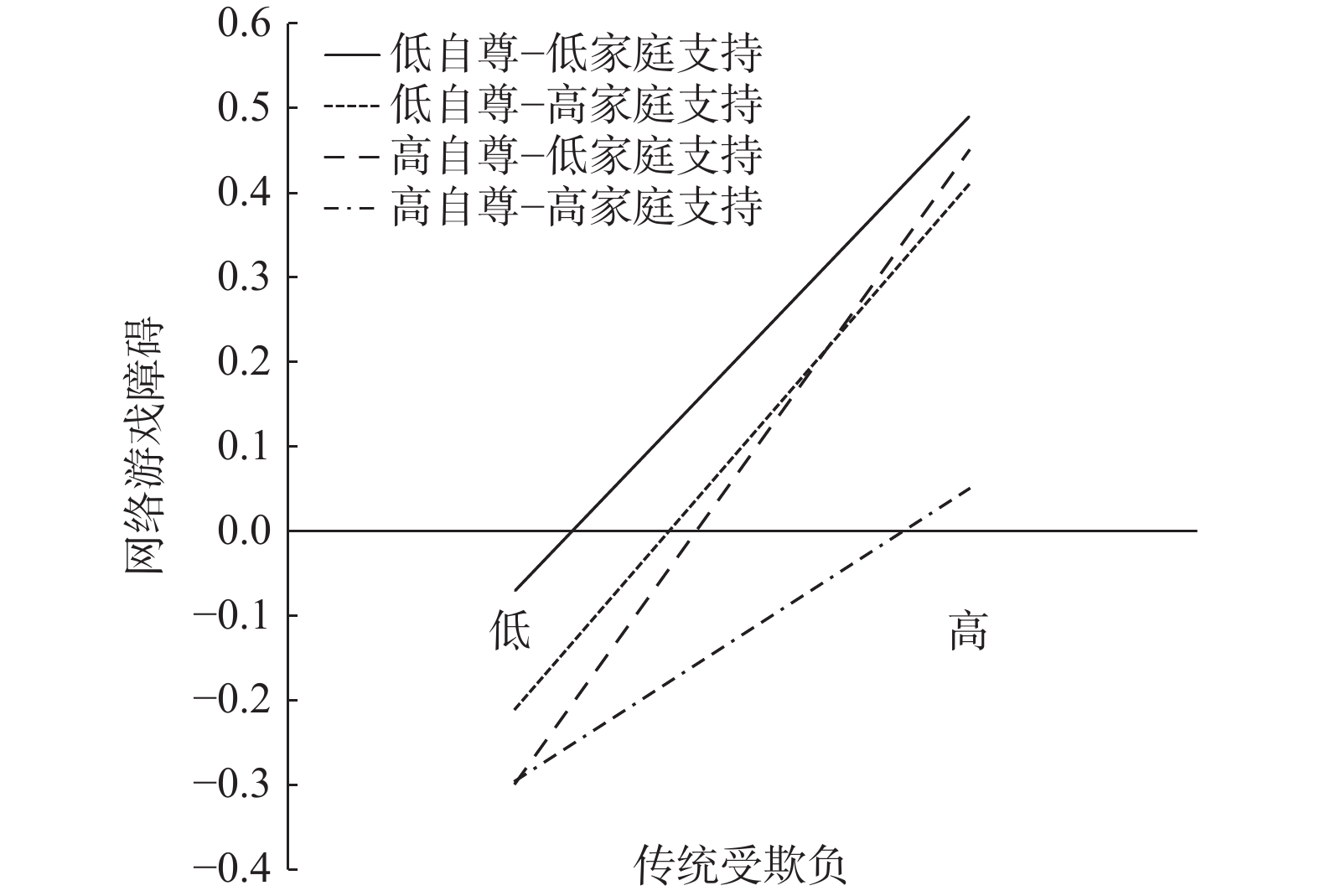
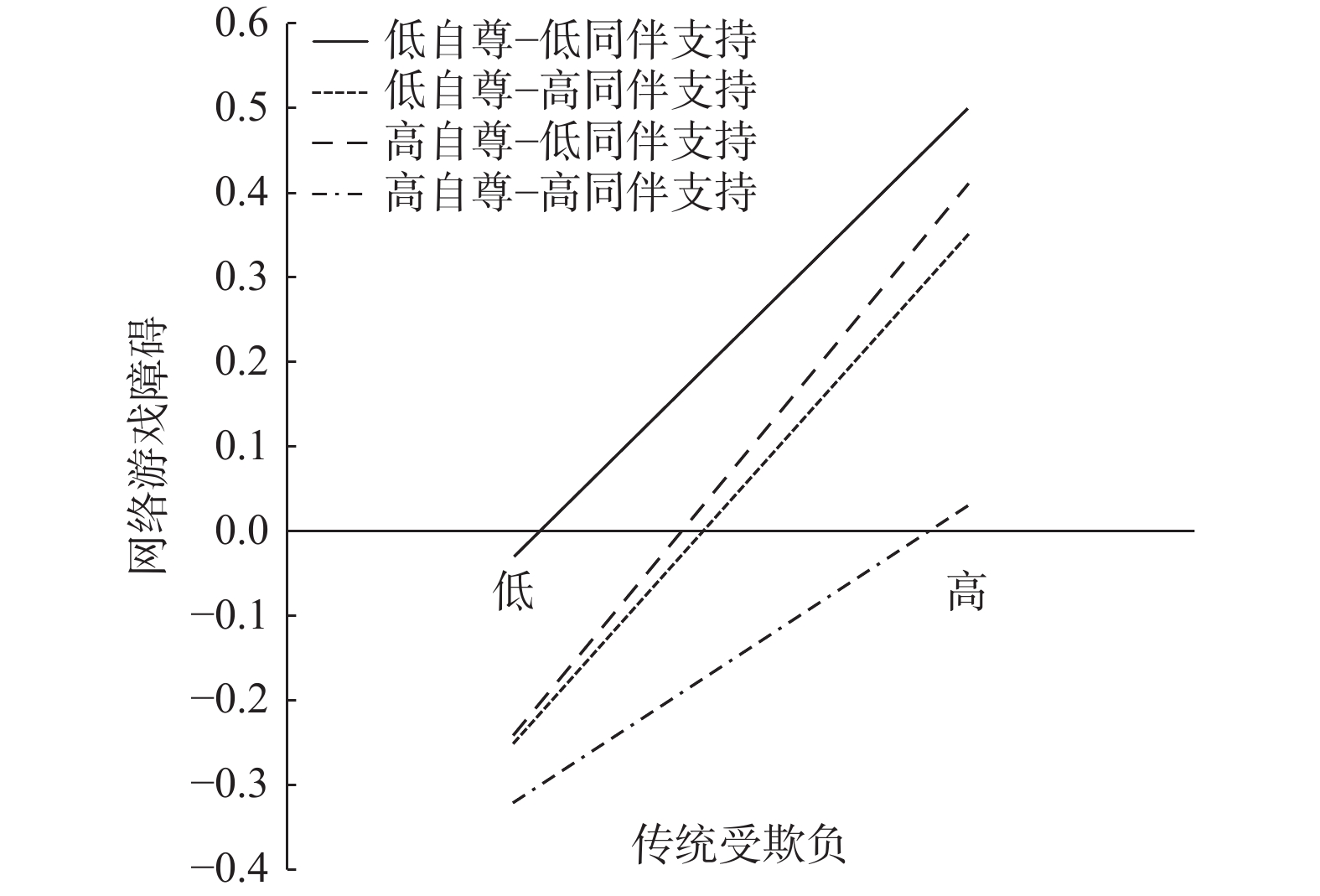
| β | SE | t | 95%CI | |
| 传统受欺负 | ||||
| 低自尊−低家庭支持 | 0.34 | 0.02 | 16.87*** | [0.30, 0.38] |
| 低自尊−高家庭支持 | 0.39 | 0.03 | 13.46*** | [0.33, 0.45] |
| 高自尊−低家庭支持 | 0.47 | 0.05 | 9.53*** | [0.37, 0.56] |
| 高自尊−高家庭支持 | 0.21 | 0.04 | 4.91*** | [0.13, 0.30] |
| 低自尊−低同伴支持 | 0.33 | 0.02 | 16.07*** | [0.29, 0.37] |
| 低自尊−高同伴支持 | 0.38 | 0.03 | 13.07*** | [0.32, 0.43] |
| 高自尊−低同伴支持 | 0.40 | 0.05 | 8.84*** | [0.31, 0.49] |
| 高自尊−高同伴支持 | 0.22 | 0.05 | 4.83*** | [0.13, 0.31] |
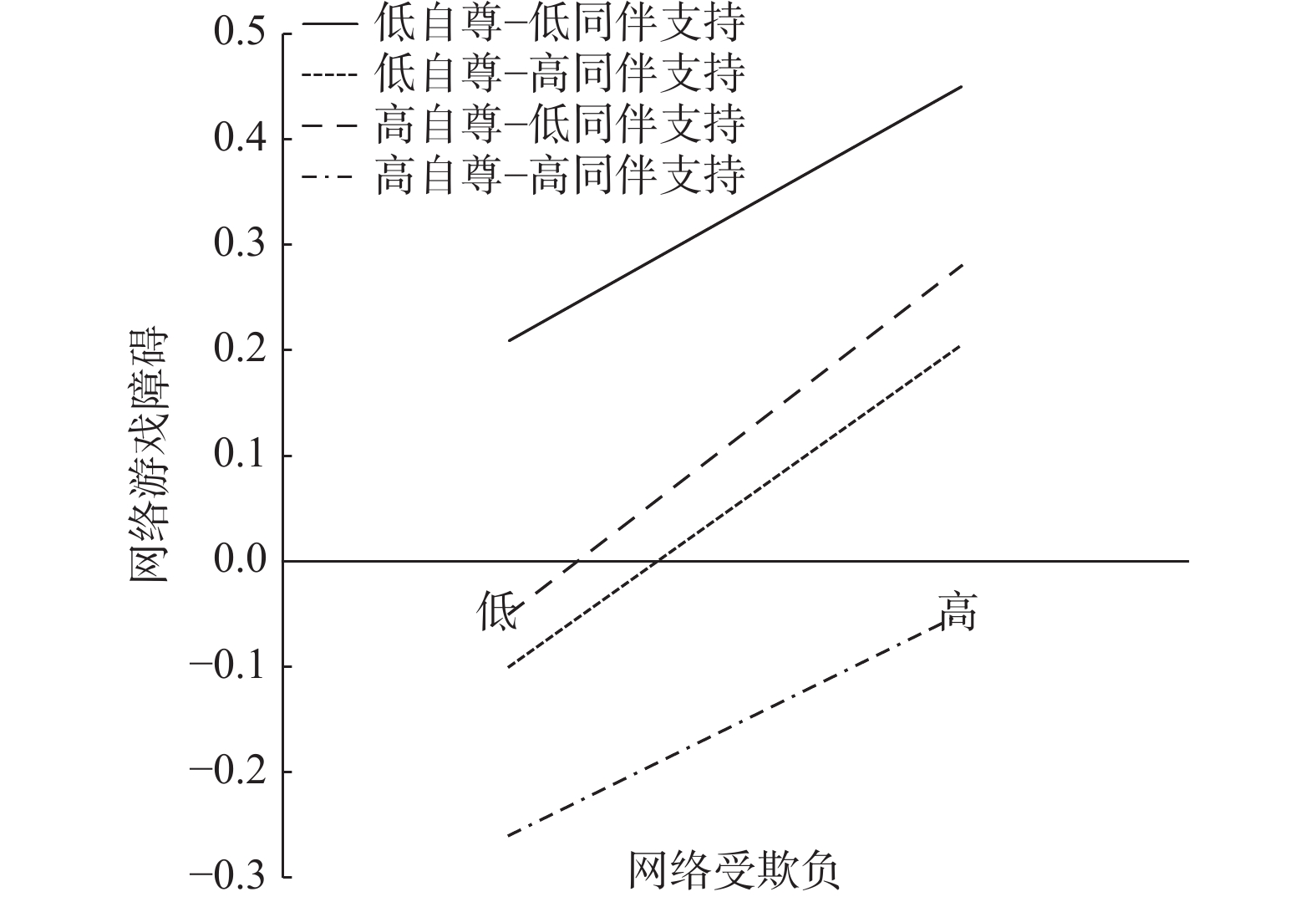
| 网络受欺负 | ||||
| 低自尊−低同伴支持 | 0.20 | 0.02 | 10.76*** | [0.16, 0.24] |
| 低自尊−高同伴支持 | 0.25 | 0.03 | 9.46*** | [0.20, 0.30] |
| 高自尊−低同伴支持 | 0.27 | 0.05 | 5.26*** | [0.17, 0.37] |
| 高自尊−高同伴支持 | 0.17 | 0.09 | 1.92 | [−0.004, 0.35] |
| β | SE | t | 95%CI | |
| 传统受欺负 | ||||
| 低自尊−低家庭支持 | 0.34 | 0.02 | 16.87*** | [0.30, 0.38] |
| 低自尊−高家庭支持 | 0.39 | 0.03 | 13.46*** | [0.33, 0.45] |
| 高自尊−低家庭支持 | 0.47 | 0.05 | 9.53*** | [0.37, 0.56] |
| 高自尊−高家庭支持 | 0.21 | 0.04 | 4.91*** | [0.13, 0.30] |
| 低自尊−低同伴支持 | 0.33 | 0.02 | 16.07*** | [0.29, 0.37] |
| 低自尊−高同伴支持 | 0.38 | 0.03 | 13.07*** | [0.32, 0.43] |
| 高自尊−低同伴支持 | 0.40 | 0.05 | 8.84*** | [0.31, 0.49] |
| 高自尊−高同伴支持 | 0.22 | 0.05 | 4.83*** | [0.13, 0.31] |
| 网络受欺负 | ||||
| 低自尊−低同伴支持 | 0.20 | 0.02 | 10.76*** | [0.16, 0.24] |
| 低自尊−高同伴支持 | 0.25 | 0.03 | 9.46*** | [0.20, 0.30] |
| 高自尊−低同伴支持 | 0.27 | 0.05 | 5.26*** | [0.17, 0.37] |
| 高自尊−高同伴支持 | 0.17 | 0.09 | 1.92 | [−0.004, 0.35] |
|
董会芹. 同伴侵害与儿童问题行为: 自尊的调节作用. 中国临床心理学杂志, 2015, 23 (2): 281- 284.
DOI |
|
|
蒋舒阳, 刘儒德, 冯毛, 洪伟, 金芳凯. 自尊与中学生问题性手机使用: 社交焦虑和逃避动机的中介作用. 心理科学, 2024, 47 (4): 940- 946.
DOI |
|
|
刘晓, 黄希庭. 社会支持及其对心理健康的作用机制. 心理研究, 2010, 3 (1): 3- 8, 15.
|
|
|
田录梅. Rosenberg(1965)自尊量表中文版的美中不足. 心理学探新, 2006, 26 (2): 88- 91.
DOI |
|
|
王建平, 喻承甫, 李文倩. 同伴侵害与青少年网络游戏成瘾: 心理需求满足的中介作用和情绪智力的调节作用. 华中师范大学学报(人文社会科学版), 2020, 59 (4): 184- 192.
|
|
|
魏华, 周宗奎, 李雄, 罗青, 高洁. 大学生压力事件与网络游戏成瘾: 逃避动机的中介效应. 心理与行为研究, 2014, 12 (3): 357- 361.
|
|
|
魏华, 周宗奎, 张永欣, 丁倩. 压力与网络成瘾的关系:家庭支持和朋友支持的调节作用. 心理与行为研究, 2018, 16 (2): 266- 271.
|
|
|
谢家树, 魏宇民, Bear, G. 特拉华欺凌受害量表(学生卷)中文版再修订及初步应用. 中国临床心理学杂志, 2018, 26 (2): 259- 263.
DOI |
|
|
杨逸群, 陈亮, 陈光辉, 张文新. 同伴拒绝、友谊支持对青少年抑郁的影响: 有中介的调节模型. 中国临床心理学杂志, 2020, 28 (2): 348- 353.
DOI |
|
|
余益兵, 于家伟, 李艳如, 杜宜展. 农村留守儿童领悟家庭支持、朋友支持与抑郁的交叉滞后分析. 心理与行为研究, 2022, 20 (4): 472- 478.
DOI |
|
|
甄瑞, 周宵. 校园欺凌受害与创伤后应激症状的关系: 公正世界信念与社会支持的作用. 中国临床心理学杂志, 2023, 31 (1): 148- 152, 193.
DOI |
|
|
中国互联网络信息中心(CNNIC). (2023). 第5次全国未成年人互联网使用情况调查报告. 2025-07-26 取自 https://www.cnnic.cn/n4/2023/1225/c116-10908.html
|
|
|
Agnew, R. When criminal coping is likely: An extension of general strain theory. Deviant Behavior, 2013, 34 (8): 653- 670.
DOI |
|
|
Batson, C. D., & Powell, A. A. (2003). Altruism and prosocial behavior. In T. Millon & M. J. Lerner (Eds.), Handbook of psychology: Personality and social psychology (Vol. 5, pp. 463–484). New York: John Wiley & Sons, Inc.
|
|
|
Brailovskaia, J., Rohmann, E., Bierhoff, H. W., Schillack, H., & Margraf, J. The relationship between daily stress, social support and Facebook Addiction Disorder. Psychiatry Research, 2019, 276, 167- 174.
DOI |
|
|
Cobb, S. Social support as a moderator of life stress. Psychosomatic Medicine, 1976, 38 (5): 300- 314.
DOI |
|
|
Cohen, S., & Wills, T. A. Stress, social support, and the buffering hypothesis. Psychological Bulletin, 1985, 98 (2): 310- 357.
DOI |
|
|
Cui, M., Li, Q. C., Cui, K. J., Xin, Y. Y., Lama, W. C., & Xia, Y. W. Low self-control, perceived social support and internet gaming addiction: Findings from an ethnicity minority region in China. Frontiers in Psychiatry, 2024, 15, 1458626.
DOI |
|
|
Desjardins, T. L., & Leadbeater, B. J. Relational victimization and depressive symptoms in adolescence: Moderating effects of mother, father, and peer emotional support. Journal of Youth and Adolescence, 2011, 40 (5): 531- 544.
DOI |
|
|
Dong, W. H., Li, S., & Wang, X. C. Parental phubbing and Chinese adolescents’ SNSs addiction: Loneliness as a mediator and self-esteem as a moderator. Current Psychology, 2023, 42 (19): 16560- 16572.
DOI |
|
|
Düll, L., Müller, A., & Steins-Loeber, S. Negative consequences experienced by individuals with gaming disorder symptoms: A systematic review of available longitudinal studies. Current Addiction Reports, 2024, 11 (3): 528- 550.
DOI |
|
|
Fino, E., Kapllanaj, M., Crocetti, E., & Rubini, M. Who matters the most? The differential role of parents, teachers, and peers’ supportive relationships in early adolescents’ subjective well-being. Journal of Happiness Studies, 2025, 26 (2): 19.
DOI |
|
|
Gao, L. F., Yang, C., Yang, X. J., Chu, X. W., Liu, Q. Q., & Zhou, Z. K. Negative emotion and problematic mobile phone use: The mediating role of rumination and the moderating role of social support. Asian Journal of Social Psychology, 2022, 25 (1): 138- 151.
DOI |
|
|
Gini, G., Card, N. A., & Pozzoli, T. A meta-analysis of the differential relations of traditional and cyber-victimization with internalizing problems. Aggressive Behavior, 2018, 44 (2): 185- 198.
DOI |
|
|
Gou, S. Y., Zhang, W. Q., Tang, Y. L., Zhang, J. H., & He, Q. H. Prevalence of internet gaming disorder among Chinese adolescents: A systematic review and meta-analysis. Asian Journal of Psychiatry, 2024, 102, 104257.
DOI |
|
|
Granic, I., Lobel, A., & Engels, R. C. M. E. The benefits of playing video games. The American Psychologist, 2014, 69 (1): 66- 78.
|
|
|
Hayes, A. F. (2017). Introduction to mediation, moderation, and conditional process analysis: A regression-based approach (2nd ed.). New York: The Guilford Press.
|
|
|
Holfeld, B., & Baitz, R. The mediating and moderating effects of social support and school climate on the association between cyber victimization and internalizing symptoms. Journal of Youth and Adolescence, 2020, 49 (11): 2214- 2228.
DOI |
|
|
Jordan, C. H., Spencer, S. J., & Zanna, M. P. Types of high self-esteem and prejudice: How implicit self-esteem relates to ethnic discrimination among high explicit self-esteem individuals. Personality and Social Psychology Bulletin, 2005, 31 (5): 693- 702.
DOI |
|
|
Kavanagh, M., Brett, C., & Brignell, C. What is the reported relationship between self-esteem and gaming disorder? A systematic review and meta-analysis. Computers in Human Behavior, 2023, 145, 107776.
DOI |
|
|
Kernis, M. H. Target article: Toward a conceptualization of optimal self-esteem. Psychological Inquiry, 2003, 14 (1): 1- 26.
DOI |
|
|
Kort-Butler, L. A. Experienced and vicarious victimization: Do social support and self-esteem prevent delinquent responses. Journal of Criminal Justice, 2010, 38 (4): 496- 505.
DOI |
|
|
Lam, L. T., & Li, Y. X. The validation of the E-Victimisation Scale (E-VS) and the E-Bullying Scale (E-BS) for adolescents. Computers in Human Behavior, 2013, 29 (1): 3- 7.
DOI |
|
|
Lazarus, R., & Folkman, S. (1984). Stress, appraisal, and coping. New York: Springer.
|
|
|
Leary, M. R., & Baumeister, R. F. (2000). The nature and function of self-esteem: Sociometer theory. In M. P. Zanna (Ed.), Advances in experimental social psychology (Vol. 32, pp. 1–62). Amsterdam: Academic Press.
|
|
|
Leung, H., Pakpour, A. H., Strong, C., Lin, Y. C., Tsai, M. C., Griffiths, M. D., ... Chen, I. H. Measurement invariance across young adults from Hong Kong and Taiwan among three internet-related addiction scales: Bergen Social Media Addiction Scale (BSMAS), Smartphone Application-Based Addiction Scale (SABAS), and Internet Gaming Disorder Scale-Short Form (IGDS-SF9) (study Part A). Addictive Behaviors, 2020, 101, 105969.
DOI |
|
|
Liu, Y., Jin, C. Y., Zhou, X. W., Chen, Y. Y., Ma, Y. Y., Chen, Z. Y., ... Ren, Y. H. The chain mediating effect of anxiety and inhibitory control between bullying victimization and internet addiction in adolescents. Scientific Reports, 2024, 14 (1): 23350.
DOI |
|
|
Midamba, N., & Moreno, M. Differences in parent and adolescent views on cyberbullying in the US. Journal of Children and Media, 2019, 13 (1): 106- 115.
DOI |
|
|
Nie, Q., Griffiths, M. D., & Teng, Z. J. The role of self-esteem in protecting against cyber-victimization and gaming disorder symptoms among adolescents: A temporal dynamics analysis. Journal of Youth and Adolescence, 2024, 53 (4): 863- 876.
DOI |
|
|
Olweus, D. Bullying at school: Basic facts and effects of a school based intervention program. Journal of Child Psychology and Psychiatry, 1994, 35 (7): 1171- 1190.
DOI |
|
|
Peng, P., Chen, Z. M., Ren, S. L., He, Y., Li, J. G., Liao, A. J., ... Liao, Y. H. Internet gaming disorder predicts the incidence, persistence, and worsening of suicidal ideation: A population-based cohort study of 96,158 Chinese adolescents. Journal of Affective Disorders, 2025, 379, 186- 193.
DOI |
|
|
Rosenberg, M. (1965). Society and the adolescent self-image (Vol. 11, p. 326). Princeton, NJ: Princeton University Press.
|
|
|
Shaheen, A. M., Hamdan, K. M., Albqoor, M., Othman, A. K., Amre, H. M., & Hazeem, M. N. A. Perceived social support from family and friends and bullying victimization among adolescents. Children and Youth Services Review, 2019, 107, 104503.
DOI |
|
|
Su, P., Yu, C. F., Zhang, W., Liu, S., Xu, Y., & Zhen, S. J. Predicting Chinese adolescent internet gaming addiction from peer context and normative beliefs about aggression: A 2-year longitudinal study. Frontiers in Psychology, 2018, 9, 1143.
DOI |
|
|
Tokunaga, R. S. Following you home from school: A critical review and synthesis of research on cyberbullying victimization. Computers in Human Behavior, 2010, 26 (3): 277- 287.
DOI |
|
|
Wang, J., Wang, M. Z., Du, X. P., Viana, K. M. P., Hou, K., & Zou, H. Parent and friend emotion socialization in early adolescence: Their unique and interactive contributions to emotion regulation ability. Journal of Youth and Adolescence, 2024, 53 (1): 53- 66.
DOI |
|
|
Wang, X. C., Gao, L., Yang, J. P., Zhao, F. Q., & Wang, P. C. Parental phubbing and adolescents’ depressive symptoms: Self-esteem and perceived social support as moderators. Journal of Youth and Adolescence, 2020, 49 (2): 427- 437.
DOI |
|
|
World Health Organization. (2018). International classification of diseases for mortality and morbidity statistics (11th Revision). Retrieved July 26, 2025, from https://icd.who.int/dev11/l-m/en#/http://id.who.int/icd/entity/1448597234
|
|
|
Xie, Y., Zhang, M. M., Wang, C., Cai, J., Wang, Y., Mu, Y. F., ... Ran, M. S. The effect of bullying victimization on internet addiction: Mediated by cyberbullying perpetration and moderated by social support. BMC Public Health, 2025, 25 (1): 2856.
DOI |
|
|
Xu, X. P., Han, W. Q., & Liu, Q. Q. Peer pressure and adolescent mobile social media addiction: Moderation analysis of self-esteem and self-concept clarity. Frontiers in Public Health, 2023, 11, 1115661.
DOI |
|
|
Zhao, H. Y., Li, X. F., Zhou, J. X., Nie, Q. Q., & Zhou, J. H. The relationship between bullying victimization and online game addiction among Chinese early adolescents: The potential role of meaning in life and gender differences. Children and Youth Services Review, 2020, 116, 105261.
DOI |
|
|
Zimet, G. D., Dahlem, N. W., Zimet, S. G., & Farley, G. K. The multidimensional scale of perceived social support. Journal of Personality Assessment, 1988, 52 (1): 30- 41.
DOI |
| Viewed | ||||||
|
Full text |
|
|||||
|
Abstract |
|
|||||
