
Studies of Psychology and Behavior ›› 2026, Vol. 24 ›› Issue (4): 525-532.DOI: 10.12139/j.1672-0628.2026.04.012
• ? • Previous Articles Next Articles
Xingyu LUO1,2, Peipei MAO1,2, Gengfeng NIU1,2, Peipei ZHAI3, Xiaojun SUN*,1,2( )
)
Received:2025-02-28
Online:2026-07-21
Published:2026-07-20
Contact:
Xiaojun SUN
罗星雨1,2, 毛佩佩1,2, 牛更枫1,2, 翟培培3, 孙晓军*,1,2()
通讯作者:
孙晓军
基金资助:CLC Number:
Xingyu LUO, Peipei MAO, Gengfeng NIU, Peipei ZHAI, Xiaojun SUN. AI-Assisted Learning: The Relationship Between Chatbot Novelty - Individual Innovativeness Congruence and Learning Engagement[J]. Studies of Psychology and Behavior, 2026, 24(4): 525-532.
罗星雨, 毛佩佩, 牛更枫, 翟培培, 孙晓军. 人工智能辅助学习:聊天机器人新颖性和个体创新性的匹配与学习投入的关系[J]. 心理与行为研究, 2026, 24(4): 525-532.
Add to citation manager EndNote|Ris|BibTeX
URL: https://psybeh.tjnu.edu.cn/EN/10.12139/j.1672-0628.2026.04.012
| 模型 | 参数约束 | 模型解释 |
| 简单一致性 上升岭模型 | b1=b2; b3=b5; b3+b4+b5=0; b6=0; b7=0; b8=0; b9=0 | 对于具有相同平均预测变量水平(x+y)/2的个体,x和y值更接近的个体z值更高(或更低)[一致性效应]; 对于具有相同差异值(x−y)的个体,平均预测变量水平(x+y)/2较高的个体z值更高(或更低)[线性上升岭效应]。 |
| 水平依赖一致性上升岭模型 | b1=b2; b3=b5; b3<0; b4=−2b3; b7=−b6; b8=−b6; b9=b6 | 对于具有相同平均预测变量水平(x+y)/2的个体,x和y值更接近的个体z值更高(或更低)[一致性效应]; 对于具有相同差异值x−y的个体,平均预测变量水平(x+y)/2较高的个体z值更高(或更低)[线性上升岭效应]; 对于四名个体A、B、C和D,其中A和B以及C和D分别具有相同的平均预测变量水平(x+y)/2,A和B的平均预测变量水平低于C和D,且A和C以及B和D分别具有相同的差异值x−y,A和B的z值绝对差异大于(或小于)C和D的z值绝对差异[水平依赖效应]。 |
| 非对称一致性 上升岭模型 | b1=b2; b3=b5; b3<0; b4=−2b3; b7=−3b6; b8=3b6; b9=−b6 | 对于两组个体,若每组内部的x和y值要么都大于或小于对方,且具有相同的平均预测变量水平(x+y)/2,则x和y值更接近的个体z值更高(或更低)[一致性效应]; 对于具有相同差异值x−y的个体,平均预测变量水平(x+y)/2较高的个体z值更高(或更低)[线性上升岭效应]; 对于平均预测变量水平[(x+y)/2]相同且差异值(x−y)大小相等但符号相反的个体,x小于y的个体z值更高(或更低)[非对称效应]。 |
| 模型 | 参数约束 | 模型解释 |
| 简单一致性 上升岭模型 | b1=b2; b3=b5; b3+b4+b5=0; b6=0; b7=0; b8=0; b9=0 | 对于具有相同平均预测变量水平(x+y)/2的个体,x和y值更接近的个体z值更高(或更低)[一致性效应]; 对于具有相同差异值(x−y)的个体,平均预测变量水平(x+y)/2较高的个体z值更高(或更低)[线性上升岭效应]。 |
| 水平依赖一致性上升岭模型 | b1=b2; b3=b5; b3<0; b4=−2b3; b7=−b6; b8=−b6; b9=b6 | 对于具有相同平均预测变量水平(x+y)/2的个体,x和y值更接近的个体z值更高(或更低)[一致性效应]; 对于具有相同差异值x−y的个体,平均预测变量水平(x+y)/2较高的个体z值更高(或更低)[线性上升岭效应]; 对于四名个体A、B、C和D,其中A和B以及C和D分别具有相同的平均预测变量水平(x+y)/2,A和B的平均预测变量水平低于C和D,且A和C以及B和D分别具有相同的差异值x−y,A和B的z值绝对差异大于(或小于)C和D的z值绝对差异[水平依赖效应]。 |
| 非对称一致性 上升岭模型 | b1=b2; b3=b5; b3<0; b4=−2b3; b7=−3b6; b8=3b6; b9=−b6 | 对于两组个体,若每组内部的x和y值要么都大于或小于对方,且具有相同的平均预测变量水平(x+y)/2,则x和y值更接近的个体z值更高(或更低)[一致性效应]; 对于具有相同差异值x−y的个体,平均预测变量水平(x+y)/2较高的个体z值更高(或更低)[线性上升岭效应]; 对于平均预测变量水平[(x+y)/2]相同且差异值(x−y)大小相等但符号相反的个体,x小于y的个体z值更高(或更低)[非对称效应]。 |
| 变量 | M | SD | 1 | 2 | 3 | 4 |
| 1.性别 | ||||||
| 2.年龄 | 22.21 | 2.76 | ||||
| 3.聊天机器人新颖性 | 5.68 | 0.84 | 0.02 | −0.02 | ||
| 4.个体创新性 | 5.41 | 0.96 | 0.23** | 0.03 | 0.46*** | |
| 5.学习投入 | 5.37 | 0.96 | 0.11* | 0.004 | 0.65*** | 0.55*** |
| 变量 | M | SD | 1 | 2 | 3 | 4 |
| 1.性别 | ||||||
| 2.年龄 | 22.21 | 2.76 | ||||
| 3.聊天机器人新颖性 | 5.68 | 0.84 | 0.02 | −0.02 | ||
| 4.个体创新性 | 5.41 | 0.96 | 0.23** | 0.03 | 0.46*** | |
| 5.学习投入 | 5.37 | 0.96 | 0.11* | 0.004 | 0.65*** | 0.55*** |
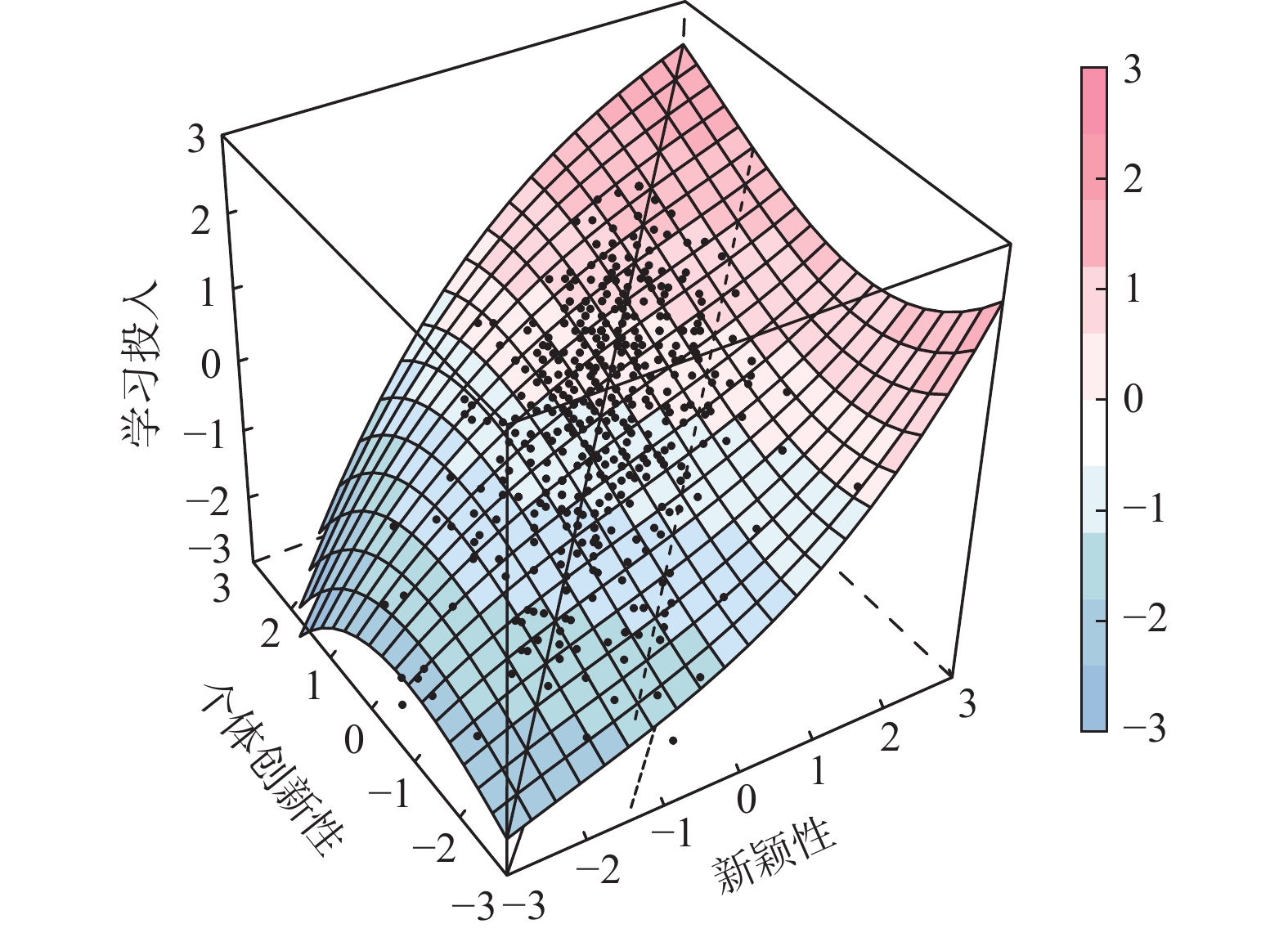
| 模型 | k | AIC | ΔAIC | Log-Likelihood | CFI | SRMR | RMSEA | R2 |
| RRCA | 3 | 1062.35 | 0.00 | −526.11 | 0.99 | 0.006 | 0.027 | 0.513 |
| FULL | 9 | 1066.60 | 4.26 | −522.04 | 1.00 | 0.000 | 0.000 | 0.521 |
| RRCL | 3 | 1067.63 | 5.29 | −528.76 | 0.98 | 0.008 | 0.049 | 0.508 |
| RRSC | 2 | 1073.10 | 10.76 | −532.51 | 0.96 | 0.015 | 0.062 | 0.501 |
| NULL | 0 | 1423.93 | 361.58 | −709.95 | 0.00 | 0.161 | 0.282 | 0.000 |
| 模型 | k | AIC | ΔAIC | Log-Likelihood | CFI | SRMR | RMSEA | R2 |
| RRCA | 3 | 1062.35 | 0.00 | −526.11 | 0.99 | 0.006 | 0.027 | 0.513 |
| FULL | 9 | 1066.60 | 4.26 | −522.04 | 1.00 | 0.000 | 0.000 | 0.521 |
| RRCL | 3 | 1067.63 | 5.29 | −528.76 | 0.98 | 0.008 | 0.049 | 0.508 |
| RRSC | 2 | 1073.10 | 10.76 | −532.51 | 0.96 | 0.015 | 0.062 | 0.501 |
| NULL | 0 | 1423.93 | 361.58 | −709.95 | 0.00 | 0.161 | 0.282 | 0.000 |
| β | SE | z | p | 95%CI | |
| b1 | 0.41 | 0.02 | 21.24 | <0.001 | [0.37, 0.44] |
| b2 | 0.41 | 0.02 | 21.24 | <0.001 | [0.37, 0.44] |
| b3 | −0.04 | 0.02 | −2.31 | 0.021 | [−0.07, −0.01] |
| b4 | 0.08 | 0.03 | 2.31 | 0.021 | [0.01, 0.14] |
| b5 | −0.04 | 0.02 | −2.31 | 0.021 | [−0.07, −0.01] |
| b6 | 0.02 | 0.01 | 3.59 | <0.001 | [0.01, 0.03] |
| b7 | −0.05 | 0.01 | −3.59 | <0.001 | [−0.08, −0.02] |
| b8 | 0.05 | 0.01 | 3.59 | <0.001 | [0.02, 0.08] |
| b9 | −0.02 | 0.01 | −3.59 | <0.001 | [−0.03, −0.01] |
| u1 | 0.81 | 0.04 | 21.24 | <0.001 | [0.74, 0.89] |
| β | SE | z | p | 95%CI | |
| b1 | 0.41 | 0.02 | 21.24 | <0.001 | [0.37, 0.44] |
| b2 | 0.41 | 0.02 | 21.24 | <0.001 | [0.37, 0.44] |
| b3 | −0.04 | 0.02 | −2.31 | 0.021 | [−0.07, −0.01] |
| b4 | 0.08 | 0.03 | 2.31 | 0.021 | [0.01, 0.14] |
| b5 | −0.04 | 0.02 | −2.31 | 0.021 | [−0.07, −0.01] |
| b6 | 0.02 | 0.01 | 3.59 | <0.001 | [0.01, 0.03] |
| b7 | −0.05 | 0.01 | −3.59 | <0.001 | [−0.08, −0.02] |
| b8 | 0.05 | 0.01 | 3.59 | <0.001 | [0.02, 0.08] |
| b9 | −0.02 | 0.01 | −3.59 | <0.001 | [−0.03, −0.01] |
| u1 | 0.81 | 0.04 | 21.24 | <0.001 | [0.74, 0.89] |
|
陈凯泉, 胡晓松, 韩小利, 牛翠琰, 韩羽, 王宪廷, 吕伟刚. 对话式通用人工智能教育应用的机理、场景、挑战与对策. 远程教育杂志, 2023, 41 (3): 21- 41.
|
|
|
高斌, 谭莉华, 张丹丹, 黎明新, 蔡艳香. 网络社会支持与高中生网络学习投入: 有调节的中介模型. 心理与行为研究, 2023, 21 (3): 403- 409.
|
|
|
马玉慧, 杨海珍, 刘凯. 什么样的聊天机器人更能促进学习?——基于60项实验与准实验研究的元分析. 开放教育研究, 2024, 30 (6): 79- 87.
|
|
|
钱莉, 金科, 章苏静. 教育游戏中学习者注意力资源开发策略. 远程教育杂志, 2010, 28 (6): 93- 97.
|
|
|
宋红波, 王悦. 大学英语学习者社会支持感、外语情绪与学习投入的关系探究. 外国语文, 2024, 40 (3): 164- 176.
|
|
|
Agarwal, R., & Prasad, J. A conceptual and operational definition of personal innovativeness in the domain of information technology. Information Systems Research, 1998, 9 (2): 204- 215.
DOI |
|
|
Akaike, H. (1998). Information theory and an extension of the maximum likelihood principle. In E. Parzen, K. Tanabe, & G. Kitagawa (Eds.), Selected papers of Hirotugu Akaike (pp. 199–213). New York: Springer.
|
|
|
Benlahcene, A., Kaur, A., & Awang-Hashim, R. Basic psychological needs satisfaction and student engagement: The importance of novelty satisfaction. Journal of Applied Research in Higher Education, 2021, 13 (5): 1290- 1304.
DOI |
|
|
Blöchl, M., Nestler, S., & Weiss, D. A limit of the subjective age bias: Feeling younger to a certain degree, but no more, is beneficial for life satisfaction. Psychology and Aging, 2021, 36 (3): 360- 372.
|
|
|
Bui, M. T., Nguyen, T. P., & Phan, B. T. (2024). How students interact with AI-teaching assistant: Roles of novelty and innovativeness. In 11th international conference on emerging challenges: Smart business and digital economy 2023 (ICECH 2023) (pp. 425–433). Dordrecht, Netherlands: Atlantis Press.
|
|
|
Chaudhry, I. S., Sarwary, S. A. M., El Refae, G. A., & Chabchoub, H. Time to revisit existing student’s performance evaluation approach in higher education sector in a new era of ChatGPT—A case study. Cogent Education, 2023, 10 (1): 2210461.
DOI |
|
|
Cheng, Y. M. Exploring the intention to use mobile learning: The moderating role of personal innovativeness. Journal of Systems and Information Technology, 2014, 16 (1): 40- 61.
DOI |
|
|
Christenson, S. L., Reschly, A. L., & Wylie, C. (Eds.). (2012). Handbook of research on student engagement. New York: Springer.
|
|
|
Edwards, J., Caplan, R., & Harrison, V. (1998). Person-environment fit theory: Conceptual foundations, empirical evidence, and directions for future research. In C. L. Cooper (Ed.), Theories of organizational stress (pp. 28–67). New York: Oxford University Press.
|
|
|
Edwards, J. R. (2002). Alternatives to difference scores: Polynomial regression analysis and response surface methodology. In F. Drasgow & N. Schmitt (Eds.), Measuring and analyzing behavior in organizations: Advances in measurement and data analysis (pp. 350–400). San Francisco: Jossey-Bass.
|
|
|
Evans, P., Vansteenkiste, M., Parker, P., Kingsford-Smith, A., & Zhou, S. J. Cognitive load theory and its relationships with motivation: A self-determination theory perspective. Educational Psychology Review, 2024, 36 (1): 7.
DOI |
|
|
Fleenor, J. W., McCauley, C. D., & Brutus, S. Self-other rating agreement and leader effectiveness. The Leadership Quarterly, 1996, 7 (4): 487- 506.
DOI |
|
|
González-Cutre, D., & Sicilia, Á. The importance of novelty satisfaction for multiple positive outcomes in physical education. European Physical Education Review, 2019, 25 (3): 859- 875.
DOI |
|
|
Gunness, A., Matanda, M. J., & Rajaguru, R. Effect of student responsiveness to instructional innovation on student engagement in semi-synchronous online learning environments: The mediating role of personal technological innovativeness and perceived usefulness. Computers & Education, 2023, 205, 104884.
DOI |
|
|
Hanaysha, J. R., Shriedeh, F. B., & In'airat, M. Impact of classroom environment, teacher competency, information and communication technology resources, and university facilities on student engagement and academic performance. International Journal of Information Management Data Insights, 2023, 3 (2): 100188.
DOI |
|
|
Humberg, S., Dufner, M., Schönbrodt, F. D., Geukes, K., Hutteman, R., Küfner, A. C., ... Back, M. D. Is accurate, positive, or inflated self-perception most advantageous for psychological adjustment? A competitive test of key hypotheses. Journal of Personality and Social Psychology, 2019, 116 (5): 835- 859.
DOI |
|
|
Humberg, S., Schönbrodt, F. D., Back, M. D., & Nestler, S. Cubic response surface analysis: Investigating asymmetric and level-dependent congruence effects with third-order polynomial models. Psychological Methods, 2022, 27 (4): 622- 649.
DOI |
|
|
Karjaluoto, H., Shaikh, A. A., Saarijärvi, H., & Saraniemi, S. How perceived value drives the use of mobile financial services apps. International Journal of Information Management, 2019, 47, 252- 261.
DOI |
|
|
Khurma, O. A., Albahti, F., Ali, N., & Bustanji, A. AI ChatGPT and student engagement: Unraveling dimensions through PRISMA analysis for enhanced learning experiences. Contemporary Educational Technology, 2024, 16 (2): ep503.
DOI |
|
|
Liu, Y., Li, H. X., & Carlsson, C. Factors driving the adoption of m-learning: An empirical study. Computers & Education, 2010, 55 (3): 1211- 1219.
DOI |
|
|
Ma, X. Y., & Huo, Y. D. Are users willing to embrace ChatGPT? Exploring the factors on the acceptance of chatbots from the perspective of AIDUA framework. Technology in Society, 2023, 75, 102362.
DOI |
|
|
Manwaring, K. C., Larsen, R., Graham, C. R., Henrie, C. R., & Halverson, L. R. Investigating student engagement in blended learning settings using experience sampling and structural equation modeling. The Internet and Higher Education, 2017, 35, 21- 33.
DOI |
|
|
Marstand, A. F., Martin, R., & Epitropaki, O. Complementary person-supervisor fit: An investigation of supplies-values (S-V) fit, leader-member exchange (LMX) and work outcomes. The Leadership Quarterly, 2017, 28 (3): 418- 437.
DOI |
|
|
Mui, M. L. S., Carpio, G. A. C., & Ong, C. M. Evaluation of engagement in learning within active learning classrooms: Does novelty make a difference. Journal of Learning Spaces, 2019, 8 (2): 1- 11.
|
|
|
Nguyen, A., Kremantzis, M., Essien, A., Petrounias, I., & Hosseini, S. Enhancing student engagement through artificial intelligence (AI): Understanding the basics, opportunities, and challenges. Journal of University Teaching and Learning Practice, 2024, 21 (6): 1- 13.
DOI |
|
|
Niemiec, C. P., & Ryan, R. M. Autonomy, competence, and relatedness in the classroom: Applying self-determination theory to educational practice. Theory and Research in Education, 2009, 7 (2): 133- 144.
DOI |
|
|
Nye, C. D., Su, R., Rounds, J., & Drasgow, F. Vocational interests and performance: A quantitative summary of over 60 years of research. Perspectives on Psychological Science, 2012, 7 (4): 384- 403.
DOI |
|
|
Pekrun, R., Goetz, T., Daniels, L. M., Stupnisky, R. H., & Perry, R. P. Boredom in achievement settings: Exploring control-value antecedents and performance outcomes of a neglected emotion. Journal of Educational Psychology, 2010, 102 (3): 531- 549.
DOI |
|
|
Reeve, J., Cheon, S. H., & Jang, H. R. (2019). A teacher-focused intervention to enhance students’ classroom engagement. In J. A. Fredricks, A. L. Reschly, & S. L. Christenson, (Eds.), Handbook of student engagement interventions (pp. 87–102). London: Academic Press.
|
|
|
Ryan, R. M., & Deci, E. L. (2017). Self-determination theory: Basic psychological needs in motivation, development, and wellness. London: Guilford Press.
|
|
|
Salmela-Aro, K., & Read, S. Study engagement and burnout profiles among Finnish higher education students. Burnout Research, 2017, 7, 21- 28.
DOI |
|
|
Silvia, P. J. (2006). Exploring the psychology of interest. New York: Oxford University Press.
|
|
|
Teuber, Z., Tang, X., Salmela-Aro, K., & Wild, E. Assessing engagement in Chinese upper secondary school students using the Chinese version of the schoolwork engagement inventory: Energy, dedication, and absorption (CEDA). Frontiers in Psychology, 2021, 12, 638189.
DOI |
|
|
van Vianen, A. E. M. Person-environment fit: A review of its basic tenets. Annual Review of Organizational Psychology and Organizational Behavior, 2018, 5 (1): 75- 101.
DOI |
|
|
Vygotsky, L. S. (1978). Mind in society: The development of higher psychological processes. Cambridge, MA: Harvard University Press.
|
|
|
Wang, W. T., & Lin, Y. L. The relationships among students’ personal innovativeness, compatibility, and learning performance: A social cognitive theory perspective. Educational Technology & Society, 2021, 24 (2): 14- 27.
|
|
|
Wells, J. D., Campbell, D. E., Valacich, J. S., & Featherman, M. The effect of perceived novelty on the adoption of information technology innovations: A risk/reward perspective. Decision Sciences, 2010, 41 (4): 813- 843.
DOI |
|
|
Wong, Z. Y., Liem, G. A. D., Chan, M., & Datu, J. A. D. Student engagement and its association with academic achievement and subjective well-being: A systematic review and meta-analysis. Journal of Educational Psychology, 2024, 116 (1): 48- 75.
DOI |
|
|
Wu, H. Y., Wu, H. S., Chen, I. S., & Su, Y. P. Toward better intelligent learning (iLearning) performance: What makes iLearning work for students in a university setting?. Behaviour & Information Technology, 2023, 42 (1): 60- 76.
DOI |
|
|
Yuan, L. J., & Liu, X. J. The effect of artificial intelligence tools on EFL learners’ engagement, enjoyment, and motivation. Computers in Human Behavior, 2025, 162, 108474.
DOI |
|
|
Zheng, L. Q., Niu, J. Y., Zhong, L., & Gyasi, J. F. The effectiveness of artificial intelligence on learning achievement and learning perception: A meta-analysis. Interactive Learning Environments, 2023, 31 (9): 5650- 5664.
DOI |
| Viewed | ||||||
|
Full text |
|
|||||
|
Abstract |
|
|||||
