?

The Longitudinal Predictive Effect of Bullying Victimization on Social Aggression: The Mediating Role of Callous-Unemotional Traits

  • Wenfeng ZHU , *, 1, 2, 3 ,
  • Songyu LIU 1, 2 ,
  • Xue TIAN 1, 2, 3
Expand
  • 1. Key Research Base of Humanities and Social Sciences of the Ministry of Education, Academy of Psychology and Behavior, Tianjin Normal University, Tianjin 300387
  • 2. Faculty of Psychology, Tianjin Normal University, Tianjin 300387
  • 3. Tianjin Social Science Laboratory of Students’ Mental Development and Learning, Tianjin 300387

Received date: 2022-09-07

  Online published: 2024-07-25

Copyright

Copyright reserved © 2024.

Abstract

Bullying victimization is a significant environmental factor influencing social aggression, yet the psychological mechanisms by which bullying victimization affects social aggression remain unclear. In this study, a longitudinal research design was employed. In two survey waves, questionnaires on bullying victimization, callous-unemotional traits, and social aggression were administered to 940 college students. Structural equation models were used to explore the relationships among bullying victimization, callous-unemotional traits, and social aggression. The results revealed that bullying victimization (T1) positively predicted callous-unemotional (T2) and social aggression (T2) six months later. Furthermore, callous-unemotional (T1) positively predicted social aggression (T2) six months later. It was also found that bullying victimization (T1) influenced social aggression (T2) through the mediation of callous-unemotional (T2).

Cite this article

Wenfeng ZHU , Songyu LIU , Xue TIAN . The Longitudinal Predictive Effect of Bullying Victimization on Social Aggression: The Mediating Role of Callous-Unemotional Traits[J]. Studies of Psychology and Behavior, 2024 , 22(2) : 274 -281 . DOI: 10.12139/j.1672-0628.2024.02.017

1 引言

社会攻击作为反社会行为的一种形式,也被称为关系攻击或间接攻击,是一种通过操纵或威胁社会关系从而伤害他人的行为,例如传播谣言、诽谤和排斥等(Burt & Donnellan, 2009; Kokkinos & Voulgaridou, 2017)。社会攻击会给个体带来一系列的心理问题,如增加受害者的抑郁、焦虑水平(Gros et al., 2010; Loudin et al., 2003),甚至会使受害者产生自杀的想法和意图(Hart & Ostrov, 2020)。同时,社会攻击的实施者也会产生问题人格、同伴拒绝、犯罪和物质成瘾等问题(Dahlen et al., 2013)。前人研究发现,诸如社会攻击、言语攻击等间接攻击行为在青少年中比直接攻击发生得更频繁(Coyne et al., 2006),且社会攻击在成年初期仍为主要的攻击方式,在大学生群体中,社会攻击比身体攻击更加普遍(Knight et al., 2018),并且社会攻击具有隐蔽性,对于初入大学、具有一定受教育程度但心理发展尚未成熟的大学生来说,社会攻击发生的可能性更大(Thomas, 2019)。因此,研究大学生社会攻击的影响因素,为社会攻击的预防和干预提供有效的建议非常重要。
受欺负已被证实是社会攻击的重要风险因素。一般压力理论提出,受欺负经历作为对个体不利的事件或情境会让人们产生压力,引起人们的负性情绪,从而使个体做出更多的攻击行为(Agnew, 2001; Ak et al., 2015)。相对于身体攻击,社会攻击更加隐蔽且难以被察觉,所以面临受激惹的事件或负性经历时,大学生更倾向以间接攻击的形式去应对(Loudin et al., 2003; Thomas, 2019)。另外,根据社会学习理论(Bandura, 1999)以及个体对惩罚策略的选择规则(Molho et al., 2020),受欺负者在遭受直接伤害、辱骂、被操纵或被威胁之后,可能会从受欺负的经历中学习伤害他人的攻击脚本,并在以后的情境中,调用排斥、孤立、诽谤等这些惩罚成本较小、更不容易招致报复的间接伤害脚本作为自己行为的指南(Rockenbach & Milinski, 2006; Wu et al., 2016),从而导致社会攻击行为。纵向研究也发现受欺负的经历可以正向预测几个月后的攻击行为(Ostrov, 2010; Rudolph et al., 2011),但社会攻击作为特定的攻击形式,还未有纵向研究直接探究受欺负与社会攻击的关系,受欺负影响社会攻击的心理机制仍是不清楚的。
受欺负是冷酷无情特质形成的重要环境因素。冷酷无情特质是一种表现为对他人冷漠、缺乏共情和懊悔感以及对自身行为表现漠不关心的人格特质(Frick, 2004),具有一定可塑性(Frick & White, 2008),环境因素会影响冷酷无情的发展轨迹(Blonigen et al., 2006; Fontaine et al., 2010; Hyde & Dotterer, 2022)。在遭受虐待、暴力的负性生活环境中生活的个体身上,发现了更多的情感缺陷(Kimonis et al., 2008),这些情感缺陷使其变得冷漠、缺乏同情与内疚,逐渐发展出冷酷无情特质(王小凤, 燕良轼, 2020; Carlson et al., 2015; Fang et al., 2022),这为冷酷无情特质会受到环境因素的影响提供了证据。之前的研究指出,长时间的暴力暴露会降低个体的共情水平及实施攻击后的内疚,使个体情感冷漠和麻木,如遭受人际欺负(如排斥)的个体会对他人的痛苦更加不敏感(DeWall & Baumeister, 2006)。同时,自适应校准模型提出青年个体的人格特质是对环境的稳定反应模式(Ellis et al., 2017; Oshri et al., 2020)。如果个体长期处于受欺负这一压力情境,则可能发展出冷酷无情特质这一极端的情绪反应模式,通过钝化自己的情绪反应来应对压力,从而使自己在情感上免受不良经历的影响(Dackis et al., 2015; Giudice et al., 2011)。目前已有多个研究发现受欺负经历与冷酷无情间的正相关关系(刘致宏 等, 2022; Fanti et al., 2009; Fanti & Kimonis, 2012; Kokkinos & Voulgaridou, 2018)。但鲜有探究受欺负是否可以正向预测冷酷无情特质的纵向研究。
冷酷无情特质已被证明是攻击行为的危险因素之一(Chang et al., 2021; Fang et al., 2022)。社会信息加工理论指出对攻击结果的评价是影响攻击产生的重要一环,由于冷酷无情个体缺乏共情与内疚,感情淡漠,对别人的痛苦麻木不仁,对自己行为的负面后果漠不关心,且不能准确识别他人痛苦(Frick et al., 2014),在对攻击结果的评价过程中,会使个体低估攻击的负性结果,增加攻击行为。同时,I3模型也对个体做出社会攻击行为的心理机制提供了框架(Finkel, 2014),认为“煽动、推动与抑制”这三个交互过程会影响攻击行为发生的可能性与强度。煽动指直接环境刺激对个体的影响,通常引起个体的攻击倾向;推动指稳定的情境或性格特质,影响着个体在受到煽动时进行攻击的可能性;抑制是情境或特质中可以使个体忽视煽动的稳定因素,可以降低个体进行攻击的可能性(Finkel & Hall, 2018)。而冷酷无情特质恰恰可以被视为一种“推动”因素,具有这种特质的个体可能在面对社会挑衅或压力时,更容易表现出攻击行为。有纵向研究表明,冷酷无情正向预测反社会青年接下来的犯罪行为、攻击行为、暴力犯罪的数量和暴力再犯的较短时间间隔(Brandt et al., 1997; Forth et al., 1990; Frick et al., 2003; Toupin et al., 1995),且高冷酷无情特质的个体易展现较高的主动和反应性攻击(Fanti et al., 2009)。同时在健康人群中也发现,高冷酷无情特质个体正向预测一年后的网络攻击行为(Fanti et al., 2012)。但是攻击包含了不同的类型,如身体与口头攻击;主动与反应性攻击;直接与间接攻击等(Björkqvist et al., 1992; Dodge & Coie, 1987)。冷酷无情特质对不同类型攻击的预测可能是不同的。目前冷酷无情是否可以纵向预测社会攻击还有待探究。同样作为具有隐蔽性的攻击行为,社会攻击与网络攻击或有一定的相似性,同时在大学生群体中,社会攻击更不容易被察觉,也是大学生倾向的攻击方式。因此,本研究推测冷酷无情特质也可以正向预测社会攻击,并采用纵向分析方法进一步探究冷酷无情特质与社会攻击的关系。
本研究旨在探讨冷酷无情特质在受欺负与社会攻击之间的潜在中介作用。一方面,前人研究表明冷酷无情特质在负性经历和网络攻击间起中介作用(Fang et al., 2022),这预示着冷酷无情也可能中介受欺负经历和社会攻击的关系;另一方面,一般攻击模型指出个体的遭遇可以通过个体因素影响攻击行为(Anderson & Bushman, 2002)。因此,本研究推测受欺负经历会通过增加个体冷酷无情水平,从而增加社会攻击频率。
综上,本研究采用两个时间点的数据建立纵向关系模型,以探究第一个时间点(T1)的受欺负能否正向预测六个月后(T2)的冷酷无情特质和社会攻击,T1的冷酷无情特质是否能正向预测T2的社会攻击,并通过构建中介模型进一步探究T2冷酷无情在T1受欺负和T2社会攻击间的中介作用。本研究提出以下假设。
假设1:受欺负经历(T1)正向预测冷酷无情特质(T2);假设2:冷酷无情特质(T1)正向预测社会攻击(T2);假设3:冷酷无情特质(T2)在受欺负(T1)与社会攻击(T2)的关系中起中介作用。

2 研究方法

2.1 被试

本研究从广西、云南、山东的三所高校中,分两个时间点收集了940名大学生的数据。第一个时间点(T1)为2021年5月,共1009名大学生参加调查(745名女生,平均年龄19.58±1.03岁,年龄范围16~24岁)。第二个时间点(T2)为2021年11月,T1中的940人参加调查(93.16%的保留率,700名女生,平均年龄20.58±0.86岁)。对流失与保留的被试在受欺负、冷酷无情和社会攻击上的得分进行差异检验,结果表明流失与保留被试在T1的受欺负(t=−1.26, p=0.212)、冷酷无情(t=−1.63, p=0.105)和社会攻击(t=−0.99, p=0.323)中均无显著差异。

2.2 研究工具

2.2.1 受欺负量表

采用欺负类型量表(Shaw et al., 2013)中的受欺负子量表测量个体的受欺负程度。共10个题项(如,“我被人用下流的方式取笑”),要求个体在5点计分表(0=从未发生过,1=1到2次,2=每几周1次,3=每周大约1次,4=每周几次或更多)上指出过去一学期的受欺负次数。平均得分越高,表示受欺负越多。在本研究中,该量表的内部一致性系数为0.95(T1)和0.97(T2),重测信度为0.51。

2.2.2 冷酷无情量表

采用冷酷无情量表(Frick, 2004)测量个体的冷酷无情特质,该量表已被应用到中国大学生样本中(方杰, 王兴超, 2020)。该量表包含冷酷、淡漠和无情三个维度,共24个题项(如,“我比较冷淡,很少怜悯其他人”),4点计分(0=完全不符合,1=不太符合,2=有些符合,3=完全符合)。平均得分越高,表示个体的冷酷无情水平越高。在本研究中,该量表的内部一致性系数为0.83(T1)和0.85(T2),重测信度为0.56。

2.2.3 社会攻击量表

采用反社会量表(Burt & Donnellan, 2009)中的社会攻击子量表测量个体社会攻击水平。该量表包含11个题项(如,“有意损坏某个人的声誉”),5点计分(1=从不,2=很少,3=有时,4=较常,5=总是),平均得分越高,表示社会攻击的频率越高。该量表在我国的大学生样本中有良好的信效度(Li & Xia, 2020),在本研究中,该量表内部一致性系数为0.93(T1)和0.96(T2),重测信度为0.45。

2.3 测试流程

问卷调查按班级开展,由各学校教师统一安排测试时间和地点。开始前获得了知情同意,并告知被试有权随时退出测试,且结果仅用于科学研究。测试时间约30分钟,测试结束,全部问卷由主试当场收回。

2.4 数据分析

用SPSS26.0进行描述统计、相关分析。用Mplus7.0建构潜变量测量模型并检验变量的纵向测量不变性,随后进行潜变量纵向关系模型和中介模型的建构,检验受欺负、冷酷无情、社会攻击行为的纵向关系。在潜变量模型建构中,用随机打包技术来改善模型拟合(Little et al., 2002)。通过偏差校正百分位Bootstrap法检验中介效应。采用5000次样本抽样,计算中介效应95%的置信区间,若该区间不包含0则中介效应显著。

3 结果

3.1 描述统计和相关分析

表1呈现了重要研究变量的平均数、标准差和两两相关系数。结果表明受欺负、冷酷无情和社会攻击之间呈正相关,相关系数范围为0.19~0.55。
表1 描述统计和相关分析结果
变量 M SD 1 2 3 4 5 6 7
1.年龄 20.58 0.86
2.性别 0.05
3.受欺负T1 0.29 0.55 0.01 0.15***
4.受欺负T2 1.29 0.59 0.02 0.15*** 0.51***
5.冷酷无情T1 0.96 0.32 0.05 0.24*** 0.23*** 0.19***
6.冷酷无情T2 1.00 0.34 0.03 0.26*** 0.25*** 0.33*** 0.55***
7.社会攻击T1 1.74 0.63 −0.02 0.13*** 0.34*** 0.26*** 0.26*** 0.22***
8.社会攻击T2 1.68 0.69 −0.04 0.08* 0.32*** 0.44*** 0.26*** 0.33*** 0.44***

  注:性别,0=女,1=男;*p<0.05,**p<0.01,***p<0.001,以下同。

3.2 测量模型和纵向测量不变性检验

纵向关系模型的测量模型拟合良好:χ2/df=3.732,RMSEA=0.054,CFI=0.965,TLI=0.958,SRMR=0.043。受欺负(T1)、冷酷无情(T1、T2)、社会攻击(T1、T2)的测量模型的拟合良好:χ2/df=4.861,RMSEA=0.064,CFI=0.954,TLI=0.943,SRMR=0.048。
采用模型比较的方法,对形态等值、单位等值、尺度等值和严格等值的模型依次进行比较,检验受欺负、冷酷无情和社会攻击的纵向不变性。根据Cheung和Rensvol(1999)推荐的指标,如果△CFI<0.01和△TLI<0.01,则认为两个模型具有测量不变性。结果显示受欺负达到了严格等值标准,冷酷无情和社会攻击均达到了尺度等值标准。

3.3 受欺负、冷酷无情和社会攻击的纵向关系

纵向关系模型检验了受欺负对冷酷无情和社会攻击,以及冷酷无情对社会攻击的纵向预测关系(见图1A)。结果表明该模型拟合良好:χ2/df=3.722,RMSEA=0.054,CFI=0.965,TLI=0.958,SRMR=0.048。受欺负正向预测六个月后的冷酷无情(β=0.12, p=0.001)和社会攻击(β=0.19, p<0.001)。冷酷无情正向预测六个月后的社会攻击(β=0.17, p<0.001)。
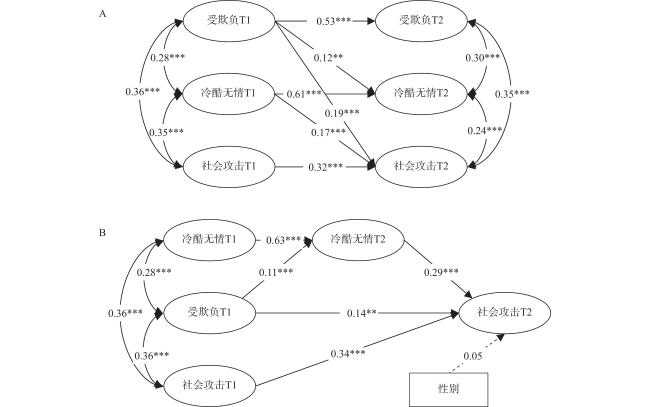
图1 结构方程模型与路径系数

注:图1A受欺负、冷酷无情和社会攻击的纵向关系模型,图1B冷酷无情在受欺负与社会攻击关系中的中介模型,所有路径系数均为标准化系数。

3.4 性别等组比较

之前研究表明性别是社会攻击的重要影响因素(Björkqvist, 2018),故采用多组结构方程对受欺负(T1、T2)、冷酷无情(T1、T2)与社会攻击(T1、T2)所构成的纵向关系模型进行分析,以检验该模型是否存在性别差异。结果表明,限定模型拟合良好,χ2/df=1.832,RMSEA=0.042,CFI=0.960,TLI=0.956,SRMR=0.056,且与自由模型的卡方检验结果无显著差异(△χ2=5.126, p>0.05)。说明该纵向关系模型总体上不存在性别差异。

3.5 冷酷无情的中介效应

中介模型被用来检验冷酷无情(T2)是否在受欺负(T1)和社会攻击(T2)的关系中起中介作用(见图1B)。由于前述分析中,年龄与各变量无显著相关,故在该模型中,仅将社会攻击(T1)、冷酷无情(T1)及性别作为控制变量。结果表明中介模型的拟合指标良好:χ2/df=5.059,RMSEA=0.066,CFI=0.946,TLI=0.934,SRMR=0.069。中介效应为0.03,95%的置信区间为[0.01, 0.05]。

4 讨论

本研究探究了受欺负、冷酷无情和社会攻击的纵向关系及冷酷无情特质在其中的中介作用。结果显示,受欺负与冷酷无情对社会攻击的纵向预测作用成立,受欺负水平越高,六个月后的冷酷无情与社会攻击频率显著升高,冷酷无情特质越高,六个月后的社会攻击频率也显著增加。中介分析发现,T1受欺负通过T2冷酷无情正向影响T2社会攻击,高受欺负水平会通过高冷酷无情特质水平而引起较高的社会攻击。这为受欺负与社会攻击的关系及其影响机制提供了纵向的证据。

4.1 受欺负对社会攻击的预测作用

本研究发现受欺负可以正向预测六个月后的社会攻击行为,受欺负经历越多,之后的社会攻击性越强。该结果与已有研究和理论一致。横向研究发现,大学生被试受欺负经历与攻击行为高度相关(叶宝娟 等, 2021)。纵向研究也发现,网络和现实受欺负经历均可预测社会和网络攻击行为(White et al., 2015; Wright & Li, 2012)。该结果可以用一般压力理论(Agnew, 2001)和社会学习理论(Bandura, 1999)进行解释,一方面,受欺负作为压力源,会导致紧张感和愤怒等负性情绪,个体可能通过社会攻击来获得补偿感和公平感,以此缓解长期的压力和负性情绪。另外,个体也可能模仿欺负者,在类似情况下用自己受欺负的方式(如传播流言蜚语、破坏名誉和孤立等)欺负他人。因此,受欺负者会倾向于产生社会攻击行为。这表明受害者在一系列心理机制的作用下也会转变为加害者并产生社会攻击行为。

4.2 受欺负对冷酷无情的预测作用

本研究发现,受欺负经历正向预测六个月后的冷酷无情特质,为压力适应模型(Giudice et al., 2011)提供了新证据。冷酷无情特质被认为是个体在压力情境中发展的。当个体在身体或心理上受到伤害时,通过对刺激的反应迟钝来避免进一步伤害(Giudice et al., 2011),从而发展出冷酷无情特质。另外,个体受欺负后可能经历愤怒、沮丧等负性情绪,为免受这些情绪困扰,他们可能通过情感麻木、冷漠等反应调节负性情绪(Northam & Dadds, 2020),减轻对外部刺激的情绪反应,以应对受欺负带来的情感压力。在压力适应模型的框架下,这种压力调节策略被解释为通过调整自己对他人行为的反应来适应外部压力,降低对受欺负经历的敏感性,从而减少受欺负经历可能造成的心理创伤。

4.3 冷酷无情与社会攻击的关系

本研究发现冷酷无情特质可以正向预测六个月后的社会攻击行为。与前人研究一致,即冷酷无情是反社会行为和攻击行为的危险因素(Frick et al., 2003; Kokkinos & Voulgaridou, 2018)。冷酷无情特质的典型特点是对他人负性情绪不敏感,且较少直接表露情绪(Horan et al., 2016)。这些特点一方面会使高冷酷无情个体对他人情绪状态不敏感,同时也会错误感知自己的情绪状态,易导致人际冲突,这为社会攻击提供了触发情境(Kokkinos & Kipritsi, 2018)。同时,这些个体对负面后果的麻木不仁,对行为后果的不敏感(Pardini et al., 2003)减轻了其参与社会攻击时的担忧。冷酷无情特质在远距离、隐蔽的社会攻击中表现尤为突出,从而增加了其社会攻击的可能性。

4.4 冷酷无情的中介作用

冷酷无情特质在受欺负与社会攻击间起中介作用,这与一般攻击模型的观点一致(Anderson & Bushman, 2002),该模型认为,攻击行为是个体特质(如冷酷无情)与情境因素(如受欺负)共同作用的产物,受欺负经历作为情境因素,可以激发或强化冷酷无情特质,进而影响攻击倾向。一方面,个体长期受欺负的经历实质上是持续性的暴力接触,暴露于持续暴力场景中的个体会产生以疏远、脱敏以及情感麻木为特征的应对方式(Kerig et al., 2012),即个体会通过发展出冷酷无情特质来应对外部的暴力情境。另一方面,高冷酷无情特质的个体对痛苦刺激的情绪反应降低(Hubbard et al., 2002),他们自身的道德情感难以抑制攻击性与反社会行为(Kimonis et al., 2008)。并且在处理社会信息时,他们会低估攻击行为的负性后果,更倾向于选择隐蔽性大、伤害性强的社会攻击。

4.5 贡献与展望

一般攻击模型认为个体的经历会通过个体特质影响攻击行为,但是该模型是否适用于社会攻击的解释还不清楚。而本研究采用纵向研究设计,揭示了受欺负这种负性经历对社会攻击的影响机制,发现了冷酷无情特质在两者关系中的中介作用,拓展了一般攻击模型并提供了证据支持。
本研究对校园中社会攻击的预防和干预具有指导意义。第一,教育者应引导学生认识欺负他人的严重后果,以降低欺负行为的发生概率。第二,应关注受欺负情况的发生,及时制止欺负事件,帮助受欺负者培养积极的情感调节策略,减少他们转变为施暴者的可能性。第三,应特别关注冷酷无情特质个体,通过社交技能培训,培养同理心和沟通技能,积累个体与他人相处的经验,减少冷酷无情的倾向。
本研究仍有不足之处。第一,本研究虽然采用纵向设计,但仅涉及两个时间点且间隔较短(六个月),且冷酷无情特质与社会攻击均在T2测量,未来研究应使用更多时间点和更长间隔的数据。第二,本研究样本为师范类院校学生且女生居多,未来研究应在更广泛的样本中进行。第三,该研究仅使用自我报告,未来研究可以结合他评或实验的方法进一步考虑其他潜在的中介变量。第四,该研究未区分欺负类型,未来研究应探讨直接和间接欺负对社会攻击的不同影响。

5 结论

(1)受欺负正向预测六个月后的冷酷无情特质和社会攻击。(2)冷酷无情特质正向预测六个月后的社会攻击。(3)冷酷无情特质在受欺负和社会攻击之间起中介作用。
方杰, 王兴超. 冷酷无情特质与大学生网络欺负行为的关系: 道德推脱的调节作用. 中国临床心理学杂志, 2020, 28 (2): 281- 284.

刘致宏, 张珊珊, 孙瑞悦, 于欣怡. 校园欺凌与外化问题行为的关系: 冷酷无情特质和亲子亲合的作用. 杭州师范大学学报(自然科学版), 2022, 21 (4): 381- 387.

王小凤, 燕良轼. 不良生活经历对大学生冷酷无情特质的影响: 有调节的中介效应. 心理与行为研究, 2020, 18 (6): 846- 853.

叶宝娟, 杨雪, 陈传升, 杨强. 大学生受欺负与攻击行为的关系: 相对剥夺感的中介作用和日常环境中的暴力暴露的调节作用. 心理科学, 2021, 44 (2): 309- 315.

Agnew, R. Building on the foundation of general strain theory: Specifying the types of strain most likely to lead to crime and delinquency. Journal of Research in Crime and Delinquency, 2001, 38 (4): 319- 361.

DOI

Ak, Ş., Özdemir, Y., & Kuzucu, Y. (2015). Cybervictimization and cyberbullying: The mediating role of anger, don’t anger me! Computers in Human Behavior, 49, 437–443.

Anderson, C. A., & Bushman, B. J. Human aggression. Annual Review of Psychology, 2002, 53 (1): 27- 51.

DOI

Bandura, A. Social cognitive theory: An agentic perspective. Asian Journal of Social Psychology, 1999, 2 (1): 21- 41.

DOI

Björkqvist, K. (2018). Gender differences in aggression. Current Opinion in Psychology, 19, 39–42.

Björkqvist, K. (2018). Gender differences in aggression. Current Opinion in Psychology, 19, 39–42.

Björkqvist, K., Lagerspetz, K. M. J., & Kaukiainen, A. Do girls manipulate and boys fight? Developmental trends in regard to direct and indirect aggression. Aggressive Behavior, 1992, 18 (2): 117- 127.

DOI

Blonigen, D. M., Hicks, B. M., Krueger, R. F., Patrick, C. J., & Iacono, W. G. Continuity and change in psychopathic traits as measured via normal-range personality: A longitudinal-biometric study. Journal of Abnormal Psychology, 2006, 115 (1): 85- 95.

DOI

Brandt, J. R., Kennedy, W. A., Patrick, C. J., & Curtin, J. J. Assessment of psychopathy in a population of incarcerated adolescent offenders. Psychological Assessment, 1997, 9 (4): 429- 435.

DOI

Burt, S. A., & Donnellan, M. B. Development and validation of the subtypes of Antisocial Behavior Questionnaire. Aggressive Behavior, 2009, 35 (5): 376- 398.

DOI

Carlson, M., Oshri, A., & Kwon, J. Child maltreatment and risk behaviors: The roles of callous/unemotional traits and conscientiousness. Child Abuse & Neglect, 2015, 50, 234- 243.

Chang, S. M., Hou, Q. Q., Wang, C. Y., Wang, M. F., Wang, L. X., & Zhang, W. X. Childhood maltreatment and violent delinquency in Chinese juvenile offenders: Callous-unemotional traits as a mediator. Child Abuse & Neglect, 2021, 117, 105085.

Cheung, G. W., & Rensvold, R. B. Testing factorial invariance across groups: A reconceptualization and proposed new method. Journal of Management, 1999, 25 (1): 1- 27.

DOI

Coyne, S. M., Archer, J., & Eslea, M. “We’re not friends anymore! unless…”: The frequency and harmfulness of indirect, relational, and social aggression. Aggressive Behavior, 2006, 32 (4): 294- 307.

DOI

Dackis, M. N., Rogosch, F. A., & Cicchetti, D. Child maltreatment, callous-unemotional traits, and defensive responding in high-risk children: An investigation of emotion-modulated startle response. Development and Psychopathology, 2015, 27 (2): 1527- 1545.

DOI

Dahlen, E. R., Czar, K. A., Prather, E., & Dyess, C. Relational aggression and victimization in college students. Journal of College Student Development, 2013, 54 (2): 140- 154.

DOI

DeWall, C. N., & Baumeister, R. F. Alone but feeling no pain: Effects of social exclusion on physical pain tolerance and pain threshold, affective forecasting, and interpersonal empathy. Journal of Personality and Social Psychology, 2006, 91 (1): 1- 15.

DOI

Dodge, K. A., & Coie, J. D. Social-information-processing factors in reactive and proactive aggression in children’s peer groups. Journal of Personality and Social Psychology, 1987, 53 (6): 1146- 1158.

DOI

Ellis, B. J., Oldehinkel, A. J., & Nederhof, E. The adaptive calibration model of stress responsivity: An empirical test in the tracking adolescents’ individual lives survey study. Development and Psychopathology, 2017, 29 (3): 1001- 1021.

DOI

Fang, J., Wang, W., Gao, L., Yang, J. P., Wang, X. C., Wang, P. C., & Wen, Z. L. Childhood maltreatment and adolescent cyberbullying perpetration: A moderated mediation model of callous-unemotional traits and perceived social support. Journal of Interpersonal Violence, 2022, 37 (7–8): NP5026- NP5049.

DOI

Fanti, K. A., Demetriou, A. G., & Hawa, V. V. A longitudinal study of cyberbullying: Examining riskand protective factors. European Journal of Developmental Psychology, 2012, 9 (2): 168- 181.

DOI

Fanti, K. A., Frick, P. J., & Georgiou, S. Linking callous-unemotional traits to instrumental and non-instrumental forms of aggression. Journal of Psychopathology and Behavioral Assessment, 2009, 31 (4): 285- 298.

DOI

Fanti, K. A., & Kimonis, E. R. Bullying and victimization: The role of conduct problems and psychopathic traits. Journal of Research on Adolescence, 2012, 22 (4): 617- 631.

DOI

Finkel, E. J. (2014). The I3 model: Metatheory, theory, and evidence. In J. M. Olson & M. P. Zanna (Eds.), Advances in experimental social psychology (Vol. 49, pp. 1–104). Amsterdam: Elsevier.

Finkel, E. J., & Hall, A. N. The I3 model: A metatheoretical framework for understanding aggression. Current Opinion in Psychology, 2018, 19, 125- 130.

DOI

Fontaine, N. M. G., Rijsdijk, F. V., McCrory, E. J. P., & Viding, E. Etiology of different developmental trajectories of callous-unemotional traits. Journal of the American Academy of Child & Adolescent Psychiatry, 2010, 49 (7): 656- 664.

Forth, A. E., Hart, S. D., & Hare, R. D. Assessment of psychopathy in male young offenders. Psychological Assessment: A Journal of Consulting and Clinical Psychology, 1990, 2 (3): 342- 344.

DOI

Frick, P. J. Developmental pathways to conduct disorder: Implications for serving youth who show severe aggressive and antisocial behavior. Psychology in the Schools, 2004, 41 (8): 823- 834.

DOI

Frick, P. J., Cornell, A. H., Barry, C. T., Bodin, S. D., & Dane, H. E. Callous-unemotional traits and conduct problems in the prediction of conduct problem severity, aggression, and self-report of delinquency. Journal of Abnormal Child Psychology, 2003, 31 (4): 457- 470.

DOI

Frick, P. J., Ray, J. V., Thornton, L. C., & Kahn, R. E. Can callous-unemotional traits enhance the understanding, diagnosis, and treatment of serious conduct problems in children and adolescents? A comprehensive review. Psychological Bulletin, 2014, 140 (1): 1- 57.

DOI

Frick, P. J., & White, S. F. Research review: The importance of callous-unemotional traits for developmental models of aggressive and antisocial behavior. Journal of Child Psychology and Psychiatry, 2008, 49 (4): 359- 375.

DOI

Giudice, M. D., Ellis, B. J., & Shirtcliff, E. A. The adaptive calibration model of stress responsivity. Neuroscience & Biobehavioral Reviews, 2011, 35 (7): 1562- 1592.

Gros, D. F., Stauffacher Gros, K., & Simms, L. J. Relations between anxiety symptoms and relational aggression and victimization in emerging adults. Cognitive Therapy and Research, 2010, 34 (2): 134- 143.

DOI

Hart, E. J., & Ostrov, J. M. Relations between forms and functions of aggression and moral judgments of aggressive transgressions. Aggressive Behavior, 2020, 46 (3): 220- 231.

DOI

Horan, J. M., Brown, J. L., Jones, S. M., & Aber, J. L. The influence of conduct problems and callous-unemotional traits on academic development among youth. Journal of Youth and Adolescence, 2016, 45 (6): 1245- 1260.

DOI

Hubbard, J. A., Smithmyer, C. M., Ramsden, S. R., Parker, E. H., Flanagan, K. D., Dearing, K. F., … Simons. R. F. Observational, physiological, and self-report measures of children’s anger: Relations to reactive versus proactive aggression. Child Development, 2002, 73 (4): 1101- 1118.

DOI

Hyde, L. W., & Dotterer, H. L. The nature and nurture of callous-unemotional traits. Current Directions in Psychological Science, 2022, 31 (6): 546- 555.

DOI

Kerig, P. K., Bennett, D. C., Thompson, M., & Becker, S. P. “Nothing really matters”: Emotional numbing as a link between trauma exposure and callousness in delinquent youth. Journal of Traumatic Stress, 2012, 25 (3): 272- 279.

DOI

Kimonis, E. R., Frick, P. J., Munoz, L. C., & Aucoin, K. J. Callous-unemotional traits and the emotional processing of distress cues in detained boys: Testing the moderating role of aggression, exposure to community violence, and histories of abuse. Development and Psychopathology, 2008, 20 (2): 569- 589.

DOI

Knight, N. M., Dahlen, E. R., Bullock-Yowell, E., & Madson, M. B. The HEXACO model of personality and dark triad in relational aggression. Personality and Individual Differences, 2018, 122, 109- 114.

DOI

Kokkinos, C. M., & Kipritsi, E. Bullying, moral disengagement and empathy: Exploring the links among early adolescents. Educational Psychology, 2018, 38 (4): 535- 552.

DOI

Kokkinos, C. M., & Voulgaridou, I. Links between relational aggression, parenting and personality among adolescents. European Journal of Developmental Psychology, 2017, 14 (3): 249- 264.

DOI

Kokkinos, C. M., & Voulgaridou, I. Relational victimization, callous-unemotional traits, and hostile attribution bias among preadolescents. Journal of School Violence, 2018, 17 (1): 111- 122.

DOI

Li, R., & Xia, L. X. The mediating mechanisms underlying the longitudinal effect of trait anger on social aggression: Testing a temporal path model. Journal of Research in Personality, 2020, 88, 104018.

DOI

Little, T. D., Cunningham, W. A., Shahar, G., & Widaman, K. F. To parcel or not to parcel: Exploring the question, weighing the merits. Structural Equation Modeling: A Multidisciplinary Journal, 2002, 9 (2): 151- 173.

DOI

Loudin, J. L., Loukas, A., & Robinson, S. Relational aggression in college students: Examining the roles of social anxiety and empathy. Aggressive Behavior, 2003, 29 (5): 430- 439.

DOI

Molho, C., Tybur, J. M., van Lange, P. A. M., & Balliet, D. Direct and indirect punishment of norm violations in daily life. Nature Communications, 2020, 11 (1): 3432.

DOI

Northam, J. C., & Dadds, M. R. Is callous always cold? A critical review of the literature on emotion and the development of callous-unemotional traits in children. Clinical Child and Family Psychology Review, 2020, 23 (2): 265- 283.

DOI

Oshri, A., Carlson, M. W., Duprey, E. B., Liu, S. H., Huffman, L. G., & Kogan, S. M. Child abuse and neglect, callous-unemotional traits, and substance use problems: The moderating role of stress response reactivity. Journal of Child & Adolescent Trauma, 2020, 13 (4): 389- 398.

Ostrov, J. M. Prospective associations between peer victimization and aggression. Child Development, 2010, 81 (6): 1670- 1677.

DOI

Pardini, D. A., Lochman, J. E., & Frick, P. J. Callous/unemotional traits and social-cognitive processes in adjudicated youths. Journal of the American Academy of Child & Adolescent Psychiatry, 2003, 42 (3): 364- 371.

Rockenbach, B., & Milinski, M. The efficient interaction of indirect reciprocity and costly punishment. Nature, 2006, 444 (7120): 718- 723.

DOI

Rudolph, K. D., Troop-Gordon, W., Hessel, E. T., & Schmidt, J. D. A latent growth curve analysis of early and increasing peer victimization as predictors of mental health across elementary school. Journal of Clinical Child & Adolescent Psychology, 2011, 40 (1): 111- 122.

Shaw, T., Dooley, J. J., Cross, D., Zubrick, S. R., & Waters, S. The Forms of Bullying Scale (FBS): Validity and reliability estimates for a measure of bullying victimization and perpetration in adolescence. Psychological Assessment, 2013, 25 (4): 1045- 1057.

DOI

Thomas, R. College student peer aggression: A review with applications for colleges and universities. Aggression and Violent Behavior, 2019, 48, 218- 229.

DOI

Toupin, J., Mercier, H., Déry, M., Côté, G., & Hodgins, S. Validity of the PCL-R for adolescents. Issues in Criminological & Legal Psychology, 1995, 24, 143- 145.

White, B. A., Gordon, H., & Guerra, R. C. Callous-unemotional traits and empathy in proactive and reactive relational aggression in young women. Personality and Individual Differences, 2015, 75, 185- 189.

DOI

Wright, M. F., & Li, Y. (2012). Kicking the digital dog: A longitudinal investigation of young adults’ victimization and cyber-displaced aggression. Cyberpsychology, Behavior, and Social Networking, 15(9), 448–454.

Wu, J. H., Balliet, D., & van Lange, P. A. M. Gossip versus punishment: The efficiency of reputation to promote and maintain cooperation. Scientific Reports, 2016, 6 (1): 23919.

DOI

Outlines

/

Copyright © Editorial office of Studies of Psychology and Behavior
Tel: 022-23540231, 23541213 E-mail: psybeh@126.com