?

The Impact of Episodic Future Thinking on Money Intertemporal Decision Making: Evidence from Three-Level Meta-Analysis

  • Zihan CHENG ,
  • Cuihua BI , * ,
  • Qi WU
Expand
  • College of Psychology, Sichuan Normal University, Chengdu 610068

Received date: 2023-09-14

  Online published: 2025-01-26

Copyright

Copyright reserved © 2024.

Abstract

This meta-analysis used a three-level meta-analysis technique to explore the influence of episodic future thinking (EFT) on intertemporal decision making in the money field and the moderating variables. A total of 89 effect sizes in 46 literatures were analyzed. The results showed that the EFT group preferred delayed rewards more than the control group (g = 0.50). In addition, the role of EFT on money intertemporal decision making was moderated by EFT valence, vividness, personally relevant and other variables. This study reveals the internal mechanism about EFT valence on intertemporal decision making, and confirms the role of EFT personal relevant on this relationship, which provides the basis to intervene intertemporal decision making.

Cite this article

Zihan CHENG , Cuihua BI , Qi WU . The Impact of Episodic Future Thinking on Money Intertemporal Decision Making: Evidence from Three-Level Meta-Analysis[J]. Studies of Psychology and Behavior, 2024 , 22(5) : 704 -712 . DOI: 10.12139/j.1672-0628.2024.05.017

1 引言

在日常生活中,人们会遇到各种各样的决策,比如,假日旅游是选择富观近景还是穷游远方,看电影是选择影院首映,还是等待网络资源等等,这些决策都需要考虑时间与金钱成本。跨期决策指个体对发生在不同时间点,主要对现在与未来的备择方案进行权衡,进而做出选择的过程(梁竹苑, 刘欢, 2011)。在决策过程中人们倾向于选择即时较小的奖励,未来奖励的主观价值随时间降低的现象称为延迟折扣(Frederick et al., 2002)。延迟折扣的增加会导致吸烟(MacKillop & Tidey, 2011)、酒精成瘾(Bobova et al., 2009)及赌博(Reynolds, 2006)等不良行为。如何降低延迟折扣率,增加前瞻思维和未来决策能力,成为心理学研究亟待解决的问题。已有研究总结了减少延迟折扣的方法,包括正念干预、应急管理、可视化训练、未来情景思维(episodic future thinking, EFT)及工作记忆训练和金钱管理指导等(Scholten et al., 2019),其中未来情景思维是降低延迟折扣的有效方法(Rung & Madden, 2018)。
未来情景思维是指个体将自我投射到未来以预先体验未来事件的心理过程(王盼盼, 何嘉梅, 2020)。虽然大量研究证明EFT影响跨期决策,但也有研究发现EFT不影响延迟折扣率(Hu et al., 2017)。甚至有研究发现,进行负性EFT任务的被试增加了延迟折扣率(Liu et al., 2013)。这可能与某些潜在的调节变量有关。已有元分析探讨了未来情景思维与跨期决策之间的关系,发现正性EFT显著增强个体对延迟选项的偏好,而中性及负性EFT对个体选择偏好影响不显著(Rösch et al., 2022; Ye et al., 2022)。但是研究中效价的亚组数量相差大,正性EFT研究数量远多于负性EFT研究,EFT效价的调节作用可能受到亚组数量不均等的影响。此外,一些重要的潜在调节因素(如EFT个人相关性、EFT唤醒程度、地域文化等)未进行检验,限制了对研究中矛盾点的全面考察。最后,延迟折扣率在不同领域(如金融、健康、环境等)的跨期决策具有差异(Krantz & Kunreuther, 2007),而已有元分析未区分不同领域内EFT的作用。因此,本元分析聚焦金钱领域跨期决策,采用三水平元分析方法探讨EFT对金钱跨期决策的影响及其调节因素。

1.1 未来情景思维影响金钱跨期决策的相关理论

依据情境预期−情绪假说,EFT内容的情绪效价存在差异,个体的选择偏好会受到情绪效价的影响,不同效价的EFT使个体对未来事件产生不同的情绪体验,积极情绪产生高确定−控制感,而消极情绪则反之(Busby Grant & Wilson, 2021; Smith & Ellsworth, 1985)。因此正性EFT增加延迟偏好,而负性EFT降低延迟偏好。也有研究发现,正性和中性效价的EFT都能增加被试对延迟奖励的偏好(Lin & Epstein, 2014),所以情绪效价并不是影响跨期决策的唯一因素。根据注意分配理论(attention allocation theory),分配给时距加工的注意资源减少,个体时距感知就会缩短(Buhusi & Meck, 2006)。EFT具有较高个人相关性时,自我相关事件不断捕获个体的注意资源,个体的主观时距缩短,进而增加延迟选择偏好(王盼盼, 何嘉梅, 2020)。而依据解释水平理论(construal level theory),心理上近的事件更具体,遥远的事件更抽象(Trope & Liberman, 2003)。EFT通过对未来事件的模拟将事件具体化、细节化来缩短个体与该事件的心理距离而达到降低延迟折扣率的效果(Ozdes, 2021)。
综上,EFT与跨期决策的关系有两种主要观点,一种认为EFT的影响与效价直接相关。另一种观点则认为EFT通过缩短与未来事件的心理距离来影响跨期决策。那么EFT影响跨期决策的内在机制是什么,本研究通过对调节变量的分析来深入探讨。

1.2 未来情景思维影响金钱跨期决策的调节变量

1.2.1 未来情景思维任务效价

EFT对跨期决策的作用机制存在争议,矛盾点主要在于EFT效价的影响。有研究发现正性效价EFT可以降低延迟折扣率,而中性效价对此并无影响(Liu et al., 2013),也有研究结果表明,正性与中性效价的EFT均可以降低延迟折扣率(Lin & Epstein, 2014);也有研究指出与中性效价的EFT相比,正性效价和负性效价的EFT都能降低延迟折扣率(Bulley et al., 2019)。Ye等(2022)和Rösch等(2022)通过元分析发现正性EFT显著增强个体对延迟选项的偏好,而中性及负性EFT对个体选择偏好影响不显著。但其中的正性EFT的研究文献远远多于负性和中性EFT,元分析结果可能受到亚组数量不均等的影响。故本研究不再将EFT效价进行分类,而把研究中报告的效价值作为连续变量进行分析。

1.2.2 未来情景思维任务个人相关性

想象未来与自我有着密切的联系,个人目标和动机对于形成未来事件具有重要作用(Stawarczyk & D’Argembeau, 2015)。研究发现,想象未来与个人目标相关的事件和与个人目标无关的事件诱发大脑不同的神经活动(D’Argembeau et al., 2010)。抑郁倾向者对未来与个人目标相关的积极事件的预期减弱,而对未来与个人目标无关的积极事件的预期则没有表现出异常(胡治国 等, 2019)。依据注意分配理论,与个人相关的事情更容易捕获个体的注意力而缩短对未来事件的时间感知,因而降低延迟折扣水平。因此,本研究假设EFT对跨期决策的影响可能受到个人相关性的调节。

1.2.3 未来情景思维任务生动性

研究表明,个人预期想象的内容更加生动时,对未来的决策产生更强烈的影响,生动想象的事件也被认为更有可能发生(Bromberg et al., 2015; Ciaramelli et al., 2019)。生动想象可能使未来更加确定,从而降低了延迟折扣水平(Bulley et al., 2016)。依据解释水平理论,当所想象的未来情景具有更多细节,抽象性更低时,人们会更加偏好该延迟选项(Lempert & Phelps, 2016; Wu et al., 2017)。故本研究假设EFT对跨期决策的影响可能受到EFT任务生动性的调节。

1.2.4 群体类型

个体在面临短期较小收益和长期较大收益的决策时,需要根据长期目标,抑制对即刻满足的冲动。当抑制控制能力降低时,容易出现心理或行为障碍,在跨期决策上表现为对即时奖励的偏好远远大于延迟奖励(Gullo & Potenza, 2014)。研究发现,与健康对照组相比,患有药物滥用障碍、病态赌博、肥胖以及其他有非健康行为习惯人群延迟折扣率更高(Story et al., 2014)。而EFT能有效减少健康个体(Scholten et al., 2019)、吸烟者(Chiou & Wu, 2017)、肥胖个体(Daniel et al., 2013a)和酗酒者(Snider et al., 2016)等人群的延迟折扣率。因此,本研究假设当EFT的主体为不同类型群体时,EFT对跨期决策的影响可能存在差异。

2 研究方法

系统评价和元分析首选报告项目(PRISMA-P)被用作元分析研究的分析指南(Moher et al., 2015)。为了提高研究透明度,本元分析的目的和假设已经在Open Science Framework(OSF)进行预注册(注册号: osf.io/5xnwb)。本元分析完整的编码表,包括所有获得的效果大小、调节变量以及R语言分析脚本,均可在OSF中获取。

2.1 文献检索

采用主题词加自由词的方式分别在中英文数据库中检索,检索内容范围为文章标题、摘要和关键词。中文检索中使用中国优秀硕博论文、中国知网(CNKI)、万方和维普四个数据库。未来情景思维的主题词为“未来情景思维”;自由词为“前瞻性思维”、“预期想象”和“心理时间旅行”,跨期决策的主题词为“跨期决策”;自由词为“跨期选择”、“延迟折扣”、“时间折扣”和“时间贴现”。英文检索使用PubMed、Web of Science、ProQuest、Embace和Cochrane Library数据库。未来情景思维的主题词为:“episodic future thinking”;自由词为:“future thinking”、“prospection”、“episodic future thought”、“imagining the future”、“episodic simulation”和“future envisioning”,跨期决策的主题词为:“intertemporal choice”;自由词为:“delay discounting”、“temporal discounting”、“time discount*”和“inter* decision making”。同时,采用文献回溯法,通过对已检索论文的参考文献进行筛选与补充,遗漏文献通过Google Scholar进行标题精确查找。文献检索的时间范围为2023年3月之前,共检索到文献2215篇。

2.2 文献纳入与排除标准

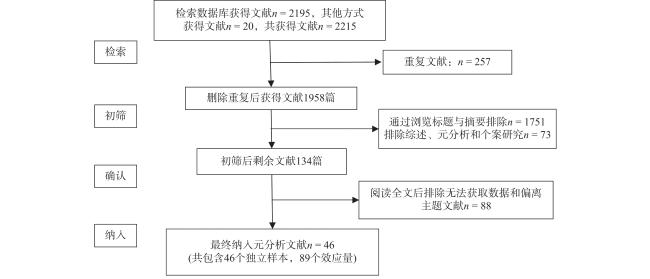
根据以下标准选择文献:(1)全文可获取,排除会议摘要;(2)要求是一项实证研究,不纳入文献综述、元分析、个案研究以及质性研究;(3)语言为英语和中文,排除其他语言的文献;(4)研究需要衡量EFT对跨期决策的影响,不纳入前后测研究的文献;(5)只纳入跨期决策任务为金钱选择的研究,排除有关健康、环境和饮食等领域跨期决策的研究;(6)明确报告测量工具;(7)提供足够数据来计算效应量,包括均值、样本量、t值、F值、卡方值等。由两位作者分别进行文献的筛选,若筛选过程中出现分歧则与其他作者讨论后决定。向未提供完整数据的文献作者联系后,收到一位作者的回复,并将数据纳入研究。最终46篇文献(5篇中文文献和41篇英文文献)纳入元分析研究,其中共8397个样本量,效应量89个(PRISMA流程图见图1)。
图1 PRISMA流程图

注:n代表文献数量。

2.3 文献编码及效应值的提取

对纳入文献进行编码:(1)基本信息(作者名、发表日期);(2)被试平均年龄;(3)被试性别比例;(4)被试群体类型(健康、肥胖、吸烟者、其他);(5)控制任务情景类型(想象特定事件、无关任务、无操作、其他);(6)EFT效价;(7)EFT个人相关性;(8)EFT生动性;(9)EFT唤醒程度;(10)EFT情景类型(未来相关事件、健康行为、其他)。
编码遵循如下原则:(1)将每篇文献中的独立样本作为一个效应量,如果一篇文献中存在多个独立样本,则提取相应多个效应量。(2)原始文献若未报告不同组的独立样本量时,则将总样本量除以组数当作各独立组的样本量。(3)原始文献若为追踪研究,则对追踪结果分别编码。为了避免编码错误,两位作者单独进行编码,若出现分歧则通过讨论后决定。一致性如下:(1)被试平均年龄ICC=1.00;(2)被试性别比例ICC=1.00;(3)被试群体类型Kappa=0.98;(4)控制任务情景类型Kappa=0.96;(5)EFT效价ICC=1.00;(6)EFT个人相关性ICC=1.00;(7)EFT生动性ICC=1.00;(8)EFT唤醒程度ICC=1.00;(9)EFT情景类型Kappa=0.84;(10)地域文化Kappa=1.00。

2.4 文献质量评估

参考张亚利等(2019)编制的文献质量评价量表,包括:(1)被试的选取,随机选取计2分,非随机选取计1分,未报告计0分;(2)数据无效率,数据无效率在0.1及以下计2分,介于0.1~0.2之间计1分,0.2以上及未报告的计0分;(3)期刊水平,按级别SCI、CSSCI(含扩展版)及SSCI期刊计2分,北大核心期刊计1分,普通期刊及未公开发表的论文计0分。最后评估每篇文献的质量总分,介于0~6分之间,分数越高表明文献质量越好。评分工作由两位作者单独进行,一致性为:Kappa=0.91。

2.5 元分析过程

2.5.1 效应量计算

本研究将Hedges’ g值作为效应量指标,一般Hedges’ g大小为0.20、0.50、0.80时分别表示小效应,中效应和大效应(Cohen, 1992)。在本研究中,大部分文献通过对均值、标准差、各组样本量计算效应量,少量文献的Hedges’ g是通过F值和t值转换得到(Harrer et al., 2021)。

2.5.2 数据处理与分析

本研究使用R(X64 4.2.1-win)进行三水平元分析,使用metafor包(Viechtbauer, 2010)和esc包(Lüdecke, 2019)中相关元分析语句,同时参照三水平元分析教程进行R语句的编写(Assink & Wibbelink, 2016; Harrer et al., 2021)。

2.5.3 出版偏倚

出版偏倚的存在是因为阳性结果的研究更容易发表,这会使已发表的文献存在不能全面代表所研究领域的问题(Rothstein et al., 2005)。因此,元分析结果会受到纳入文献出版偏倚的影响,本研究通过Egger’s回归检验、Rosenthal失安全系数N来检验纳入文献是否存在出版偏倚的问题。

3 结果

3.1 出版偏倚检验

从出版偏倚检验结果来看,各研究的效应量在总效应量的两侧和上部均匀分布;Egger’s检验结果显示,t=0.70,p=0.483,截距为0.50,95%CI为[−0.90, 1.91];经计算Rosenthal失安全系数(N=9943)大于5k+10(k=90)。综上,本研究不存在明显的出版偏倚问题。

3.2 主效应分析和异质性检验

主效应分析表明,未来情景思维可以中等程度(g=0.50, 95% CI=[0.36, 0.64])地影响个体对金钱的延迟选择偏好。总方差来源中,抽样方差(水平1)为15.56%,研究内方差(水平2)为54.32%,研究间方差(水平3)为30.12%。单侧对数似然比检验发现,研究内方差(p=0.001)和研究间方差(p<0.001)均显著,这表明同一研究(水平2)和不同研究(水平3)中提取的效应大小存在很大差异,可以进行调节效应检验(Assink & Wibbelink, 2016)。

3.3 调节效应检验

调节效应检验结果表明,EFT效价[F(1, 35)=42.38, p<0.001]和EFT个人相关性[F(1, 30)=13.43, p<0.001]的调节效应显著,EFT生动性[F(1, 38)=4.01, p=0.052]的调节效应边缘显著。连续调节变量中的EFT效价(β=0.40, 95%CI=[0.28, 0.53])和EFT个人相关性(β=1.05, 95%CI=[0.47, 1.64])可以显著正向预测对延迟奖励的偏好程度。而被试平均年龄[F(1, 83)=0.12, p=0.726]、被试性别比例[F(1, 84)=0.01, p=0.929]、被试群体[F(3, 85)=0.47, p=0.703]、地域文化[F(1, 87)=0.80, p=0.373]、控制任务效价[F(1, 85)=3.76, p=0.056]、控制任务情景类型[F(3, 85)=1.71, p=0.170]、EFT唤醒程度[F(1, 19)=2.94, p=0.103]和EFT情景类型[F(2, 86)=0.45, p=0.642]的调节效应均不显著。见表1
表1 未来情景思维对跨期决策影响的调节效应检验结果
调节变量 k #ES Intercept/Hedges’g β1 F p 研究内方差 研究间方差
样本特征
平均年龄 44 85 −0.002(−0.01, 0.01) 0.12 0.726 0.14*** 0.10***
性别比例 44 85 0.03(−0.66, 0.72) 0.01 0.929 0.13** 0.06***
特殊人群 0.47 0.703 0.16** 0.10***
健康 27 63 0.46(0.29, 0.64)***
肥胖 7 9 0.65(0.26, 1.05)** 0.19(−0.24, 0.62)
吸烟者 6 8 0.41(0.01, 0.80)* −0.06(−0.49, 0.38)
其他 7 9 0.61(0.22, 1.01)** 0.15(−0.29, 0.59)
地域文化 0.80 0.373 0.16** 0.08***
东方 10 33 0.39(0.12, 0.66)**
西方 36 56 0.53(0.37, 0.69)*** 0.14(−0.17, 0.45)
控制任务特征
情景类型 1.71 0.170 0.16* 0.07***
特定事件 27 36 0.61(0.42, 0.80)***
无关事件 6 8 0.45(0.05, 0.85)* −0.16(−0.60, 0.27)
无操作 12 40 0.29(0.06, 0.53)* −0.32(−0.62, 0.02)*
其他 5 5 0.70(0.20, 1.20)** 0.09(−0.43, 0.61)
实验任务特征
生动性 16 40 0.98(−0.01, 1.97) 4.01 0.052 0.19 0.47***
个人相关性 10 32 1.05(0.47, 1.64)*** 13.43 <0.001 0.13*** 1.09***
任务效价 13 37 0.41(0.28, 0.53)*** 42.38 <0.001 0.07** 0.54***
唤醒程度 8 21 0.93(−0.21, 2.07) 2.94 0.103 0.39 1.37***
情景类型 0.45 0.642 0.16** 0.09***
未来相关事件 41 80 0.49(0.34, 0.64)***
健康事件 3 5 0.40(−0.12, 0.92) −0.09(−0.62, 0.44)
其他 3 4 0.78(0.13, 1.42)* 0.29(−0.37, 0.95)

  注:k为研究数量;#ES为效应量数量;β1为回归系数;*p<0.05,**p<0.01,***p<0.001。

4 讨论

本研究通过元分析探讨了EFT对金钱领域跨期决策的影响及其调节变量的作用。结果发现,EFT可以显著降低延迟折扣率。并且该效应受到EFT效价、EFT个人相关性和EFT生动性的调节。
主效应结果表明,EFT显著增加金钱跨期决策中对延迟奖励的偏好(g=0.50)。EFT对于金钱跨期决策的作用可结合注意分配理论与解释水平理论进行解释。依据注意分配理论,凝视会放大选项价值(Smith & Krajbich, 2019),EFT过程会捕获个体的注意来缩短未来事件的心理距离而偏好延迟奖励。依据解释水平理论,EFT过程使人们对抽象未来事件的表征从高解释水平转移到低解释水平。想象和描述丰富的细节可能会使未来的结果更具吸引力,从而增加了选择延迟选项的可能性(Bulley et al., 2019; Ozdes, 2021)。
EFT效价的调节作用显著,这与已有元分析结果不同(Rösch et al., 2022; Ye et al., 2022)。已有研究表明正性效价可以显著增强EFT对个体延迟奖励的偏好,但本研究发现除了EFT正性效价的作用,EFT效价值较低时仍具有调节作用,只是该作用较弱。EFT相关的情绪可能起到“制动作用”(Boyer, 2008),而不同效价的EFT可以不同程度地抑制个体对即时奖励的冲动。依据注意分配理论,EFT任务将注意力集中在未来事件上,不管效价如何,未来事件都会捕获一定的注意资源。此外,EFT使人们预先体验未来事件并产生预期感受,这个过程可能会扩大时间窗口,带来更多的积极影响,从而增加对延迟奖励的容忍度使人们偏好延迟奖励(Snider et al., 2016; Suddendorf & Moore, 2011)。
本研究首次将EFT个人相关性纳入调节变量分析,发现调节作用显著。研究发现,个人相关性会增强未来情景想象的效果,表现为当EFT任务的个人相关性更高时,会引起未来事件更高的效价和生动性(杨莲莲, 2016)。人们倾向高估积极事件在未来发生在自己身上的概率,个体相关性高的事件情绪体验强度更大,更偏好延迟奖励(Bromberg et al., 2015)。当EFT任务的个人相关性更高时,会使得未来事件的解释水平降低,使个体在时间感知上更接近现在,所以人们偏好延迟的更大奖励。
EFT的生动性的调节作用边缘显著(p=0.052),这与已有元分析整合结果一致,生动性更高的EFT增加延迟奖励偏好(Rösch et al., 2022)。生动的EFT可以增加延迟奖励的价值,这为追求目标提供更强的动力(Bulley et al., 2019)。此外,更生动的EFT任务在延迟选项上会产生更多更具体的细节(Lempert & Phelps, 2016)。因此,生动的想象使未来更加确定,因而降低个体延迟折扣率。
EFT任务情景类型、控制任务的情景类型的调节作用不显著,这与已有研究不一致(Ye et al., 2022)。本研究发现,无论是控制任务情景还是EFT任务情景都不起调节作用。这可能因为EFT是通过对未来事件的表征从抽象转向具体水平来调节个体对未来事件的事件感知,从而导致人们倾向于选择未来更大的奖励(Bulley et al., 2019)。EFT对跨期决策的影响主要是与EFT内容中那些可以改变未来事件抽象性的因素(如EFT生动性、EFT效价等)有关。
被试群体类型的调节作用不显著,这与之前的研究一致(Dassen et al., 2016; Ye et al., 2022)。地域文化的调节作用不显著。虽然已有研究表明中国与西方国家人们的时间焦点或时间洞察力上存在差异(纪丽君 等, 2023),面对跨期决策时也应存在差异。但这种差异是在不同地域文化下人群的一种相对稳定的时间观,当EFT任务要求被试想象未来时,使得被试的时间焦点都面向未来。此时,两种地域文化之间时间观上的差异便在情景任务下缩小了。
本元分析存在以下问题:第一,对于群体类型这一调节变量的分析,亚组中包含的研究数量不平衡。例如人群特征中的肥胖人群的研究有7个,而健康人群却有27个,故该研究结论适用于健康群体。未来可待其他群体相关研究丰富后进一步考察。第二,有研究表明过去的情景思维也可以减少延迟折扣(Lempert et al., 2017),但相关研究较少,未来可以进行探讨。

5 结论

本元分析通过三水平元分析发现,EFT可以增加人们在金钱跨期决策任务中对延迟时间长但奖励较大选项的偏好;二者的关系受到EFT效价、EFT生动性和个人相关性的影响,但不受年龄、性别、被试群体、地域文化、控制任务情景类型、EFT情景类型、EFT唤醒程度等因素的影响。
*为纳入元分析文献

*蔡曙光. (2017). 跨期选择的可塑性: 基于预期想象训练的研究(硕士学位论文). 西南大学, 重庆.

*郭逸群. (2018). 不同尺度的时间认知影响跨期选择的认知神经机制(博士学位论文). 西南大学, 重庆.

胡治国, 陈静, 吴惠君, Georg, N. 个人目标相关性对非临床抑郁者未来想象的影响. 心理学报, 2019, 51 (1): 58- 70.

纪丽君, 吴莹, 杨宜音. 中国人的时间知觉广度. 心理学报, 2023, 55 (3): 421- 434.

梁竹苑, 刘欢. 跨期选择的性质探索. 心理科学进展, 2011, 19 (7): 959- 966.

*秦玲玲. (2014). 预期情绪对跨期选择调控的认知神经机制(硕士学位论文). 西南大学, 重庆.

*王珂, 张顺民, 冯廷勇. 预期想象影响延迟折扣的内在机制: 情绪的作用——高、低冲动特质的分离效应. 西南大学学报(自然科学版), 2017, 39 (4): 151- 157.

王盼盼, 何嘉梅. 情景预见对跨期决策的影响机制. 心理学报, 2020, 52 (1): 38- 54.

*吴旭瑶. (2021). 不确定感对跨期决策的影响——未来取向的中介作用(硕士学位论文). 华中师范大学, 武汉.

杨莲莲. (2016). 情绪与自我相关性对情节式未来思考的影响及其神经机制(硕士学位论文). 西南大学, 重庆.

张亚利, 李森, 俞国良. 自尊与社交焦虑的关系: 基于中国学生群体的元分析. 心理科学进展, 2019, 27 (6): 1005- 1018.

Assink, M., & Wibbelink, C. J. M. Fitting three-level meta-analytic models in R: A step-by-step tutorial. The Quantitative Methods for Psychology, 2016, 12 (3): 154- 174.

DOI

*Athamneh, L. N., Stein, M. D., Lin, E. H., Stein, J. S., Mellis, A. M., Gatchalian, K. M., … Bickel, W. K. Setting a goal could help you control: Comparing the effect of health goal versus general episodic future thinking on health behaviors among cigarette smokers and obese individuals. Experimental and Clinical Psychopharmacology, 2021, 29 (1): 59- 72.

DOI

*Ballance, B. C., Tuen, Y. J., Petrucci, A. S., Orwig, W., Safi, O. K., Madan, C. R., & Palombo, D. J. Imagining emotional events benefits future-oriented decisions. Quarterly Journal of Experimental Psychology, 2022, 75 (12): 2332- 2348.

DOI

*Banes, K. E. (2016). The effect of episodic future thought on delay discounting, outcome expectancies, and alcohol use among risky college drinkers (Unpublished doctorial dissertation). Virginia Tech, Blacksburg.

*Benoit, R. G., Gilbert, S. J., & Burgess, P. W. A neural mechanism mediating the impact of episodic prospection on farsighted decisions. The Journal of Neuroscience, 2011, 31 (18): 6771- 6779.

DOI

*Bickel, W. K., Stein, J. S., Paluch, R. A., Mellis, A. M., Athamneh, L. N., Quattrin, T., … Epstein, L. H. Does episodic future thinking repair immediacy bias at home and in the laboratory in patients with prediabetes. Psychosomatic Medicine, 2020, 82 (7): 699- 707.

DOI

Bobova, L., Finn, P. R., Rickert, M. E., & Lucas, J. Disinhibitory psychopathology and delay discounting in alcohol dependence: Personality and cognitive correlates. Experimental and Clinical Psychopharmacology, 2009, 17 (1): 51- 61.

DOI

Boyer, P. Evolutionary economics of mental time travel. Trends in Cognitive Sciences, 2008, 12 (6): 219- 224.

DOI

Bromberg, U., Wiehler, A., & Peters, J. Episodic future thinking is related to impulsive decision making in healthy adolescents. Child Development, 2015, 86 (5): 1458- 1468.

DOI

Buhusi, C. V., & Meck, W. H. Interval timing with gaps and distracters: Evaluation of the ambiguity, switch, and time-sharing hypotheses. Journal of Experimental Psychology: Animal Behavior Processes, 2006, 32 (3): 329- 338.

DOI

*Bulley, A., & Gullo, M. J. The influence of episodic foresight on delay discounting and demand for alcohol. Addictive Behaviors, 2017, 66, 1- 6.

DOI

Bulley, A., Henry, J., & Suddendorf, T. Prospection and the present moment: The role of episodic foresight in intertemporal choices between immediate and delayed rewards. Review of General Psychology, 2016, 20 (1): 29- 47.

DOI

*Bulley, A., Miloyan, B., Pepper, G. V., Gullo, M. J., Henry, J. D., & Suddendorf, T. Cuing both positive and negative episodic foresight reduces delay discounting but does not affect risk-taking. Quarterly Journal of Experimental Psychology, 2019, 72 (8): 1998- 2017.

DOI

Busby Grant, J., & Wilson, N. Manipulating the valence of future thought: The effect on affect. Psychological Reports, 2021, 124 (1): 227- 239.

DOI

*Canning, C., Graham, A. J., & McCormack, T. Reward-related episodic future thinking and delayed gratification in children. Journal of Experimental Child Psychology, 2023, 228, 105618.

DOI

*Carr, K. A., Hollis-Hansen, K., Austin, K., & Epstein, L. H. Written or drawn episodic future thinking cues improves delay discounting in adults. Learning and Motivation, 2021, 74, 101727.

DOI

*Cheng, Y. Y., Shein, P. P., & Chiou, W. B. Escaping the impulse to immediate gratification: The prospect concept promotes a future-oriented mindset, prompting an inclination towards delayed gratification. British Journal of Psychology, 2012, 103 (1): 129- 141.

DOI

*Chiou, W. B., & Wu, W. H. Episodic future thinking involving the nonsmoking self can induce lower discounting and cigarette consumption. Journal of Studies on Alcohol and Drugs, 2017, 78 (1): 106- 112.

DOI

Ciaramelli, E., Sellitto, M., Tosarelli, G., & Di Pellegrino, G. Imagining events alternative to the present can attenuate delay discounting. Frontiers in Behavioral Neuroscience, 2019, 13, 269.

DOI

Cohen, J. A power primer. Psychological Bulletin, 1992, 112 (1): 155- 159.

DOI

*Craft, W. H., Tegge, A. N., & Bickel, W. K. Episodic future thinking reduces chronic pain severity: A proof of concept study. Drug and Alcohol Dependence, 2020, 215, 108250.

DOI

*Daniel, T. O., Said, M., Stanton, C. M., & Epstein, L. H. Episodic future thinking reduces delay discounting and energy intake in children. Eating Behaviors, 2015, 18, 20- 24.

DOI

*Daniel, T. O., Sawyer, A., Dong, Y. L., Bickel, W. K., & Epstein, L. H. Remembering versus imagining: When does episodic retrospection and episodic prospection aid decision making. Journal of Applied Research in Memory and Cognition, 2016, 5 (3): 352- 358.

DOI

*Daniel, T. O., Stanton, C. M., & Epstein, L. H. The future is now: Comparing the effect of episodic future thinking on impulsivity in lean and obese individuals. Appetite, 2013a, 71, 120- 125.

DOI

*Daniel, T. O., Stanton, C. M., & Epstein, L. H. The future is now: Reducing impulsivity and energy intake using episodic future thinking. Psychological Science, 2013b, 24 (11): 2339- 2342.

DOI

*Dassen, F. C. M., Jansen, A., Nederkoorn, C., & Houben, K. Focus on the future: Episodic future thinking reduces discount rate and snacking. Appetite, 2016, 96, 327- 332.

DOI

D’Argembeau, A., Stawarczyk, D., Majerus, S., Collette, F., Van der Linden, M., Feyers, D., … Salmon, E. The neural basis of personal goal processing when envisioning future events. Journal of Cognitive Neuroscience, 2010, 22 (8): 1701- 1713.

DOI

Frederick, S., Loewenstein, G., & O’donoghue, T. Time discounting and time preference: A critical review. Journal of Economic Literature, 2002, 40 (2): 351- 401.

DOI

Gullo, M. J., & Potenza, M. N. Impulsivity: Mechanisms, moderators and implications for addictive behaviors. Addictive Behaviors, 2014, 39 (11): 1543- 1546.

DOI

Harrer, M., Cuijpers, P., Furukawa, T., & Ebert, D. (2021). Doing meta-analysis with R: A hands-on guide. New York: Chapman and Hall/CRC.

*Hollis-Hansen, K., O’Donnell, S. E., Seidman, J. S., Brande, S. J., & Epstein, L. H. Improvements in episodic future thinking methodology: Establishing a standardized episodic thinking control. PLoS One, 2019, 14 (3): e0214397.

DOI

*Hu, X. C., Kleinschmidt, H., Martin, J. A., Han, Y., Thelen, M., Meiberth, D., ... Weber, B. A reduction in delay discounting by using episodic future imagination and the association with episodic memory capacity. Frontiers in Human Neuroscience, 2017, 10, 663.

*Jia, L. X., Liu, Z., Cui, J. F., Ding, Q. Y., Ye, J. Y., Liu, L. L., ... Wang, Y. Future thinking is related to lower delay discounting than recent thinking, regardless of the magnitude of the reward, in individuals with schizotypy. Australian Psychologist, 2020, 55 (5): 572- 581.

DOI

*Kakoschke, N., Hawker, C., Castine, B., de Courten, B., & Verdejo-Garcia, A. Smartphone-based cognitive bias modification training improves healthy food choice in obesity: A pilot study. European Eating Disorders Review, 2018, 26 (5): 526- 532.

DOI

Krantz, D. H., & Kunreuther, H. C. Goals and plans in decision making. Judgment and Decision Making, 2007, 2 (3): 137- 168.

DOI

Lempert, K. M., & Phelps, E. A. The malleability of intertemporal choice. Trends in Cognitive Sciences, 2016, 20 (1): 64- 74.

DOI

Lempert, K. M., Speer, M. E., Delgado, M. R., & Phelps, E. A. Positive autobiographical memory retrieval reduces temporal discounting. Social Cognitive and Affective Neuroscience, 2017, 12 (10): 1584- 1593.

DOI

Lin, H., & Epstein, L. H. Living in the moment: Effects of time perspective and emotional valence of episodic thinking on delay discounting. Behavioral Neuroscience, 2014, 128 (1): 12- 19.

DOI

*Liu, L., Feng, T. Y., Chen, J., & Li, H. The value of emotion: How does episodic prospection modulate delay discounting. PLoS One, 2013, 8 (11): e81717.

DOI

Lüdecke, D. (2019). Esc: Effect size computation for meta analysis. Retrieved July 6, 2022, from https://cran.r-project.org/web/packages/esc/

MacKillop, J., & Tidey, J. W. Cigarette demand and delayed reward discounting in nicotine-dependent individuals with schizophrenia and controls: An initial study. Psychopharmacology, 2011, 216 (1): 91- 99.

DOI

*Mansouri, T. H., Crandall, A. K., & Temple, J. L. The effect of repeated episodic future thinking on the relative reinforcing value of snack food. Journal of Health Psychology, 2021, 26 (13): 2402- 2413.

DOI

Moher, D., Shamseer, L., Clarke, M., Ghersi, D., Liberati, A., Petticrew, M., ... Stewart, L. A. Preferred reporting items for systematic review and meta-analysis protocols (PRISMA-P) 2015 statement. Systematic Reviews, 2015, 4 (1): 1.

DOI

*Mok, J. N. Y., Kwan, D., Green, L., Myerson, J., Craver, C. F., & Rosenbaum, R. S. Is it time? Episodic imagining and the discounting of delayed and probabilistic rewards in young and older adults. Cognition, 2020, 199, 104222.

DOI

*Naudé, G. P., Dolan, S. B., Strickland, J. C., Berry, M. S., Cox, D. J., & Johnson, M. W. The influence of episodic future thinking and graphic warning labels on delay discounting and cigarette demand. International Journal of Environmental Research and Public Health, 2021, 18 (23): 12637.

DOI

*O’Donnell, S., Daniel, T. O., Koroschetz, J., Kilanowski, C., Otminski, A., Bickel, W. K., & Epstein, L. H. Do process simulations during episodic future thinking enhance the reduction of delay discounting for middle income participants and those living in poverty. Journal of Behavioral Decision Making, 2019, 32 (3): 231- 240.

DOI

*O’Donnell, S., Hollis-Hansen, K., & Epstein, L. H. Mix and match: An investigation into whether episodic future thinking cues need to match discounting delays in order to be effective. Behavioral Sciences, 2018, 9 (1): 1.

DOI

Ozdes, A. How did I do it then? How will I do it later? A theoretical review of the impact of mental time travel on decision-making processes. New Ideas in Psychology, 2021, 62, 100869.

DOI

*Patel, H., & Amlung, M. Acute and extended exposure to episodic future thinking in a treatment seeking addiction sample: A pilot study. Journal of Substance Abuse Treatment, 2020, 116, 108046.

DOI

Reynolds, B. A review of delay-discounting research with humans: Relations to drug use and gambling. Behavioural Pharmacology, 2006, 17 (8): 651- 667.

DOI

Rösch, S. A., Stramaccia, D. F., & Benoit, R. G. Promoting farsighted decisions via episodic future thinking: A meta-analysis. Journal of Experimental Psychology: General, 2022, 151 (7): 1606- 1635.

DOI

Rothstein, H. R., Sutton, A. J., & Borenstein, M. (2005). Publication bias in meta-analysis: Prevention, assessment and adjustments. Chichester, UK: John Wiley & Sons.

*Ruhi-Williams, P., King, M. J., Stein, J. S., & Bickel, W. K. Episodic future thinking about smoking-related illness: A preliminary investigation of effects on delay discounting, cigarette craving, and cigarette demand. International Journal of Environmental Research and Public Health, 2022, 19 (12): 7136.

DOI

*Rung, J. M., & Epstein, L. H. Translating episodic future thinking manipulations for clinical use: Development of a clinical control. PLoS One, 2020, 15 (8): e0237435.

DOI

Rung, J. M., & Madden, G. J. Experimental reductions of delay discounting and impulsive choice: A systematic review and meta-analysis. Journal of Experimental Psychology: General, 2018, 147 (9): 1349- 1381.

DOI

*Sasse, L. K., Peters, J., Büchel, C., & Brassen, S. Effects of prospective thinking on intertemporal choice: The role of familiarity: Future event construction and delay discounting. Human Brain Mapping, 2015, 36 (10): 4210- 4221.

DOI

Scholten, H., Scheres, A., De Water, E., Graf, U., Granic, I., & Luijten, M. Behavioral trainings and manipulations to reduce delay discounting: A systematic review. Psychonomic Bulletin & Review, 2019, 26 (6): 1803- 1849.

Smith, C. A., & Ellsworth, P. C. Patterns of cognitive appraisal in emotion. Journal of Personality and Social Psychology, 1985, 48 (4): 813- 838.

DOI

Smith, S. M., & Krajbich, I. Gaze amplifies value in decision making. Psychological Science, 2019, 30 (1): 116- 128.

DOI

*Snider, S. E., LaConte, S. M., & Bickel, W. K. Episodic future thinking: Expansion of the temporal window in individuals with alcohol dependence. Alcoholism: Clinical and Experimental Research, 2016, 40 (7): 1558- 1566.

DOI

*Sofis, M. J., Lemley, S. M., Lee, D. C., & Budney, A. J. A web-based episodic specificity and future thinking session modulates delay discounting in cannabis users. Psychology of Addictive Behaviors, 2020, 34 (4): 532- 540.

DOI

Stawarczyk, D., & D’Argembeau, A. Neural correlates of personal goal processing during episodic future thinking and mind-wandering: An ALE meta-analysis. Human Brain Mapping, 2015, 36 (8): 2928- 2947.

DOI

*Stein, J. S., Craft, W. H., Paluch, R. A., Gatchalian, K. M., Greenawald, M. H., Quattrin, T., … Bickel, W. K. Bleak present, bright future: II. Combined effects of episodic future thinking and scarcity on delay discounting in adults at risk for type 2 diabetes. Journal of Behavioral Medicine, 2021, 44 (2): 222- 230.

DOI

*Stein, J. S., Sze, Y. Y., Athamneh, L., Koffarnus, M. N., Epstein, L. H., & Bickel, W. K. Think fast: Rapid assessment of the effects of episodic future thinking on delay discounting in overweight/obese participants. Journal of Behavioral Medicine, 2017, 40 (5): 832- 838.

DOI

*Stein, J. S., Tegge, A. N., Turner, J. K., & Bickel, W. K. Episodic future thinking reduces delay discounting and cigarette demand: An investigation of the good-subject effect. Journal of Behavioral Medicine, 2018, 41 (2): 269- 276.

DOI

*Stein, J. S., Wilson, A. G., Koffarnus, M. N., Daniel, T. O., Epstein, L. H., & Bickel, W. K. Unstuck in time: Episodic future thinking reduces delay discounting and cigarette smoking. Psychopharmacology, 2016, 233 (21–22): 3771- 3778.

DOI

Story, G. W., Vlaev, I., Seymour, B., Darzi, A., & Dolan, R. J. Does temporal discounting explain unhealthy behavior? A systematic review and reinforcement learning perspective. Frontiers in Behavioral Neuroscience, 2014, 8, 76.

Suddendorf, T., & Moore, C. Introduction to the special issue: The development of episodic foresight. Cognitive Development, 2011, 26 (4): 295- 298.

DOI

*Sze, Y. Y., Stein, J. S., Bickel, W. K., Paluch, R. A., & Epstein, L. H. Bleak present, bright future: Online episodic future thinking, scarcity, delay discounting, and food demand. Clinical Psychological Science, 2017, 5 (4): 683- 697.

DOI

Trope, Y., & Liberman, N. Temporal construal. Psychological Review, 2003, 110 (3): 403- 421.

DOI

Viechtbauer, W. Conducting meta-analyses in R with the metafor package. Journal of Statistical Software, 2010, 36 (3): 1- 48.

*Voss, A. T., Jorgensen, M. K., & Murphy, J. G. Episodic future thinking as a brief alcohol intervention for heavy drinking college students: A pilot feasibility study. Experimental and Clinical Psychopharmacology, 2022, 30 (3): 313- 325.

DOI

*Wu, W. H., Cheng, W., & Chiou, W. B. Episodic future thinking about the ideal self induces lower discounting, leading to a decreased tendency toward cheating. Frontiers in Psychology, 2017, 8, 287.

Ye, J. Y., Ding, Q. Y., Cui, J. F., Liu, Z., Jia, L. X., Qin, X. J., ... Wang, Y. A meta-analysis of the effects of episodic future thinking on delay discounting. Quarterly Journal of Experimental Psychology, 2022, 75 (10): 1876- 1891.

DOI

*Yi, R., Stuppy-Sullivan, A., Pickover, A., & Landes, R. D. Impact of construal level manipulations on delay discounting. PLoS One, 2017, 12 (5): e0177240.

DOI

Outlines

/

Copyright © Editorial office of Studies of Psychology and Behavior
Tel: 022-23540231, 23541213 E-mail: psybeh@126.com