

1 前言
生活充满了选择和决策。从生物进化角度来看,有机体(人类和动物)具有选择偏好,因为选择可能会带来最好的结果,使生存和繁衍的可能性增加。自主选择可以实现心理自由,无论是养老院的老人(Langer & Rodin, 1976)、行动自由的成人(Webb et al., 2018)、身患重病的患者(Cosme & Berkman, 2020)还是自主性不足的儿童(Linkiewich et al., 2021),自主选择对他们情绪状态的调节和改善均起重要作用。
自主选择是指个体在两种或两种以上选项中按照自己的意志和目标进行自由抉择的行为(Deci & Ryan, 2012),自主选择的实现可以视为意志的成功表达(Luo et al., 2022; Luo et al., 2024)。自主选择是情境选择策略的核心成分。情境选择策略是一种先行关注的情绪调节策略,其允许个体自主选择接近还是回避特定情境刺激(Gross, 2015)。个体通过自主选择符合预期的情绪目标刺激,来维持最佳情绪状态(Sands & Isaacowitz, 2017),表现为更倾向暴露于积极情境和更少接近消极情境(Isaacowitz et al., 2018)。不仅不同的情绪刺激能诱发不同情绪,自主选择本身对个体的情绪调节也发挥重要影响(Thuillard & Dan-Glauser, 2017, 2020, 2021)。
自主选择削弱了消极情境的负面影响。相关研究发现,要求被试自主选择未来经历的病症后,被试对不同病症的厌恶评定等级发生变化。行为结果发现,相比未选择的病症,被试对自主选择的病症厌恶评定等级变低。脑成像结果发现,想象身患自主选择的病症时,前扣带回的激活增大(Sharot et al., 2010)。前扣带回的显著激活表明个体情绪调节效果得到较大改善(Bomyea et al., 2022),由此可见在自主选择下,前扣带回调节了对厌恶等级的评定。自主选择观看消极图片也能达到同样的结果。Thuillard和Dan-Glauser(2017)让每个被试在自主和强制两种选择下观看相同的消极图片。结果发现,相较强制选择,自主选择的被试消极情绪体验显著下降,并且皮肤电导水平和呼吸频率显著降低。该结果表明自主选择通过降低情绪体验和生理唤醒改善了个体的消极情绪状态(Thuillard & Dan-Glauser, 2020, 2021)。此外,在成就任务中发现,与成功反馈相比,失败反馈引起的腹内侧前额叶激活下降在强制选择中出现,但在自主选择中却没有发现(Murayama et al., 2015)。腹内侧前额叶与奖赏价值编码和奖赏结果偏好有关(Bomyea et al., 2023),反映失败反馈的负面奖赏价值会降低腹内侧前额叶的激活(Daniel & Pollmann, 2010),表明自主选择缓冲了失败反馈带来的消极情绪。综上可知,自主选择在一定程度上赋予了人们削弱消极情绪的能力,有利于人们对消极事件的短期情绪修复(Bourret et al., 2023)。
自主选择对积极情绪的影响并未得到统一的结论。Thuillard和Dan-Glauser(2017)的研究发现,被试在自主和强制两种选择下观看风景、动物和婴儿等积极图片的情绪体验没有显著差异;并且在观看后期,自主选择下被试的心率和呼吸频率显著下降。表明自主选择通过降低生理唤醒,对被试的积极情绪状态起到镇静作用(Thuillard & Dan-Glauser, 2020, 2021)。而在观看美食图片时发现,相比强制选择,自主选择降低了被试对美食的渴望程度(Cosme et al., 2018)。表明自主选择可能降低了被试的积极情绪。但也有研究发现,对于初始评分愉悦程度相等的度假区图片,被试随后自主选择再次观看时,却增加了对这些度假区图片的愉悦程度评分(Sharot et al., 2009)。相关脑成像指标同样支持自主选择对积极情绪的增强作用。Leotti和Delgado(2011, 2014)的研究发现对自主选择的预期触发了负责奖赏处理的大脑区域网络的活跃度,表现为自主选择线索下双侧纹状体的激活更大,而在强制选择线索时该区域的激活更弱。同样自主选择可以增加与自我参照相关的腹内侧前额叶皮层(de la Vega et al., 2016)等相关脑区的活动,进而增强幸福感和自豪感等积极情绪(Stolz et al., 2020)。此外,作为多巴胺系统之一的尾状核(Bomyea et al., 2023),也反映出自主选择前后的显著变化。结果发现,观看自主选择的度假区图片时,被试的尾状核激活增强(Sharot et al., 2009),积极情绪增加。综合以往研究发现,研究者在不同的实验中采用的情绪图片在唤醒度上差异较大,例如,风景和婴儿等图片的唤醒度较低,而美食的唤醒度却很高。所以没有发现自主选择对积极情绪产生一致的影响,可能是研究者采用了不同唤醒度的积极图片。为了弥补以往研究的不足,本研究将采用与Sharot等人(2009)研究中唤醒度相似的聚会和游乐场图片,来探究自主选择对积极情绪的调节效果。
综上可知,自主选择可以有效降低消极情绪,而对积极情绪的影响却未取得一致结论。主观报告、面部表情和生理唤醒是评估情绪变化的三个指标(Kaczmarek et al., 2019),主观报告易受到个体偏差、记忆准确性及测量工具局限性等因素的影响(姚冠中, 2022),但仍能为记录被试的主观情绪体验提供参考;面部表情却容易受到文化和社会因素的影响(韦程耀, 赵冬梅, 2012);而生理唤醒是有机体对情绪刺激的生理反应,通常不受个体的意志控制,能提供真实、客观的情绪变化信息(Gullett et al., 2023)。例如在压力和焦虑情绪下皮肤电导水平升高,紧张状态下皮肤温度降低及呼吸频率加快(Kreibig, 2010; Rossini, 2011)。这些生理指标的变化由个体自主神经系统活动引起,可以通过各种生物测量技术进行记录和分析(例如,心率监测器、多导生理记录仪等),为研究情绪变化提供丰富、真实的数据。但皮肤温度(欧聪颖 等, 2021)和皮肤电导水平(Qasim et al., 2022)很容易受到个人体质和外界环境的影响,因此被试间差异较大。而心率变异性(heart rate variability, HRV)可以准确衡量自主神经系统的变化(Kobylińska et al., 2023)。自主神经系统包含交感和副交感神经系统,分别起促进机体激活和恢复平静的作用(Appelhans & Luecken, 2006; Sakaki et al., 2016)。心率变异性可以细分为低频心率变异性(low frequency heart rate variability, LF-HRV)、高频心率变异性(high frequency heart rate variability, HF-HRV)及LF/HF比值。LF-HRV通常反映交感神经系统的变化,HF-HRV主要受副交感神经系统的调节,LF/HF评估了交感神经系统和副交感神经系统间的平衡(彭婉晴 等, 2019; 孙莎莎 等, 2018)。虽然以往研究并未探究自主选择对HRV的影响,但它们提供了自主神经系统活动信息,因此本研究加入HRV指标,同时记录被试的主观情绪体验,从主客观两个角度共同量化自主选择对积极和消极情绪的影响。
本研究对情境选择范式加以改进,并在增加实验生态效度的同时排除消极和积极图片混合呈现带来的干扰(Thuillard & Dan-Glauser, 2017),在同一实验中先呈现积极图片再呈现消极图片,来探究自主选择对积极情绪和消极情绪的调节作用。以此检验自主选择的情绪调节效果(Eldesouky & Gross, 2019; Gross, 1998, 2002)。
虽然以往研究并未发现自主选择对积极情绪的一致影响,但已有研究发现自主选择能激活奖励系统(Kelley et al., 2019),给人带来快乐体验(Finley & Schmeichel, 2019; Leotti & Delgado, 2014; Rudorf et al., 2018)。并且欣喜、愉悦等积极情绪通常令个体情绪舒缓,副交感神经系统激活增强(Sveinsdóttir & Jóhannsdóttir, 2023)。因此提出本研究的假设1:相比强制选择,自主选择下被试的积极情绪体验评分增加;高频心率变异性增加。自主选择对消极情绪的降低作用较为一致,并且恐惧、害怕等消极情绪通常导致个体“战斗或逃跑”反应,交感神经系统激活增强(林崇德 等, 2003)。因此提出本研究的假设2:相比强制选择,自主选择下消极情绪体验评分降低;低频心率变异性降低。
2 研究方法
2.1 被试
使用0.8的统计功效,0.05的单尾检验α值和0.65的效应量(李子媛 等, 2024),在G*Power 3.1软件上计算出目标样本量为17人。随机招募被试41名,女性占58.50%。被试均为天津某大学在校生,年龄在18~26岁之间,平均年龄为20.71±2.24岁。一名被试为左利手,其余均为右利手,视力或矫正视力正常,身心健康状况良好。被试在实验前均签订知情同意书。
2.2 实验仪器和实验材料
本研究采用24寸的显示器呈现图片刺激,1920×1080像素,刷新率为100 Hz。由E-Prime 2.0采集记录行为指标,使用16通道多导生理记录仪(BIOPAC MP150)记录被试的生理指标。
本研究的实验材料为积极和消极情绪图片。从中国情绪图片库和百度图片库中选取48张目标图片,积极和消极图片各24张。每种效价的图片由两类组成,其中积极图片含有游乐园和聚会,消极图片包含蛇和蜘蛛,每类12张。随机招募30名在校大学生对这些图片的效价和唤醒度进行Likert九点评分。被试的平均年龄为22.33±1.90岁,女性占36.7%。配对样本t检验发现,游乐园和聚会图片的效价和唤醒度差异不显著,分别为t(29)效价=0.25,p=0.802;t(29)唤醒度=0.26,p=0.795。蛇和蜘蛛图片的效价和唤醒度差异也不显著,分别为t(29)效价=0.37,p=0.717;t(29)唤醒度=1.11,p=0.276。
2.3 实验设计
采用2(情境:积极情境、消极情境)×2(选择:自主选择、强制选择)的被试内实验设计。因变量包括主观指标(愉快度评分)和客观指标(LF-HRV、HF-HRV和LF/HF)。
2.4 实验流程
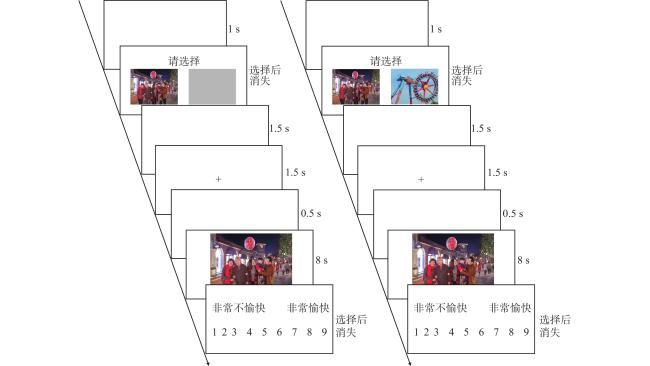
本研究共有6个组块(4个强制选择组块和2个自主选择组块),每个组块含12个试次,共有72个试次。2个积极的强制选择组块(各12张积极图片),2个消极的强制选择组块(各12张消极图片),1个积极的自主选择组块(24张积极图片),1个消极的自主选择组块(24张消极图片)。每张图片在每个组块中仅呈现一次。自主选择与强制选择组块交叉呈现。为了排除消极和积极情绪图片间的相互干扰,先呈现积极情境组块,四分钟的安静放松后(Sveinsdóttir & Jóhannsdóttir, 2023),再呈现消极情境组块。在强制选择组块中,先呈现1 s空白屏,选择阶段呈现一张图片缩略图和一张灰色图片缩略图(被试只能选择图片缩略图),选择结束后呈现1.5 s空白屏,之后呈现1.5 s固定点“+”,0.5 s的空白屏之后观看所选图片,呈现时间为8 s。在观看期间对被试的心率变异性进行记录,图片观看结束后被试对愉快度进行Likert九点评分。在自主选择组块,选择阶段呈现两张图片缩略图,在图片观看阶段呈现被试自主选择的图片。其余流程同强制选择组块。整个实验过程持续20分钟。实验流程如图1 所示。
2.5 数据处理
为了排除图片差异,本研究只对强制选择组块和自主选择组块中呈现相同图片的试次进行分析,所以共纳入48个试次,积极情境和消极情境各有12个强制选择试次和12个自主选择试次。因为选择条件和情境类型的交互作用不是本研究关注的重点,所以将积极情境和消极情境分开分析。使用SPSS29.0进行数据处理,41名被试的行为数据全部纳入分析。使用AcqKnowledge 4.2.1对心率变异性进行离线处理,计算每8 s时间段(Dan-Glauser & Gross, 2011)的LF-HRV、HF-HRV及LF/HF。在整个采集过程中操作规范合理,但由于被试的变异性较大,所以对数据进行±2SD的异常值剔除。且每个被试的基线水平不同,所以未对缺失值进行插补。最后积极情境下有20名有效被试,消极情境下有19名有效被试。
3 结果
3.1 实验操纵检验
为探究被试在积极图片和消极图片的选择中是否存在偏好,分别对两类图片的选择率进行配对样本t检验。结果发现,游乐园(45.53%)与聚会(54.47%)的选择率差异不显著,t(40)=0.93,p=0.357;蛇(54.67%)与蜘蛛(45.33%)的选择率差异不显著,t(40)=0.77,p=0.444。
3.2 主观情绪体验评分
对愉快度评分结果进行夏皮洛−威尔克正态性检验,结果发现ps>0.05,即符合正态分布。因此对强制和自主选择下的愉快度评分进行描述统计和配对样本t检验,结果见表1 。在积极情境中,自主选择下的愉快度显著高于强制选择,p=0.011;在消极情境中,自主选择下的愉快度边缘大于强制选择,p=0.087。表明自主选择让被试更愉快,并倾向降低被试的消极情绪。
表1 两种选择下积极和消极情境的愉快度分析(M±SD) |
| 强制选择 | 自主选择 | t | Cohen’s d | |
| 积极情境 | 6.80±1.20 | 6.94±1.16 | 2.65* | 0.41 |
| 消极情境 | 2.75±1.75 | 2.88±1.71 | 1.75 | 0.27 |
注:*p<0.05,以下同。 |
3.3 自主神经系统的变化
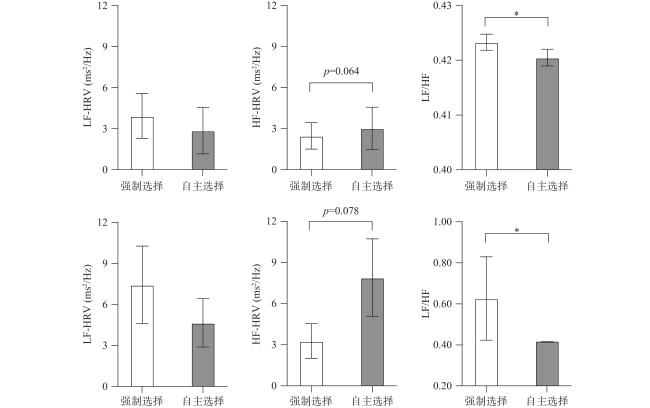
对积极和消极情境下的LF-HRV、HF-HRV和LF/HF进行夏皮洛−威尔克正态性检验,结果发现ps<0.05,即不符合正态分布。所以对LF-HRV、HF-HRV和LF/HF进行配对样本Wilcoxon符号秩检验。结果发现,在积极情境中,自主选择和强制选择间的LF-HRV差异不显著,ZLF-HRV=−1.06,p=0.289;自主选择的HF-HRV边缘高于强制选择,ZHF-HRV=−1.85,p=0.064,Hedge’s g=0.34;自主选择的LF/HF显著小于强制选择,ZLF/HF=−2.11,p=0.035,Hedge’s g=0.55。在消极情境中,自主选择和强制选择的LF-HRV差异不显著,ZLF-HRV=−0.81,p=0.421;自主选择的HF-HRV边缘大于强制选择,ZHF-HRV=−1.76,p=0.078,Hedge’s g=0.48;自主选择的LF/HF显著小于强制选择,ZLF/HF=−2.16,p=0.031,Hedge’s g=0.25。如图2 所示。


4 讨论
本研究在增加实验生态效度的同时,排除了图片和个体差异的影响,并采用经典主观情绪体验报告和客观生理唤醒两种指标,探究在自主和强制两种选择下观看不同效价情绪图片时的情绪变化。结果发现,自主选择增强了被试的积极情绪体验,并倾向于削弱被试的消极情绪体验;积极情境和消极情境中自主选择令被试的交感−副交感神经系统的平衡性偏向于副交感神经系统更强烈的激活,表明自主选择有助于个体改善和维持最佳情绪状态(Sands & Isaacowitz, 2017)。
实验结果发现,在积极情境中,自主选择使人更快乐(陈煦海, 吴茜, 2019),支持了本研究的实验假设。但自主选择对积极情绪的增强与Thuillard和Dan-Glauser(2017, 2020, 2021)的研究结果不一致。在Thuillard和Dan-Glauser(2017)的研究中,积极图片和消极图片在同一组块中混合呈现,前期消极图片产生的消极情绪,可能覆盖了自主选择对积极情绪的调节作用,所以未发现自主选择对积极情绪的增强效应。本研究让同一被试先后观看积极和消极图片,既增加了实验的生态效度也排除了两种情绪的相互干扰,在相对纯净的条件下验证了自主选择使人快乐的假设(Cosme & Berkman, 2020; Linkiewich et al., 2021)。此外,Thuillard和Dan-Glauser(2017)的研究中采用的风景、动物和婴儿等积极图片的唤醒度相对较低,观看这三类图片本身就会使被试的情绪状态趋于平缓(Kutsuzawa et al., 2021; Shuman et al., 2013)。而本研究结果与Sharot等人(2009)的研究结果一致,因为本研究采用的聚会和游乐场图片与Sharot等人实验采用的度假区图片相似,均为中高等唤醒度的积极图片。此外自主选择本身就令人更快乐。人们更喜欢可以引发更多自主选择的选项(Leotti & Delgado, 2011),仅仅当预测到有自主选择存在就可以激活负责奖赏系统的纹状体和腹内侧前额叶(Aoki et al., 2014; Stolz et al., 2020)。自主选择是自由和人权的基石(Leotti et al., 2010),是幸福感的重要影响因素之一(Helliwell et al., 2018)。当事物是由自主选择时,无论结果好坏都会让人更容易接受和理解。自主选择会让人感知到选择了与自身价值和目标相一致的行为(Lemos et al., 2017),从而增加了个体对自主选择结果的喜爱程度(Izuma & Murayama, 2013; Murayama et al., 2015; Sullivan-Toole et al., 2017)。所以自主选择本身就可以增强人们的积极情绪体验。
本研究发现在消极情境中,自主选择倾向于降低人们的消极情绪体验,但降低效果不明显。这可能是由于本研究选用的消极刺激仅是蛇和蜘蛛,这两种刺激材料可能均引起了被试强烈的恐惧感(Rádlová et al., 2019),过激的消极情绪暂时削弱了自主选择对被试主观情绪体验的调节作用。而且,虽然刺激材料的唤醒度会影响被试的自主选择行为(Vujovic et al., 2014),但无论是自主选择观看蛇还是蜘蛛,给被试带来的不适感并无本质差异。以至于即使可以进行自主选择,也无法快速、显著降低被试的消极情绪。所以本研究选用的消极材料引发了被试强烈的恐惧情绪,通过自主选择接近或回避其中一种消极情绪的方式,并无法使自主选择对情绪状态的短期修复作用有效实现(Thuillard & Dan-Glauser, 2017, 2020, 2021)。但自主选择和强制选择间情绪体验的变化趋势,仍然表明自主选择对消极情绪的削弱倾向。
在生理指标上,同时发现面对高唤醒积极情绪和消极情绪时,自主选择对自主神经系统内稳态平衡的维持作用(Sveinsdóttir & Jóhannsdóttir, 2023)。HRV由交感神经系统和副交感神经系统间的动态活动引起(Dziembowska et al., 2016),能客观反映个体的应激水平(翟佳 等, 2024)。本研究通过观察LF-HRV、HF-HRV以及LF/HF这三个指标来反映自主神经系统在自主选择和强制选择间的变化。结果发现,积极情境中自主选择的高频心率变异性边缘大于强制选择,支持了研究假设,表明自主选择可以加快被试从高唤醒的积极情绪中恢复平静。并且自主选择下的LF/HF显著小于强制选择,说明当自主选择时,被试的交感−副交感神经系统平衡性向副交感神经系统激活、交感神经系统活性逐渐降低的趋势变化(孙莎莎 等, 2018)。Sveinsdóttir和Jóhannsdóttir(2023)研究发现,积极情绪对个体是有利的,其可以通过增加副交感神经系统的激活和降低交感神经系统的激活,来达到最佳情绪状态。所以在积极情境中,自主选择令被试恢复平静的速度加快,即起到镇静作用(Thuillard & Dan-Glauser, 2017, 2020, 2021)。这与东方文化中人们对低唤醒积极情绪的偏好是一致的(Tsai et al., 2006)。在消极情境中,蛇和蜘蛛均诱发了被试强烈的情绪体验,所以自主选择的调节作用无法通过降低低频心率变异性有效降低被试的高唤醒消极状态。但同时发现自主选择下的HF-HRV边缘大于强制选择,而且LF/HF也显著小于强制选择,表明自主选择下的HF-HRV更占优势。即,在消极情境中,自主选择通过增强副交感神经系统的激活和降低交感神经激活,为快速降低高唤醒消极状态做准备。综上可知,无论是积极情绪还是消极情绪,当处于高生理唤醒状态时,自主选择都有助于交感神经系统和副交感神经系统间的动态激活调整。这是因为人们存在中等唤醒程度偏好(Sands & Isaacowitz, 2017),并认为在中等唤醒程度下的愉悦度最高(Hebb, 1955)。所以自主选择在维持个体良好情绪状态中发挥重要作用。
本研究虽然仅对自主和强制选择组块中呈现同张图片的试次进行分析,从而控制图片偏好差异,发现了自主选择对积极情绪和消极情绪的调节作用,但在强制选择条件下呈现一张目标图片缩略图和一张灰色缩略图的方式,与实际生活情境仍不太吻合。所以未来研究可以同时呈现两张目标图片缩略图然后再进行强制选择,从而增加自主选择和强制选择的对比和实验的生态效度。其次,本研究的被试虽然达到所需目标被试量,但生理指标的有效被试有限且仅有大学生,未来研究可以选取更多不同的群体,来验证自主选择情绪调节作用的稳定性。另外,未来研究可以佩戴情绪手环,并记录被试日常生活中的自主选择情况和情绪体验,在更生态的环境下探究自主选择的时间累积作用。
5 结论
(1)在积极情境中,自主选择增强了积极情绪体验,但对高唤醒的积极状态起到镇静作用;(2)在消极情境中,自主选择削弱了消极情绪体验,并加快从高唤醒的消极状态中恢复平静。