

1 前言
当人们全神贯注进行一项活动时,往往会体验到一种愉快的精神状态。在这种状态下,他们常常会忘记自我、失去对时间的明确感知。Csikszentmihalyi和Csikszentmihalyi(1988)将这种状态定义为心流(flow),又被称为“最佳体验”(optimal experience)。心流是一种个体完全沉浸于活动中的整体感知(Ottiger et al., 2021)。在这一过程中,个体全身心投入任务,精神高度集中,以至于忽略了其它事情,暂时失去反思性的自我意识,同时感受到对自身行为的强大控制感(Ottiger et al., 2021)。
心流具有跨阶级性、跨性别性、跨年龄性、跨文化性,即便是幼儿也会体验到这种心理状态(Tan & Sin, 2021)。例如,研究发现,7个月到8岁的幼儿在音乐活动中能够根据音乐反馈调整自己的动作、主动探索动作的可能性等,以实现音乐与自身动作的结合,这表现出了寻求挑战、行动与意识的融合、行为的控制感等心流特点,并且这些特点会随着幼儿年龄的增长变得更加明显(Custodero, 2005)。心流能使个体产生更强的专注力,从而有助于提高学习表现(Engeser et al., 2021)。对幼儿心流产生的影响因素进行研究,有助于教育工作者和幼儿家长使用科学有效的方式引导幼儿进入心流。
研究者指出,挑战性任务和心流之间存在显著的正相关(Scheepers & Keller, 2022)。具体来说,当个体在进行具有挑战性的任务时,他们更容易深度集中注意力或沉浸其中,从而进入心流(Csikszentmihalyi, 1996)。具有挑战性的活动能够显著促进个体心流的产生,并增强其在活动中的沉浸感(毛燕辉 等, 2024)。在Larche和Dixon(2020)的研究中也发现,相比于简单任务,个体在更具挑战性的任务中产生的心流水平更高。此外,对活动的主观挑战感知会影响其心流水平(Engeser & Rheinberg, 2008)。这是因为在感知到较高挑战性的活动中,个体的注意力比平时更集中,他们不仅感到更加愉悦和具有控制感,还会更加积极地参与活动并希望能够继续活动,从而表现出更高程度的心流(Peifer & Engeser, 2021)。Scheepers和Keller(2022)的研究也发现,在一定条件下,随着主观挑战感知的增加,个体在任务过程中变得更加投入,事后自我报告的心流得分也更高。心流四象限模型(quadrant model of flow)进一步指出,个体在具有适度挑战性的活动中,更容易进入心流,并且体验到更强烈的心流(Larche & Dixon, 2020)。而游戏是学前教育的主要活动,也是教育幼儿的最佳方式;并且游戏具有明确的目标,能够提供即时反馈(Lamrani & Abdelwahed, 2020),是调查幼儿心理现象的有效方式。与其它活动相比,幼儿更能在游戏中不厌其烦地玩耍与体验,进而沉浸其中(侯雅龄, 2009)。体验式游戏模型(experiential gaming model)认为,游戏挑战性是增强儿童心流水平的最有效因素(Kiili, 2005)。据此,提出假设1:与低游戏挑战性相比,幼儿在高游戏挑战性中表现出更高程度的心流。
以往研究发现,人格特质会调节个体的挑战性感知和心流之间的关系,例如具有内生性人格特质(autotelic personality)的个体在感知到任务困难时,仍能保持较高的好奇心和毅力,因此表现出更高的心流水平(彭婧琨 等, 2024; Peifer & Engeser, 2021)。此外,研究者发现,不同的目标取向的人,在同一情境中的心流也存在差异。那些对掌握挑战性任务有着强烈需求并渴望掌握技能的人更容易进入心流(Tse et al., 2020, 2021)。Stavrou等人(2015)也发现,与表现目标取向的运动员相比,掌握目标取向的运动员在比赛中的心流水平更高。成就目标理论(achievement goal theory)指出,持掌握目标取向的个体更愿意深入发展、掌握一项技能并投入其中,因此在遇到困难与挑战时仍能保持专注;而表现目标取向的个体则更关注外界对自己的评价,为了能够获取他人的表扬会更多地选择简单任务和逃避困难任务(Urdan & Kaplan, 2020; Wang et al., 2014)。Smiley和Dweck(1994)发现,4~5岁的幼儿已经在目标取向上显现出稳定的个体差异。在面对挑战性任务时,掌握目标取向的幼儿会坚持完成任务,而表现目标取向的幼儿则可能不愿意继续进行任务(Kamins & Dweck, 1999; Smiley & Dweck, 1994; Wigfield & Cambria, 2010)。认知−情感−行为模式指出,当感知到任务困难时,持掌握目标取向的幼儿会感到兴奋并高度关注任务以学习技能,持表现目标取向的幼儿则会感到无助,注意力在执行任务和担心结果之间分散(Dweck & Leggett, 1988; Kaplan & Maehr, 2007)。据此,提出研究假设2:目标取向调节了游戏挑战性对幼儿心流的影响。
本研究将通过实验法探究游戏挑战性对幼儿心流的影响(研究1)以及目标取向在其中的调节作用(研究2),以理解幼儿心流产生的条件和机制,从而帮助教师和家长更好地利用游戏激发幼儿的活动热情,让幼儿在游戏中实现自我成长和发展。
2 研究1:游戏挑战性对5~6岁幼儿心流的影响
2.1 实验设计
采用单因素被试内实验设计,自变量为游戏挑战性(高挑战性、低挑战性),因变量为心流得分(幼儿目光转移次数的相反数)。
2.2 被试
在实验开展前,对16位幼儿教师(教龄均在3年以上)进行访谈,结果显示,15位(93.75%)老师均认为幼儿存在心流现象。其中,8位(50.00%)教师表示,不同年龄段的幼儿均能观察到心流现象,但年龄越小的幼儿的心流表现越不明显;另外7位(43.75%)教师则认为仅能在中班和大班观察到幼儿的心流现象。同时,对某幼儿园的大中小班进行各一周的随班观察发现,与中小班幼儿相比,大班幼儿的心流表现更明显,持续时间更长,更稳定,不会因外界刺激而出现目光转移;并且大班幼儿能够按照指导规则进行游戏。心流产生的条件之一是人们明确知道自己要做什么并该如何做(席居哲 等, 2022),因此本研究选取大班幼儿作为被试。
采用G*Power计算样本量,选择配对样本t检验,设定效应值为0.5,显著性水平为0.05,效力为0.80,求出样本量为34。最后共招募银川市某幼儿园大班幼儿38人,其中男生20人,女生18人,平均月龄为65.29±3.20个月。所选幼儿智力正常,无语言、听力或认知障碍。此外,本研究进行的所有研究程序己经由广西师范大学教育学部伦理委员会批准,并已得到家长和幼儿园老师的知情同意。
2.3 实验材料
2.3.1 游戏情景
采用赵婷和王娟(2021)在研究中所使用的钓鱼游戏。游戏中,幼儿被分配到32条玩具鱼(红、黄、蓝、绿各八条)以及一根玩具钓竿,要求幼儿在规定的三分钟时间内进行钓鱼。本研究设置了低挑战性和高挑战性两种水平。在低游戏挑战性中,玩具鱼的最中央和钓竿上均安有磁铁,鱼可以通过磁力吸引被轻松钓起;而在高游戏挑战性中,磁铁钓竿被挂钩钓竿替代,幼儿需要将鱼的牙齿钩在挂钩上才能将鱼钓上。游戏挑战性作为被试内变量,在被试间进行顺序平衡。每名幼儿完成两轮游戏后,将要求其主观比较两种游戏的难度,收集他们对游戏挑战性的主观感知。
2.3.2 心流的测量
心流的核心在于注意力的高度集中,它强调高度的专注和投入以及长时间的持续注意(Schiefele, 2013; Schiefele & Raabe, 2011)。目光转移次数可以直观地反映个体在任务中的注意力切换频率(Jennett et al., 2008; Zhang, 2020)。个体的沉浸程度越高,将注意力转移到其它事物的难度就越大,目光转移次数就会越少(Jennett et al., 2008; Zhang, 2020)。因此,本研究将幼儿在游戏中对钓鱼活动以外因素的目光转移次数的相反数作为心流得分。在游戏过程中,在幼儿视线范围内放置沙漏以帮助幼儿计时,同时使用摄像机记录幼儿的游戏表现,主试则全程坐在幼儿对面进行观察和记录。
为确保准确统计目光转移次数,由另一位评分者观看录像视频来统计幼儿的目光转移次数。将两位评分者统计的目光转移次数取平均数,并取该平均数的相反数作为幼儿的心流得分。在研究1中,幼儿在低游戏挑战性和高游戏挑战性中的目光转移次数的评分者一致性信度均为0.99。
2.3.3 趣味性的测量
兴趣可能会影响个体在活动中的内在动机,从而影响心流(Bricteux et al., 2017)。因此,本研究在游戏结束后,测量幼儿对两种游戏的感兴趣程度。采用五个圆圈表示游戏的有趣程度,五个圆圈由小到大排列,圆圈越大代表游戏越有趣。幼儿选择最小的圆圈计1分,选择最大的圆圈计5分。
2.4 实验过程
由主试带领幼儿到安静的房间中进行一对一实验。房间内放有一张桌子和两把面对面摆放的椅子,桌子上放置了钓鱼游戏的材料和计时沙漏,并在幼儿对面安好摄像机,以记录幼儿在游戏中的表现。引导幼儿坐到主试对面后,主试向幼儿介绍游戏规则和计时规则,随后让幼儿进行练习,直到成功钓到第一条鱼后停止练习,并在确认幼儿已理解游戏规则和沙漏的计时规则后正式开始游戏。
第一轮游戏结束后,收集幼儿对游戏的感兴趣程度,待幼儿作答后,更换游戏。第二轮游戏和第一轮游戏的程序相同。所有参与实验的幼儿中,一半先进行低游戏挑战性后进行高游戏挑战性,另一半则顺序相反。两轮游戏结束后询问幼儿:“刚才我们进行了两次游戏,你觉得两次游戏哪次更难呢?”
2.5 结果
2.5.1 对游戏挑战性分组的操纵检验
使用配对样本t检验分析幼儿在不同游戏挑战性中钓鱼数量差异,结果显示高游戏挑战性中幼儿钓鱼数量显著低于低游戏挑战性中的钓鱼数量[M低挑战性=21.42±5.62, M高挑战性=10.95±5.35, t(37)=12.11, p<0.001, Cohen’s d=1.96]。在两次游戏后,要求幼儿比较两轮游戏的难度,发现幼儿对游戏的主观难度评价和挑战性设置完全一致。游戏挑战性操纵有效。
幼儿在完成游戏后对游戏的趣味性进行评分。使用配对样本t检验比较不同游戏挑战性的趣味性,结果显示不同游戏挑战性的趣味性无显著差异[M低挑战性=4.00±0.87, M高挑战性=4.08±0.82, t(37)=−0.34, p=0.73, Cohen’s d=0.06],证明对幼儿而言,高游戏挑战性和低游戏挑战性都同样有趣。
2.5.2 幼儿在不同游戏挑战性中的心流差异
采用配对样本t检验比较幼儿在不同游戏挑战性中心流得分的差异。不同游戏挑战性中的幼儿心流得分差异显著,高游戏挑战性中幼儿的心流得分高于低游戏挑战性[M低挑战性=−2.87±2.20, M高挑战性=−2.09±2.13, t(37)=−3.83, p<0.001, Cohen’s d=0.62]。
研究1结果表明,游戏挑战性能够提升5~6岁幼儿的心流水平,但是其产生条件还有待探索。以往研究指出,掌握目标取向者与表现目标取向者在挑战性任务中的表现有所不同(Preenen et al., 2014)。因此,研究2将探讨目标取向在游戏挑战性对5~6岁幼儿心流影响中的调节作用。
3 研究2:目标取向在游戏挑战性影响5~6岁幼儿心流中的调节作用
3.1 实验设计
采用单因素被试内实验设计探索游戏挑战性影响幼儿心流的内在机制。研究2的自变量与因变量和研究1相同,调节变量为目标取向(掌握目标取向、表现目标取向)。
3.2 被试
采用G*Power计算样本量,选择线性回归分析,设定效应值为0.5,显著性水平为0.05,效力为0.80,预测因子为2,求出样本量为23。综合研究1配对样本t检验的样本量计算,最后共招募银川市幼儿园大班幼儿34人,其中男生19人,女生15人,平均月龄为63.38±3.92个月。所选幼儿智力正常,无语言、听力或认知障碍。此外,本研究进行的所有研究程序己经由广西师范大学教育学部伦理委员会批准,并已得到家长和幼儿园老师的知情同意。
3.3 实验材料
3.3.1 游戏情景
游戏情景设置同研究1。由于研究1中幼儿在高游戏挑战性和低游戏挑战性中钓鱼的方式和钓鱼材料存在差异。为了避免这些差异对研究产生干扰,并降低幼儿在游戏过程中的安全风险(如避免钓钩可能对幼儿造成的意外伤害),将研究2钓鱼游戏的钓竿统一改为磁铁钓竿,只是在高游戏挑战性时,在鱼的磁铁上粘贴胶布,以增加钓鱼游戏的难度,使高低游戏挑战性仅存在难度差异。
3.3.2 心流的测量
同研究1。在研究2中,幼儿在低游戏挑战性时的目光转移次数的评分者一致性信度为0.98,在高游戏挑战性时为0.99。
3.3.3 趣味性的测量
同研究1。
3.3.4 目标取向的测量
本研究参照Compagnoni等人(2019)使用的方法测量幼儿的目标取向。研究过程中使用平板为幼儿呈现两个相同的玩偶,分别在屏幕的左右两侧,点击玩偶可以播放语音:一个玩偶的陈述表达了掌握目标取向,如“我喜欢能学习更多知识的任务”,另一个玩偶的陈述表达了表现目标取向,如“我喜欢容易做到的任务”。两种陈述随机伴随左侧或右侧玩偶出现,孩子们可以重复播放玩偶的语音,要求孩子选择自己更认同哪个玩偶的说法。题目改编自Gunderson等人(2013)编制的量表,共三道题目,赞同掌握目标取向的回答计1分,赞同表现目标取向的回答计0分,三道题目得分加和即为个体目标取向得分。在本研究中,这三个题目的标准化McDonald’s ω系数为0.73,说明题目具有较高的一致性(Hayes & Coutts, 2020)。
3.4 实验过程
研究2的游戏过程和兴趣测量与研究1相同。在幼儿完成两轮钓鱼游戏后,邀请幼儿来到另一桌子前,测量目标取向。收集幼儿在三轮语音陈述中的选择后,结束实验并对幼儿表示感谢。
3.5 结果
3.5.1 对游戏挑战性分组的操纵检验
采用配对样本t检验分析幼儿在不同游戏挑战性中钓鱼数量差异,结果显示高游戏挑战性中幼儿钓鱼数量远低于低游戏挑战性的钓鱼数量[M低挑战性=21.12±5.58, M高挑战性=12.85±6.00, t(33)=6.07, p<0.001, Cohen’s d=1.04]。所有幼儿对游戏挑战性的主观感知和客观设置完全一致。说明研究中对游戏挑战性的操纵是有效的。
幼儿在完成游戏后对游戏的趣味性进行评分。使用配对样本t检验比较不同游戏挑战性的趣味性,结果显示不同游戏挑战性的趣味性无显著差异(M低挑战性=4.09±0.93, M高挑战性=4.09±0.93, t(33)=0.00, p=1.00, Cohen’s d=0.00),说明对幼儿而言,高游戏挑战性和低游戏挑战性都同样有趣。
3.5.2 幼儿在不同游戏挑战性中的心流差异
采用配对样本t检验的方法比较幼儿在不同游戏挑战性中心流得分的差异。结果显示,不同游戏挑战性中的幼儿心流得分差异显著,高游戏挑战性中幼儿心流得分高于低游戏挑战性中幼儿心流得分[M低挑战性=−3.91±3.10, M高挑战性=−2.10±2.31, t(33)=−4.99, p<0.001, Cohen’s d=0.86]。
3.5.3 目标取向的调节作用
幼儿的目标取向平均分为2.18,标准差为1.00。根据已有研究(Gunderson et al., 2013; Hayes & Rockwood, 2017; Kaplan & Maehr, 2007; Thurstone, 1928)及本研究目标取向的计分方法,将得分为0~1分的视为表现目标取向,2~3分的则视为掌握目标取向。
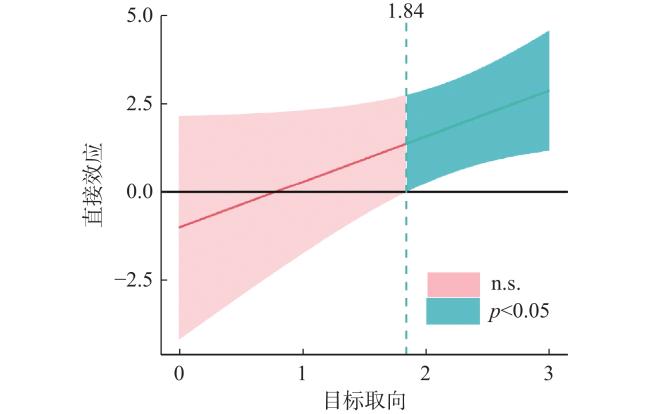
由于本研究为被试内实验设计,因此使用SPSS MEMORE 2.1宏进行调节效应分析(方杰, 温忠麟, 2022; Montoya, 2019),检验目标取向的调节作用。结果显示,目标取向在游戏挑战性对心流的影响中起到调节作用(β=−1.29, t=−4.38, p<0.001)。采用Johnson-Neyman检验进一步分析调节效应发现,目标取向调节游戏挑战性与5~6岁幼儿心流关系的直接路径的效应图见图1 ,当目标取向得分大于1.84时,置信区间不包含0,这表明调节效应具有统计学意义,游戏挑战性对幼儿心流的影响随着目标取向总分的提高而增强。也就是说,游戏挑战性对幼儿心流的影响主要存在于掌握目标取向的幼儿中。


4 讨论
4.1 游戏挑战性对5~6岁幼儿心流的影响
两个研究的结果均显示,在高游戏挑战性中,幼儿的心流得分更高;这表明游戏的挑战性有助于提升幼儿心流水平。这一结果也印证了体验式游戏模型,该模型强调游戏的挑战性对儿童是非常重要的,是促进儿童心流水平提升的最有效因素(Kiili, 2005)。根据该模型,适当的游戏挑战性可以有效维持个体对游戏的参与动机,并通过完成游戏挑战性来促进心流的产生,使个体能够更加投入并沉浸其中(Kiili, 2005)。此外,心流四象限模型进一步阐明了游戏挑战性对个体心流水平的影响(Larche & Dixon, 2020)。根据该模型,在低游戏挑战性中,个体往往觉得任务易于完成,缺乏足够的挑战性,容易引发无聊情绪。此时,个体的专注度较低,难以保持心流。而在高游戏挑战性中,任务具有一定的难度,个体需要付出更多的努力,集中注意力才能完成任务(Larche & Dixon, 2020)。通过高度集中的注意和持续的努力,幼儿能够进入到心流,更容易体验到游戏带来的成就感和满足感,从而进一步增强对游戏的投入(Csikszentmihalyi, 1996)。
4.2 目标取向的调节作用
研究2发现游戏挑战性对幼儿心流的影响主要存在于掌握目标取向的幼儿中。成就目标理论指出,当个体将成功视为学习和掌握一项技能,他们更关心的是自我提升和个人努力,会趋向于努力做事,就更有可能在遇到具有挑战的任务时保持高动机水平,能够继续保持较高的注意力进行任务(Nicolosi et al., 2021; Urdan & Kaplan, 2020)。这与风险承担模型(risk-taking model)理论一致,动机水平较高的个体在任务具有挑战性时更容易体验到心流(Gold & Ciorciari, 2020)。认知−情感−行为模式也指出,持掌握目标取向的幼儿在高挑战任务时情绪高涨,能全神贯注进行任务(Dweck & Leggett, 1988; Kaplan & Maehr, 2007)。他们在参与挑战性任务时,将在任务中收获到乐趣作为内部的回报,就更有可能在具有挑战性的活动中体验到心流(Csikszentmihalyi, 2002),也更愿意投入更多的精力在高挑战性活动中(Kaya & Ercag, 2023)。因此掌握目标取向的幼儿在高游戏挑战性中体验更高程度的心流。
当幼儿表现为表现目标时,游戏挑战性对心流不存在显著影响,这可能是因为表现目标取向的个体更关注的是外部评价而非任务本身。表现目标取向者是通过外部标准来评估自己的能力,他们在任务中会特别关注与他人的比较或是否能得到外界的表扬(Stasielowicz, 2019; Vandewalle et al., 2019)。目标取向层次的动机行动理论模型(motivated action theory model)也指出,表现目标取向个体倾向于将自己的表现与他人的表现进行比较,从而促进其表现(DeShon & Gillespie, 2005)。而在本研究中,游戏不存在竞争性,也没有外部评价,因此表现目标取向的幼儿在两个游戏中的心流得分没有存在显著差异。
4.3 不足与展望
第一,本研究中的游戏挑战性任务只有高低两个水平,属于相对概念,是通过任务之间的比较而定义的,但对幼儿而言都不是难以完成的任务,因此之后可以考虑增加活动的挑战性水平,进一步明确游戏挑战性对幼儿心流的影响。第二,本研究仅采用目光转移次数作为心流的衡量指标,没有测量目光转移的时间,未来可以采用眼动仪等设备测量个体的注视持续时间以及目光转移的时间,以更为精确有效地考察个体的心流。第三,本研究使用的幼儿游戏活动为钓鱼游戏,主要涉及动作技能,后续可以采用其他脑力活动游戏,以便更为全面地考察幼儿在不同游戏中的心流。
5 结论
游戏挑战性显著影响幼儿的心流水平,目标取向在两者间起调节作用。具体而言,相较于低游戏挑战性,5~6岁幼儿在高游戏挑战性中的心流水平更高,并且持有掌握目标取向的幼儿在高游戏挑战性中拥有更高程度的心流。