

1 引言
科技的发展让产品的设计有了更多的可能,越来越多的企业设计开发多功能产品,即,将两种或多种功能融合到同一产品中(Thompson & Norton, 2011)。例如,多功能桌子设计,既可以摆放物品,同时也具备无线充电及空气净化的功能;十四合一多功能工具,可以实现开瓶器、剪线钳、小刀、起钉器等14项功能。多功能产品能够同时满足消费者多种功能需求,不仅在功能和效率方面更具有竞争力(Kasulaitis et al., 2021; Thompson et al., 2005),还可以给消费者带来社交效用(Brannon & Soltwisch, 2017; Thompson & Norton, 2011)。但是,多个功能的叠加也可能减少功能的价值感知(Makov & Newman, 2022),降低产品的易用性(Thompson et al., 2005)。由于这种差异化的影响,全面理解何种因素能够驱动多功能产品消费对于企业营销十分重要。
现有的研究一方面集中探讨消费者对多功能产品功能的采纳、认知推断等。例如,Hahm等(2023)发现对多功能健康类穿戴产品的采用取决于消费者对其功能易用性和有用性感知。消费者也会存在一种固有信念,即单功能产品的功能比多功能产品中同一功能更有效(Makov & Newman, 2022);另一方面的研究聚焦多功能产品对消费者动机、社会效用等的影响,例如,You等(2022)研究发现仅仅多功能产品的呈现就能够导致消费者在各种情景中表现得更不耐心。但是也有研究发现,多功能产品展现了消费者技术能力和开放性,使得拥有者会被更积极地看待(Thompson & Norton, 2011)。已有研究为人们理解多功能产品的特征以及对消费者心理和行为的影响提供了重要的基础。然而,关于多功能产品偏好形成的心理驱动因素仍缺乏深入的研究。本研究拓展了相关研究,关注了一个新的前因变量—个人控制感。个人控制感是指个体感知到能够显著改变相关事件的能力,获得想要的结果,回避不想要的结果的能力(Burger, 1989; Landau et al., 2015)。本研究通过三个实验探究了个人控制感如何影响消费者对多功能产品的偏好及其心理机制。
1.1 个人控制感对多功能产品偏好的影响
在日常生活中维持较高个人控制感对人们的心理和生理健康有重要的意义(Rippé et al., 2021; Zheng et al., 2020)。根据控制补偿理论(compensatory control theory),当个人控制感受到威胁,人们会依赖各种不同的策略修复个人控制感(柳武妹 等, 2014; 郑晓莹, 彭泗清, 2014; Landau et al., 2015)。其中,个人控制感缺失一种重要的应对方式是通过提高个人能动性(Landau et al., 2015)。这里的个人能动性是指能够完成目标的资源,包括技能、知识和其他能够帮助个体付诸行动、努力实现目标以及在逆境中坚持的能力(Landau et al., 2015)。对于控制感缺失的消费者最直接的一种应对方式是获得相应的资源(Durante & Laran, 2016)。例如,Chen等(2017)发现控制感被威胁的消费者会通过获取实用品来应对,因为实用品通常是用来帮助消费者解决问题的(例如,吸尘器用来解决室内灰尘问题)。
消费者还可以通过提高资源利用的个人效率来应对个人控制感缺失(Fernbach et al., 2015)。例如,多重任务处理是一种有效提高时间资源效率的方式,因此低控制感会提高人们多重任务处理倾向(Han & Broniarczyk, 2021)。在本研究的情境中,多功能产品是指同时具备多种特征,能够满足消费者多种功能需求的产品(Thompson & Norton, 2011)。研究发现,仅仅展示多功能产品就可以激活消费者的效率目标(You et al., 2022)。而购买多功能产品则可以进一步帮助消费者有效管理和完成多个目标,提高个人感知效率,有利于应对控制感缺失(Fernbach et al., 2015)。综上,提出以下假设。假设1:相较于高个人控制感,低个人控制感会提高消费者对多功能产品的消费意愿。假设2:感知效率中介了个人控制感对多功能产品消费意愿的影响。
1.2 多功能外观特征的调节作用
外观特征对消费者的产品或品牌感知具有十分重要的作用(谢志鹏, 汪涛, 2017; 许销冰 等, 2023)。多功能产品的功能与外观特征的关系有两种类型:一种是可以直接体现多种功能的设计,例如,户外多功能军刀,多功能的特征以及各个功能的实现很容易从产品外观中判断;另一种则是在产品外观特征中无法判断其多功能的属性,例如,洗衣凝珠。其多种功能与其外观特征上无明显的推断关系。在营销实践中,商家也可以通过包装的方式将不同功能区隔开,用来提醒消费者。已有研究表明,消费者对多功能产品的单个功能属性进行判断时会存在一些协同推断(Chernev & Carpenter, 2001; Gunasti & Ross, 2015)。个体决策过程中可能会存在功能属性之间的“补偿”效应,即产品的某项功能比较强时,消费者可能推断其他功能会比较弱。同时,消费者在整体评估多功能产品时,也会有多个功能之间可能存在干扰或冲突的担忧。例如,在新产品创新的研究中就发现,相比于一体化的新产品创新,采用可拆卸的方式进行产品创新可以有效降低感知风险(Ma et al., 2015)。
在本研究的情境下,研究者认为产品的外观设计会调节个人控制感对多功能产品的偏好。具体而言,当外观特征能够体现多种功能时,消费者很容易推断产品的多功能的特征以及其实现。相反,当外观特征不能体现多种功能时,消费者对多个功能之间可能产生消极推断,从而削弱控制感对多功能产品偏好的影响。其核心逻辑在于外观设计是否能够帮助消费者理解多个功能是如何实现的,以及是否存在其他消极的推断。例如,洗烘一体设计的洗衣机可能让消费者在“洗衣”和“烘干”这个两个功能的实现方面存在消极的推断:这两个功能可能相互干扰、可能更容易损坏等。因此,本研究认为,当外观设计不能帮助消费者降低消极推断时,个人控制感对多功能产品偏好的影响将会削弱。此时,消费者无法从多功能产品中获得感知效率,反而可能增加风险感知。因此,提出假设3:个人控制感对多功能产品偏好的影响受到多功能外观特征的调节,即当功能外观特征凸显时,控制感缺失的促进效应存在;当多功能外观特征不凸显时,控制感缺失的促进效应被削弱。
2 实验1:个人控制感与多功能产品偏好
实验1的目的是检验本研究的假设1,即个人控制感对多功能产品消费意愿的影响。首先操控被试的个人控制感,然后测量被试对多功能产品的购买意愿。本研究预测相比高控制感组,低控制感的被试对多功能产品的购买意愿更高。
2.1 被试与实验设计
实验1采用单因子组间设计。将被试随机分配到高个人控制感组或低个人控制感组。本次实验在Credamo平台招募被试200名,其中男性79名,占39.5%(Mage=29.10岁, SD=6.94岁)。
2.2 实验流程与刺激材料
告知被试将分别完成一个写作任务和一个产品测评任务。首先,完成一个写作任务,实际目的是操控被试的个人控制感,操控材料改编自相关文献(黄静 等, 2023; Chen et al., 2017; Cutright & Samper, 2014)。具体来说,让被试描述生活中让他们感觉有较高或较低控制感的控制感的意外事件,简要写下发生的事情、当时的感受等,不少于50字。
然后,让被试完成一个看似不相关的产品测评任务。多功能产品的实验刺激参考You等(2022)的研究。具体描述为:“一家公司推出了一种工具,可用作剪刀、小刀、开瓶器、螺丝刀和镊子。”要求被试完成购买意愿测量题项(Chen et al., 2017):你在多大兴趣/可能购买这个产品(7级量表,1表示“完全不可能/完全没兴趣”,7表示“非常可能/非常有兴趣”;项目的相关系数r=0.80, p<0.001)。最后,被试填写人口统计信息。
2.3 结果
2.3.1 操控检验
写作任务后,两个独立研究助理对被试描述事件的个人控制感程度进行打分(−5表示“非常缺乏控制感”,5表示“非常有控制感”),结果具有较高的相关性(r=0.93, p<0.001),将均值作为个人控制感的操控检验指标。对操控检验的测量进行独立样本t检验,结果表明低控制感组(M=−3.04, SD=2.11)被试的打分要显著低于高控制感组[M=2.36, SD=2.10; t(198)=18.14, p<0.001],结果表明个人控制感操控成功。
2.3.2 产品的购买意愿
对购买消费意愿进行独立样本t检验,结果表明低控制感组(M=5.60, SD=1.27)被试的消费意愿要显著高于高控制感组[M=5.11, SD=1.26; t(198)=2.70, p=0.006, d=0.39]。结果支持假设1。实验1的结果表明,当控制感较低时,消费者对多功能产品的购买意愿更高,初步验证了个人控制感与多功能产品偏好之间的因果关系。实验2将进一步检验这一效应的作用机制。
2.4 讨论
实验1的结果为假设1提供了初步的证据,结果表明当控制感较低时,消费者对多功能产品的购买意愿更高。为了进一步提供实验结果的内外部效度,实验2将采用不同的操控方法和实验刺激来验证假设1。另外,实验2还将进一步检验这一效应背后的心理机制。
3 实验2:感知效率的中介作用
实验2的目的有以下三个方面:一是检验假设2,即感知效率的中介作用。本研究预测,个人控制感较低的消费者通过多功能产品消费来提高感知效率,从而修复个人控制感。二是排除其他的解释机制。已有研究发现,较低的个人控制感会促进实用产品的获取,因为实用品可以带来普遍的问题解决倾向(Chen et al., 2017)。在本研究的情境中,虽然多功能产品也具有实用性,能够为消费者解决问题,但消费者对多功能产品的反应往往更集中于其具备的多个功能这一特征上。也就是说,相比于单功能产品,多功能产品会将消费者注意力从“单个功能的效用和结果”转移到“多功能的特征以及多个功能之间的关系”。本实验通过测量的方式排除这一竞争性的解释机制。另外,通过设置单功能产品对照组,进一步揭示控制感和感知效率对多功能产品的特异性作用。三是使用不同的个人控制感的操控方法以及不同的多功能产品刺激,重复验证实验1的结果,增加实验结论的外部效度。
3.1 被试与实验设计
实验2采用2(高控制感、低控制感)×2(多功能产品、单一功能产品)组间设计。将被试随机分配到这四组之一。本次实验在Credamo平台招募被试400名,其中男性117名,占29.3%(Mage=31.16岁, SD=7.37岁)。
3.2 实验流程与刺激材料
实验2让被试完成两个不相关的任务。首先,通过阅读任务操控被试的个人控制感(Zhang et al., 2023)。让被试阅读心理学的报告,低控制感组强调人们实际上对自己的生活无法掌控。相反,在高控制感组则强调人们对自己的生活有完全的掌控能力。
然后,让被试完成产品测评任务。在本次实验中,更换了另一个产品,多功能产品组的具体描述为:“多功能激光笔:一只笔就能满足您的所有演示需求。功能全面,自由操纵,一笔搞定!三大功能合一:USB存储器(即插即用,高速传输)、PPT远程遥控翻页笔(上下翻页,稳健灵敏)、录音笔(智能语音记录)。”单功能产品组的描述为:“PPT远程遥控翻页笔:上下翻页,稳健灵敏。远程操控,快捷翻页。”接着,让被试依次完成购买意愿(相关系数r=0.73, p<0.001)、中介感知效率、问题解决倾向和操控检验的测量量表。中介测量问卷参考了You等(2022)、Han和Broniarczyk(2021)的研究。具体而言,使用了三个测量题项:(1)该产品让我感觉使用较少的资源实现了更多的功能目标;(2)该产品让我感觉拥有一件产品即可轻易获得更多的功能;(3)该产品让我觉得能够非常高效地实现自己的功能诉求(7点计分, 1=非常不同意, 7=非常同意; Cronbach’s α=0.80)。
为了排除其他解释机制,实验2通过4个题项测量了普遍的问题解决倾向(Chen et al., 2017):(1)我想要采取行动努力改善困境;(2)我想集中精力解决当前或潜在的问题;(3)我想要就如何解决某个问题制定策略;(4)我想要考虑采取什么措施来解决问题(1=非常不同意, 7=非常同意; Cronbach’s α=0.75)。被试完成三个题项的量表,作为个人控制感的操控检验(Zhang et al., 2023):(1)我可以做任何我想做的事情;(2)当我真的想做某件事情时,我通常会找到成功的方法;(3)我几乎无法改变我生命中的许多重要事情(反向编码; Cronbach’s α=0.81)。最后,被试填写人口统计信息。
3.3 结果
3.3.1 操控检验
对操控检验的测量进行2(个人控制感)×2(产品类型)的方差分析,结果表明个人控制感的主效应显著,具体而言,低控制感组(M=4.72, SD=1.39)被试的评分要显著低于高控制感组[M=5.44, SD=0.87; F(1, 396)=37.89, p<0.001],结果表明个人控制感操控成功。
3.3.2 产品的购买意愿
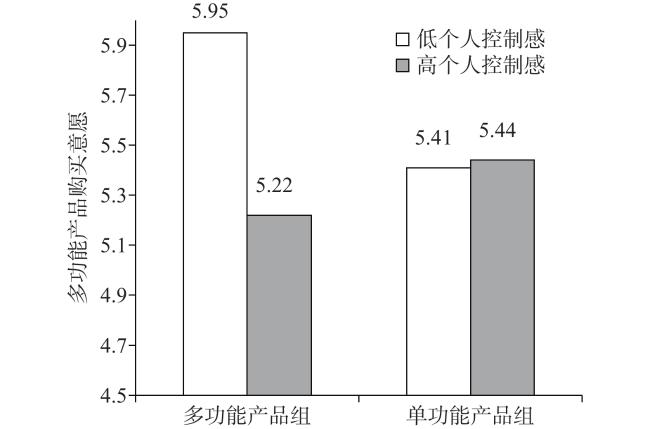
对购买消费意愿进行2(个人控制感)×2(产品类型)的方差分析,结果表明个人控制感和产品类型的交互作用显著[F(1, 396)=11.84, p=0.001, η2=0.03]。随后简单效应分析结果发现,在多功能产品组,低控制感组(M=5.95, SD=1.00)被试的消费意愿要显著高于高控制感组[M=5.22, SD=1.14; F(1, 396)=21.35, p<0.001, η2=0.05]。在单功能产品组,低控制感组和高控制感组被试的消费意愿差异不显著[M低=5.41, SD=1.23, M高=5.44, SD=1.05; F(1, 396)=0.06, p=0.806]。结果支持假设1(见图1 )。
3.3.3 中介检验
使用Hayes(2017)的PROCESS插件进行有调节的中介检验(Model 8; 使用Bootstrap检验,重复抽样5000次,95%的置信区间)。其中,个人控制感作为自变量,产品类型作为调节变量,感知效率作为中介变量,购买意愿作为因变量。检验结果发现,有调节的中介效应显著(LLCI=0.04, ULCI=0.74, 区间不包含0),效应值为0.39。具体而言,对于多功能产品组,感知效率的中介效应显著(LLCI=−0.55, ULCI=−0.08, 区间不包含0),中介效应大小为−0.31。对于单功能产品组,感知效率的中介不显著(LLCI=−0.17, ULCI=0.34, 区间包含0)。结果支持假设2。
为了排除其他解释机制,将普遍解决问题倾向纳入平行中介,使用同样的方法进行中介效应检验,结果发现普遍问题解决倾向的有调节的中介效应不显著(LLCI=−0.04, ULCI=0.06, 区间包含0),其在多功能组(LLCI=−0.05, ULCI=0.03, 区间包含0)和单功能组(LLCI=−0.01, ULCI=0.02, 区间包含0)的中介效应均不显著。
3.4 讨论
实验2的结果进一步支持了假设1和假设2,即感知效率中介了个人控制感对多功能产品偏好的影响。通过对比多功能产品组和单功能产品组揭示了,个人控制感对多功能产品的独特作用机制。并且排除了普遍解决问题倾向在这一过程中的替代性解释。这说明消费者在面对多功能产品时注意力更多地集中的多功能特征带来的感知效率上,而不是解决问题倾向上。另外,实验2通过不同的实验刺激和操控方法,重复了实验1的结论。实验3将进一步检验这一效应的边界条件。
4 实验3:多功能外观特征的调节作用
实验3的目的是检验多功能外观特征的调节作用。本研究预测当产品物理外观特征能够直观体现多功能时,个人控制感对产品购买意愿有显著影响。当多功能产品的产品外观方面不能直观体现多功能时,感知效率会降低,从而导致个人控制感对多功能产品的作用被削弱。
4.1 被试与实验设计
实验3采用2(个人控制感:高、低)×2(多功能特征:凸显、不凸显)的组间设计。将被试随机分配到其中一组。本次实验在Credamo平台招募被试300名,其中男性117名,占39.0%(Mage=30.17岁, SD=8.08岁)。
4.2 实验流程与刺激材料
首先,通过阅读材料操控被试的个人控制感,材料同实验2(Zhang et al., 2023)。然后,将被试随机分配到多功能外观特征凸显组和不凸显组。实验刺激采用的是多功能洗衣凝珠,具备8倍清洁力、微胶囊锁香、100%除螨和护色因子等四种功能,其中多功能外观特征不凸显组采用的是一个方形包装,而凸显组则采用方形的四格包装将四种功能区隔出来。然后,依次测量被试的购买意愿(相关系数r=0.81, p<0.001)、感知效率(Cronbach’s α=0.88)以及个人控制感的操控检验(Cronbach’s α=0.90),量表同实验2。最后,被试填写人口统计信息。
4.3 结果
4.3.1 操控检验
对操控检验的测量进行2(个人控制感)×2(多功能外观特征)方差分析,结果表明只有个人控制感的主效应显著[M低=3.44, SD低=1.58, M高=5.31, SD高=1.05; F(1, 296)=144.77, p<0.001, η2=0.33]。多功能外观特征的主效应[F(1, 296)=0.60 , p=0.44],及其与个人控制感的交互作用都不显著[F(1, 296)=0.89, p=0.35]。说明个人控制感操控成功。
4.3.2 产品的购买意愿
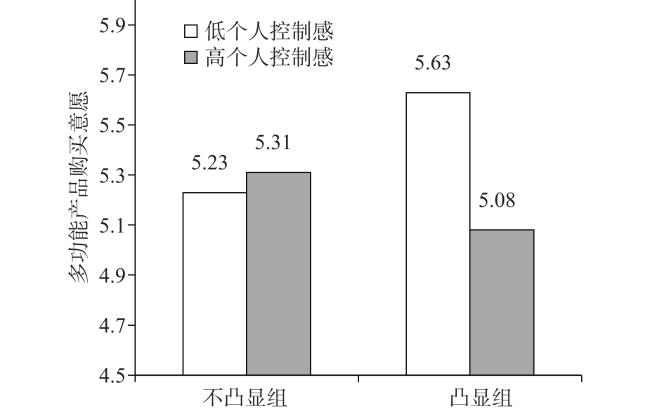
对购买消费意愿进行2(个人控制感)×2(多功能外观特征)方差分析,结果表明个人控制感和多功能外观特征交互作用显著[F(1, 296)=4.17, p=0.042, η2=0.01]。随后简单效应分析结果发现,对于外观特征凸显组,低个人控制感被试(M=5.63, SD=1.39)比高个人控制感组被试的购买意愿更高[M=5.08, SD=1.12; F(1, 296)=6.22, p=0.013, η2=0.02]。对于外观特征不凸显组,两组被试的购买意愿差异不显著[M低=5.23, SD低=1.52, M高=5.31, SD高=1.32; F(1, 296)=0.69, p=0.69]。结果支持假设3(见图2 )。


4.3.3 中介检验
使用Hayes(2017)的PROCESS插件,做有调节的中介检验(Model 8; 使用Bootstrap检验,重复抽样5000次,95%的置信区间)。检验结果表明,有调节的中介效应显著(LLCI=0.15, ULCI=1.02, 区间不包含0),效应值为0.60。具体而言,对于多功能外观特征凸显组,感知效应的中介效应显著(LLCI=0.03, ULCI=0.67, 区间不包含0);对于多功能外观特征不凸显组,感知效率的中介不显著(LLCI=−0.56, ULCI=0.08, 区间包含0)。结果支持假设2。
4.4 讨论
实验3验证了多功能外观特征的调节作用,结果支持了假设3。具体而言,当多功能外观特征凸显时,较低的个人控制感促进多功能产品购买意愿,且感知效率在其中起到了中介作用,重复了实验1和实验2中的结果。当多功能外观特征不凸显时,个人控制感对多功能产品购买意愿的影响被削弱。
5 总讨论
本研究揭示个人控制感对多功能产品偏好的影响。首先,这一发现推进了个人控制感在消费者行为领域的研究。个人控制感对消费行为有广泛的影响,如可持续消费(Zhang et al., 2023)、领先品牌偏好(Beck et al., 2020)、食物与饮料消费(Lunardo et al., 2022)等。本研究则进一步拓展,关注个人控制感如何影响消费者对多个实用功能产品偏好。其次,补充了多功能产品的研究。现有多功能产品的前因研究集中在消费者的产品知识(Sääksjärvi & Samiee, 2011)、购买前的信念(Goodman & Irmak, 2013)以及个人特质(Brannon & Soltwisch, 2017)等方面。本研究聚焦于个人控制感这一重要的前因变量,拓展了对多功能产品偏好前因的研究。
本研究发现个人感知效率在个人控制感对多功能产品偏好过程中起部分中介作用。研究发现拓展了控制感补偿机制的相关研究,以往的个人控制感的补偿机制主要包括秩序寻求(Landau et al., 2015; Lembregts & Pandelaere, 2019)、感知自主性(黄静 等, 2023)、时间资源的效率动机(Han & Broniarczyk, 2021)等。本研究提出低个人控制感的被试对多功能产品的偏好是由于获得产品带来的感知效率。研究结论也为应对个人控制感缺失提供了有效的策略。通过多功能产品的获取,可以有效帮助消费者提高个人的感知效率,让消费者感觉“一举多得”,补偿了个人控制感。
本研究还揭示了多功能产品的外观设计对于上述影响机制的调节作用。研究结果表明,当多功能产品的外观设计不能够帮助消费者推断多个功能实现时,个人控制感对多功能产品购买意愿的影响消失。因此,企业也应该重视多功能产品的外观设计,通过视觉元素帮助消费者理解产品的功能。多个功能在提升性能感知的基础上,也可能带来一些负面的推断,例如,在易用性和功能效用的不确定性(Chernev, 2007; Thompson et al., 2005)。通过合理的外观设计可以有效规避产品的风险感知,提高产品利益感知。
本研究还存在以下局限,有待进一步研究。第一,本研究更多关注的是五种或少于五种功能的简单多功能产品。未来的研究可以继续探讨当功能数量更多时,个人控制感的作用是否会发生变化。此外,从功能的属性上看,未来也可以探讨不同类型的功能是否会产生不同的影响。第二,本研究关注的普遍的个人控制感的影响,但是个人控制感缺失有不同的来源,对信息加工也产生不同的影响(Chaxel, 2016)。不同类型的个人控制感是否会造成不同的影响也是值得继续探讨的问题。
6 结论
本研究探讨了个人控制感对多功能产品偏好的影响、机制及其边界条件。研究结论如下:相比于高控制感,低控制感的消费者对多功能产品的购买意愿会更高。这一效应的潜在机制是多功能产品能够提高消费者的个人感知效率,从而帮助其修复控制感缺失。另外,个人控制感对多功能产品的影响会受到产品外观设计的调节。当消费者不能通过外观设计直观理解产品多功能的实现时,会降低消费者的感知效率,从而削弱个人控制感对多功能产品偏好的影响。