

1 引言
近年来,随着信息通信技术(ICT)的高速发展,全球互联网普及率已达世界人口的67%(International Telecommunication Union, 2023)。网络在为人们获取信息和沟通交流提供便利的同时,也增加了个体接触媒介暴力、媒介色情等信息的机率,使其更易卷入网络欺凌等网络侵害事件(Luo et al., 2023)。网络欺凌是指个体或群体在互联网上通过使用电子设备和网络平台,对无法轻易为自己辩护的受害者故意实施的、有攻击性的且意图造成不适和伤害的任何行为(Tokunaga, 2010)。尽管国内外研究已系统考察了个体卷入网络欺凌的成因(Liang, 2024),并深度探究了网络欺凌对欺凌者和受害者的消极作用机制及干预策略(Li et al., 2024; Merlici & Maftei, 2024),但对于数量更多、影响机制更隐蔽、社会影响更大的网络欺凌旁观者的心理和行为机制仍缺乏关注(莫梅锋, 宋飞颐, 2020)。因此,有必要从促进网络旁观者的积极行为角度出发,深入探究促进旁观者助人意愿与行为的影响因素,为网络欺凌的预防与干预提供新的视角。
根据参与网络欺凌事件的性质,可以将参与者划分为网络欺凌者、网络受害者和网络旁观者三种角色(肖丹鹤 等, 2022)。其中,网络旁观者是指在互联网环境中目睹网络欺凌的人,其人数比例显著高于其他两种角色(Polanco-Levicán & Salvo-Garrido, 2021)。既往研究表明,作为欺凌事件的重要第三方,旁观者在面对网络欺凌事件时的不同反应会对欺凌行为的走向和结果产生不同影响(Chen, 2024)。根据目睹网络欺凌后的行为反应,网络旁观者可分为保护者(defender)、局外人(outsider)、协助者(assister)及强化者(reinforcer)(Song & Oh, 2018)。作为唯一的施助角色,保护者的行为又可分为建设性干预(制止欺凌者或支持、安慰受害者)和攻击性干预(攻击欺凌者)(Moxey & Bussey, 2020)。研究发现,旁观者的建设性干预会减少网络欺凌事件的发生频率,缓解对网络受害者的不良影响(Zhao et al., 2023),而消极旁观者行为(如置身事外及攻击欺凌者等)不仅会加剧欺凌事件的严重程度,延长事件的消极影响(DeSmet et al., 2019),还会使旁观者自身出现高水平的认知失调和道德推脱,导致其未来更易出现焦虑、抑郁、欺凌和犯罪等问题(Luo & Bussey, 2022)。然而,以往研究一致发现,网络欺凌事件中旁观者的建设性干预行为远低于消极旁观者行为(Moxey & Bussey, 2020; Polanco-Levicán & Salvo-Garrido, 2021),因此,深入考察网络欺凌情境中旁观者建设性干预的关键影响因素,以及探究如何促进与提升旁观者的建设性干预意愿与行为就显得愈发重要。
研究表明,尽管有59%至70%的个体目睹过网络欺凌事件(Jia et al., 2022),但只有少数旁观者会采取积极行动,大多数个体会选择成为局外人,并呈现出跨文化的普遍性(黄勖喆 等, 2019)。根据旁观者干预模型(bystander intervention model, BIM),个体从注意到欺凌事件到提供帮助共经历五个步骤,即注意到该事件(注意)、将该事件解释为需要干预的紧急情况(解释)、承担干预的责任(责任)、了解如何干预(能力),以及执行干预决定(干预)(Latané & Darley, 1970)。研究发现,有68%的人会注意到网络欺凌事件的发生,但仅有10%的人会选择直接干预(Dillon & Bushman, 2015),这提示从注意到网络欺凌事件到执行干预决定的过程中,存在着某些阻碍旁观者建设性干预意愿的因素。根据应用于网络欺凌情境中的归因理论(Holfeld, 2014),网络受害者反应可能是影响旁观者建设性干预意愿的重要因素。网络受害者反应是指个体在遭受网络欺凌时所采取的行动或策略,包括消极行为(如忽视)、积极行为(如寻求帮助)和反击行为(如对抗网络欺凌者)等典型行为反应(Mishna et al., 2010)。以往研究表明,在网络欺凌情境中,相较于反击和求助行为,当受害者表现出忽视行为时,旁观者感知到的欺凌事件严重程度显著更低(Gao et al., 2024),而低严重程度的感知会使旁观者认为受害者对欺凌事件拥有更强的控制感,使旁观者形成对受害者更强的责任归因和责备归因(Yao & Siegel, 2021),进而降低旁观者对欺凌事件紧急情况的解释水平(黄勖喆 等, 2019),阻断旁观者从注意到欺凌事件到提供帮助的行为反应路径,最终可能会降低旁观者建设性干预意愿。因此,本研究提出假设1:网络受害者的行为反应会影响旁观者的建设性干预意愿,相较于受害者的消极行为,其积极行为和反击行为均会明显增强旁观者的建设性干预意愿。
此外,共情−利他主义假说认为,高水平共情会增强个体的利他动机,使其产生能够帮助他人脱离困境的利他行为(Batson & Shaw, 1991)。因此,如果能够提高网络旁观者在面对受害者不同反应时的共情水平,将有可能在很大程度上促进其建设性干预意愿的产生。共情(empathy)是指个体识别、理解和分享他人情绪状态和观点的能力(Eisenberg, 2000),分为特质共情和状态共情两个层面。与较难改变的特质共情不同,状态共情是指通过观察或想象他人所处情境而被诱发出的一种即时性的情绪性反应(Davis, 1980),包括认知共情和情感共情两种成分。Fredrick等人(2020)指出,高认知共情与BIM中前四个步骤相关,而高情感共情则与步骤五相关,这说明高状态共情可能会通过BIM五个步骤对旁观者的建设性干预意愿产生影响。此外,唤醒:成本−回报模型(the arousal: cost-reward model)(Dovidio, 1984)指出,个体的共情水平越高,其感知到的事件严重程度就越高,对欺凌事件的唤醒程度也越强(McLoughlin et al., 2021)。因此,当启动状态共情以提升网络旁观者的共情水平后,高状态共情可能会与受害者的不同行为反应共同对旁观者感知到的欺凌事件严重程度产生累加影响,即相比于受害者的忽视行为,当受害者表现出求助或反击行为时,这些行为所造成的影响会与旁观者的高状态共情共同作用,进一步加剧旁观者对事件严重程度的评估,进而促使其对欺凌事件的识别速度更快、唤醒程度更强且准确度更高(Wang, 2021),也更易使其将事件评估为紧急情况,最终明显提升建设性干预意愿水平。进一步研究表明,高水平共情能使个体更易理解和感知他人的求助诉求与求助感受(丁凤琴, 陆朝晖, 2016),这种深度的共情体验使得个体更倾向于对求助者的内心感受产生共鸣(Bennett et al., 2022),进而增强其帮助求助者的意愿与决定(Xie et al., 2022)。因此,当启动旁观者的状态共情时,相比受害者的其他行为反应,其求助行为有可能会引发旁观者更加强烈的建设性干预意愿。综上,本研究提出假设2:状态共情在网络受害者反应影响网络旁观者建设性干预意愿的过程中起正向调节作用。当启动网络旁观者的状态共情时,相较于受害者的忽视行为,其求助和反击行为均会唤起旁观者更强的建设性干预意愿,其中求助行为所引发的干预意愿最为强烈;在控制状态共情的情况下,相比于忽视行为,求助和反击行为虽然也能增强旁观者的建设性干预意愿,但其影响相对较弱。
2 实验1:网络受害者反应对旁观者建设性干预意愿的影响
实验1考察网络受害者的反击、求助和忽视行为对旁观者建设性干预意愿的影响。
2.1 研究方法
2.1.1 被试
在辽宁省两所高校随机招募大学生202名,其中7名被试因问卷填写无效被剔除,最终剩余有效被试195名,有效率为96.53%。其中男生96名,女生99名,平均年龄为21.12±2.78岁。
2.1.2 实验设计
采用单因素三水平被试间实验设计,自变量为网络受害者反应,其中反击组65人(男生33人),求助组63人(男生31人),忽视组67人(男生32人);因变量为旁观者建设性干预意愿。
2.1.3 实验材料
(1)受害者反应描述材料
在预实验筛选出的网络欺凌事件描述材料基础上,参考Holfeld(2014)的研究,将欺凌情境中的受害者反应分为三种:反击(对抗欺凌者)、求助(报告该行为)及忽视(忽视该行为)。
(2)网络旁观者的建设性干预意愿量表
采用Bastiaensens等人(2014)编制的网络旁观者助人行为意愿量表。本研究主要评估5种旁观者建设性干预意愿(如“给受害者提供帮助”等),采用6点计分,1代表“肯定不会这样做”,6代表“肯定会这样做”。本研究中该量表的Cronbach’s α系数为0.74。
(3)网络欺凌经历检验材料
(4)特质共情检验材料
采用张凤凤等人(2010)修订的中文版人际反应指针量表,共22个条目,采用5点计分,0代表“不恰当”,4代表“非常恰当”,总分越高,表示特质共情水平越高。本研究中该量表的Cronbach’s α系数为0.94。
2.1.4 实验程序
(1)预实验。
旨在筛选出用于正式实验的网络欺凌事件描述材料。参照解晓龙等人(2022)的研究,将描述材料设定为网络欺凌的6种常见情况(如“网络欺凌者把侵犯受害者隐私的照片放在网上并配有讽刺言论”等)。为衡量这6种欺凌情况在严重程度上的差异性,以避免事件严重程度的干扰,通过Bastiaensens等人(2014)编制的量表让20名大学生(男生10名)对事件严重程度进行测量,共5个条目,采用7点计分,分数越高表示欺凌事件越严重。结果显示,6种描述材料的平均分数分别为6.32±1.10、6.36±0.98、6.63±0.88、5.99±1.15、5.99±1.19和5.81±1.36,且各材料间均无显著差异(ps>0.05),因此选择事件严重程度适中的事件五作为网络欺凌背景材料,并在此基础上考察受害者反应对旁观者建设性干预意愿的影响。
(2)正式实验。
将被试随机分配到受害者忽视组、求助组和反击组。所有实验材料以一份纸质问卷形式呈现。第一部分按照组别分别呈现三种受害者反应的网络欺凌事件描述材料,并测量被试的建设性干预意愿。被试阅读描述材料后,填写网络旁观者助人行为意愿量表。第二部分是实验目的排查,通过询问被试猜测的实验目的,以排除猜出正确目的的被试。最后,为控制网络欺凌经历和特质共情的影响,所有被试均需填写简版网络欺凌和网络受害量表以及中文版人际反应指针量表。
2.2 结果
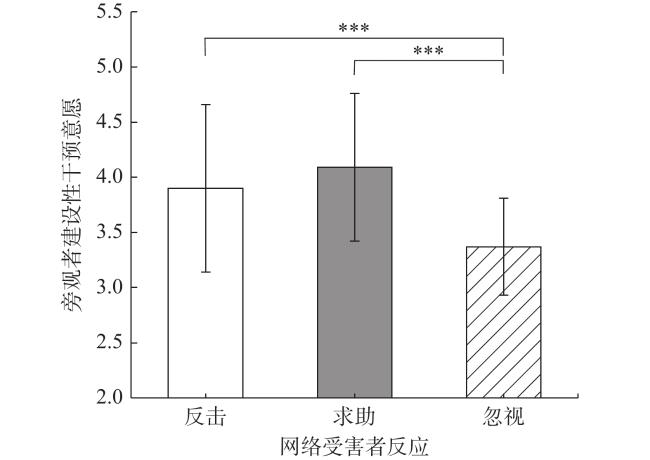
方差分析结果表明,网络受害者反应的主效应显著,F(2, 187)=28.09,p<0.001,$ \text{η}_\text{p}^2 $ =0.23(图1 )。反击组的建设性干预意愿得分(3.90±0.76)显著高于忽视组(3.37±0.44),p<0.001;求助组的建设性干预意愿得分(4.09±0.67)显著高于忽视组,p<0.001;反击组和求助组的建设性干预意愿得分差异不显著,p=0.112。
2.3 讨论
实验1发现,相比于忽视行为,受害者的求助和反击行为均会显著增强网络旁观者的建设性干预意愿,验证了假设1。在此基础上,实验2进一步引入状态共情,考察启动网络旁观者的状态共情是否会显著提升其在面对受害者不同反应时的建设性干预意愿。
3 实验2:状态共情在网络受害者反应与旁观者建设性干预意愿间的调节作用
实验2考察状态共情在网络受害者不同反应与旁观者建设性干预意愿关系中的调节作用。
3.1 研究方法
3.1.1 被试
在辽宁省两所高校随机招募大学生396名,其中31名被试因问卷填写无效被剔除,最终剩余有效被试365名,有效率为92.17%。其中男生181名,女生184名,平均年龄为21.29±2.64岁。
3.1.2 实验设计
采用3(受害者反应:反击、求助、忽视)×2(状态共情:启动组、控制组)的被试间实验设计,其中反击启动组被试62名(男生31名),反击控制组被试61名(男生31名),求助启动组被试60名(男生30名),求助控制组被试60名(男生28名),忽视启动组被试62名(男生30名),忽视控制组被试60名(男生31名)。因变量为旁观者建设性干预意愿。
3.1.3 实验材料
(1)状态共情启动材料
采用改编后的经典情景启动范式(林沐雨 等, 2016),并通过预实验筛选出的2段状态共情启动材料和控制材料操纵状态共情。
(2)状态共情检验材料
采用由Batson等人(1995)编制的共情反应量表(Empathy Concern Scale, ECS)来测量个体的状态共情水平。该量表由6个反应共情的形容词(如“怜悯的”“同情的”)组成,采用7点计分,1代表“完全没有”,7代表“非常强烈”,总分越高表明个体的状态共情水平越高。本研究中该量表的Cronbach’ α系数为0.92。
(3)受害者反应描述材料
同实验1。
(4)网络旁观者的建设性干预意愿量表
同实验1。
(5)网络欺凌经历检验材料
同实验1。
(6)特质共情检验材料
同实验1。
3.1.4 实验程序
(1)预实验。
旨在筛选出用于正式实验的状态共情启动和控制材料。选择字数约为四百字的4段状态共情启动材料和2段控制材料对20名大学生(男生10名)进行预测,采用7点计分,总分越高表明状态共情水平越高。结果显示,6段描述材料的平均分数分别为4.65±1.46、5.01±1.28、5.20±1.30、4.73±1.31、2.96±1.54和2.00±1.25。选择得分最高的材料三(5.20±1.30)作为状态共情启动组材料,得分最低的材料六(2.00±1.25)作为状态共情控制组材料。结果显示启动组得分显著高于控制组,t(18)=6.73,p<0.001,d=1.54。
(2)正式实验。
将被试随机分配到6个实验条件组(受害者反应×状态共情)。所有的实验材料都集中于一份纸质版问卷。第一部分是状态共情启动操作,按照状态共情启动组和控制组分别呈现能够/不能唤起状态共情的材料。第二部分分别呈现三种受害者反应的欺凌事件描述材料并测量被试的建设性干预意愿,同实验1。第三部分是状态共情效果检验,即所有被试填写状态共情反应量表。第四部分是实验目的排查以及测量被试的网络欺凌经历和特质共情水平,同实验1。
3.2 结果
3.2.1 状态共情启动有效性检验
使用独立样本t检验对状态共情启动组和控制组的特质共情水平进行检验。结果显示,状态共情启动组的人际反应指针量表总分(49.29±11.64)与控制组(48.60±11.86)无显著差异,t(363)=0.57,p=0.572,d=0.06,表明状态共情启动组和控制组被试的特质共情水平无显著差异。使用独立样本t检验对状态共情操纵的有效性进行检验。结果显示,启动组被试的状态共情反应量表得分(4.90±1.13)显著高于控制组(4.19±1.54),t(363)=5.06,p<0.001,d=0.53,表明状态共情的启动有效。
3.2.2 网络旁观者建设性干预意愿的结果分析
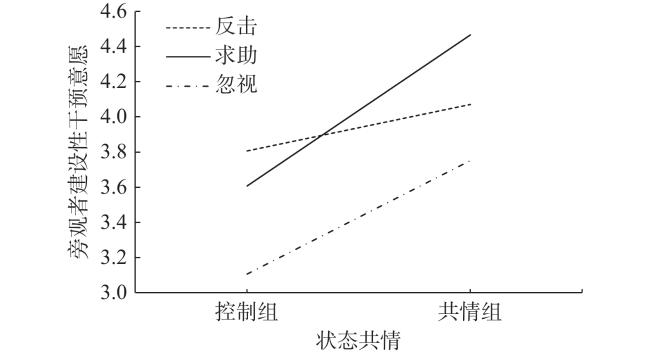
方差分析结果表明,受害者反应的主效应显著,F(2, 354)=49.25,p<0.001,$ \text{η}_{\mathrm{p}}^2$ =0.22,反击组的建设性干预意愿得分(3.94±0.75)显著高于忽视组(3.43±0.69),p<0.001;求助组(4.04±0.72)显著高于忽视组,p<0.001;反击组和求助组差异不显著,p=0.277。状态共情的主效应显著,F(1, 354)=31.63,p<0.001,$ \text{η}_{\mathrm{p}}^2$ =0.08,启动组的建设性干预意愿得分(4.09±0.72)显著高于控制组(3.51±0.69),p<0.001。状态共情和受害者反应的交互效应显著,F(2, 354)=9.52,p<0.001,$ \text{η}_{\mathrm{p}}^2 $ =0.05(图2 )。简单效应分析发现,在状态共情启动情况下,求助组的建设性干预意愿显著高于反击组(p=0.003)和忽视组(p<0.001),反击组显著高于忽视组(p=0.006);在状态共情控制情况下,反击组和求助组的建设性干预意愿均显著高于忽视组(ps<0.001),反击组和求助组差异不显著(p=0.253)。


3.3 讨论
实验2发现,在启动状态共情的情况下,相比于忽视行为,求助行为和反击行为会引发旁观者更强的建设性干预意愿,其中当受害者表现出求助行为时,旁观者的建设性干预意愿最强,这不仅验证了假设2,还表明在启动状态共情的情况下,受害者表现出的求助行为是有助于旁观者提升建设性干预意愿的最佳策略。
4 总讨论
4.1 网络受害者反应对旁观者建设性干预意愿的影响
实验1发现,相比于忽视行为,网络受害者的求助和反击行为会唤起旁观者更强的建设性干预意愿,这首次证实了不同类型网络受害者反应对旁观者建设性干预意愿影响的差异性。道德角色定型理论指出,个体会在无意识中对道德事件所涉及的不同角色进行形象定型,并预期各角色会产生相应的情绪特征和行为反应(Gray et al., 2012)。当受害者的反应特征符合个体预期时,个体会对受害者的印象评价更加积极,信任程度也更高(邵晓露, 2019)。因此,在网络欺凌事件中,旁观者预期受害者会表达情绪状态(如痛苦)和相应行为(如求助或反抗)(Lens et al., 2014),这些情绪和行为会感染旁观者,使其对受害者的整体评价和信任程度更高,进而更愿意提供帮助。同时,根据扩展到网络欺凌情境的归因理论(Holfeld, 2014),当受害者忽视网络欺凌事件时,旁观者更有可能将欺凌事件归因于受害者,认为欺凌事件是由受害者内部的、稳定的因素所导致,进而引发对受害者更强的责任归因和责备归因,最终降低了建设性干预意愿。因此,当网络欺凌受害者表现出反击或求助行为时,往往会唤起旁观者更强的建设性干预意愿,而当受害者忽视其所遭受的网络欺凌时,则会明显降低旁观者的建设性干预意愿。
4.2 状态共情的调节作用
实验2发现,状态共情在网络欺凌受害者反应影响旁观者建设性干预意愿的关系中起正向调节作用。当启动状态共情时,与受害者表现出忽视行为的情况相比,旁观者在目睹受害者的求助和反击行为时,会表现出更强的建设性干预意愿。以往研究发现,高水平共情会诱发个体对他人行为反应的判断和情绪体验,使其更易感知到他人行为的诉求和感受(Martingano & Konrath, 2022),这将促使个体对他人的情感和需求更为敏感,进而减少个体的道德推脱和责备归因等不良认知倾向,恢复和增加其对他人的信任感(Bagdasarov et al., 2019),并增强想要帮助他人脱离困境的利他行为动机,最终引发更多的助人意愿与行为(Liang et al., 2020)。因此,当启动状态共情时,对于表现出明确行为(求助和反击)的受害者,网络欺凌旁观者更能深刻理解和感受到受害者的情感和需求,进而增强了对受害者的印象评价和利他动机,从而提升其建设性干预意愿的水平。
本研究结果进一步表明,在启动状态共情下,相比另外两种受害者反应,直接求助会引发旁观者最强的建设性干预意愿。以往研究表明,高共情状态可以提高个体对于他人消极心理感受的注意和关切能力(Fischer et al., 2011),进而提升其道德敏感性水平,这会促使个体更容易与他人产生共鸣,最终有助于增强其亲社会意愿和行为的产生(Hu et al., 2017)。因此,启动网络旁观者的状态共情会提高其道德敏感性水平,进而促使旁观者自身体验到更强的内疚、焦虑、不适和负罪感(Zhao et al., 2023),而旁观者的这些消极情绪体验在受害者向其明确提出帮助请求时更为强烈,为减轻这种不愉快体验,他们会对提出求助意愿者产生更强的帮助意愿和动机(Wang, 2021),最终以有助于求助者的方式去行动。此外,根据感知行为模型(Verplanken & Holland, 2002),高共情状态的个体会注意到危机情境中求助者的消极状态,这种求助信号会自动激发个体识别他人的不良状态,进而迅速促使其表现出具有利他主义的亲社会决策倾向(Vieira et al., 2020)。因此,网络受害者向他人明确提出帮助请求无疑是保障受害者身心安全的最佳策略。
4.3 研究意义与展望
本研究深入探讨了信息通信技术高速发展背景下,网络受害者不同反应对旁观者建设性干预意愿的影响及状态共情的调节作用。研究不仅丰富了网络欺凌领域的理论体系,验证了归因理论和共情−利他主义假说等理论在网络情境中的适用性,还首次揭示了网络受害者的三种典型行为反应对旁观者建设性干预意愿的差异性影响,并在实践中指出,促进网络受害者的求助行为和提升旁观者的状态共情水平,是激发旁观者建设性干预意愿、有效减少网络欺凌的关键策略。因此,通过引导网络受害者采取积极的求助行为和适度的反击行为,以及提升旁观者的共情水平,可以更有效地激发旁观者的建设性干预意愿。
本研究仍存在一些不足:首先,研究采用的是问卷情景法,尽管其有效性已被以往研究证实,但被试仍有可能受到社会赞许性的影响(王跃鹏, 孟维杰, 2022)。未来可在真实的网络欺凌情境中考察旁观者建设性干预意愿的影响机制,以提高研究结果的生态效度。其次,本研究仅考察了在恒定严重程度的网络欺凌事件中受害者反应对旁观者建设性干预意愿的影响,并未将事件的不同严重程度纳入研究。以往研究发现,在不同严重程度下,旁观者的干预意愿存在较大差异(Macaulay et al., 2019)。未来可将事件严重程度纳入研究,以考察其与受害者反应对旁观者建设性干预意愿的共同作用。最后,虽然有研究表明助人意愿显著正向预测助人行为(Leung, 2021),但也有研究发现个体报告的助人意愿较高,但实际的保护行为较少(Lindstrom Johnson et al., 2013)。因此,未来有必要进一步考察网络欺凌情境中受害者反应对实际建设性干预行为的影响及其与建设性干预意愿之间的差异。
5 结论
(1)相比于网络受害者的忽视行为,其求助和反击行为会引发网络旁观者更强的建设性干预意愿。(2)状态共情在网络受害者反应与旁观者建设性干预意愿的关系中起正向调节作用。当启动旁观者的状态共情时,受害者的求助和反击行为相比忽视行为更能激发旁观者的建设性干预意愿,其中求助行为所引发的建设性干预意愿最强。