?

Interoceptive Rhythm and Mental Health: From a New Perspective

  • Jiale LI ,
  • Yuqing ZHANG ,
  • Jiawen YAN ,
  • Qiong WU , *
Expand
  • School of Psychology, Capital Normal University, Beijing 100048

Received date: 2024-07-03

  Online published: 2026-01-01

Copyright

Copyright reserved © 2025.

Abstract

Interoception, a process wherein the nervous system senses, interprets, and integrates signals originating from within the body to provide a moment-by-moment mapping of the body’s internal state across conscious and unconscious levels, is crucial for maintaining homeostasis. The interoceptive system exhibits a unique rhythm, and the disruption of this rhythm is a prominent feature of different mental disorders. Therefore, the role of interoception in mental health has gained increased attention from researchers. In this paper, we review the physiological and psychological mechanisms of interoceptive rhythm, and then summarize the empirical evidence on the interaction between interoceptive rhythm and mental health. Finally, we propose an integrative theory grounded in the free energy framework and predictive coding model, which provides a testable framework to quantify the potential mechanism through which interoceptive rhythm affects mental health.

Cite this article

Jiale LI , Yuqing ZHANG , Jiawen YAN , Qiong WU . Interoceptive Rhythm and Mental Health: From a New Perspective[J]. Studies of Psychology and Behavior, 2025 , 23(6) : 721 -730 . DOI: 10.12139/j.1672-0628.2025.06.001

1 引言

近几十年以来,国内外学术界对心理健康相关议题的关注度一直呈上升趋势,大部分研究从脑−认知−行为的视角开展,关注心理疾病在认知和行为异常上的神经机制,通过开发相关行为疗法或直接的神经调控对其进行矫治(Braun et al., 2018; Cui et al., 2024; Fox & Lobo, 2019; Hooten, 2016)。但这一视角忽略了心理健康问题在认知或行为异常之外的一个重要的症状表现,即对躯体和身体信号感受的异常。比如,焦虑、抑郁患者常常报告其情绪和身体相脱离(Paulus & Stein, 2010),这种感受与身体的内部信号相联系。随着具身认知理论的兴起,身心之间的交互作用不断被证实,从身体信号这一新视角来探讨心理健康问题的潜在原因、发生机制和干预方案是必要的(Canino et al., 2024; Khalsa et al., 2018)。内感受(interoception)是指神经系统(中枢和外周)感觉、解释、整合来自身体内部的信号,从而在意识和无意识层面上提供关于身体内部的实时映射(Craig, 2002; Critchley et al., 2004; Khalsa et al., 2018; Sherrington, 1906)。内感受信号源于身体内部,涵盖心跳、呼吸、胃肠和泌尿系统等,这些信号的节律性活动对于维护心理健康至关重要。

2 内感受节律的生理和心理机制

2.1 内感受节律的生理机制

内感受信号的一个重要特征是节律性,反映内感受信号在一定时间间隔内的重复波动。众多内感受信号中,心跳、呼吸和胃肠的节律性活动最具代表性。心跳周期由心室收缩期与舒张期的规律性交替构成,成年人一次心跳的周期通常为900 毫秒(Engelen et al., 2023)。呼吸周期是吸气呼气的节律活动,时程为5秒(Smith et al., 1991)。胃肠周期是胃肠道消化食物时肌肉的收缩、舒张运动,时程约为20秒(Wolpert et al., 2020)。
内感受信号遵循核心的内感受通路进行传递(图1)。这一通路始于化学感受器、温度感受器和机械感受器,随后通过两条主要的传入通路—颅神经和脊髓通路—传递到中枢神经系统,除了脑干中典型的内脏接收区孤束核和臂旁核外,内脏传入信息被更直接地传递和/或投射到后岛叶(Phillips et al., 2019)和初级感觉皮层(Berntson & Khalsa, 2021; Critchley & Harrison, 2013; Khalsa et al., 2009),之后在岛叶中部与其他感觉输入进行整合,最终在前岛叶重新表达,成为意识可及的信息(Craig, 2009; Kleckner et al., 2017)。
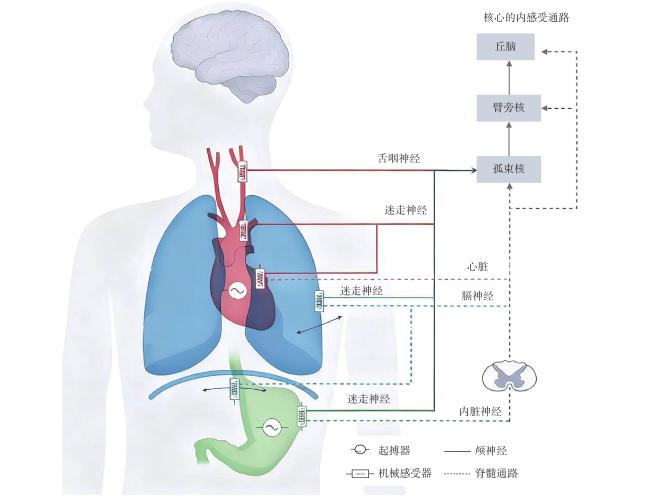
尽管内脏信息的核心内感受通路是一致的,但心跳、呼吸和胃肠产生节律信号的具体位置不同。心跳节律产生在压力感受器(Skora et al., 2022),心脏收缩时,血液被射入主动脉,产生的压力变化会被压力感受器检测到,发生牵张反应,随着心室进入舒张期,血液不再被排出,压力感受器呈相对静止状态(Eckberg & Sleight, 1992)。呼吸过程受自主神经系统调节,呼吸节律在脑干的前包钦格(pre-Bötzinger)复合体中产生,这一复合体协调呼吸循环的所有阶段,驱动吸气肌并协调呼气运动(Del Negro et al., 2018)。胃肠节律性由卡哈尔(Cajal)间质细胞引发(Sanders et al., 2006),瘦素、胃饥饿素和胆囊收缩素等激素也参与调节饥饿、饱腹感和食物摄入(Berntson & Khalsa, 2021)。

2.2 内感受节律的心理机制

Garfinkel等(2015)基于客观测量、主观体验和元认知意识三个角度,提出了内感受心理加工的三维度模型,该模型将内感受分为内感受准确性(interoceptive accuracy)、内感受敏感性(interoceptive sensibility)和内感受意识(interoceptive awareness)。

2.2.1 内感受准确性维度

内感受准确性是指正确监测身体内部感觉的能力,是客观维度的内感受测量,一般通过行为学任务来进行。最初对内感受的客观测量是从心跳这一感觉通路开始的,由于心跳感知相较于其他内脏器官活动更容易,且心跳的测量过程不会对人体造成伤害,这使得心跳知觉任务成为测量内感受准确性的经典范式。心跳知觉任务包括两种常用范式:心跳计数任务(heartbeat counting task, HCT)(Dale & Anderson, 1978; Schandry, 1981)和心跳探测任务(heartbeat detection task, HDT)(Whitehead et al., 1977)。HCT操作简单、易于执行,但其表面效度一直受到质疑,因为个体可以在没有知觉到任何心跳的情况下通过以接近其心率的速度进行计数,从而准确地完成任务(Zamariola et al., 2018)。HDT弥补了HCT的不足,被试的良好表现取决于对心跳的准确觉察(Brener & Ring, 2016)。
由于心跳信号在平静状态下较难被多数人所感知到,其知觉准确性在50%~70%之间,使得基于心跳范式的研究因其“测不准”问题而变得难以解释(Brener & Ring, 2016; Zamariola et al., 2018)。呼吸可以自主控制,呼吸检测近年来成为测量内感受准确性的重要方法。比较常用的测量范式是呼吸阻力负荷探测/区分范式(respiratory resistance tasks)(Davenport et al., 2007; Webster & Colrain, 2000),其生态效度较高,但由于研究内感受时倾向于使用中性刺激,所以存在一些缺陷(van Den Houte et al., 2021)。Harrison等研究者在此基础上进行了改进,提出“是/否”任务和两区间强制选择任务(Harrison, Garfinkel, et al., 2021; Harrison, Köchli, et al., 2021; Harrison, Marlow, et al., 2021)。受限于过滤器中一次性吹嘴耗材的使用,该范式实验成本较高。呼吸延迟探测任务(breath-delay detection task, BDT)是最近开发的测量范式(Wang et al., 2019),该任务便于操作,性价比高。呼吸范式被证明具有良好的信效度,可重复性较高,应用潜力更广(Garfinkel, Manassei, et al., 2016; Wu et al., 2022)。
相比之下,胃肠活动属于较隐蔽的生理过程。对胃肠节律生理信号的探测往往借助于胃肠电等生物电信号监测技术来间接测量。近年来对胃肠节律主观感知的测量得到发展。Mayeli等(2021)通过让被试口服摄入振动胶囊来研究对胃肠进行无创振动刺激是否会产生可靠的胃肠道感知信号。

2.2.2 内感受敏感性维度

内感受敏感性的测量要求被试报告自己对内感受的信念(Suksasilp & Garfinkel, 2022),是主观维度的内感受测量,一般通过两种方式来进行:一种是信心评级,通常是被试在客观测量内感受准确性的行为任务基础上对其进行信心打分(Garfinkel et al., 2015)。另一种是通过问卷进行测量,常用的问卷包括身体知觉问卷的身体觉察子量表(Awareness Subscale of Body Perception Questionnaire, BPQ-A)(Porges, 1993)、内感受准确性量表(Interoceptive Accuracy Scale, IAS)(Murphy et al., 2018)、内感受注意量表(Interoceptive Attention Scale, IATS)(Gabriele et al., 2022)。这些量表具有良好的内部一致性(Murphy et al., 2020)。需要注意的是,这两种测量方式之间常常不存在关联(Garfinkel et al., 2015)。

2.2.3 内感受意识维度

内感受意识通常是将内感受准确性得分和信心评级相联系来进行量化。采用信号检测论II型模型中的相关指标来表示。经典的信号检测论I型模型把“击中”定义为信号出现时被试报告“有”的概率,“虚报”定义为噪音出现时被试报告“有”的概率,输出指标是辨别力d’ ,用作内感受准确性维度的客观指标。II型模型将元认知意识看作主观信心评分对判断准确性的敏感度,将“击中”定义为判断正确时出现高信心的概率,“虚报”定义为判断错误时出现高信心的概率,输出指标为meta-d’ (Fleming & Lau, 2014),也有研究者称其为“绝对II型辨别力”(Maniscalco & Lau, 2012)。meta-d’反映了信心评估包含信息的多少,既取决于待评估信息的质量,又取决于元认知评估本身的质量,这会影响对元认知评估本身质量的衡量。因此,“相对II型辨别力”被提出,一般用meta-d’−d’或meta-d’ /d’表示,该因素排除了Ⅰ型表现的贡献,提供了元认知评估本身效能的衡量(Maniscalco & Lau, 2012; Wu et al., 2020)。内感受意识维度可以采用“绝对II型辨别力”和“相对II型辨别力”来作为量化指标。
针对三个维度间的关系,大部分研究集中在内感受准确性和敏感性上,对内感受意识的相关探讨较少。内感受客观测量和主观信念之间的对应能够支持任务效度。在心跳通道上由于测量任务本身的局限性,未发现内感受准确性和敏感性之间的相关(Garfinkel et al., 2015; Murphy et al., 2020)。在呼吸通道上,内感受准确性和敏感性之间的对应关系受到任务影响。采用呼吸阻力任务测量的准确性与敏感性无关(Garfinkel, Manassei, et al., 2016),而采用BDT测量的准确性与敏感性显著相关(闫俊利, 2023; Wang et al., 2019),这种相关支持了BDT的良好效度。

3 内感受节律与心理健康的关系

3.1 内感受节律与心理健康关系的研究进展

首先,内感受节律的生理机制影响心理健康,但研究结果尚未形成统一。有研究发现,在心跳周期中,相比于舒张期,收缩期抑制情绪加工(Garfinkel et al., 2013)。然而,近些年的研究结果反驳了这一观点,支持收缩期促进特定情绪加工。例如,有研究发现与舒张期相比,收缩期时厌恶面孔被评价为更强烈(Gray et al., 2012),恐惧情绪更容易被个体感知(Garfinkel et al., 2014; Leganes-Fonteneau et al., 2021)。这一复杂的结果可能是由于特定威胁性的视觉刺激更容易被察觉,并在收缩期时被评价为更强烈,因为收缩期时压力感受器激活,内脏传入信号通过编码心跳的时间和强度,提示大脑心血管觉醒的状态。
其次,内感受节律的心理机制影响心理健康,但在三个维度上的表现不同。在内感受准确性维度上,心脏内感受准确性与心理健康关系的研究结果存在不一致。对早期证据的系统回顾发现,心脏内感受准确性越高的个体焦虑程度越高(Domschke et al., 2010; Schandry, 1981),抑郁症患者的心脏内感受准确性通常较差(Eggart et al., 2019)。然而,随后的研究未能发现心脏内感受准确性与特质焦虑和抑郁之间的显著关联(Adams, Edwards, et al., 2022; Desmedt et al., 2022; Jenkinson et al., 2024)。这可能是个体对自己心跳的感知能力造成的偏差,来源于基于心跳的测量方法本身的局限性。呼吸内感受准确性和心理健康关系的研究发现,准确性高的个体其焦虑水平更低,通过正念训练可以提高呼吸内感受准确性并改善负面情绪(Harrison, Köchli, et al., 2021; Wu et al., 2022)。对胃肠通道来说,胃肠内感受准确性较低的个体有较高的身体羞耻感和体重焦虑(Todd et al., 2021)。对内感受敏感性和心理健康关系的早期实证回顾发现,内感受敏感性越高,抑郁程度越高(Wiebking et al., 2010),但近年来研究证据表明,较高的抑郁严重程度与较低的敏感性相关(Dunne et al., 2021; Eggart & Valdés-Stauber, 2021)。这种矛盾的结果可能是样本异质性和测量方法不同造成的(Jenkinson et al., 2024)。在内感受意识维度上,研究发现拥有良好的元认知意识会减少焦虑症状,促进情绪调节(Füstös et al., 2013; Harrison, Marlow, et al., 2021)。
最后,心理健康水平也会影响个体的内感受加工,同时伴随着内感受神经环路上的变化。例如,焦虑状态增强时,心跳传入信号的频率增加(Nord & Garfinkel, 2022)。抑郁症患者和高功能孤独症患者的内感受准确性和敏感性通常较低(Critchley & Garfinkel, 2017; Furman et al., 2013; Garfinkel, Tiley, et al., 2016)。脑岛是大脑的内感受中枢,焦虑症和抑郁症患者的岛叶皮层的神经活动表现出异常(Gu et al., 2013; Paulus & Stein, 2006)。

3.2 内感受节律与心理健康的相关理论

本部分基于经典理论和理论的发展对实证发现进行机制阐释,随后从一个整合模型出发阐述内感受节律与心理健康相互作用机制。

3.2.1 内感受节律对心理健康的影响:经典理论

(1)詹姆斯−兰格情绪理论
James(1884)最早提出,内脏传入反馈与情绪体验密切相关。先有机体的生理变化,而后才有情绪,情绪是对身体变化的知觉。Lange(1885)认为,情绪更多的是生理推理,是内脏活动的结果。他们看到了情绪与机体变化的直接关系,强调情绪的产生是植物性神经活动的产物。现有的一些实证研究支持了该理论(Leirgul et al., 2022; Longmuir et al., 2018; Nord & Garfinkel, 2022)。这一理论主要强调生理变化影响情绪,进而影响心理健康,忽视了对生理信号的主动感知和调节在其中发挥的作用。
(2)沙赫特−辛格情绪认知理论
Schachter和Singer(1962)支持James(1884)的观点,认为内脏唤醒是情绪体验的先决条件,但他们强调认知评价在所产生的情绪状态中的重要性。个体对自身内部信号的认知存在异质性,这种差异影响情绪和心理健康。一方面,个体对内部信号感知的客观准确性影响心理健康(Harrison, Köchli, et al., 2021; Todd et al., 2021; Wu et al., 2022);另一方面,个体对内部信号感知准确性的主观评价影响心理健康(Dunne et al., 2021; Eggart & Valdés-Stauber, 2021)。该理论更强调认知在情绪体验中的重要性,忽略了生理信号本身的作用。
(3)躯体标记假说
Damasio(1994)提出躯体标记假说,由詹姆斯−兰格情绪理论发展而来。Damasio对情绪的定义为:大脑系统会对一些特定感知内容做出反应,反应时所引起的身体和大脑状态改变的总和就是情绪。该假说认为,情绪是具身的情绪,情绪反应既针对身体又针对大脑。其核心观点是,由身体状态产生的反馈最终会在脑岛和体感皮质中表现出来,形成内脏感觉状态和内感受记忆基底,这些基底会调节个体在不确定和复杂情境中的决策行为。这一理论既关注内感受节律的生理机制,又强调心理机制的重要性。

3.2.2 内感受节律对心理健康的影响:理论的发展

(1) 具身认知理论
后续理论在经典理论的基础上实现系统性拓展,更全面地阐释内感受节律影响心理健康。具身认知,这一概念赋予了身体新的内涵,认为身体是认知的主体(叶浩生, 2013)。具身认知理论由身体观和模拟观组成,两者从不同角度证明了高级认知过程和身体体验之间的密切关系。身体观认为实际的身体状态会对高级认知加工产生影响(Larsen et al., 1992; Strack et al., 1988)。模拟观认为高级认知加工会激活并使用感知觉、运动和内省系统的先前经验(Barsalou et al., 2008; Barsalou et al., 2003)。该理论不仅考虑到了生理体验和主观认知,而且强调了主观认知中先验预期的重要性。
(2)振荡同步机制
最初的振荡同步理论认为,大脑的振荡同步现象独立于身体节律(Fries, 2005; Singer, 1993)。随后发展出的“脚手架假说”(Engelen et al., 2023)提出了不同的视角:大脑不同区域的神经活动的节律性特征实际上反映了内感受信号的节律。当这些节律与大脑活动相匹配时,可视为这些区域间存在同步。脚手架假说可以解释收缩期和舒张期对外部刺激的差异加工:周期效应是由于感觉采样增强和减弱的时间窗口所导致的,在这些窗口期内,大脑对感觉信息的处理更为高效或缓慢。振荡同步机制可以解释压力感受器的激活促进特定情绪加工,但难以解释一些矛盾的结果,比如,在疼痛感觉领域,压力感受器的激活会抑制疼痛感(Al et al., 2021; Grund et al., 2022)。另外,该机制不能解释当振荡同步发生紊乱时心理疾病问题如何产生。
(3)多感觉整合机制
多感觉整合是不同感觉通道的信息在大脑中汇集,并在特定神经元上共同加工的过程(Park & Blanke, 2019)。这一框架下,内外感觉信息的组合输入不仅仅是信息的简单叠加,而是通过增强或减弱的方式,使得同时呈现两种感觉输入时的反应强度大于或小于单独呈现每种输入时反应的总和(Stein & Stanford, 2008)。例如,心脏收缩期时,触觉刺激引起的神经反应受到抑制,这可能反映了触觉和压力感受器输入在躯体感觉皮层中的多感官竞争(Al et al., 2021)。多感觉整合是构建身体自我感知的基础,可以改变精神疾病患者扭曲的身体意象(张静, 陈巍, 2020, 2021; Adams, Murphy, et al., 2022; Blanke et al., 2015),但这一机制在解释焦虑、抑郁的产生上还缺乏实证研究。该机制综合了内外感受,不再仅从单一通道考虑内感受节律对心理健康的影响。

3.2.3 内感受节律与心理健康的相互影响:一个整合的理论

以往理论解释了生理体验对心理状态的影响,对于心理状态如何影响内部体验目前还没有较为系统的理论解释。随着内感受研究的蓬勃发展,很多理论论证表明贝叶斯推理是内感受和外感受的统一原则(Petzschner et al., 2017; Pezzulo et al., 2015)。
贝叶斯大脑假说(Clark, 2013)认为,大脑不是简单的“刺激−反应”器官,并不被动地接收外界刺激,而是主动地构建和预测所处环境。在这个过程中,大脑不断利用已有的知识、经验和期望,生成对未来的假设,并与实际的感觉输入进行比较和修正。这就是大脑的预测模型,其理论基础是贝叶斯推理(Khalsa et al., 2018)。自由能原理由Friston(2010)提出,基本思想是将贝叶斯推理转换为数学优化问题。该原理认为,生物体通过最小化它们所体验到的世界与其内部生成模型之间的差异来减少自由能消耗,以维持稳态生存(Friston, 2009, 2010),这一过程通过预测编码来进行数学建模。预测编码模型最初用来解释外感受(如视觉、听觉)领域的知觉加工过程,近年来也逐渐被应用于内感受领域(Seth, 2013; Seth & Critchley, 2013)。
依据预测编码模型,内感受加工可以被理解为先验预期、预测误差和精度这三个变量间的相互作用(Ainley et al., 2016; Petzschner et al., 2017)。人们对于自身内感受信号的知觉依赖于由先前经验所产生的自上而下的预期,当其与自下而上的真实内感受信号输入不匹配时,将产生一个预测误差。日常生活中个体之所以不会觉察到心跳、呼吸等内感受信号,是因为预期和输入信号之间完全匹配,没有预测误差产生。但当内感受传入信号或先验预期改变时,感觉输入不能完全被先验预期所预测,所产生的预测误差使得先验预期被更新,内感受信号因而被觉察(Quadt et al., 2018)。为了最小化预测误差,系统需要判断误差的精度。精度是为了确定输入信号和先验预期在内感受加工中的相对权重:当输入信号的精度低于先验预期时,信号被认为是不可靠的,对预期更新的贡献较小;当输入信号的精度高于先验预期时,信号被认为是可靠的,就会被更多地放大(Barrett et al., 2016; Barrett & Simmons, 2015)。该模型可以解释由内感受加工异常所导致的焦虑、抑郁等负性情绪。当先验预期不够精确时,自下而上的内感受信号不能被先验预期所解释,产生较大的预测误差,使个体异常觉察内感受信号,表现出心慌、气短等外显症状。此外,大脑为了解释这些误差信号的来源,将会调动大量认知资源,从而导致前额叶等高级皮层的过度激活,表现为冗思、担忧等外显症状,这些是焦虑的典型症状。抑郁则是大脑相对“封闭”的结果,如果先验预期过度精确,对外界输入的信号不敏感进而很难被真实的信号所更新,预期与现实的差异会逐渐加大,这种自上而下的顽固机制是负性且过于强的时候,就容易产生抑郁情绪。
大脑作为预测机器这一视角先前主要应用于外感受,Seth(2013)描述了一个关于内感受的预测性视角:“内感受推理”,将主观感受状态构想为产生于对内感受传入原因的主动推断的预测性模型。内感受推理在维持体内平衡中发挥作用,内稳态和外稳态是生物体维持体内平衡的两种方式,二者都依赖于预测误差最小化。主动推理扩展了预测编码的概念,不仅考虑了大脑如何通过调整内部模型来减少预测误差,还包括生物体如何通过采取行动改变外部环境,使得感官输入更加符合其预期。这一框架中,感知和行动紧密耦合,这里的行动不仅仅是对外部刺激的反应,也是为了最小化预测误差而采取的动作(Gu & FitzGerald, 2014; Seth, 2013; Seth & Friston, 2016; Tsakiris & Critchley, 2016)。主动推理框架可以用来解释心理健康对内感受节律的影响。比如,焦虑症患者往往表现出高警觉性和对潜在威胁的过度敏感,导致外稳态负荷,为了维持体内平衡,减少预测误差,个体的心跳强度和对信号的感知能力增加(Nord & Garfinkel, 2022)。
尽管在理论上预测编码和主动推理框架很好地回答了内感受节律与心理健康如何相互作用,但仍缺乏实验证据。有研究者通过模拟仿真将情绪纳入自由能框架,支持了情绪分类的动态自由能解释(Joffily & Coricelli, 2013)。最近的研究比较了强化学习模型和预测编码模型在呼吸内感受和焦虑关系中的解释力,结果支持了强化学习模型(Harrison, Köchli, et al., 2021),但由于该研究未能有效操纵高层级的环境波动预测误差,所以这一结论可能仍存在争议,亟待系统探讨预测编码模型在内感受中发挥的作用。这一模型的优势在于,其变量具有实验可操纵性,计算模型具有可比较性。因此,在进一步回答内感受与心理健康关系上其具有更优的实践可行性。

4 总结和展望

本文系统阐述了内感受节律的生理和心理机制,在此基础上回顾了内感受节律与心理健康关系的实证研究进展,最后总结了解释内感受节律与心理健康关系的相关理论。首先,虽然有关内感受生理机制的结果较为明确,但由于测量心跳内感受的行为学任务(HCT、HDT)的效度受到挑战,目前在心理机制三个维度关系上的结果还存在很多矛盾之处,与之相比,呼吸通道的行为学任务更具前景性。但关于内感受加工是通道特异性还是通道一般性的争论尚缺乏实证证据的支持,未来应通过对内感受不同通道之间的直接比较对此进行探讨。其次,尽管相关理论揭示了内感受节律如何影响心理健康,但它们对于心理健康如何反作用于内感受节律的建构仍显不足。最后,本文所提出的预测编码模型在理论层面具有较好的解释力,但还缺乏相关实证研究的检验。未来可以通过操纵内感受加工中的预期、预测误差和精度等关键变量,比较贝叶斯和强化学习模型家族的解释力和拟合度来回答内感受与心理健康关系底层的认知计算机制,并进一步通过神经科学的技术手段来回答其背后的神经基础。
闫俊利. (2023). 探寻测量内感受最佳方式(硕士学位论文). 首都师范大学, 北京.

叶浩生. 认知与身体: 理论心理学的视角. 心理学报, 2013, 45 (4): 481- 488.

张静, 陈巍. 身体拥有感及其可塑性: 基于内外感受研究的视角. 心理科学进展, 2020, 28 (2): 305- 315.

张静, 陈巍. 对话心智与身体: 具身认知的内感受研究转向. 心理科学, 2021, 44 (1): 30- 36.

Adams, K. L., Edwards, A., Peart, C., Ellett, L., Mendes, I., Bird, G., & Murphy, J. The association between anxiety and cardiac interoceptive accuracy: A systematic review and meta-analysis. Neuroscience & Biobehavioral Reviews, 2022, 140, 104754.

Adams, K. L., Murphy, J., Catmur, C., & Bird, G. The role of interoception in the overlap between eating disorders and autism: Methodological considerations. European Eating Disorders Review, 2022, 30 (5): 501- 509.

DOI

Ainley, V., Apps, M. A. J., Fotopoulou, A., & Tsakiris, M. ‘Bodily precision’: A predictive coding account of individual differences in interoceptive accuracy. Philosophical Transactions of the Royal Society B: Biological Sciences, 2016, 371 (1708): 20160003.

DOI

Al, E., Iliopoulos, F., Nikulin, V. V., & Villringer, A. Heartbeat and somatosensory perception. NeuroImage, 2021, 238, 118247.

DOI

Barrett, L. F., Quigley, K. S., & Hamilton, P. An active inference theory of allostasis and interoception in depression. Philosophical Transactions of the Royal Society B: Biological Sciences, 2016, 371 (1708): 20160011.

DOI

Barrett, L. F., & Simmons, W. K. Interoceptive predictions in the brain. Nature Reviews Neuroscience, 2015, 16 (7): 419- 429.

DOI

Barsalou, L. W., Santos, A., Simmons, W. K., & Wilson, C. D. (2008). Language and simulation in conceptual processing. In M. de Vega, A. Glenberg, & A. Graesser (Eds.), Symbols and embodiment: Debates on meaning and cognition (pp. 245–284). Oxford: Oxford University Press.

Barsalou, L. W., Simmons, W. K., Barbey, A. K., & Wilson, C. D. Grounding conceptual knowledge in modality-specific systems. Trends in Cognitive Sciences, 2003, 7 (2): 84- 91.

DOI

Berntson, G. G., & Khalsa, S. S. Neural circuits of interoception. Trends in Neurosciences, 2021, 44 (1): 17- 28.

DOI

Blanke, O., Slater, M., & Serino, A. Behavioral, neural, and computational principles of bodily self-consciousness. Neuron, 2015, 88 (1): 145- 166.

DOI

Braun, U., Schaefer, A., Betzel, R. F., Tost, H., Meyer-Lindenberg, A., & Bassett, D. S. From maps to multi-dimensional network mechanisms of mental disorders. Neuron, 2018, 97 (1): 14- 31.

DOI

Brener, J., & Ring, C. Towards a psychophysics of interoceptive processes: The measurement of heartbeat detection. Philosophical Transactions of the Royal Society B: Biological Sciences, 2016, 371 (1708): 20160015.

DOI

Canino, S., Torchia, V., Gaita, M., Raimo, S., & Palermo, L. Linking the inner and outer mental representations of the body to social cognition skills: A systematic review and meta-analysis. Neuropsychologia, 2024, 204, 108989.

DOI

Clark, A. Whatever next? Predictive brains, situated agents, and the future of cognitive science. Behavioral and Brain Sciences, 2013, 36 (3): 181- 204.

DOI

Craig, A. D. How do you feel? Interoception: The sense of the physiological condition of the body. Nature Reviews Neuroscience, 2002, 3 (8): 655- 666.

DOI

Craig, A. D. How do you feel—now? The anterior insula and human awareness. Nature Reviews Neuroscience, 2009, 10 (1): 59- 70.

DOI

Critchley, H. D., & Garfinkel, S. N. Interoception and emotion. Current Opinion in Psychology, 2017, 17, 7- 14.

DOI

Critchley, H. D., & Harrison, N. A. Visceral influences on brain and behavior. Neuron, 2013, 77 (4): 624- 638.

DOI

Critchley, H. D., Wiens, S., Rotshtein, P., Öhman, A., & Dolan, R. J. Neural systems supporting interoceptive awareness. Nature Neuroscience, 2004, 7 (2): 189- 195.

DOI

Cui, L. L., Li, S., Wang, S. M., Wu, X. F., Liu, Y. Y., Yu, W. Y., … Li, B. M. Major depressive disorder: Hypothesis, mechanism, prevention and treatment. Signal Transduction and Targeted Therapy, 2024, 9 (1): 30.

DOI

Dale, A., & Anderson, D. Information variables in voluntary control and classical conditioning of heart rate: Field dependence and heart-rate perception. Perceptual and Motor Skills, 1978, 47 (1): 79- 85.

DOI

Damasio, A. R. (1994). Descartes’ error: Emotion, reason, and the human brain. New York: Putnam.

Davenport, P. W., Chan, P. Y. S., Zhang, W. R., & Chou, Y. L. Detection threshold for inspiratory resistive loads and respiratory-related evoked potentials. Journal of Applied Physiology, 2007, 102 (1): 276- 285.

DOI

Del Negro, C. A., Funk, G. D., & Feldman, J. L. Breathing matters. Nature Reviews Neuroscience, 2018, 19 (6): 351- 367.

DOI

Desmedt, O., van Den Houte, M., Walentynowicz, M., Dekeyser, S., Luminet, O., & Corneille, O. How does heartbeat counting task performance relate to theoretically-relevant mental health outcomes? A meta-analysis. Collabra: Psychology, 2022, 8 (1): 33271.

DOI

Domschke, K., Stevens, S., Pfleiderer, B., & Gerlach, A. L. Interoceptive sensitivity in anxiety and anxiety disorders: An overview and integration of neurobiological findings. Clinical Psychology Review, 2010, 30 (1): 1- 11.

DOI

Dunne, J., Flores, M., Gawande, R., & Schuman-Olivier, Z. Losing trust in body sensations: Interoceptive awareness and depression symptom severity among primary care patients. Journal of Affective Disorders, 2021, 282, 1210- 1219.

DOI

Eckberg, D. L., & Sleight, P. (1992). Human baroreflexes in health and disease. Oxford: Oxford University Press.

Eggart, M., Lange, A., Binser, M.J., Queri, S., & Müller-Oerlinghausen, B. Major depressive disorder is associated with impaired interoceptive accuracy: A systematic review. Brain Sciences, 2019, 9 (6): 131.

DOI

Eggart, M., & Valdés-Stauber, J. Can changes in multidimensional self-reported interoception be considered as outcome predictors in severely depressed patients? A moderation and mediation analysis. Journal of Psychosomatic Research, 2021, 141, 110331.

DOI

Engelen, T., Solcà, M., & Tallon-Baudry, C. Interoceptive rhythms in the brain. Nature Neuroscience, 2023, 26 (10): 1670- 1684.

DOI

Fleming, S. M., & Lau, H. C. How to measure metacognition. Frontiers in Human Neuroscience, 2014, 8, 443.

Fox, M. E., & Lobo, M. K. The molecular and cellular mechanisms of depression: A focus on reward circuitry. Molecular Psychiatry, 2019, 24 (12): 1798- 1815.

DOI

Fries, P. A mechanism for cognitive dynamics: Neuronal communication through neuronal coherence. Trends in Cognitive Sciences, 2005, 9 (10): 474- 480.

DOI

Friston, K. The free-energy principle: A rough guide to the brain. Trends in Cognitive Sciences, 2009, 13 (7): 293- 301.

DOI

Friston, K. The free-energy principle: A unified brain theory. Nature Reviews Neuroscience, 2010, 11 (2): 127- 138.

DOI

Furman, D. J., Waugh, C. E., Bhattacharjee, K., Thompson, R. J., & Gotlib, I. H. Interoceptive awareness, positive affect, and decision making in major depressive disorder. Journal of Affective Disorders, 2013, 151 (2): 780- 785.

DOI

Füstös, J., Gramann, K., Herbert, B. M., & Pollatos, O. On the embodiment of emotion regulation: Interoceptive awareness facilitates reappraisal. Social Cognitive and Affective Neuroscience, 2013, 8 (8): 911- 917.

DOI

Gabriele, E., Spooner, R., Brewer, R., & Murphy, J. Dissociations between self-reported interoceptive accuracy and attention: Evidence from the Interoceptive Attention Scale. Biological Psychology, 2022, 168, 108243.

DOI

Garfinkel, S. N., Barrett, A. B., Minati, L., Dolan, R. J., Seth, A. K., & Critchley, H. D. What the heart forgets: Cardiac timing influences memory for words and is modulated by metacognition and interoceptive sensitivity. Psychophysiology, 2013, 50 (6): 505- 512.

DOI

Garfinkel, S. N., Manassei, M. F., Hamilton-Fletcher, G., In den Bosch, Y., Critchley, H. D., & Engels, M. Interoceptive dimensions across cardiac and respiratory axes. Philosophical Transactions of the Royal Society B: Biological Sciences, 2016, 371 (1708): 20160014.

DOI

Garfinkel, S. N., Minati, L., Gray, M. A., Seth, A. K., Dolan, R. J., & Critchley, H. D. Fear from the heart: Sensitivity to fear stimuli depends on individual heartbeats. The Journal of Neuroscience, 2014, 34 (19): 6573- 6582.

DOI

Garfinkel, S. N., Seth, A. K., Barrett, A. B., Suzuki, K., & Critchley, H. D. Knowing your own heart: Distinguishing interoceptive accuracy from interoceptive awareness. Biological Psychology, 2015, 104, 65- 74.

DOI

Garfinkel, S. N., Tiley, C., O’Keeffe, S., Harrison, N. A., Seth, A. K., & Critchley, H. D. Discrepancies between dimensions of interoception in autism: Implications for emotion and anxiety. Biological Psychology, 2016, 114, 117- 126.

DOI

Gray, M. A., Beacher, F. D., Minati, L., Nagai, Y., Kemp, A. H., Harrison, N. A., & Critchley, H. D. Emotional appraisal is influenced by cardiac afferent information. Emotion, 2012, 12 (1): 180- 191.

DOI

Grund, M., Al, E., Pabst, M., Dabbagh, A., Stephani, T., Nierhaus, T., … Villringer, A. Respiration, heartbeat, and conscious tactile perception. The Journal of Neuroscience, 2022, 42 (4): 643- 656.

DOI

Gu, X. S., & FitzGerald, T. H. B. Interoceptive inference: Homeostasis and decision-making. Trends in Cognitive Sciences, 2014, 18 (6): 269- 270.

DOI

Gu, X. S., Hof, P. R., Friston, K. J., & Fan, J. Anterior insular cortex and emotional awareness. The Journal of Comparative Neurology, 2013, 521 (15): 3371- 3388.

DOI

Harrison, O. K., Garfinkel, S. N., Marlow, L., Finnegan, S. L., Marino, S., Köchli, L., … Fleming, S. M. The filter detection task for measurement of breathing-related interoception and metacognition. biological psychology, 2021, 165, 108185.

DOI

Harrison, O. K., Köchli, L., Marino, S., Luechinger, R., Hennel, F., Brand, K., … Stephan, K. E. Interoception of breathing and its relationship with anxiety. Neuron, 2021, 109 (24): 4080- 4093.

DOI

Harrison, O. K., Marlow, L., Finnegan, S. L., Ainsworth, B., & Pattinson, K. T. S. Dissociating breathlessness symptoms from mood in asthma. Biological Psychology, 2021, 165, 108193.

DOI

Hooten, W. M. Chronic pain and mental health disorders: Shared neural mechanisms, epidemiology, and treatment. Mayo Clinic Proceedings, 2016, 91 (7): 955- 970.

DOI

James, W. (1884). What is an emotion? Mind, os-IX(34), 188–205.

Jenkinson, P. M., Fotopoulou, A., Ibañez, A., & Rossell, S. Interoception in anxiety, depression, and psychosis: A review. eClinicalMedicine, 2024, 73, 102673.

DOI

Joffily, M., & Coricelli, G. Emotional valence and the free-energy principle. PLoS Computational Biology, 2013, 9 (6): e1003094.

DOI

Khalsa, S. S., Adolphs, R., Cameron, O. G., Critchley, H. D., Davenport, P. W., Feinstein, J. S., … Zucker, N. Interoception and mental health: A roadmap. Biological Psychiatry: Cognitive Neuroscience and Neuroimaging, 2018, 3 (6): 501- 513.

DOI

Khalsa, S. S., Rudrauf, D., Feinstein, J. S., & Tranel, D. The pathways of interoceptive awareness. Nature Neuroscience, 2009, 12 (12): 1494- 1496.

DOI

Kleckner, I. R., Zhang, J. H., Touroutoglou, A., Chanes, L., Xia, C. J., Simmons, W. K., … Feldman Barrett, L. Evidence for a large-scale brain system supporting allostasis and interoception in humans. Nature Human Behaviour, 2017, 1 (5): 0069.

DOI

Lange, C. G. (1885). The mechanism of the emotions. In D. Dunlap (Ed.), The emotions (pp. 33–92). Baltimore: Williams & Wilkins.

Larsen, R. J., Kasimatis, M., & Frey, K. Facilitating the furrowed brow: An unobtrusive test of the facial feedback hypothesis applied to unpleasant affect. Cognition and Emotion, 1992, 6 (5): 321- 338.

DOI

Leganes-Fonteneau, M., Buckman, J. F., Suzuki, K., Pawlak, A., & Bates, M. E. More than meets the heart: Systolic amplification of different emotional faces is task dependent. Cognition and Emotion, 2021, 35 (2): 400- 408.

DOI

Leirgul, E., Hysing, M., Greve, G., & Sivertsen, B. Physical and mental health in young adults with heart disease - A national survey of Norwegian University students. Cardiology in the Young, 2022, 32 (2): 257- 265.

DOI

Longmuir, P. E., Sampson, M., Ham, J., Weekes, M., Patel, B. J., & Gow, R. M. The mental health of adolescents and pre-adolescents living with inherited arrhythmia syndromes: A systematic review of the literature. Cardiology in the Young, 2018, 28 (5): 621- 631.

DOI

Maniscalco, B., & Lau, H. A signal detection theoretic approach for estimating metacognitive sensitivity from confidence ratings. Consciousness and Cognition, 2012, 21 (1): 422- 430.

DOI

Mayeli, A., Al Zoubi, O., White, E. J., Chappelle, S., Kuplicki, R., Smith, R., … Khalsa, S. S. (2021). Neural indicators of human gut feelings. Neuroscience. Advance online publication. https://doi.org/10.1101/2021.02.11.430867

Murphy, J., Brewer, R., Hobson, H., Catmur, C., & Bird, G. Is alexithymia characterised by impaired interoception? Further evidence, the importance of control variables, and the problems with the heartbeat counting task. Biological Psychology, 2018, 136, 189- 197.

DOI

Murphy, J., Brewer, R., Plans, D., Khalsa, S. S., Catmur, C., & Bird, G. Testing the independence of self-reported interoceptive accuracy and attention. Quarterly Journal of Experimental Psychology, 2020, 73 (1): 115- 133.

DOI

Nord, C. L., & Garfinkel, S. N. Interoceptive pathways to understand and treat mental health conditions. Trends in Cognitive Sciences, 2022, 26 (6): 499- 513.

DOI

Park, H. D., & Blanke, O. Coupling inner and outer body for self-consciousness. Trends in Cognitive Sciences, 2019, 23 (5): 377- 388.

DOI

Paulus, M. P., & Stein, M. B. An insular view of anxiety. Biological Psychiatry, 2006, 60 (4): 383- 387.

DOI

Paulus, M. P., & Stein, M. B. Interoception in anxiety and depression. Brain Structure and Function, 2010, 214 (5–6): 451- 463.

DOI

Petzschner, F. H., Weber, L. A. E., Gard, T., & Stephan, K. E. Computational psychosomatics and computational psychiatry: Toward a joint framework for differential diagnosis. Biological Psychiatry, 2017, 82 (6): 421- 430.

DOI

Pezzulo, G., Rigoli, F., & Friston, K. Active inference, homeostatic regulation and adaptive behavioural control. Progress in Neurobiology, 2015, 134, 17- 35.

DOI

Phillips, J. W., Schulmann, A., Hara, E., Winnubst, J., Liu, C. H., Valakh, V., … Hantman, A. W. A repeated molecular architecture across thalamic pathways. Nature Neuroscience, 2019, 22 (11): 1925- 1935.

DOI

Porges, S. W. (1993). Body Perception Questionnaire. College Park: Laboratory of Developmental Assessment, University of Maryland.

Quadt, L., Critchley, H. D., & Garfinkel, S. N. The neurobiology of interoception in health and disease. Annals of the New York Academy of Sciences, 2018, 1428 (1): 112- 128.

DOI

Sanders, K. M., Koh, S. D., & Ward, S. M. Interstitial cells of Cajal as pacemakers in the gastrointestinal tract. Annual Review of Physiology, 2006, 68, 307- 343.

DOI

Schachter, S., & Singer, J. Cognitive, social, and physiological determinants of emotional state. Psychological Review, 1962, 69 (5): 379- 399.

DOI

Schandry, R. Heart beat perception and emotional experience. Psychophysiology, 1981, 18 (4): 483- 488.

DOI

Seth, A. K. Interoceptive inference, emotion, and the embodied self. Trends in Cognitive Sciences, 2013, 17 (11): 565- 573.

DOI

Seth, A. K., & Critchley, H. D. Extending predictive processing to the body: Emotion as interoceptive inference. Behavioral and Brain Sciences, 2013, 36 (3): 227- 228.

DOI

Seth, A. K., & Friston, K. J. Active interoceptive inference and the emotional brain. Philosophical Transactions of the Royal Society B: Biological Sciences, 2016, 371 (1708): 20160007.

DOI

Sherrington, C. S. (1906). The integrative action of the nervous system. New Haven, CT: Yale University Press.

Singer, W. Synchronization of cortical activity and its putative role in information processing and learning. Annual Review of Physiology, 1993, 55, 349- 374.

DOI

Skora, L. I., Livermore, J. J. A., & Roelofs, K. The functional role of cardiac activity in perception and action. Neuroscience & Biobehavioral Reviews, 2022, 137, 104655.

Smith, J. C., Ellenberger, H. H., Ballanyi, K., Richter, D. W., & Feldman, J. L. Pre-Bötzinger complex: A brainstem region that may generate respiratory rhythm in mammals. Science, 1991, 254 (5032): 726- 729.

DOI

Stein, B. E., & Stanford, T. R. Multisensory integration: Current issues from the perspective of the single neuron. Nature Reviews Neuroscience, 2008, 9 (4): 255- 266.

DOI

Strack, F., Martin, L. L., & Stepper, S. Inhibiting and facilitating conditions of the human smile: A nonobtrusive test of the facial feedback hypothesis. Journal of Personality and Social Psychology, 1988, 54 (5): 768- 777.

DOI

Suksasilp, C., & Garfinkel, S. N. Towards a comprehensive assessment of interoception in a multi-dimensional framework. Biological Psychology, 2022, 168, 108262.

DOI

Todd, J., Cardellicchio, P., Swami, V., Cardini, F., & Aspell, J. E. Weaker implicit interoception is associated with more negative body image: Evidence from gastric-alpha phase amplitude coupling and the heartbeat evoked potential. Cortex, 2021, 143, 254- 266.

DOI

Tsakiris, M., & Critchley, H. Interoception beyond homeostasis: Affect, cognition and mental health. Philosophical Transactions of the Royal Society B: Biological Sciences, 2016, 371 (1708): 20160002.

DOI

van Den Houte, M., Vlemincx, E., Franssen, M., van Diest, I., van Oudenhove, L., & Luminet, O. The respiratory occlusion discrimination task: A new paradigm to measure respiratory interoceptive accuracy. Psychophysiology, 2021, 58 (4): e13760.

DOI

Wang, X. C., Wu, Q., Egan, L., Gu, X. S., Liu, P. N., Gu, H., … Fan, J. Anterior insular cortex plays a critical role in interoceptive attention. eLife, 2019, 8, e42265.

DOI

Webster, K. E., & Colrain, I. M. The relationship between respiratory-related evoked potentials and the perception of inspiratory resistive loads. Psychophysiology, 2000, 37 (6): 831- 841.

DOI

Whitehead, W. E., Drescher, V. M., Heiman, P., & Blackwell, B. Relation of heart rate control to heartbeat perception. Biofeedback and Self-Regulation, 1977, 2 (4): 371- 392.

DOI

Wiebking, C., Bauer, A., de Greck, M., Duncan, N. W., Tempelmann, C., & Northoff, G. Abnormal body perception and neural activity in the insula in depression: An fMRI study of the depressed “material me”. The World Journal of Biological Psychiatry, 2010, 11 (3): 538- 549.

DOI

Wolpert, N., Rebollo, I., & Tallon-Baudry, C. Electrogastrography for psychophysiological research: Practical considerations, analysis pipeline, and normative data in a large sample. Psychophysiology, 2020, 57 (9): e13599.

DOI

Wu, Q., Mao, J., & Li, J. Oxytocin alters the effect of payoff but not base rate in emotion perception. Psychoneuroendocrinology, 2020, 114, 104608.

DOI

Wu, Q. R., Mao, X., Luo, W., Fan, J., Liu, X. H., & Wu, Y. H. Enhanced interoceptive attention mediates the relationship between mindfulness training and the reduction of negative mood. Psychophysiology, 2022, 59 (4): e13991.

DOI

Zamariola, G., Maurage, P., Luminet, O., & Corneille, O. Interoceptive accuracy scores from the heartbeat counting task are problematic: Evidence from simple bivariate correlations. Biological Psychology, 2018, 137, 12- 17.

DOI

Outlines

/

Copyright © Editorial office of Studies of Psychology and Behavior
Tel: 022-23540231, 23541213 E-mail: psybeh@126.com