

1 引言
面部特征在人类社交中至关重要,其中娃娃脸特征(如圆脸、高额头等)容易引发快速加工和优先注意,这被称为“娃娃脸效应”(窦东徽 等, 2014; Berry & McArthur, 1985; Bressan et al., 2009; Zheng et al., 2018)。现有娃娃脸研究多集中在特质推断和印象形成领域,发现娃娃脸个体普遍被认为更热情、诚实和善良(Berry & McArthur, 1985)。但其在不同性别上表现不同:女性娃娃脸被认为更单纯、温和等,这与女性刻板印象相符(Friedman & Zebrowitz, 1992);而男性娃娃脸则被认为缺少男子气概,往往与其刻板印象相悖(窦东徽 等, 2014)。
类似地,娃娃脸的优先注意也存在性别分离,有限的研究发现女性娃娃脸和男性成熟脸更快捕获注意(Zheng et al., 2018)。这说明面孔性别是影响娃娃脸注意加工的重要因素,其可能源于社会文化对男女性别角色的刻板印象与期望。除娃娃脸及其关联的性别角色等社会性信息外,目光注视作为重要社会性线索,在社会交互中亦发挥关键作用。个体能够通过他人的目光注视方向推断其注意焦点、心理状态和行为意图(Kleinke, 1986)。Friesen和Kingstone(1998)通过中央线索范式探究了目光注视引发的社会性注意。结果发现被试对有效条件下目标的反应显著快于无效条件,这一现象被称为注视线索效应(gaze cueing effect, GCE; Friesen & Kingstone, 1998; Friesen et al., 2004)。这种效应并非孤立存在,个体通常会整合目光注视信息与其他面部社会性信息(如娃娃脸和面孔性别),以预测他人的行为并促进社交互动(张美晨 等, 2015; Dalmaso et al., 2012; Ishikawa et al., 2021)。神经成像研究也显示,杏仁核参与个体面孔加工的多个过程,其中包括注视方向(Sato et al., 2011)、成人娃娃脸(Friesen et al., 2004)和性别信息(Friesen et al., 2004)。基于上述证据,本研究假设:娃娃脸特征可能调节GCE,且该调节作用受面孔性别影响,导致社会性注意偏向女性娃娃脸和男性成熟脸。
GCE的社会性调节并非必然,而是一个受上位维度调谐的可塑性系统,即eyeTUNE框架(Dalmaso et al., 2020)。该框架指出,情境因素决定社会特征是否被激活与利用。根据此框架,社会性因素对GCE的调节作用取决于情境因素,只有当社会类别在情境中被凸显时,娃娃脸等社会性信息才会对GCE产生影响。现有研究多以自下而上和自上而下两种方式操纵情境因素,自下而上的方式主要是基于刺激的操纵,包括面孔条件的呈现方式(如在目标面孔呈现之前呈现特定面孔作为背景情境)或者特定面孔刺激的呈现频率(Kuhn et al., 2016; Zhang, Dalmaso, et al., 2023)。如Zhang,Dalmaso等通过组块内混合呈现各种面孔条件以形成对比情境,发现面孔种族能够调节GCE;而在通过组块间呈现不同面孔条件形成的非对比情境中,这种调节作用消失。这些研究结果表明,对比情境激活了社会类别或比较框架,特定的社会性信息被凸显,从而使得GCE受到该社会性信息的调节;而非对比情境中这种比较性加工减弱,导致该调节作用消失。综上,本研究预测非对比情境可以消除对比情境中娃娃脸对GCE的影响。
除了自下而上的方式,还可以通过自上而下的启动改变情境。音乐诱导法作为一种有效的情绪启动手段(Ali & Peynircioǧlu, 2010; Kreutz et al., 2008; Västfjäll, 2001),能够有效增强或减弱甚至逆转GCE或娃娃脸效应(Gorn et al., 2008; Ishikawa et al., 2021)。然而,自上而下的情绪情境是否能够调节娃娃脸对GCE的影响及其内部机制仍不可知。本研究整合现有理论提出“情绪情境调谐双通路模型”,认为情绪情境通过两条路径共同调节社会性注意。其一为加工方式通路。根据情绪信息等价说,积极情绪作为安全信号,会促使个体采取对认知资源需求较少的整体性加工方式;而消极情绪作为停止或惩罚信号,会限制个体运用既有信息的能力,促使个体采取更细致的分析性加工方式(蒋军 等, 2011; Clore et al., 2001)。由此推测,积极情绪情境下个体会对面孔类型(娃娃脸 vs. 成熟脸)和面孔性别进行整体性加工,表现出面孔类型和面孔性别交互影响GCE,结果呈现出与中性情境一致的结果模式;而消极情绪情境下,分析性加工导致面孔类型和面孔性别加工分离,使得娃娃脸效应导致的注意偏向减弱或消失。
其二是一致性偏向通路。基于情绪一致性效应假说,个体偏好选择在效价上与当前情绪状态一致的刺激(蒋军 等, 2011; Bower, 1981)。前人研究表明,女性面孔常被知觉为更积极(Harris et al., 2016)。据此推测,积极情境下被试对与情绪效价一致的女性面孔,无论娃娃脸还是成熟脸,都有更强的注意偏向,导致其GCE差异减小甚至消失;而男性面孔与情绪情境效价不一致,因此不会受到情绪情境的调节,表现出与中性情境一致的模式。
综上所述,本研究旨在通过注视线索范式,操纵情境因素考察娃娃脸对GCE的影响。本研究包含三个实验,实验1采用组块内设计形成对比情境,探究娃娃脸对GCE的影响及性别的调节作用;实验2和实验3则分别通过自下而上的组块间设计和自上而下的音乐启动情绪情境,探究情境因素对娃娃脸GCE的影响。研究假设:在对比情境中(实验1),被试更倾向于追随女性娃娃脸和男性成熟脸的注视方向;在非对比情境中(实验2),娃娃脸的GCE效应消失;在情绪情境中(实验3),基于情绪情境调谐双通路模型,积极情境下女性娃娃脸的GCE效应消失,社会性注意偏向男性成熟脸,而消极情境中娃娃脸不调节GCE。
2 实验1:对比情境下娃娃脸对注视线索效应的影响
2.1 研究方法
2.1.1 被试
采用MorePower(V6.0.4; Campbell & Thompson, 2012)进行先验分析预估样本量。设定2(面孔性别:男、女)×2(面孔类型:娃娃脸、成熟脸)×2(注视线索有效性:有效、无效)交互作用的效应量$ \eta _{\mathrm{p}}^{2} $ 为0.20,α水平为0.05,统计检验力为0.80(Krenz et al., 2023),计算得到的样本量为34人。再者,参考以往研究的样本量25~35人(Ishikawa et al., 2021; Zhang, Gao, et al., 2023),共有34名大学生(男女各半,平均年龄19±2岁)参与实验1。所有被试的视力或矫正视力正常,优势手均为右利手且无精神疾病史。实验经陕西师范大学心理学院人体实验伦理委员会批准,被试签署知情同意书后参与,完成后获得报酬。
2.1.2 实验仪器与材料
实验共使用2名男性和2名女性中性情绪面孔(娃娃脸和成熟脸各一名)。前测评定结果表明,两对娃娃脸和成熟脸仅在娃娃脸程度得分上差异显著,ps<0.001,在情绪效价、唤醒度、优势度、吸引力和可信度得分上均无显著差异,ps>0.05。面孔图片均选自贾云丞等(2019)制作的婴儿与成人同面孔多表情图库。面孔筛选结合客观测量和主观评价两种方式。参照前人研究(李夏 等, 2013; 张美晨 等, 2015),使用Photoshop调整所选面孔图片的眼睛注视方向,使虹膜偏离眼睛中央约0.21°,生成向左或向右注视的面孔图片。刺激通过19英寸显示器(1280×1024像素,60 Hz)呈现,实验程序采用E-Prime编制并记录被试反应数据。
2.1.3 实验设计与流程
采用2(面孔性别:男、女)×2(面孔类型:娃娃脸、成熟脸)×2(注视线索有效性:有效、无效)被试内设计,因变量为反应时。正式实验由3个组块组成,目标试次有480个,空白试次有48个。目标试次中注视线索有效性为50%,实验时长约20分钟。
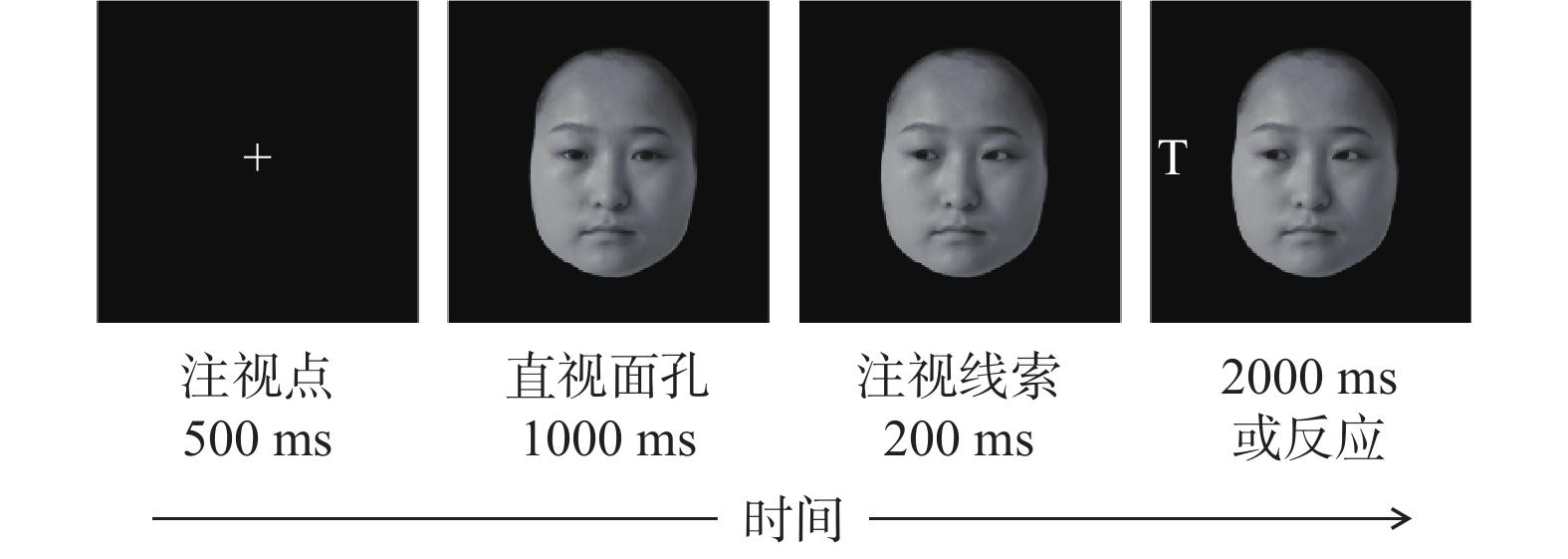
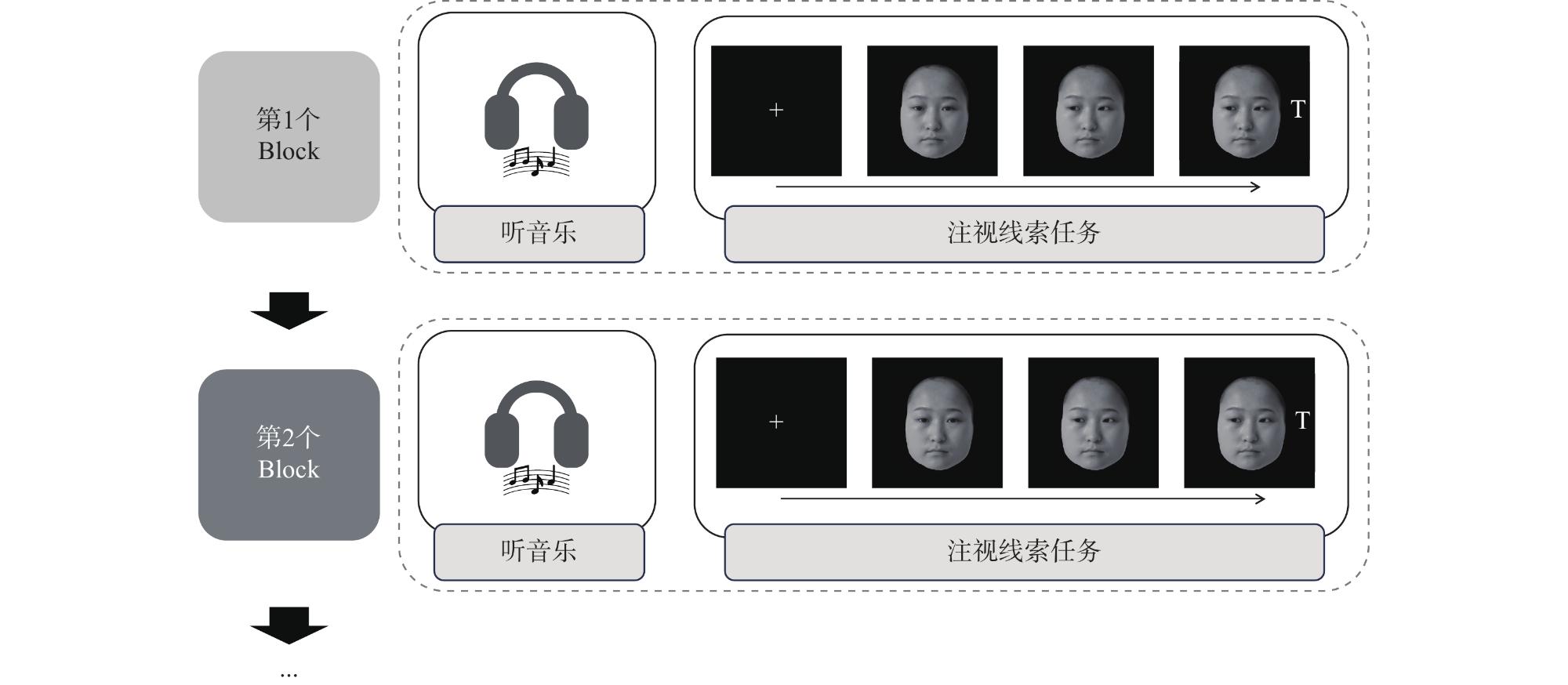
实验在安静明亮的实验隔间内进行,视距为57 cm。实验流程如图1所示,所有条件在同一组块中混合随机呈现。每个试次开始时,先呈现500 ms的注视点“+”(0.6°×0.6°)。随后呈现1000 ms直视面孔(7.85°×9.06°),接着呈现200 ms向左或向右看的注视线索。随后,目标字母“T”(0.6°×0.8°,距中央注视点5°视角)随机出现在面孔左或右侧。实验任务是在2000 ms内对目标字母作出又准又快的按键反应。正式实验前被试需完成24个练习试次。实验后要求被试对面孔刺激的娃娃脸程度进行9点评分(1=极度不属于娃娃脸,9=极度属于娃娃脸)以验证刺激材料的有效性。
2.2 数据分析
使用SPSS26.0进行数据分析,正式分析前剔除错误反应和平均值±3个标准差以外的数据(1.40%)。
2.3 结果
2.3.1 娃娃脸程度后测评分
配对样本t检验显示,男性[t(33)=2.72, p=0.005, Cohen’s d=0.47]和女性[t(33)=5.57, p<0.001, Cohen’s d=0.96]面孔娃娃脸评分皆显著高于成熟脸,验证了面孔刺激的有效性。
2.3.2 反应时
以反应时为因变量,进行2(面孔性别:男、女)×2(面孔类型:娃娃脸、成熟脸)×2(注视线索有效性:有效、无效)的重复测量ANOVA。结果显示,面孔性别主效应显著,F(1, 33)=5.58,p=0.024,$ \eta _{\mathrm{p}}^{2} $ =0.15,被试对女性面孔的反应(M=308 ms, SE=5)显著快于男性面孔(M=310 ms, SE=5)。面孔类型主效应显著,F(1, 33)=15.69,p<0.001,$ \eta _{\mathrm{p}}^{2} $ =0.32,被试对成熟脸的反应(M=307 ms, SE=5)显著快于娃娃脸(M=311 ms, SE=5)。注视线索有效性主效应显著,F(1, 33)=139.27,p<0.001,$ \eta _{\mathrm{p}}^{2} $ =0.81,被试对有效试次的反应(M=302 ms, SE=5)显著快于无效试次(M=316 ms, SE=5)。二重交互作用均不显著,Fs<4.04,ps>0.05。重要的是,面孔性别、面孔类型和注视线索有效性的三重交互作用显著,F(1, 33)=17.48,p<0.001,$ \eta _{\mathrm{p}}^{2} $ =0.35。
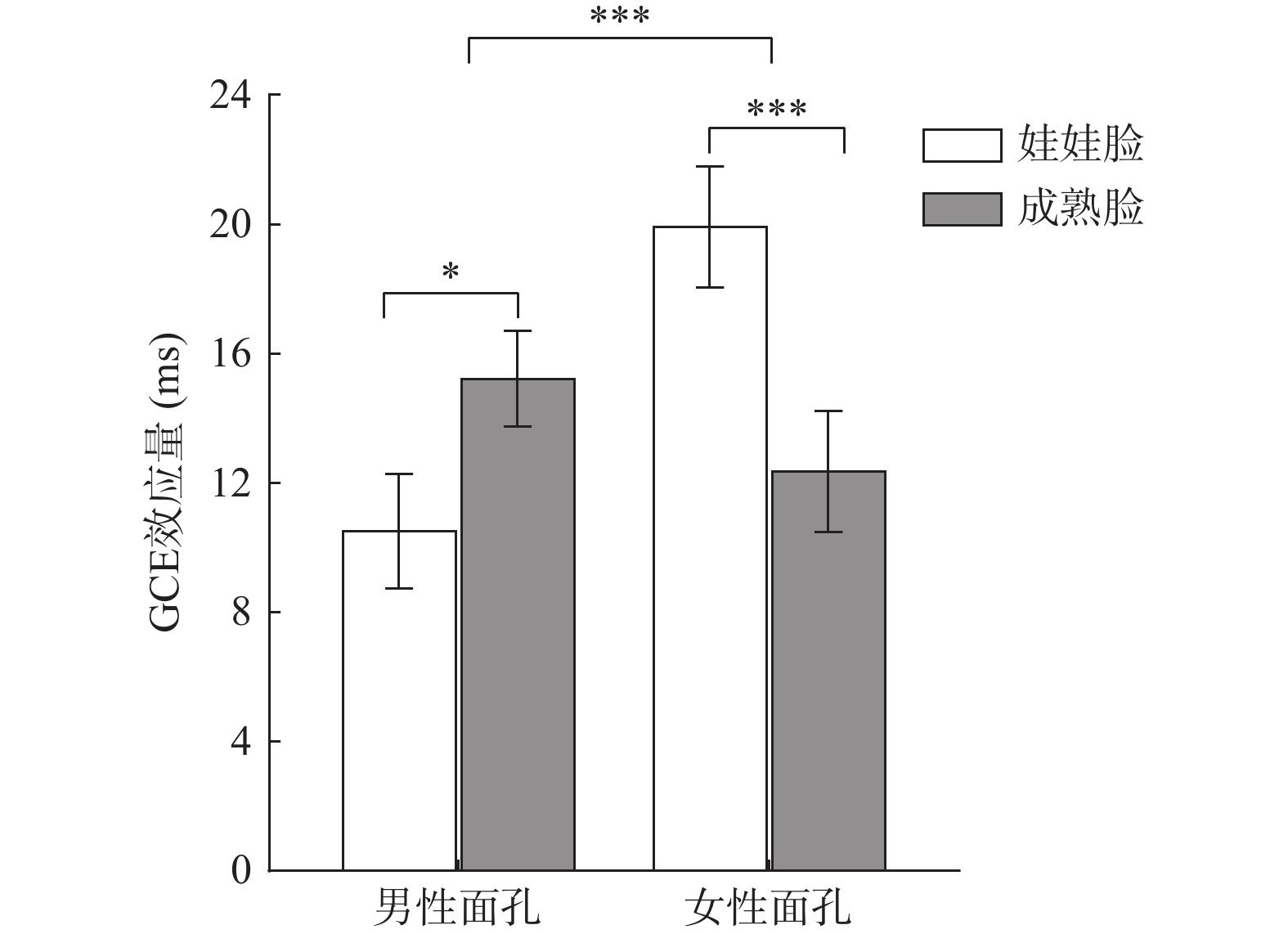
为了进一步探究面孔性别和面孔类型对GCE的影响,以GCE效应量(RT无效线索−RT有效线索)为因变量,进行2(面孔性别:男、女)×2(面孔类型:娃娃脸、成熟脸)重复测量ANOVA。结果如图2所示。面孔性别和面孔类型的交互作用显著,F(1, 33)=17.48,p<0.001,$ \eta _{\mathrm{p}}^{2} $ =0.35。进一步分析发现,男性成熟脸诱发的GCE(M=15 ms, SE=1)显著大于娃娃脸(M=11 ms, SE=2),F(1, 33)=7.42,p=0.010;女性娃娃脸诱发的GCE(M=20 ms, SE=2)显著大于成熟脸(M=12 ms, SE=2),F(1, 33)=13.40,p<0.001。其他效应均不显著,Fs<4.04,ps>0.05。
正确率的结果显示,各主效应和交互作用均不显著,Fs<1,ps>0.05,排除了速度−准确性权衡。
2.4 讨论
实验1结果发现,被试更愿意追随男性成熟脸或女性娃娃脸的注视方向,这与Zheng等(2018)的结果一致,证实了对比情境中娃娃脸影响GCE这一假设,说明社会交互中娃娃脸会使个体产生注意偏向。为探究非对比情境是否能够消除娃娃脸对社会性注意的影响,实验2采用组块间设计,将女性娃娃脸、女性成熟脸、男性娃娃脸和男性成熟脸在单独组块中呈现。
3 实验2:自下而上非对比情境下娃娃脸对注视线索效应的影响
3.1 研究方法
3.1.1 被试
实验2样本量的确定方法与实验1相同,共34名大学生(男女各半,平均年龄20±2岁)参与实验2。
3.1.2 实验仪器与材料
实验仪器与材料和实验1相同。
3.1.3 实验设计与流程
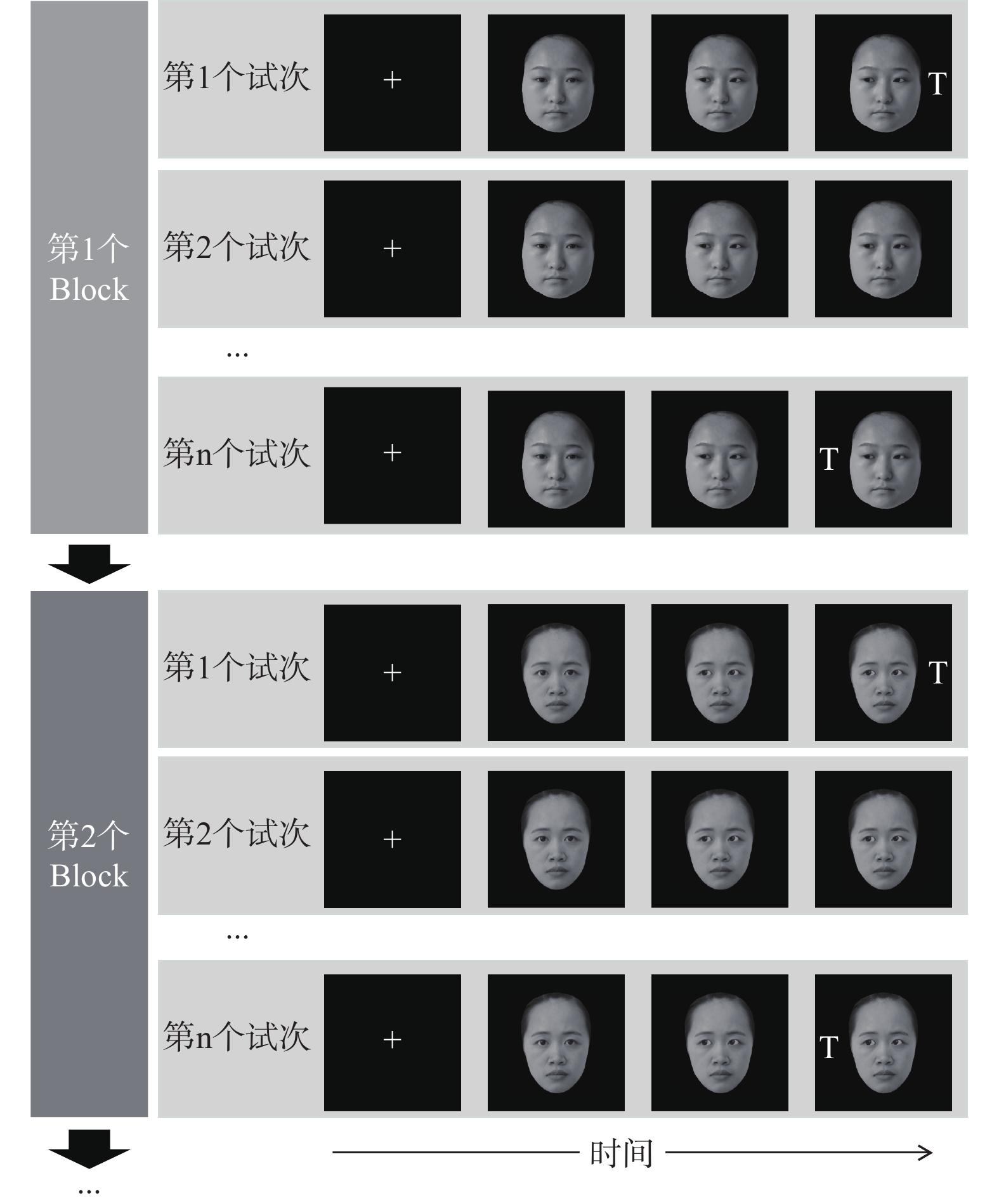
3.2 数据分析
实验2数据分析与实验1相同。正式分析前剔除错误反应和平均值±3个标准差以外的数据(1.29%)。
3.3 结果
3.3.1 娃娃脸程度后测评分
配对样本t检验显示,男性[t(33)=4.94, p<0.001, Cohen’s d=0.85]和女性[t(33)=3.54, p<0.001, Cohen’s d=0.61]面孔的娃娃脸评分皆显著高于成熟脸,验证了面孔刺激的有效性。
3.3.2 反应时
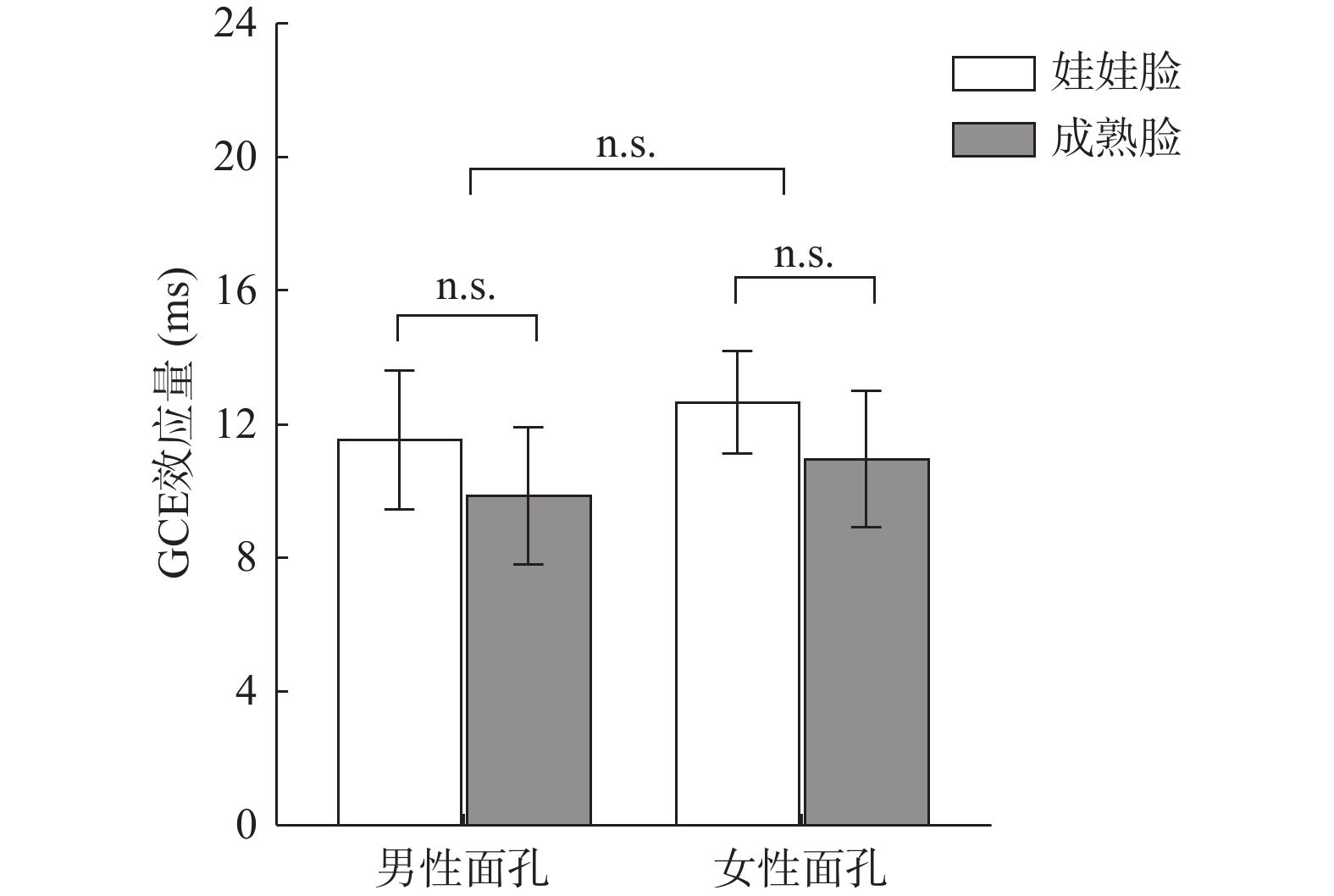
以反应时为因变量,进行2(面孔性别:男、女)×2(面孔类型:娃娃脸、成熟脸)×2(注视线索有效性:有效、无效)的重复测量ANOVA。结果显示,注视线索有效性主效应显著,F(1, 33)=63.15,p<0.001,$ \eta _{\mathrm{p}}^{2} $ =0.66,被试对有效试次的反应(M=304 ms, SE=5)显著快于无效试次(M=315 ms, SE=5)。重要的是,面孔类型和注视线索有效性的交互作用不显著,F(1, 33)=1.09,p=0.304;且面孔性别、面孔类型和注视线索有效性的三重交互作用不显著,F(1, 33)<0.001,p=0.990。如图4所示。这说明当处于非对比情境时,娃娃脸不调节GCE。这一频率学阴性结果与贝叶斯分析结果相印证。其他效应均不显著,Fs<0.56,ps>0.05。
正确率的结果显示,各主效应和交互作用均不显著,Fs<1,ps>0.05,排除了速度−准确性权衡。
3.4 讨论
实验2的结果发现,面孔性别、面孔类型和注视线索有效性的交互作用在非对比情境中消失。这与研究假设一致,非对比情境的娃娃脸信息不再凸显,使得实验1中娃娃脸的调节效应在实验2中消失。本研究拟进一步验证自上而下的操纵方式,即音乐诱发的情绪情境是否同样具备调节效应。与图片和影片等情绪诱导方法相比,音乐诱导的情绪强度相对更为强烈,且持续时间相对较长(Baumgartner et al., 2006; Talamini et al., 2022)。因此,实验3选取了积极、消极和中性的音乐诱发个体的情绪,且将情绪情境作为被试内变量,确保被试持续沉浸于同一情绪情境中,以探究不同情绪情境下社会性注意中的娃娃脸效应。
4 实验3:自上而下情绪情境下娃娃脸对注视线索效应的影响
4.1 研究方法
4.1.1 被试
实验3样本量计算方法类似实验1,设定3(情绪情境:积极、中性、消极)×2(面孔性别:男、女)×2(面孔类型:娃娃脸、成熟脸)×2(注视线索有效性:有效、无效)交互作用的效应量$ \eta _{\mathrm{p}}^{2} $ 为0.20(Zhang, Gao, et al., 2023),α水平为0.05,统计检验力为0.80,计算得样本量为22人。参考以往研究的样本量,最终共34名在校大学生参与本实验(男女各半,平均年龄19±1岁)。
4.1.2 实验仪器与材料
实验面孔材料和仪器与实验1相同。
首先通过预实验筛选音乐材料,30名被试采用9点李克特量表评定35段音乐材料的情绪效价(1=极不愉悦,9=极愉悦)、唤醒度(1=极为平静,9=极激动)和优势度(1=极不可控,9=极可控)。最终选取能够诱发积极、中性和消极情绪状态的音乐材料各2段。
4.1.3 实验设计与流程
4.2 数据分析
实验3数据分析与实验1相同。正式分析前剔除错误反应和平均值±3个标准差以外的数据(1.47%)。
4.3 结果
4.3.1 娃娃脸和音乐材料的后测评分
配对样本t检验显示,男性[t(33)=9.06, p<0.001, Cohen’s d=1.55]和女性[t(33)=9.31, p<0.001, Cohen’s d=1.60]面孔娃娃脸评分皆显著高于成熟脸,验证了面孔刺激的有效性。
以音乐材料类型作为自变量,分别对被试听到音乐后的情绪效价、唤醒度和优势度的评分进行单因素ANOVA。结果验证了音乐材料的有效性。
4.3.2 反应时
对反应时数据进行3(情绪情境:积极、中性、消极)×2(面孔性别:男、女)×2(面孔类型:娃娃脸、成熟脸)×2(注视线索有效性:有效、无效)的重复测量ANOVA。结果显示,情绪情境主效应显著,F(2, 66)=41.67,p<0.001,$ \eta _{\mathrm{p}}^{2} $ =0.56,被试在积极情绪情境下的反应(M=314 ms, SE=5)显著快于中性(M=345 ms, SE=7)和消极情境(M=322 ms, SE=5),ps<0.05;且消极情境下的反应显著快于中性情境,p<0.001。面孔类型主效应显著,F(1, 33)=10.13,p=0.003,$ \eta _{\mathrm{p}}^{2} $ =0.24,被试对娃娃脸的反应(M=326 ms, SE=6)显著快于成熟脸(M=328 ms, SE=6)。注视线索有效性主效应显著,F(1, 33)=113.13,p<0.001,$ \eta _{\mathrm{p}}^{2} $ =0.77,被试对有效试次的反应(M=320 ms, SE=5)显著快于无效试次(M=335 ms, SE=6)。情绪情境和面孔类别的交互作用显著,F(2, 66)=5.86,p=0.005,$ \eta _{\mathrm{p}}^{2} $ =0.15。面孔性别和面孔类型的交互作用显著,F(1, 33)=5.51,p=0.025,$ \eta _{\mathrm{p}}^{2} $ =0.14。情绪情境、面孔性别和面孔类型,情绪情境、面孔性别和注视线索有效性,面孔性别、面孔类型和注视线索有效性的三重交互作用均显著,Fs>4.39,ps<0.05。情绪情境、面孔性别、面孔类型和注视线索有效性的四重交互作用显著,F(2, 66)=3.18,p=0.048,$ \eta _{\mathrm{p}}^{2} $ =0.09。其他效应均不显著,Fs<2.43,ps>0.05。
为了考察不同情绪情境下面孔性别和面孔类型对GCE的影响,将GCE效应量作为因变量,分别对三种情绪情境进行2(面孔性别:男、女)×2(面孔类型:娃娃脸、成熟脸)的重复测量ANOVA。结果如图6所示,中性情绪情境下面孔性别和面孔类型的交互作用显著,F(1, 33)=15.60,p<0.001,$ \eta _{\mathrm{p}}^{2} $ =0.32。进一步分析发现,男性成熟脸(M=18 ms, SE=3)诱发的GCE显著大于娃娃脸(M=10 ms, SE=3),F(1, 33)=4.83,p=0.035;女性娃娃脸(M=18 ms, SE=2)诱发的GCE显著大于成熟脸(M=14 ms, SE=2),F(1, 33)=6.13,p=0.019。其他效应均不显著,Fs<0.80,ps>0.05。该结果进一步验证了实验1结果的稳定性。积极情绪情境下,面孔性别的主效应显著,F(1, 33)=11.43,p=0.002,$ \eta _{\mathrm{p}}^{2} $ =0.26,女性面孔的GCE(M=19 ms, SE=2)显著大于男性面孔(M=11 ms, SE=2)。面孔类型主效应不显著,F(1, 33)=3.81,p=0.059。面孔性别和面孔类型的交互作用显著,F(1, 33)=4.32,p=0.046,$ \eta _{\mathrm{p}}^{2} $ =0.12。进一步分析发现,男性成熟脸(M=17 ms, SE=3)诱发的GCE显著大于娃娃脸(M=6 ms, SE=3),F(1, 33)=6.96,p=0.013;女性娃娃脸(M=19 ms, SE=3)和成熟脸(M=19 ms, SE=3)诱发的GCE无显著差异,F(1, 33)<0.01,p=0.986。该结果表明积极情绪对女性面孔产生调节作用,使得女性娃娃脸和成熟脸的差异消失。消极情绪情境下面孔性别的主效应显著,F(1, 33)=17.66,p<0.001,$ \eta _{\mathrm{p}}^{2} $ =0.35,男性面孔的GCE(M=20 ms, SE=2)显著大于女性面孔(M=12 ms, SE=2)。其他效应均不显著,Fs<0.58,ps>0.05。该结果表明消极情绪对男性和女性面孔均产生调节作用,使得所有面孔中娃娃脸和成熟脸的GCE差异均消失。
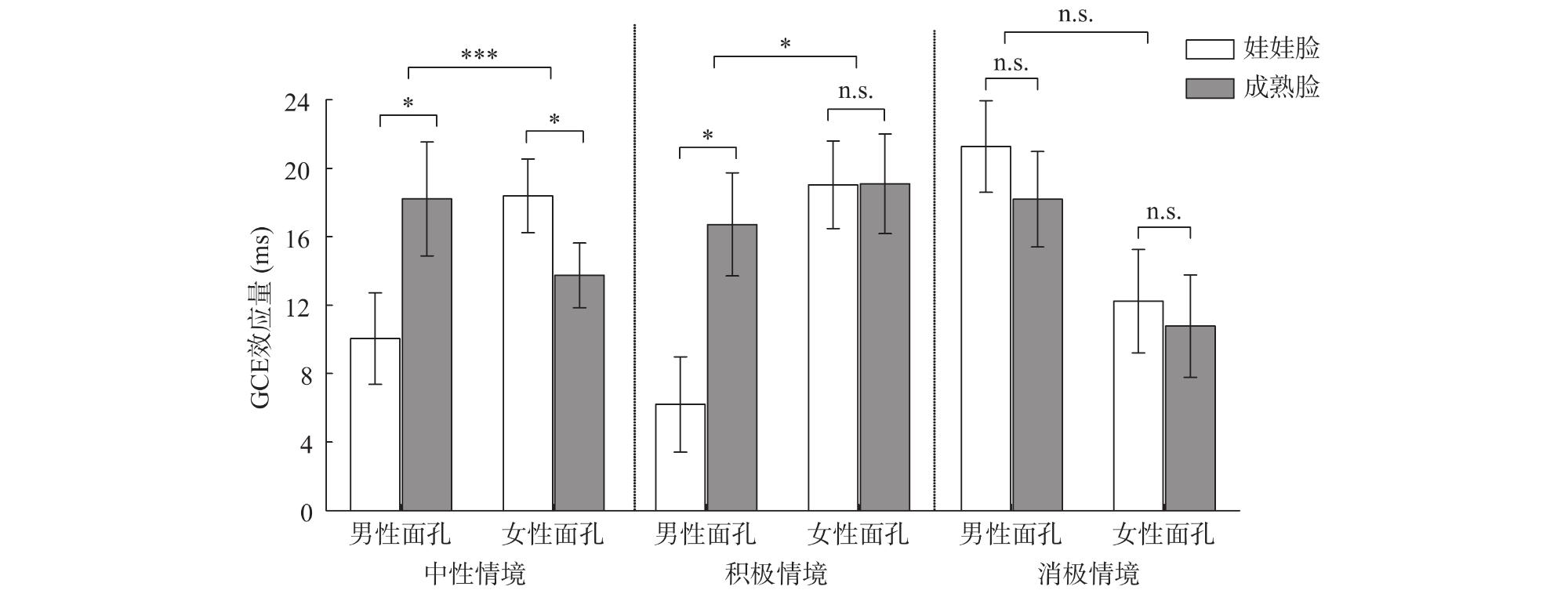


正确率的结果显示,各主效应和交互作用均不显著,Fs<1,ps>0.05,排除了速度−准确性权衡。
4.4 讨论
实验3的结果发现,积极情境下女性娃娃脸和成熟脸之间的GCE差异消失,而消极情境下,无论是男性还是女性面孔,其娃娃脸和成熟脸的GCE差异均不显著。这与“情绪情境调谐双通路模型”预测一致。在加工方式通路上,积极情境促使个体对面孔性别和面孔类型采用整体性加工策略,导致二者交互影响GCE;消极情境则引发面孔性别与面孔类型分离的分析性加工,故娃娃脸不调节GCE。在一致性偏向通路上,积极情境下被试对于情绪效价一致的女性面孔,无论娃娃脸还是成熟脸,都有更强的注意偏向,从而导致其GCE差异消失;男性面孔因与情绪情境效价不一致,其GCE模式与中性情境一致。
5 总讨论
本研究采用注视线索范式,探讨娃娃脸对GCE的影响以及情境的作用。实验1采用对比情境,结果发现娃娃脸影响GCE,女性娃娃脸较成熟脸诱发了更大的GCE,而男性娃娃脸诱发的GCE则小于成熟脸。实验2和实验3分别以自下而上和自上而下的方式操纵情境因素,结果一致地发现,娃娃脸对GCE的调节作用消失。这些结果模式表明娃娃脸虽然能够与面孔性别交互作用于GCE,但其具体作用取决于情境因素。
本研究发现,个体更愿意追随男性成熟脸和女性娃娃脸面孔的注视方向,支持了McCall和Kennedy(1980)提出的婴儿图式快速加工理论,并将其扩展至成人面孔。值得注意的是,该结果在实验1和实验3中性情境中表现出高度一致的跨实验效应,这一可重复性证据为研究结论提供了有力的内部验证。以往研究认为GCE是反射性的,而娃娃脸能够与面孔性别共同作用调节这一效应,提示了个体对娃娃脸的加工可能是自动化的。不同性别面孔之间的差异与Zheng等(2018)在非社会性注意中的发现类似,这可能源于性别角色刻板印象的作用。钱铭怡等(1999)调查发现,个体认为男性坚强理智,而女性顺从感性。这与娃娃脸特质(例如温暖、纯真、顺从等)形成鲜明对比,解释了性别刻板印象和娃娃脸特征共同塑造个体的行为反应。也进一步验证了就像其他与注意相关的刺激一样,社会线索(如注视线索)似乎也能获取并参与领域一般注意过程(Hayward & Ristic, 2013; Hietanen et al., 2006; Ji et al., 2020; Joseph et al., 2015; Marino et al., 2015; Wang et al., 2020; Wu & Kirkham, 2010)。然而,由于人类大脑对面孔社会信息进行了专门的感知处理(Bernstein & Yovel, 2015; Fairhall & Ishai, 2007; Freiwald et al., 2016; Yang et al., 2015),娃娃脸似乎以一种提供额外推断和社会评价的方式(Charlesworth et al., 2019; Song et al., 2021; Pivonkova et al., 2011)获取这些领域一般注意过程。
更重要的是,本研究证明了情境因素在不同性别娃娃脸调节GCE中的关键作用,支持了eyeTUNE框架理论(Dalmaso et al., 2020)。对比情境(实验1)凸显了娃娃脸特征,观察到了社会性注意中的娃娃脸效应。实验2通过自下而上非对比情境使得娃娃脸特征的凸显性降低,导致娃娃脸的调节作用消失,这与Zhang,Dalmaso等(2023)以及特质推断相关研究(Gorn et al., 2008)中的发现一致,情境因素可以减弱甚至消除娃娃脸效应。这提示,娃娃脸对晚期社会认知和行为的影响可能在早期注意加工阶段就已经发生,揭示了早期干预的重要性。
此外,实验3以自上而下的方式启动被试处于同一情绪情境时,发现相比于中性情绪情境,积极情境下仅男性面孔存在面孔类型的GCE差异,女性面孔上娃娃脸对GCE的影响消失;消极情境下,男性和女性面孔中娃娃脸对GCE的影响均消失。这支持了本研究整合的“情绪情境调谐双通路模型”。该模型认为加工方式通路和一致性偏向通路共同在情绪情境调节社会性注意中发挥作用。积极和消极情绪情境下个体分别采用整体性和分析性加工策略(蒋军 等, 2011; Clore et al., 2001),使得消极情境中个体的性别角色刻板印象未被激活,而积极情境中面孔类型依然受面孔性别影响。积极情境中的女性面孔(无论娃娃脸或成熟脸)因效价一致(蒋军 等, 2011; Bower, 1981),获得更强的注意偏向,导致其GCE差异消失;而男性面孔因与积极情境的效价不一致,仍表现出与中性情境一致的结果模式。消极情境中面孔性别与面孔类型加工分离,导致GCE差异消失。
本研究存在一定局限性。为控制其他面部特征维度,本研究仅选用四张经过严格筛选的面孔作为实验刺激。未来研究可采用更大规模的面孔样本检验结论的泛化性。对比和非对比的情境操纵也可能引发刺激可预测性和认知习惯化等可能性解释,未来研究可进一步分离情境和这些可能性机制。
6 结论
(1)娃娃脸能够调节注视线索效应,但在不同性别的面孔上表现不同,女性娃娃脸和男性成熟脸更具注意优势;(2)娃娃脸的注视线索效应取决于情境,自下而上和自上而下的情境均可消除这种由不同性别娃娃脸造成的社会性注意偏向。