

1 引言
现实生活中的道德决策常伴随风险与不确定性(Brock et al., 2013),伸出援手可能意味着承担个人损失或行动失败的风险。在此情境中,个体的自我保护动机(规避风险、避免损失)与亲社会动机(帮助他人、避免内疚)会产生根本性冲突(Vieira et al., 2020)。因此,厘清风险如何影响道德决策,特别是探索其内在心理路径,成为道德心理学与行为决策领域的核心议题。然而,风险偏好与社会偏好如何共同影响风险情境下的道德决策过程与结果,目前尚不清楚。鉴于此,本研究旨在结合行为实验与计算建模,系统考察风险情境下个体道德决策的内在认知计算机制,并进一步探索积极与消极情绪的调节作用。
道德决策指个体在社会规范指导下,面临两难冲突时根据自我价值导向做出选择的过程(Rilling & Sanfey, 2011)。研究表明,助人失败的风险水平是抑制利他行为的关键变量(Hao et al., 2023)。例如,Gross等人(2021)开发的“有风险的助人任务”为此提供了精确证据:随着助人失败概率从0%升至100%,个体的助人选择系统性下降,并在约40%风险水平处出现明显的“风险厌恶转折点”。这一“风险抑制助人”效应在不同群体和情境中得到了重复验证(占友龙 等, 2025; Liu et al., 2025)。Liu等人(2023)还发现,无论风险类型如何,个体在高风险困境下的助人行为均显著更低。然而,现有研究主要聚焦于外显行为结果的宏观描述。一个更深层的问题是:风险水平的升高,究竟是通过强化个体对自身损失的担忧(改变风险偏好),还是通过削弱对他人福祉的关切(改变风险偏好),抑或两者协同驱动决策改变?传统行为数据分析方法难以对背后的内在认知过程进行有效分离与量化(Hu et al., 2021)。
近年来,认知计算建模技术因其能量化并揭示行为背后的潜在认知机制而被广泛关注(张银花 等, 2020; Chen et al., 2022)。该技术通过构建数学模型,将可观测行为数据与心理构念(如偏好权重、主观价值)联系起来,其核心优势在于:能分离与量化多重动机,如同步估计损失和内疚厌恶参数;揭示价值整合计算过程,并提供机制层面的灵敏检测,识别外部干预(如情绪)是特异性还是整体性地改变决策策略(van Baar et al., 2019)。其中,内疚厌恶反映个体对不帮助他人可能产生的负面道德情绪的回避倾向(Chen et al., 2022);风险厌恶则体现对潜在利益受损的敏感性(Moreira et al., 2021)。因此,采用计算建模方法不仅能验证风险对行为的影响,更能深入“决策黑箱”,阐明其内在认知计算路径。
情绪作为决策过程的核心要素,可能对上述认知权衡产生系统性调节。根据情绪即信息理论,即使与当前决策无关的偶然情绪也会影响判断与决策(Barasch et al., 2014)。在亲社会决策领域,积极情绪的拓展−建构理论指出,积极情绪能拓宽认知−行动范围,促进个体关注他人和社会目标(Fredrickson, 2001),从而增强合作与利他行为(马丽云, 莫名文, 2022; Tao et al., 2020)。而消极情绪则可能加剧自我关注,减少对他人需求的敏感性(范伟, 程颖, 2026),进而降低亲社会意愿或行为(杨昭宁 等, 2017; Wang et al., 2021)。在风险决策领域,“风险即情绪”理论认为,决策时的即时情感体验直接影响个体的风险感知与行为选择(Lerner & Keltner, 2001)。研究表明,积极情绪常诱发更强的风险寻求倾向(陆翠薇 等, 2021),而消极情绪则降低冒险意愿,增强对不确定性的回避(徐富明 等, 2015; Kugler et al., 2012)。然而,尽管情绪的基础性作用已获公认,但现有研究在情绪如何“精确”调节风险情境下道德决策的具体认知计算过程上,仍存在显著空白。以往研究多分别考察情绪对亲社会行为或风险决策行为的主效应,未能回答关键机制问题:情绪究竟是通过改变个体对“风险”的容忍度(调节损失厌恶),还是通过改变对“道德”规范的关注(调节内疚厌恶)来起作用?鉴于风险助人决策本质上是多重动机的整合计算,情绪很可能扮演“认知调节器”的角色,通过改变不同动机在决策方程中的相对权重来影响最终输出。
综上,现有研究虽明确风险对助人行为有抑制作用,但对其认知计算机制缺乏定量阐释;情绪的调节作用虽重要,但其调节路径仍属未知。本研究采用“有风险的助人任务”结合认知计算建模,旨在:第一,定量揭示风险通过调节“损失厌恶”与“内疚厌恶”两个核心参数影响决策;第二,探究积极与消极情绪如何特异性调节上述认知计算过程。据此提出假设:(1)随着助人失败风险增加,助人比例下降,存在风险厌恶转折点;机制上,风险增加导致损失厌恶(α)增强、内疚厌恶(β)减弱,从而降低对风险助人选项的主观价值评估(H1);(2)情绪对该过程具有调节作用:与中性情绪相比,积极情绪能降低损失厌恶,提升主观价值与助人选择;而消极情绪则可能强化损失厌恶,抑制助人行为(H2)。
2 实验1:风险情境下大学生道德决策的认知机制
2.1 研究方法
2.1.1 被试
参考Gross等人(2021)采用相同范式的研究所报告的中等效应量($ \eta _{\mathrm{p}}^{2} $ =0.06,对应f=0.25),设定α=0.05,统计效能(1−β)=0.90,采用G*Power3.1进行样本量估算,结果显示至少需要24名被试。同时,为满足认知计算建模对数据稳定性的更高要求(Palminteri et al., 2017; Wilson & Collins, 2019),最终招募84名在校大学生(男生40名,女生44名,平均年龄20.24±1.25岁)。所有被试视力或矫正视力正常,无精神疾病史,在签署知情同意书后参与实验,最后获得相应报酬。本实验已获得湖南科技大学教育学院学术伦理委员会的批准。
2.1.2 实验设计
实验1采用单因素被试内设计,自变量为11个水平的助人失败风险(0%~100%,以10%递增),因变量为助人比例、主观决策价值差(ΔSV)、损失厌恶参数(α)和内疚厌恶参数(β)。
2.1.3 实验任务与程序
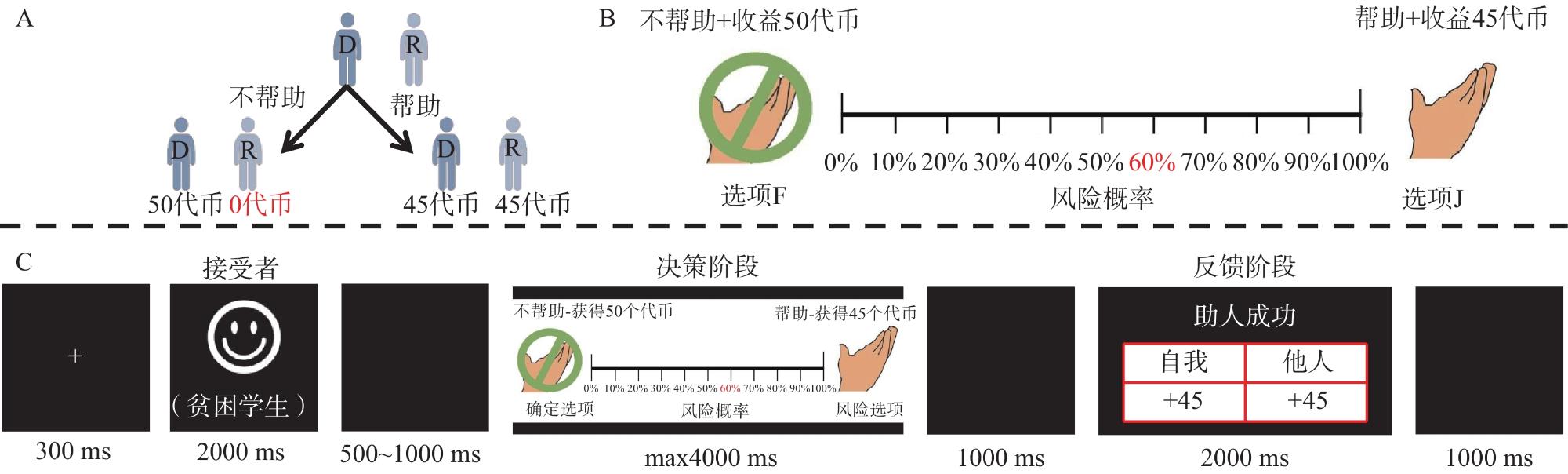
实验采用“有风险的助人任务”(崔芳 等, 2021; Gross et al., 2021)。被试被告知将随机担任决策者或接受者,实则始终扮演决策者,接受者由实验员扮演的“贫困大学生”担任。每个试次中,被试面临选择:不助人则自己确定获得M元代币(10~100元,10元递增),接受者得0元;助人则助人成功概率为1−P,P为0%~100%的失败风险。若成功,双方各得0.9×M元;若失败,双方均得0元。因此,助人选项意味着承担0.1×M元的确定损失成本和可能失败的风险。为控制额外变量,实验在安静空间内由一名主试指导完成。主试强调贫困生照片来自真实困难学生,以确保被试信任与决策真实(见图1A、图1B)。具体实验流程见图1C,首先呈现300 ms的注视点;随后呈现贫困大学生的照片2000 ms;接着是500~1000 ms的随机空屏;接下来则是决策界面,数轴上标红的概率为该试次的风险概率P,限时4000 ms反应,选择帮助按“J”键,选择不帮助按“F”键;1000 ms的空屏后呈现2000 ms的结果反馈界面,告知决策结果及当前试次的收益;1000 ms的空屏后进入下一试次。正式实验前有11试次练习,正式实验共110试次,每个风险水平重复10次,顺序随机,实验时长约15分钟。报酬从正式试次中随机抽取5试次,按10∶1比例兑换现金,外加20元基础被试费。
2.1.4 计算建模
(1)模型构建。为量化决策的认知机制,在MATLAB环境中构建并比较了三种计算模型:完全损失厌恶模型(见公式1)、完全内疚厌恶模型(见公式2)和损失−内疚厌恶整合加工模型(见公式3),以计算风险助人选项相对于不助人选项的主观价值差(ΔSV)。依据前人研究(Chang & Koban, 2013; Chen et al., 2022),模型基于三种决策模式假设:完全损失厌恶模型仅由风险规避驱动,忽略利他动机;完全内疚厌恶模型仅由利他动机驱动,忽略风险成本;整合模型则同时包含二者,假定个体依据主观价值最大化原则在风险规避与利他动机之间进行权衡。其中,SV(subjective value)指决策的主观价值,由损失厌恶参数α和内疚厌恶参数β加权获得,决策遵循SV最大化原则;ΔSV为助人选项与回避选项的主观价值差,其值越大表明越倾向助人;α表征风险规避程度(值越大规避越强),β表征亲社会倾向(值越大倾向越强)。M为不助人时的确定收益,EM为助人成功时期望总收益(见公式4),受失败概率P1与M共同影响。通过Softmax函数(见公式5)将ΔSV转化为选择助人的概率P2,其中γ为逆温度参数(反映选择对价值差异的敏感性,值越大决策越确定),ε为随机误差率(固定为0.01)。
(2)模型拟合与参数估计。采用最大似然估计法,通过非线性优化(如MATLAB的fmincon函数,MEL,见公式6)在参数空间内搜索(van Baar et al., 2019),以最大化行为数据的似然度,从而得到每名被试的最优参数组合(α, β, γ)。具体对每名被试110个试次的选择数据进行个体层面拟合,通过迭代寻找使模型预测与实际行为误差最小化的参数值。为避免局部最优,拟合过程从参数空间中10000个随机起始点进行初始化。
(3)模型比较。为比较模型的优劣,采用Akaike信息准则(Akaike Information Criterion, AIC)进行评估(Akaike, 1987; van Baar et al., 2019)。与BIC准则不同,AIC不假设真实模型必存在于候选集中,因而更适用于本研究的模型选择。基于公式7计算各模型的AIC值,并对被试间的AIC差异进行配对秩和检验,完美拟合的被试不纳入比较。本研究预期整合模型为最优模型(Crockett, 2016)。
完全损失厌恶个体:
完全内疚厌恶个体:
损失−内疚厌恶整合加工个体:
期望函数:
Softmax函数:
模型拟合与参数估计:
模型比较:
2.1.5 数据统计与分析
在行为数据方面,记录被试在各试次中的助人比例;在计算建模方面,使用MATLAB估计损失厌恶参数α、内疚厌恶参数β与主观决策价值差ΔSV。对助人比例及ΔSV进行以风险水平为自变量的重复测量方差分析,对参数α与β进行配对样本t检验,事后比较采用Bonferroni法校正。参考前人研究(Gross et al., 2021),将风险厌恶转折点定义为助人比例(或ΔSV)开始出现连续、显著下降的第一个风险水平。
2.2 结果
2.2.1 行为结果
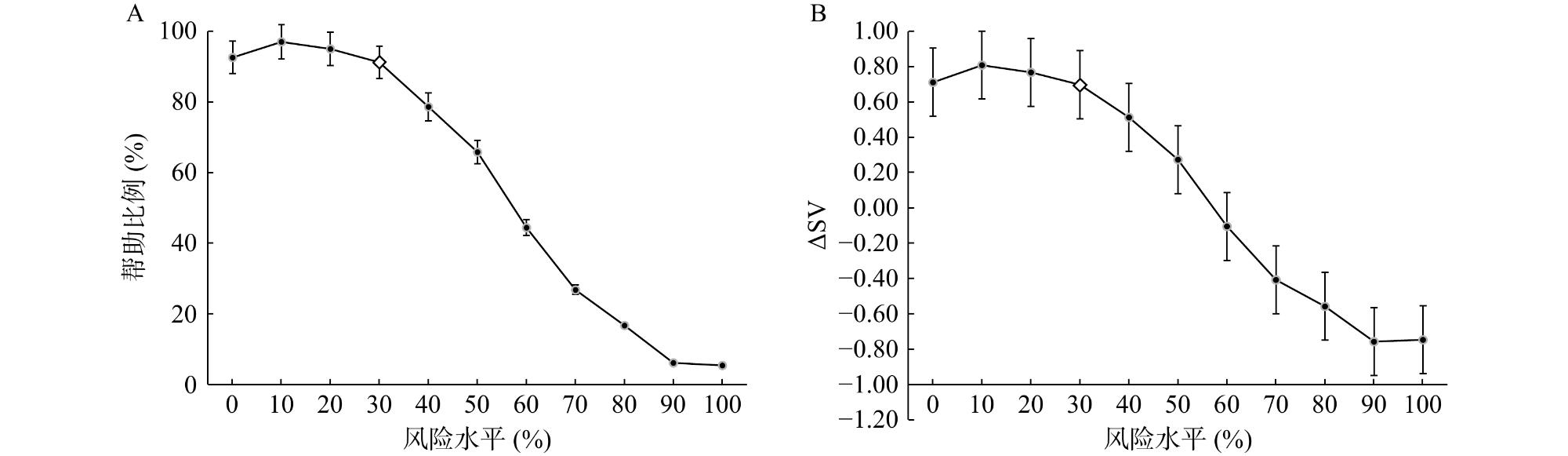
在帮助比例上,风险水平的主效应显著,F(10, 830)=271.13,p<0.001,$ \eta _{\mathrm{p}}^{2} $ =0.77。进一步多重比较发现,在风险水平为0%~20%和100%条件下的帮助比例没有显著差异,ps>0.05;而在风险水平为30%~90%条件下,随着风险水平的增加,被试的帮助比例逐渐显著减少,ps<0.01,这表明被试的风险厌恶转折点为30%的风险水平(见图2A)。
2.2.2 模型构建与比较
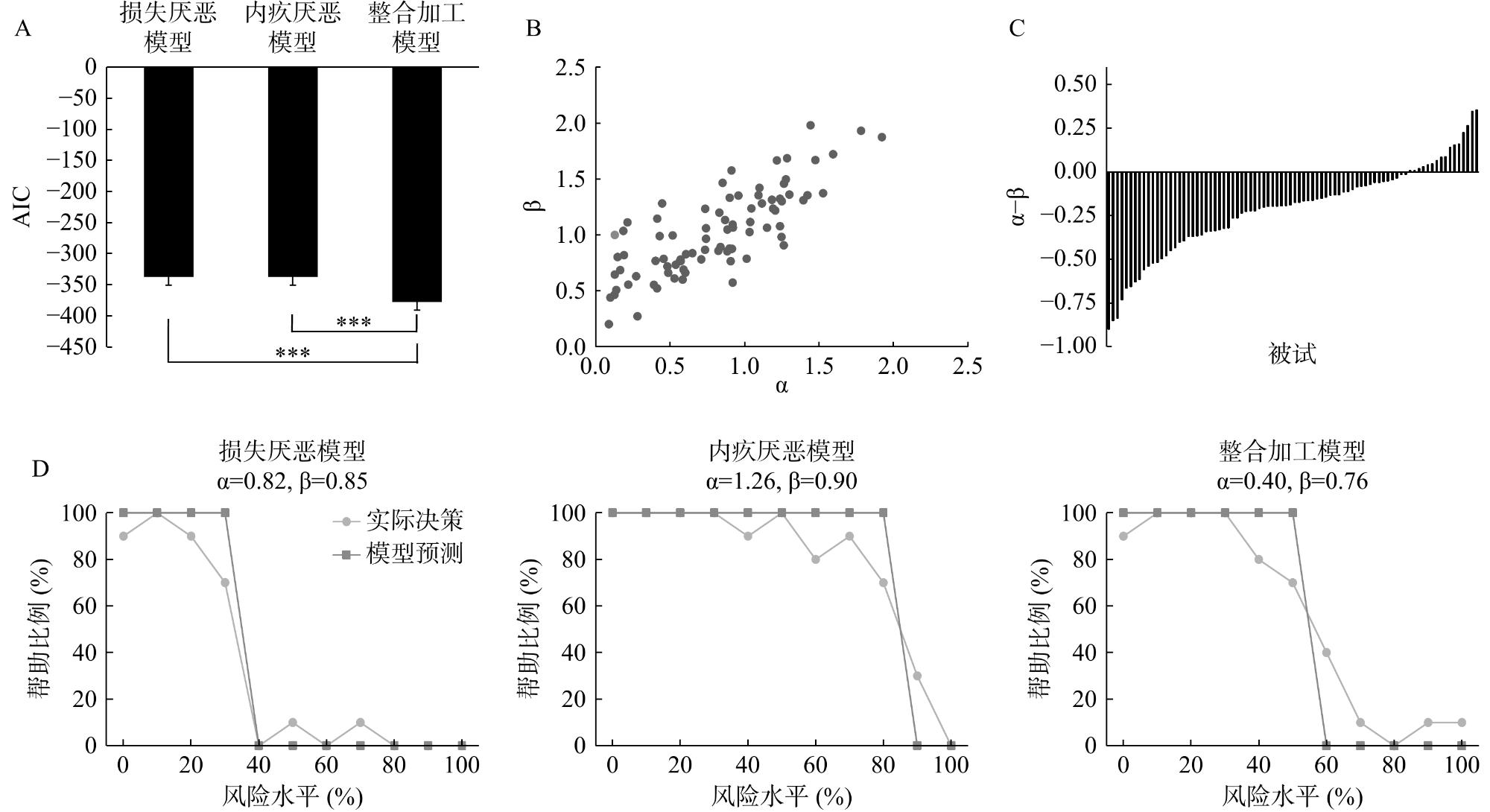
为比较模型拟合,计算各模型AIC值并对两完全模型与整合加工模型进行配对秩和检验。结果显示(图3A),完全内疚厌恶模型和完全损失厌恶模型的AIC值均显著大于整合加工模型(两者ΔAIC均为87.59, t=10.39, p<0.001),表明单一动机模型解释力相当但均远不及整合模型,凸显双重偏好协同加工的必要性。参数二维分布(图3B、3C)显示,损失厌恶α与内疚厌恶β在个体间广泛变异(0~5),且呈显著正相关(r=0.32, p=0.003),表明个体决策模式可由该二维空间表征。将数据拟合三种模型并预测帮助比例,整合加工模型预测效果显著优于单独模型(R2=0.93),随机选取被试53、83、90图示个体预测精度(图3D)。综上,整合加工模型为优胜模型,后续分析基于该模型计算∆SV与决策偏好参数。
2.2.3 模型参数估计
(1)主观决策价值差(∆SV)
方差分析发现,风险水平的主效应显著,F(10, 830)=179.39,p<0.001,$ \eta _{\mathrm{p}}^{2} $ =0.68;多重比较发现,在风险水平为0%~20%时,被试进行道德决策时的主观决策价值差没有显著差异,ps>0.05。然而当风险水平为30%~90%,随着风险水平的升高,被试在从事亲社会风险行为时的主观决策价值在显著减少,ps<0.05(图2B)。
(2)决策偏好参数
配对样本t检验的结果显示,在风险情境下,个体的内疚厌恶参数β(M±SD=1.03±0.38)显著高于损失厌恶参数α(M±SD=0.82±0.43),t(83)=−7.44,p<0.001,95%CI=[−0.27, −0.16]。这表明本研究情境中大学生群体的社会偏好(即内疚厌恶参数)整体上强于其风险规避偏好(即损失厌恶参数),这可能是其做出助人决策的重要认知基础。
3 实验2:正负性情绪对风险情境下大学生道德决策的影响
3.1 研究方法
3.1.1 被试
根据同类研究的中等效应量($ \eta _{\mathrm{p}}^{2} $ =0.08,对应f=0.30; Tao et al., 2020),使用G*Power3.1估算所需样本量(α=0.05, 1−β=0.90),结果为至少120人。为满足计算建模对参数估计稳定性的要求(Palminteri et al., 2017; Wilson & Collins, 2019),实际招募135名大学生,随机分入三组。剔除无效数据后,有效被试131人(积极组35人,消极组47人,中性组49人;其中男生75名,女生56名,平均年龄19.89±2.13岁)。所有被试视力或矫正视力正常,无精神疾病史,在签署知情同意书后参与实验,并在结束后获得相应报酬。本实验已获得湖南科技大学教育学院学术伦理委员会的批准。
3.1.2 实验设计
实验2采用3(情绪启动:积极、消极、中性)×11(风险水平:0%~100%)的混合实验设计,因变量为各条件下的助人比例、主观决策价值差(ΔSV)、损失厌恶参数(α)和内疚厌恶参数(β)。
3.1.3 实验材料与程序
情绪启动材料。根据前人相关研究(仇璐昱 等, 2015),积极情绪材料为电影《超级奶爸》片段(5分30秒,温馨搞笑情节),消极情绪材料为《南京大屠杀》片段(5分52秒,悲伤战争情节)。21名被试对影片愉悦度进行9点评定(1=非常不愉悦,9=非常愉悦),结果显示积极影片评分(7.19±1.52)显著高于消极影片的(2.14±1.03, p<0.001)。
正负性情绪量表。采用中文版正负性情绪量表(张卫东 等, 2004),共20项,5点等级计分,用于评估情绪启动后体验的强度。正性、负性子量表的Cronbach’s α在本研究中分别为0.79和0.82。
实验采用E-Prime2.0软件编制并收集数据,要求被试眼睛距离屏幕约80 cm,以更好的视角观看影片。图形及文字颜色为白色,均呈现于纯黑色背景。积极组与消极组分别观看对应影片,中性组休息3分钟,随后完成情绪量表;最后,所有被试完成与实验1相同的“有风险的助人任务”(含11试次练习与110试次正式实验),任务总时长约20分钟。
3.1.4 数据统计与分析
行为数据记录助人比例;计算建模获得损失厌恶参数α、内疚厌恶参数β及ΔSV。对助人比例和ΔSV进行3(情绪启动)×11(风险水平)重复测量方差分析;对参数α和β进行单因素(情绪启动)方差分析。所有事后比较采用Bonferroni法校正。
3.2 结果
3.2.1 情绪启动的操纵检验
正性量表上,三组差异显著,F(2, 128)=47.19,p<0.001,$ \eta _{\mathrm{p}}^{2} $ =0.42;积极情绪组得分(3.33±0.09)高于中性情绪组(2.57±0.08),t(86)=7.19,p<0.001,Cohen’s d=0.62;消极情绪组(2.16±0.08)低于中性情绪组,t(86)=−3.11,p=0.003,Cohen’s d=0.89;积极情绪组高于消极情绪组,t(84)=9.46,p<0.001,Cohen’s d=0.78。负性量表上,三组差异显著,F(2, 128)=101.08,p<0.001,$ \eta _{\mathrm{p}}^{2} $ =0.61;消极情绪组(3.11±0.07)高于中性情绪组(2.72±0.07),t(86)=3.35,p=0.002,Cohen’s d=0.77;积极情绪组(1.68±0.08)低于中性情绪组,t(86)=−9.51,p<0.001,Cohen’s d=0.64;积极情绪组低于消极情绪组,t(84)=−16.53,p<0.001,Cohen’s d=0.51。结果表明情绪启动有效。
3.2.2 行为结果
在助人比例上,情绪启动的主效应显著,F(2, 128)=60.69,p<0.001,$ \eta _{\mathrm{p}}^{2} $ =0.49,与中性情绪组(0.57±0.10)相比,积极情绪组(0.73±0.10)做出更多的助人选择,t(86)=7.92,Cohen’s d=1.38,p<0.001;而消极情绪组(0.48±0.13)做出了更少的助人选择,t(86)=−3.58,Cohen’s d=−0.78,p=0.001;且积极情绪组的也显著高于消极情绪组,t(84)=10.47,Cohen’s d=1.92,p<0.001。风险水平的主效应显著,F(10, 1280)=755.27,p<0.001,$ \eta _{\mathrm{p}}^{2} $ =0.86;多重比较发现,在风险水平为0%~30%条件下,被试的帮助比例没有显著差异(ps>0.05),但在风险水平为40%~100%条件下,随着风险水平的增加,被试的帮助比例在逐渐显著减少(ps<0.001)。
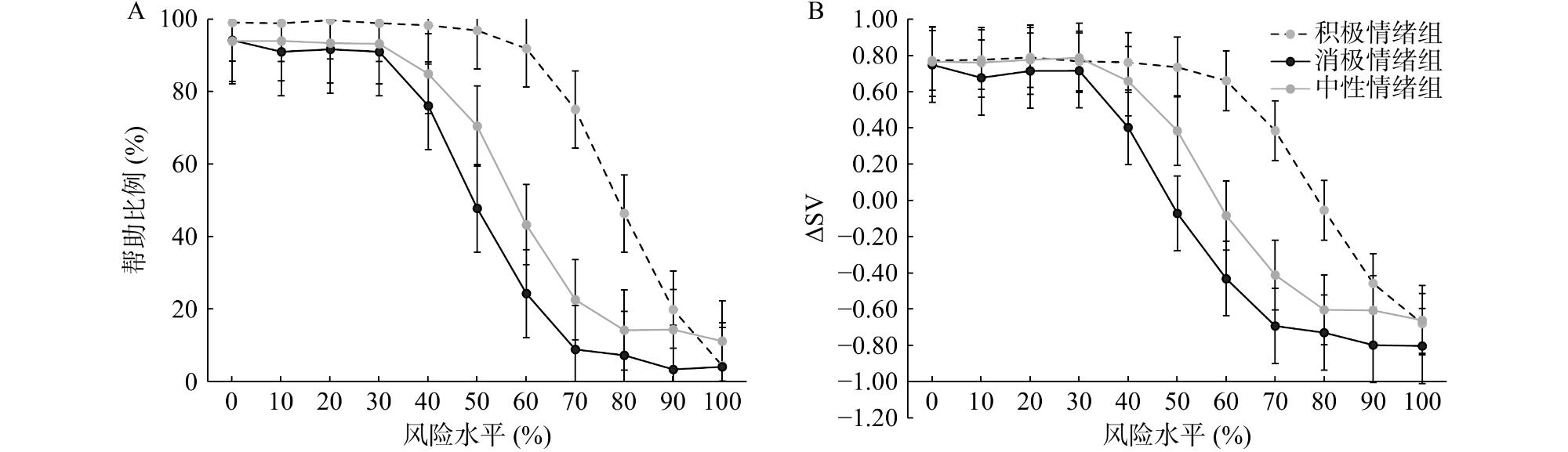
此外,二者交互作用显著,F(20, 1280)=25.52,p<0.001,$ \eta _{\mathrm{p}}^{2} $ =0.29;简单效应分析发现,在中性情绪组,帮助比例在0%~30%与90%~100%风险水平区间内差异不显著(ps>0.05),而在40%~80%风险水平区间内是显著逐渐降低的(ps<0.05),即风险转折点为40%,F(10, 119)=249.68,p<0.001;在消极情绪组,帮助比例在0%~30%与70%~100%的风险水平区间内差异不显著(ps>0.05),而在40%~70%风险水平区间内是显著逐渐降低的(ps<0.001),即风险转折点也为40%,F(10, 119)=286.05,p<0.001;而在积极情绪组,被试的帮助比例在0%~50%风险水平区间内差异不显著(ps>0.05),而在60%~100%风险水平区间内是显著逐渐降低的(ps<0.001),即风险转折点为60%,F(10, 119)=283.18,p<0.001(见图4A)。
3.2.3 模型构建与比较
AIC模型比较表明,三组情绪条件下,完全内疚厌恶模型和完全损失厌恶模型的AIC值均显著大于对应的整合加工模型,且两单一模型的ΔAIC在各组中均相等(中性情绪组: −693.31, Z=−6.06, p<0.001, 整合模型AIC=−766.99; 积极情绪组: −709.70, Z=−4.11, p<0.001, 整合模型AIC=−749.21; 消极情绪组: −648.04, Z=−5.96, p<0.001, 整合模型AIC=−744.46)。结果跨情绪条件一致验证了整合模型的稳定性。而且,所有被试的损失厌恶参数α和内疚厌恶参数β在个体间存在广泛变异(α和β的范围为: 0~5),且二者呈显著正相关(中性情绪组: r=0.83, p<0.001; 积极情绪组: r=0.71, p<0.001; 消极情绪组: r=0.82, p<0.001);这表明不同个体的决策权衡模式存在差异。此外,整合加工模型的预测效果显著优于两个单独模型(中性情绪组: R2=0.75; 积极情绪组: R2=0.65; 消极情绪组: R2=0.77)。因此结果再次验证整合加工模型为优胜模型。
3.2.4 模型参数估计
(1)主观决策价值差(ΔSV)
情绪启动的主效应显著,F(2, 128)=40.45,p<0.001,$ \eta _{\mathrm{p}}^{2} $ =0.38;多重比较发现,与中性情绪组相比(0.14±0.20),积极情绪组被试对助人选项的ΔSV要显著更大(0.38±0.21),t(86)=5.68,Cohen’s d=1.17,p<0.001;而消极情绪组被试的ΔSV更小(−0.04±0.25),t(86)=−3.75,Cohen’s d=−0.80,p<0.001;且积极情绪组的也显著大于消极情绪的,t(84)=8.52,Cohen’s d=1.82,p<0.001。风险水平的主效应显著,F(10, 1280)=381.72,p<0.001,$ \eta _{\mathrm{p}}^{2} $ =0.75;多重比较发现,在风险水平为0%~30%和90%~100%时,被试对风险选项的ΔSV在不同风险水平间均无显著差异(ps>0.05),而当风险水平为40%~90%,则随风险水平升高逐渐减少(ps<0.001)。
此外,二者交互作用显著,F(20, 1280)=12.18,p<0.001,$ \eta _{\mathrm{p}}^{2} $ =0.16。简单效应分析显示,在中性情绪组,ΔSV在0%~30%与90%~100%的风险水平区间内均无显著变化(ps>0.05),而在40%~80%的风险水平下显著逐渐下降(ps<0.001),即风险转折点为40%,F(10, 119)=33.66,p<0.001;在消极情绪组,被试的ΔSV在0%~30%与90%~100%的风险水平区间内均无显著变化(ps>0.05),而在40%~80%的风险水平下显著逐渐下降(ps<0.001),即风险转折点也为40%,F(10, 119)=39.95,p<0.001;而在积极情绪组,被试的主ΔSV在0%~50%风险水平间均无显著变化(ps>0.05),而在60%~100%的风险水平下逐渐显著逐渐下降(ps<0.05),即风险转折点为60%,F(10, 119)=36.34,p<0.001(见图4B)。
(2)决策偏好参数
损失厌恶参数ɑ:被试决策时的损失厌恶参数在三组间存在显著差异,F(2, 128)=34.76,p<0.001,$ \eta _{\mathrm{p}}^{2} $ =0.35;事后多重比较发现,与中性情绪组相比(0.76±0.36),积极情绪组决策时的损失厌恶倾向要显著更弱[0.37±0.33, t(86)=−5.34, p<0.001, Cohen’s d=−1.13],而消极情绪组的要显著更强[1.03±0.42, t(86)=3.25, p=0.002, Cohen’s d=0.69],且积极情绪组的也显著小于消极情绪组的[t(84)=−8.14, p<0.001, Cohen’s d=−1.75](见图5A)。
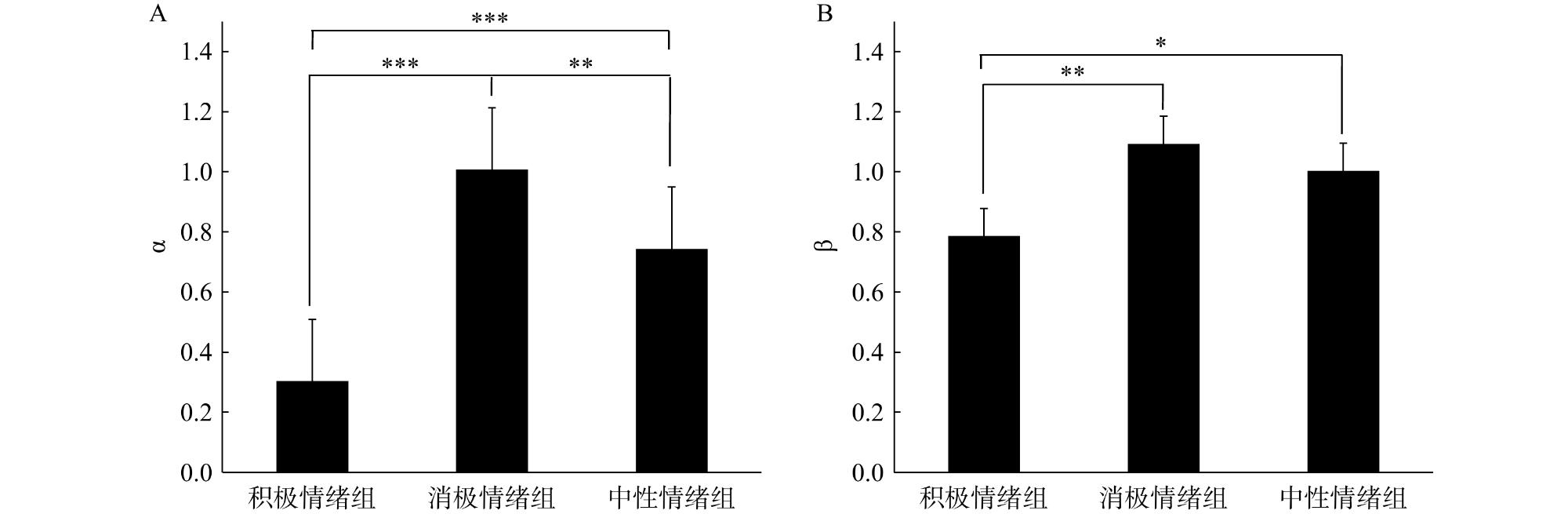


内疚厌恶参数β:被试决策时的内疚厌恶参数在三组间存在显著差异,F(2, 128)=5.83,p=0.004,$ \eta _{\mathrm{p}}^{2} $ =0.09;事后多重比较发现,与中性情绪组相比(1.00±0.40),积极情绪组决策时的内疚厌恶倾向要显著更弱[0.83±0.32, t(86)=−2.18, p=0.030, Cohen’s d=−0.47],而消极情绪组的并无显著差异[1.10±0.38, t(86)=1.19, p=0.240, Cohen’s d=0.25],且积极情绪组的也显著小于消极情绪组的[t(84)=−3.56, p=0.001, Cohen’s d=−0.75](见图5B)。
此外,为检验结果的稳健性,将实验1的无情绪启动组(n=84)与实验2的中性情绪组被试(n=49)的结果进行了比较。独立样本t检验结果显示,两组被试在帮助比例[实验1: 0.56±0.14; 实验2: 0.60±0.10, t(131)=1.66, p=0.100]、主观决策价值差ΔSV[实验1: 0.15±0.46; 实验2: 0.16±0.20, t(131)=1.21, p=0.930]、损失厌恶参数α[实验1: 0.82±0.43; 实验2: 0.74±0.35, t(131)=−1.38, p=0.170]和内疚厌恶参数β[实验1: 1.00±0.38; 实验2: 1.00±0.39, t(131)=−0.35, p=0.510]等四个指标上均未呈现显著差异。
4 讨论
4.1 风险通过改变损失与内疚厌恶权衡抑制助人
两个实验均发现,随着助人失败风险升高,大学生助人比例显著下降,主观决策价值(ΔSV)降低,且整体上在30%(实验1)或40%(实验2)风险处出现转折点,符合“概率折扣”现象,验证了假设1。计算建模结果揭示,决策遵循“损失−内疚厌恶”整合模型:内疚厌恶参数β普遍高于损失厌恶参数α,说明个体在可承受风险范围内仍倾向助人;但随着风险增加,损失厌恶增强、内疚厌恶减弱,导致助人意愿下降。这与Gross等人(2021)和Liu等人(2023)研究中的行为趋势一致,并通过计算模型量化了双重偏好的动态权衡机制。低风险下的利他倾向可能反映我国集体主义文化中社会规范的引导(苑明亮 等, 2024);风险升高后,个体对损失规避的考量超过对内疚的回避,从而减少助人。依据预期理论(Kermer et al., 2006),损失厌恶体现为对损失的心理权重高于等量获益,内疚厌恶则源于对违反社会规范可能引发内疚的预期,二者均涉及对潜在结果的认知评估。本研究表明,个体在风险较低时更倾向于回避内疚而选择助人;当风险升高时,对损失的规避超过对内疚的回避,从而减少助人行为,这与风险决策中概率升高加剧风险规避的一般规律相符(Wang et al., 2023)。
4.2 积极情绪通过缓解损失厌恶来提升风险情境下的助人意愿
实验2发现积极情绪组表现出更低的损失厌恶、更高的ΔSV及更多的助人选择,验证了假设2。这一结果支持积极情绪的拓展—建构理论:积极情绪能提升个体对风险的容忍度和乐观预期,从而促进亲社会风险行为(何雨真 等, 2024; 马丽云, 莫文, 2022; Carmona-Perera et al., 2013)。例如,积极情绪不仅能够激发个体的亲社会行为,还能通过情绪维持动机进一步促进亲社会行为,即个体在体验到积极情绪后,可能会通过助人行为来延长和增加这种积极情绪状态(李温平 等, 2019)。Zhang等人(2024)也认为积极情绪通常与亲社会行为存在密切关系,积极情绪体验能导致个体对决策结果更加乐观,更能容忍不确定性,进而在风险情境下做出更多的利他选择。然而,值得注意的是,尽管本研究支持积极情绪促进风险情境下的助人行为,但已有研究提示高兴情绪对道德规范敏感性的影响可能并非普遍增强,这一差异可能源于情绪诱发方式、道德情境类型或个体特质的调节作用(刘传军 等, 2021)。
4.3 消极情绪对助人行为及认知参数的抑制效应
实验2还发现消极情绪组的个体表现出更强的损失厌恶、更低的ΔSV及更少的助人选择。这一结果与代价−回报理论是一致的(肖凤秋 等, 2014):消极情绪下个体更关注自身成本与风险,减少对他人需求的注意,从而抑制助人行为。例如,消极情绪会促使个体更关注自己的感受和需求,减少对他人需求的关注,感觉自己没有足够的精力或资源去帮助他人(刘新燕 等, 2023)。同时,消极情绪亦会增强风险规避倾向(徐富明 等, 2015; Lerner & Keltner, 2001),如愤怒情绪具有高确定性和控制感,可能导致个体偏爱延迟选择和做出风险博弈,而悲伤和恐惧情绪下个体可能偏爱即刻选择和规避风险(陆翠薇 等, 2021)。在本研究中具体表现为损失厌恶升高,进而降低个体在风险情境下的助人意愿。
综上,本研究通过行为实验与计算建模,发现风险情境下的道德决策遵循“损失−内疚厌恶”整合模型:风险升高会增强损失厌恶并减弱内疚厌恶,从而降低助人行为;积极情绪则能缓冲损失厌恶,促进助人。然而,研究存在局限:一是样本主要为大学生,结论推广需谨慎,未来应拓展至青少年等群体;二是风险以10%为梯度划分,与实际感知有差异,需进一步优化;三是情绪启动未测基线且对照组设置简单,后续应采用中性视频与前测设计;四是情绪操纵仅区分效价,未细分具体情绪类型;五是“内疚厌恶”的操纵可能混杂共情等动机,需通过更纯粹范式(如违反事前承诺)进一步检验。
5 结论
本研究得出以下结论:(1)风险情境下的道德决策同时受损失厌恶与内疚厌恶共同调节,并表现出风险规避倾向;(2)积极情绪可通过降低损失厌恶促进冒险助人,而消极情绪则通过增强损失厌恶抑制该行为。