
心理与行为研究 ›› 2025, Vol. 23 ›› Issue (2): 185-192.DOI: 10.12139/j.1672-0628.2025.02.006
程黎1,2, 陈啸宇1, 刘玉娟*,3( )
)
收稿日期:2024-04-19
出版日期:2025-03-20
发布日期:2025-03-20
通讯作者:
刘玉娟
基金资助:
Li CHENG1,2, Xiaoyu CHEN1, Yujuan LIU*,3()
Received:2024-04-19
Online:2025-03-20
Published:2025-03-20
Contact:
Yujuan LIU
摘要:
本研究考察教师支持与同伴支持对情绪智力的影响以及心理韧性的中介作用在超常与常态儿童群体间的差异,对改善超常儿童学习生活环境、为超常与常态儿童提供针对性教育支持、促进超常与常态儿童的协同发展与健康成长具有重要意义。采用情绪智力自陈量表、教师支持量表、同伴支持量表和心理韧性量表对292名超常儿童和322名常态儿童进行测量。结果表明:(1)教师支持与同伴支持均正向预测超常与常态儿童情绪智力,但教师支持对超常儿童的预测作用较常态儿童更弱,而同伴支持对超常儿童的预测作用较常态儿童更强;(2)心理韧性在超常儿童教师支持与情绪智力间不发挥中介作用而在常态儿童中发挥部分中介作用,在超常儿童同伴支持与情绪智力间发挥部分中介作用而在常态儿童中发挥完全中介作用。
程黎, 陈啸宇, 刘玉娟. 教师支持、同伴支持、心理韧性与情绪智力的关系:超常与常态儿童的比较[J]. 心理与行为研究, 2025, 23(2): 185-192.
Li CHENG, Xiaoyu CHEN, Yujuan LIU. The Relationship Between Teacher Support, Student Support, Resilience, and Emotional Intelligence: Comparison of Gifted and Nongifted Children[J]. Studies of Psychology and Behavior, 2025, 23(2): 185-192.
| 超常儿童 | 常态儿童 | ||||
| 人数(n) | 年龄(M±SD) | 人数(n) | 年龄(M±SD) | ||
| 男生 | 149 | 8.15±1.18 | 162 | 8.20±1.16 | |
| 女生 | 143 | 8.00±1.11 | 160 | 8.09±1.11 | |
| 总计 | 292 | 8.08±1.15 | 322 | 8.15±1.14 | |
表1 研究对象基本信息
| 超常儿童 | 常态儿童 | ||||
| 人数(n) | 年龄(M±SD) | 人数(n) | 年龄(M±SD) | ||
| 男生 | 149 | 8.15±1.18 | 162 | 8.20±1.16 | |
| 女生 | 143 | 8.00±1.11 | 160 | 8.09±1.11 | |
| 总计 | 292 | 8.08±1.15 | 322 | 8.15±1.14 | |
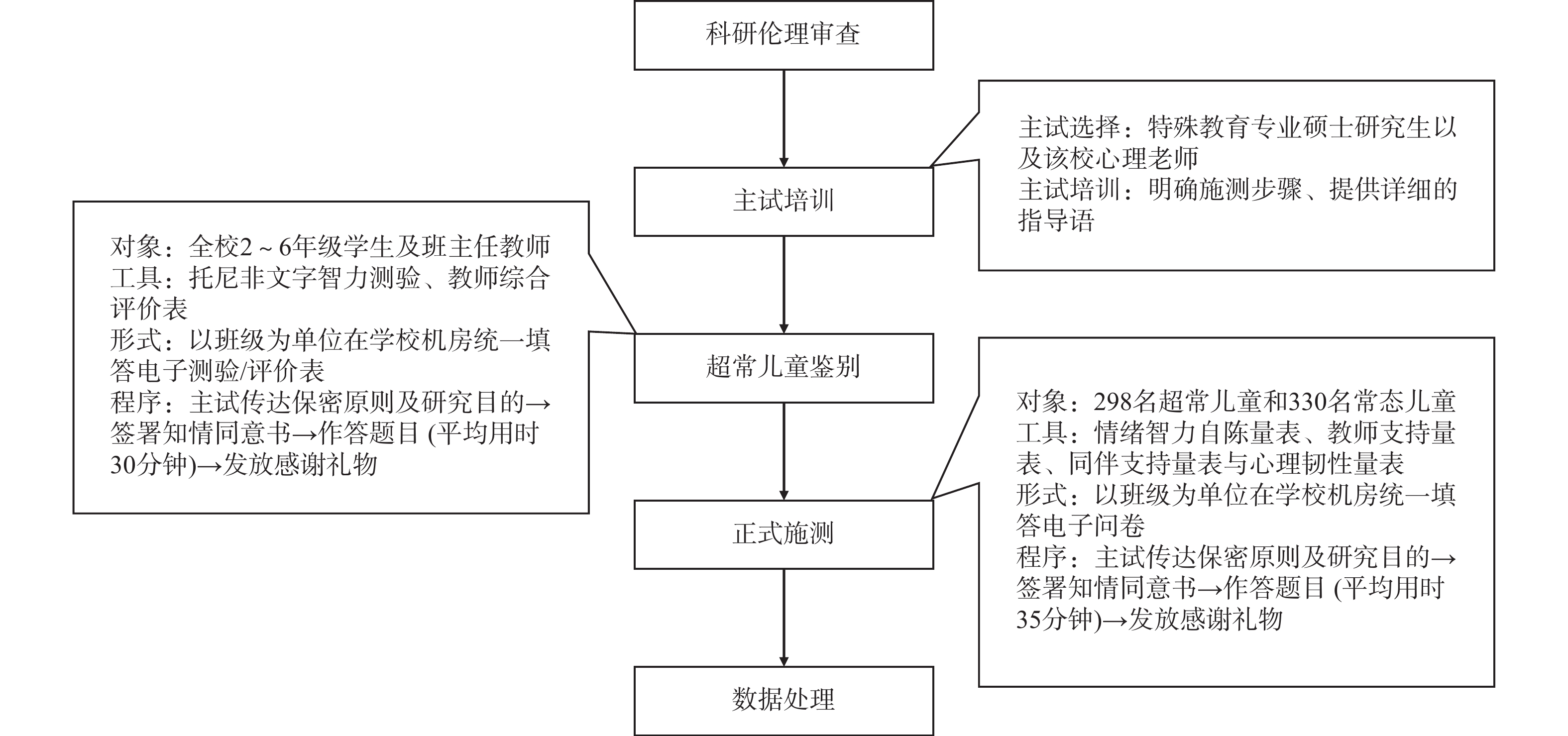
图1 研究流程图
| 变量 | 1 | 2 | 3 | 4 | 5 | 6 | 7 | 8 | 9 | 10 | 11 |
| 1.情绪感知 | 0.69*** | 0.75*** | 0.66*** | 0.42*** | 0.49*** | 0.54*** | 0.47*** | 0.59*** | 0.10 | 0.12* | |
| 2.理解和推理自身情绪 | 0.64*** | 0.69*** | 0.74*** | 0.50*** | 0.52*** | 0.56*** | 0.51*** | 0.59*** | 0.06 | 0.03 | |
| 3.理解和推理他人情绪 | 0.69*** | 0.73*** | 0.73*** | 0.54*** | 0.52*** | 0.63*** | 0.56*** | 0.62*** | 0.11 | 0.07 | |
| 4.情绪运用 | 0.61*** | 0.68*** | 0.74*** | 0.44*** | 0.46*** | 0.56*** | 0.49*** | 0.55*** | 0.13* | 0.04 | |
| 5.教师情感支持 | 0.50*** | 0.51*** | 0.60*** | 0.50*** | 0.72*** | 0.57*** | 0.56*** | 0.37*** | 0.06 | −0.06 | |
| 6.教师学业支持 | 0.46*** | 0.50*** | 0.55*** | 0.45*** | 0.73*** | 0.50*** | 0.45*** | 0.31*** | 0.16** | 0.02 | |
| 7.同伴情感支持 | 0.39*** | 0.43*** | 0.56*** | 0.40*** | 0.59*** | 0.48*** | 0.80*** | 0.48*** | 0.17** | −0.04 | |
| 8.同伴学业支持 | 0.38*** | 0.37*** | 0.48*** | 0.38*** | 0.53*** | 0.39*** | 0.81*** | 0.44*** | 0.17** | −0.09 | |
| 9.心理韧性 | 0.50*** | 0.62*** | 0.59*** | 0.52*** | 0.36*** | 0.32*** | 0.37*** | 0.32*** | 0.02 | 0.09 | |
| 10.性别 | 0.08 | 0.04 | 0.12* | −0.01 | 0.19** | 0.22** | 0.13* | 0.11 | −0.03 | −0.07 | |
| 11.年级 | 0.13* | 0.03 | 0.04 | 0.03 | 0.00 | 0.08 | −0.01 | −0.03 | 0.03 | −0.05 | |
| 12.M超常 | 3.83 | 4.08 | 3.94 | 4.11 | 4.08 | 4.49 | 3.83 | 3.66 | 3.72 | ||
| 13.SD超常 | 0.65 | 0.64 | 0.71 | 0.74 | 0.90 | 0.72 | 0.98 | 1.07 | 0.75 | ||
| 14.M常态 | 3.75 | 3.97 | 3.88 | 4.01 | 3.91 | 4.28 | 3.72 | 3.60 | 3.66 | ||
| 15.SD常态 | 0.61 | 0.63 | 0.78 | 0.82 | 1.03 | 0.89 | 1.01 | 1.11 | 0.73 |
表2 各变量的描述统计与相关系数
| 变量 | 1 | 2 | 3 | 4 | 5 | 6 | 7 | 8 | 9 | 10 | 11 |
| 1.情绪感知 | 0.69*** | 0.75*** | 0.66*** | 0.42*** | 0.49*** | 0.54*** | 0.47*** | 0.59*** | 0.10 | 0.12* | |
| 2.理解和推理自身情绪 | 0.64*** | 0.69*** | 0.74*** | 0.50*** | 0.52*** | 0.56*** | 0.51*** | 0.59*** | 0.06 | 0.03 | |
| 3.理解和推理他人情绪 | 0.69*** | 0.73*** | 0.73*** | 0.54*** | 0.52*** | 0.63*** | 0.56*** | 0.62*** | 0.11 | 0.07 | |
| 4.情绪运用 | 0.61*** | 0.68*** | 0.74*** | 0.44*** | 0.46*** | 0.56*** | 0.49*** | 0.55*** | 0.13* | 0.04 | |
| 5.教师情感支持 | 0.50*** | 0.51*** | 0.60*** | 0.50*** | 0.72*** | 0.57*** | 0.56*** | 0.37*** | 0.06 | −0.06 | |
| 6.教师学业支持 | 0.46*** | 0.50*** | 0.55*** | 0.45*** | 0.73*** | 0.50*** | 0.45*** | 0.31*** | 0.16** | 0.02 | |
| 7.同伴情感支持 | 0.39*** | 0.43*** | 0.56*** | 0.40*** | 0.59*** | 0.48*** | 0.80*** | 0.48*** | 0.17** | −0.04 | |
| 8.同伴学业支持 | 0.38*** | 0.37*** | 0.48*** | 0.38*** | 0.53*** | 0.39*** | 0.81*** | 0.44*** | 0.17** | −0.09 | |
| 9.心理韧性 | 0.50*** | 0.62*** | 0.59*** | 0.52*** | 0.36*** | 0.32*** | 0.37*** | 0.32*** | 0.02 | 0.09 | |
| 10.性别 | 0.08 | 0.04 | 0.12* | −0.01 | 0.19** | 0.22** | 0.13* | 0.11 | −0.03 | −0.07 | |
| 11.年级 | 0.13* | 0.03 | 0.04 | 0.03 | 0.00 | 0.08 | −0.01 | −0.03 | 0.03 | −0.05 | |
| 12.M超常 | 3.83 | 4.08 | 3.94 | 4.11 | 4.08 | 4.49 | 3.83 | 3.66 | 3.72 | ||
| 13.SD超常 | 0.65 | 0.64 | 0.71 | 0.74 | 0.90 | 0.72 | 0.98 | 1.07 | 0.75 | ||
| 14.M常态 | 3.75 | 3.97 | 3.88 | 4.01 | 3.91 | 4.28 | 3.72 | 3.60 | 3.66 | ||
| 15.SD常态 | 0.61 | 0.63 | 0.78 | 0.82 | 1.03 | 0.89 | 1.01 | 1.11 | 0.73 |
| 模型 | χ2/df | CFI | TLI | RMSEA | SRMR |
| M1 | 2.46 | 0.97 | 0.96 | 0.07 | 0.06 |
| M2 | 2.13 | 0.98 | 0.97 | 0.06 | 0.06 |
| M3 | 2.13 | 0.98 | 0.97 | 0.06 | 0.06 |
| M4 | 2.02 | 0.98 | 0.97 | 0.06 | 0.06 |
| M5 | 2.11 | 0.98 | 0.97 | 0.06 | 0.06 |
表3 教师支持与同伴支持对超常与常态儿童情绪智力影响的多群组结构方程模型拟合指标
| 模型 | χ2/df | CFI | TLI | RMSEA | SRMR |
| M1 | 2.46 | 0.97 | 0.96 | 0.07 | 0.06 |
| M2 | 2.13 | 0.98 | 0.97 | 0.06 | 0.06 |
| M3 | 2.13 | 0.98 | 0.97 | 0.06 | 0.06 |
| M4 | 2.02 | 0.98 | 0.97 | 0.06 | 0.06 |
| M5 | 2.11 | 0.98 | 0.97 | 0.06 | 0.06 |
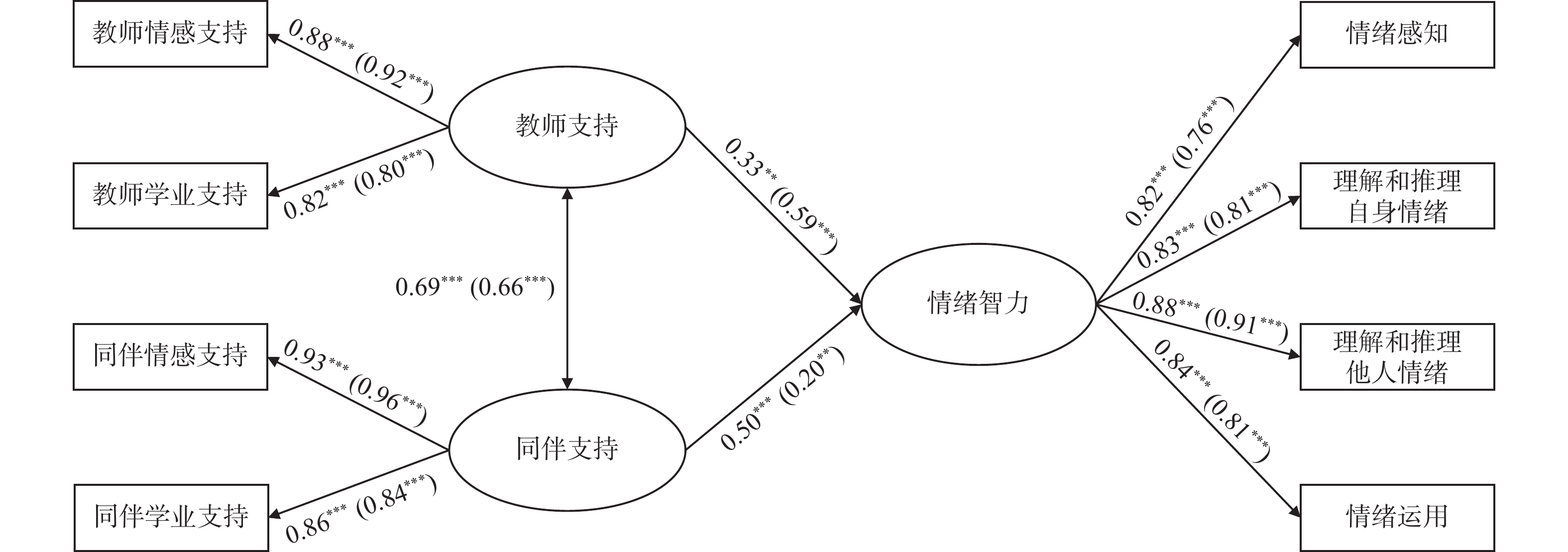
图2 超常与常态儿童教师支持与同伴支持对情绪智力影响的多群组模型 注:本图呈现的均为标准化系数,括号外为超常儿童,括号内为常态儿童;为使模型图简洁美观,图中未标出各项残差及控制变量,以下同。
| 模型 | χ2/df | CFI | TLI | RMSEA | SRMR |
| M6 | 2.32 | 0.97 | 0.96 | 0.07 | 0.05 |
| M7 | 2.20 | 0.98 | 0.97 | 0.06 | 0.06 |
| M8 | 2.12 | 0.98 | 0.97 | 0.06 | 0.05 |
| M9 | 2.02 | 0.98 | 0.97 | 0.06 | 0.05 |
| M10 | 2.04 | 0.98 | 0.97 | 0.06 | 0.06 |
表4 超常与常态儿童心理韧性的中介作用多群组结构方程模型拟合指标
| 模型 | χ2/df | CFI | TLI | RMSEA | SRMR |
| M6 | 2.32 | 0.97 | 0.96 | 0.07 | 0.05 |
| M7 | 2.20 | 0.98 | 0.97 | 0.06 | 0.06 |
| M8 | 2.12 | 0.98 | 0.97 | 0.06 | 0.05 |
| M9 | 2.02 | 0.98 | 0.97 | 0.06 | 0.05 |
| M10 | 2.04 | 0.98 | 0.97 | 0.06 | 0.06 |
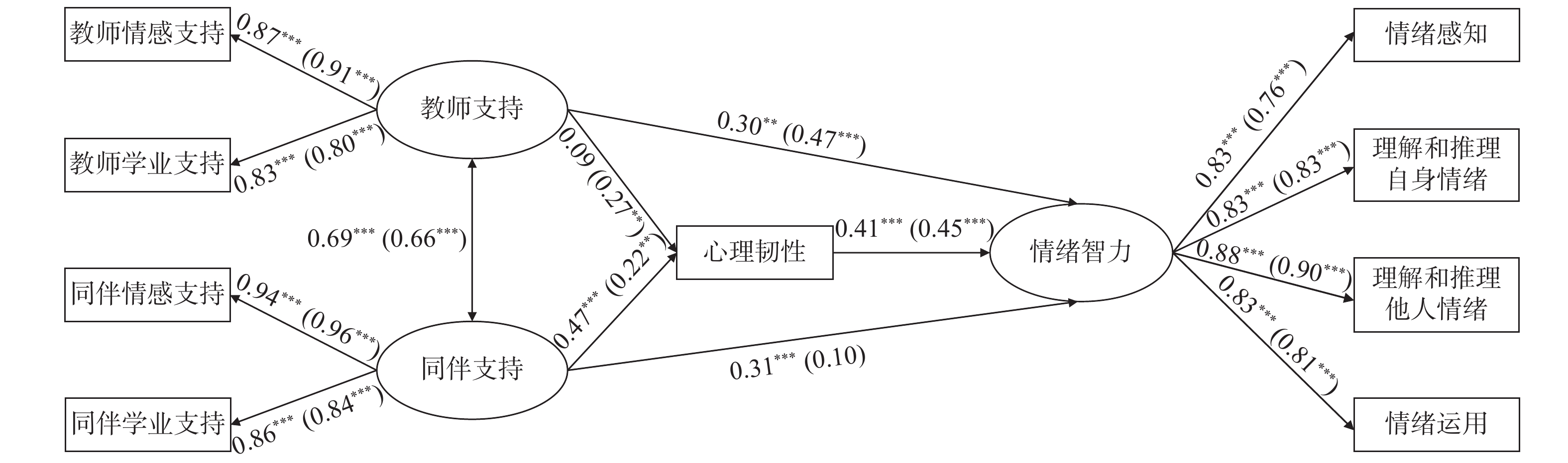
图3 超常与常态儿童心理韧性中介作用的多群组模型
| 中介路径 | 群体 | 中介 效应量 | 95%CI | 占总效应量 比例(%) | |
| Lower | Upper | ||||
| 教师支持→心理韧性→ 情绪智力 | 超常 | 0.04 | −0.04 | 0.11 | 10.81 |
| 常态 | 0.12 | 0.06 | 0.20 | 20.24 | |
| 同伴支持→心理韧性→ 情绪智力 | 超常 | 0.19 | 0.10 | 0.30 | 38.32 |
| 常态 | 0.10 | 0.04 | 0.19 | 49.74 | |
表5 超常与常态儿童心理韧性的中介效应量
| 中介路径 | 群体 | 中介 效应量 | 95%CI | 占总效应量 比例(%) | |
| Lower | Upper | ||||
| 教师支持→心理韧性→ 情绪智力 | 超常 | 0.04 | −0.04 | 0.11 | 10.81 |
| 常态 | 0.12 | 0.06 | 0.20 | 20.24 | |
| 同伴支持→心理韧性→ 情绪智力 | 超常 | 0.19 | 0.10 | 0.30 | 38.32 |
| 常态 | 0.10 | 0.04 | 0.19 | 49.74 | |
|
程黎, 陈啸宇, 张嘉桐. 美国超常儿童教育教师准备标准解析及启示. 中国特殊教育, 2022, (11): 62- 71.
DOI |
|
|
程黎, 李达棋, 刘海龙, 吴怡霖, 邵鑫雅. 超常儿童创造力促进的实证研究——基于数学创造性课堂环境的构建. 中国特殊教育, 2023, (12): 79- 89.
DOI |
|
|
程黎, 王美玲. 国内外超常儿童概念的发展及启示. 中国特殊教育, 2021, (10): 65- 69, 76.
DOI |
|
|
管童, 朱永新. 普通学校开展超常儿童教育的现实需要、主要特征以及路径选择. 中国特殊教育, 2022, (10): 3- 8.
DOI |
|
|
刘玉娟. 为超常儿童提供适宜的课程——基于对超常儿童理论及已有课程模式的分析. 中国特殊教育, 2023, (11): 73- 80, 72.
|
|
|
桑青松, 李海澜, 刘思义, 舒首立, 刘正奎. 心理韧性集体咨询对校园受欺凌小学生状态焦虑的影响. 心理与行为研究, 2019, 17 (3): 333- 339.
|
|
|
孙琬琰. 中小学生学校人际关系与幸福感的关联: 情绪调节能力的中介作用. 中国健康心理学杂志, 2023, 31 (1): 148- 156.
|
|
|
王才康, 何智雯. 父母养育方式和中学生自我效能感、情绪智力的关系研究. 中国心理卫生杂志, 2002, 16 (11): 781- 782, 785.
DOI |
|
|
习近平. 高举中国特色社会主义伟大旗帜 为全面建设社会主义现代化国家而团结奋斗——. 在中国共产党第二十次全国代表大会上的报告, 2022,
|
|
|
曾丽红. 教师支持与校园欺凌的关系: 特质情绪智力的中介作用. 中国健康心理学杂志, 2022, 30 (10): 1524- 1529.
|
|
|
张娜, 唐科莉, 李美娟. 构建超常儿童鉴别体系: 国际经验与本土思考. 中国特殊教育, 2023, (2): 88- 96.
DOI |
|
|
张雨青, 查子秀, 龚正行, 程念祖, 刘彭芝. 托尼非文字智力测验(TONT-2)的初步修订. 心理科学, 2003, 26 (2): 330- 331, 333.
DOI |
|
|
Bandura, A. (1986). Social foundations of thought and action: A social cognitive theory. Englewood Cliffs, NJ: Prentice–Hall.
|
|
|
Bildiren, A. The examination of nonverbal tests in the identification of giftedness. TALENT, 2018, 8 (2): 99- 113.
|
|
|
Campbell-Sills, L., & Stein, M. B. Psychometric analysis and refinement of the Connor-Davidson Resilience Scale (CD-RISC): Validation of a 10-item measure of resilience. Journal of Traumatic Stress, 2007, 20 (6): 1019- 1028.
DOI |
|
|
Chen, S. T. Chinese adolescents’ emotional intelligence, perceived social support, and resilience—The impact of school type selection. Frontiers in Psychology, 2019, 10, 1299.
DOI |
|
|
Chen, X. Y., & Cheng, L. Emotional intelligence and creative self-efficacy among gifted children: Mediating effect of self-esteem and moderating effect of gender. Journal of Intelligence, 2023, 11 (1): 17.
DOI |
|
|
Cheng, L., Chen, X. Y., Fu, W. Q., Ma, X. C., & Zhao, M. J. (2021). Perceptions of inclusive school quality and well-being among parents of children with disabilities in China: The mediation role of resilience. International Journal of Disability, Development and Education, 68(6), 806–821.
|
|
|
Forsblom, L., Peixoto, F., & Mata, L. Perceived classroom support: Longitudinal effects on students’ achievement emotions. Learning and Individual Differences, 2021, 85, 101959.
DOI |
|
|
French, L. R., Walker, C. L., & Shore, B. M. Do gifted students really prefer to work alone. Roeper Review, 2011, 33 (3): 145- 159.
DOI |
|
|
Gere, D. R., Capps, S. C., Mitchell, D. W., & Grubbs, E. Sensory sensitivities of gifted children. The American Journal of Occupational Therapy, 2009, 63 (3): 288- 295.
DOI |
|
|
Guignard, J. H., Bacro, F., & Guimard, P. School life satisfaction and peer connectedness of intellectually gifted adolescents in France: Is there a labeling effect. New Directions for Child and Adolescent Development, 2021, 2021 (179): 59- 74.
DOI |
|
|
Haddow, S., Taylor, E. P., & Schwannauer, M. Positive peer relationships, coping and resilience in young people in alternative care: A systematic review. Children and Youth Services Review, 2021, 122, 105861.
DOI |
|
|
Kassis, W., Vasiou, A., Govaris, C., Favre, C., Aksoy, D., & Graf, U. Social and individual factors predicting students’ resilience: A multigroup structural equation model. Education Sciences, 2024, 14 (1): 15.
|
|
|
Kitano, M. K., & Lewis, R. B. Resilience and coping: Implications for gifted children and youth at risk. Roeper Review, 2005, 27 (4): 200- 205.
DOI |
|
|
Kumpfer, K. L. (1999). Factors and processes contributing to resilience: The resilience framework. In M. D. Glantz & J. L. Johnson (Eds.), Resilience and development: Positive life adaptations (pp. 179–224). New York: Springer.
|
|
|
Longobardi, C., Settanni, M., Lin, S. Y., & Fabris, M. A. Student-teacher relationship quality and prosocial behaviour: The mediating role of academic achievement and a positive attitude towards school. British Journal of Educational Psychology, 2021, 91 (2): 547- 562.
DOI |
|
|
Ma, Q. Q. The role of teacher autonomy support on students’ academic engagement and resilience. Frontiers in Psychology, 2021, 12, 778581.
DOI |
|
|
Moreira, A. L., Yunes, M. Â. M., Nascimento, C. R. R., & Bedin, L. M. Children’s subjective well-being, peer relationships and resilience: An integrative literature review. Child Indicators Research, 2021, 14 (5): 1723- 1742.
DOI |
|
|
Mueller, C. E. Protective factors as barriers to depression in gifted and nongifted adolescents. Gifted Child Quarterly, 2009, 53 (1): 3- 14.
DOI |
|
|
Patrick, H., Ryan, A. M., & Kaplan, A. Early adolescents’ perceptions of the classroom social environment, motivational beliefs, and engagement. Journal of Educational Psychology, 2007, 99 (1): 83- 98.
DOI |
|
|
Renzulli, J. S. What makes giftedness?: Reexamining a definition. Phi Delta Kappan, 2011, 92 (8): 81- 88.
DOI |
|
|
Romano, L., Tang, X., Hietajärvi, L., Salmela-Aro, K., & Fiorilli, C. Students’ trait emotional intelligence and perceived teacher emotional support in preventing burnout: The moderating role of academic anxiety. International Journal of Environmental Research and Public Health, 2020, 17 (13): 4771.
DOI |
|
|
Sabouripour, F., & Roslan, S. B. Resilience, optimism and social support among international students. Asian Social Science, 2015, 11 (15): 159- 170.
|
|
|
Schutte, N. S., Malouff, J. M., Hall, L. E., Haggerty, D. J., Cooper, J. T., Golden, C. J., & Dornheim, L. Development and validation of a measure of emotional intelligence. Personality and Individual Differences, 1998, 25 (2): 167- 177.
DOI |
|
|
Tortosa Martínez, B. M., Pérez-Fuentes, M. D. C., & Molero Jurado, M. D. M. Mediating role of emotional intelligence in the relationship between resilience and academic engagement in adolescents: Differences between men and women. Psychology Research and Behavior Management, 2023, 16, 2721- 2733.
DOI |
|
|
VanTassel-Baska, J., & Brown, E. F. Toward best practice: An analysis of the efficacy of curriculum models in gifted education. Gifted Child Quarterly, 2007, 51 (4): 342- 358.
DOI |
|
|
Vogelaar, B., Resing, W. C. M., Stad, F. E., & Sweijen, S. W. Is planning related to dynamic testing outcomes? Investigating the potential for learning of gifted and average-ability children. Acta Psychologica, 2019, 196, 87- 95.
DOI |
|
|
Wang, K. F., & Kong, F. Linking trait mindfulness to life satisfaction in adolescents: The mediating role of resilience and self-esteem. Child Indicators Research, 2020, 13 (1): 321- 335.
DOI |
|
|
Werner, E. E. (2000). Protective factors and individual resilience. In J. P. Shonkoff & S. J. Meisels (Eds.), Handbook of early childhood intervention (pp. 115–132). Cambridge, United Kingdom: Cambridge University.
|
| [1] | 赵黎明, 韩蒙蒙, 贾津津. 中学生社交焦虑与攻击性的关系:言语流畅性的中介作用和情绪智力的调节作用[J]. 心理与行为研究, 2025, 23(2): 265-272. |
| [2] | 范苗苗, 林怡静, 辛自强, 陈文锋. 同伴依恋对青少年网络成瘾的影响:应对方式和心理韧性的链式中介作用[J]. 心理与行为研究, 2025, 23(1): 91-98. |
| [3] | 张耀华, 徐敏, 黄云云, 辛素飞. 心理韧性缓冲压力生活事件与青少年学业倦怠之间的非线性关系[J]. 心理与行为研究, 2024, 22(1): 123-129. |
| [4] | 刘峻君, 何晓燕, 李松, 冉光明. 社交回避与青少年自杀意念的关系:有调节的中介模型[J]. 心理与行为研究, 2023, 21(5): 675-681. |
| [5] | 李嘉欣, 雒瑞帆, 封洪敏, 司继伟. 初中生感知到的同伴支持与数学学习投入—基于变量为中心和个体为中心的分析[J]. 心理与行为研究, 2022, 20(5): 629-636. |
| [6] | 江盈颖, 马丽, 张丽锦, 朱莉琪. 子女数量与育龄母亲生活满意度的链式中介模型[J]. 心理与行为研究, 2022, 20(5): 651-656. |
| [7] | 曾玲娟, 江丽晶, 彭叶. 家庭环境和教师支持对中学生学业拖延的影响:基本心理需求满足与心理资本的链式中介作用[J]. 心理与行为研究, 2022, 20(4): 501-507. |
| [8] | 李娇娇, 刘晓冰, 裴丹丹, 徐碧波, 尹锡杨. 情绪智力对大学生恶意创造力的影响:一个有调节的中介模型[J]. 心理与行为研究, 2022, 20(4): 563-569. |
| [9] | 李永占. 情绪智力在身体自尊与进食障碍倾向间的调节作用[J]. 心理与行为研究, 2022, 20(4): 570-576. |
| [10] | 白慧慧, 王雨晴, 孙婉靖. 留守儿童心理韧性的元分析[J]. 心理与行为研究, 2022, 20(2): 261-267. |
| [11] | 姜琨, 兰泽波, 孙晓铜, 丁晓辉, 陶佳雨. 听障大学生社会支持对学业自我效能感的影响:心理韧性的中介作用[J]. 心理与行为研究, 2022, 20(1): 96-100. |
| [12] | 张珊珊, 鞠睿, 李亚林, 王晓庄. 亲子依恋与青少年内外化问题的关系:心理韧性与同伴影响抵抗的链式中介作用[J]. 心理与行为研究, 2021, 19(3): 354-360. |
| [13] | 孙芳, 李欢欢, 包佳敏, 甄子昂, 宋巍, 蒋松源. 教师支持、同伴支持与中学生心理危机的关系:歧视知觉的中介作用[J]. 心理与行为研究, 2021, 19(2): 209-215. |
| [14] | 闫广芬, 姜琨, 兰泽波, 丁晓辉. 听障大学生社会支持对适应的影响:心理韧性的中介作用[J]. 心理与行为研究, 2021, 19(2): 252-257. |
| [15] | 孙小坚, 宋乃庆, 梁学友. 感知的父母及教师支持与学生STEAM学习的持续性动机:学习兴趣和自我效能感的多重中介作用[J]. 心理与行为研究, 2021, 19(1): 37-44. |
| 阅读次数 | ||||||
|
全文 |
|
|||||
|
摘要 |
|
|||||
