
心理与行为研究 ›› 2025, Vol. 23 ›› Issue (3): 391-398.DOI: 10.12139/j.1672-0628.2025.03.014
祖雯妍, 杨晓峰*( )
)
收稿日期:2024-07-30
出版日期:2025-05-20
发布日期:2025-05-20
通讯作者:
杨晓峰
基金资助:
Wenyan ZU, Xiaofeng YANG*()
Received:2024-07-30
Online:2025-05-20
Published:2025-05-20
Contact:
Xiaofeng YANG
摘要:
为探讨核心自我评价、压力知觉、短视频成瘾以及时间贫困感之间的关系,本研究采用核心自我评价量表、压力知觉量表、短视频成瘾量表及时间贫困感量表对中国810名大学生进行问卷调查。结果发现:(1)核心自我评价显著负向预测时间贫困感;(2)压力知觉在核心自我评价和时间贫困感中起中介作用;(3)压力知觉和短视频成瘾在核心自我评价和时间贫困感中起链式中介作用。本研究提示在降低个体时间贫困感时,提高个体核心自我评价也许是有效途径。
祖雯妍, 杨晓峰. 核心自我评价与时间贫困感的关系:压力知觉与短视频成瘾的链式中介作用[J]. 心理与行为研究, 2025, 23(3): 391-398.
Wenyan ZU, Xiaofeng YANG. The Relationship Between Core Self-Evaluation and Perceived Time Poverty: Chain Mediation of Perceived Stress and Short Video Addiction[J]. Studies of Psychology and Behavior, 2025, 23(3): 391-398.
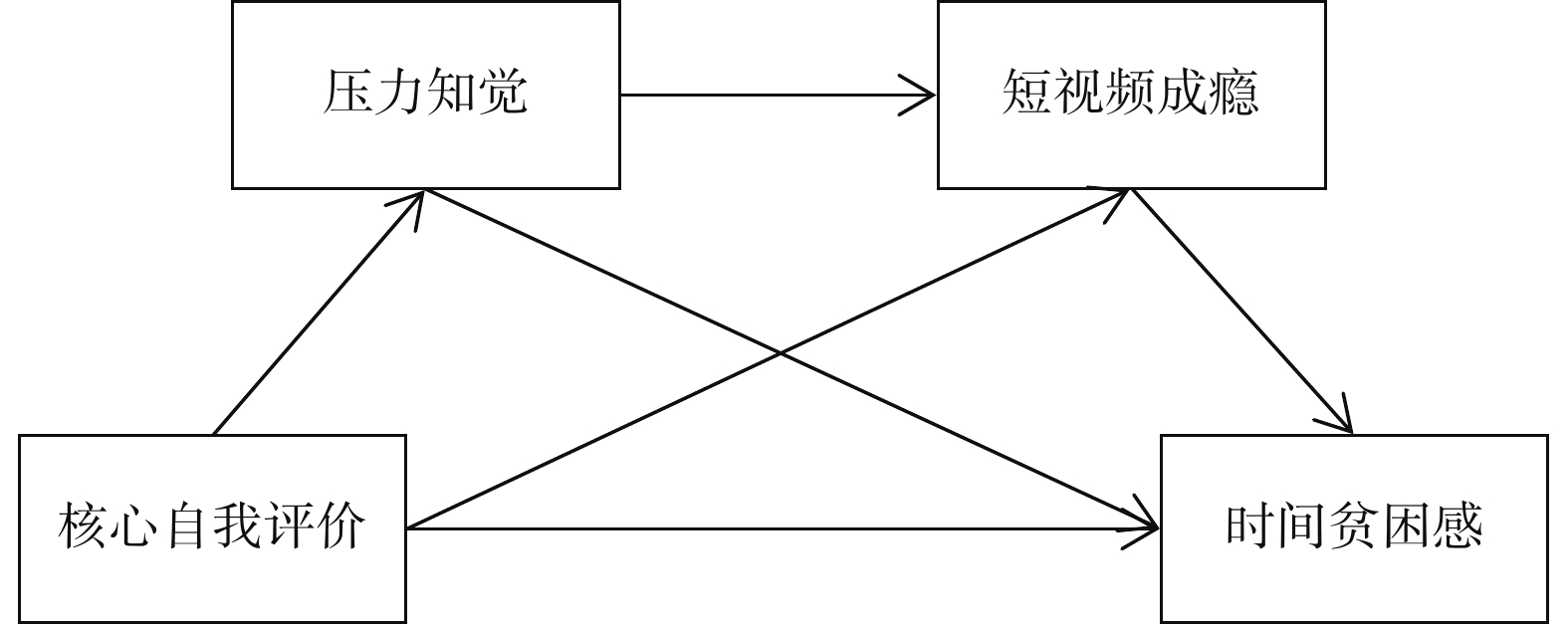
图1 假设模型
| M±SD | 1 | 2 | 3 | |
| 1.核心自我评价 | 3.55±0.83 | |||
| 2.压力知觉 | 2.77±0.61 | −0.79** | ||
| 3.短视频成瘾 | 3.16±0.88 | −0.42** | 0.51** | |
| 4.时间贫困感 | 3.80±1.43 | −0.60** | 0.61** | 0.50** |
表1 各变量的描述统计与相关分析结果(n=810)
| M±SD | 1 | 2 | 3 | |
| 1.核心自我评价 | 3.55±0.83 | |||
| 2.压力知觉 | 2.77±0.61 | −0.79** | ||
| 3.短视频成瘾 | 3.16±0.88 | −0.42** | 0.51** | |
| 4.时间贫困感 | 3.80±1.43 | −0.60** | 0.61** | 0.50** |
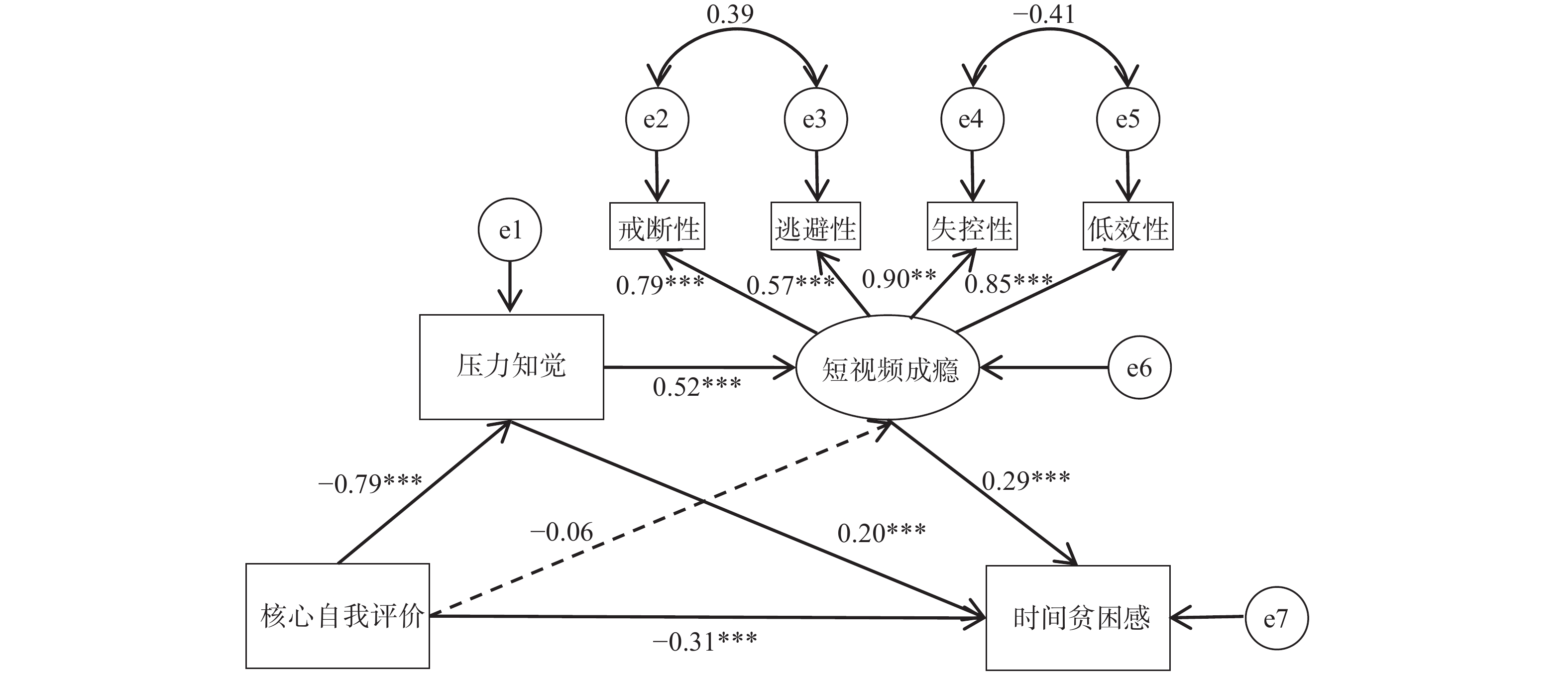
图2 核心自我评价与时间贫困感的链式中介模型(标准化)
| 路径 | 标准化 路径效应 | 效应率(%) | 95%的置信区间 | |
| Lower | Upper | |||
| 核心自我评价−压力知觉−时间贫困感 | −0.15 | 25.25 | −0.26 | −0.08 |
| 核心自我评价−短视频成瘾−时间贫困感 | −0.02 | 2.82 | −0.05 | 0.02 |
| 核心自我评价−压力知觉−短视频成瘾−时间贫困感 | −0.12 | 20.43 | −0.19 | −0.09 |
| 间接效应 | −0.29 | 48.50 | −0.37 | −0.22 |
| 直接效应 | −0.31 | 51.50 | −0.41 | −0.22 |
| 总效应 | −0.60 | 100.00 | −0.66 | −0.56 |
表2 对中介效应显著性检验的Bootstrap分析及其效应率
| 路径 | 标准化 路径效应 | 效应率(%) | 95%的置信区间 | |
| Lower | Upper | |||
| 核心自我评价−压力知觉−时间贫困感 | −0.15 | 25.25 | −0.26 | −0.08 |
| 核心自我评价−短视频成瘾−时间贫困感 | −0.02 | 2.82 | −0.05 | 0.02 |
| 核心自我评价−压力知觉−短视频成瘾−时间贫困感 | −0.12 | 20.43 | −0.19 | −0.09 |
| 间接效应 | −0.29 | 48.50 | −0.37 | −0.22 |
| 直接效应 | −0.31 | 51.50 | −0.41 | −0.22 |
| 总效应 | −0.60 | 100.00 | −0.66 | −0.56 |
|
曹瑞琳, 梅松丽, 梁磊磊, 李传恩, 张莹. 感恩与大学生网络成瘾的关系: 核心自我评价和生命意义感的中介作用. 心理发展与教育, 2023, 39 (2): 286- 294.
|
|
|
杜建政, 张翔, 赵燕. 核心自我评价的结构验证及其量表修订. 心理研究, 2012, 5 (3): 54- 60.
DOI |
|
|
姜福斌, 王震. 压力认知评价理论在管理心理学中的应用: 场景, 方式与迷思. 心理科学进展, 2022, 30 (12): 2825- 2845.
DOI |
|
|
金一丹, 李小山. 父母教养方式对大学生时间态度的影响: 核心自我评价的中介作用. 心理学探新, 2023, 43 (5): 472- 480.
|
|
|
黎建斌, 聂衍刚. 核心自我评价研究的反思与展望. 心理科学进展, 2010, 18 (12): 1848- 1857.
|
|
|
秦浩轩, 李霞, 曾美红, 何玉雪, 侯木兰. 大学生短视频成瘾量表的初步编制. 中国心理学前沿, 2019, 1 (8): 586- 598.
|
|
|
宋静静, 刘陈陵, 黄海. 自我概念清晰性和核心自我评价对青少年病理性互联网使用的影响: 社会适应的中介作用. 中国健康心理学杂志, 2020, 28 (3): 409- 414.
|
|
|
孙晓敏, 杨舒婷, 孔小杉, 刘臻臻, 马榕梓, 原悦, … 李志航. 时间贫困内涵及其对幸福感的影响: 稀缺理论视角. 心理科学进展, 2024, 32 (1): 27- 38.
|
|
|
汤丹丹, 温忠麟. 共同方法偏差检验: 问题与建议. 心理科学, 2020, 43 (1): 215- 223.
|
|
|
温忠麟, 叶宝娟. 有调节的中介模型检验方法: 竞争还是替补. 心理学报, 2014, 46 (5): 714- 726.
|
|
|
杨廷忠, 黄汉腾. 社会转型中城市居民心理压力的流行病学研究. 中华流行病学杂志, 2003, 24 (9): 760- 764.
DOI |
|
|
杨晓峰, 许思安, 郑雪. 大学生社会支持、核心自我评价与主观幸福感的关系研究. 中国特殊教育, 2009, (12): 83- 89.
DOI |
|
|
张晔, 刘勤学, 隆舟, 艾婷. 大学生特质焦虑与网络成瘾的关系: 一个有调节的中介模型. 心理发展与教育, 2016, 32 (6): 745- 752.
|
|
|
张志杰. 时间管理倾向与自尊、自我效能、学习满意度: 中介作用分析. 心理科学, 2005, 28 (3): 566- 568.
DOI |
|
|
中国互联网络信息中心(CNNIC). (2025). 第55次中国互联网络发展状况统计报告. 2025–01–31取自https://www.cnnic.net.cn/n4/2025/0117/c88-11229.html
|
|
|
Birkás, B., Pátkai, G., & Csathó, Á. The mediating role of the dark triad between life history strategy and perceived stress factors. Psychological Reports, 2020, 123 (2): 252- 265.
DOI |
|
|
Chang, C. H., Ferris, D. L., Johnson, R. E., Rosen, C. C., & Tan, J. A. Core self-evaluations: A review and evaluation of the literature. Journal of Management, 2012, 38 (1): 81- 128.
DOI |
|
|
Chen, J., Li, J. P., Cao, B. R., Wang, F., Luo, L., & Xu, J. J. Mediating effects of self-efficacy, coping, burnout, and social support between job stress and mental health among young Chinese nurses. Journal of Advanced Nursing, 2020, 76 (1): 163- 173.
DOI |
|
|
Cohen, S., Kamarck, T., & Mermelstein, R. A global measure of perceived stress. Journal of Health and Social Behavior, 1983, 24 (4): 385- 396.
DOI |
|
|
Davis, R. A. A cognitive-behavioral model of pathological internet use. Computers in Human Behavior, 2001, 17 (2): 187- 195.
DOI |
|
|
Elliot, A. J. Approach and avoidance motivation and achievement goals. Educational Psychologist, 1999, 34 (3): 169- 189.
DOI |
|
|
Feng, Y. H., Ma, Y. T., & Zhong, Q. S. The relationship between adolescents’ stress and internet addiction: A mediated-moderation model. Frontiers in Psychology, 2019, 10, 2248.
DOI |
|
|
Folkman, S., Lazarus, R. S., Dunkel-Schetter, C., DeLongis, A., & Gruen, R. J. Dynamics of a stressful encounter: Cognitive appraisal, coping, and encounter outcomes. Journal of Personality and Social Psychology, 1986, 50 (5): 992- 1003.
DOI |
|
|
Gärling, T., Gamble, A., Fors, F., & Hjerm, M. Emotional well-being related to time pressure, impediment to goal progress, and stress-related symptoms. Journal of Happiness Studies, 2016, 17 (5): 1789- 1799.
DOI |
|
|
Giurge, L. M., Whillans, A. V., & West, C. Why time poverty matters for individuals, organisations and nations. Nature Human Behaviour, 2020, 4 (10): 993- 1003.
DOI |
|
|
Gladden, P. R., Figueredo, A. J., & Snyder, B. Life History strategy and Evaluative Self-Assessment. Personality and Individual Differences, 2010, 48 (6): 731- 735.
DOI |
|
|
Griskevicius, V., Ackerman, J. M., Cantú, S. M., Delton, A. W., Robertson, T. E., Simpson, J. A., … Tybur, J. M. When the economy falters, do people spend or save? Responses to resource scarcity depend on childhood environments. Psychological Science, 2013, 24 (2): 197- 205.
DOI |
|
|
Judge, T. A., & Bono, J. E. Relationship of core self-evaluations traits—self-esteem, generalized self-efficacy, locus of control, and emotional stability—with job satisfaction and job performance: A meta-analysis. Journal of Applied Psychology, 2001, 86 (1): 80- 92.
DOI |
|
|
Judge, T. A., Erez, A., & Bono, J. E. The power of being positive: The relation between positive self-concept and job performance. Human Performance, 1998, 11 (2–3): 167- 187.
DOI |
|
|
Judge, T. A., Erez, A., Bono, J. E., & Thoresen, C. J. The Core Self-Evaluations Scale: Development of a measure. Personnel Psychology, 2003, 56 (2): 303- 331.
DOI |
|
|
Judge, T. A., Locke, E. A., & Durham, C. C. The dispositional causes of job satisfaction: A core evaluations approach. Research in Organizational Behavior, 1997, 19, 151- 188.
|
|
|
Kalenkoski, C. M., & Hamrick, K. S. How does time poverty affect behavior? A look at eating and physical activity. Applied Economic Perspectives and Policy, 2013, 35 (1): 89- 105.
DOI |
|
|
Kim, H. K., & Davis, K. E. Toward a comprehensive theory of problematic internet use: Evaluating the role of self-esteem, anxiety, flow, and the self-rated importance of internet activities. Computers in Human Behavior, 2009, 25 (2): 490- 500.
DOI |
|
|
Krueger, A. B. (Ed.). (2009). Measuring the subjective well-being of nations: National accounts of time use and well-being. Chicago: University of Chicago Press.
|
|
|
Malkoc, S. A., & Tonietto, G. N. Activity versus outcome maximization in time management. Current Opinion in Psychology, 2019, 26, 49- 53.
DOI |
|
|
Mani, A., Mullainathan, S., Shafir, E., & Zhao, J. Poverty impedes cognitive function. Science, 2013, 341 (6149): 976- 980.
DOI |
|
|
Marko, M., & Riečanský, I. Sympathetic arousal, but not disturbed executive functioning, mediates the impairment of cognitive flexibility under stress. Cognition, 2018, 174, 94- 102.
DOI |
|
|
Mittal, C., & Griskevicius, V. Sense of control under uncertainty depends on people’s childhood environment: A life history theory approach. Journal of Personality and Social Psychology, 2014, 107 (4): 621- 637.
DOI |
|
|
Mullainathan, S., & Shafir, E. (2013). Scarcity: Why having too little means so much. New York: Henry Holt and Company.
|
|
|
Nikseresht, A., Hajipour, B., Pishva, N., & Mohammadi, H. A. Using artificial intelligence to make sustainable development decisions considering VUCA: A systematic literature review and bibliometric analysis. Environmental Science and Pollution Research, 2022, 29 (28): 42509- 42538.
DOI |
|
|
Qin, Y., Omar, B., & Musetti, A. The addiction behavior of short-form video app TikTok: The information quality and system quality perspective. Frontiers in Psychology, 2022, 13, 932805.
DOI |
|
|
Rivero, T. S., Covre, P., Reyes, M. B., & Bueno, O. F. A. (2013). Effects of chronic video game use on time perception: Differences between sub- and multi-second intervals. Cyberpsychology, Behavior, and Social Networking, 16(2), 140–144.
|
|
|
Rosa, H. (2013). Social acceleration: A new theory of modernity. New York: Columbia University Press.
|
|
|
Rosen, C. C., Chang, C. H., Djurdjevic, E., & Eatough, E. (2010). Occupational stressors and job performance: An updated review and recommendations. In P. L. Perrewé & D. C. Ganster (Eds.), New developments in theoretical and conceptual approaches to job stress (pp. 1–60). Leeds, United Kingdom: Emerald Group Publishing Limited.
|
|
|
Roxburgh, S. “There just aren’t enough hours in the day”: The mental health consequences of time pressure. Journal of Health and Social Behavior, 2004, 45 (2): 115- 131.
DOI |
|
|
Schilbach, F., Schofield, H., & Mullainathan, S. The psychological lives of the poor. American Economic Review, 2016, 106 (5): 435- 440.
DOI |
|
|
Sng, O., Neuberg, S. L., Varnum, M. E. W., & Kenrick, D. T. The crowded life is a slow life: Population density and life history strategy. Journal of Personality and Social Psychology, 2017, 112 (5): 736- 754.
DOI |
|
|
Sullivan, O. Busyness, status distinction and consumption strategies of the income rich, time poor. Time & Society, 2008, 17 (1): 5- 26.
|
|
|
van der Meulen Rodgers, Y. Time poverty: Conceptualization, gender differences, and policy solutions. Social Philosophy and Policy, 2023, 40 (1): 79- 102.
DOI |
|
|
Vickery, C. The time-poor: A new look at poverty. Journal of Human Resources, 1977, 12 (1): 27- 48.
DOI |
|
|
Whillans, A. V., Dunn, E. W., Smeets, P., Bekkers, R., & Norton, M. I. Buying time promotes happiness. Proceedings of the National Academy of Sciences of the United States of America, 2017, 114 (32): 8523- 8527.
|
|
|
Zhang, K. Y., Ma, S. S., Yang, Z. Y., Zhu, S. H., & Yang, Y. No time to slow down: Time poverty predicts fast life history strategy via dissatisfaction of basic psychological needs. Personality and Individual Differences, 2025, 233, 112939.
DOI |
|
|
Zhao, Q., Ma, R. Z., Liu, Z. Z., Wang, T. X., Sun, X. M., van Prooijen, J. W., … Yuan, Y. Why do we never have enough time? Economic inequality fuels the perception of time poverty by aggravating status anxiety. British Journal of Social Psychology, 2024, 63 (2): 614- 636.
DOI |
|
|
Zheng, X. S., Zhang, Q., Li, X. X., & Wu, B. Q. Being busy, feeling poor: The scale development and validation of perceived time poverty. International Journal of Selection and Assessment, 2022, 30 (4): 596- 613.
DOI |
| [1] | 韩嘉桐, 关文军, 刘菁菁. 父母心理控制对中小学生短视频成瘾的影响:自主感和逆反心理的链式中介作用[J]. 心理与行为研究, 2026, 24(1): 95-102. |
| [2] | 赵纤, 黎志华. 童年累积创伤对成年早期抑郁症状的影响:压力知觉的中介机制[J]. 心理与行为研究, 2026, 24(1): 69-77. |
| [3] | 谷莉, 黄晓彤, 梁广华, 蔡頠, 郭丰波. 核心自我评价与青少年自伤行为的关系:有调节的中介模型[J]. 心理与行为研究, 2025, 23(6): 798-805. |
| [4] | 钞淼, 张宇, 谢启慧, 刘拓. 情感忽视对农村青少年短视频成瘾的纵向影响:负性情绪中介及留守差异[J]. 心理与行为研究, 2025, 23(3): 361-368. |
| [5] | 高斌, 谭莉华, 张丹丹, 黎明新, 蔡艳香. 网络社会支持与高中生网络学习投入:有调节的中介模型[J]. 心理与行为研究, 2023, 21(3): 403-409. |
| [6] | 吴旻, 宋文琦, 鞠佳雯. 父母粗暴养育与儿童睡眠质量的关系:核心自我评价和消极情绪的中介作用[J]. 心理与行为研究, 2023, 21(3): 344-351. |
| [7] | 陈姣, 熊猛. 相对剥夺感与大学生社交焦虑的关系:一个有调节的中介模型[J]. 心理与行为研究, 2023, 21(1): 65-71. |
| [8] | 黄杰, 朱丹, 周丽敏, 刘望. 核心自我评价的代际传递:父母支持和子女基本心理需要满足的链式中介作用[J]. 心理与行为研究, 2022, 20(4): 515-521. |
| [9] | 罗杰, 陈维, 杨桂芳, 吴丹萍, 刘拓. 大学生主动性人格对其拖延行为的影响:核心自我评价的中介作用[J]. 心理与行为研究, 2019, 17(5): 692-698. |
| [10] | 田宏杰. 完美主义高标准对大学生拖延行为的影响:链式中介效应分析[J]. 心理与行为研究, 2019, 17(5): 668-674. |
| [11] | 郭纪昌, 叶一舵. 青少年核心自我评价对生活满意度的影响:希望的中介效应[J]. 心理与行为研究, 2017, 15(5): 663-668. |
| [12] | 李洪玉,崔英文,何一粟,肖鹏,王璐. 核心自我评价研究综述*[J]. 心理与行为研究, 2014, 12(3): 400-406. |
| [13] | 黎建斌;聂衍刚;司徒巧敏;陶惠斯. 大学生核心自我评价对生活满意度的影响:水平和稳定性的作用[J]. , 2012, 10(5): 389-394. |
| 阅读次数 | ||||||
|
全文 |
|
|||||
|
摘要 |
|
|||||
