
心理与行为研究 ›› 2026, Vol. 24 ›› Issue (2): 195-203.DOI: 10.12139/j.1672-0628.2026.02.007
樊雪戎, 段依凡, 邢晓沛*( )
)
收稿日期:2025-01-22
出版日期:2026-03-20
发布日期:2026-03-20
通讯作者:
邢晓沛
基金资助:
Xuerong FAN, Yifan DUAN, Xiaopei XING*()
Received:2025-01-22
Online:2026-03-20
Published:2026-03-20
Contact:
Xiaopei XING
摘要:
研究以548名青少年及其父母为被试,采用二项式回归与响应曲面分析探究温暖的亲子感知差异与青少年内化问题的关系及其父母及青少年性别差异。结果发现:(1)父母感知的温暖水平普遍高于青少年;(2)在感知一致时,温暖水平越高,青少年内化问题越少,但父亲温暖的上升或下降均会使男生内化问题增加;(3)在感知不一致时,青少年感知温暖高于父母且差异越大,内化问题越少;无论差异方向如何,母子感知差异增加均会使青少年内化问题上升。研究结果揭示了亲子感知温暖的一致性与差异性在青少年内化问题中的复杂作用及其性别特异化模式,拓展了代际利害假说和操作三元模型,为制定性别特异化的青少年心理健康干预方案及家庭教养策略提供了启发。
樊雪戎, 段依凡, 邢晓沛. 温暖的亲子感知差异与青少年内化问题的关系:基于二项式回归的响应面分析[J]. 心理与行为研究, 2026, 24(2): 195-203.
Xuerong FAN, Yifan DUAN, Xiaopei XING. The Relationship Between Parent-Child Warmth Perception Discrepancies and Adolescent Internalizing Problems: A Response Surface Analysis[J]. Studies of Psychology and Behavior, 2026, 24(2): 195-203.
| 变量 | 男 M(SD) | 女 M(SD) | 1 | 2 | 3 | 4 | 5 |
| 1.父亲报告父亲温暖 | 3.35(0.55) | 3.35(0.61) | 0.35*** | 0.31*** | 0.18** | −0.04 | |
| 2.母亲报告母亲温暖 | 3.48(0.52) | 3.55(0.48) | 0.45*** | 0.16** | 0.24*** | −0.09 | |
| 3.青少年报告父亲温暖 | 3.23(0.77) | 3.03(0.86) | 0.39*** | 0.29*** | 0.70*** | −0.36*** | |
| 4.青少年报告母亲温暖 | 3.41(0.65) | 3.26(0.74) | 0.36*** | 0.23*** | 0.74*** | −0.32** | |
| 5.内化问题 | 0.27(0.35) | 0.41(0.43) | −0.23*** | −0.11 | −0.46*** | −0.40*** |
表1 研究主要变量的描述性统计及相关结果
| 变量 | 男 M(SD) | 女 M(SD) | 1 | 2 | 3 | 4 | 5 |
| 1.父亲报告父亲温暖 | 3.35(0.55) | 3.35(0.61) | 0.35*** | 0.31*** | 0.18** | −0.04 | |
| 2.母亲报告母亲温暖 | 3.48(0.52) | 3.55(0.48) | 0.45*** | 0.16** | 0.24*** | −0.09 | |
| 3.青少年报告父亲温暖 | 3.23(0.77) | 3.03(0.86) | 0.39*** | 0.29*** | 0.70*** | −0.36*** | |
| 4.青少年报告母亲温暖 | 3.41(0.65) | 3.26(0.74) | 0.36*** | 0.23*** | 0.74*** | −0.32** | |
| 5.内化问题 | 0.27(0.35) | 0.41(0.43) | −0.23*** | −0.11 | −0.46*** | −0.40*** |
| t | df | 亲子报告差异的具体比例(%) | |||
| 父/母高 | 一致 | 青少年高 | |||
| 父亲−男生报告父亲温暖 | 2.67** | 268 | 31 | 42 | 27 |
| 母亲−男生报告母亲温暖 | 1.69 | 268 | 31 | 39 | 30 |
| 父亲−女生报告父亲温暖 | 5.87*** | 278 | 42 | 36 | 23 |
| 母亲−女生报告母亲温暖 | 6.40*** | 278 | 38 | 44 | 18 |
表2 父/母温暖的亲子感知差异
| t | df | 亲子报告差异的具体比例(%) | |||
| 父/母高 | 一致 | 青少年高 | |||
| 父亲−男生报告父亲温暖 | 2.67** | 268 | 31 | 42 | 27 |
| 母亲−男生报告母亲温暖 | 1.69 | 268 | 31 | 39 | 30 |
| 父亲−女生报告父亲温暖 | 5.87*** | 278 | 42 | 36 | 23 |
| 母亲−女生报告母亲温暖 | 6.40*** | 278 | 38 | 44 | 18 |
| 回归系数 | 响应面曲线分数 | ||||||||||
| b0 (SE) | b1 (SE) | b2 (SE) | b3 (SE) | b4 (SE) | b5 (SE) | a1 (SE) | a2 (SE) | a3 (SE) | a4 (SE) | ||
| 因变量:内化问题 | |||||||||||
| 父亲温暖 | |||||||||||
| 男生 | 0.22*** (0.03) | −0.19*** (0.04) | −0.01 (0.04) | −0.01 (0.03) | 0.03 (0.05) | 0.14 (0.07) | −0.20*** (0.04) | 0.16** (0.06) | −0.18** (0.06) | 0.11 (0.11) | |
| 女生 | 0.36*** (0.04) | −0.15*** (0.04) | 0.04 (0.04) | 0.04 (0.04) | −0.03 (0.05) | −0.01 (0.05) | −0.11* (0.05) | 0.00 (0.05) | −0.19** (0.06) | 0.06 (0.10) | |
| 母亲温暖 | |||||||||||
| 男生 | 0.23*** (0.03) | −0.17*** (0.04) | −0.02 (0.04) | 0.03 (0.05) | −0.16 (0.08) | 0.12 (0.07) | −0.19*** (0.05) | −0.01 (0.08) | −0.15* (0.08) | 0.31* (0.15) | |
| 女生 | 0.38*** (0.03) | −0.19*** (0.05) | 0.01 (0.05) | 0.00 (0.05) | 0.05 (0.08) | 0.00 (0.07) | −0.18** (0.07) | 0.05 (0.06) | −0.20* (0.08) | −0.05 (0.15) | |
表3 亲子报告的父/母温暖与内化问题的二项式回归和RSA结果
| 回归系数 | 响应面曲线分数 | ||||||||||
| b0 (SE) | b1 (SE) | b2 (SE) | b3 (SE) | b4 (SE) | b5 (SE) | a1 (SE) | a2 (SE) | a3 (SE) | a4 (SE) | ||
| 因变量:内化问题 | |||||||||||
| 父亲温暖 | |||||||||||
| 男生 | 0.22*** (0.03) | −0.19*** (0.04) | −0.01 (0.04) | −0.01 (0.03) | 0.03 (0.05) | 0.14 (0.07) | −0.20*** (0.04) | 0.16** (0.06) | −0.18** (0.06) | 0.11 (0.11) | |
| 女生 | 0.36*** (0.04) | −0.15*** (0.04) | 0.04 (0.04) | 0.04 (0.04) | −0.03 (0.05) | −0.01 (0.05) | −0.11* (0.05) | 0.00 (0.05) | −0.19** (0.06) | 0.06 (0.10) | |
| 母亲温暖 | |||||||||||
| 男生 | 0.23*** (0.03) | −0.17*** (0.04) | −0.02 (0.04) | 0.03 (0.05) | −0.16 (0.08) | 0.12 (0.07) | −0.19*** (0.05) | −0.01 (0.08) | −0.15* (0.08) | 0.31* (0.15) | |
| 女生 | 0.38*** (0.03) | −0.19*** (0.05) | 0.01 (0.05) | 0.00 (0.05) | 0.05 (0.08) | 0.00 (0.07) | −0.18** (0.07) | 0.05 (0.06) | −0.20* (0.08) | −0.05 (0.15) | |
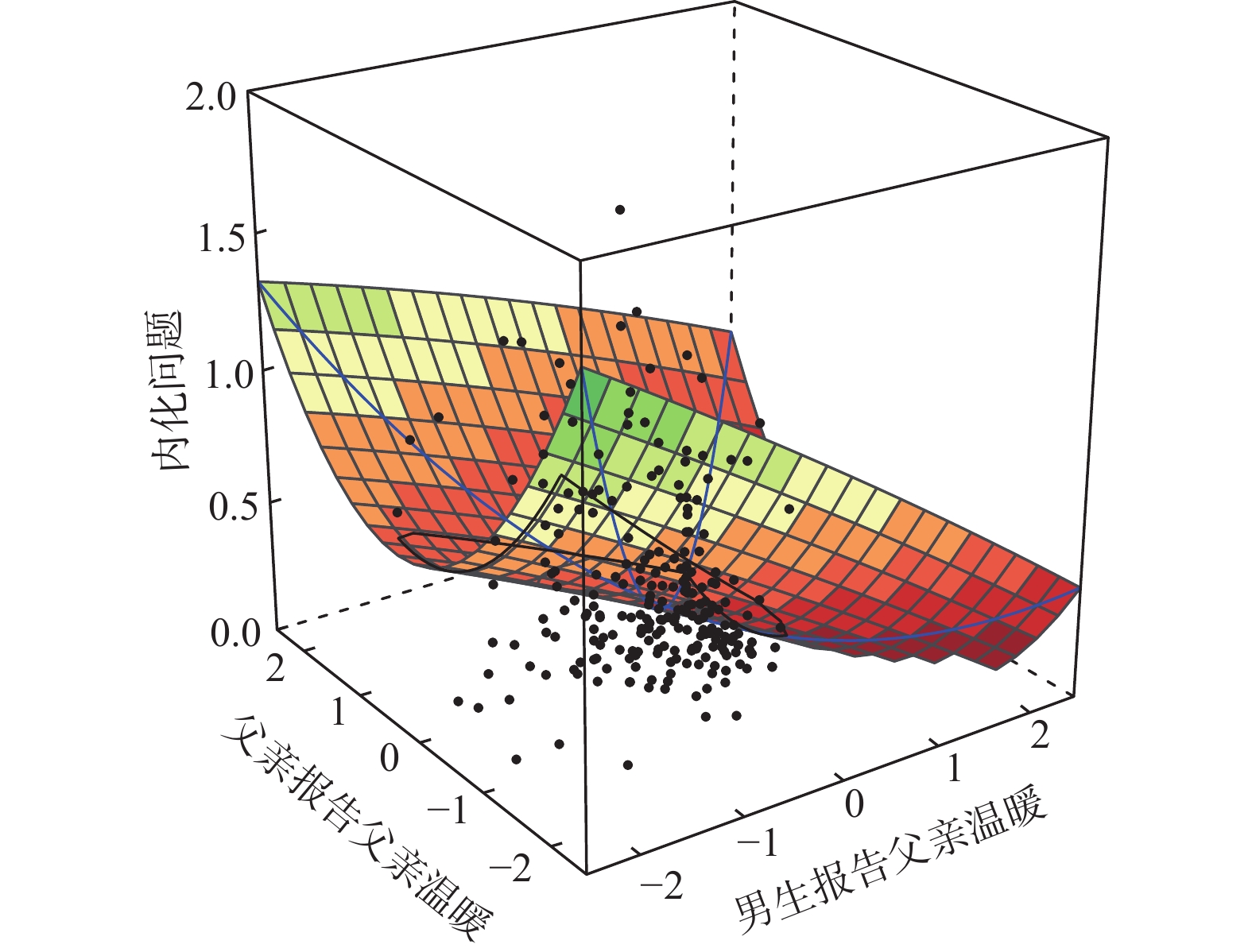
图1 父子感知温暖与男生内化问题模型
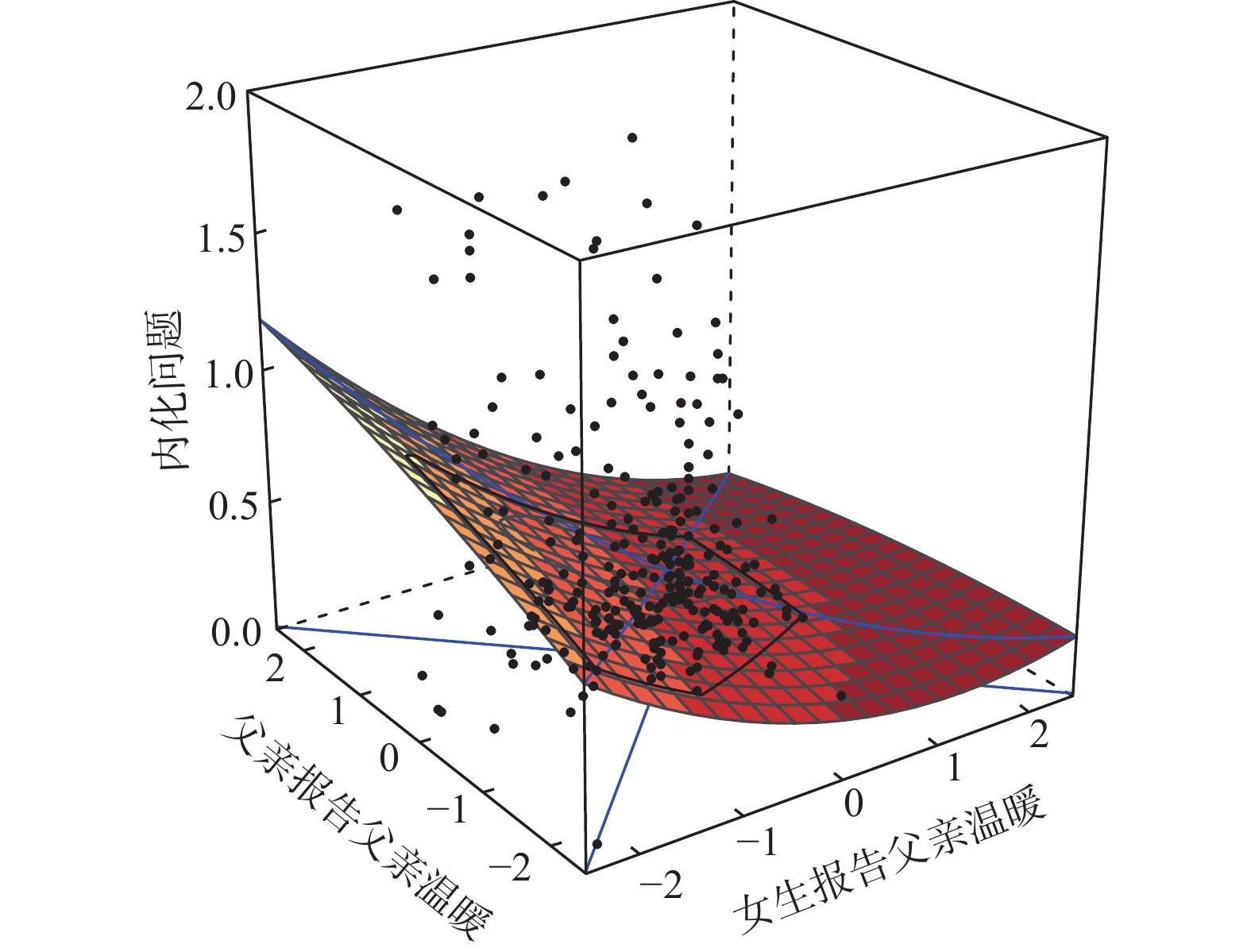
图2 父女感知温暖与女生内化问题模型
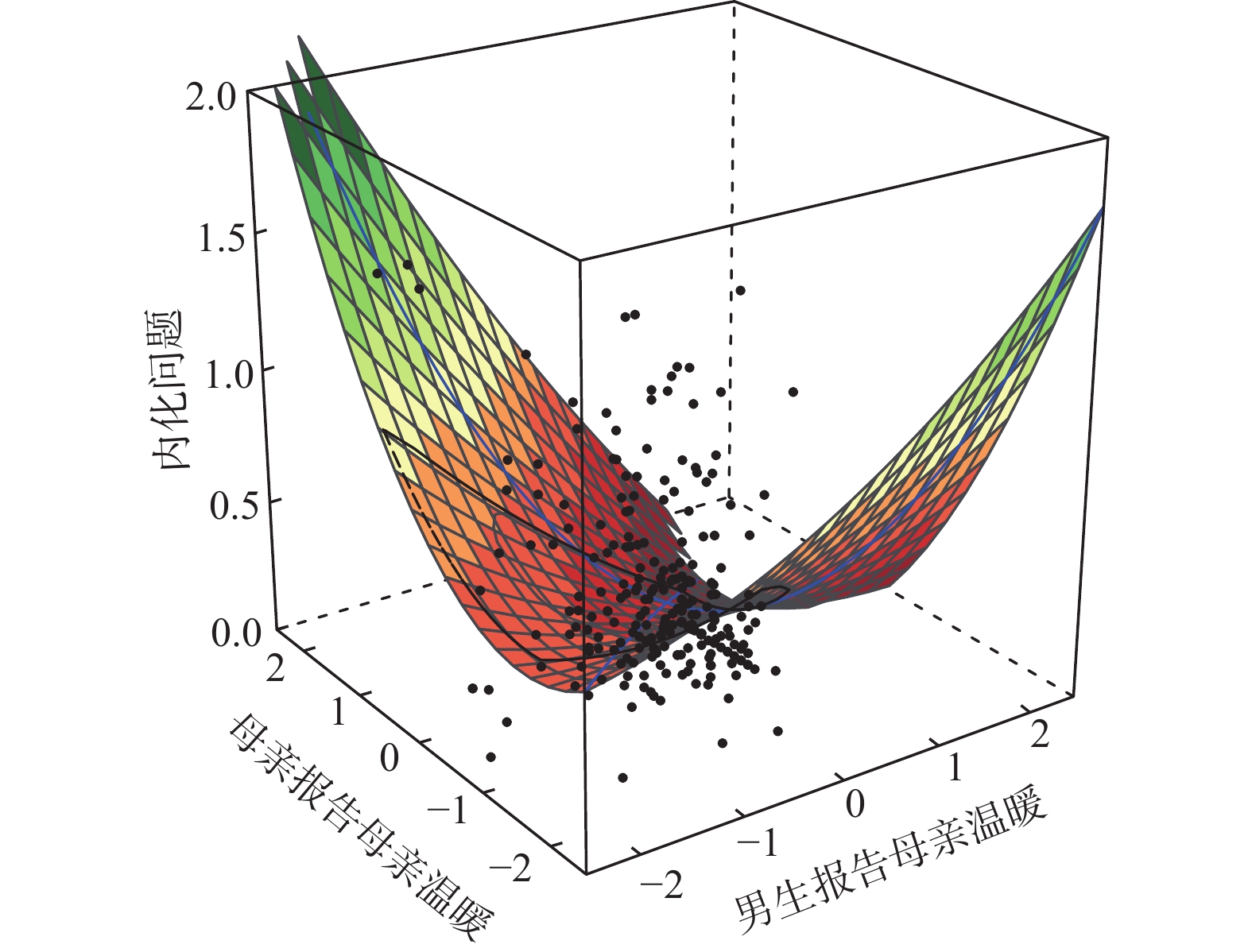
图3 母子感知温暖与男生内化问题模型
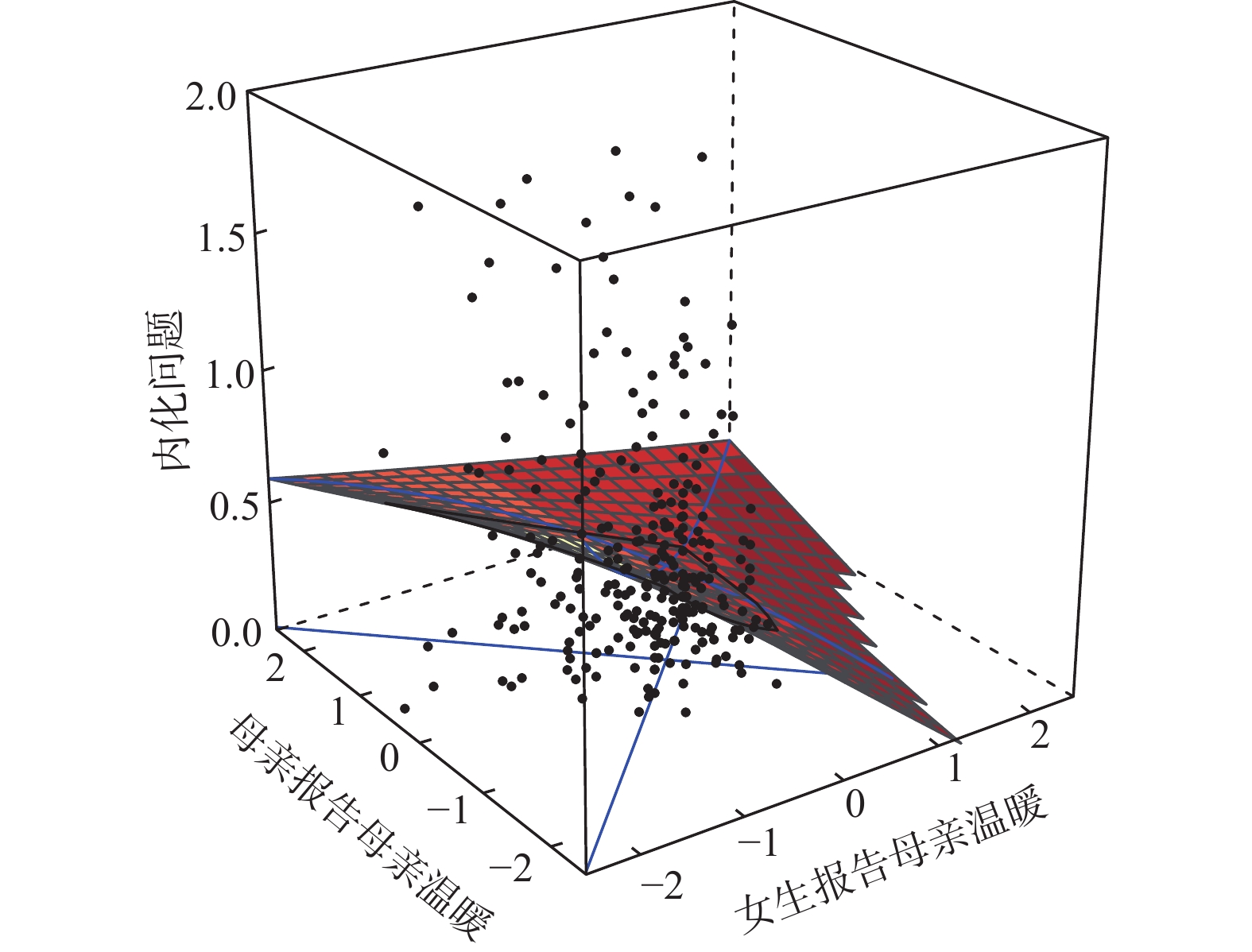
图4 母女感知温暖与女生内化问题模型
|
陈福美, 赵云燕, 罗芮, 何然, 罗玉晗. 父母−青少年对家庭亲密性的感知差异及其对青少年孤独感与攻击行为的影响: 基于RSA模型的分析. 心理科学, 2023, 46 (4): 873- 880.
|
|
|
郭菲, 王薪舒, 陈祉妍. (2023). 2022年中国青少年心理健康状况调查报告. 见 傅小兰, 张侃 (编), 中国国民心理健康发展报告(2021~2022) (pp. 30–69). 北京: 社会科学文献出版社.
|
|
|
刘敏敏, 郭菲, 陈祉妍. 父亲过度保护对高中生成就动机的影响: 自主需要和坚毅力的链式中介效应. 中国健康心理学杂志, 2023, 31 (6): 931- 935.
|
|
|
刘玉路, 李新影. 父母教养方式对青少年问题行为及性别差异影响. 中国公共卫生, 2015, 31 (12): 1655- 1657.
|
|
|
王帆, 方晓义, 胡伟, 陈海德, 吴梦希, 唐芹. 家庭环境与高中生发展: 自主的中介作用及其性别差异. 心理发展与教育, 2014, 30 (6): 585- 593.
|
|
|
王美芳, 牛骅, 赵晓. 儿童版父母教养方式问卷的修订. 中国临床心理学杂志, 2018, 26 (1): 6- 11.
DOI |
|
|
王紫薇, 涂平. 社会排斥情境下自我关注变化的性别差异. 心理学报, 2014, 46 (11): 1782- 1792.
|
|
|
Achenbach, T. M. (1991). Manual for the youth self-report and 1991 profile. Burlington: University of Vermont, Department of Psychiatry.
|
|
|
Ainsworth, M. D. S., Blehar, M. C., Waters, E., & Wall, S. (1979). Patterns of attachment: A psychological study of the strange situation. New York: Psychology Press.
|
|
|
Allen, J. P., Porter, M., McFarland, C., McElhaney, K. B., & Marsh, P. The relation of attachment security to adolescents’ paternal and peer relationships, depression, and externalizing behavior. Child Development, 2007, 78 (4): 1222- 1239.
DOI |
|
|
Aquilino, W. S. Two views of one relationship: Comparing parents’ and young adult children’s reports of the quality of intergenerational relations. Journal of Marriage and Family, 1999, 61 (4): 858- 870.
DOI |
|
|
Blakemore, S. J., & Choudhury, S. Development of the adolescent brain: Implications for executive function and social cognition. Journal of Child Psychology and Psychiatry, 2006, 47 (3–4): 296- 312.
DOI |
|
|
Branje, S. Development of parent-adolescent relationships: Conflict interactions as a mechanism of change. Child Development Perspectives, 2018, 12 (3): 171- 176.
DOI |
|
|
Butterfield, R. D., Silk, J. S., Lee, K. H., Siegle, G. S., Dahl, R. E., Forbes, E. E., … Ladouceur, C. D. Parents still matter! Parental warmth predicts adolescent brain function and anxiety and depressive symptoms 2 years later. Development and Psychopathology, 2021, 33 (1): 226- 239.
DOI |
|
|
Cummings, C. M., Caporino, N. E., & Kendall, P. C. Comorbidity of anxiety and depression in children and adolescents: 20 years after. Psychological Bulletin, 2014, 140 (3): 816- 845.
DOI |
|
|
De Los Reyes, A., Augenstein, T. M., Wang, M., Thomas, S. A., Drabick, D. A. G., Burgers, D. E., & Rabinowitz, J. The validity of the multi-informant approach to assessing child and adolescent mental health. Psychological Bulletin, 2015, 141 (4): 858- 900.
DOI |
|
|
De Los Reyes, A., Goodman, K. L., Kliewer, W., & Reid-Quiñones, K. Whose depression relates to discrepancies? Testing relations between informant characteristics and informant discrepancies from both informants’ perspectives. Psychological Assessment, 2008, 20 (2): 139- 149.
DOI |
|
|
De Los Reyes, A., & Ohannessian, C. M. Introduction to the special issue: Discrepancies in adolescent-parent perceptions of the family and adolescent adjustment. Journal of Youth and Adolescence, 2016, 45 (10): 1957- 1972.
DOI |
|
|
De Los Reyes, A., Wang, M., Lerner, M. D., Makol, B. A., Fitzpatrick, O. M., & Weisz, J. R. The operations triad model and youth mental health assessments: Catalyzing a paradigm shift in measurement validation. Journal of Clinical Child & Adolescent Psychology, 2023, 52 (1): 19- 54.
DOI |
|
|
Giarrusso, R., Feng, D., & Bengtson, V. L. (2005). The intergenerational-stake phenomenon over 20 years. In M. Silverstein & K. W. Schaie (Eds.), Annual review of gerontology and geriatrics, 2004: Focus on intergenerational relations across time and place (pp. 55–76). New York: Springer Publishing Company.
|
|
|
Hart, C. H., Newell, L. D., & Olsen, S. F. (2003). Parenting skills and social-communicative competence in childhood. In J. O. Greene & B. R. Burleson (Eds.), Handbook of communication and social interaction skills (pp. 753–797). Mahwah, NJ: Lawrence Erlbaum Associates Publishers.
|
|
|
Hein, S., Stone, L., Tan, M., Barbot, B., Luthar, S. S., & Grigorenko, E. L. Child internalizing problems and mother-child discrepancies in maternal rejection: Evidence for bidirectional associations. Journal of Family Psychology, 2018, 32 (2): 229- 239.
DOI |
|
|
Hill, J. P., & Lynch, M. E. (1983). The intensification of gender-related role expectations during early adolescence. In J. Brooks-Gunn & A. C. Petersen (Eds.), Girls at puberty: Biological and psychosocial perspectives (pp. 201–228). Boston, MA: Springer.
|
|
|
Hou, Y., Benner, A. D., Kim, S. Y., Chen, S. T., Spitz, S., Shi, Y., & Beretvas, T. Discordance in parents’ and adolescents’ reports of parenting: A meta-analysis and qualitative review. American Psychologist, 2020, 75 (3): 329- 348.
DOI |
|
|
Hou, Y., Kim, S. Y., & Benner, A. D. Parent-adolescent discrepancies in reports of parenting and adolescent outcomes in Mexican immigrant families. Journal of Youth and Adolescence, 2018, 47 (2): 430- 444.
DOI |
|
|
Hu, J., & Zhou, T. Parent-adolescent congruence and discrepancy in perceived parental emotion socialization to anger and sadness: Using response surface analysis to examine the links with adolescent depressive symptoms. Journal of Youth and Adolescence, 2024, 53 (1): 67- 78.
DOI |
|
|
Hu, J., Zhou, T., & Huang, Z. Parental emotion socialization, emotion regulation and depressive symptoms in Chinese adolescence: The role of family cohesion. The Journal of Early Adolescence, 2024, 44 (3): 281- 305.
DOI |
|
|
Janssen, L. H. C., Verkuil, B., van Houtum, L. A. E. M., Wever, M. C. M., & Elzinga, B. M. Perceptions of parenting in daily life: Adolescent-parent differences and associations with adolescent affect. Journal of Youth and Adolescence, 2021, 50 (12): 2427- 2443.
DOI |
|
|
Kapetanovic, S., & Boson, K. Discrepancies in parents’ and adolescents’ reports on parent-adolescent communication and associations to adolescents’ psychological health. Current Psychology, 2022, 41 (7): 4259- 4270.
DOI |
|
|
Korelitz, K. E., & Garber, J. Congruence of parents’ and children’s perceptions of parenting: A meta-analysis. Journal of Youth and Adolescence, 2016, 45 (10): 1973- 1995.
DOI |
|
|
Leung, J. T. Y., & Shek, D. T. L. Parent-adolescent discrepancies in perceived parenting characteristics and adolescent developmental outcomes in poor Chinese families. Journal of Child and Family Studies, 2014, 23 (2): 200- 213.
DOI |
|
|
Li, F. H., Cui, Y. H., Li, Y., Guo, L. T., Ke, X. Y., Liu, J., …Leckman, J. F. Prevalence of mental disorders in school children and adolescents in China: Diagnostic data from detailed clinical assessments of 17,524 individuals. Journal of Child Psychology and Psychiatry, 2022, 63 (1): 34- 46.
DOI |
|
|
Luo, X. H., Wang, H., Xu, J. J., Liu, H. Y., Suveg, C., & Han, Z. R. Dynamic processes of parent-adolescent conflict and warmth in Chinese families: Differences between mothers and fathers. Journal of Youth and Adolescence, 2025, 54 (8): 1985- 1998.
DOI |
|
|
Mathijs, L., Mouton, B., Zimmermann, G., & van Petegem, S. Overprotective parenting and social anxiety in adolescents: The role of emotion regulation. Journal of Social and Personal Relationships, 2024, 41 (2): 413- 434.
DOI |
|
|
Muris, P., Meesters, C., & van Brakel, A. Assessment of anxious rearing behaviors with a modified version of “Egna Minnen Beträffande Uppfostran” questionnaire for children. Journal of Psychopathology and Behavioral Assessment, 2003, 25 (4): 229- 237.
DOI |
|
|
Nolen-Hoeksema, S., & Aldao, A. Gender and age differences in emotion regulation strategies and their relationship to depressive symptoms. Personality and Individual Differences, 2011, 51 (6): 704- 708.
DOI |
|
|
Reijntjes, A., Kamphuis, J. H., Prinzie, P., & Telch, M. J. Peer victimization and internalizing problems in children: A meta-analysis of longitudinal studies. Child Abuse & Neglect, 2010, 34 (4): 244- 252.
DOI |
|
|
Rohner, R. P., & Khaleque, A. Parental acceptance-rejection and life-span development: A universalist perspective. Online Readings in Psychology and Culture, 2002, 6 (1): 1- 10.
|
|
|
Rosen, K. S., & Rothbaum, F. Quality of parental caregiving and security of attachment. Developmental Psychology, 1993, 29 (2): 358- 367.
DOI |
|
|
Webster, L., Low, J., Siller, C., & Hackett, R. K. (2013). Understanding the contribution of a father’s warmth on his child’s social skills. Fathering: A Journal of Theory, Research, and Practice About Men as Fathers, 11(1), 90–113.
|
|
|
Wu, C. X., & Chao, R. K. Intergenerational cultural dissonance in parent-adolescent relationships among Chinese and European Americans. Developmental Psychology, 2011, 47 (2): 493- 508.
|
|
|
Xiao, B. W., Bullock, A., Coplan, R. J., Liu, J. S., & Cheah, C. S. L. Exploring the relations between parenting practices, child shyness, and internalizing problems in Chinese culture. Journal of Family Psychology, 2021, 35 (6): 833- 843.
DOI |
|
|
Xing, X. P., Wang, M. F., Zhang, Q., He, X. R., & Zhang, W. X. Gender differences in the reciprocal relationships between parental physical aggression and children’s externalizing problem behavior in China. Journal of Family Psychology, 2011, 25 (5): 699- 708.
DOI |
|
|
Zhang, L. D., Wang, R. J., & Chen, L. The impact of harsh parental discipline and emotional warmth on adolescent problem behaviors. Psychology Research and Behavior Management, 2024, 17, 2309- 2319.
DOI |
|
|
Zhang, Q. W., Pan, Y. G., Chen, Y. H., Liu, W., Wang, L., & Jean, J. A. Effects of father-adolescent and mother-adolescent relationships on depressive symptoms among Chinese early adolescents. Applied Research in Quality of Life, 2022, 17 (5): 2657- 2672.
DOI |
| [1] | 王惠惠, 唐慎佩, 赵双祐, 黄向圆, 兰松. 内在自我与外界眼光:自我评价与反射性评价一致性对青少年心理健康问题的影响[J]. 心理与行为研究, 2026, 24(2): 187-194. |
| [2] | 张一林, 牛更枫, 白旭青, 辛素飞, 孙晓军. 社会逆境感知与青少年社交媒体成瘾的双向关系:控制感的作用[J]. 心理与行为研究, 2026, 24(2): 258-264. |
| [3] | 张野, 刘致宏, 赵丽云. 青少年网络社会排斥、敌意归因偏向与网络偏差行为的关系:一项纵向研究[J]. 心理与行为研究, 2026, 24(1): 60-68. |
| [4] | 曾子豪, 何震, 袁言云, 赵纤, 印利红, 谭嵘, 常梦梦, 胡义秋. HPA轴系统多基因−亲子关系交互对青少年抑郁发展影响及性别差异[J]. 心理与行为研究, 2026, 24(1): 78-86. |
| [5] | 杨昕珠, 王腾飞, 郑晓龙. 青少年社会情感能力与学业倦怠的双向预测作用:一项交叉滞后研究[J]. 心理与行为研究, 2025, 23(6): 789-797. |
| [6] | 谷莉, 黄晓彤, 梁广华, 蔡頠, 郭丰波. 核心自我评价与青少年自伤行为的关系:有调节的中介模型[J]. 心理与行为研究, 2025, 23(6): 798-805. |
| [7] | 张春妹, 骆玉冰, 温冬雪, 郑航. 青少年逆反心理与偏差行为的关系:偏差同伴联系和偏差群体同一性的链式中介作用[J]. 心理与行为研究, 2025, 23(5): 645-652. |
| [8] | 刘鑫, 刘衍玲, 曾晋逸. 心理需要挫折与青少年抑郁症状的纵向联系:心理素质的调节作用[J]. 心理与行为研究, 2025, 23(4): 496-503. |
| [9] | 鲍振宙, 刘花, 于明申. 青少年校园欺凌旁观行为与焦虑抑郁症状的关系:基于纵向网络分析法[J]. 心理与行为研究, 2025, 23(4): 504-512. |
| [10] | 刘佳, 高培晋, 李楠, 孙敏, 白学军. 社会变化程度感知对青少年社会公平感的影响[J]. 心理与行为研究, 2025, 23(4): 551-559. |
| [11] | 张庆吉, 郭丰波, 涂叶满, 卿再花, 宋凤. 劳动价值观对青少年心理健康潜在类别及其转换的影响:双因素模型视角[J]. 心理与行为研究, 2025, 23(4): 569-576. |
| [12] | 张阔, 李珮瑜, 赵晋娥, 贾绪计. 二分还是多重?青少年成长型思维动机框架的异质性及其与学业适应的关系[J]. 心理与行为研究, 2025, 23(3): 346-353. |
| [13] | 钞淼, 张宇, 谢启慧, 刘拓. 情感忽视对农村青少年短视频成瘾的纵向影响:负性情绪中介及留守差异[J]. 心理与行为研究, 2025, 23(3): 361-368. |
| [14] | 王锦, 杨晓凡, 刘晓金, 徐紫陌. 中学生的未来自我连续性对主观幸福感的作用:价值冲突的中介模型[J]. 心理与行为研究, 2025, 23(2): 201-207. |
| [15] | 黎光明, 刘钰. 基于多组增长混合模型的青少年网络成瘾纵向分析[J]. 心理与行为研究, 2025, 23(2): 208-215. |
| 阅读次数 | ||||||
|
全文 |
|
|||||
|
摘要 |
|
|||||
