
心理与行为研究 ›› 2026, Vol. 24 ›› Issue (4): 533-541.DOI: 10.12139/j.1672-0628.2026.04.013
王娜1, 黄柏栋2,3, 张琪涵*,2,3,4( )
)
收稿日期:2025-12-23
出版日期:2026-07-20
发布日期:2026-07-21
通讯作者:
张琪涵
基金资助:
Na WANG1, Baidong HUANG2,3, Qihan ZHANG*,2,3,4()
Received:2025-12-23
Online:2026-07-20
Published:2026-07-21
Contact:
Qihan ZHANG
摘要:
AI正在重塑音乐创作,但公众对AI音乐的态度可能并非单一维度,而是存在认知层面与评价层面的分化,其中认知层面主要表现为个体对AI艺术主体性的判断,而评价层面则表现为审美偏差。本研究通过两项研究考察音乐素养和AI素养对这两个态度层面的差异化预测作用。研究1(n=1203)采用问卷法发现,音乐素养和AI素养均正向预测AI艺术主体性,且AI素养在音乐素养与AI艺术主体性之间发挥部分中介作用。研究2(n=84)采用创作来源标签操纵范式发现,AI独立创作标签下的审美评分显著低于人类独立创作标签。探索性分析进一步发现,音乐素养正向、AI素养负向预测这一审美偏差,且该现象主要体现在创新风格维度上;AI艺术主体性与审美偏差无显著关联。这表明音乐素养和AI素养对AI音乐的认知态度及评价态度呈现出不同的关联模式。
中图分类号:
王娜, 黄柏栋, 张琪涵. 音乐素养与AI素养对AI艺术主体性及审美偏差的预测作用[J]. 心理与行为研究, 2026, 24(4): 533-541.
Na WANG, Baidong HUANG, Qihan ZHANG. The Predictive Roles of Musical Sophistication and AI Literacy in AI Artistic Subjectivity and Aesthetic Bias[J]. Studies of Psychology and Behavior, 2026, 24(4): 533-541.
| 变量 | M | SD | 1 | 2 |
| 1.音乐素养 | 85.14 | 16.92 | ||
| 2.AI素养 | 57.09 | 7.88 | 0.13*** | |
| 3.AI艺术主体性 | 27.23 | 7.79 | 0.10*** | 0.39*** |
表1 研究1主要变量的描述统计与相关分析
| 变量 | M | SD | 1 | 2 |
| 1.音乐素养 | 85.14 | 16.92 | ||
| 2.AI素养 | 57.09 | 7.88 | 0.13*** | |
| 3.AI艺术主体性 | 27.23 | 7.79 | 0.10*** | 0.39*** |
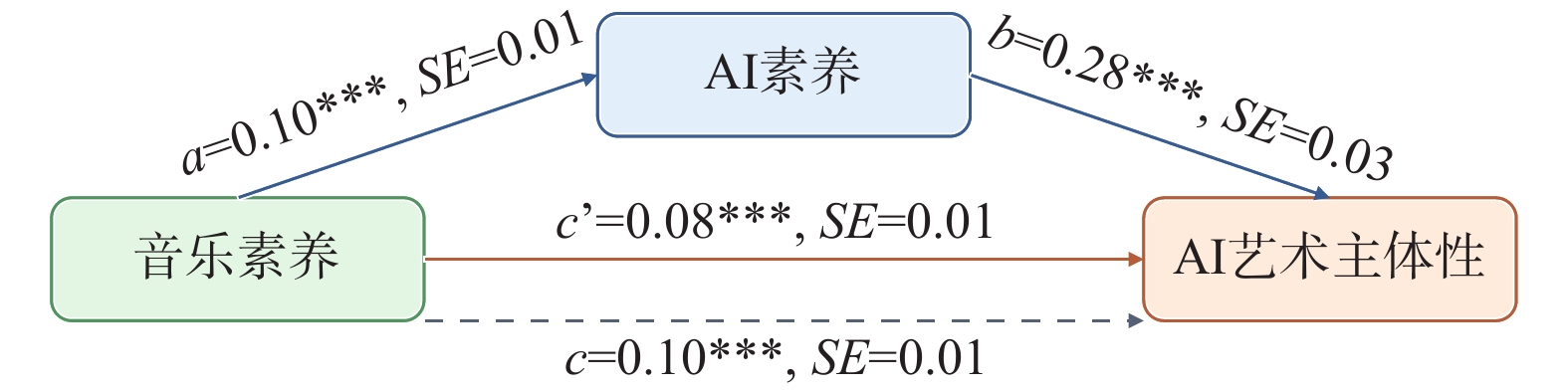
图1 AI素养的中介作用
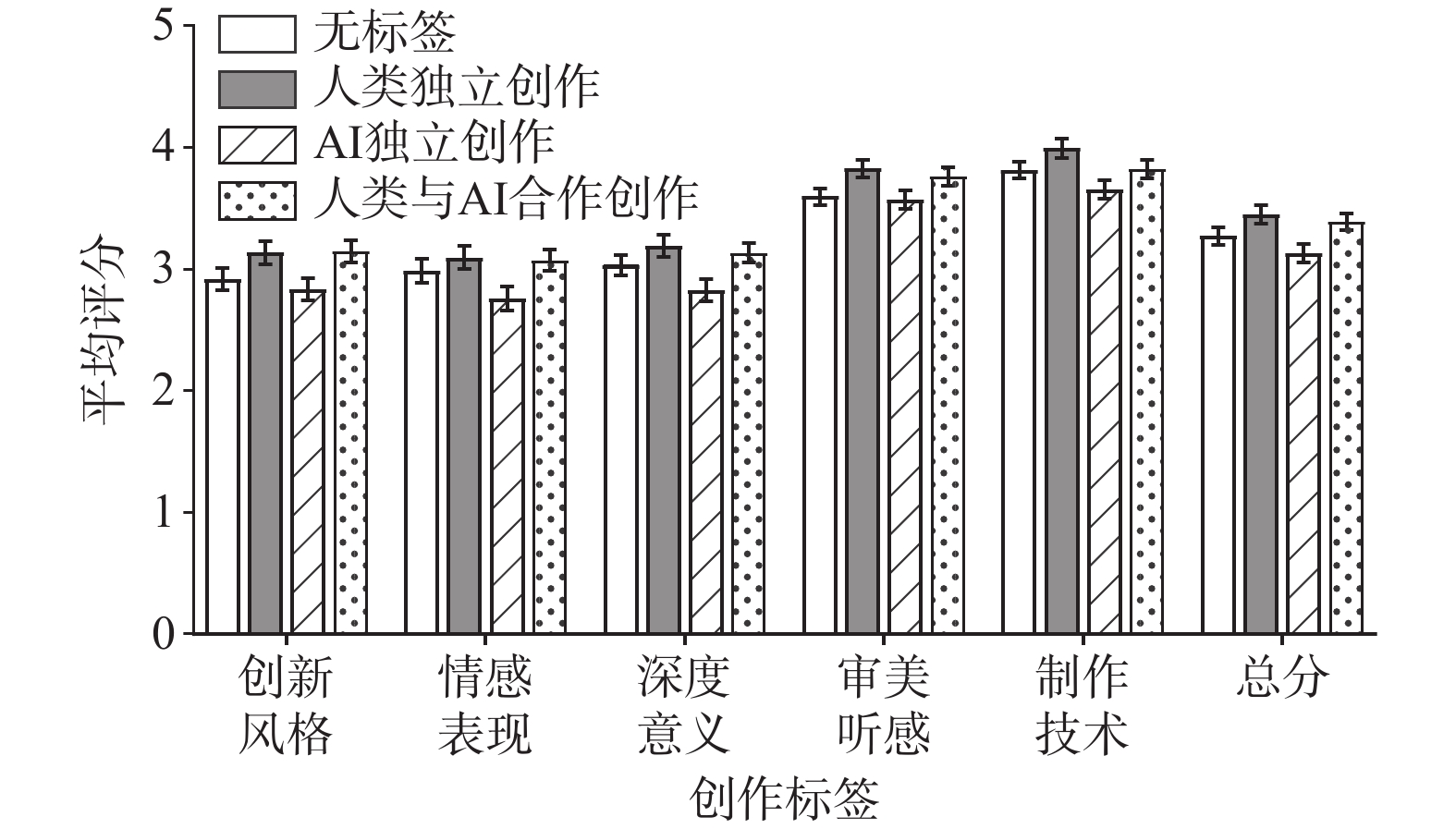
图2 音乐审美的创作标签效应
| 变量 | M | SD | 1 | 2 | 3 |
| 1.总体审美偏差 | 0.33 | 0.77 | |||
| 2.音乐素养 | 91.42 | 14.52 | 0.14 | ||
| 3.AI素养 | 55.33 | 8.65 | −0.17 | 0.49*** | |
| 4.AI艺术主体性 | 23.99 | 7.78 | −0.02 | 0.51*** | 0.39** |
表2 研究2主要变量的描述统计与相关分析
| 变量 | M | SD | 1 | 2 | 3 |
| 1.总体审美偏差 | 0.33 | 0.77 | |||
| 2.音乐素养 | 91.42 | 14.52 | 0.14 | ||
| 3.AI素养 | 55.33 | 8.65 | −0.17 | 0.49*** | |
| 4.AI艺术主体性 | 23.99 | 7.78 | −0.02 | 0.51*** | 0.39** |
|
Ajzen, I. Nature and operation of attitudes. Annual Review of Psychology, 2001, 52, 27- 58.
DOI |
|
|
Amabile, T. M. Social psychology of creativity: A consensual assessment technique. Journal of Personality and Social Psychology, 1982, 43 (5): 997- 1013.
|
|
|
Barnett, S. M., & Ceci, S. J. When and where do we apply what we learn?: A taxonomy for far transfer. Psychological Bulletin, 2002, 128 (4): 612- 637.
DOI |
|
|
Bellaiche, L., Shahi, R., Turpin, M. H., Ragnhildstveit, A., Sprockett, S., Barr, N., ... Seli, P. Humans versus AI: Whether and why we prefer human-created compared to AI-created artwork. Cognitive Research: Principles and Implications, 2023, 8 (1): 42.
DOI |
|
|
Bigand, E., & Poulin-Charronnat, B. Are we “experienced listeners”? A review of the musical capacities that do not depend on formal musical training. Cognition, 2006, 100 (1): 100- 130.
DOI |
|
|
Casini, L., Vila, L. C., Dalmazzo, D., Kaila, A. K., & Sturm, B. L. T. (2025). Data-driven analysis of text-conditioned AI-generated music: A case study with Suno and Udio. Retrieved December 23, 2025, from https://arxiv.org/abs/2509.11824
|
|
|
Chiarella, S. G., Torromino, G., Gagliardi, D. M., Rossi, D., Babiloni, F., & Cartocci, G. Investigating the negative bias towards artificial intelligence: Effects of prior assignment of AI-authorship on the aesthetic appreciation of abstract paintings. Computers in Human Behavior, 2022, 137, 107406.
DOI |
|
|
Coeckelbergh, M. Can machines create art?. Philosophy & Technology, 2017, 30 (3): 285- 303.
DOI |
|
|
Davis, F. D. Perceived usefulness, perceived ease of use, and user acceptance of information technology. MIS Quarterly, 1989, 13 (3): 319- 340.
DOI |
|
|
Grötschla, F., Solak, A., Lanzendörfer, L. A., & Wattenhofer, R. (2025). Benchmarking music generation models and metrics via human preference studies. In ICASSP 2025 - 2025 IEEE international conference on acoustics, speech and signal processing (ICASSP) (pp. 1–5). Hyderabad, India: IEEE.
|
|
|
Haverals, W., & Martin, M. (2025). Everyone prefers human writers, including AI. Retrieved December 23, 2025, from https://arxiv.org/abs/2510.08831
|
|
|
Hitsuwari, J., Ueda, Y., Yun, W., & Nomura, M. Does human-AI collaboration lead to more creative art? Aesthetic evaluation of human-made and AI-generated haiku poetry. Computers in Human Behavior, 2023, 139, 107502.
DOI |
|
|
Hong, J. W., Peng, Q. Y., & Williams, D. Are you ready for artificial Mozart and Skrillex? An experiment testing expectancy violation theory and AI music. New Media & Society, 2021, 23 (7): 1920- 1935.
DOI |
|
|
Horton, C. B., Jr., White, M. W., & Iyengar, S. S. Bias against AI art can enhance perceptions of human creativity. Scientific Reports, 2023, 13 (1): 19001.
DOI |
|
|
Hullman, J., Holtzman, A., & Gelman, A. (2023). Artificial intelligence and aesthetic judgment. Retrieved December 23, 2025, from https://arxiv.org/abs/2309.12338
|
|
|
Juslin, P. N., & Västfjäll, D. Emotional responses to music: The need to consider underlying mechanisms. Behavioral and Brain Sciences, 2008, 31 (5): 559- 575.
DOI |
|
|
Laupichler, M. C., Aster, A., Schirch, J., & Raupach, T. Artificial intelligence literacy in higher and adult education: A scoping literature review. Computers and Education: Artificial Intelligence, 2022, 3, 100101.
DOI |
|
|
Long, D. R., & Magerko, B. (2020). What is AI literacy? Competencies and design considerations. In Proceedings of the 2020 CHI conference on human factors in computing systems (pp. 1–16). Honolulu, HI: Association for Computing Machinery.
|
|
|
Ma, S., & Chen, Z. Z. The development and validation of the artificial intelligence literacy scale for Chinese college students (AILS-CCS). IEEE Access, 2024, 12, 146419- 146429.
DOI |
|
|
Mahmud, H., Islam, A. K. M. N., Ahmed, S. I., & Smolander, K. What influences algorithmic decision-making? A systematic literature review on algorithm aversion. Technological Forecasting and Social Change, 2022, 175, 121390.
DOI |
|
|
Mikalonytė, E. S., & Kneer, M. Can artificial intelligence make art?: Folk intuitions as to whether AI-driven robots can be viewed as artists and produce art. ACM Transactions on Human-Robot Interaction, 2022, 11 (4): 43.
DOI |
|
|
Millet, K., Buehler, F., Du, G. Z., & Kokkoris, M. D. Defending humankind: Anthropocentric bias in the appreciation of AI art. Computers in Human Behavior, 2023, 143, 107707.
DOI |
|
|
Müllensiefen, D., Gingras, B., Musil, J., & Stewart, L. The musicality of non-musicians: An index for assessing musical sophistication in the general population. PLoS One, 2014, 9 (2): e89642.
DOI |
|
|
Nazaretsky, T., Ariely, M., Cukurova, M., & Alexandron, G. Teachers’ trust in AI-powered educational technology and a professional development program to improve it. British Journal of Educational Technology, 2022, 53 (4): 914- 931.
DOI |
|
|
Ng, D. T. K., Leung, J. K. L., Chu, S. K. W., & Qiao, M. S. Conceptualizing AI literacy: An exploratory review. Computers and Education: Artificial Intelligence, 2021, 2, 100041.
DOI |
|
|
North, A., & Hargreaves, D. (2008). The social and applied psychology of music. New York: Oxford University Press.
|
|
|
Perkins, D. N., & Salomon, G. (1992). Transfer of learning. In T. Husén & T. N. Postlethwaite (Eds.), International encyclopedia of education (2nd ed, pp. 425–441), Oxford: Pergamon Press.
|
|
|
Ragot, M., Martin, N., & Cojean, S. (2020). AI-generated vs. human artworks. A perception bias towards artificial intelligence? In Extended abstracts of the 2020 CHI conference on human factors in computing systems (pp. 1–10). Honolulu, HI: Association for Computing Machinery.
|
|
|
Raj, M., Berg, J., & Seamans, R. (2023). Art-ificial intelligence: The effect of AI disclosure on evaluations of creative content. Retrieved December 23, 2025, from https://arxiv.org/abs/2303.06217
|
|
|
Reber, R., Schwarz, N., & Winkielman, P. Processing fluency and aesthetic pleasure: Is beauty in the perceiver's processing experience?. Personality and Social Psychology Review, 2004, 8 (4): 364- 382.
DOI |
|
|
Rentfrow, P. J., Goldberg, L. R., & Levitin, D. J. The structure of musical preferences: A five-factor model. Journal of Personality and Social Psychology, 2011, 100 (6): 1139- 1157.
DOI |
|
|
Salimpoor, V. N., Benovoy, M., Larcher, K., Dagher, A., & Zatorre, R. J. Anatomically distinct dopamine release during anticipation and experience of peak emotion to music. Nature Neuroscience, 2011, 14 (2): 257- 262.
DOI |
|
|
Shi, J. Y., Jain, R., Duan, R. L., & Ramani, K. (2023). Understanding generative AI in art: An interview study with artists on G-AI from an HCI perspective. Retrieved December 23, 2025, from https://arxiv.org/abs/2310.13149
|
|
|
Viberg, O., Cukurova, M., Feldman-Maggor, Y., Alexandron, G., Shirai, S., Kanemune, S., … Kizilcec, R. F. What explains teachers’ trust in AI in education across six countries?. International Journal of Artificial Intelligence in Education, 2025, 35 (3): 1288- 1316.
DOI |
|
|
Vuust, P., Heggli, O. A., Friston, K. J., & Kringelbach, M. L. Music in the brain. Nature Reviews Neuroscience, 2022, 23 (5): 287- 305.
DOI |
|
|
Zajonc, R. B. Attitudinal effects of mere exposure. Journal of Personality and Social Psychology, 1968, 9 (2): 1- 27.
|
|
|
Zentner, M., Grandjean, D., & Scherer, K. R. Emotions evoked by the sound of music: Characterization, classification, and measurement. Emotion, 2008, 8 (4): 494- 521.
DOI |
| [1] | 罗星雨, 毛佩佩, 牛更枫, 翟培培, 孙晓军. 人工智能辅助学习:聊天机器人新颖性和个体创新性的匹配与学习投入的关系[J]. 心理与行为研究, 2026, 24(4): 525-532. |
| [2] | 罗彬彬, 荆怡雪, 宋晓蕾. 颜色分区与导向标识间距对地下空间寻路的影响—一项VR研究[J]. 心理与行为研究, 2026, 24(4): 542-550. |
| [3] | 尚俊辰, 钟凯音, 郝芳. “外貌”还是“身份”:女性对男性信任决策的双重考量[J]. 心理与行为研究, 2026, 24(4): 551-558. |
| [4] | 肖啸, 占友龙, 肖青茵, 李晓阳, 和旺达. 风险情境下道德决策的认知计算机制及情绪调节[J]. 心理与行为研究, 2026, 24(4): 559-568. |
| [5] | 孙永生, 丁金, 梁文玲. 职场不公正事件强度对员工抱怨的差异化影响:心理韧性与自我威胁感的交互作用[J]. 心理与行为研究, 2026, 24(4): 569-576. |
| [6] | 翟宏堃, 周详, 付江洪, 李坤钊, 崔虞馨, 魏晓薇. 面向数智时代的新素养:人智协同创新素养的结构与测量[J]. 心理与行为研究, 2026, 24(3): 375-383. |
| [7] | 杜雪娇, 孟子凡, 李瑶, 王楚雯, 董颖红. 教学代理语言风格及AI生成方式对不同认知风格小学生视频学习的影响[J]. 心理与行为研究, 2026, 24(3): 384-392. |
| [8] | 盖笑松, 刘本扬, 邸楠. 人工智能技术在青少年未来取向评分中的适用性[J]. 心理与行为研究, 2026, 24(3): 393-400. |
| [9] | 杨海波, 李奕康, 郭雅雯, 刘冰洁. 不同网络游戏成瘾程度青少年对游戏信息注意偏向的差异[J]. 心理与行为研究, 2026, 24(3): 401-409. |
| [10] | 孟鸿兴, 王晓庄, 马红宇. 年长员工退休后继续工作动机的前因组态研究:基于模糊集定性比较分析方法[J]. 心理与行为研究, 2026, 24(3): 410-417. |
| [11] | 刘路培, 秦刚, 冯才华. 生命意义感与大学生抑郁的关系:反刍思维和自尊的链式中介作用[J]. 心理与行为研究, 2026, 24(3): 418-424. |
| [12] | 高永金, 钱璟烨, 高结, 马晓琳, 蒋珊珊. 高中生综合幸福感量表的编制[J]. 心理与行为研究, 2026, 24(3): 425-432. |
| [13] | 白博仁, 周详, 张婧婧, 崔虞馨. 人工智能自恋提升人机合作创新意愿及其机制[J]. 心理与行为研究, 2024, 22(1): 137-144. |
| [14] | 支慧晶, 刘阳. 竞走裁判员在多人情景下判罚决策的视觉搜索特征[J]. 心理与行为研究, 2024, 22(1): 130-136. |
| [15] | 张耀华, 徐敏, 黄云云, 辛素飞. 心理韧性缓冲压力生活事件与青少年学业倦怠之间的非线性关系[J]. 心理与行为研究, 2024, 22(1): 123-129. |
| 阅读次数 | ||||||
|
全文 |
|
|||||
|
摘要 |
|
|||||
