
Studies of Psychology and Behavior ›› 2024, Vol. 22 ›› Issue (6): 721-729.DOI: 10.12139/j.1672-0628.2024.06.001
• ? • Next Articles
Xiangwen CHEN1,2, Longge WANG1,2, Huilan HU1,2, Zhichao ZHANG1,2,3, Mengsi WANG1,2,3, Qiang WANG*,1,2,3( ), Manman ZHANG*,1,2,3()
Received:2024-01-23
Online:2024-11-20
Published:2024-11-20
Contact:
Qiang WANG, Manman ZHANG
陈相文1,2, 王泷歌1,2, 胡惠兰1,2, 张志超1,2,3, 王梦思1,2,3, 汪强*,1,2,3(), 张慢慢*,1,2,3()
通讯作者:
汪强, 张慢慢
基金资助:Xiangwen CHEN, Longge WANG, Huilan HU, Zhichao ZHANG, Mengsi WANG, Qiang WANG, Manman ZHANG. The Neural Structural Basis of Individual Differences in Word Frequency Effect on Eye Movement Measures During Chinese Reading[J]. Studies of Psychology and Behavior, 2024, 22(6): 721-729.
陈相文, 王泷歌, 胡惠兰, 张志超, 王梦思, 汪强, 张慢慢. 中文阅读词频效应个体差异的脑结构基础:基于眼动指标的分析[J]. 心理与行为研究, 2024, 22(6): 721-729.
Add to citation manager EndNote|Ris|BibTeX
URL: https://psybeh.tjnu.edu.cn/EN/10.12139/j.1672-0628.2024.06.001
| 词频 | 句子 |
| 高频 | 节目请到的经济学家预测石油价格明年将会继续上涨。 |
| 低频 | 节目请到的经济学家预测稀土价格明年将会继续上涨。 |
| 词频 | 句子 |
| 高频 | 节目请到的经济学家预测石油价格明年将会继续上涨。 |
| 低频 | 节目请到的经济学家预测稀土价格明年将会继续上涨。 |
| 眼动指标 | 高频 | 低频 |
| 首次注视时间(ms) | 231(33) | 243(36) |
| 首次注视次数 | 1.05(0.08) | 1.08(0.12) |
| 单次注视时间(ms) | 231(34) | 242(39) |
| 凝视时间(ms) | 245(42) | 266(50) |
| 回视路径时间(ms) | 293(70) | 318(89) |
| 总注视时间(ms) | 305(68) | 349(89) |
| 总注视次数 | 1.33(0.23) | 1.46(0.34) |
| 眼动指标 | 高频 | 低频 |
| 首次注视时间(ms) | 231(33) | 243(36) |
| 首次注视次数 | 1.05(0.08) | 1.08(0.12) |
| 单次注视时间(ms) | 231(34) | 242(39) |
| 凝视时间(ms) | 245(42) | 266(50) |
| 回视路径时间(ms) | 293(70) | 318(89) |
| 总注视时间(ms) | 305(68) | 349(89) |
| 总注视次数 | 1.33(0.23) | 1.46(0.34) |
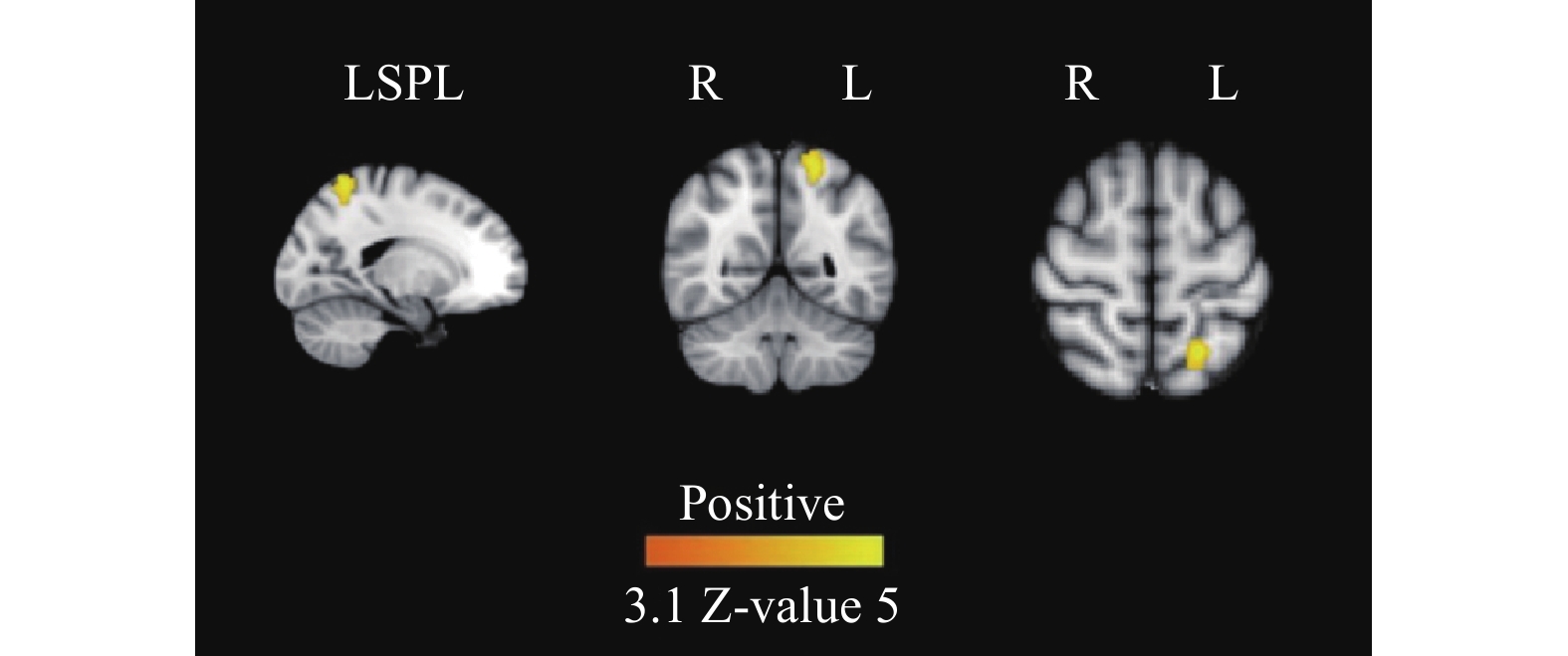
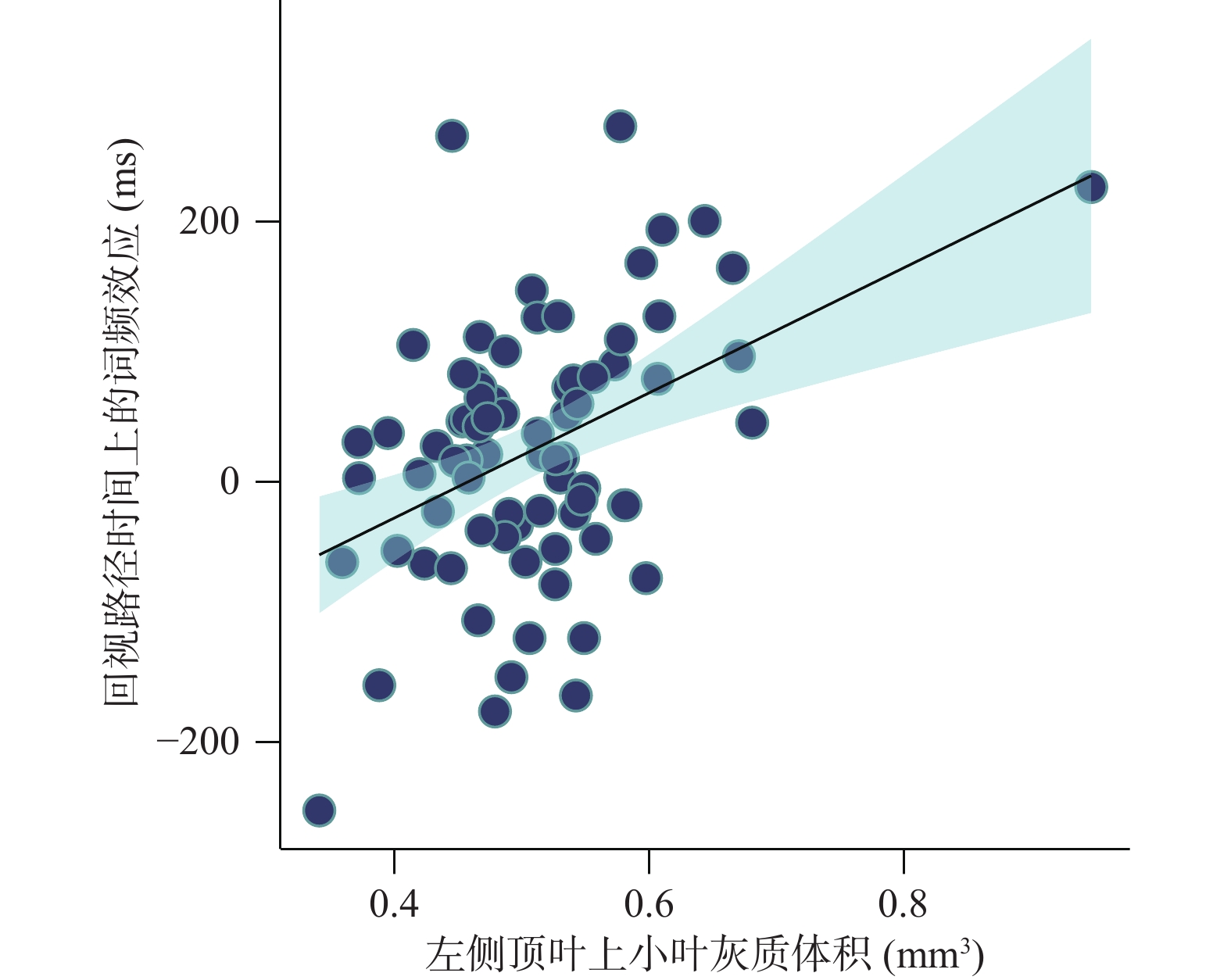
| 眼动指标 | 词频效应(低频vs.高频) | ||||
| b | SE | t | p | 95%CI | |
| 首次注视时间 | 0.05 | 0.01 | 4.41 | <0.001 | [0.03, 0.08] |
| 首次注视次数 | 0.02 | 0.01 | 2.88 | 0.004 | [0.01, 0.04] |
| 单次注视时间 | 0.05 | 0.01 | 4.15 | <0.001 | [0.03, 0.08] |
| 凝视时间 | 0.08 | 0.01 | 5.79 | <0.001 | [0.05, 0.11] |
| 回视路径时间 | 0.08 | 0.02 | 4.36 | <0.001 | [0.05, 0.12] |
| 总注视时间 | 0.12 | 0.02 | 7.02 | <0.001 | [0.09, 0.16] |
| 总注视次数 | 0.08 | 0.01 | 5.35 | <0.001 | [0.05, 0.10] |
| 眼动指标 | 词频效应(低频vs.高频) | ||||
| b | SE | t | p | 95%CI | |
| 首次注视时间 | 0.05 | 0.01 | 4.41 | <0.001 | [0.03, 0.08] |
| 首次注视次数 | 0.02 | 0.01 | 2.88 | 0.004 | [0.01, 0.04] |
| 单次注视时间 | 0.05 | 0.01 | 4.15 | <0.001 | [0.03, 0.08] |
| 凝视时间 | 0.08 | 0.01 | 5.79 | <0.001 | [0.05, 0.11] |
| 回视路径时间 | 0.08 | 0.02 | 4.36 | <0.001 | [0.05, 0.12] |
| 总注视时间 | 0.12 | 0.02 | 7.02 | <0.001 | [0.09, 0.16] |
| 总注视次数 | 0.08 | 0.01 | 5.35 | <0.001 | [0.05, 0.10] |
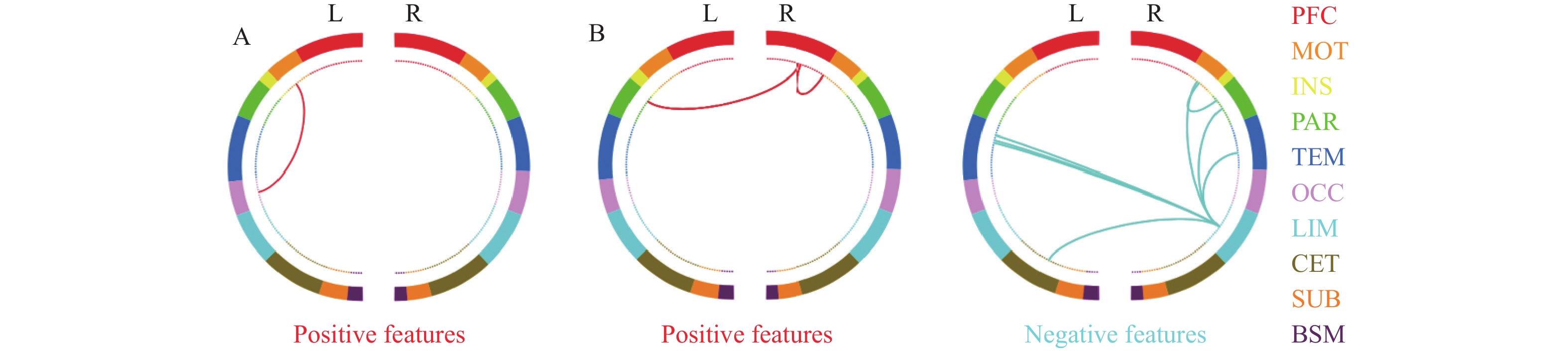
| 眼动指标 | 预测模型 | 预测系统 |
| 总注视次数 | 正向 | “皮质下−小脑”−V1皮层 |
| 首次注视次数 | 正向 | 运动−额顶叶 |
| 运动−内侧额叶 | ||
| 负向 | 默认网络−额顶叶 | |
| 默认网络−内侧额叶 | ||
| 默认网络−运动 | ||
| 默认网络−“皮质下−小脑” | ||
| 默认网络−视觉联想皮层 | ||
| 运动−运动 |
| 眼动指标 | 预测模型 | 预测系统 |
| 总注视次数 | 正向 | “皮质下−小脑”−V1皮层 |
| 首次注视次数 | 正向 | 运动−额顶叶 |
| 运动−内侧额叶 | ||
| 负向 | 默认网络−额顶叶 | |
| 默认网络−内侧额叶 | ||
| 默认网络−运动 | ||
| 默认网络−“皮质下−小脑” | ||
| 默认网络−视觉联想皮层 | ||
| 运动−运动 |
|
王永胜, 何立媛. 双字词词频与尾字字频在老年读者眼跳目标选择中的作用. 天津师范大学学报(社会科学版), 2022, (3): 114- 120.
|
|
|
闫国利, 熊建萍, 臧传丽, 余莉莉, 崔磊, 白学军. 阅读研究中的主要眼动指标评述. 心理科学进展, 2013, 21 (4): 589- 605.
|
|
|
张慢慢, 胡惠兰, 边菡, 李芳, 张志超, 臧传丽. 中文阅读中快速读者与慢速读者的词频效应. 心理与行为研究, 2022, 20 (3): 304- 310.
DOI |
|
|
周蔚. 自然阅读的脑成像研究及其与眼动技术结合. 心理科学进展, 2017, 25 (10): 1656- 1663.
|
|
|
Ashby, J., Rayner, K., & Clifton, C., Jr. Eye movements of highly skilled and average readers: Differential effects of frequency and predictability. The Quarterly Journal of Experimental Psychology Section A, 2005, 58 (6): 1065- 1086.
DOI |
|
|
Barnes, A. E., Kim, Y. S., Tighe, E. L., & Vorstius, C. Readers in adult basic education: Component skills, eye movements, and fluency. Journal of Learning Disabilities, 2017, 50 (2): 180- 194.
DOI |
|
|
Bates, D., Mächler, M., Bolker, B., & Walker, S. Fitting linear mixed-effects models using lme4. Journal of Statistical Software, 2015, 67 (1): 1- 48.
|
|
|
Blackmon, K., Barr, W. B., Kuzniecky, R., Dubois, J., Carlson, C., Quinn, B. T., … Thesen, T. Phonetically irregular word pronunciation and cortical thickness in the adult brain. NeuroImage, 2010, 51 (4): 1453- 1458.
DOI |
|
|
Botev, Z. I., Grotowski, J. F., & Kroese, D. P. Kernel density estimation via diffusion. The Annals of Statistics, 2010, 38 (5): 2916- 2957.
|
|
|
Brysbaert, M., Mandera, P., & Keuleers, E. The word frequency effect in word processing: An updated review. Current Directions in Psychological Science, 2018, 27 (1): 45- 50.
DOI |
|
|
Clark, S. V., Semmel, E. S., Aleksonis, H. A., Steinberg, S. N., & King, T. Z. Cerebellar-subcortical-cortical systems as modulators of cognitive functions. Neuropsychology Review, 2021, 31 (3): 422- 446.
DOI |
|
|
Clifton, C., Jr., Ferreira, F., Henderson, J. M., Inhoff, A. W., Liversedge, S. P., Reichle, E. D., & Schotter, E. R. Eye movements in reading and information processing: Keith Rayner’s 40 year legacy. Journal of Memory and Language, 2016, 86, 1- 19.
|
|
|
Cole, M. W., Reynolds, J. R., Power, J. D., Repovs, G., Anticevic, A., & Braver, T. S. Multi-task connectivity reveals flexible hubs for adaptive task control. Nature Neuroscience, 2013, 16 (9): 1348- 1355.
DOI |
|
|
Corbetta, M., & Shulman, G. L. Control of goal-directed and stimulus-driven attention in the brain. Nature Reviews Neuroscience, 2002, 3 (3): 201- 215.
DOI |
|
|
Demb, J. B., Boynton, G. M., & Heeger, D. J. Brain activity in visual cortex predicts individual differences in reading performance. Proceedings of the National Academy of Sciences of the United States of America, 1997, 94 (24): 13363- 13366.
|
|
|
Deng, Y., Guo, R. F., Ding, G. S., & Peng, D. L. Top-down modulations from dorsal stream in lexical recognition: An effective connectivity fMRI study. PLoS One, 2012, 7 (3): e33337.
DOI |
|
|
Grande, M., Meffert, E., Huber, W., Amunts, K., & Heim, S. Word frequency effects in the left IFG in dyslexic and normally reading children during picture naming and reading. NeuroImage, 2011, 57 (3): 1212- 1220.
DOI |
|
|
Haier, R. J., Karama, S., Leyba, L., & Jung, R. E. MRI assessment of cortical thickness and functional activity changes in adolescent girls following three months of practice on a visual-spatial task. BMC Research Notes, 2009, 2, 174.
DOI |
|
|
He, Q. H., Xue, G., Chen, C. H., Chen, C. S., Lu, Z. L., & Dong, Q. Decoding the neuroanatomical basis of reading ability: A multivoxel morphometric study. Journal of Neuroscience, 2013, 33 (31): 12835- 12843.
DOI |
|
|
Heim, S., Wehnelt, A., Grande, M., Huber, W., & Amunts, K. Effects of lexicality and word frequency on brain activation in dyslexic readers. Brain and Language, 2013, 125 (2): 194- 202.
DOI |
|
|
Henderson, J. M., Choi, W., Luke, S. G., & Schmidt, J. Neural correlates of individual differences in fixation duration during natural reading. Quarterly Journal of Experimental Psychology, 2018, 71 (1): 314- 323.
DOI |
|
|
Kellermann, T., Regenbogen, C., De Vos, M., Mößnang, C., Finkelmeyer, A., & Habel, U. Effective connectivity of the human cerebellum during visual attention. Journal of Neuroscience, 2012, 32 (33): 11453- 11460.
DOI |
|
|
Koenigs, M., Barbey, A. K., Postle, B. R., & Grafman, J. Superior parietal cortex is critical for the manipulation of information in working memory. Journal of Neuroscience, 2009, 29 (47): 14980- 14986.
DOI |
|
|
Kong, X. Z., Wang, X., Huang, L. J., Pu, Y., Yang, Z. T., Dang, X. B., … Liu, J. Measuring individual morphological relationship of cortical regions. Journal of Neuroscience Methods, 2014, 237, 103- 107.
DOI |
|
|
Kristanto, D., Liu, M. X., Liu, X. Y., Sommer, W., & Zhou, C. S. Predicting reading ability from brain anatomy and function: From areas to connections. NeuroImage, 2020, 218, 116966.
DOI |
|
|
Kuo, W. J., Yeh, T. C., Lee, C. Y., Wu, Y. T., Chou, C. C., Ho, L. T., … Hsieh, J. C. Frequency effects of Chinese character processing in the brain: An event-related fMRI study. NeuroImage, 2003, 18 (3): 720- 730.
DOI |
|
|
Lee, C. E., Godwin, H., Blythe, H. I., & Drieghe, D. (2024). Individual differences in skilled reading and the word frequency effect. Journal of Experimental Psychology: Learning, Memory, and Cognition. Advance online publication. https://eprints.soton.ac.uk/494799/
|
|
|
Mechelli, A., Price, C. J., Friston, K. J., & Ashburner, J. Voxel-based morphometry of the human brain: Methods and applications. Current Medical Imaging, 2005, 1 (2): 105- 113.
|
|
|
Monaghan, P., Chang, Y. N., Welbourne, S., & Brysbaert, M. Exploring the relations between word frequency, language exposure, and bilingualism in a computational model of reading. Journal of Memory and Language, 2017, 93, 1- 21.
DOI |
|
|
Norbom, L. B., Hanson, J., van der Meer, D., Ferschmann, L., Røysamb, E., von Soest, T., ... Tamnes, C. K. Parental socioeconomic status is linked to cortical microstructure and language abilities in children and adolescents. Developmental Cognitive Neuroscience, 2022, 56, 101132.
DOI |
|
|
Otsuka, Y., Osaka, N., & Osaka, M. Functional asymmetry of superior parietal lobule for working memory in the elderly. NeuroReport, 2008, 19 (14): 1355- 1359.
DOI |
|
|
Parzen, E. On estimation of a probability density function and mode. The Annals of Mathematical Statistics, 1962, 33 (3): 1065- 1076.
DOI |
|
|
Prat, C. S., Keller, T. A., & Just, M. A. Individual differences in sentence comprehension: A functional magnetic resonance imaging investigation of syntactic and lexical processing demands. Journal of Cognitive Neuroscience, 2007, 19 (12): 1950- 1963.
DOI |
|
|
R Core Team. (2022). R: A language and environment for statistical computing. Vienna, Austria: R Foundation for Statistical Computing.
|
|
|
Raichle, M. E. The brain’s default mode network. Annual Review of Neuroscience, 2015, 38, 433- 447.
DOI |
|
|
Rayner, K. The 35th Sir Frederick Bartlett Lecture: Eye movements and attention in reading, scene perception, and visual search. Quarterly Journal of Experimental Psychology, 2009, 62 (8): 1457- 1506.
DOI |
|
|
Reichle, E. D., Liversedge, S. P., Drieghe, D., Blythe, H. I., Joseph, H. S. S. L., White, S. J., & Rayner, K. Using E-Z Reader to examine the concurrent development of eye-movement control and reading skill. Developmental Review, 2013, 33 (2): 110- 149.
DOI |
|
|
Richlan, F., Kronbichler, M., & Wimmer, H. Structural abnormalities in the dyslexic brain: A meta-analysis of voxel-based morphometry studies. Human Brain Mapping, 2013, 34 (11): 3055- 3065.
DOI |
|
|
Schall, J. D. On the role of frontal eye field in guiding attention and saccades. Vision Research, 2004, 44 (12): 1453- 1467.
DOI |
|
|
Shen, X. L., Finn, E. S., Scheinost, D., Rosenberg, M. D., Chun, M. M., Papademetris, X., & Constable, R. T. Using connectome-based predictive modeling to predict individual behavior from brain connectivity. Nature Protocols, 2017, 12 (3): 506- 518.
DOI |
|
|
Silver, M. A., Ress, D., & Heeger, D. J. Topographic maps of visual spatial attention in human parietal cortex. Journal of Neurophysiology, 2005, 94 (2): 1358- 1371.
DOI |
|
|
Siman-Tov, T., Granot, R. Y., Shany, O., Singer, N., Hendler, T., & Gordon, C. R. Is there a prediction network? Meta-analytic evidence for a cortical-subcortical network likely subserving prediction. Neuroscience & Biobehavioral Reviews, 2019, 105, 262- 275.
|
|
|
Squeglia, L. M., Jacobus, J., Sorg, S. F., Jernigan, T. L., & Tapert, S. F. Early adolescent cortical thinning is related to better neuropsychological performance. Journal of the International Neuropsychological Society, 2013, 19 (9): 962- 970.
DOI |
|
|
Taylor, J. N., & Perfetti, C. A. Eye movements reveal readers’ lexical quality and reading experience. Reading and Writing, 2016, 29 (6): 1069- 1103.
DOI |
|
|
Vandenberghe, R., Gitelman, D. R., Parrish, T. B., & Mesulam, M. M. Functional specificity of superior parietal mediation of spatial shifting. NeuroImage, 2001, 14 (3): 661- 673.
DOI |
|
|
Vincent, J. L., Kahn, I., Snyder, A. Z., Raichle, M. E., & Buckner, R. L. Evidence for a frontoparietal control system revealed by intrinsic functional connectivity. Journal of Neurophysiology, 2008, 100 (6): 3328- 3342.
DOI |
|
|
Wu, C. Y., Ho, M. H. R., & Chen, S. H. A. A meta-analysis of fMRI studies on Chinese orthographic, phonological, and semantic processing. NeuroImage, 2012, 63 (1): 381- 391.
DOI |
|
|
Yan, G. L., Meng, Z., Liu, N. N., He, L. Y., & Paterson, K. B. Effects of irrelevant background speech on eye movements during reading. Quarterly Journal of Experimental Psychology, 2018, 71 (6): 1270- 1275.
DOI |
|
|
Zhang, G. Y., Yuan, B. K., Hua, H. M., Lou, Y., Lin, N., & Li, X. S. Individual differences in first-pass fixation duration in reading are related to resting-state functional connectivity. Brain and Language, 2021, 213, 104893.
DOI |
|
|
Zhang, M. X., Li, J., Chen, C. S., Mei, L. L., Xue, G., Lu, Z. L., … Dong, Q. The contribution of the left mid-fusiform cortical thickness to Chinese and English reading in a large Chinese sample. NeuroImage, 2013, 65, 250- 256.
DOI |
|
|
Zhou, W., & Shu, H. A meta-analysis of functional magnetic resonance imaging studies of eye movements and visual word reading. Brain and Behavior, 2017, 7 (5): e00683.
DOI |
| [1] | Lu ZHANG, Yuhan JIANG, Jingxin WANG. Word Frequency Effect in Mongolian Lexical Processing [J]. Studies of Psychology and Behavior, 2024, 22(6): 737-743. |
| [2] | Bingjie ZHAO, Qihan ZHANG. The Role of Salient Stimuli in the Statistical Summary Representations of Facial Emotion [J]. Studies of Psychology and Behavior, 2024, 22(6): 752-760. |
| [3] | Xin LI, Mengling LONG, Feifei LIANG, Yongsheng WANG. The Role of Character Positional Probability During Chinese Reading: Evidence from Eye Movements of Uyghur Readers [J]. Studies of Psychology and Behavior, 2024, 22(5): 585-593. |
| [4] | Yuqing JIA, Tongqi GAO, Guoli YAN. Eye Movements in Silent and Oral Sentence Reading Among Chinese First Graders [J]. Studies of Psychology and Behavior, 2024, 22(5): 633-641. |
| [5] | Min CHANG, Kuo ZHANG, Yue SUN, Sha LI, Jingxin WANG. Semantic Similarity Effects in Chinese Reading: Evidence for Semantic Prediction [J]. Studies of Psychology and Behavior, 2024, 22(4): 442-449. |
| [6] | Wen ZHANG, Chao KAN, Limin GUO, Zhihe LIU, Yang LIU. A Study on the Cognitive Processing Characteristics of Perceptual Anticipation in Volleyball Players’ Reception of Smashes: Correlated Evidence from Eye Movements and fNIRS [J]. Studies of Psychology and Behavior, 2024, 22(4): 562-569. |
| [7] | Yingchao WANG, Sainan LI, Ziming SONG, Guoli YAN. The Influence of Reading Mode on Word Frequency Effect in Chinese Sentence Reading [J]. Studies of Psychology and Behavior, 2024, 22(2): 183-188, 226. |
| [8] | Tongwen HU, Kuo ZHANG, Yuru CHENG, Jingxin WANG. The Emotion Word Type Effect in Chinese Reading not Moderated by Valence: Evidence from Eye-Tracking [J]. Studies of Psychology and Behavior, 2024, 22(2): 197-203. |
| [9] | Ruqi CHEN, Yaqian BAO, Linjieqiong HUANG, Xingshan LI. An Introduction to the Chinese Reading Model (CRM) [J]. Studies of Psychology and Behavior, 2023, 21(6): 725-735. |
| [10] | Feifei LIANG, Linlin FENG, Ying LIU, Changhao WANG, Jie WANG. The Role of Character Positional Probability in Chinese Two-Word Identification: Moderation of Lexical Contextual Diversity [J]. Studies of Psychology and Behavior, 2023, 21(6): 736-743. |
| [11] | Zijia LU, Zhichao ZHANG, Ying FU, Manman ZHANG, Chuanli ZANG, Xuejun BAI. Repeating Words Cannot Help Chinese Readers to Obtain Word Class Information from Parafoveal Words [J]. Studies of Psychology and Behavior, 2023, 21(5): 577-584. |
| [12] | Lijuan ZHANG, Fengjun ZHANG, Sainan ZHAO, Jingxin WANG. The Predominant Role of Preview Plausibility on Semantic Preview Benefit of Two-Character Words in Chinese Reading: An Eye Movement Study [J]. Studies of Psychology and Behavior, 2023, 21(1): 12-19. |
| [13] | Haibo CAO, Liang REN, Dan HAN, Dongli JIA, Jingxin WANG. The Role of Character Positional Frequency of Word Segmentation of Overlapping Ambiguous Strings in Chinese [J]. Studies of Psychology and Behavior, 2022, 20(6): 732-738. |
| [14] | LI Shiyi, XIE Yanfeng, ZHAO Guang, BAI Xuejun. The Influence of Media Multitasking Experience on Implicit Memory in Different Attention Patterns [J]. Studies of Psychology and Behavior, 2022, 20(4): 433-440. |
| [15] | ZHANG Manman, HU Huilan, BIAN Han, LI Fang, ZHANG Zhichao, ZANG Chuanli. Word Frequency Effects in Fast and Slow Readers During Skilled Chinese Reading [J]. Studies of Psychology and Behavior, 2022, 20(3): 304-310. |
| Viewed | ||||||
|
Full text |
|
|||||
|
Abstract |
|
|||||
