
Studies of Psychology and Behavior ›› 2026, Vol. 24 ›› Issue (4): 551-558.DOI: 10.12139/j.1672-0628.2026.04.015
• ? • Previous Articles Next Articles
Junchen SHANG1, Kaiyin ZHONG*,1( ), Fang HAO*,2()
Received:2025-09-05
Online:2026-07-21
Published:2026-07-20
Contact:
Kaiyin ZHONG, Fang HAO
尚俊辰1, 钟凯音*,1(), 郝芳*,2()
通讯作者:
钟凯音, 郝芳
基金资助:CLC Number:
Junchen SHANG, Kaiyin ZHONG, Fang HAO. “Appearance” or “Identity”: Women’s Dual Considerations in Trust Decisions with Men[J]. Studies of Psychology and Behavior, 2026, 24(4): 551-558.
尚俊辰, 钟凯音, 郝芳. “外貌”还是“身份”:女性对男性信任决策的双重考量[J]. 心理与行为研究, 2026, 24(4): 551-558.
Add to citation manager EndNote|Ris|BibTeX
URL: https://psybeh.tjnu.edu.cn/EN/10.12139/j.1672-0628.2026.04.015
| 内群体 | 外群体 | 未知群体 | |
| 高吸引力 | 5.79±0.58 | 5.82±0.50 | 5.81±0.47 |
| 低吸引力 | 3.07±0.39 | 2.91±0.35 | 3.04±0.36 |
| 内群体 | 外群体 | 未知群体 | |
| 高吸引力 | 5.79±0.58 | 5.82±0.50 | 5.81±0.47 |
| 低吸引力 | 3.07±0.39 | 2.91±0.35 | 3.04±0.36 |
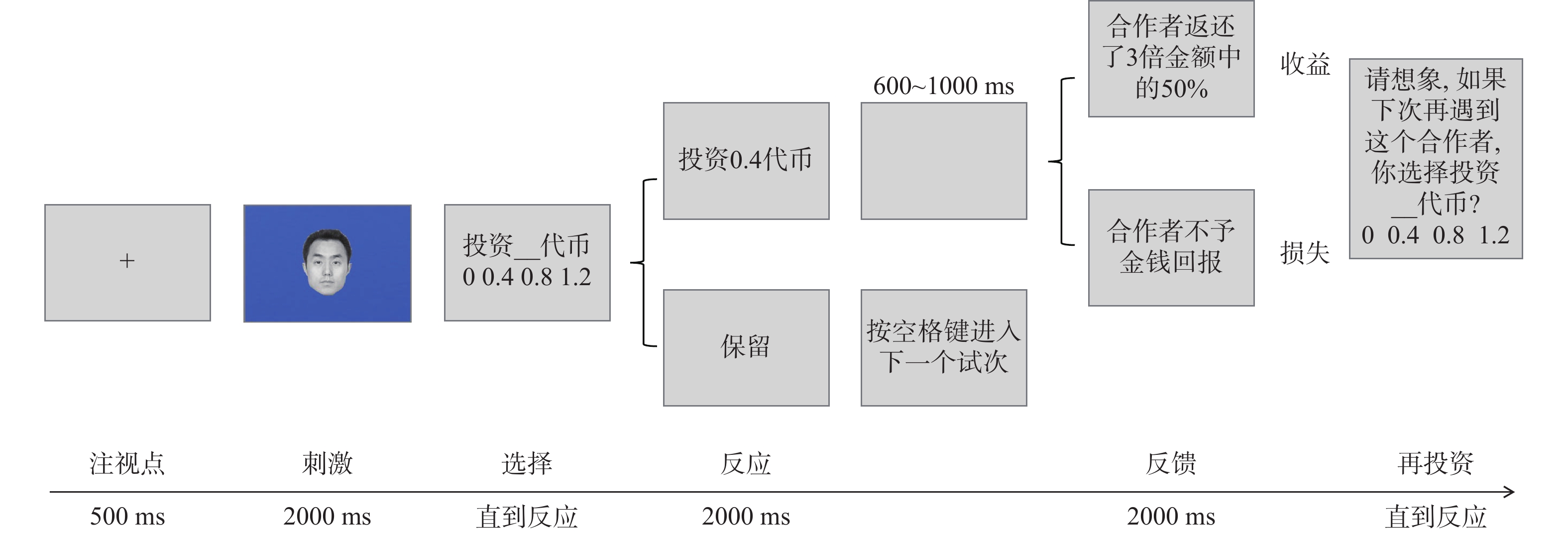
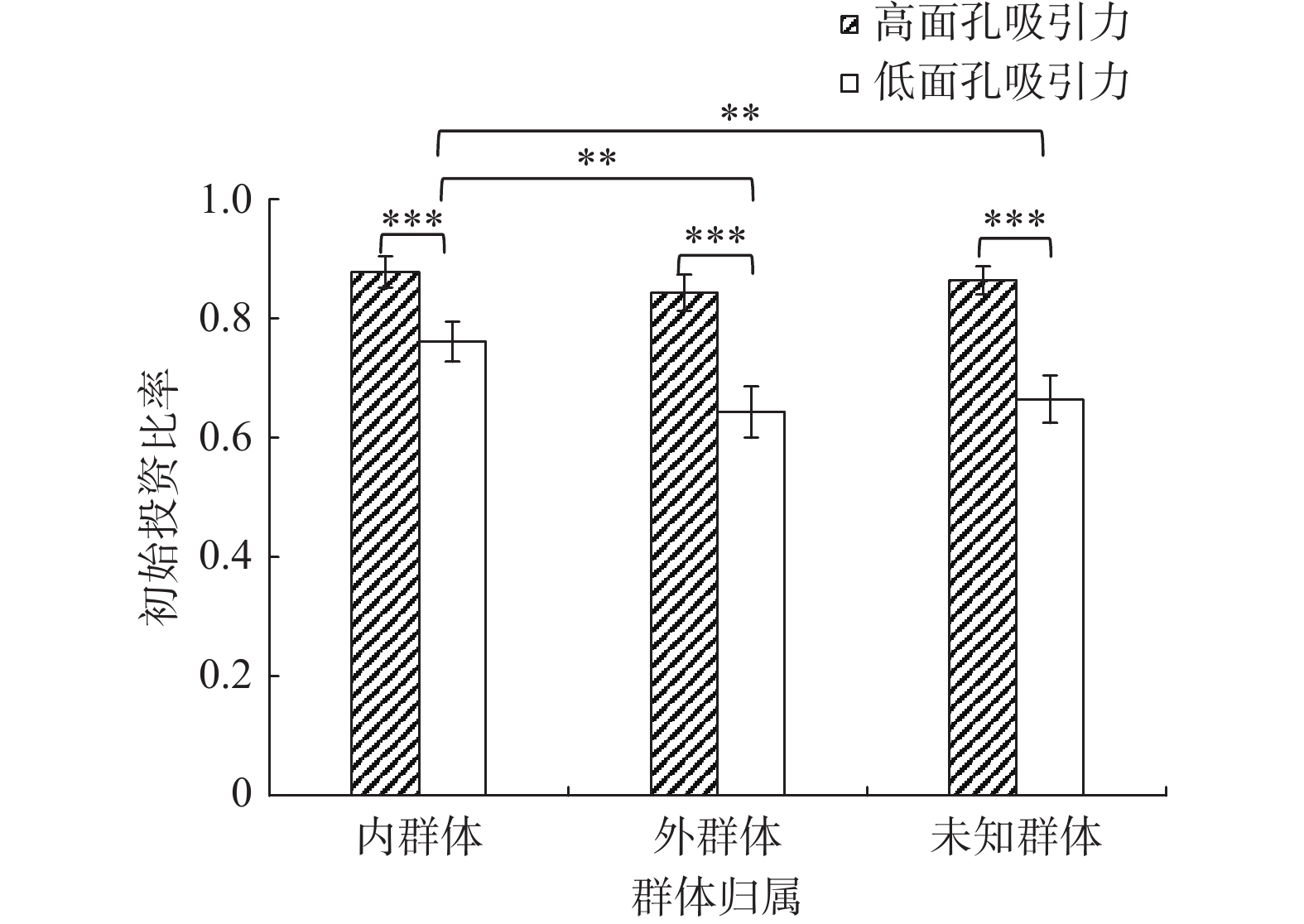
| 初投资比率 | 再投资比率(收益反馈) | 再投资比率(损失反馈) | 再投资金额(收益反馈) | 再投资金额(损失反馈) | |
| 高面孔吸引力−内群体 | 0.88±0.20 | 0.97±0.11 | 0.12±0.25 | 1.04±0.20 | 0.63±0.27 |
| 高面孔吸引力−外群体 | 0.84±0.22 | 0.97±0.10 | 0.10±0.23 | 0.97±0.23 | 0.60±0.17 |
| 高面孔吸引力−未知群体 | 0.86±0.17 | 0.98±0.07 | 0.11±0.20 | 0.99±0.21 | 0.53±0.14 |
| 低面孔吸引力−内群体 | 0.76±0.25 | 0.97±0.08 | 0.13±0.26 | 0.98±0.25 | 0.61±0.35 |
| 低面孔吸引力−外群体 | 0.64±0.32 | 0.98±0.06 | 0.08±0.19 | 0.87±0.32 | 0.55±0.17 |
| 低面孔吸引力−未知群体 | 0.66±0.29 | 0.97±0.11 | 0.08±0.21 | 0.94±0.27 | 0.60±0.23 |
| 初投资比率 | 再投资比率(收益反馈) | 再投资比率(损失反馈) | 再投资金额(收益反馈) | 再投资金额(损失反馈) | |
| 高面孔吸引力−内群体 | 0.88±0.20 | 0.97±0.11 | 0.12±0.25 | 1.04±0.20 | 0.63±0.27 |
| 高面孔吸引力−外群体 | 0.84±0.22 | 0.97±0.10 | 0.10±0.23 | 0.97±0.23 | 0.60±0.17 |
| 高面孔吸引力−未知群体 | 0.86±0.17 | 0.98±0.07 | 0.11±0.20 | 0.99±0.21 | 0.53±0.14 |
| 低面孔吸引力−内群体 | 0.76±0.25 | 0.97±0.08 | 0.13±0.26 | 0.98±0.25 | 0.61±0.35 |
| 低面孔吸引力−外群体 | 0.64±0.32 | 0.98±0.06 | 0.08±0.19 | 0.87±0.32 | 0.55±0.17 |
| 低面孔吸引力−未知群体 | 0.66±0.29 | 0.97±0.11 | 0.08±0.21 | 0.94±0.27 | 0.60±0.23 |
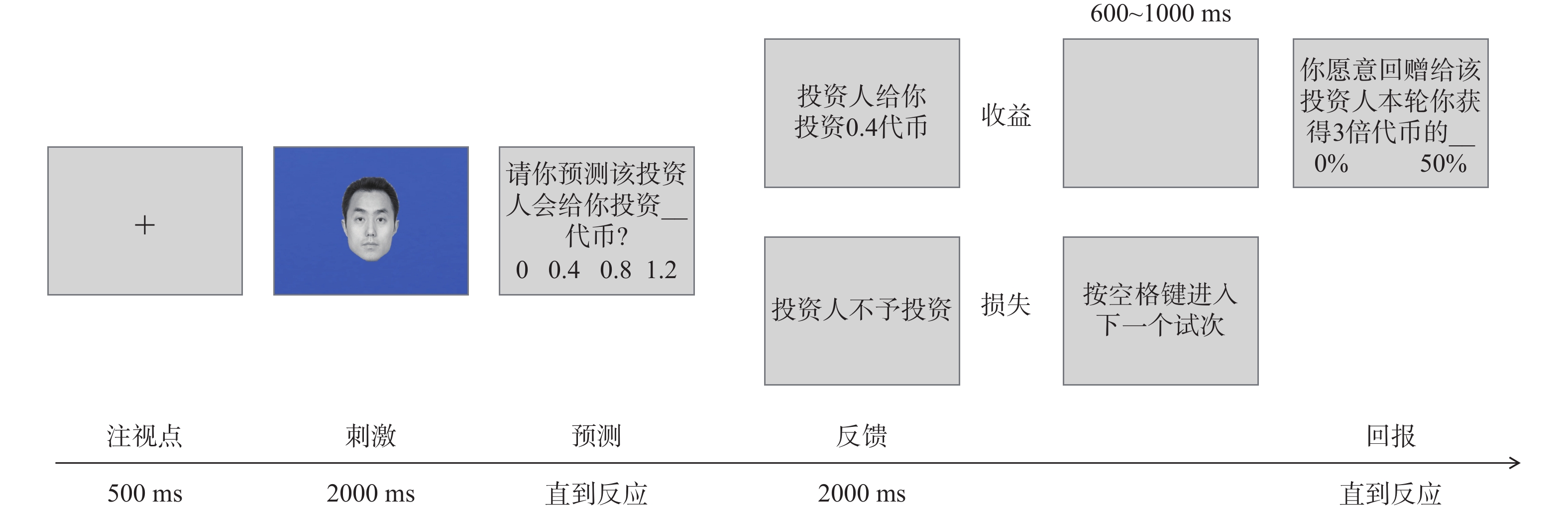
| 预测投资比率 | 回报比率 (预测正确) | 回报比率 (预测错误) | |
| 高面孔吸引力−内群体 | 0.94±0.10 | 0.69±0.38 | 0.68±0.35 |
| 高面孔吸引力−外群体 | 0.92±0.11 | 0.73±0.36 | 0.63±0.35 |
| 高面孔吸引力−未知群体 | 0.91±0.11 | 0.74±0.37 | 0.66±0.32 |
| 低面孔吸引力−内群体 | 0.83±0.18 | 0.72±0.39 | 0.70±0.32 |
| 低面孔吸引力−外群体 | 0.82±0.16 | 0.72±0.36 | 0.63±0.34 |
| 低面孔吸引力−未知群体 | 0.82±0.15 | 0.70±0.37 | 0.69±0.35 |
| 预测投资比率 | 回报比率 (预测正确) | 回报比率 (预测错误) | |
| 高面孔吸引力−内群体 | 0.94±0.10 | 0.69±0.38 | 0.68±0.35 |
| 高面孔吸引力−外群体 | 0.92±0.11 | 0.73±0.36 | 0.63±0.35 |
| 高面孔吸引力−未知群体 | 0.91±0.11 | 0.74±0.37 | 0.66±0.32 |
| 低面孔吸引力−内群体 | 0.83±0.18 | 0.72±0.39 | 0.70±0.32 |
| 低面孔吸引力−外群体 | 0.82±0.16 | 0.72±0.36 | 0.63±0.34 |
| 低面孔吸引力−未知群体 | 0.82±0.15 | 0.70±0.37 | 0.69±0.35 |
|
车敬上, 孙海龙, 肖晨洁, 李爱梅. 为什么信息超载损害决策? 基于有限认知资源的解释. 心理科学进展, 2019, 27 (10): 1758- 1768.
|
|
|
付超, 张振, 何金洲, 黄四林, 仇剑崟, 王益文. 普遍信任博弈决策的动态过程——来自脑电时频分析的证据. 心理学报, 2018, 50 (3): 317- 326.
DOI |
|
|
黄亮, 李森, 陈永辉, 黄文欣, 张秀松, 陈顺森. 意图信息透明与互惠意图促进人际信任: 来自噪音信任博弈的证据. 心理科学, 2024, 47 (2): 402- 410.
|
|
|
寇慧, 苏艳华, 张妍, 孔繁昌, 胡媛艳, 王洋, 陈红. 面孔吸引力的影响因素: 观察者假设. 心理科学进展, 2013, 21 (12): 2144- 2153.
|
|
|
刘璐, 肖雪, 刘丽莎, 徐良苑, 张旭然, 李燕芳. 儿童在不同卷入情境下基于资源价值的分配行为特点: 内群体偏爱的作用. 心理学报, 2019, 51 (5): 584- 597.
DOI |
|
|
渠亚明, 冯利, 杜冰, 王鑫文. 群体身份对过度的第三方惩罚的影响及其机制. 心理技术与应用, 2025, 13 (2): 82- 91.
DOI |
|
|
尚俊辰, 张懿倬, 陈文锋, 傅小兰. 面孔吸引力对经济决策的影响机制. 科学通报, 2024, 69 (11): 1447- 1460.
|
|
|
Akerlof, G. A., & Kranton, R. E. Economics and identity. The Quarterly Journal of Economics, 2000, 115 (3): 715- 753.
|
|
|
Berg, J., Dickhaut, J., & McCabe, K. Trust, reciprocity, and social history. Games and Economic Behavior, 1995, 10 (1): 122- 142.
|
|
|
Brustkern, J., Heinrichs, M., Walker, M., & Schiller, B. Facial threat affects trust more strongly than facial attractiveness in women than it does in men. Scientific Reports, 2021, 11 (1): 22475.
DOI |
|
|
Burnham, T., McCabe, K., & Smith, V. L. Friend-or-foe intentionality priming in an extensive form trust game. Journal of Economic Behavior & Organization, 2000, 43 (1): 57- 73.
DOI |
|
|
Eysenck, H. J., & Eysenck, S. B. G. (1975). Manual of the Eysenck personality questionnaire (junior and adult). London: Hodder & Stoughton.
|
|
|
Gao, W., Cao, B., Shan, S. G., Chen, X. L., Zhou, D. L., Zhang, X. H., & Zhao, D. B. (2008). The CAS-PEAL large-scale Chinese face database and baseline evaluations. IEEE Transactions on Systems, Man, and Cybernetics-Part A: Systems and Humans, 38(1), 149–161.
|
|
|
Griffin, A. M., & Langlois, J. H. Stereotype directionality and attractiveness stereotyping: Is beauty good or is ugly bad. Social Cognition, 2006, 24 (2): 187- 206.
DOI |
|
|
Ioannou, C. A., Qi, S., & Rustichini, A. Group payoffs as public signals. Journal of Economic Psychology, 2015, 48, 89- 105.
DOI |
|
|
Jaeger, B., Oud, B., Williams, T., Krumhuber, E. G., Fehr, E., & Engelmann, J. B. Can people detect the trustworthiness of strangers based on their facial appearance. Evolution and Human Behavior, 2022, 43 (4): 296- 303.
DOI |
|
|
Krämer, W. Kahneman, D. (2011): Thinking, fast and slow. Statistical Papers, 2014, 55 (3): 915.
|
|
|
Li, H. Y., Cai, D. T., Li, G., & Hu, M. M. The “beauty premium” phenomenon: Appearance discrimination in the P2P market. Journal of Travel Research, 2025, 64 (4): 783- 811.
DOI |
|
|
Liang, L. Y., Lin, L. J., Jin, L. W., Xie, D. R., & Li, M. R. (2018). SCUT-FBP5500: A diverse benchmark dataset for multi-paradigm facial beauty prediction. Paper presented at the 24th International Conference on Pattern Pecognition (ICPR), Beijing.
|
|
|
Loustau, T., Glassman, J., Martin, J. W., Young, L., & McAuliffe, K. The impact of group membership on punishment versus partner rejection. Scientific Reports, 2024, 14 (1): 22238.
DOI |
|
|
Ma, Q. G., Cheng, L., Qiu, W. W., & Pei, G. X. Role effect on beauty premium: Female as proposer may gain more fairness. PsyCh Journal, 2022, 11 (5): 691- 706.
DOI |
|
|
Ni, J., Yang, J. X., & Ma, Y. N. Social bonding in groups of humans selectively increases inter-status information exchange and prefrontal neural synchronization. PLoS Biology, 2024, 22 (3): e3002545.
DOI |
|
|
Pandey, G., & Zayas, V. What is a face worth? Facial attractiveness biases experience-based monetary decision-making. British Journal of Psychology, 2021, 112 (4): 934- 963.
DOI |
|
|
Peng, L. C., Wang, X., & Ying, S. S. The heterogeneity of beauty premium in China: Evidence from CFPS. Economic Modelling, 2020, 90, 386- 396.
DOI |
|
|
Rostovtseva, V. V., Puurtinen, M., Méndez Salinas, E., Cox, R. F. A., Groothuis, A. G. G., Butovskaya, M. L., & Weissing, F. J. Unravelling the many facets of human cooperation in an experimental study. Scientific Reports, 2023, 13 (1): 19573.
DOI |
|
|
Shang, J. C., & Zhang, Y. Z. Influence of male’s facial attractiveness, vocal attractiveness and social interest on female’s decisions of fairness. Scientific Reports, 2024, 14 (1): 16778.
DOI |
|
|
Shang, J. C., & Zhang, Y. Z. Beauty is not always a perk: The role of attractiveness and social interest in trust decisions. Behavioral Sciences, 2025, 15 (2): 175.
DOI |
|
|
Shang, J. C., & Zhong, K. Y. Facial attractiveness and group identity influence decision-making. PsyCh Journal, 2025, 14 (3): 457- 459.
DOI |
|
|
Shen, J., Han, S. F., Shen, X. Y., White, K. R. G., Guo, Z. B., Xu, Q., … Yang, Y. P. Group membership moderates the process of making trust judgments based on facial cues. The Journal of Social Psychology, 2022, 162 (5): 595- 606.
DOI |
|
|
Tajfel, H., & Turner, J. An integrative theory of intergroup conflict. Social Psychology of Intergroup Relations, 1979, 33, 94- 109.
DOI |
|
|
Tang, Y. J., & Gong, Z. Trust game, survey trust, are they correlated? Evidence from China. Current Psychology, 2024, 43 (3): 2253- 2263.
DOI |
|
|
Vermue, M., Meleady, R., & Seger, C. R. Member-to-member generalisation in trust behaviour: How do prior experiences inform prosocial behaviour towards novel ingroup and outgroup members. Current Psychology, 2019, 38 (4): 1003- 1020.
DOI |
|
|
Wang, X. G., & Tang, X. O. Face photo-sketch synthesis and recognition. IEEE Transactions on Pattern Analysis and Machine Intelligence, 2009, 31 (11): 1955- 1967.
DOI |
|
|
Wilson, R. K., & Eckel, C. C. Judging a book by its cover: Beauty and expectations in the trust game. Political Research Quarterly, 2006, 59 (2): 189- 202.
DOI |
|
|
Woitzel, J., Ingendahl, M., & Alves, H. Intergroup bias in perceived trustworthiness among few or many minimal groups. Journal of Experimental Social Psychology, 2024, 115, 104668.
DOI |
|
|
Wu, Q., Tan, C., Wang, B., & Zhou, P. Behavioral immune system and ingroup derogation: The effects of infectious diseases on ingroup derogation attitudes. PLoS One, 2015, 10 (3): e0122794.
DOI |
| [1] | XIAO Xiao, ZHAN Youlong, XIAO Qingyin, LI Xiaoyang, HE Wangda. The Cognitive Computational Mechanism and Emotional Regulation of Moral Decision-Making Under Risk Situations [J]. Studies of Psychology and Behavior, 2026, 24(4): 559-568. |
| [2] | Zhen WU, Xue TIAN. The Influence of Body Posture on Interpersonal Trust: The Competing Roles of Positive Emotion and Sense of Power [J]. Studies of Psychology and Behavior, 2026, 24(3): 320-326. |
| [3] | Jing ZHANG, Gege LIU, Tingmin LI, Shuangzhu ZHOU, Rixin TANG, Ziying WANG. The Influence of Others’ Kindness Traits and Children’s Initial Beliefs on Selective Learning in Early Childhood [J]. Studies of Psychology and Behavior, 2026, 24(2): 204-211. |
| [4] | Juncai WANG, Yan WU. Trust and Its Repair in Betrayal Trauma Individuals: The Moderating Role of Perceived Social Mindfulness [J]. Studies of Psychology and Behavior, 2025, 23(6): 830-838. |
| [5] | Yixu PANG, Zixuan PENG, Jia LI, Yixuan SONG, Meng YU. The Magic of Altruism: The Effect of Self-Interest/Altruistic Behaviour on Risk Decision-Making in College Students with High Social Anxiety [J]. Studies of Psychology and Behavior, 2025, 23(4): 560-568. |
| [6] | Chenhui DAI, Xiaojun ZHAO, Changxiu SHI, Mingzhen LI, Yaoyao ZHAO. The Influence of Social Exclusion on Interpersonal Trust: A Dual Analytical View Based on the Scenario Perspective and Trait Perspective [J]. Studies of Psychology and Behavior, 2025, 23(3): 384-390. |
| [7] | Huijing ZHI, Yang LIU. A Study of Gaze Behavior for Decision-Making of Race-Walking Referees in the Multi-Person Scenarios [J]. Studies of Psychology and Behavior, 2024, 22(1): 130-136. |
| [8] | Liyuan SUN, Binheng ZHANG, Minghui WANG, Entao ZHANG. Apology or Compensation? The Impact of Repair Strategies on Trust Repair in High- and Low-Power Victims [J]. Studies of Psychology and Behavior, 2023, 21(3): 418-424. |
| [9] | Xiaofei LIU, Xiaoyan LIANG, Ziqiang XIN. The Combined Effect of Two Types Reputation Information of Charity on Donation Intention [J]. Studies of Psychology and Behavior, 2022, 20(6): 813-820. |
| [10] | XU Hui, LI Meijia, PENG Huamao. Influence of Being Watched on Risky Decision-Making in Fund Investment [J]. Studies of Psychology and Behavior, 2022, 20(1): 37-44. |
| [11] | LIAO Yahui, HAN Mengfei. The Effect of Task Type and Outcome Framing on Risk Decision-Making [J]. Studies of Psychology and Behavior, 2022, 20(1): 45-51. |
| [12] | REN Yaping, SUN Yan, ZHAO Xuesong. The Influence of Ego Depletion on Self-Other Risk Decision-Making Under Different Task Frames [J]. Studies of Psychology and Behavior, 2021, 19(6): 750-756. |
| [13] | YANG Ling, YANG Xiaohui, ZHANG Liyuan, LI Yun, CAO Hua, ZHANG Jianxun. The Influence of Episodic Future Thinking on Intertemporal Decision-Making in Abstinent Heroin Users [J]. Studies of Psychology and Behavior, 2021, 19(4): 535-541. |
| [14] | DENG Yanyan, GUO Cheng. The Influence of Social Comparison on High School Students’ Cognitive and Affective Trust in the Context of Cooperative and Competitive Relationships [J]. Studies of Psychology and Behavior, 2021, 19(4): 556-562. |
| [15] | ZHAO Junzhe, QIAO Shiqi, WANG Minghui. Impact of Social Media Use on Employee Job Performance in Workplace: Based on the Perspective of Interpersonal Relationship [J]. Studies of Psychology and Behavior, 2020, 18(6): 819-825. |
| Viewed | ||||||
|
Full text |
|
|||||
|
Abstract |
|
|||||
