
Studies of Psychology and Behavior ›› 2025, Vol. 23 ›› Issue (2): 273-279.DOI: 10.12139/j.1672-0628.2025.02.017
• ? • Previous Articles Next Articles
Xinyue ZENG, Yanling LIU*( ), Xu WANG
Received:2024-12-18
Online:2025-03-20
Published:2025-03-20
Contact:
Yanling LIU
曾欣悦, 刘衍玲*(), 王旭
通讯作者:
刘衍玲
基金资助:Xinyue ZENG, Yanling LIU, Xu WANG. The Influence of Interpersonal Relationships on the Psychological Suzhi of Middle School Students: The Longitudinal Mediating Role of Self-Esteem[J]. Studies of Psychology and Behavior, 2025, 23(2): 273-279.
曾欣悦, 刘衍玲, 王旭. 人际关系对初中生心理素质的影响:自尊的纵向中介作用[J]. 心理与行为研究, 2025, 23(2): 273-279.
Add to citation manager EndNote|Ris|BibTeX
URL: https://psybeh.tjnu.edu.cn/EN/10.12139/j.1672-0628.2025.02.017
| 变量 | 1 | 2 | 3 | 4 | 5 | 6 |
| 1.T1父子关系 | ||||||
| 2.T1母子关系 | 0.56*** | |||||
| 3.T1同伴关系 | 0.33*** | 0.33*** | ||||
| 4.T1师生关系 | 0.27*** | 0.30*** | 0.61*** | |||
| 5.T1自尊 | 0.43*** | 0.42*** | 0.41*** | 0.37*** | ||
| 6.T2心理素质 | 0.29*** | 0.27*** | 0.41*** | 0.37*** | 0.41*** | |
| M | 3.49 | 3.76 | 3.40 | 3.65 | 2.93 | 4.05 |
| SD | 0.79 | 0.69 | 0.63 | 0.64 | 0.47 | 0.72 |
| 变量 | 1 | 2 | 3 | 4 | 5 | 6 |
| 1.T1父子关系 | ||||||
| 2.T1母子关系 | 0.56*** | |||||
| 3.T1同伴关系 | 0.33*** | 0.33*** | ||||
| 4.T1师生关系 | 0.27*** | 0.30*** | 0.61*** | |||
| 5.T1自尊 | 0.43*** | 0.42*** | 0.41*** | 0.37*** | ||
| 6.T2心理素质 | 0.29*** | 0.27*** | 0.41*** | 0.37*** | 0.41*** | |
| M | 3.49 | 3.76 | 3.40 | 3.65 | 2.93 | 4.05 |
| SD | 0.79 | 0.69 | 0.63 | 0.64 | 0.47 | 0.72 |
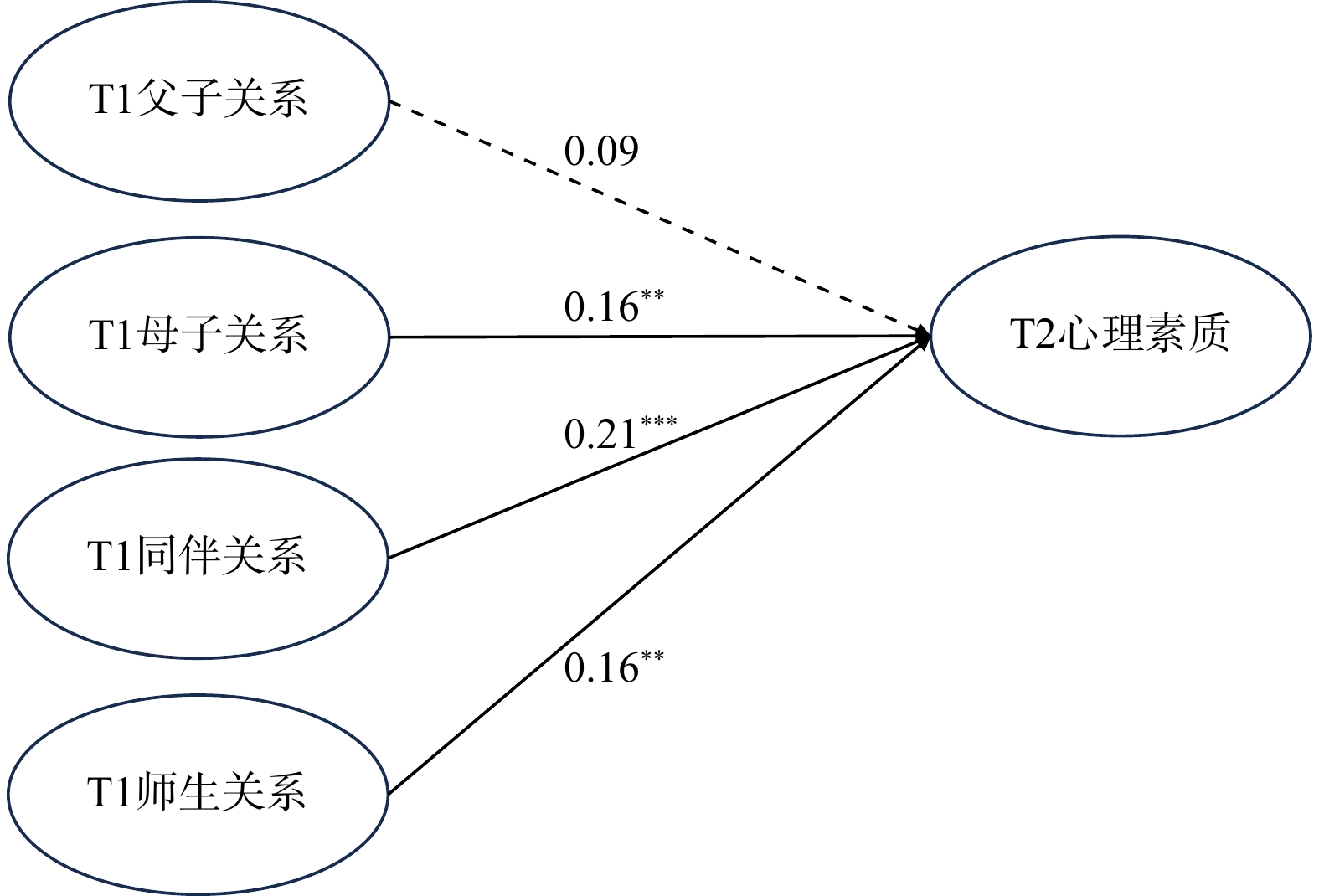
| 差异 | 估计值 | 标准误 | 95%置信区间 |
| 母子关系的直接影响−同伴关系的 直接影响 | −0.04 | 0.13 | [−0.29, 0.21] |
| 母子关系的直接影响−师生关系的 直接影响 | −0.01 | 0.13 | [−0.25, 0.24] |
| 同伴关系的直接影响−师生关系的 直接影响 | 0.04 | 0.10 | [−0.17, 0.24] |
| 差异 | 估计值 | 标准误 | 95%置信区间 |
| 母子关系的直接影响−同伴关系的 直接影响 | −0.04 | 0.13 | [−0.29, 0.21] |
| 母子关系的直接影响−师生关系的 直接影响 | −0.01 | 0.13 | [−0.25, 0.24] |
| 同伴关系的直接影响−师生关系的 直接影响 | 0.04 | 0.10 | [−0.17, 0.24] |
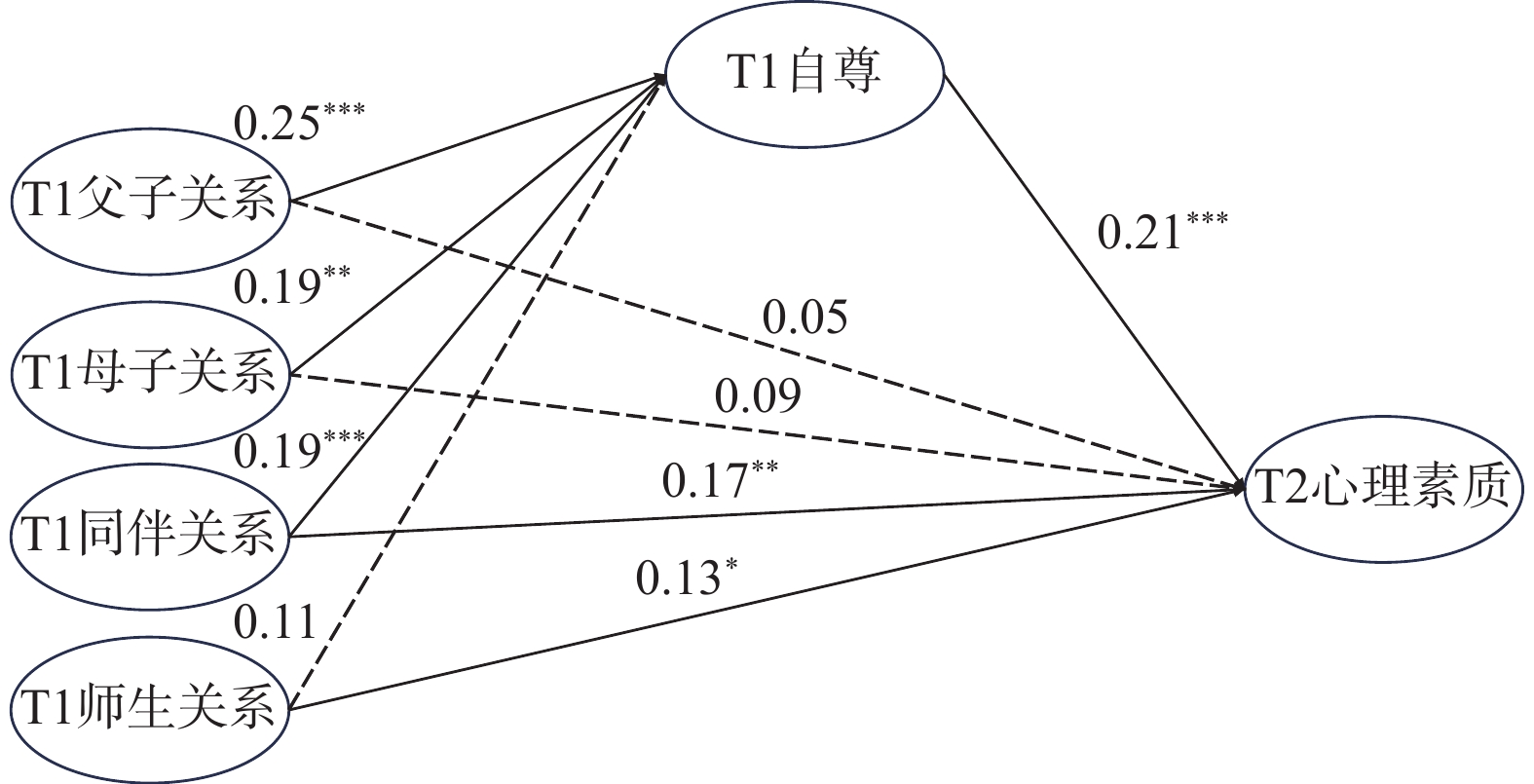
| 路径 | 估计值 | 标准误 | 95%置信区间 | 效应量 |
| 父子关系→自尊→心理素质 | 0.05 | 0.02 | [0.01, 0.09] | 0.51 |
| 母子关系→自尊→心理素质 | 0.04 | 0.02 | [0.01, 0.07] | 0.30 |
| 同伴关系→自尊→心理素质 | 0.04 | 0.02 | [0.01, 0.07] | 0.19 |
| 师生关系→自尊→心理素质 | 0.02 | 0.01 | [0.00, 0.05] | 0.14 |
| 路径 | 估计值 | 标准误 | 95%置信区间 | 效应量 |
| 父子关系→自尊→心理素质 | 0.05 | 0.02 | [0.01, 0.09] | 0.51 |
| 母子关系→自尊→心理素质 | 0.04 | 0.02 | [0.01, 0.07] | 0.30 |
| 同伴关系→自尊→心理素质 | 0.04 | 0.02 | [0.01, 0.07] | 0.19 |
| 师生关系→自尊→心理素质 | 0.02 | 0.01 | [0.00, 0.05] | 0.14 |
|
陈旭, 张大均, 程刚, 胡天强, 刘广增. 教师支持与心理素质对中学生学业成绩的影响. 心理发展与教育, 2018, 34 (6): 707- 714.
|
|
|
陈英敏, 李迎丽, 肖胜, 邓秋月, 高玉洁, 高峰强. 初中生人际关系与学校适应的关系: 多重中介模型检验. 中国特殊教育, 2019, (4): 83- 89.
DOI |
|
|
程黎, 刘鑫梅, 韩子荷. 父亲自主支持对超常儿童创造性自我效能感的影响: 基本心理需求与自尊的链式中介. 中国特殊教育, 2023, (7): 71- 79.
DOI |
|
|
韩宗桥, 郭成, 王蝶, 余宾, 何丽. 自尊与留守儿童攻击性的关系: 生活满意度和心理素质的中介作用. 西南大学学报(自然科学版), 2023, 45 (12): 28- 35.
|
|
|
胡天强, 张大均, 程刚. 中学生心理素质问卷(简化版)的修编及信效度检验. 西南大学学报(社会科学版), 2017, 43 (2): 120- 126.
|
|
|
金琳, 张大均, 刘广增. 父母教养方式与班级氛围对中学生心理素质的影响: 基于多层线性分析. 心理研究, 2021, 14 (3): 82- 89.
DOI |
|
|
李佳忆, 郭成, 陈帅, 廖锦千, 余宾, 刘红梅. 亲子关系与中小学生自杀意念的关系: 自尊的中介和心理素质的调节. 西南大学学报(自然科学版), 2023, 45 (12): 36- 43.
|
|
|
苗嘉鑫. (2023). 基于双因素模型青少年心理健康的动态追踪: 人际因素的作用 (硕士学位论文). 天津师范大学.
|
|
|
聂倩, 张大均, 滕召军, 陆星月, 郭成. 学生感知的学校氛围与主客观学业成绩: 心理素质及其分维度的中介作用. 心理发展与教育, 2018, 34 (6): 715- 723.
|
|
|
聂瑞虹, 周楠, 张宇驰, 方晓义. 人际关系与高中生内外化问题的关系: 自尊的中介及性别的调节作用. 心理发展与教育, 2017, 33 (6): 708- 718.
|
|
|
潘颖秋. 初中青少年自尊发展趋势及影响因素的追踪分析. 心理学报, 2015, 47 (6): 787- 796.
|
|
|
王萍, 高华, 许家玉, 黄金菊, 王成江. 自尊量表信度效度研究. 山东精神医学, 1998, (4): 31- 32, 22.
|
|
|
王鑫强, 张大均. 心理素质与心理健康关系模型构建: 对PTH和DFM的超越. 西南大学学报(社会科学版), 2012, 38 (6): 67- 74.
|
|
|
王旭, 刘衍玲, 林杰, 刘传星, 魏灵真, 邱涵宇. 亲子关系对中学生心理健康的影响: 社会支持和心理素质的链式中介作用. 心理发展与教育, 2022, 38 (2): 263- 271.
|
|
|
吴旻, 刘争光, 梁丽婵. 亲子关系对儿童青少年心理发展的影响. 北京师范大学学报(社会科学版), 2016, (5): 55- 63.
|
|
|
燕良轼, 王小凤, 李桃, 郑红, 徐琳琳. 中学生人际关系对学习投入的影响机制研究. 中国临床心理学杂志, 2018, 26 (1): 123- 128.
|
|
|
张大均, 苏志强, 王鑫强. 儿童青少年心理素质研究30年: 回顾与展望. 心理与行为研究, 2017, 15 (1): 3- 11.
DOI |
|
|
张大均, 王鑫强. 心理健康与心理素质的关系: 内涵结构分析. 西南大学学报(社会科学版), 2012, 38 (3): 69- 74, 174.
|
|
|
张文新, 王美萍, Fuligni, A. 青少年的自主期望、对父母权威的态度与亲子冲突和亲合. 心理学报, 2006, 38 (6): 868- 876.
|
|
|
张兴旭, 郭海英, 林丹华. 亲子、同伴、师生关系与青少年主观幸福感关系的研究. 心理发展与教育, 2019, 35 (4): 458- 466.
|
|
|
周浩, 龙立荣. 共同方法偏差的统计检验与控制方法. 心理科学进展, 2004, 12 (6): 942- 950.
DOI |
|
|
周宗奎, 曹敏, 田媛, 黄淳, 杨秀娟, 宋友志. 初中生亲子关系与抑郁: 自尊和情绪弹性的中介作用. 心理发展与教育, 2021, 37 (6): 864- 872.
|
|
|
Bear, G. G., Gaskins, C., Blank, J., & Chen, F. F. Delaware school climate survey-student: Its factor structure, concurrent validity, and reliability. Journal of School Psychology, 2011, 49 (2): 157- 174.
DOI |
|
|
Bowen, M. The use of family theory in clinical practice. Comprehensive Psychiatry, 1966, 7 (5): 345- 374.
DOI |
|
|
Bronfenbrenner, U. Ecology of the family as a context for human development: Research perspectives. Developmental Psychology, 1986, 22 (6): 723- 742.
DOI |
|
|
Cohen, J. (1988). Statistical power analysis for the behavioral sciences (2nd ed.). Hillsdale, MI: Erlbaum.
|
|
|
Gorrese, A., & Ruggieri, R. Peer attachment and self-esteem: A meta-analytic review. Personality and Individual Differences, 2013, 55 (5): 559- 568.
DOI |
|
|
Greenberg, J., Solomon, S., Pyszczynski, T., Rosenblatt, A., Burling, J., Lyon, D., … Pinel, E. Why do people need self-esteem? Converging evidence that self-esteem serves an anxiety-buffering function. Journal of Personality and Social Psychology, 1992, 63 (6): 913- 922.
DOI |
|
|
Hartup, W. W. Social relationships and their developmental significance. American Psychologist, 1989, 44 (2): 120- 126.
DOI |
|
|
Herres, J., & Kobak, R. The role of parent, teacher, and peer events in maintaining depressive symptoms during early adolescence. Journal of Abnormal Child Psychology, 2015, 43 (2): 325- 337.
DOI |
|
|
Jambon, M., & Malti, T. Developmental relations between children’s peer relationship quality and prosocial behavior: The mediating role of trust. The Journal of Genetic Psychology, 2022, 183 (3): 197- 210.
DOI |
|
|
Keizer, R., Helmerhorst, K. O. W., & van Rijn-van Gelderen, L. Perceived quality of the mother-adolescent and father-adolescent attachment relationship and adolescents’ self-esteem. Journal of Youth and Adolescence, 2019, 48 (6): 1203- 1217.
DOI |
|
|
Leary, M. R., Tambor, E. S., Terdal, S. K., & Downs, D. L. Self-esteem as an interpersonal monitor: The sociometer hypothesis. Journal of Personality and Social Psychology, 1995, 68 (3): 518- 530.
DOI |
|
|
Lee, J. S., Joo, E. J., & Choi, K. S. Perceived stress and self-esteem mediate the effects of work-related stress on depression. Stress and Health, 2013, 29 (1): 75- 81.
DOI |
|
|
Longobardi, C., Settanni, M., Lin, S. Y., & Fabris, M. A. Student-teacher relationship quality and prosocial behaviour: The mediating role of academic achievement and a positive attitude towards school. British Journal of Educational Psychology, 2021, 91 (2): 547- 562.
DOI |
|
|
Matte-Gagné, C., Harvey, B., Stack, D. M., & Serbin, L. A. Contextual specificity in the relationship between maternal autonomy support and children’s socio-emotional development: A longitudinal study from preschool to preadolescence. Journal of Youth and Adolescence, 2015, 44 (8): 1528- 1541.
DOI |
|
|
Orth, U., Erol, R. Y., & Luciano, E. C. Development of self-esteem from age 4 to 94 years: A meta-analysis of longitudinal studies. Psychological Bulletin, 2018, 144 (10): 1045- 1080.
DOI |
|
|
Pan, Y. G., Hu, Y., Zhang, D. J., Ran, G. M., Li, B. B., Liu, C. X., … Chen, W. F. Parental and peer attachment and adolescents’ behaviors: The mediating role of psychological suzhi in a longitudinal study. Children and Youth Services Review, 2017, 83, 218- 225.
DOI |
|
|
Rosenberg, M. (1965). Society and the adolescent self-image. Princeton, NJ: Princeton University Press.
|
|
|
Wang, X. Y., Yao, C. L., Su, S. W., Yu, X., Bai, N. X., & Gao, S. Teacher-student relationships and coping styles in Chinese children: The chain mediating role of peer relationships and psychological suzhi. Behavioral Sciences, 2024, 14 (9): 797.
DOI |
| Viewed | ||||||
|
Full text |
|
|||||
|
Abstract |
|
|||||
