
Studies of Psychology and Behavior ›› 2025, Vol. 23 ›› Issue (3): 369-376.DOI: 10.12139/j.1672-0628.2025.03.011
• ? • Previous Articles Next Articles
Yanhui XIANG*,1,2,3,4( ), Lizhuoyao ZHOU2,3,4
Received:2024-04-22
Online:2025-05-20
Published:2025-05-20
Contact:
Yanhui XIANG
向燕辉*,1,2,3,4(), 周李卓瑶2,3,4
通讯作者:
向燕辉
基金资助:Yanhui XIANG, Lizhuoyao ZHOU. The Effect of Father Love Absence on Non-Suicidal Self-Injury in Adolescents: Longitudinal Mediation of Self-Control and Smartphone Addiction[J]. Studies of Psychology and Behavior, 2025, 23(3): 369-376.
向燕辉, 周李卓瑶. 父爱缺失对青少年非自杀性自伤的影响:自我控制和手机成瘾的纵向中介作用[J]. 心理与行为研究, 2025, 23(3): 369-376.
Add to citation manager EndNote|Ris|BibTeX
URL: https://psybeh.tjnu.edu.cn/EN/10.12139/j.1672-0628.2025.03.011
| 变量 | M±SD | 1 | 2 | 3 | 4 | 5 | 6 | 7 |
| 1.T1父爱缺失 | 46.35±14.28 | |||||||
| 2.T2父爱缺失 | 46.80±14.32 | 0.63** | ||||||
| 3.T1自我控制 | 20.84±4.72 | −0.33** | −0.27** | |||||
| 4.T2自我控制 | 20.48±4.55 | −0.23** | −0.30** | 0.43** | ||||
| 5.T1手机成瘾 | 20.78±6.46 | 0.30** | 0.22** | −0.24** | −0.22** | |||
| 6.T2手机成瘾 | 21.00±6.05 | 0.24** | 0.35** | −0.22** | −0.25** | 0.44** | ||
| 7.T1NSSI | 11.60±3.73 | 0.23** | 0.20** | −0.19** | −0.20** | 0.13** | 0.19** | |
| 8.T2NSSI | 11.42±3.31 | 0.21** | 0.23** | −0.17** | −0.20** | 0.14** | 0.17** | 0.48** |
| 变量 | M±SD | 1 | 2 | 3 | 4 | 5 | 6 | 7 |
| 1.T1父爱缺失 | 46.35±14.28 | |||||||
| 2.T2父爱缺失 | 46.80±14.32 | 0.63** | ||||||
| 3.T1自我控制 | 20.84±4.72 | −0.33** | −0.27** | |||||
| 4.T2自我控制 | 20.48±4.55 | −0.23** | −0.30** | 0.43** | ||||
| 5.T1手机成瘾 | 20.78±6.46 | 0.30** | 0.22** | −0.24** | −0.22** | |||
| 6.T2手机成瘾 | 21.00±6.05 | 0.24** | 0.35** | −0.22** | −0.25** | 0.44** | ||
| 7.T1NSSI | 11.60±3.73 | 0.23** | 0.20** | −0.19** | −0.20** | 0.13** | 0.19** | |
| 8.T2NSSI | 11.42±3.31 | 0.21** | 0.23** | −0.17** | −0.20** | 0.14** | 0.17** | 0.48** |
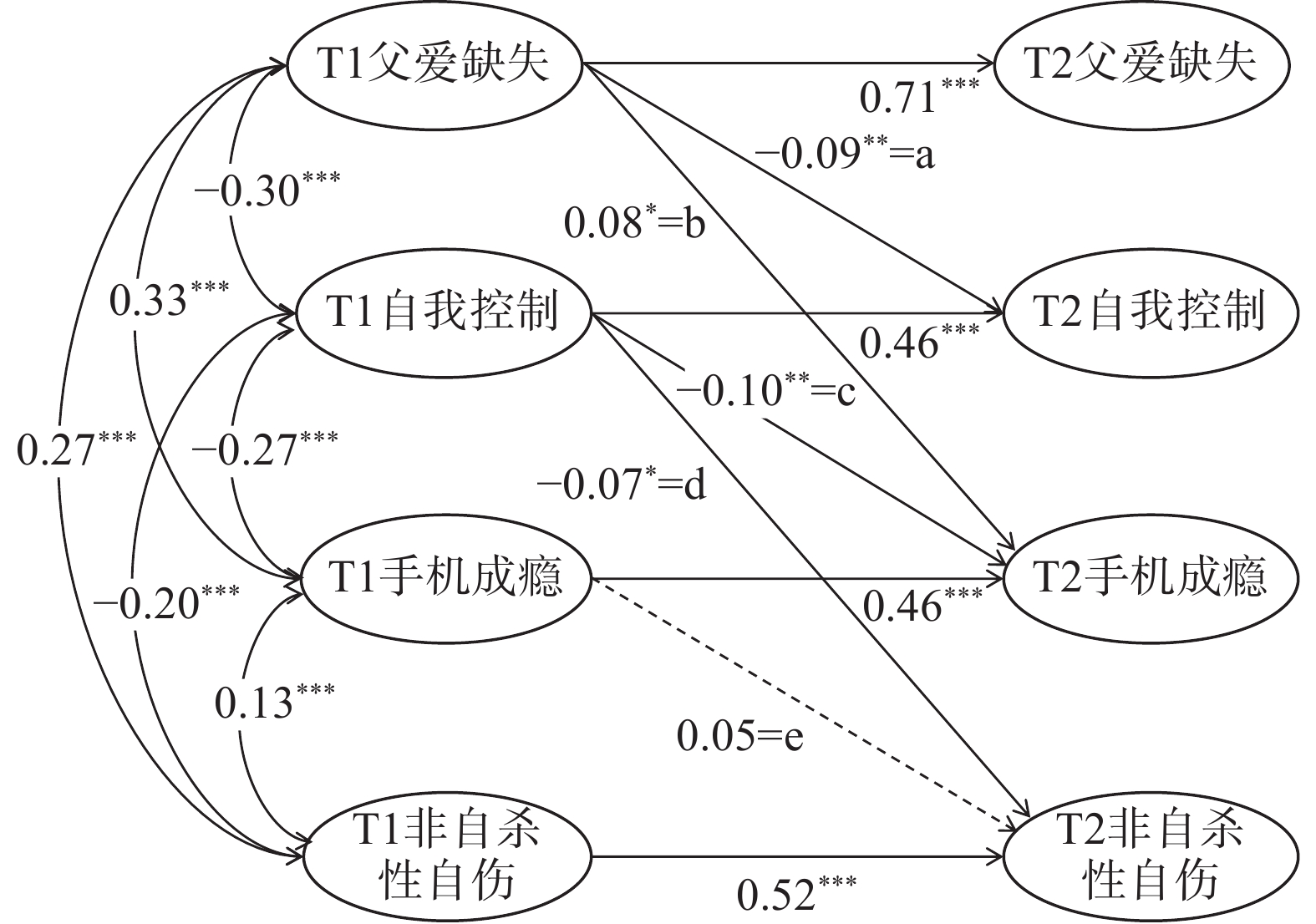
| 路径 | b(95%CI) | SE | β | p |
| 自回归路径 | ||||
| T1父爱缺失→T2父爱缺失 | 3.25[2.94, 3.57] | 0.15 | 0.71 | <0.001 |
| T1自我控制→T2自我控制 | 0.34[0.28, 0.39] | 0.03 | 0.46 | <0.001 |
| T1手机成瘾→T2手机成瘾 | 0.43[0.35, 0.51] | 0.03 | 0.46 | <0.001 |
| T1NSSI→T2NSSI | 0.18[0.13, 0.23] | 0.01 | 0.52 | <0.001 |
| 交叉滞后路径 | ||||
| T1父爱缺失→T2自我控制 | −0.07[−0.12, −0.02] | 0.02 | −0.09 | 0.003 |
| T1父爱缺失→T2手机成瘾 | 0.08[0.01, 0.14] | 0.03 | 0.08 | 0.015 |
| T1自我控制→T2手机成瘾 | −0.09[−0.15, −0.03] | 0.03 | −0.10 | 0.001 |
| T1自我控制→T2NSSI | −0.02[−0.05, 0.00] | 0.01 | −0.07 | 0.018 |
| T1手机成瘾→T2NSSI | 0.02[−0.00, 0.04] | 0.01 | 0.05 | 0.094 |
| 路径 | b(95%CI) | SE | β | p |
| 自回归路径 | ||||
| T1父爱缺失→T2父爱缺失 | 3.25[2.94, 3.57] | 0.15 | 0.71 | <0.001 |
| T1自我控制→T2自我控制 | 0.34[0.28, 0.39] | 0.03 | 0.46 | <0.001 |
| T1手机成瘾→T2手机成瘾 | 0.43[0.35, 0.51] | 0.03 | 0.46 | <0.001 |
| T1NSSI→T2NSSI | 0.18[0.13, 0.23] | 0.01 | 0.52 | <0.001 |
| 交叉滞后路径 | ||||
| T1父爱缺失→T2自我控制 | −0.07[−0.12, −0.02] | 0.02 | −0.09 | 0.003 |
| T1父爱缺失→T2手机成瘾 | 0.08[0.01, 0.14] | 0.03 | 0.08 | 0.015 |
| T1自我控制→T2手机成瘾 | −0.09[−0.15, −0.03] | 0.03 | −0.10 | 0.001 |
| T1自我控制→T2NSSI | −0.02[−0.05, 0.00] | 0.01 | −0.07 | 0.018 |
| T1手机成瘾→T2NSSI | 0.02[−0.00, 0.04] | 0.01 | 0.05 | 0.094 |
|
陈慧, 周建松. 非自杀性自伤行为的成瘾特征研究进展. 中华精神科杂志, 2022, 55 (1): 64- 68.
DOI |
|
|
Adiyatma, R., Mudjiran, M., & Afdal, A. The contribution of self-control towards student smartphone addiction. SCHOULID: Indonesian Journal of School Counseling, 2020, 5 (1): 45- 49.
DOI |
|
|
Anggraini, V., Priyanto, A., & Yulsyofriend, Y. (2022). Fathers’ role in developing child emotional development. Paper presented at the 6th International Conference of Early Childhood Education (ICECE-6 2021), Padang, Indonesia.
|
|
|
Babbie, E. R. The practice of social research. Contemporary Sociology, 1976, 5 (2): 163- 164.
|
|
|
Billieux, J., van der Linden, M., & Rochat, L. The role of impulsivity in actual and problematic use of the mobile phone. Applied Cognitive Psychology, 2008, 22 (9): 1195- 1210.
DOI |
|
|
Bowlby, J. (1969). Attachment and loss: Vol. 1: Attachment. London: Hogarth Press and Institute of Psycho-Analysis.
|
|
|
Bowlby, J. (1973). Attachment and loss: Vol. 2: Separation, anxiety and anger. London: Hogarth Press and Institute of Psycho-Analysis.
|
|
|
Bowlby, J. (1988). A secure base: Parent-child attachment and healthy human development. New York: Basic Books.
|
|
|
Byrne, B. M. Structural equation modeling with AMOS, EQS, and LISREL: Comparative approaches to testing for the factorial validity of a measuring instrument. International Journal of Testing, 2001, 1 (1): 55- 86.
DOI |
|
|
Cassels, M., Neufeld, S., van Harmelen, A. L., Goodyer, I., & Wilkinson, P. Prospective pathways from impulsivity to non-suicidal self-injury among youth. Archives of Suicide Research, 2022, 26 (2): 534- 547.
DOI |
|
|
Chow, J. T., Hui, C. M., & Lau, S. A depleted mind feels inefficacious: Ego-depletion reduces self-efficacy to exert further self-control. European Journal of Social Psychology, 2015, 45 (6): 754- 768.
DOI |
|
|
Cole, D. A., & Maxwell, S. E. Testing mediational models with longitudinal data: Questions and tips in the use of structural equation modeling. Journal of Abnormal Psychology, 2003, 112 (4): 558- 577.
DOI |
|
|
Csibi, S., Demetrovics, Z., & Szabó, A. Development and psychometric validation of the Brief Smartphone Addiction Scale (BSAS) with schoolchidren. Psychiatria Hungarica: A Magyar Pszichiatriai Tarsasag Tudomanyos Folyoirata, 2016, 31 (1): 71- 77.
|
|
|
Culpin, I., Heron, J., Araya, R., Melotti, R., & Joinson, C. Father absence and depressive symptoms in adolescence: Findings from a UK cohort. Psychological Medicine, 2013, 43 (12): 2615- 2626.
DOI |
|
|
de Ridder, D. T. D., Lensvelt-Mulders, G., Finkenauer, C., Stok, F. M., & Baumeister, R. F. Taking stock of self-control: A meta-analysis of how trait self-control relates to a wide range of behaviors. Personality and Social Psychology Review, 2012, 16 (1): 76- 99.
DOI |
|
|
Ding, Y. M., Wan, X., Lu, G. L., Huang, H. T., Liang, Y. P., Yu, J. F., & Chen, C. R. The associations between smartphone addiction and self-esteem, self-control, and social support among Chinese adolescents: A meta-analysis. Frontiers in Psychology, 2022, 13, 1029323.
DOI |
|
|
Duckworth, A. L. The significance of self-control. Proceedings of the National Academy of Sciences of the United States of America, 2011, 108 (7): 2639- 2640.
|
|
|
East, L., Jackson, D., & O’Brien, L. Father absence and adolescent development: A review of the literature. Journal of Child Health Care, 2006, 10 (4): 283- 295.
DOI |
|
|
Glenn, C. R., & Klonsky, E. D. A multimethod analysis of impulsivity in nonsuicidal self-injury. Personality Disorders, 2010, 1 (1): 67- 75.
DOI |
|
|
Gottfredson, M. R., & Hirschi, T. (1990). A general theory of crime (pp. 97). Stanford, CA: Stanford University Press.
|
|
|
Han, X. Y., Zhang, Y. H., Chen, D., Sun, J. Y., Di, Z. X., Yang, Z., & He, H. C. The impact of negative cognitive bias on NSSI: Mediating non-adaptive cognitive emotion regulation strategies. BMC Nursing, 2024, 23 (1): 358.
DOI |
|
|
Hofmann, W., Friese, M., & Strack, F. Impulse and self-control from a dual-systems perspective. Perspectives on Psychological Science, 2009, 4 (2): 162- 176.
DOI |
|
|
Horwood, S., & Anglim, J. (2021). Emotion regulation difficulties, personality, and problematic smartphone use. Cyberpsychology, Behavior, and Social Networking, 24(4), 275–281.
|
|
|
Kendall, P. C., & Wilcox, L. E. Self-control in children: Development of a rating scale. Journal of Consulting and Clinical Psychology, 1979, 47 (6): 1020- 1029.
DOI |
|
|
Li, X., & Lamb, M. E. (2015). Fathering in Chinese culture: Traditions and transitions. In J. L. Roopnarine (Ed.), Fathers across cultures: The importance, roles, and diverse practices of dads (pp. 273–306). Santa Barbara, CA: Praeger/ABC–CLIO.
|
|
|
Lin, S., Li, Y. J., Sheng, J., Chen, L. J., Zhang, Y. Z., & Chen, J. Non-suicidal self-injury in Chinese adolescents with problematic smartphone use: A one-year longitudinal study. Children and Youth Services Review, 2025, 169, 108101.
DOI |
|
|
Little, T. D., Cunningham, W. A., Shahar, G., & Widaman, K. F. To parcel or not to parcel: Exploring the question, weighing the merits. Structural Equation Modeling, 2002, 9 (2): 151- 173.
DOI |
|
|
Liu, Y., Xiao, Y. Y., Ran, H. L., He, X. T., Jiang, L. L., Wang, T. L., … Lu, J. Association between parenting and non-suicidal self-injury among adolescents in Yunnan, China: A cross-sectional survey. PeerJ, 2020, 8, e10493.
DOI |
|
|
Mancinelli, E., Ruocco, E., Napolitano, S., & Salcuni, S. A network analysis on self-harming and problematic smartphone use: The role of self-control, internalizing and externalizing problems in a sample of self-harming adolescents. Comprehensive Psychiatry, 2022, 112, 152285.
DOI |
|
|
Memon, A. M., Sharma, S. G., Mohite, S. S., & Jain, S. The role of online social networking on deliberate self-harm and suicidality in adolescents: A systematized review of literature. Indian Journal of Psychiatry, 2018, 60 (4): 384- 392.
DOI |
|
|
Mészáros, G., Győri, D., Horváth, L. O., Szentiványi, D., & Balázs, J. Nonsuicidal self-injury: Its associations with pathological internet use and psychopathology among adolescents. Frontiers in Psychiatry, 2020, 11, 814.
DOI |
|
|
Mun, I. B., & Lee, S. (2020). How does parental smartphone addiction affect adolescent smartphone addiction?: Testing the mediating roles of parental rejection and adolescent depression. Cyberpsychology, Behavior, and Social Networking, 24(6), 399–406.
|
|
|
Ningsih, Y. S. Dominasi ayah atau ibu? Analisis peranan orang tua dalam pendidikan anak di lingkungan keluarga. FITRAH: International Islamic Education Journal, 2022, 4 (1): 77- 98.
DOI |
|
|
Nock, M. K. Why do people hurt themselves. Current Directions in Psychological Science, 2009, 18 (2): 78- 83.
DOI |
|
|
Nock, M. K. Self-injury. Annual Review of Clinical Psychology, 2010, 6, 339- 363.
DOI |
|
|
Nock, M. K., & Favazza, A. R. (2009). Nonsuicidal self-injury: Definition and classification. In M. K. Nock (Ed.), Understanding nonsuicidal self-injury: Origins, assessment, and treatment (pp. 9–18). Washington, D.C.: American Psychological Association.
|
|
|
Pan, W. G., Gao, B. X., Long, Y. H., Teng, Y., & Yue, T. Effect of caregivers’ parenting styles on the emotional and behavioral problems of left-behind children: The parallel mediating role of self-control. International Journal of Environmental Research and Public Health, 2021, 18 (23): 12714.
DOI |
|
|
Pan, Y. F., & Zhan, P. D. The impact of sample attrition on longitudinal learning diagnosis: A prolog. Frontiers in Psychology, 2020, 11, 1051.
DOI |
|
|
Peng, Y., Wang, Y. L., Liu, S. Z., & Hu, X. Z. Parenting and mobile phone addiction tendency of Chinese adolescents: The roles of self-control and future time perspective. Frontiers in Psychology, 2022, 13, 985608.
DOI |
|
|
Preacher, K. J., & Hayes, A. F. Asymptotic and resampling strategies for assessing and comparing indirect effects in multiple mediator models. Behavior Research Methods, 2008, 40 (3): 879- 891.
DOI |
|
|
Qiu, C. X., Li, R. J., Luo, H. C., Li, S. N., & Nie, Y. G. Parent-child relationship and smartphone addiction among Chinese adolescents: A longitudinal moderated mediation model. Addictive Behaviors, 2022, 130, 107304.
DOI |
|
|
Qureshi, M. S. (2014). Effects of father absence on children’s academic performance. Journal of Educational, Health and Community Psychology, 3(1), 1–6.
|
|
|
Rakotomanana, H., Walters, C. N., Komakech, J. J., Hildebrand, D., Gates, G. E., Thomas, D. G., … Stoecker, B. J. Fathers’ involvement in child care activities: Qualitative findings from the highlands of Madagascar. PLoS One, 2021, 16 (3): e0247112.
DOI |
|
|
Rong, F. J., Wang, M. N., Peng, C., Cheng, J. H., Ding, H. L., Wang, Y., & Yu, Y. Z. Association between problematic smartphone use, chronotype and nonsuicidal self-injury among adolescents: A large-scale study in China. Addictive Behaviors, 2023, 144, 107725.
DOI |
|
|
Rothbaum, F., Weisz, J. R., & Snyder, S. S. Changing the world and changing the self: A two-process model of perceived control. Journal of Personality and Social Psychology, 1982, 42 (1): 5- 37.
DOI |
|
|
Schore, A. N. Effects of a secure attachment relationship on right brain development, affect regulation, and infant mental health. Infant Mental Health Journal, 2001, 22 (1–2): 7- 66.
DOI |
|
|
Situmorang, N. Z., Pratiwi, Y., & Agung R, D. P. (2018). Peran ayah dan kontrol diri sebagai preditor kecenderungan perilaku agresif remaja. Jurnal Muara Ilmu Sosial, Humaniora, dan Seni, 2(1), 115–126.
|
|
|
Steinbeis, N., Haushofer, J., Fehr, E., & Singer, T. Development of behavioral control and associated vmPFC-DLPFC connectivity explains children’s increased resistance to temptation in intertemporal choice. Cerebral Cortex, 2016, 26 (1): 32- 42.
DOI |
|
|
Su, J. L., Xiang, Y. H., & Wang, L. (2024). The relationship between father absence and benign/malicious envy: The mediating role of social support and core self-evaluation. Deviant Behavior. Advance online publication. https://doi.org/10.1080/01639625.2024.2435911
|
|
|
Tangney, J. P., Boone, A. L., & Baumeister, R. F. (2018). High self-control predicts good adjustment, less pathology, better grades, and interpersonal success. In R. Baumeister (Ed.), Self-regulation and self-control (pp. 173–212). London: Routledge.
|
|
|
Trivedi, S., & Bose, K. Fatherhood and roles of father in children’s upbringing in Botswana: Fathers’ perspectives. Journal of Family Studies, 2020, 26 (4): 550- 563.
DOI |
|
|
Wang, L. X., Dou, K., Li, J. B., Zhang, M. C., & Guan, J. Y. The association between interparental conflict and problematic internet use among Chinese adolescents: Testing a moderated mediation model. Computers in Human Behavior, 2021, 122, 106832.
DOI |
|
|
Wang, R., Yang, R. X., Ran, H. L., Xu, X. F., Yang, G. Y., Wang, T. L., … Xiao, Y. Y. Mobile phone addiction and non-suicidal self-injury among adolescents in China. PeerJ: Life & Environment, 2022, 10, e14057.
|
|
|
Wang, W., Li, D. P., Li, X., Wang, Y. H., Sun, W. Q., Zhao, L. Y., & Qiu, L. L. Parent-adolescent relationship and adolescent internet addiction: A moderated mediation model. Addictive Behaviors, 2018, 84, 171- 177.
DOI |
|
|
Wibiharto, B. M. Y., Setiadi, R., & Widyaningsih, Y. Relationship pattern of fatherless impacts to internet addiction, suicidal tendencies and learning difficulties for students at SMAN ABC Jakarta. Society, 2021, 9 (1): 264- 276.
DOI |
|
|
Williams, J., & Mackinnon, D. P. Resampling and distribution of the product methods for testing indirect effects in complex models. Structural Equation Modeling: A Multidisciplinary Journal, 2008, 15 (1): 23- 51.
DOI |
|
|
Woo, J., Wrath, A. J., & Adams, G. C. The relationship between attachment and self-injurious behaviors in the child and adolescent population: A systematic review of the literature. Archives of Suicide Research, 2022, 26 (2): 406- 427.
DOI |
|
|
Xiang, Y. H., & Zhou, Y. Development and validation of the Father-Love Absence Scale for adolescents. Behavioral Sciences, 2023, 13 (5): 435.
DOI |
|
|
Xu, H. Q., Xiao, W., Xie, Y., Xu, S. J., Wan, Y. H., & Tao, F. B. Association of parent-child relationship quality and problematic mobile phone use with non-suicidal self-injury among adolescents. BMC Psychiatry, 2023, 23 (1): 304.
DOI |
|
|
You, J. N., Lin, M. P., Xu, S. A., & Hu, W. H. Big Five personality traits in the occurrence and repetition of nonsuicidal self-injury among adolescents: The mediating effects of depressive symptoms. Personality and Individual Differences, 2016, 101, 227- 231.
DOI |
|
|
Zhang, L., Wang, W. H., Wang, X., Yuan, X. X., Luo, Y., Wu, M. Y., & Ma, L. The relationship between mobile phone addiction and non-suicidal self-injury: Findings from six universities in Shaanxi province, China. Journal of Affective Disorders, 2024, 349, 472- 478.
DOI |
|
|
Zhang, Y., Tan, D. L., & Lei, T. T. Parental attachment and problematic smartphone use among Chinese young adults: A moderated mediation model of interpersonal adaptation and self-control. Journal of Adult Development, 2020, 27 (1): 49- 57.
DOI |
|
|
Zhou, Y. H., Li, X. J., & Xiang, Y. H. The relationship between father-love absence and non-suicidal self-injury: Based on Nock’s integrated theoretical model of NSSI. International Journal of Mental Health Promotion, 2024, 26 (1): 31- 38.
DOI |
|
|
Zhu, J. J., Chen, Y. Y., Su, B. Y., & Zhang, W. Anxiety symptoms mediates the influence of cybervictimization on adolescent non-suicidal self-injury: The moderating effect of self-control. Journal of Affective Disorders, 2021, 285, 144- 151.
DOI |
| Viewed | ||||||
|
Full text |
|
|||||
|
Abstract |
|
|||||
