
Studies of Psychology and Behavior ›› 2024, Vol. 22 ›› Issue (4): 442-449.DOI: 10.12139/j.1672-0628.2024.04.002
• ? • Previous Articles Next Articles
Min CHANG1, Kuo ZHANG2, Yue SUN3, Sha LI4, Jingxin WANG*,3( )
)
Received:2023-09-14
Online:2024-07-20
Published:2024-07-20
Contact:
Jingxin WANG
常敏1, 张阔2, 孙悦3, 李莎4, 王敬欣*,3()
通讯作者:
王敬欣
基金资助:Min CHANG, Kuo ZHANG, Yue SUN, Sha LI, Jingxin WANG. Semantic Similarity Effects in Chinese Reading: Evidence for Semantic Prediction[J]. Studies of Psychology and Behavior, 2024, 22(4): 442-449.
常敏, 张阔, 孙悦, 李莎, 王敬欣. 汉语阅读中的语义相似度效应:语义预测的证据[J]. 心理与行为研究, 2024, 22(4): 442-449.
Add to citation manager EndNote|Ris|BibTeX
URL: https://psybeh.tjnu.edu.cn/EN/10.12139/j.1672-0628.2024.04.002
| 条件 | 句子 |
| 高预测词H | 救援队当前面临的困难是如何移动受伤的游客。 |
| 低预测词L1 | 救援队当前面临的问题是如何移动受伤的游客。 |
| 低预测词L2 | 救援队当前面临的挑战是如何移动受伤的游客。 |
| 低预测词L3 | 救援队当前面临的任务是如何移动受伤的游客。 |
| 条件 | 句子 |
| 高预测词H | 救援队当前面临的困难是如何移动受伤的游客。 |
| 低预测词L1 | 救援队当前面临的问题是如何移动受伤的游客。 |
| 低预测词L2 | 救援队当前面临的挑战是如何移动受伤的游客。 |
| 低预测词L3 | 救援队当前面临的任务是如何移动受伤的游客。 |
| 高预测词(H) | 低预测词1(L1) | 低预测词2(L2) | 低预测词3(L3) | |
| 预测性 | 0.83(0.15) | 0.03(0.04) | 0.02(0.03) | 0.02(0.04) |
| 句子通顺性 | 5.26(0.50) | 5.26(0.44) | 5.25(0.45) | 5.18(0.40) |
| 词频 | 3.04(0.67) | 2.61(0.85) | 2.64(0.84) | 2.54(0.77) |
| 首字字频 | 4.19(0.57) | 4.17(0.61) | 4.13(0.65) | 4.13(0.61) |
| 尾字字频 | 4.12(0.57) | 4.22(0.64) | 4.03(0.83) | 4.17(0.64) |
| 整词笔画数 | 16.25(4.44) | 16.83(4.29) | 16.88(4.83) | 15.85(4.85) |
| 首字笔画数 | 8.00(2.60) | 8.34(2.99) | 8.78(3.12) | 7.71(3.33) |
| 尾字笔画数 | 8.25(3.02) | 8.49(3.18) | 8.10(3.17) | 8.14(3.40) |
| 语义相似度 | 1.00(0.00) | 0.69(0.11) | 0.58(0.11) | 0.47(0.11) |
| 高预测词(H) | 低预测词1(L1) | 低预测词2(L2) | 低预测词3(L3) | |
| 预测性 | 0.83(0.15) | 0.03(0.04) | 0.02(0.03) | 0.02(0.04) |
| 句子通顺性 | 5.26(0.50) | 5.26(0.44) | 5.25(0.45) | 5.18(0.40) |
| 词频 | 3.04(0.67) | 2.61(0.85) | 2.64(0.84) | 2.54(0.77) |
| 首字字频 | 4.19(0.57) | 4.17(0.61) | 4.13(0.65) | 4.13(0.61) |
| 尾字字频 | 4.12(0.57) | 4.22(0.64) | 4.03(0.83) | 4.17(0.64) |
| 整词笔画数 | 16.25(4.44) | 16.83(4.29) | 16.88(4.83) | 15.85(4.85) |
| 首字笔画数 | 8.00(2.60) | 8.34(2.99) | 8.78(3.12) | 7.71(3.33) |
| 尾字笔画数 | 8.25(3.02) | 8.49(3.18) | 8.10(3.17) | 8.14(3.40) |
| 语义相似度 | 1.00(0.00) | 0.69(0.11) | 0.58(0.11) | 0.47(0.11) |
| 高预测词(H) | 低预测词1(L1) | 低预测词2(L2) | 低预测词3(L3) | |
| 跳读率(%) | 37(1) | 31(1) | 33(1) | 34(1) |
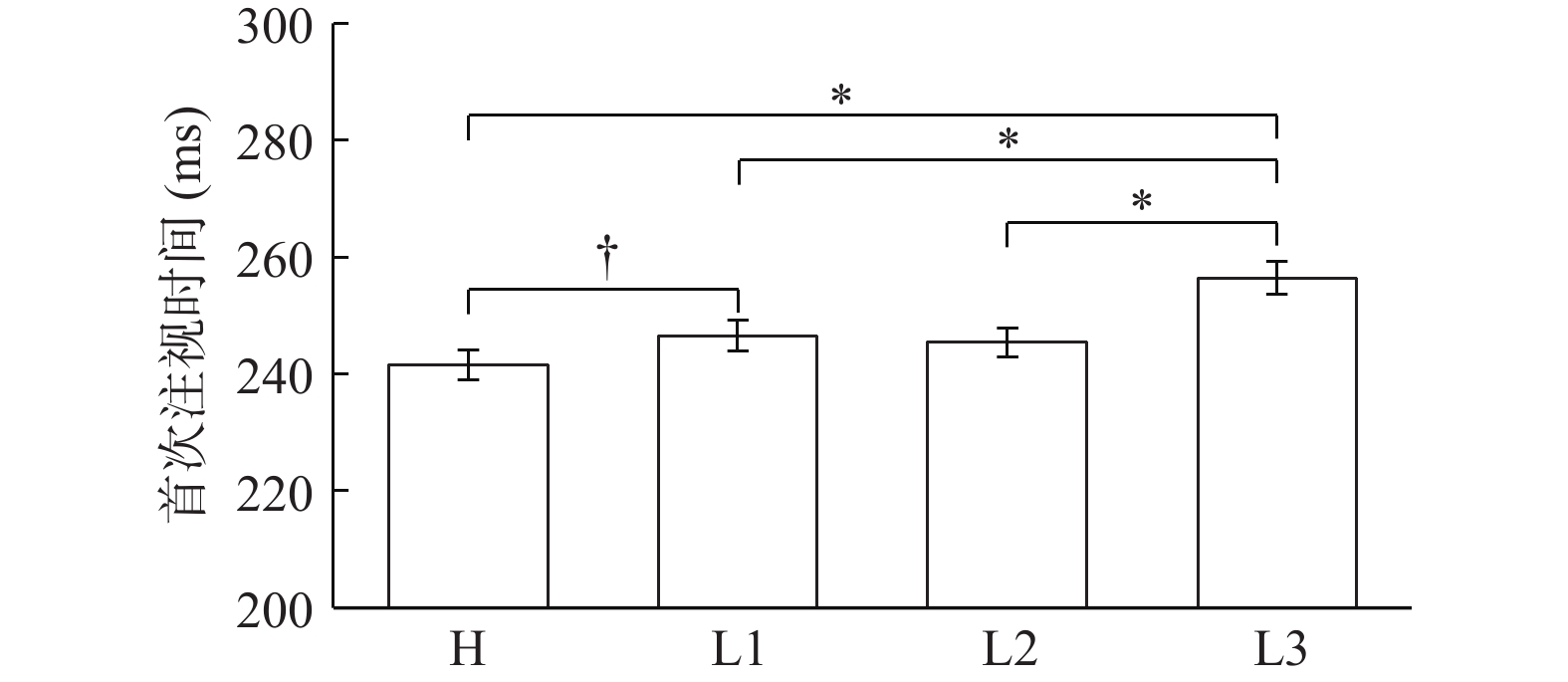
| 首次注视时间(ms) | 242(3) | 247(3) | 245(2) | 256(3) |
| 单一注视时间(ms) | 240(3) | 245(3) | 244(3) | 255(3) |
| 凝视时间(ms) | 258(4) | 271(4) | 278(4) | 282(4) |
| 回视路径阅读时间(ms) | 312(8) | 330(7) | 335(8) | 349(9) |
| 总注视时间(ms) | 322(6) | 345(6) | 355(6) | 365(7) |
| 高预测词(H) | 低预测词1(L1) | 低预测词2(L2) | 低预测词3(L3) | |
| 跳读率(%) | 37(1) | 31(1) | 33(1) | 34(1) |
| 首次注视时间(ms) | 242(3) | 247(3) | 245(2) | 256(3) |
| 单一注视时间(ms) | 240(3) | 245(3) | 244(3) | 255(3) |
| 凝视时间(ms) | 258(4) | 271(4) | 278(4) | 282(4) |
| 回视路径阅读时间(ms) | 312(8) | 330(7) | 335(8) | 349(9) |
| 总注视时间(ms) | 322(6) | 345(6) | 355(6) | 365(7) |

|
白学军, 曹玉肖, 顾俊娟, 郭志英, 闫国利. 可预测性和空格对中文阅读影响的眼动研究. 心理科学, 2011, 34 (6): 1282- 1288.
|
|
|
李琳, 赵赛男, 张俐娟, 王敬欣. 老年人汉语阅读中预测误差成本的产生机制. 心理科学进展, 2022, 30 (1): 1- 14.
|
|
|
张慢慢, 胡惠兰, 张志超, 李鑫, 汪强, 白学军, 臧传丽. 预测性对快速读者和慢速读者词汇加工的影响. 心理学报, 2023, 55 (1): 79- 93.
|
|
|
赵赛男, 李琳, 张俐娟, 王敬欣. 汉语阅读中高限制性语境对不可预测词加工的影响: 眼动研究. 心理与行为研究, 2021, 19 (6): 736- 742.
|
|
|
Bates, D., Mächler, M., Bolker, B., & Walker, S. Fitting linear mixed-effects models using lme4. Journal of Statistical Software, 2015, 67 (1): 1- 48.
|
|
|
Bonhage, C. E., Mueller, J. L., Friederici, A. D., & Fiebach, C. J. Combined eye tracking and fMRI reveals neural basis of linguistic predictions during sentence comprehension. Cortex, 2015, 68, 33- 47.
DOI |
|
|
Brothers, T., & Kuperberg, G. R. Word predictability effects are linear, not logarithmic: Implications for probabilistic models of sentence comprehension. Journal of Memory and Language, 2021, 116, 104174.
|
|
|
Cai, Q., & Brysbaert, M. SUBTLEX-CH: Chinese word and character frequencies based on film subtitles. PLoS One, 2010, 5 (6): e10729.
DOI |
|
|
Carter, B. T., Foster, B., Muncy, N. M., & Luke, S. G. Linguistic networks associated with lexical, semantic and syntactic predictability in reading: A fixation-related fMRI study. NeuroImage, 2019, 189, 224- 240.
DOI |
|
|
Chang, M., Zhang, K., Sun, Y., Li, S., & Wang, J. X. The graded predictive pre-activation in Chinese sentence reading: Evidence from eye movements. Frontiers in Psychology, 2023, 14, 1136488.
DOI |
|
|
Cui, L., Zang, C. L., Xu, X. C., Zhang, W. X., Su, Y. H., & Liversedge, S. P. Predictability effects and parafoveal processing of compound words in natural Chinese reading. Quarterly Journal of Experimental Psychology, 2022, 75 (1): 18- 29.
DOI |
|
|
Delong, K. A., Urbach, T. P., & Kutas, M. Probabilistic word pre-activation during language comprehension inferred from electrical brain activity. Nature Neuroscience, 2005, 8 (8): 1117- 1121.
DOI |
|
|
Federmeier, K. D., & Kutas, M. A rose by any other name: Long-term memory structure and sentence processing. Journal of Memory and Language, 1999, 41 (4): 469- 495.
DOI |
|
|
Federmeier, K. D., McLennan, D. B., de Ochoa, E., & Kutas, M. The impact of semantic memory organization and sentence context information on spoken language processing by younger and older adults: An ERP study. Psychophysiology, 2002, 39 (2): 133- 146.
DOI |
|
|
Federmeier, K. D., Wlotko, E. W., De Ochoa-Dewald, E., & Kutas, M. Multiple effects of sentential constraint on word processing. Brain Research, 2007, 1146, 75- 84.
|
|
|
Frank, S. L., Otten, L. J., Galli, G., & Vigliocco, G. The ERP response to the amount of information conveyed by words in sentences. Brain and Language, 2015, 140, 1- 11.
DOI |
|
|
Frisson, S., Harvey, D. R., & Staub, A. No prediction error cost in reading: Evidence from eye movements. Journal of Memory and Language, 2017, 95, 200- 214.
DOI |
|
|
Günther, F., Dudschig, C., & Kaup, B. Latent semantic analysis cosines as a cognitive similarity measure: Evidence from priming studies. Quarterly Journal of Experimental Psychology, 2016, 69 (4): 626- 653.
|
|
|
Huettig, F., & Mani, N. (2016). Is prediction necessary to understand language? Probably not. Language, Cognition and Neuroscience, 31(1), 19–31.
|
|
|
Ito, A., Corley, M., Pickering, M. J., Martin, A. E., & Nieuwland, M. S. Predicting form and meaning: Evidence from brain potentials. Journal of Memory and Language, 2016, 86, 157- 171.
DOI |
|
|
Kliegl, R., Grabner, E., Rolfs, M., & Engbert, R. Length, frequency, and predictability effects of words on eye movements in reading. European Journal of Cognitive Psychology, 2004, 16 (1–2): 262- 284.
DOI |
|
|
Kuperberg, G. R., & Jaeger, T. F. (2016). What do we mean by prediction in language comprehension? Language, Cognition and Neuroscience, 31(1), 32–59.
|
|
|
Kutas, M., & Hillyard, S. A. Brain potentials during reading reflect word expectancy and semantic association. Nature, 1984, 307 (5947): 161- 163.
|
|
|
Li, X. S., & Pollatsek, A. An integrated model of word processing and eye-movement control during Chinese reading. Psychological Review, 2020, 127 (6): 1139- 1162.
DOI |
|
|
Liu, Y. P., Guo, S. Y., Yu, L., & Reichle, E. D. Word predictability affects saccade length in Chinese reading: An evaluation of the dynamic-adjustment model. Psychonomic Bulletin & Review, 2018, 25 (5): 1891- 1899.
|
|
|
Luke, S. G., & Christianson, K. Limits on lexical prediction during reading. Cognitive Psychology, 2016, 88, 22- 60.
|
|
|
McRae, K., de Sa, V. R., & Seidenberg, M. S. On the nature and scope of featural representations of word meaning. Journal of Experimental Psychology: General, 1997, 126 (2): 99- 130.
DOI |
|
|
Pan, J. E., Yan, M., Richter, E. M., Shu, H., & Kliegl, R. The Beijing sentence corpus: A Chinese sentence corpus with eye movement data and predictability norms. Behavior Research Methods, 2021, 54 (4): 1989- 2000.
DOI |
|
|
Pynte, J., New, B., & Kennedy, A. On-line contextual influences during reading normal text: A multiple-regression analysis. Vision Research, 2008, 48 (21): 2172- 2183.
|
|
|
Rayner, K., Li, X. S., Juhasz, B. J., & Yan, G. L. The effect of word predictability on the eye movements of Chinese readers. Psychonomic Bulletin & Review, 2005, 12 (6): 1089- 1093.
|
|
|
Rayner, K., & Well, A. D. Effects of contextual constraint on eye movements in reading: A further examination. Psychonomic Bulletin & Review, 1996, 3 (4): 504- 509.
|
|
|
Roland, D., Yun, H., Koenig, J. P., & Mauner, G. Semantic similarity, predictability, and models of sentence processing. Cognition, 2012, 122 (3): 267- 279.
DOI |
|
|
Schuster, S., Hawelka, S., Richlan, F., Ludersdorfer, P., & Hutzler, F. Eyes on words: A fixation-related fMRI study of the left occipito-temporal cortex during self-paced silent reading of words and pseudowords. Scientific Reports, 2015, 5 (1): 12686.
DOI |
|
|
Song, Y., Shi, S. M., Li, J., & Zhang, H. S. (2018). Directional skip-gram: Explicitly distinguishing left and right context for word embeddings. In Proceedings of 2018 Conference of the North American Chapter of the Association for Computational Linguistics: Human Language Technologies (pp. 175–180). New Orleans, LA: Association for Computational Linguistics.
|
|
|
Staub, A. The effect of lexical predictability on eye movements in reading: Critical review and theoretical interpretation. Language and Linguistics Compass, 2015, 9 (8): 311- 327.
DOI |
|
|
Taylor, W. L. “Cloze Procedure”: A new tool for measuring readability. Journalism Quarterly, 1953, 30 (4): 415- 433.
|
|
|
Traxler, M. J. Trends in syntactic parsing: Anticipation, Bayesian estimation, and good-enough parsing. Trends in Cognitive Sciences, 2014, 18 (11): 605- 611.
DOI |
|
|
Venables, W. N., & Ripley, B. D. (2002). Modern applied statistics with S (4th ed.). New York: Springer.
|
|
|
Westfall, J. (2016). PANGEA: Power analysis for general ANOVA designs. Retrieved June 1, 2023, from https://github.com/jake-westfall/pangea
|
|
|
Yun, H., Mauner, G., Roland, D., & Koenig, J. P. (2012). The effect of semantic similarity is a function of contextual constraint. In Proceedings of the 34th Annual Meeting of the Cognitive Science Society (pp. 1191–1196). Austin, TX: The Cognitive Science Society.
|
| [1] | Shuangshuang WANG, Zhichao ZHANG, Manman ZHANG, Chuanli ZANG, Guoli YAN. Are the Literal Meanings of Constituents Activated in Chinese Idioms’ Processing? Evidence from the Semantic Preview Effect [J]. Studies of Psychology and Behavior, 2025, 23(6): 759-765. |
| [2] | Yufei DU, Zhichao ZHANG, Manman ZHANG, Chuanli ZANG. Semantics Takes Precedence over World Knowledge in Sentence Comprehension: Evidence from Eye Movements [J]. Studies of Psychology and Behavior, 2025, 23(2): 153-160. |
| [3] | Yongsheng WANG, Yang HAN, Xin LI, Liyuan HE. The Promotion of Inter-Word Space in Chinese Sentence Reading of Uyghur College Students with Different Text Presentation Directions [J]. Studies of Psychology and Behavior, 2025, 23(1): 41-48. |
| [4] | Xiangwen CHEN, Longge WANG, Huilan HU, Zhichao ZHANG, Mengsi WANG, Qiang WANG, Manman ZHANG. The Neural Structural Basis of Individual Differences in Word Frequency Effect on Eye Movement Measures During Chinese Reading [J]. Studies of Psychology and Behavior, 2024, 22(6): 721-729. |
| [5] | Xin LI, Mengling LONG, Feifei LIANG, Yongsheng WANG. The Role of Character Positional Probability During Chinese Reading: Evidence from Eye Movements of Uyghur Readers [J]. Studies of Psychology and Behavior, 2024, 22(5): 585-593. |
| [6] | Tongwen HU, Kuo ZHANG, Yuru CHENG, Jingxin WANG. The Emotion Word Type Effect in Chinese Reading not Moderated by Valence: Evidence from Eye-Tracking [J]. Studies of Psychology and Behavior, 2024, 22(2): 197-203. |
| [7] | Ruqi CHEN, Yaqian BAO, Linjieqiong HUANG, Xingshan LI. An Introduction to the Chinese Reading Model (CRM) [J]. Studies of Psychology and Behavior, 2023, 21(6): 725-735. |
| [8] | Feifei LIANG, Linlin FENG, Ying LIU, Changhao WANG, Jie WANG. The Role of Character Positional Probability in Chinese Two-Word Identification: Moderation of Lexical Contextual Diversity [J]. Studies of Psychology and Behavior, 2023, 21(6): 736-743. |
| [9] | Zijia LU, Zhichao ZHANG, Ying FU, Manman ZHANG, Chuanli ZANG, Xuejun BAI. Repeating Words Cannot Help Chinese Readers to Obtain Word Class Information from Parafoveal Words [J]. Studies of Psychology and Behavior, 2023, 21(5): 577-584. |
| [10] | Lijuan ZHANG, Fengjun ZHANG, Sainan ZHAO, Jingxin WANG. The Predominant Role of Preview Plausibility on Semantic Preview Benefit of Two-Character Words in Chinese Reading: An Eye Movement Study [J]. Studies of Psychology and Behavior, 2023, 21(1): 12-19. |
| [11] | Haibo CAO, Liang REN, Dan HAN, Dongli JIA, Jingxin WANG. The Role of Character Positional Frequency of Word Segmentation of Overlapping Ambiguous Strings in Chinese [J]. Studies of Psychology and Behavior, 2022, 20(6): 732-738. |
| [12] | ZHANG Manman, HU Huilan, BIAN Han, LI Fang, ZHANG Zhichao, ZANG Chuanli. Word Frequency Effects in Fast and Slow Readers During Skilled Chinese Reading [J]. Studies of Psychology and Behavior, 2022, 20(3): 304-310. |
| [13] | WANG Yongsheng, HE Liyuan, LI Xin, BAI Xuejun. The Role of the First Character Frequency in Low-Frequency Two-Character Words in Parafoveal Processing in Chinese Reading [J]. Studies of Psychology and Behavior, 2022, 20(3): 311-317. |
| [14] | LIANG Feifei, XIANG Ying, LONG Mengling. Initial Character Positional Probability Does Not Influence Word Segmentation in Chinese Reading: Evidence from Parafoveal Processing [J]. Studies of Psychology and Behavior, 2022, 20(3): 318-324. |
| [15] | HE Liyuan, ZHAO Xing, BAI Yu, LIU Nina. Multi-Word Unit Processing for Chinese Older Readers: Evidence from Eye Movements [J]. Studies of Psychology and Behavior, 2022, 20(2): 160-166. |
| Viewed | ||||||
|
Full text |
|
|||||
|
Abstract |
|
|||||
