
Studies of Psychology and Behavior ›› 2025, Vol. 23 ›› Issue (4): 487-495.DOI: 10.12139/j.1672-0628.2025.04.008
• ? • Previous Articles Next Articles
Qiaoling YE1,2, Ting ZHOU3, Wen LI4, Zheng HUANG*,1,2( )
)
Received:2023-11-02
Online:2025-07-20
Published:2025-07-20
Contact:
Zheng HUANG
叶巧玲1,2, 周婷3, 李文4, 黄峥*,1,2()
通讯作者:
黄峥
基金资助:Qiaoling YE, Ting ZHOU, Wen LI, Zheng HUANG. Longitudinal Relationships of Cumulative Family Risk on Academic Buoyancy of Middle School Students: The Mediating Role of Self-Efficacy and The Moderating Role of Peer Support[J]. Studies of Psychology and Behavior, 2025, 23(4): 487-495.
叶巧玲, 周婷, 李文, 黄峥. 累积家庭风险与中学生日常性学业弹性的纵向关系:自我效能感的中介和同伴支持的调节作用[J]. 心理与行为研究, 2025, 23(4): 487-495.
Add to citation manager EndNote|Ris|BibTeX
URL: https://psybeh.tjnu.edu.cn/EN/10.12139/j.1672-0628.2025.04.008

| M | SD | 1 | 2 | 3 | 4 | 5 | 6 | 7 | |
| 1.T1累积家庭风险 | 1.56 | 1.48 | |||||||
| 2.T2累积家庭风险 | 1.66 | 1.58 | 0.63*** | ||||||
| 3.T1自我效能感 | 2.89 | 0.70 | −0.38*** | −0.28*** | |||||
| 4.T2自我效能感 | 2.87 | 0.71 | −0.25*** | −0.38*** | 0.40*** | ||||
| 5.T1日常性学业弹性 | 3.91 | 0.86 | −0.39*** | −0.28*** | 0.65*** | 0.30*** | |||
| 6.T2日常性学业弹性 | 3.89 | 0.93 | −0.24*** | −0.36*** | 0.27*** | 0.54*** | 0.34*** | ||
| 7.T1同伴支持 | 4.31 | 0.85 | −0.35*** | −0.26*** | 0.45*** | 0.24*** | 0.49*** | 0.21*** | |
| 8.T2同伴支持 | 4.28 | 0.82 | −0.25*** | −0.36*** | 0.24*** | 0.40*** | 0.25*** | 0.41*** | 0.48*** |
| M | SD | 1 | 2 | 3 | 4 | 5 | 6 | 7 | |
| 1.T1累积家庭风险 | 1.56 | 1.48 | |||||||
| 2.T2累积家庭风险 | 1.66 | 1.58 | 0.63*** | ||||||
| 3.T1自我效能感 | 2.89 | 0.70 | −0.38*** | −0.28*** | |||||
| 4.T2自我效能感 | 2.87 | 0.71 | −0.25*** | −0.38*** | 0.40*** | ||||
| 5.T1日常性学业弹性 | 3.91 | 0.86 | −0.39*** | −0.28*** | 0.65*** | 0.30*** | |||
| 6.T2日常性学业弹性 | 3.89 | 0.93 | −0.24*** | −0.36*** | 0.27*** | 0.54*** | 0.34*** | ||
| 7.T1同伴支持 | 4.31 | 0.85 | −0.35*** | −0.26*** | 0.45*** | 0.24*** | 0.49*** | 0.21*** | |
| 8.T2同伴支持 | 4.28 | 0.82 | −0.25*** | −0.36*** | 0.24*** | 0.40*** | 0.25*** | 0.41*** | 0.48*** |
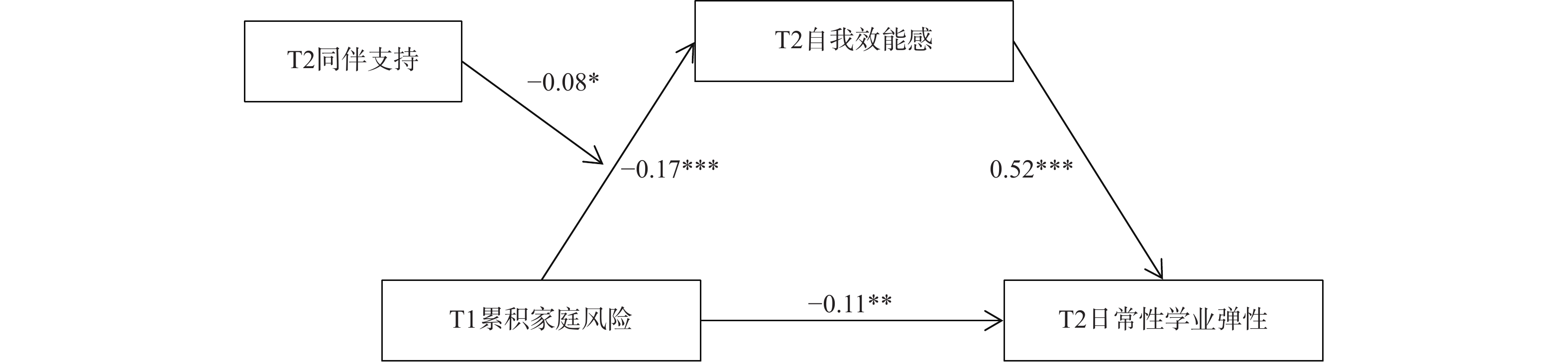
| 结果变量 | 预测变量 | R | R2 | F | β | SE | t | LLCI | ULCI |
| T2自我效能感 | T1累积家庭风险 | 0.43 | 0.19 | 40.19*** | −0.17*** | 0.04 | −4.23 | −0.23 | −0.09 |
| T2同伴支持 | 0.37*** | 0.04 | 8.92 | 0.29 | 0.45 | ||||
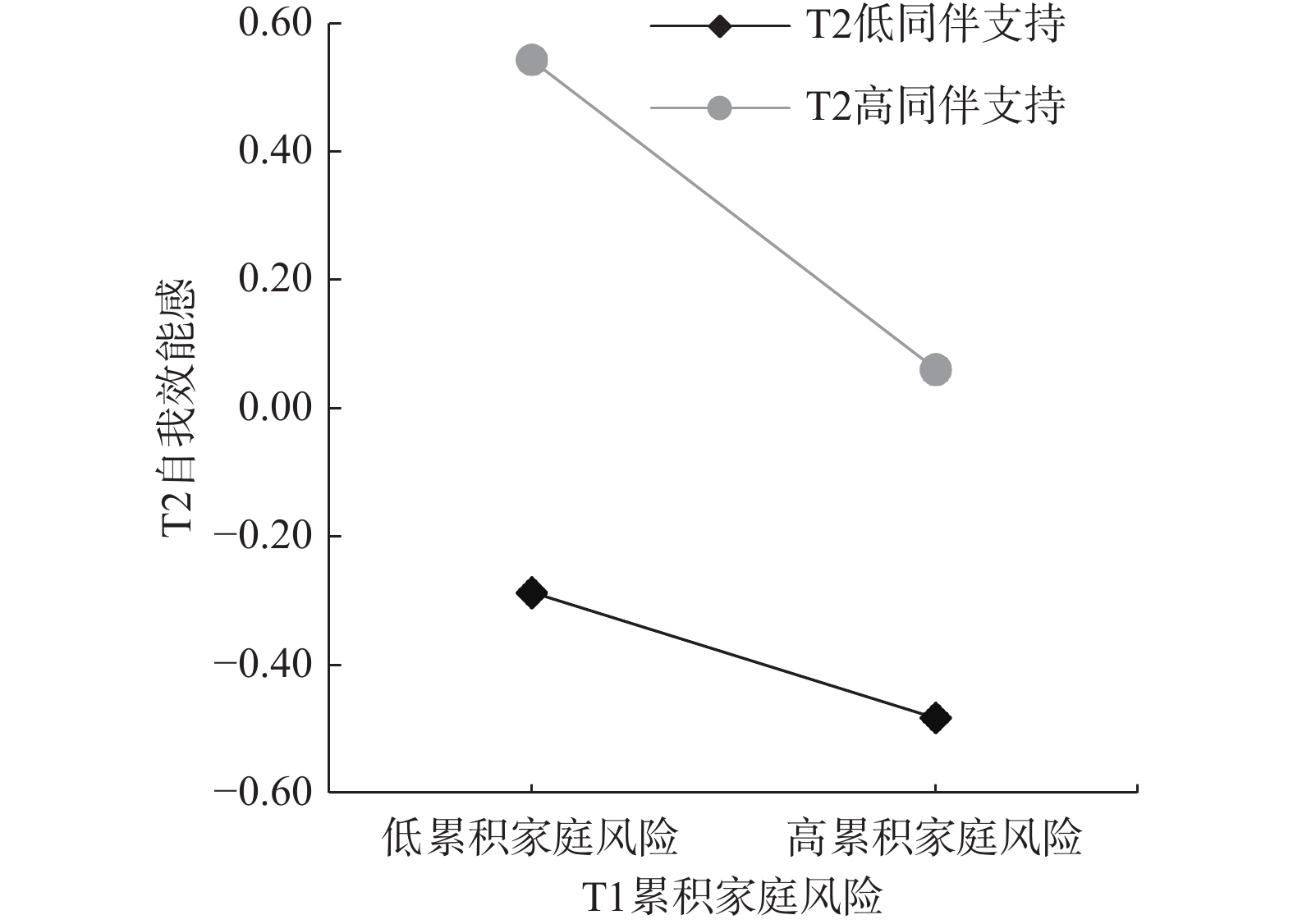
| T1累积家庭风险×T2同伴支持 | −0.08* | 0.04 | −1.99 | −0.15 | −0.001 | ||||
| T2日常性学业弹性 | T1累积家庭风险 | 0.55 | 0.31 | 115.27*** | −0.11** | 0.04 | −2.87 | −0.18 | −0.03 |
| T2自我效能感 | 0.52*** | 0.04 | 13.72 | 0.44 | 0.59 |
| 结果变量 | 预测变量 | R | R2 | F | β | SE | t | LLCI | ULCI |
| T2自我效能感 | T1累积家庭风险 | 0.43 | 0.19 | 40.19*** | −0.17*** | 0.04 | −4.23 | −0.23 | −0.09 |
| T2同伴支持 | 0.37*** | 0.04 | 8.92 | 0.29 | 0.45 | ||||
| T1累积家庭风险×T2同伴支持 | −0.08* | 0.04 | −1.99 | −0.15 | −0.001 | ||||
| T2日常性学业弹性 | T1累积家庭风险 | 0.55 | 0.31 | 115.27*** | −0.11** | 0.04 | −2.87 | −0.18 | −0.03 |
| T2自我效能感 | 0.52*** | 0.04 | 13.72 | 0.44 | 0.59 |
|
鲍振宙, 李董平, 张卫, 王艳辉, 孙文强, 赵力燕. 累积生态风险与青少年的学业和社交能力: 子女责任感的风险补偿与调节效应. 心理发展与教育, 2014, 30 (5): 482- 495.
|
|
|
董奇, 林崇德. (2011). 中国儿童青少年心理发育标准化测验简介. 北京: 科学出版社.
|
|
|
费立鹏, 沈其杰, 郑延平, 赵靖平, 蒋少艾, 王立伟, 汪向东. “家庭亲密度和适应性量表”和“家庭环境量表”的初步评价——正常家庭与精神分裂症家庭成员对照研究. 中国心理卫生杂志, 1991, 5 (5): 198- 202, 238.
|
|
|
李董平. (2012). 多重生态学风险因素与青少年社会适应风险建模与作用机制研究(博士学位论文). 华南师范大学, 广州.
|
|
|
潘云波. 中职护生领悟社会支持、一般自我效能感与心理韧性的关系. 中国健康心理学杂志, 2018, 26 (12): 1871- 1876.
|
|
|
孙蔚雯. (2009). 高中生日常性学业复原力、学业投入对学习成绩的影响(硕士学位论文). 东北师范大学, 长春.
|
|
|
王才康, 胡中锋, 刘勇. 一般自我效能感量表的信度和效度研究. 应用心理学, 2001, 7 (1): 37- 40.
DOI |
|
|
王建平, 李董平, 张卫. 家庭经济困难与青少年社会适应的关系: 应对效能的补偿、中介和调节效应. 北京师范大学学报(社会科学版), 2010, (4): 22- 32.
|
|
|
王金涛. (2017). 中学生累积生态风险与心理健康的关系: 累积生态风险的作用机制研究(硕士学位论文). 华中师范大学, 武汉.
|
|
|
王琼, 肖桃, 刘慧瀛, 胡伟. 父母拒绝与留守儿童网络成瘾的关系: 一个有调节的中介模型. 心理发展与教育, 2019, 35 (6): 749- 758.
|
|
|
温忠麟, 张雷, 侯杰泰, 刘红云. 中介效应检验程序及其应用. 心理学报, 2004, 36 (5): 614- 620.
|
|
|
席居哲, 左志宏, Wu, W. 心理韧性研究诸进路. 心理科学进展, 2012, 20 (9): 1426- 1447.
|
|
|
熊俊梅, 海曼, 黄飞, 辛亮, 徐颖. 家庭累积风险与青少年心理健康的关系——心理资本的补偿效应和调节效应. 心理发展与教育, 2020, 36 (1): 94- 102.
|
|
|
徐文明, 叶彩霞, 方烨仪. 早期累积家庭风险对青少年内化问题的影响: 弹性双重机制. 心理与行为研究, 2020, 18 (3): 361- 368.
|
|
|
赵凤青, 俞国良. 日常性学业弹性: 日常学业压力下的积极适应机制. 心理科学进展, 2018, 26 (6): 1054- 1062.
|
|
|
周浩, 龙立荣. 共同方法偏差的统计检验与控制方法. 心理科学进展, 2004, 12 (6): 942- 950.
DOI |
|
|
周宗奎, 孙晓军, 刘亚, 周东明. 农村留守儿童心理发展与教育问题. 北京师范大学学报(社会科学版), 2005, (1): 71- 79.
|
|
|
Alexander, K. L., Entwisle, D. R., & Kabbani, N. The dropout process in life course perspective: Early risk factors at home and school. Teachers College Record, 2001, 103 (5): 760- 822.
DOI |
|
|
Bandura, A. (1997). Self-efficacy: The exercise of control. New York: W. H. Freeman.
|
|
|
Bronfenbrenner, U. (2005). Making human beings human: Bioecological perspectives on human development. Thousand Oaks, CA: Sage.
|
|
|
Conley, K. M., & Lehman, B. J. Test anxiety and cardiovascular responses to daily academic stressors. Stress and Health, 2012, 28 (1): 41- 50.
DOI |
|
|
Criss, M. M., Pettit, G. S., Bates, J. E., Dodge, K. A., & Lapp, A. L. Family adversity, positive peer relationships, and children’s externalizing behavior: A longitudinal perspective on risk and resilience. Child Development, 2002, 73 (4): 1220- 1237.
DOI |
|
|
Cutrín, O., Gómez-Fraguela, J. A., & Luengo, M. Á. Peer-group mediation in the relationship between family and juvenile antisocial behavior. European Journal of Psychology Applied to Legal Context, 2015, 7 (2): 59- 65.
DOI |
|
|
Dahal, J., Prasad, P. W. C., Maag, A., Alsadoon, A., & Hoe, L. S. The effect of culture and belief systems on students’ academic buoyancy. Education and Information Technologies, 2018, 23 (4): 1465- 1482.
DOI |
|
|
Evans, G. W., Li, D. P., & Whipple, S. S. Cumulative risk and child development. Psychological Bulletin, 2013, 139 (6): 1342- 1396.
DOI |
|
|
Forehand, R., Biggar, H., & Kotchick, B. A. Cumulative risk across family stressors: Short- and long-term effects for adolescents. Journal of Abnormal Child Psychology, 1998, 26 (2): 119- 128.
DOI |
|
|
Furrer, C. J., Skinner, E. A., & Pitzer, J. R. The influence of teacher and peer relationships on students’ classroom engagement and everyday motivational resilience. National Society for the Study of Education, 2014, 113 (1): 101- 123.
|
|
|
Gerard, J. M., & Buehler, C. Cumulative environmental risk and youth problem behavior. Journal of Marriage and Family, 2004, 66 (3): 702- 720.
DOI |
|
|
Hamill, S. K. Resilience and self-efficacy: The importance of efficacy beliefs and coping mechanisms in resilient adolescents. Colgate University Journal of the Sciences, 2003, 35 (1): 115- 146.
|
|
|
Hobfoll, S. E. Conservation of resources: A new attempt at conceptualizing stress. American Psychologist, 1989, 44 (3): 513- 524.
DOI |
|
|
King, R. B. Sense of relatedness boosts engagement, achievement, and well-being: A latent growth model study. Contemporary Educational Psychology, 2015, 42, 26- 38.
|
|
|
Li, D. P., Zhang, W., Li, X., Li, N. N., & Ye, B. J. Gratitude and suicidal ideation and suicide attempts among Chinese adolescents: Direct, mediated, and moderated effects. Journal of Adolescence, 2012, 35 (1): 55- 66.
DOI |
|
|
Lin, Y. C., & Seo, D. C. Cumulative family risks across income levels predict deterioration of children’s general health during childhood and adolescence. PLoS One, 2017, 12 (5): e0177531.
DOI |
|
|
Luthar, S. S., Cicchetti, D., & Becker, B. The construct of resilience: A critical evaluation and guidelines for future work. Child Development, 2000, 71 (3): 543- 562.
DOI |
|
|
Martin, A. J. Motivation and engagement across the academic life span: A developmental construct validity study of elementary school, high school, and university/college students. Educational and Psychological Measurement, 2009, 69 (5): 794- 824.
DOI |
|
|
Martin, A. J., Colmar, S. H., Davey, L. A., & Marsh, H. W. Longitudinal modelling of academic buoyancy and motivation: Do the 5Cs hold up over time. British Journal of Educational Psychology, 2010, 80 (3): 473- 496.
DOI |
|
|
Martin, A. J., & Marsh, H. W. Academic buoyancy: Towards an understanding of students’ everyday academic resilience. Journal of School Psychology, 2008, 46 (1): 53- 83.
DOI |
|
|
Moore, G. F., Cox, R., Evans, R. E., Hallingberg, B., Hawkins, J., Littlecott, H. J., ... Murphy, S. School, peer and family relationships and adolescent substance use, subjective wellbeing and mental health symptoms in Wales: A cross sectional study. Child Indicators Research, 2018, 11 (6): 1951- 1965.
DOI |
|
|
Parker, P. D., Ciarrochi, J., Heaven, P., Marshall, S., Sahdra, B., & Kiuru, N. Hope, friends, and subjective well-being: A social network approach to peer group contextual effects. Child Development, 2015, 86 (2): 642- 650.
DOI |
|
|
Piquero, A. R., Farrington, D. P., Fontaine, N. M. G., Vincent, G., Coid, J., & Ullrich, S. (2012). Childhood risk, offending trajectories, and psychopathy at age 48 years in the Cambridge Study in Delinquent Development. Psychology, Public Policy, and Law, 18(4), 577–598.
|
|
|
Randolph, K. A., Fraser, M. W., & Orthner, D. K. A strategy for assessing the impact of time varying family risk factors on high school dropout. Journal of Family Issues, 2006, 27 (7): 933- 950.
DOI |
|
|
Sandler, I. Quality and ecology of adversity as common mechanisms of risk and resilience. American Journal of Community Psychology, 2001, 29 (1): 19- 61.
DOI |
|
|
Schwartz, D., Dodge, K. A., Pettit, G. S., & Bates, J. E. Friendship as a moderating factor in the pathway between early harsh home environment and later victimization in the peer group. Developmental Psychology, 2000, 36 (5): 646- 662.
DOI |
|
|
Soheili, M., Kazemi, S., Sohrabi Shekofti, N., & Barzegar, M. A causal model of parents’ personality traits and academic performance with the mediating role of academic buoyancy. Iranian Evolutionary and Educational Psychology Journal, 2020, 2 (3): 200- 207.
DOI |
|
|
Ulu-Yalçınkaya, A., & Demir, A. Loneliness with regard to maternal and paternal acceptance-rejection and sibling relationship quality. Journal of Psychologists and Counsellors in Schools, 2018, 28 (2): 197- 211.
DOI |
|
|
Wentzel, K. R. (2009). Peers and academic functioning at school. In K. H. Rubin, W. M. Bukowski, & B. Laursen (Eds.), Handbook of peer interactions, relationships, and groups (pp. 531–547). New York: Guilford Press.
|
|
|
Yun, S., Hiver, P., & Al-Hoorie, A. H. Academic buoyancy: Exploring learners’ everyday resilience in the language classroom. Studies in Second Language Acquisition, 2018, 40 (4): 805- 830.
DOI |
| Viewed | ||||||
|
Full text |
|
|||||
|
Abstract |
|
|||||
