
Studies of Psychology and Behavior ›› 2025, Vol. 23 ›› Issue (5): 603-611.DOI: 10.12139/j.1672-0628.2025.05.004
• ? • Previous Articles Next Articles
Chenguang ZHAO1,2, Rong WU1,2, Yaojin LI1,2, Wei ZHANG*,1,2( )
)
Received:2023-08-07
Online:2025-09-20
Published:2025-09-20
Contact:
Wei ZHANG
赵晨光1,2, 吴容1,2, 李垚锦1,2, 张微*,1,2()
通讯作者:
张微
基金资助:Chenguang ZHAO, Rong WU, Yaojin LI, Wei ZHANG. Neural Mechanisms of Interference Control in Internet Gaming Disorder: Evidence from a Global-Local Task with fNIRS[J]. Studies of Psychology and Behavior, 2025, 23(5): 603-611.
赵晨光, 吴容, 李垚锦, 张微. 网络游戏成瘾者干扰控制的神经机制:来自整体−局部任务和近红外脑成像的证据[J]. 心理与行为研究, 2025, 23(5): 603-611.
Add to citation manager EndNote|Ris|BibTeX
URL: https://psybeh.tjnu.edu.cn/EN/10.12139/j.1672-0628.2025.05.004
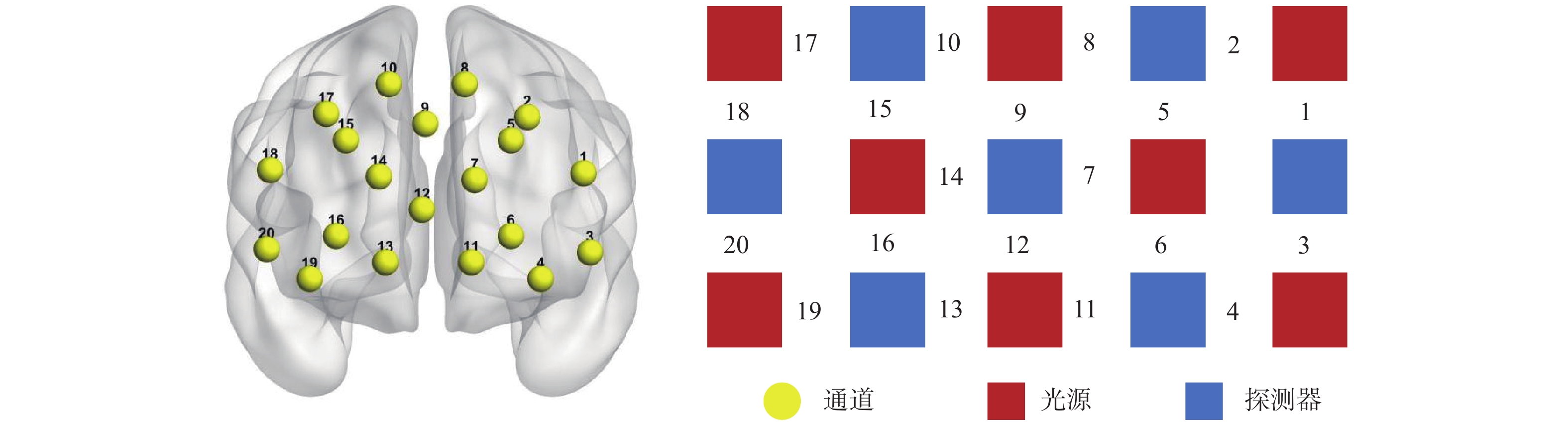
| 通道 | MNI坐标 | BA分区 | 覆盖率(%) | ||
| X | Y | Z | |||
| CH1 | −46 | 45 | 26 | 45-布洛卡三角区 | 70 |
| CH2 | −28 | 45 | 43 | 9-背外侧前额叶 | 92 |
| CH3 | −47 | 52 | 3 | 46-背外侧前额叶 | 89 |
| CH4 | −34 | 65 | −6 | 10-额极区 | 38 |
| 11-眶额叶 | 42 | ||||
| CH5 | −41 | 56 | 17 | 46-背外侧前额叶 | 84 |
| CH6 | −24 | 70 | 8 | 10-额极区 | 83 |
| CH7 | −14 | 67 | 26 | 10-额极区 | 94 |
| CH8 | −10 | 47 | 52 | 9-背外侧前额叶 | 78 |
| CH9 | 2 | 55 | 42 | 9-背外侧前额叶 | 97 |
| CH10 | 13 | 46 | 53 | 9-背外侧前额叶 | 74 |
| CH11 | −11 | 73 | −2 | 10-额极区 | 62 |
| 11-眶额叶 | 38 | ||||
| CH12 | 3 | 69 | 17 | 10-额极区 | 100 |
| CH13 | 16 | 73 | −1 | 10-额极区 | 57 |
| 11-眶额叶 | 43 | ||||
| CH14 | 17 | 67 | 26 | 10-额极区 | 95 |
| CH15 | 29 | 69 | 8 | 10-额极区 | 82 |
| CH16 | 45 | 54 | 19 | 46-背外侧前额叶 | 84 |
| CH17 | 33 | 44 | 44 | 9-背外侧前额叶 | 94 |
| CH18 | 49 | 42 | 27 | 45-布洛卡三角区 | 88 |
| CH19 | 38 | 65 | −6 | 10-额极区 | 41 |
| 11-眶额叶 | 35 | ||||
| CH20 | 51 | 49 | 4 | 46-背外侧前额叶 | 79 |
| 通道 | MNI坐标 | BA分区 | 覆盖率(%) | ||
| X | Y | Z | |||
| CH1 | −46 | 45 | 26 | 45-布洛卡三角区 | 70 |
| CH2 | −28 | 45 | 43 | 9-背外侧前额叶 | 92 |
| CH3 | −47 | 52 | 3 | 46-背外侧前额叶 | 89 |
| CH4 | −34 | 65 | −6 | 10-额极区 | 38 |
| 11-眶额叶 | 42 | ||||
| CH5 | −41 | 56 | 17 | 46-背外侧前额叶 | 84 |
| CH6 | −24 | 70 | 8 | 10-额极区 | 83 |
| CH7 | −14 | 67 | 26 | 10-额极区 | 94 |
| CH8 | −10 | 47 | 52 | 9-背外侧前额叶 | 78 |
| CH9 | 2 | 55 | 42 | 9-背外侧前额叶 | 97 |
| CH10 | 13 | 46 | 53 | 9-背外侧前额叶 | 74 |
| CH11 | −11 | 73 | −2 | 10-额极区 | 62 |
| 11-眶额叶 | 38 | ||||
| CH12 | 3 | 69 | 17 | 10-额极区 | 100 |
| CH13 | 16 | 73 | −1 | 10-额极区 | 57 |
| 11-眶额叶 | 43 | ||||
| CH14 | 17 | 67 | 26 | 10-额极区 | 95 |
| CH15 | 29 | 69 | 8 | 10-额极区 | 82 |
| CH16 | 45 | 54 | 19 | 46-背外侧前额叶 | 84 |
| CH17 | 33 | 44 | 44 | 9-背外侧前额叶 | 94 |
| CH18 | 49 | 42 | 27 | 45-布洛卡三角区 | 88 |
| CH19 | 38 | 65 | −6 | 10-额极区 | 41 |
| 11-眶额叶 | 35 | ||||
| CH20 | 51 | 49 | 4 | 46-背外侧前额叶 | 79 |
| 整体 | 局部 | |||||||
| 一致 | 不一致 | 中性 | 一致 | 不一致 | 中性 | |||
| ACC | IGD组 | 0.96±0.04 | 0.97±0.03 | 0.97±0.04 | 0.99±0.02 | 0.98±0.02 | 0.98±0.02 | |
| 对照组 | 0.99±0.02 | 0.94±0.11 | 0.98±0.03 | 0.98±0.02 | 0.96±0.04 | 0.98±0.03 | ||
| RT(ms) | IGD组 | 492±68 | 532±67 | 511±74 | 507±71 | 571±68 | 540±71 | |
| 对照组 | 520±106 | 600±148 | 528±116 | 538±63 | 591±82 | 558±77 | ||
| 整体 | 局部 | |||||||
| 一致 | 不一致 | 中性 | 一致 | 不一致 | 中性 | |||
| ACC | IGD组 | 0.96±0.04 | 0.97±0.03 | 0.97±0.04 | 0.99±0.02 | 0.98±0.02 | 0.98±0.02 | |
| 对照组 | 0.99±0.02 | 0.94±0.11 | 0.98±0.03 | 0.98±0.02 | 0.96±0.04 | 0.98±0.03 | ||
| RT(ms) | IGD组 | 492±68 | 532±67 | 511±74 | 507±71 | 571±68 | 540±71 | |
| 对照组 | 520±106 | 600±148 | 528±116 | 538±63 | 591±82 | 558±77 | ||
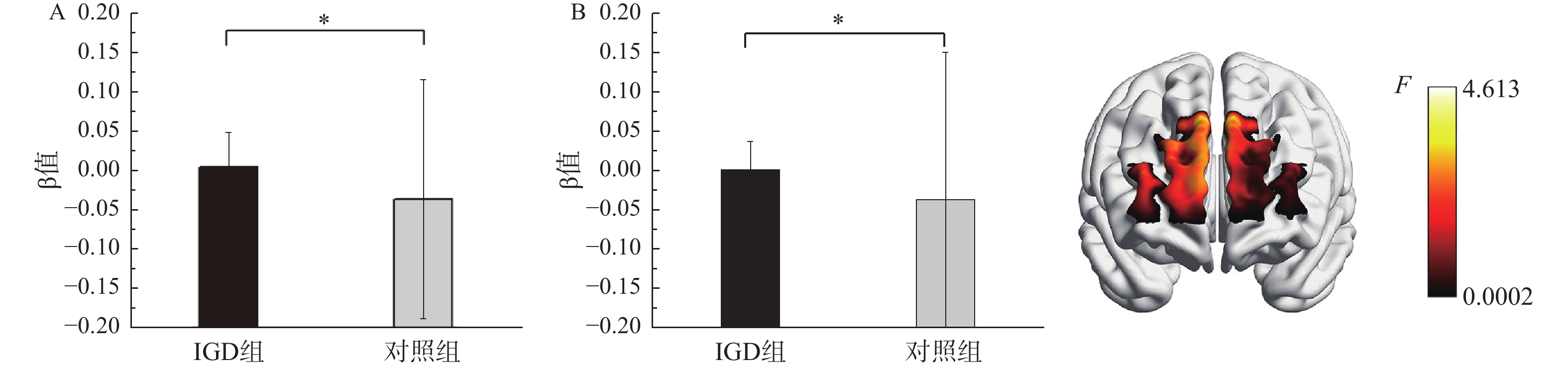
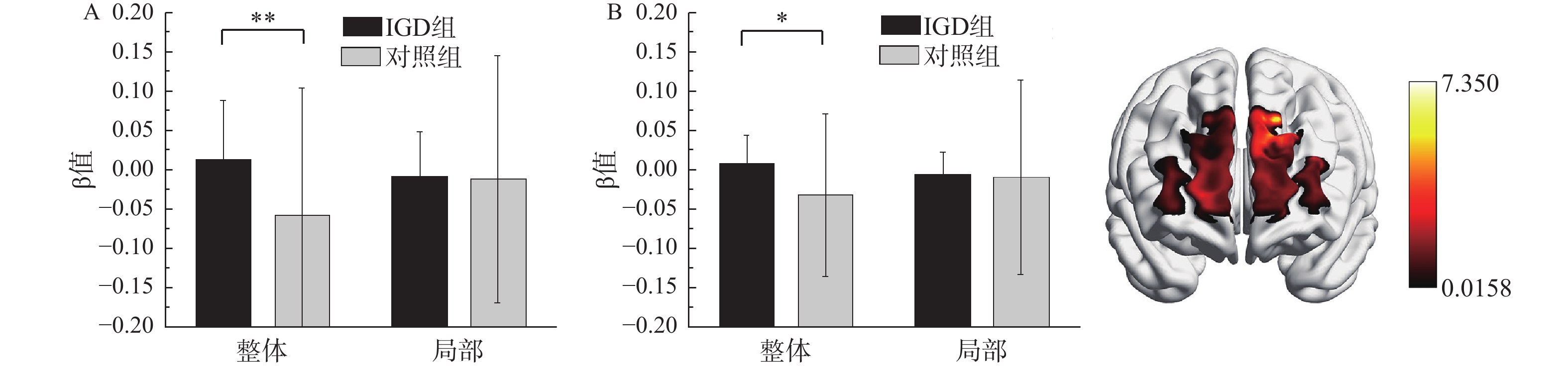
| 2 | 8 | 10 | 13 | 19 | ||||||||||
| r | p | r | p | r | p | r | p | r | p | |||||
| 整体一致-ACC | 0.00 | 0.978 | 0.03 | 0.829 | 0.01 | 0.971 | −0.11 | 0.475 | −0.12 | 0.426 | ||||
| 整体不一致-ACC | −0.03 | 0.860 | −0.01 | 0.949 | −0.00 | 0.949 | 0.05 | 0.765 | 0.03 | 0.834 | ||||
| 整体中性-ACC | 0.26 | 0.083 | 0.23 | 0.132 | 0.23 | 0.132 | −0.04 | 0.804 | −0.16 | 0.308 | ||||
| 局部一致-ACC | 0.42** | 0.005 | 0.36* | 0.015 | 0.39** | 0.008 | 0.12 | 0.450 | 0.07 | 0.675 | ||||
| 局部不一致-ACC | −0.04 | 0.778 | −0.03 | 0.870 | −0.00 | 0.995 | −0.17 | 0.277 | −0.51*** | <0.001 | ||||
| 局部中性-ACC | −0.12 | 0.443 | −0.18 | 0.254 | −0.20 | 0.185 | 0.00 | 0.993 | −0.14 | 0.382 | ||||
| 整体一致-RT | 0.15 | 0.340 | 0.17 | 0.280 | 0.12 | 0.455 | 0.12 | 0.439 | 0.06 | 0.676 | ||||
| 整体不一致-RT | 0.05 | 0.730 | 0.02 | 0.879 | −0.03 | 0.831 | 0.09 | 0.544 | 0.06 | 0.706 | ||||
| 整体中性-RT | −0.06 | 0.696 | 0.06 | 0.700 | 0.05 | 0.740 | 0.14 | 0.352 | 0.04 | 0.819 | ||||
| 局部一致-RT | −0.04 | 0.813 | 0.12 | 0.452 | 0.12 | 0.452 | 0.12 | 0.438 | 0.11 | 0.493 | ||||
| 局部不一致-RT | −0.01 | 0.969 | 0.13 | 0.415 | 0.09 | 0.552 | −0.08 | 0.584 | 0.06 | 0.702 | ||||
| 局部中性-RT | −0.03 | 0.848 | 0.12 | 0.419 | −0.04 | 0.817 | −0.04 | 0.779 | 0.01 | 0.935 | ||||
| 2 | 8 | 10 | 13 | 19 | ||||||||||
| r | p | r | p | r | p | r | p | r | p | |||||
| 整体一致-ACC | 0.00 | 0.978 | 0.03 | 0.829 | 0.01 | 0.971 | −0.11 | 0.475 | −0.12 | 0.426 | ||||
| 整体不一致-ACC | −0.03 | 0.860 | −0.01 | 0.949 | −0.00 | 0.949 | 0.05 | 0.765 | 0.03 | 0.834 | ||||
| 整体中性-ACC | 0.26 | 0.083 | 0.23 | 0.132 | 0.23 | 0.132 | −0.04 | 0.804 | −0.16 | 0.308 | ||||
| 局部一致-ACC | 0.42** | 0.005 | 0.36* | 0.015 | 0.39** | 0.008 | 0.12 | 0.450 | 0.07 | 0.675 | ||||
| 局部不一致-ACC | −0.04 | 0.778 | −0.03 | 0.870 | −0.00 | 0.995 | −0.17 | 0.277 | −0.51*** | <0.001 | ||||
| 局部中性-ACC | −0.12 | 0.443 | −0.18 | 0.254 | −0.20 | 0.185 | 0.00 | 0.993 | −0.14 | 0.382 | ||||
| 整体一致-RT | 0.15 | 0.340 | 0.17 | 0.280 | 0.12 | 0.455 | 0.12 | 0.439 | 0.06 | 0.676 | ||||
| 整体不一致-RT | 0.05 | 0.730 | 0.02 | 0.879 | −0.03 | 0.831 | 0.09 | 0.544 | 0.06 | 0.706 | ||||
| 整体中性-RT | −0.06 | 0.696 | 0.06 | 0.700 | 0.05 | 0.740 | 0.14 | 0.352 | 0.04 | 0.819 | ||||
| 局部一致-RT | −0.04 | 0.813 | 0.12 | 0.452 | 0.12 | 0.452 | 0.12 | 0.438 | 0.11 | 0.493 | ||||
| 局部不一致-RT | −0.01 | 0.969 | 0.13 | 0.415 | 0.09 | 0.552 | −0.08 | 0.584 | 0.06 | 0.702 | ||||
| 局部中性-RT | −0.03 | 0.848 | 0.12 | 0.419 | −0.04 | 0.817 | −0.04 | 0.779 | 0.01 | 0.935 | ||||
|
郭文欣, 张微, 李雨茜. 动作电子游戏玩家工作记忆优势的跨系统一致性: 一项近红外研究. 心理与行为研究, 2023, 21 (4): 454- 463.
|
|
|
华艳, 李明霞, 王巧婷, 冯彩霞, 张晶. 左侧眶额皮层在自动情绪调节下注意选择中的作用: 来自经颅直流电刺激的证据. 心理学报, 2020, 52 (9): 1048- 1056.
|
|
|
杨海波, 刘和珺, 章鹏, 李量. 掩蔽刺激对目标识别加工的作用: 来自fNIRS的证据. 心理学报, 2019, 51 (11): 1187- 1197.
|
|
|
杨玲, 张建勋, 赵鑫. 海洛因依赖者对药物相关线索的注意偏向. 心理科学进展, 2013, 21 (12): 2174- 2183.
|
|
|
杨文娇, 周治金. 大学生网络成瘾类型及其人格特征研究. 华中科技大学学报(社会科学版), 2004, 18 (3): 39- 42.
|
|
|
American Psychiatric Association. (2013). Diagnostic and statistical manual of mental disorders (5th ed.). Washington, D.C.: American Psychiatric Publishing.
|
|
|
Argilés, M., González-Fortuny, X., Fonts, E., & Sunyer-Grau, B. Global visual attention SPAN in different video game genres. Scientific Reports, 2023, 13 (1): 21882.
DOI |
|
|
Banich, M. T., & Depue, B. E. Recent advances in understanding neural systems that support inhibitory control. Current Opinion in Behavioral Sciences, 2015, 1, 17- 22.
DOI |
|
|
Bavelier, D., & Green, C. S. Enhancing attentional control: Lessons from action video games. Neuron, 2019, 104 (1): 147- 163.
DOI |
|
|
Berridge, K. C., & Robinson, T. E. Liking, wanting, and the incentive-sensitization theory of addiction. American Psychologist, 2016, 71 (8): 670- 679.
DOI |
|
|
Bertoni, S., Franceschini, S., Puccio, G., Mancarella, M., Gori, S., & Facoetti, A. Action video games enhance attentional control and phonological decoding in children with developmental dyslexia. Brain Sciences, 2021, 11 (2): 171.
DOI |
|
|
Brand, M., Müller, A., Wegmann, E., Antons, S., Brandtner, A., Müller, S. M., ... Potenza, M. N. Current interpretations of the I-PACE model of behavioral addictions. Journal of Behavioral Addictions, 2025, 14 (1): 1- 17.
DOI |
|
|
Ehlis, A. C., Zarantonello, L., Haeussinger, F. B., Rohe, T., Rosenbaum, D., Fallgatter, A. J., & Maier, M. J. The DLPFC is centrally involved in resolving Stroop conflicts, suppressing distracting sensory input within the auditory and visual system. Frontiers in Psychology, 2024, 15, 1427455.
DOI |
|
|
Evans, J. S. B. T. (2017). Dual process theory: Perspectives and problems. In W. De Neys (Ed.), Dual process theory 2.0 (pp. 137–155). London: Routledge.
|
|
|
Feizpour, A., Buckley, M. J., Mundinano, I. C., Rosa, M. G. P., & Mansouri, F. A. The role of frontopolar cortex in adjusting the balance between response execution and action inhibition in anthropoids. Progress in Neurobiology, 2024, 241, 102671.
DOI |
|
|
Fleming, K. A., & Bartholow, B. D. Alcohol cues, approach bias, and inhibitory control: Applying a dual process model of addiction to alcohol sensitivity. Psychology of Addictive Behaviors, 2014, 28 (1): 85- 96.
DOI |
|
|
Franceschini, S., Bertoni, S., Lulli, M., Pievani, T., & Facoetti, A. Short-term effects of video-games on cognitive enhancement: The role of positive emotions. Journal of Cognitive Enhancement, 2022, 6 (1): 29- 46.
DOI |
|
|
Friedman, N. P., & Robbins, T. W. The role of prefrontal cortex in cognitive control and executive function. Neuropsychopharmacology, 2022, 47 (1): 72- 89.
DOI |
|
|
Gerlach, C., & Poirel, N. Who’s got the global advantage? Visual field differences in processing of global and local shape. Cognition, 2020, 195, 104131.
DOI |
|
|
Griffiths, M. D., & Nuyens, F. An overview of structural characteristics in problematic video game playing. Current Addiction Reports, 2017, 4 (3): 272- 283.
DOI |
|
|
Hayward, D. A., Fenerci, C., & Ristic, J. An investigation of global-local processing bias in a large sample of typical individuals varying in autism traits. Consciousness and Cognition, 2018, 65, 271- 279.
DOI |
|
|
Hoshi, Y., Kobayashi, N., & Tamura, M. Interpretation of near-infrared spectroscopy signals: A study with a newly developed perfused rat brain model. Journal of Applied Physiology, 2001, 90 (5): 1657- 1662.
DOI |
|
|
Jeromin, F., Nyenhuis, N., & Barke, A. Attentional bias in excessive internet gamers: Experimental investigations using an addiction Stroop and a visual probe. Journal of Behavioral Addictions, 2016a, 5 (1): 32- 40.
DOI |
|
|
Jeromin, F., Rief, W., & Barke, A. Using two web-based addiction Stroops to measure the attentional bias in adults with internet gaming disorder. Journal of Behavioral Addictions, 2016b, 5 (4): 666- 673.
DOI |
|
|
King, D., Delfabbro, P., & Griffiths, M. Video game structural characteristics: A new psychological taxonomy. International Journal of Mental Health and Addiction, 2010, 8 (1): 90- 106.
DOI |
|
|
Koo, H. J., Han, D. H., Park, S. Y., & Kwon, J. H. The structured clinical interview for DSM-5 internet gaming disorder: Development and validation for diagnosing IGD in adolescents. Psychiatry Investigation, 2017, 14 (1): 21- 29.
DOI |
|
|
Lee, Y., & Kim, C. The role of frontopolar cortex in the individual differences in conflict adaptation. Neuroscience Letters, 2019, 705, 212- 218.
DOI |
|
|
Li, Z. Y., Zhang, W., & Du, Y. J. Neural mechanisms of intertemporal and risky decision-making in individuals with internet use disorder: A perspective from directed functional connectivity. Journal of Behavioral Addictions, 2023, 12 (4): 907- 919.
DOI |
|
|
Luijten, M., Machielsen, M. W. J., Veltman, D. J., Hester, R., De Haan, L., & Franken, I. H. A. Systematic review of ERP and fMRI studies investigating inhibitory control and error processing in people with substance dependence and behavioural addictions. Journal of Psychiatry & Neuroscience, 2014, 39 (3): 149- 169.
|
|
|
Munakata, Y., Herd, S. A., Chatham, C. H., Depue, B. E., Banich, M. T., & O’Reilly, R. C. A unified framework for inhibitory control. Trends in Cognitive Sciences, 2011, 15 (10): 453- 459.
DOI |
|
|
Nasser, N. M. A., Mohamad, M., Chan, L. F., Suppiah, S., Yusoff, A. N., Hamid, A. I. A., ... Sim, S. T. The task-based fMRI study on neural activity of internet gaming addiction among Malaysian adolescents: A Stroop color task. Neurology Asia, 2021, 26 (3): 561- 574.
DOI |
|
|
Pinti, P., Tachtsidis, I., Hamilton, A., Hirsch, J., Aichelburg, C., Gilbert, S., & Burgess, P. W. The present and future use of functional near-infrared spectroscopy (fNIRS) for cognitive neuroscience. Annals of the New York Academy of Sciences, 2020, 1464 (1): 5- 29.
DOI |
|
|
Shen, X., Li, Z. J., Sheng, J. R., Zhou, X. Q., & Wang, J. L. Functional MRI of inhibitory control processing in problematic mobile video gamers. Psychiatry Research, 2023, 325, 115220.
DOI |
|
|
Toth, A. J., Kowal, M., & Campbell, M. J. The color-word Stroop task does not differentiate cognitive inhibition ability among esports gamers of varying expertise. Frontiers in Psychology, 2019, 10, 2852.
DOI |
|
|
Wang, L. X., Yang, G. C., Zheng, Y., Li, Z. H., Wei, P., Li, Q., ... Liu, X. Neural substrates of deficient cognitive control in individuals with severe internet gaming disorder. NeuroImage: Clinical, 2021, 32, 102828.
DOI |
|
|
Weinbach, N., & Henik, A. Alerting enhances attentional bias for salient stimuli: Evidence from a global/local processing task. Cognition, 2014, 133 (2): 414- 419.
DOI |
|
|
Wiley, K., Berger, P., Friehs, M. A., & Mandryk, R. L. Measuring the reliability of a gamified Stroop task: Quantitative experiment. JMIR Serious Games, 2024, 12, e50315.
DOI |
|
|
Wong, N. H. L., & Chang, D. H. F. Attentional advantages in video-game experts are not related to perceptual tendencies. Scientific Reports, 2018, 8 (1): 5528.
DOI |
|
|
Wu, L. L., Zhu, L., Shi, X. H., Zhou, N., Wang, R., Liu, G. Q., ... Zhang, J. T. Impaired regulation of both addiction-related and primary rewards in individuals with internet gaming disorder. Psychiatry Research, 2020, 286, 112892.
DOI |
|
|
Xu, P., Wang, S., Yang, Y. L., Guragai, B., Zhang, Q. Z., Zhang, J. J., ... Li, L. cTBS to right DLPFC modulates physiological correlates of conflict processing: Evidence from a Stroop task. Brain Topography, 2024, 37 (1): 37- 51.
DOI |
|
|
Zhang, X. Y., Liu, D. Y., Li, J. Q., Zheng, X. Y., Zhou, S. T., Elhai, J. D., ... Yang, H. B. Prefrontal cortex responses to game rewards and losses in individuals with internet gaming disorder: Insights from fNIRS during mobile gameplay. Journal of Behavioral Addictions, 2025, 14 (1): 347- 360.
DOI |
|
|
Zhang, Z. J., Wang, S. Z., Du, X. X., Qi, Y. Y., Wang, L. X., & Dong, G. H. Brain responses to positive and negative events in individuals with internet gaming disorder during real gaming. Journal of Behavioral Addictions, 2023, 12 (3): 758- 774.
DOI |
| [1] | Wen ZHANG, Chao KAN, Limin GUO, Zhihe LIU, Yang LIU. A Study on the Cognitive Processing Characteristics of Perceptual Anticipation in Volleyball Players’ Reception of Smashes: Correlated Evidence from Eye Movements and fNIRS [J]. Studies of Psychology and Behavior, 2024, 22(4): 562-569. |
| [2] | Juan SONG, Zhibin JIAO, Xue YANG, Gaoxin HAN, Yiyue CHEN, Tao LIAN, Jingyuan LIANG. Shared Experience of Social Exclusion Increases Female’s Cooperative Tendency: An fNIRS-Based Hyperscanning Study [J]. Studies of Psychology and Behavior, 2024, 22(4): 553-561. |
| [3] | Lei LIU, Yanan LI, Ruoyu NIU, Wenting YU, Yuxue CHEN, Ying LIU. Neural Basis of Motor Coordination in Stepping Tasks [J]. Studies of Psychology and Behavior, 2023, 21(5): 600-607. |
| [4] | Xiani CHEN, Peng ZHANG, Shizhen YAN, Lina JIA, Xiaobo MA, Yifan YU, Hua JIN. The Neural Basis of Spatial Contiguity Effect in Chinese Ancient Poetry: Evidence from fNIRS [J]. Studies of Psychology and Behavior, 2022, 20(6): 760-767. |
| [5] | BAI Xuejun, ZHANG Qihan, ZHAO Guang, SUN Hongjin, CHEN Yixin, SUN Shinan, ZHANG Peng, SONG Lu, YANG Yu, YUAN Sheng. The Cognitive and Neural Mechanisms of Obstacle Affecting Individual Motion in Continuous Reach Motion [J]. Studies of Psychology and Behavior, 2019, 17(2): 145-152. |
| [6] | Bai Xuejun, Liu Ying, Zhang Peng, Zhang Qihan. The Functional Differentiation of the Lateral Prefrontal on the Behavior Control in the Context of Emotional and Non-emotional: A fNIRS Study [J]. Studies of Psychology and Behavior, 2015, 13(5): 606-613. |
| [7] | Yang Haibo, Zhang Xuejian, Zhou Song, Liu Ying, Bai Xuejun. The Mechanism of Phonological Processing: Evidence from Functional Near Infrared Spectroscopy Technology [J]. Studies of Psychology and Behavior, 2014, 12(4): 566-571. |
| Viewed | ||||||
|
Full text |
|
|||||
|
Abstract |
|
|||||
