
Studies of Psychology and Behavior ›› 2025, Vol. 23 ›› Issue (6): 789-797.DOI: 10.12139/j.1672-0628.2025.06.009
• ? • Previous Articles Next Articles
Xinzhu YANG1, Tengfei WANG2, Xiaolong ZHENG*,2( )
)
Received:2025-06-16
Online:2025-11-20
Published:2025-11-20
Contact:
Xiaolong ZHENG
杨昕珠1, 王腾飞2, 郑晓龙*,2()
通讯作者:
郑晓龙
基金资助:Xinzhu YANG, Tengfei WANG, Xiaolong ZHENG. Bidirectional Relationship Between Social-Emotional Competence and Academic Burnout in Adolescence: A Cross-Lagged Study[J]. Studies of Psychology and Behavior, 2025, 23(6): 789-797.
杨昕珠, 王腾飞, 郑晓龙. 青少年社会情感能力与学业倦怠的双向预测作用:一项交叉滞后研究[J]. 心理与行为研究, 2025, 23(6): 789-797.
Add to citation manager EndNote|Ris|BibTeX
URL: https://psybeh.tjnu.edu.cn/EN/10.12139/j.1672-0628.2025.06.009
| 1 | 2 | 3 | 4 | 5 | 6 | 7 | 8 | |
| 1.性别 | ||||||||
| 2.年龄 | −0.08* | |||||||
| 3.社会情感能力T1 | −0.12** | 0.01 | ||||||
| 4.社会情感能力T2 | −0.17*** | 0.05 | 0.67*** | |||||
| 5.社会情感能力T3 | −0.15*** | −0.02 | 0.61*** | 0.72*** | ||||
| 6.学业倦怠T1 | 0.00 | −0.03 | −0.71*** | −0.52*** | −0.51*** | |||
| 7.学业倦怠T2 | 0.01 | −0.06 | −0.57*** | −0.73*** | −0.59*** | 0.67*** | ||
| 8.学业倦怠T3 | 0.03 | −0.03 | −0.51*** | −0.56*** | −0.73*** | 0.61*** | 0.68*** | |
| M | 0.47 | 12.52 | 4.05 | 4.02 | 3.99 | 2.47 | 2.44 | 2.49 |
| SD | 0.50 | 0.59 | 0.66 | 0.65 | 0.66 | 1.06 | 1.03 | 1.01 |
| 1 | 2 | 3 | 4 | 5 | 6 | 7 | 8 | |
| 1.性别 | ||||||||
| 2.年龄 | −0.08* | |||||||
| 3.社会情感能力T1 | −0.12** | 0.01 | ||||||
| 4.社会情感能力T2 | −0.17*** | 0.05 | 0.67*** | |||||
| 5.社会情感能力T3 | −0.15*** | −0.02 | 0.61*** | 0.72*** | ||||
| 6.学业倦怠T1 | 0.00 | −0.03 | −0.71*** | −0.52*** | −0.51*** | |||
| 7.学业倦怠T2 | 0.01 | −0.06 | −0.57*** | −0.73*** | −0.59*** | 0.67*** | ||
| 8.学业倦怠T3 | 0.03 | −0.03 | −0.51*** | −0.56*** | −0.73*** | 0.61*** | 0.68*** | |
| M | 0.47 | 12.52 | 4.05 | 4.02 | 3.99 | 2.47 | 2.44 | 2.49 |
| SD | 0.50 | 0.59 | 0.66 | 0.65 | 0.66 | 1.06 | 1.03 | 1.01 |
| 模型 | χ2(df) | CFI | TLI | RMSEA | 模型比较 | Δχ2SB(Δdf) | p | ΔCFI | ΔRMSEA |
| 社会情感能力 | |||||||||
| M1:形态等值 | 2100.287(882) | 0.912 | 0.901 | 0.043 | |||||
| M2:弱等值 | 2160.379(910) | 0.910 | 0.902 | 0.043 | M2−M1 | 60.406(28) | <0.001 | −0.002 | 0.000 |
| M3:强等值 | 2333.929(940) | 0.900 | 0.894 | 0.045 | M3−M2 | 210.929(30) | <0.001 | −0.010 | 0.002 |
| 学业倦怠 | |||||||||
| M1:形态等值 | 1857.433(888) | 0.922 | 0.913 | 0.038 | |||||
| M2:弱等值 | 1886.419(916) | 0.922 | 0.916 | 0.038 | M2−M1 | 27.452(28) | 0.494 | 0.000 | 0.000 |
| M3:强等值 | 1939.631(946) | 0.920 | 0.916 | 0.038 | M3−M2 | 50.891(30) | 0.010 | −0.002 | 0.000 |
| 模型 | χ2(df) | CFI | TLI | RMSEA | 模型比较 | Δχ2SB(Δdf) | p | ΔCFI | ΔRMSEA |
| 社会情感能力 | |||||||||
| M1:形态等值 | 2100.287(882) | 0.912 | 0.901 | 0.043 | |||||
| M2:弱等值 | 2160.379(910) | 0.910 | 0.902 | 0.043 | M2−M1 | 60.406(28) | <0.001 | −0.002 | 0.000 |
| M3:强等值 | 2333.929(940) | 0.900 | 0.894 | 0.045 | M3−M2 | 210.929(30) | <0.001 | −0.010 | 0.002 |
| 学业倦怠 | |||||||||
| M1:形态等值 | 1857.433(888) | 0.922 | 0.913 | 0.038 | |||||
| M2:弱等值 | 1886.419(916) | 0.922 | 0.916 | 0.038 | M2−M1 | 27.452(28) | 0.494 | 0.000 | 0.000 |
| M3:强等值 | 1939.631(946) | 0.920 | 0.916 | 0.038 | M3−M2 | 50.891(30) | 0.010 | −0.002 | 0.000 |
| 模型 | χ2(df) | CFI | TLI | RMSEA | 模型比较 | Δχ2SB(Δdf) | p | ΔCFI | ΔRMSEA |
| 社会情感能力与学业倦怠的交叉滞后模型 | |||||||||
| M1.1:自由估计 | 4.585(2) | 0.999 | 0.987 | 0.042 | |||||
| M1.2:限定相邻时间点自回归路径相等 | 7.874(4) | 0.998 | 0.990 | 0.036 | M1.2-M1.1 | 3.199(2) | 0.202 | −0.001 | −0.006 |
| M1.3:限定相邻时间点交叉滞后路径相等 | 7.130(4) | 0.998 | 0.992 | 0.033 | M1.3-M1.1 | 2.507(2) | 0.286 | −0.001 | −0.009 |
| M1.4:限定相邻时间点自回归和交叉滞后路径相等 | 14.226(6) | 0.996 | 0.986 | 0.043 | M1.4-M1.1 | 9.658(4) | 0.047 | −0.003 | 0.001 |
| 社会情感能力与学业倦怠的交叉滞后模型:男生 | |||||||||
| M2.1:自由估计 | 1.597(2) | 1.000 | 1.000 | 0.000 | |||||
| M2.2:限定相邻时间点自回归路径相等 | 4.762(4) | 0.999 | 0.996 | 0.022 | M2.2-M2.1 | 3.262(2) | 0.196 | −0.001 | 0.022 |
| M2.3:限定相邻时间点交叉滞后路径相等 | 6.145(4) | 0.997 | 0.990 | 0.037 | M2.3-M2.1 | 4.691(2) | 0.096 | −0.003 | 0.037 |
| M2.4:限定相邻时间点自回归和交叉滞后路径相等 | 13.032(4) | 0.990 | 0.977 | 0.055 | M2.4-M2.1 | 11.790(4) | 0.019 | −0.010 | 0.055 |
| 社会情感能力与学业倦怠的交叉滞后模型:女生 | |||||||||
| M3.1:自由估计 | 6.649(2) | 0.995 | 0.962 | 0.082 | |||||
| M3.2:限定相邻时间点自回归路径相等 | 8.292(4) | 0.995 | 0.982 | 0.056 | M3.2-M3.1 | 1.473(2) | 0.479 | 0.000 | −0.026 |
| M3.3:限定相邻时间点交叉滞后路径相等 | 8.230(4) | 0.995 | 0.983 | 0.055 | M3.3-M3.1 | 1.472(2) | 0.479 | 0.000 | −0.027 |
| M3.4:限定相邻时间点自回归和交叉滞后路径相等 | 9.751(6) | 0.996 | 0.990 | 0.042 | M3.4-M3.1 | 2.679(4) | 0.613 | 0.001 | −0.040 |
| 模型 | χ2(df) | CFI | TLI | RMSEA | 模型比较 | Δχ2SB(Δdf) | p | ΔCFI | ΔRMSEA |
| 社会情感能力与学业倦怠的交叉滞后模型 | |||||||||
| M1.1:自由估计 | 4.585(2) | 0.999 | 0.987 | 0.042 | |||||
| M1.2:限定相邻时间点自回归路径相等 | 7.874(4) | 0.998 | 0.990 | 0.036 | M1.2-M1.1 | 3.199(2) | 0.202 | −0.001 | −0.006 |
| M1.3:限定相邻时间点交叉滞后路径相等 | 7.130(4) | 0.998 | 0.992 | 0.033 | M1.3-M1.1 | 2.507(2) | 0.286 | −0.001 | −0.009 |
| M1.4:限定相邻时间点自回归和交叉滞后路径相等 | 14.226(6) | 0.996 | 0.986 | 0.043 | M1.4-M1.1 | 9.658(4) | 0.047 | −0.003 | 0.001 |
| 社会情感能力与学业倦怠的交叉滞后模型:男生 | |||||||||
| M2.1:自由估计 | 1.597(2) | 1.000 | 1.000 | 0.000 | |||||
| M2.2:限定相邻时间点自回归路径相等 | 4.762(4) | 0.999 | 0.996 | 0.022 | M2.2-M2.1 | 3.262(2) | 0.196 | −0.001 | 0.022 |
| M2.3:限定相邻时间点交叉滞后路径相等 | 6.145(4) | 0.997 | 0.990 | 0.037 | M2.3-M2.1 | 4.691(2) | 0.096 | −0.003 | 0.037 |
| M2.4:限定相邻时间点自回归和交叉滞后路径相等 | 13.032(4) | 0.990 | 0.977 | 0.055 | M2.4-M2.1 | 11.790(4) | 0.019 | −0.010 | 0.055 |
| 社会情感能力与学业倦怠的交叉滞后模型:女生 | |||||||||
| M3.1:自由估计 | 6.649(2) | 0.995 | 0.962 | 0.082 | |||||
| M3.2:限定相邻时间点自回归路径相等 | 8.292(4) | 0.995 | 0.982 | 0.056 | M3.2-M3.1 | 1.473(2) | 0.479 | 0.000 | −0.026 |
| M3.3:限定相邻时间点交叉滞后路径相等 | 8.230(4) | 0.995 | 0.983 | 0.055 | M3.3-M3.1 | 1.472(2) | 0.479 | 0.000 | −0.027 |
| M3.4:限定相邻时间点自回归和交叉滞后路径相等 | 9.751(6) | 0.996 | 0.990 | 0.042 | M3.4-M3.1 | 2.679(4) | 0.613 | 0.001 | −0.040 |
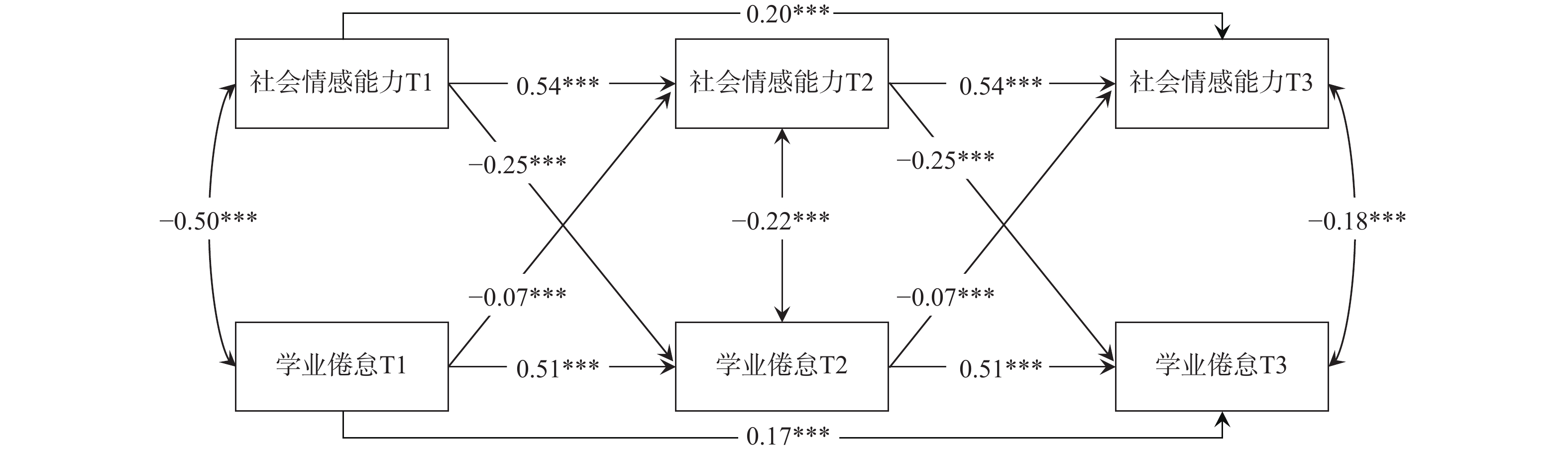
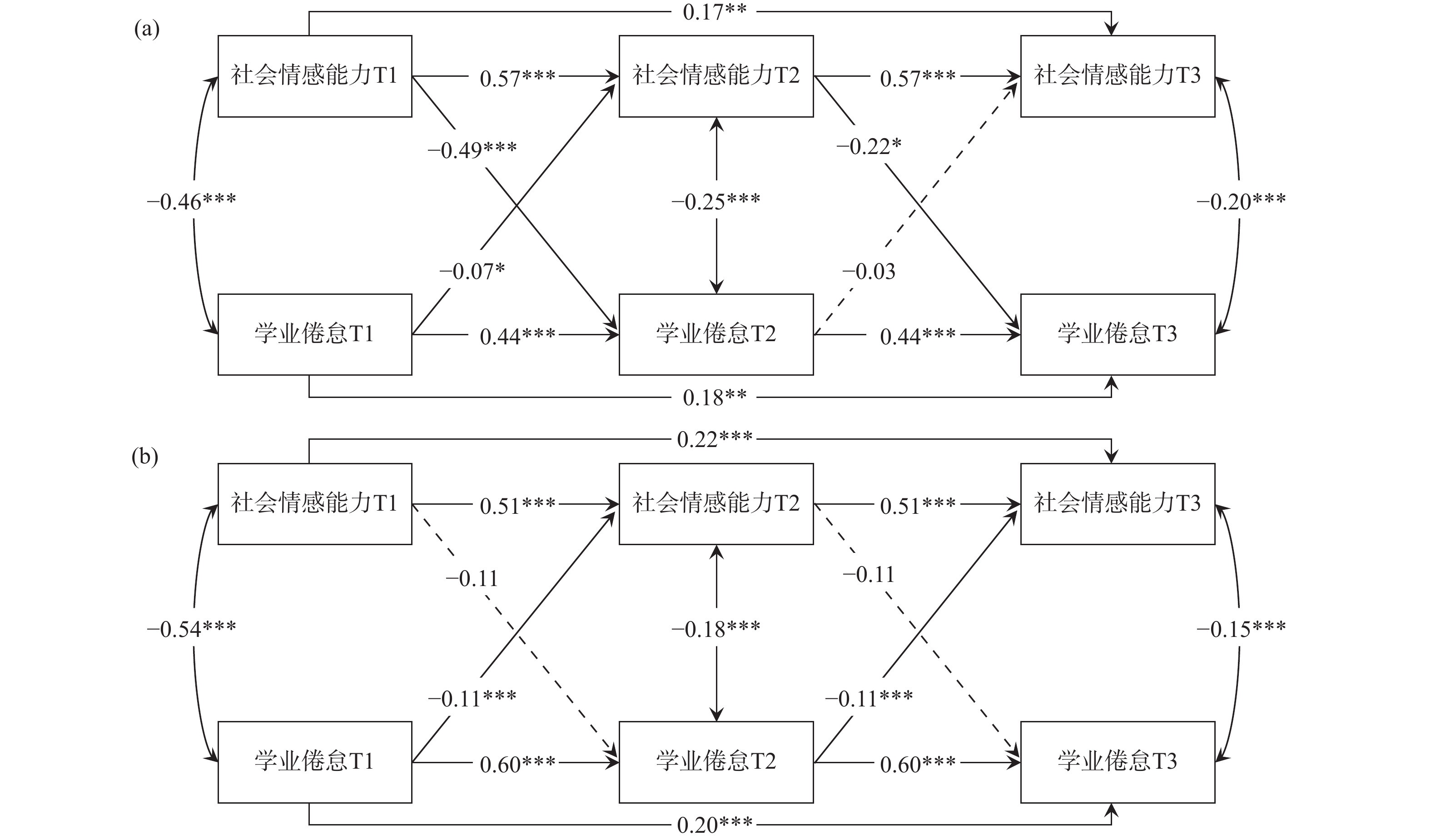
|
邓宇泽, 杨佳奇, 朱芷滢, 王烨晖. 小学生社会情感能力、师生关系和同伴关系:一项交叉滞后研究. 心理发展与教育, 2025, 41 (3): 322- 331.
|
|
|
韩宪国, 金国敏, 李丹, 刘世宏, 吴琴, 刘俊升, 陈欣银. 父母温暖与儿童晚期亲社会行为的关系:集体取向的作用. 心理学报, 2025, 57 (4): 614- 630.
|
|
|
李若璇, 朱文龙, 刘红瑞, 姚梅林. 家长教育期望对学业倦怠的影响:家长投入的中介及家庭功能的调节. 心理发展与教育, 2018, 34 (4): 489- 496.
|
|
|
汤丹丹, 温忠麟. 共同方法偏差检验:问题与建议. 心理科学, 2020, 43 (1): 215- 223.
|
|
|
袁振国, 黄忠敬, 李婧娟, 张静. (2021). 中国青少年社会与情感能力发展水平报告. 华东师范大学学报(教育科学版), 39(9), 1–32.
|
|
|
袁振国, 黄忠敬, 王纮, 王翔宇, 张静. 中国青少年社会与情感能力发展水平报告——基于第二轮SSES测评数据. 华东师范大学学报(教育科学版), 2024, 42 (5): 1- 32.
|
|
|
周浩, 龙立荣. 共同方法偏差的统计检验与控制方法. 心理科学进展, 2004, 12 (6): 942- 950.
|
|
|
Basu, S., Zuo, X. Y., Lou, C. H., Acharya, R., & Lundgren, R. (2017). Learning to be gendered: Gender socialization in early adolescence among urban poor in delhi, India, and shanghai, China. Journal of Adolescent Health, 61(4 Suppl), S24–S29.
|
|
|
Brown, M., Blanchard, T., & McGrath, R. E. Differences in self-reported character strengths across adolescence. Journal of Adolescence, 2020, 79 (1): 1- 10.
DOI |
|
|
Chaplin, T. M. Gender and emotion expression: A developmental contextual perspective. Emotion Review: Journal of the International Society for Research on Emotion, 2015, 7 (1): 14- 21.
|
|
|
Chernyshenko, O. S., Kankaraš, M., & Drasgow, F. (2018). Social and emotional skills for student success and well-being: Conceptual framework for the OECD study on social and emotional skills (OECD Education Working Papers No. 173). Paris: OECD.
|
|
|
Gavelin, H. M., Domellöf, M. E., Åström, E., Nelson, A., Launder, N. H., Neely, A. S., & Lampit, A. Cognitive function in clinical burnout: A systematic review and meta-analysis. Work & Stress, 2022, 36 (1): 86- 104.
|
|
|
Graham, J. W. Missing data analysis: Making it work in the real world. Annual Review of Psychology, 2009, 60 (1): 549- 576.
DOI |
|
|
Guo, J. S., Tang, X., Marsh, H. W., Parker, P., Basarkod, G., Sahdra, B., ... Salmela-Aro, K. The roles of social-emotional skills in students’ academic and life success: A multi-informant and multicohort perspective. Journal of Personality and Social Psychology, 2023, 124 (5): 1079- 1110.
DOI |
|
|
Hampel, P., & Petermann, F. Age and gender effects on coping in children and adolescents. Journal of Youth and Adolescence, 2005, 34 (2): 73- 83.
DOI |
|
|
Hu, L. T., & Bentler, P. M. Cutoff criteria for fit indexes in covariance structure analysis: Conventional criteria versus new alternatives. Structural Equation Modeling: A Multidisciplinary Journal, 1999, 6 (1): 1- 55.
DOI |
|
|
Huttunen, I., Upadyaya, K., & Salmela-Aro, K. Longitudinal associations between adolescents’ social-emotional skills, school engagement, and school burnout. Learning and Individual Differences, 2024, 115, 102537.
DOI |
|
|
Kankaraš, M., & Suarez-Alvarez, J. (2019). Assessment framework of the OECD study on social and emotional skills (OECD Education Working Papers No. 207). Paris: OECD.
|
|
|
Lee, J., Wang, C. X., & Lui, I. D. (2025). Exploring gender differences in multidimensional social-emotional competence from developmental and cross-cultural perspectives. Social and Emotional Learning: Research, Practice, and Policy, 6, 100137.
|
|
|
Little, T. D. (2013). Longitudinal structural equation modeling. New York: The Guilford Press.
|
|
|
Liu, W. Q., Zhang, R. Y., Wang, H., Rule, A., Wang, M., Abbey, C., ... Tong, L. Association between anxiety, depression symptoms, and academic burnout among Chinese students: The mediating role of resilience and self-efficacy. BMC Psychology, 2024, 12 (1): 335.
DOI |
|
|
Liu, Z. P., Guo, J. S., Huang, H. Y., & Tang, X. Which social-emotional skills are most important for students’ learning and well-being? An international comparison among China, USA and Finland. Learning and Individual Differences, 2025, 121, 102703.
DOI |
|
|
Marsh, H. W., Pekrun, R., Murayama, K., Arens, A. K., Parker, P. D., Guo, J., & Dicke, T. An integrated model of academic self-concept development: Academic self-concept, grades, test scores, and tracking over 6 years. Developmental Psychology, 2018, 54 (2): 263- 280.
DOI |
|
|
May, R. W., Bauer, K. N., & Fincham, F. D. School burnout: Diminished academic and cognitive performance. Learning and Individual Differences, 2015, 42, 126- 131.
DOI |
|
|
Putnick, D. L., & Bornstein, M. H. Measurement invariance conventions and reporting: The state of the art and future directions for psychological research. Developmental Review, 2016, 41, 71- 90.
DOI |
|
|
Ross, K. M., Kim, H., Tolan, P. H., & Jennings, P. A. An exploration of normative social and emotional skill growth trajectories during adolescence. Journal of Applied Developmental Psychology, 2019, 62, 102- 115.
DOI |
|
|
Salmela-Aro, K., Tang, X., & Upadyaya, K. (2022). Study demands-resources model of student engagement and burnout. In A. L. Reschly & S. L. Christenson (Eds.), Handbook of Research on Student Engagement (pp. 77–93). Cham, Switzerland: Springer International Publishing.
|
|
|
Salmela-Aro, K., & Upadyaya, K. School burnout and engagement in the context of demands-resources model. The British Journal of Educational Psychology, 2014, 84 (1): 137- 151.
DOI |
|
|
Salmela-Aro, K., & Upadyaya, K. School engagement and school burnout profiles during high school—The role of socio-emotional skills. European Journal of Developmental Psychology, 2020, 17 (6): 943- 964.
DOI |
|
|
Salmela-Aro, K., Upadyaya, K., Vinni-Laakso, J., & Hietajärvi, L. Adolescents’ longitudinal school engagement and burnout before and during COVID-19—The role of socio-emotional skills. Journal of Research on Adolescence, 2021, 31 (3): 796- 807.
DOI |
|
|
Schaufeli, W. B., Martínez, I. M., Pinto, A. M., Salanova, M., & Bakker, A. B. Burnout and engagement in university students: A cross-national study. Journal of Cross-Cultural Psychology, 2002, 33 (5): 464- 481.
DOI |
|
|
Sebastian, C., Burnett, S., & Blakemore, S.J. Development of the self-concept during adolescence. Trends in Cognitive Sciences, 2008, 12 (11): 441- 446.
DOI |
|
|
Tang, X., Upadyaya, K., & Salmela-Aro, K. School burnout and psychosocial problems among adolescents: Grit as a resilience factor. Journal of Adolescence, 2021, 86 (1): 77- 89.
DOI |
|
|
Van den Akker, A. L., Deković, M., Asscher, J., & Prinzie, P. Mean-level personality development across childhood and adolescence: A temporary defiance of the maturity principle and bidirectional associations with parenting. Journal of Personality and Social Psychology, 2014, 107 (4): 736- 750.
DOI |
|
|
Von Stumm, S., Hell, B., & Chamorro-Premuzic, T. The hungry mind: Intellectual curiosity is the third pillar of academic performance. Perspectives on Psychological Science, 2011, 6 (6): 574- 588.
DOI |
|
|
Wang, F. M., Zeng, L. M., & King, R. B. Teacher support for basic needs is associated with socio-emotional skills: A self-determination theory perspective. Social Psychology of Education, 2025, 28 (1): 76.
DOI |
|
|
Weissberg, R. P., Durlak, J. A., Domitrovich, C. E., & Gullotta, T. P. (2015). Social and emotional learning: Past, present, and future. In J. A. Durlak, C. E. Domitrovich, R. P. Weissberg, & T. P. Gullotta (Eds.), Handbook of social and emotional learning: Research and practice (pp. 3–19). New York: The Guilford Press.
|
|
|
Yang, L., Shrestha, S., Zhan, S. Q., & Cheng, F. Q. Parents’ education anxiety and adolescents’ academic burnout: The role of parenting style and academic self-efficacy. Personality and Individual Differences, 2025, 238, 113082.
DOI |
|
|
Zhu, Q. Y., Cheong, Y., Wang, C. X., & Tong, J. J. The impact of maternal and paternal parenting styles and parental involvement on Chinese adolescents’ academic engagement and burnout. Current Psychology, 2023, 42 (4): 2827- 2840.
DOI |
| Viewed | ||||||
|
Full text |
|
|||||
|
Abstract |
|
|||||
