
Studies of Psychology and Behavior ›› 2025, Vol. 23 ›› Issue (6): 798-805.DOI: 10.12139/j.1672-0628.2025.06.010
• ? • Previous Articles Next Articles
Li GU, Xiaotong HUANG, Guanghua LIANG, Wei CAI, Fengbo GUO*( )
)
Received:2025-01-08
Online:2025-11-20
Published:2025-11-20
Contact:
Fengbo GUO
谷莉, 黄晓彤, 梁广华, 蔡頠, 郭丰波*()
通讯作者:
郭丰波
基金资助:Li GU, Xiaotong HUANG, Guanghua LIANG, Wei CAI, Fengbo GUO. The Relationship Between Core Self-Evaluations and Non-Suicidal Self-Injury in Adolescents: A Moderated Mediation Model[J]. Studies of Psychology and Behavior, 2025, 23(6): 798-805.
谷莉, 黄晓彤, 梁广华, 蔡頠, 郭丰波. 核心自我评价与青少年自伤行为的关系:有调节的中介模型[J]. 心理与行为研究, 2025, 23(6): 798-805.
Add to citation manager EndNote|Ris|BibTeX
URL: https://psybeh.tjnu.edu.cn/EN/10.12139/j.1672-0628.2025.06.010
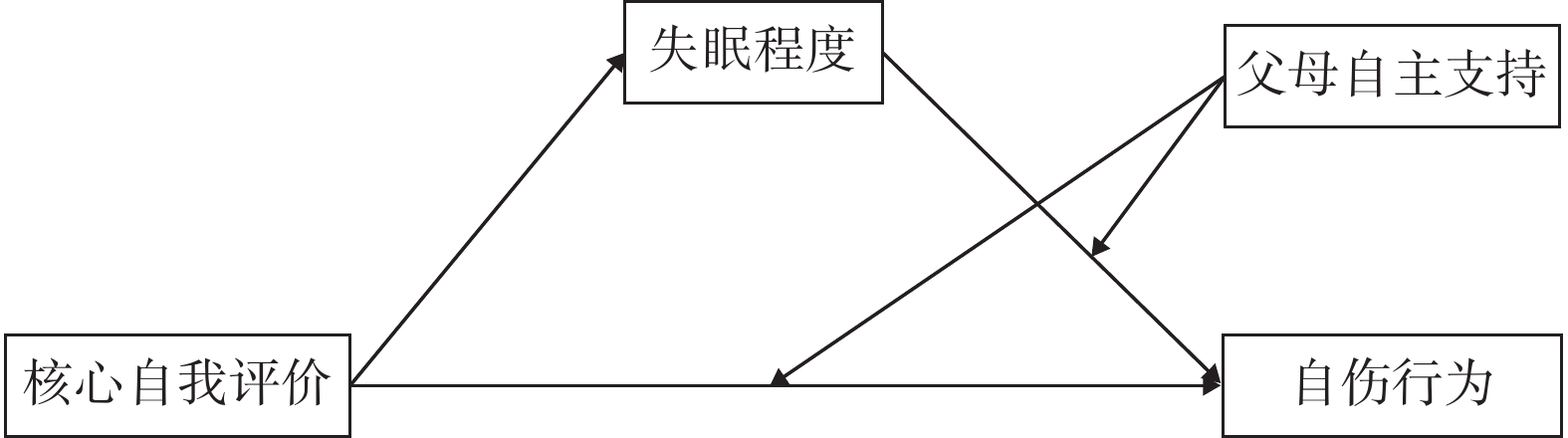
| 人口学变量 | 失眠检出率 | 自伤检出率 | |||||||||
| 无失眠 | 有失眠 | χ2(df) | p | 无自伤 | 有自伤 | χ2(df) | p | ||||
| 性别 | 男 | 1717(72.23%) | 660(27.77%) | 5.30(1) | 0.021 | 1743(73.33%) | 634(26.67%) | 44.50(1) | <0.001 | ||
| 女 | 1649(69.20%) | 734(30.80%) | 1534(64.37%) | 849(35.63%) | |||||||
| 学段 | 初中生 | 1171(75.99%) | 370(24.01%) | 30.62(1) | <0.001 | 1012(65.67%) | 529(34.33%) | 10.70(1) | 0.001 | ||
| 高中生 | 2195(68.19%) | 1024(31.81%) | 2265(70.36%) | 954(29.64%) | |||||||
| 独生子女状况 | 独生 | 547(71.78%) | 215(28.22%) | 0.56(1) | 0.455 | 553(71.35%) | 222(28.65%) | 2.72(1) | 0.099 | ||
| 非独生 | 2807(70.44%) | 1178(29.56%) | 2724(68.36%) | 1261(31.64%) | |||||||
| 留守状况 | 留守 | 166(72.17%) | 64(27.83%) | 0.24(1) | 0.624 | 151(65.65%) | 79(34.35%) | 1.15(1) | 0.284 | ||
| 非留守 | 3173(70.67%) | 1317(29.33%) | 3126(69.01%) | 1404(30.99%) | |||||||
| 人口学变量 | 失眠检出率 | 自伤检出率 | |||||||||
| 无失眠 | 有失眠 | χ2(df) | p | 无自伤 | 有自伤 | χ2(df) | p | ||||
| 性别 | 男 | 1717(72.23%) | 660(27.77%) | 5.30(1) | 0.021 | 1743(73.33%) | 634(26.67%) | 44.50(1) | <0.001 | ||
| 女 | 1649(69.20%) | 734(30.80%) | 1534(64.37%) | 849(35.63%) | |||||||
| 学段 | 初中生 | 1171(75.99%) | 370(24.01%) | 30.62(1) | <0.001 | 1012(65.67%) | 529(34.33%) | 10.70(1) | 0.001 | ||
| 高中生 | 2195(68.19%) | 1024(31.81%) | 2265(70.36%) | 954(29.64%) | |||||||
| 独生子女状况 | 独生 | 547(71.78%) | 215(28.22%) | 0.56(1) | 0.455 | 553(71.35%) | 222(28.65%) | 2.72(1) | 0.099 | ||
| 非独生 | 2807(70.44%) | 1178(29.56%) | 2724(68.36%) | 1261(31.64%) | |||||||
| 留守状况 | 留守 | 166(72.17%) | 64(27.83%) | 0.24(1) | 0.624 | 151(65.65%) | 79(34.35%) | 1.15(1) | 0.284 | ||
| 非留守 | 3173(70.67%) | 1317(29.33%) | 3126(69.01%) | 1404(30.99%) | |||||||
| 变量 | M | SD | 1 | 2 | 3 |
| 1.自伤行为 | 3.60 | 7.99 | |||
| 2.失眠程度 | 5.77 | 4.48 | 0.30*** | ||
| 3.核心自我评价 | 3.28 | 0.78 | –0.30*** | –0.44*** | |
| 4.父母自主支持 | 3.58 | 0.82 | –0.22*** | –0.23*** | 0.34*** |
| 变量 | M | SD | 1 | 2 | 3 |
| 1.自伤行为 | 3.60 | 7.99 | |||
| 2.失眠程度 | 5.77 | 4.48 | 0.30*** | ||
| 3.核心自我评价 | 3.28 | 0.78 | –0.30*** | –0.44*** | |
| 4.父母自主支持 | 3.58 | 0.82 | –0.22*** | –0.23*** | 0.34*** |
| 变量 | 失眠程度 | 自伤行为 | ||||
| M1 | M2 | M3 | M4 | M5 | ||
| 控制变量 | ||||||
| 性别 | 0.02 | –0.06*** | 0.09*** | 0.04** | 0.05*** | |
| 学段 | 0.10*** | 0.04** | –0.08*** | –0.13*** | –0.14*** | |
| 自变量 | ||||||
| 核心自我评价 | –0.45*** | –0.31*** | –0.21*** | |||
| 中介变量 | ||||||
| 失眠程度 | 0.22*** | |||||
| F | 27.05*** | 401.65*** | 33.54*** | 181.04*** | 196.04*** | |
| R2 | 0.01 | 0.20 | 0.01 | 0.11 | 0.15 | |
| ΔF | 27.05*** | 1137.91*** | 33.54*** | 469.20*** | 215.67*** | |
| ΔR2 | 0.01 | 0.19 | 0.01 | 0.09 | 0.04 | |
| 变量 | 失眠程度 | 自伤行为 | ||||
| M1 | M2 | M3 | M4 | M5 | ||
| 控制变量 | ||||||
| 性别 | 0.02 | –0.06*** | 0.09*** | 0.04** | 0.05*** | |
| 学段 | 0.10*** | 0.04** | –0.08*** | –0.13*** | –0.14*** | |
| 自变量 | ||||||
| 核心自我评价 | –0.45*** | –0.31*** | –0.21*** | |||
| 中介变量 | ||||||
| 失眠程度 | 0.22*** | |||||
| F | 27.05*** | 401.65*** | 33.54*** | 181.04*** | 196.04*** | |
| R2 | 0.01 | 0.20 | 0.01 | 0.11 | 0.15 | |
| ΔF | 27.05*** | 1137.91*** | 33.54*** | 469.20*** | 215.67*** | |
| ΔR2 | 0.01 | 0.19 | 0.01 | 0.09 | 0.04 | |
| 变量 | 自伤行为 | ||
| M1 | M2 | M3 | |
| 控制变量 | |||
| 性别 | 0.09*** | 0.05** | 0.04** |
| 学段 | –0.08*** | –0.12*** | –0.11*** |
| 自变量 | |||
| 核心自我评价 | –0.27*** | –0.27*** | |
| 调节变量 | |||
| 父母自主支持 | –0.13*** | –0.13*** | |
| 交互项 | |||
| 核心自我评价×父母自主支持 | 0.13*** | ||
| F | 33.54*** | 156.97*** | 147.34*** |
| R2 | 0.11 | 0.12 | 0.14 |
| ΔF | 33.54*** | 276.38*** | 95.85*** |
| ΔR2 | 0.01 | 0.11 | 0.02 |
| 变量 | 自伤行为 | ||
| M1 | M2 | M3 | |
| 控制变量 | |||
| 性别 | 0.09*** | 0.05** | 0.04** |
| 学段 | –0.08*** | –0.12*** | –0.11*** |
| 自变量 | |||
| 核心自我评价 | –0.27*** | –0.27*** | |
| 调节变量 | |||
| 父母自主支持 | –0.13*** | –0.13*** | |
| 交互项 | |||
| 核心自我评价×父母自主支持 | 0.13*** | ||
| F | 33.54*** | 156.97*** | 147.34*** |
| R2 | 0.11 | 0.12 | 0.14 |
| ΔF | 33.54*** | 276.38*** | 95.85*** |
| ΔR2 | 0.01 | 0.11 | 0.02 |
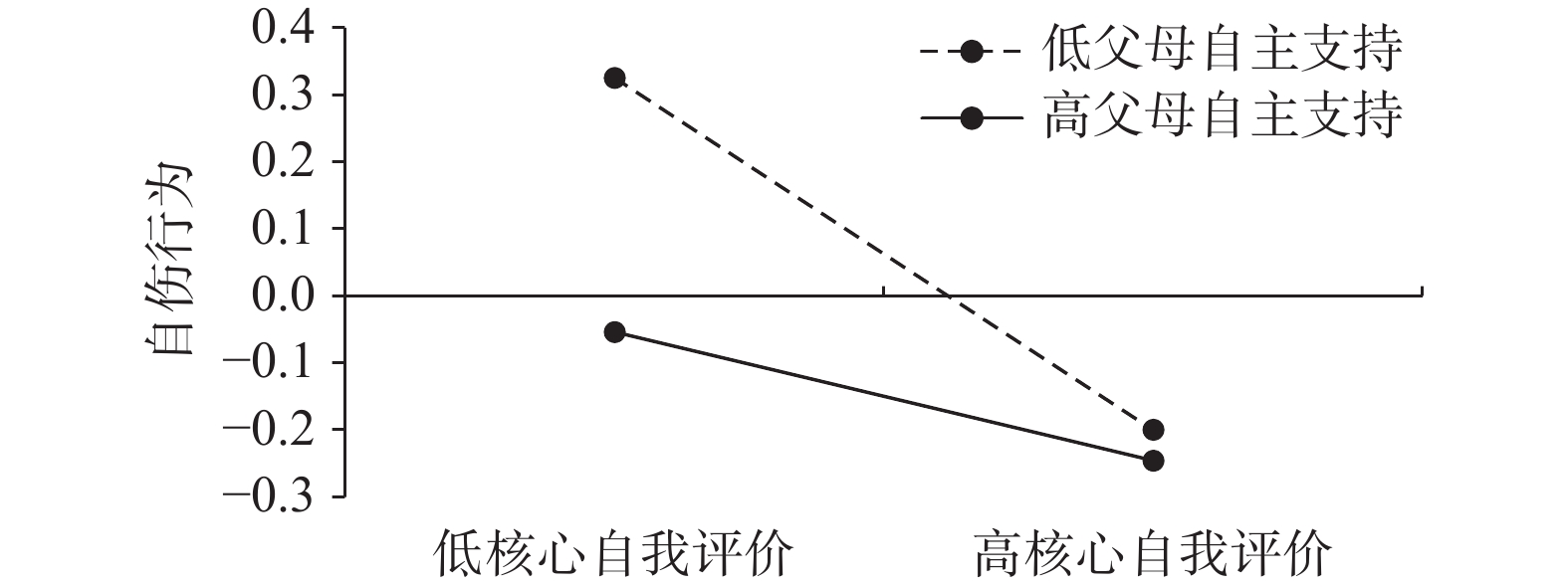
| 变量 | 自伤行为 | ||
| M1 | M2 | M3 | |
| 控制变量 | |||
| 性别 | 0.09*** | 0.09*** | 0.09*** |
| 学段 | –0.08*** | –0.11*** | –0.10*** |
| 自变量 | |||
| 失眠程度 | 0.28*** | 0.27*** | |
| 调节变量 | |||
| 父母自主支持 | –0.16*** | –0.15*** | |
| 交互项 | |||
| 失眠程度×父母自主支持 | –0.12*** | ||
| F | 33.52*** | 178.85*** | 160.06*** |
| R2 | 0.01 | 0.14 | 0.15 |
| ΔF | 33.52*** | 319.52*** | 73.62*** |
| ΔR2 | 0.01 | 0.12 | 0.01 |
| 变量 | 自伤行为 | ||
| M1 | M2 | M3 | |
| 控制变量 | |||
| 性别 | 0.09*** | 0.09*** | 0.09*** |
| 学段 | –0.08*** | –0.11*** | –0.10*** |
| 自变量 | |||
| 失眠程度 | 0.28*** | 0.27*** | |
| 调节变量 | |||
| 父母自主支持 | –0.16*** | –0.15*** | |
| 交互项 | |||
| 失眠程度×父母自主支持 | –0.12*** | ||
| F | 33.52*** | 178.85*** | 160.06*** |
| R2 | 0.01 | 0.14 | 0.15 |
| ΔF | 33.52*** | 319.52*** | 73.62*** |
| ΔR2 | 0.01 | 0.12 | 0.01 |
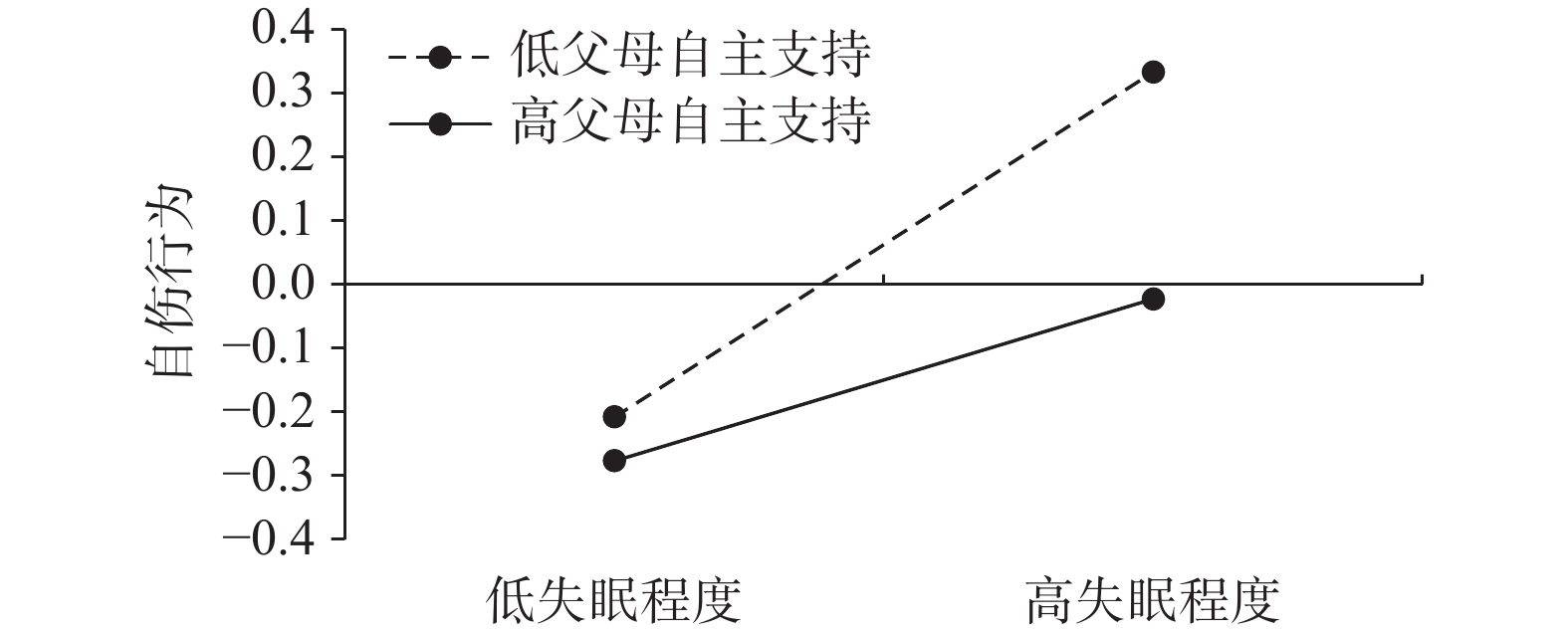
| 父母自主支持 | 效应值 | Boot标准误 | 95%置信区间 | |
| Boot CI下限 | Boot CI上限 | |||
| M−1SD | −0.12 | 0.02 | −0.16 | −0.08 |
| M | −0.09 | 0.01 | −0.11 | −0.07 |
| M+1SD | −0.06 | 0.01 | −0.09 | −0.03 |
| 父母自主支持 | 效应值 | Boot标准误 | 95%置信区间 | |
| Boot CI下限 | Boot CI上限 | |||
| M−1SD | −0.12 | 0.02 | −0.16 | −0.08 |
| M | −0.09 | 0.01 | −0.11 | −0.07 |
| M+1SD | −0.06 | 0.01 | −0.09 | −0.03 |
|
杜建政, 张翔, 赵燕. 核心自我评价的结构验证及其量表修订. 心理研究, 2012, 5 (3): 54- 60.
|
|
|
冯玉. (2008). 青少年自我伤害行为与个体情绪因素和家庭环境因素的关系(硕士学位论文). 华中师范大学, 武汉.
|
|
|
郭霜霜, 焦婷, 马颖, 唐杰. 青少年非自杀性自伤行为的家庭影响因素分析. 中国学校卫生, 2022, 43 (5): 768- 771.
DOI |
|
|
李恩泽. (2018). 失眠严重指数量表的效度和信度研究(硕士学位论文). 南方医科大学, 广州.
|
|
|
秦瑶, 彭运石. 父母教养方式对初中生社交焦虑的影响: 同伴接纳和反刍思维的链式中介作用. 心理发展与教育, 2024, 40 (1): 103- 113.
DOI |
|
|
王群, 罗鹏, 张江萍, 陈思银, 徐孟群, 彭晓唯, 汪俊华. 专业心理求助态度在家庭教养方式与中学生非自杀性自伤间的中介作用. 现代预防医学, 2024, 51 (18): 3398- 3403.
DOI |
|
|
徐学, 王娜, 王晶晶, 吴静珊, 周海瑞. 本科师范生父母教养方式与核心自我评价: 控制源的中介作用. 中国健康心理学杂志, 2018, 26 (1): 98- 102.
DOI |
|
|
郑莺. (2006). 武汉市中学生自我伤害行为流行学调查及其功能模型(硕士学位论文). 华中师范大学, 武汉.
|
|
|
Bandel, S. L., & Brausch, A. M. Poor sleep associates with recent nonsuicidal self-injury engagement in adolescents. Behavioral Sleep Medicine, 2020, 18 (1): 81- 90.
DOI |
|
|
Bastien, C. H., Vallières, A., & Morin, C. M. Validation of the Insomnia Severity Index as an outcome measure for insomnia research. Sleep Medicine, 2001, 2 (4): 297- 307.
DOI |
|
|
Berthelon, M., Contreras, D., Kruger, D., & Palma, M. I. Harsh parenting during early childhood and child development. Economics & Human Biology, 2020, 36, 100831.
|
|
|
Brager-Larsen, A., Zeiner, P., Klungsøyr, O., & Mehlum, L. Is age of self-harm onset associated with increased frequency of non-suicidal self-injury and suicide attempts in adolescent outpatients?. BMC Psychiatry, 2022, 22 (1): 58.
DOI |
|
|
Crosswhite, J. M., & Kerpelman, J. L. Parenting and children’s self-control: Concurrent and longitudinal relations. Deviant Behavior, 2012, 33 (9): 715- 737.
DOI |
|
|
Dong, Y. F., Wang, L. X., Luo, L. S., Wang, Y. R., Song, T., Shao, Y. C., ... Shi, G. H. The selective impairments of total sleep deprivation on alerting, orienting, and executive control: Evidence from event-related potentials. Journal of Integrative Neuroscience, 2024, 23 (10): 191.
DOI |
|
|
Ewing, E. L., Mackaronis, J. E., Poole, E. M., Critchfield, K. L., & Gunn, H. E. An interpersonal and meta-analytic approach to parenting behaviors and adolescent sleep. Clinical Child and Family Psychology Review, 2024, 27 (4): 1088- 1112.
DOI |
|
|
Fang, J., Wan, Y. H., Zhang, X. Y., Su, P. Y., Tao, F. B., & Sun, Y. Sleep duration trajectory during the transition to adolescence and subsequent risk of non-suicidal self-harm. European Child & Adolescent Psychiatry, 2022, 31 (8): 1- 9.
|
|
|
Fikke, L., T., Melinder, A., & Landrø, N., I. Executive functions are impaired in adolescents engaging in non-suicidal self-injury. Psychological Medicine, 2011, 41 (3): 601- 610.
DOI |
|
|
Fong, Z. H., Loh, W. N. C., Fong, Y. J., Neo, H. L. M., & Chee, T. T. Parenting behaviors, parenting styles, and non-suicidal self-injury in young people: A systematic review. Clinical Child Psychology and Psychiatry, 2022, 27 (1): 61- 81.
DOI |
|
|
Hawton, K., Zahl, D., & Weatherall, R. Suicide following deliberate self-harm: Long-term follow-up of patients who presented to a general hospital. The British Journal of Psychiatry, 2003, 182 (6): 537- 542.
DOI |
|
|
He, H., Hong, L., Jin, W., Xu, Y., Kang, W., Liu, J., ... Zhao, K. Heterogeneity of non-suicidal self-injury behavior in adolescents with depression: Latent class analysis. BMC Psychiatry, 2023, 23 (1): 301.
DOI |
|
|
Hooley, J. M., Fox, K. R., & Boccagno, C. Nonsuicidal self-injury: Diagnostic challenges and current perspectives. Neuropsychiatric Disease and Treatment, 2020, 16, 101- 112.
DOI |
|
|
Hooley, J. M., & Franklin, J. C. Why do people hurt themselves? A new conceptual model of nonsuicidal self-injury. Clinical Psychological Science, 2018, 6 (3): 428- 451.
DOI |
|
|
Hooley, J. M., Ho, D. T., Slater, J., & Lockshin, A. (2010). Pain perception and nonsuicidal self-injury: A laboratory investigation. Personality Disorders: Theory, Research, and Treatment, 1(3), 170–179.
|
|
|
Huang, J. H., Zhang, D., Chen, Y. H., Yu, C. F., Zhen, S. J., & Zhang, W. Parental psychological control, psychological need satisfaction, and non-suicidal self-injury among Chinese adolescents: The moderating effect of sensation seeking. Children and Youth Services Review, 2022, 136, 106417.
DOI |
|
|
Hysing, M., Sivertsen, B., Stormark, K. M., & O’Connor, R. C. Sleep problems and self-harm in adolescence. The British Journal of Psychiatry, 2015, 207 (4): 306- 312.
DOI |
|
|
Johnson, D. P., & Whisman, M. A. Gender differences in rumination: A meta-analysis. Personality and Individual Differences, 2013, 55 (4): 367- 374.
DOI |
|
|
Judge, T. A., Erez, A., Bono, J. E., & Thoresen, C. J. The Core Self-Evaluations Scale: Development of a measure. Personnel Psychology, 2003, 56 (2): 303- 331.
DOI |
|
|
Kim, J., Shim, H. S., & Hay, C. Unpacking the dynamics involved in the impact of bullying victimization on adolescent suicidal ideation: Testing general strain theory in the Korean context. Children and Youth Services Review, 2020, 110, 104781.
DOI |
|
|
McPartland, J. M., & Epstein, J. L. Open schools and achievement: Extended tests of a finding of no relationship. Sociology of Education, 1977, 50 (2): 133- 144.
DOI |
|
|
Noble, K. G., Houston, S. M., Kan, E., & Sowell, E. R. Neural correlates of socioeconomic status in the developing human brain. Developmental Science, 2012, 15 (4): 516- 527.
DOI |
|
|
Nock, M. K., & Favazza, A. R. (2009). Nonsuicidal self-injury: Definition and classification. In M. K. Nock (Ed.), Understanding nonsuicidal self-injury: Origins, assessment, and treatment (pp. 9–18). Washington, DC: American Psychological Association.
|
|
|
Rahman, F., Webb, R. T., & Wittkowski, A. Risk factors for self-harm repetition in adolescents: A systematic review. Clinical Psychology Review, 2021, 88, 102048.
DOI |
|
|
Stumper, A., & Alloy, L. B. Associations between pubertal stage and depression: A systematic review of the literature. Child Psychiatry & Human Development, 2023, 54 (2): 312- 339.
|
|
|
Taylor, S. E., Kemeny, M. E., Reed, G. M., Bower, J. E., & Gruenewald, T. L. Psychological resources, positive illusions, and health. American Psychologist, 2000, 55 (1): 99- 109.
DOI |
|
|
Thai, M., Başgöze, Z., Westlund Schreiner, M., Roediger, D. J., Falke, C. A., Mueller, B. A., ... Cullen, K. R. A multi-modal assessment of self-knowledge in adolescents with non-suicidal self-injury: A Research Domains Criteria (RDoC) study. Psychological Medicine, 2024, 54 (12): 3273- 3284.
DOI |
|
|
Trompeter, N., Bussey, K., & Fitzpatrick, S. Cyber victimization and internalizing difficulties: The mediating roles of coping self-efficacy and emotion dysregulation. Journal of Abnormal Child Psychology, 2018, 46 (5): 1129- 1139.
DOI |
|
|
Vargas, I., Nguyen, A. M., Haeffel, G. J., & Drake, C. L. A negative cognitive style is associated with greater insomnia and depression symptoms: The mediating role of sleep reactivity. Journal of Affective Disorders Reports, 2020, 1, 100010.
DOI |
|
|
Vergara-Lopez, C., Scalco, M. D., Gaffey, A. E., Reid, B. M., Bublitz, M. H., Lee, S. Y., ... Stroud, L. R. The interactive effects of rejection and rumination on diurnal cortisol among adolescent girls: A preliminary daily diary study. Cognitive Therapy and Research, 2024, 48 (5): 1027- 1034.
DOI |
|
|
Wang, Q., Pomerantz, E. M., & Chen, H. C. The role of parents’ control in early adolescents’ psychological functioning: A longitudinal investigation in the United States and China. Child Development, 2007, 78 (5): 1592- 1610.
DOI |
|
|
Wang, S. Y., Ding, W., Song, S. C., Tan, Y. X., Ahmed, M. Z., Xie, R. B., & Li, L. The relationship between adolescent victimization, nonsuicidal self-injury, and core self-evaluation: A cross-lagged study. Current Psychology, 2024, 43 (1): 28- 38.
DOI |
|
|
Zheng, Y. G., Xiao, L., Wang, H. L., Chen, Z H., & Wang, G. H. A retrospective research on non-suicidal self-injurious behaviors among young patients diagnosed with mood disorders. Frontiers in Psychiatry, 2022, 13, 895892.
DOI |
| Viewed | ||||||
|
Full text |
|
|||||
|
Abstract |
|
|||||
