
Studies of Psychology and Behavior ›› 2026, Vol. 24 ›› Issue (2): 151-160.DOI: 10.12139/j.1672-0628.2026.02.002
• ? • Previous Articles Next Articles
Guandoudou YANG1, Jingwen TAN1,2, Miaomiao LIU1,3, Hong LI*,1( )
)
Received:2025-03-18
Online:2026-03-20
Published:2026-03-20
Contact:
Hong LI
杨官豆豆1, 谭静文1,2, 刘苗苗1,3, 李虹*,1()
通讯作者:
李虹
基金资助:Guandoudou YANG, Jingwen TAN, Miaomiao LIU, Hong LI. The Application of the Comparative Judgment in Chinese Text Difficulty Assessment[J]. Studies of Psychology and Behavior, 2026, 24(2): 151-160.
杨官豆豆, 谭静文, 刘苗苗, 李虹. 两两比较在汉语文本难度评估中的应用[J]. 心理与行为研究, 2026, 24(2): 151-160.
Add to citation manager EndNote|Ris|BibTeX
URL: https://psybeh.tjnu.edu.cn/EN/10.12139/j.1672-0628.2026.02.002
| 分组类别 | 分组依据 | 人数 | 相对阅读习惯分数 | infit值 | t/Z | p |
| 专业 | 理科 | 29 | 21.45(3.26) | 0.90(0.31) | –0.31 | 0.76 |
| 文科 | 51 | 21.31(4.94) | 0.93(0.40) | |||
| 高考语文成绩 | 119分及以下 | 38 | 21.29(5.29) | 0.98(0.41) | –1.40 | 0.16 |
| 120分及以上 | 42 | 21.43(3.44) | 0.87(0.32) | |||
| 相对于阅读习惯 | ≤21 | 35 | 17.54(2.95) | 0.96(0.38) | –0.94 | 0.35 |
| >21 | 45 | 24.33(2.67) | 0.89(0.36) | |||
| 总计 | 80 | 21.36(4.38) | 0.92(0.37) |
| 分组类别 | 分组依据 | 人数 | 相对阅读习惯分数 | infit值 | t/Z | p |
| 专业 | 理科 | 29 | 21.45(3.26) | 0.90(0.31) | –0.31 | 0.76 |
| 文科 | 51 | 21.31(4.94) | 0.93(0.40) | |||
| 高考语文成绩 | 119分及以下 | 38 | 21.29(5.29) | 0.98(0.41) | –1.40 | 0.16 |
| 120分及以上 | 42 | 21.43(3.44) | 0.87(0.32) | |||
| 相对于阅读习惯 | ≤21 | 35 | 17.54(2.95) | 0.96(0.38) | –0.94 | 0.35 |
| >21 | 45 | 24.33(2.67) | 0.89(0.36) | |||
| 总计 | 80 | 21.36(4.38) | 0.92(0.37) |
| 册数 | 文本篇数 | 字数 | 字种 | 词数 | 词种 | 句数 | 句长 | 可读性分数 | |
| 随机森林 | 支持向量机 | ||||||||
| 1 | 10 | 70.20(36.67) | 35.30(16.28) | 52.40(29.27) | 29.10(14.42) | 4.30(2.00) | 18.03(8.66) | 1.24(0.13) | 1.67(0.27) |
| 2 | 10 | 115.90(55.67) | 60.00(14.71) | 87.30(44.49) | 50.60(14.28) | 7.20(4.21) | 17.56(4.55) | 2.04(0.22) | 2.30(0.17) |
| 3 | 10 | 163.60(48.80) | 88.50(16.35) | 118.30(39.34) | 73.80(16.35) | 9.40(3.60) | 19.03(6.80) | 2.97(0.17) | 3.33(0.24) |
| 4 | 10 | 237.10(61.03) | 106.10(23.85) | 174.80(45.47) | 91.20(21.52) | 13.90(5.26) | 18.04(3.98) | 3.86(0.15) | 4.18(0.13) |
| 5 | 10 | 361.90(114.09) | 158.50(36.24) | 253.10(87.20) | 138.40(39.39) | 19.40(7.63) | 19.46(3.42) | 5.06(0.25) | 5.11(0.10) |
| 6 | 10 | 434.40(54.73) | 199.40(21.19) | 300.40(45.40) | 169.50(22.85) | 17.30(5.33) | 26.56(6.12) | 6.22(0.16) | 6.20(0.17) |
| 7 | 10 | 513.20(66.14) | 241.30(17.52) | 333.80(51.20) | 203.50(21.68) | 21.50(4.77) | 24.48(3.62) | 7.23(0.15) | 7.25(0.10) |
| 8 | 10 | 716.10(175.72) | 303.80(37.35) | 458.40(127.33) | 256.90(44.58) | 24.60(8.07) | 30.05(5.06) | 8.36(0.24) | 8.00(0.25) |
| 总计 | 80 | 326.55(224.95) | 149.11(91.24) | 222.31(145.33) | 126.63(78.80) | 14.70(8.56) | 21.65(6.92) | 4.62(2.39) | 4.75(2.17) |
| 册数 | 文本篇数 | 字数 | 字种 | 词数 | 词种 | 句数 | 句长 | 可读性分数 | |
| 随机森林 | 支持向量机 | ||||||||
| 1 | 10 | 70.20(36.67) | 35.30(16.28) | 52.40(29.27) | 29.10(14.42) | 4.30(2.00) | 18.03(8.66) | 1.24(0.13) | 1.67(0.27) |
| 2 | 10 | 115.90(55.67) | 60.00(14.71) | 87.30(44.49) | 50.60(14.28) | 7.20(4.21) | 17.56(4.55) | 2.04(0.22) | 2.30(0.17) |
| 3 | 10 | 163.60(48.80) | 88.50(16.35) | 118.30(39.34) | 73.80(16.35) | 9.40(3.60) | 19.03(6.80) | 2.97(0.17) | 3.33(0.24) |
| 4 | 10 | 237.10(61.03) | 106.10(23.85) | 174.80(45.47) | 91.20(21.52) | 13.90(5.26) | 18.04(3.98) | 3.86(0.15) | 4.18(0.13) |
| 5 | 10 | 361.90(114.09) | 158.50(36.24) | 253.10(87.20) | 138.40(39.39) | 19.40(7.63) | 19.46(3.42) | 5.06(0.25) | 5.11(0.10) |
| 6 | 10 | 434.40(54.73) | 199.40(21.19) | 300.40(45.40) | 169.50(22.85) | 17.30(5.33) | 26.56(6.12) | 6.22(0.16) | 6.20(0.17) |
| 7 | 10 | 513.20(66.14) | 241.30(17.52) | 333.80(51.20) | 203.50(21.68) | 21.50(4.77) | 24.48(3.62) | 7.23(0.15) | 7.25(0.10) |
| 8 | 10 | 716.10(175.72) | 303.80(37.35) | 458.40(127.33) | 256.90(44.58) | 24.60(8.07) | 30.05(5.06) | 8.36(0.24) | 8.00(0.25) |
| 总计 | 80 | 326.55(224.95) | 149.11(91.24) | 222.31(145.33) | 126.63(78.80) | 14.70(8.56) | 21.65(6.92) | 4.62(2.39) | 4.75(2.17) |
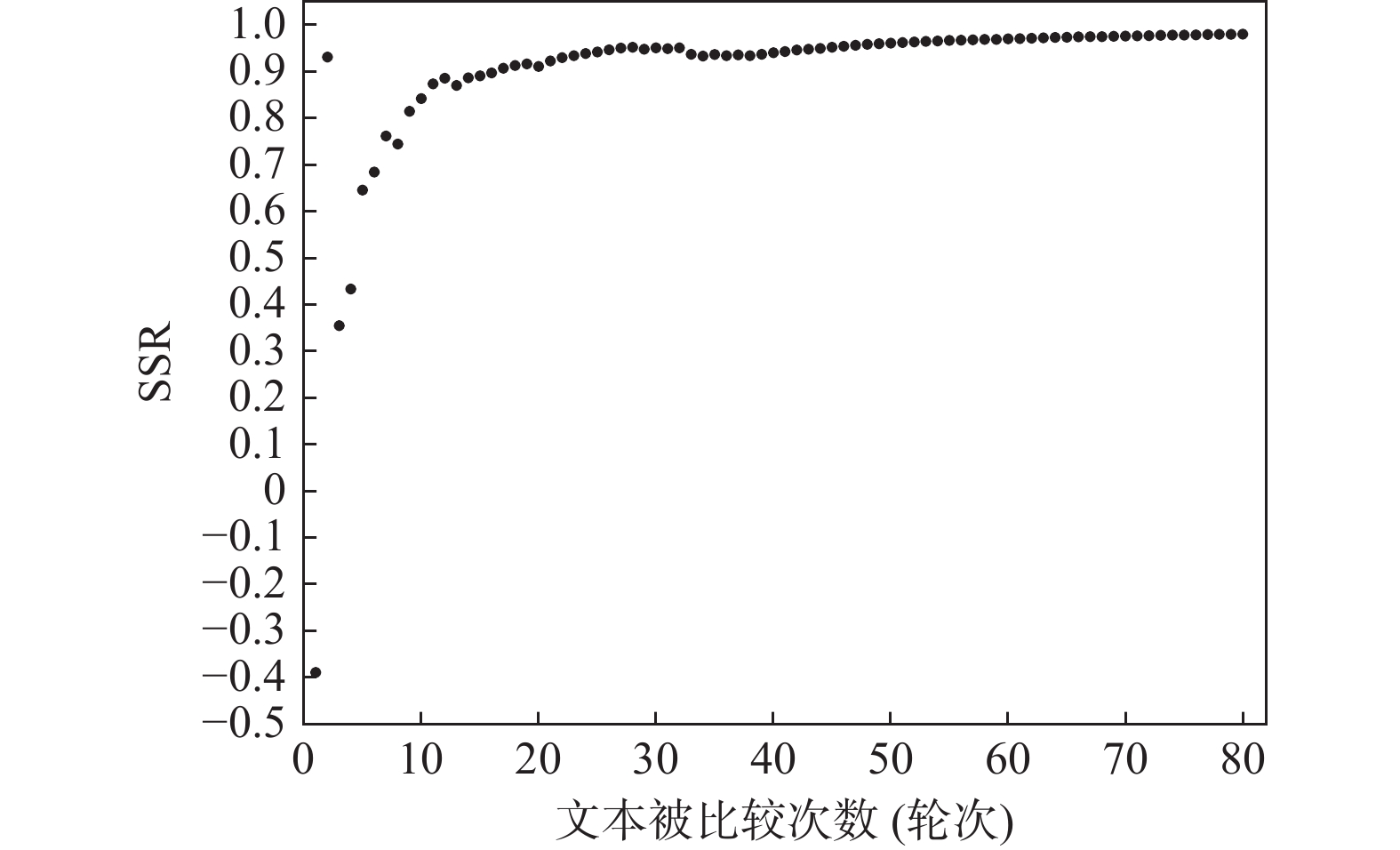
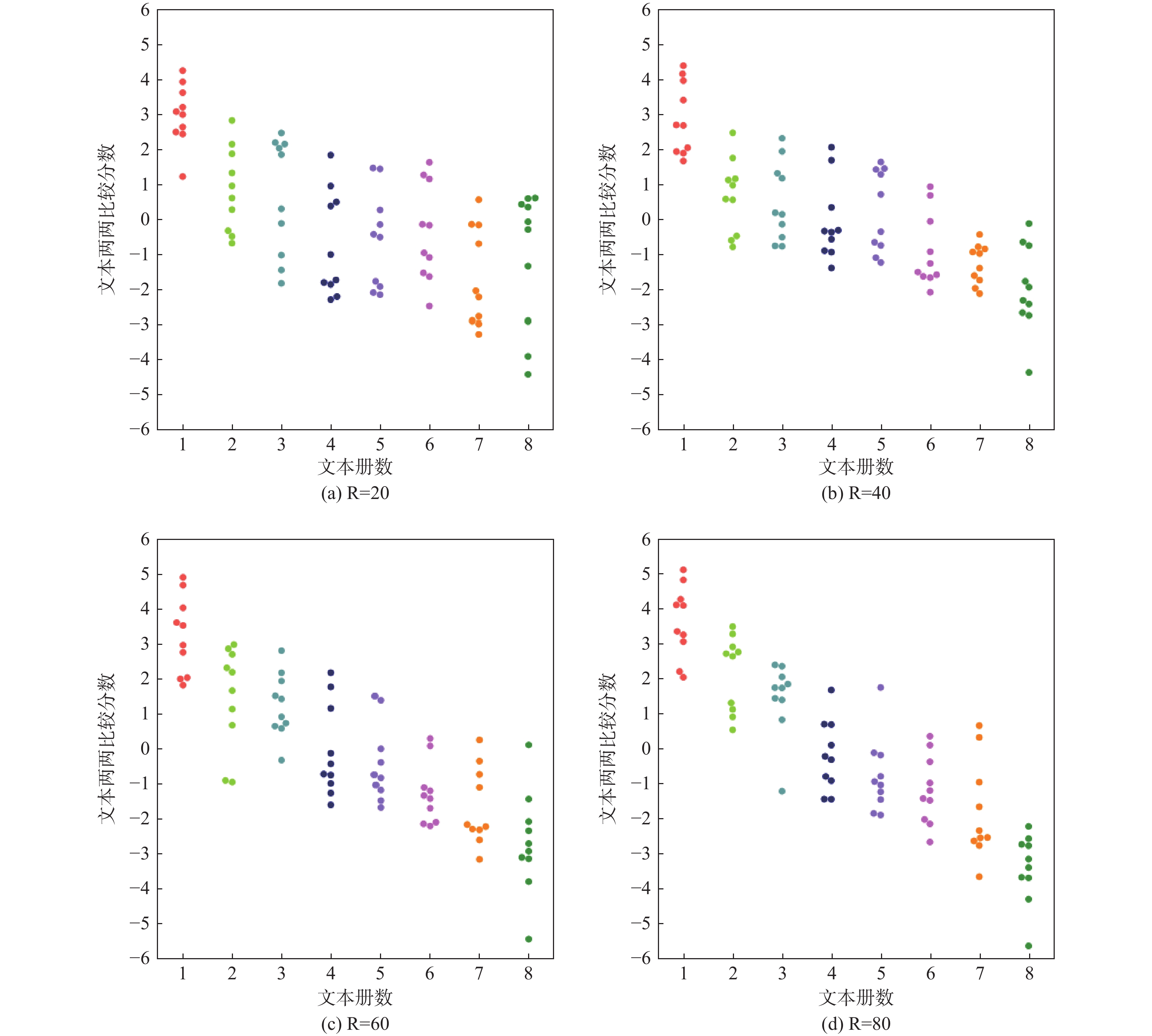
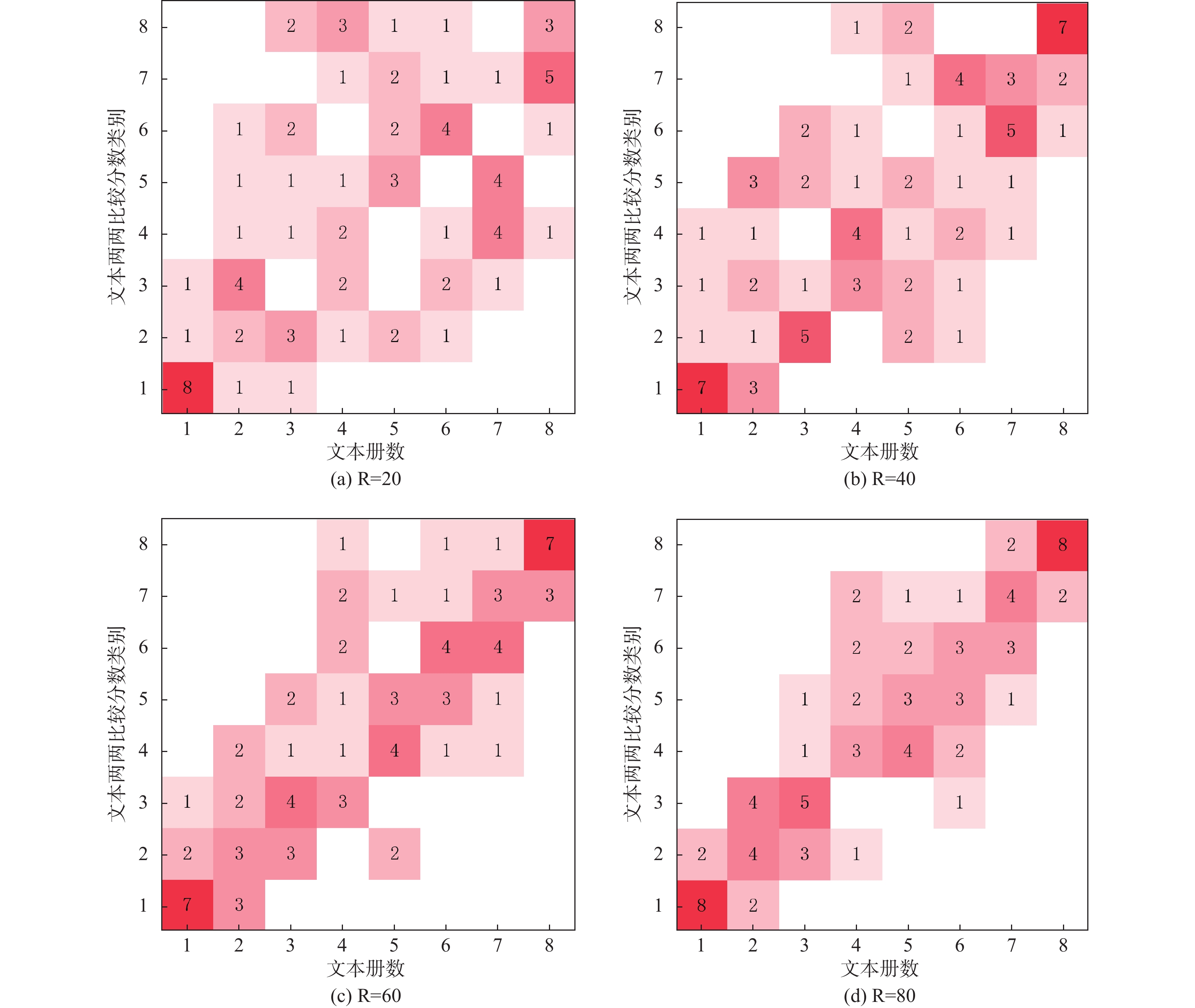
| 册数 | 文本篇数 | 两两比较分数 | |||
| R=20 | R=40 | R=60 | R=80 | ||
| 1 | 10 | 2.99a(0.87) | 2.88a(1.03) | 3.27a(1.11) | 3.66a(1.03) |
| 2 | 10 | 0.85b(1.19) | 0.67b(1.06) | 1.50b(1.47) | 2.19ab(1.08) |
| 3 | 10 | 0.65bc(1.68) | 0.48bc(1.13) | 1.27b(0.91) | 1.48b(1.05) |
| 4 | 10 | –0.73bc(1.50) | –0.08bc(1.13) | –0.05bc(1.32) | –0.18c(1.01) |
| 5 | 10 | –0.59bc(1.39) | 0.24bc(1.17) | –0.42c(1.11) | –0.76cd(1.07) |
| 6 | 10 | –0.40bc(1.39) | –0.92cde(1.06) | –1.26cd(0.88) | –1.17cd(0.99) |
| 7 | 10 | –1.67c(1.41) | –1.29de(0.57) | –1.65cd(1.11) | –1.80d(1.41) |
| 8 | 10 | –1.10bc(1.95) | –1.99e(1.24) | –2.67d(1.46) | –3.41e(1.00) |
| 册数 | 文本篇数 | 两两比较分数 | |||
| R=20 | R=40 | R=60 | R=80 | ||
| 1 | 10 | 2.99a(0.87) | 2.88a(1.03) | 3.27a(1.11) | 3.66a(1.03) |
| 2 | 10 | 0.85b(1.19) | 0.67b(1.06) | 1.50b(1.47) | 2.19ab(1.08) |
| 3 | 10 | 0.65bc(1.68) | 0.48bc(1.13) | 1.27b(0.91) | 1.48b(1.05) |
| 4 | 10 | –0.73bc(1.50) | –0.08bc(1.13) | –0.05bc(1.32) | –0.18c(1.01) |
| 5 | 10 | –0.59bc(1.39) | 0.24bc(1.17) | –0.42c(1.11) | –0.76cd(1.07) |
| 6 | 10 | –0.40bc(1.39) | –0.92cde(1.06) | –1.26cd(0.88) | –1.17cd(0.99) |
| 7 | 10 | –1.67c(1.41) | –1.29de(0.57) | –1.65cd(1.11) | –1.80d(1.41) |
| 8 | 10 | –1.10bc(1.95) | –1.99e(1.24) | –2.67d(1.46) | –3.41e(1.00) |
| 1 | 2 | 3 | 4 | 5 | 6 | |
| 1.文本两两比较分数(R=20) | ||||||
| 2.文本两两比较分数(R=40) | 0.52** | |||||
| 3.文本两两比较分数(R=60) | 0.55** | 0.73** | ||||
| 4.文本两两比较分数(R=80) | 0.57** | 0.68** | 0.83** | |||
| 5.文本册数 | –0.59** | –0.76** | –0.84** | –0.89** | ||
| 6.文本可读性分数(随机森林) | –0.58** | –0.78** | –0.86** | –0.90** | 0.99** | |
| 7.文本可读性分数(支持向量机) | –0.58** | –0.78** | –0.83** | –0.89** | 0.99** | 0.99** |
| 1 | 2 | 3 | 4 | 5 | 6 | |
| 1.文本两两比较分数(R=20) | ||||||
| 2.文本两两比较分数(R=40) | 0.52** | |||||
| 3.文本两两比较分数(R=60) | 0.55** | 0.73** | ||||
| 4.文本两两比较分数(R=80) | 0.57** | 0.68** | 0.83** | |||
| 5.文本册数 | –0.59** | –0.76** | –0.84** | –0.89** | ||
| 6.文本可读性分数(随机森林) | –0.58** | –0.78** | –0.86** | –0.90** | 0.99** | |
| 7.文本可读性分数(支持向量机) | –0.58** | –0.78** | –0.83** | –0.89** | 0.99** | 0.99** |
|
陈茹玲, 蔡鑫廷, 宋曜廷, 李宜宪. 文本适读性分级架构之建立研究. 教育科学研究期刊, 2015, 60 (1): 1- 32.
|
|
|
刘苗苗, 李燕, 王欣萌, 甘琳琳, 李虹. 分级阅读初探: 基于小学教材的汉语可读性公式研究. 语言文字应用, 2021 (2): 116- 126.
DOI |
|
|
杨慊, 贺文洁, 王海龙. 单参数单维度Rasch模型的优势与意义. 心理科学, 2021, 44 (6): 1491- 1498.
|
|
|
中国新闻出版研究院. (2022). 第十九次全国国民阅读调查结果. 2022-11-30取自https://society.huanqiu.com/article/47ix20UIt5x
|
|
|
Bartholomew, S. R., Ruesch, E. Y., Hartell, E., & Strimel, G. J. Identifying design values across countries through adaptive comparative judgment. International Journal of Technology and Design Education, 2020, 30 (2): 321- 347.
DOI |
|
|
Bloxham, S. Marking and moderation in the UK: False assumptions and wasted resources. Assessment & Evaluation in Higher Education, 2009, 34 (2): 209- 220.
DOI |
|
|
Bradley, R. A., & Terry, M. E. Rank analysis of incomplete block designs: I. The method of paired comparisons. Biometrika, 1952, 39 (3–4): 324- 345.
DOI |
|
|
Bramley, T. (2007). Paired comparison methods. In P. Newton, J. A. Baird, H. Goldstein, H. Patrick, & P. Tymms (Eds.), Techniques for monitoring the comparability of examination standards (pp. 246–300). London: Qualifications and Curriculum Authority.
|
|
|
Bramley, T. (2015). Investigating the reliability of adaptive comparative judgment. Cambridge: Cambridge University Press & Assessment.
|
|
|
Bramley, T., & Vitello, S. (2019). The effect of adaptivity on the reliability coefficient in adaptive comparative judgement. Assessment in Education: Principles, Policy & Practice, 26(1), 43–58.
|
|
|
Chall, J. S., & Conard, S. S. (1991). Should textbooks challenge students? :The case for easier or harder books. New York: Teachers College Press.
|
|
|
Chen, S. Y., & Fang, S. P. Developing a Chinese version of an author recognition test for college students in Taiwan. Journal of Research in Reading, 2015, 38 (4): 344- 360.
DOI |
|
|
Coertjens, L., Lesterhuis, M., Verhavert, S., van Gasse, R., & De Maeyer, S. Judging texts with rubrics and comparative judgement: Taking into account reliability and time investment. Pedagogische Studien, 2017, 94 (4): 283- 303.
|
|
|
Crompvoets, E. A. V., Béguin, A. A., & Sijtsma, K. Adaptive pairwise comparison for educational measurement. Journal of Educational and Behavioral Statistics, 2020, 45 (3): 316- 338.
DOI |
|
|
Crossley, S., Heintz, A., Choi, J. S., Batchelor, J., Karimi, M., & Malatinszky, A. A large-scaled corpus for assessing text readability. Behavior Research Methods, 2023, 55 (2): 491- 507.
DOI |
|
|
Crossley, S. A., Skalicky, S., & Dascalu, M. Moving beyond classic readability formulas: New methods and new models. Journal of Research in Reading, 2019, 42 (3–4): 541- 561.
DOI |
|
|
Dale, E., & Chall, J. S. The concept of readability. Elementary English, 1949, 26 (1): 19- 26.
|
|
|
Fountas, I. C., & Pinnell, G. S. Guided reading: The romance and the reality. The Reading Teacher, 2012, 66 (4): 268- 284.
DOI |
|
|
Fry, E. Readability versus leveling. The Reading Teacher, 2002, 56 (3): 286- 291.
|
|
|
Jones, I., & Inglis, M. The problem of assessing problem solving: Can comparative judgement help?. Educational Studies in Mathematics, 2015, 89 (3): 337- 355.
DOI |
|
|
Jones, I., Swan, M., & Pollitt, A. Assessing mathematical problem solving using comparative judgement. International Journal of Science and Mathematics Education, 2015, 13 (1): 151- 177.
DOI |
|
|
Kuhn, M. R., Schwanenflugel, P. J., & Meisinger, E. B. Aligning theory and assessment of reading fluency: Automaticity, prosody, and definitions of fluency. Reading Research Quarterly, 2010, 45 (2): 230- 251.
DOI |
|
|
Landrieu, Y., De Smedt, F., van Keer, H., & De Wever, B. Assessing the quality of argumentative texts: Examining the general agreement between different rating procedures and exploring inferences of (dis)agreement cases. Frontiers in Education, 2022, 7, 784261.
DOI |
|
|
Lesterhuis, M., Bouwer, R., van Daal, T., Donche, V., & De Maeyer, S. Validity of comparative judgment scores: How assessors evaluate aspects of text quality when comparing argumentative texts. Frontiers in Education, 2022, 7, 823895.
DOI |
|
|
Lesterhuis, M., van Daal, T., van Gasse, R., Coertjens, L., Donche, V., & De Maeyer, S. When teachers compare argumentative texts: Decisions informed by multiple complex aspects of text quality. L1-Educational Studies in Language and Literature, 2018, 18 (1): 1- 22.
DOI |
|
|
Liu, M. M., Li, Y. X., Su, Y. Q., & Li, H. Text complexity of Chinese elementary school textbooks: Analysis of text linguistic features using machine learning algorithms. Scientific Studies of Reading, 2024, 28 (3): 235- 255.
DOI |
|
|
Luce, R. D. (1959). Individual choice behavior: A theoretical analysis. New York: John Wiley & Sons, Inc.
|
|
|
Meng, X. L., Rosenthal, R., & Rubin, D. B. Comparing correlated correlation coefficients. Psychological Bulletin, 1992, 111 (1): 172- 175.
DOI |
|
|
Paquot, M., Rubin, R., & Vandeweerd, N. Crowdsourced adaptive comparative judgment: A community-based solution for proficiency rating. Language Learning, 2022, 72 (3): 853- 885.
DOI |
|
|
Pollitt, A. (2012). The method of adaptive comparative judgement. Assessment in Education: Principles, Policy & Practice, 19(3), 281–300.
|
|
|
Pollitt, A., & Murray, N. L. (1996). What raters really pay attention to. In M. Milanovic & N. Saville (Eds.), Studies in language testing 3: Performance testing, cognition and assessment (pp. 74–91). Cambridge: Cambridge University Press.
|
|
|
Renaissance. (2022). What kids are reading report 2022. Retrieved November 30, 2022, from https://www.renaissance.com/2022/03/01/news-renaissance-shares-findings-of-worlds-largest-annual-k12-reading-survey/
|
|
|
Sheehan, K. M., Kostin, I., Napolitano, D., & Flor, M. The TextEvaluator tool: Helping teachers and test developers select texts for use in instruction and assessment. The Elementary School Journal, 2014, 115 (2): 184- 209.
DOI |
|
|
Smith, D. R., Stenner, A. J., Horabin, I., & Smith, M. (1989). The lexile scale in theory and practice: Final report for NIH Grant HD-19448. Bethesda, MD: National Institutes of Health.
|
|
|
Thurstone, L. L. A law of comparative judgment. Psychological Review, 1927, 34 (4): 273- 286.
|
|
|
Thwaites, P., Kollias, C., & Paquot, M. Is CJ a valid, reliable form of L2 writing assessment when texts are long, homogeneous in proficiency, and feature heterogeneous prompts?. Assessing Writing, 2024, 60, 100843.
DOI |
|
|
Verhavert, S., Bouwer, R., Donche, V., & De Maeyer, S. (2019). A meta-analysis on the reliability of comparative judgement. Assessment in Education: Principles, Policy & Practice, 26(5), 541–562.
|
|
|
Verhavert, S., De Maeyer, S., Donche, V., & Coertjens, L. Scale separation reliability: What does it mean in the context of comparative judgment?. Applied Psychological Measurement, 2018, 42 (6): 428- 445.
DOI |
|
|
Wheadon, C., Barmby, P., Christodoulou, D., & Henderson, B. (2020). A comparative judgement approach to the large-scale assessment of primary writing in England. Assessment in Education: Principles, Policy & Practice, 27(1), 46–64.
|
| No related articles found! |
| Viewed | ||||||
|
Full text |
|
|||||
|
Abstract |
|
|||||
