
Studies of Psychology and Behavior ›› 2026, Vol. 24 ›› Issue (2): 161-169.DOI: 10.12139/j.1672-0628.2026.02.003
• ? • Previous Articles Next Articles
Yake WANG1,2, Yuxuan ZHANG1,2, Linlin FENG1,2, Mingfang KA1,2, Feifei LIANG*,1,2,3( )
)
Received:2025-05-27
Online:2026-03-20
Published:2026-03-20
Contact:
Feifei LIANG
王娅珂1,2, 张雨轩1,2, 冯琳琳1,2, 卡明芳1,2, 梁菲菲*,1,2,3()
通讯作者:
梁菲菲
基金资助:Yake WANG, Yuxuan ZHANG, Linlin FENG, Mingfang KA, Feifei LIANG. Developmental Trajectories of Eye Movement in Reading Among Third- to Fifth-Grade Children and Their Relationship with Reading Comprehension[J]. Studies of Psychology and Behavior, 2026, 24(2): 161-169.
王娅珂, 张雨轩, 冯琳琳, 卡明芳, 梁菲菲. 小学三到五年级儿童阅读眼动模式的发展及其与阅读理解的关系[J]. 心理与行为研究, 2026, 24(2): 161-169.
Add to citation manager EndNote|Ris|BibTeX
URL: https://psybeh.tjnu.edu.cn/EN/10.12139/j.1672-0628.2026.02.003
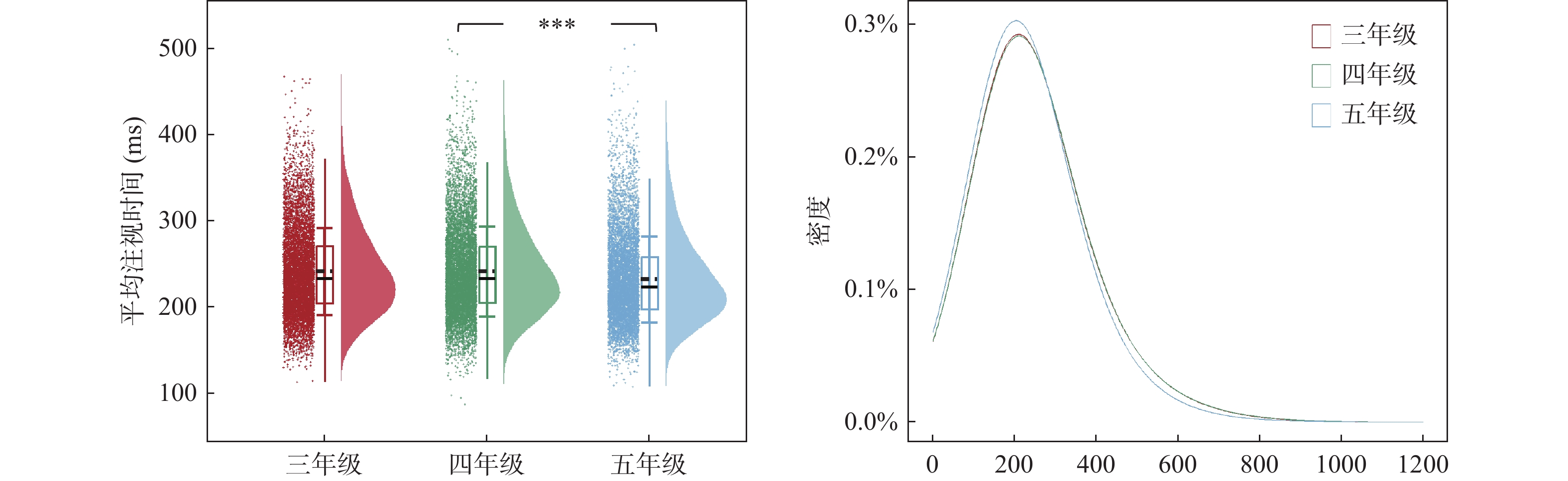
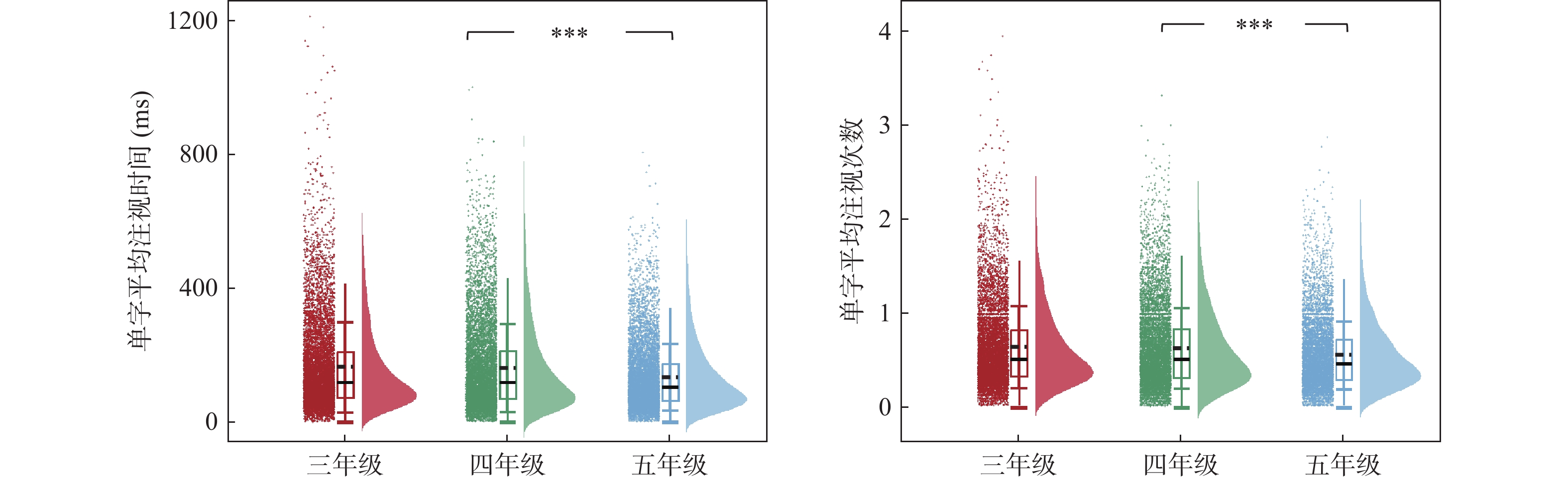
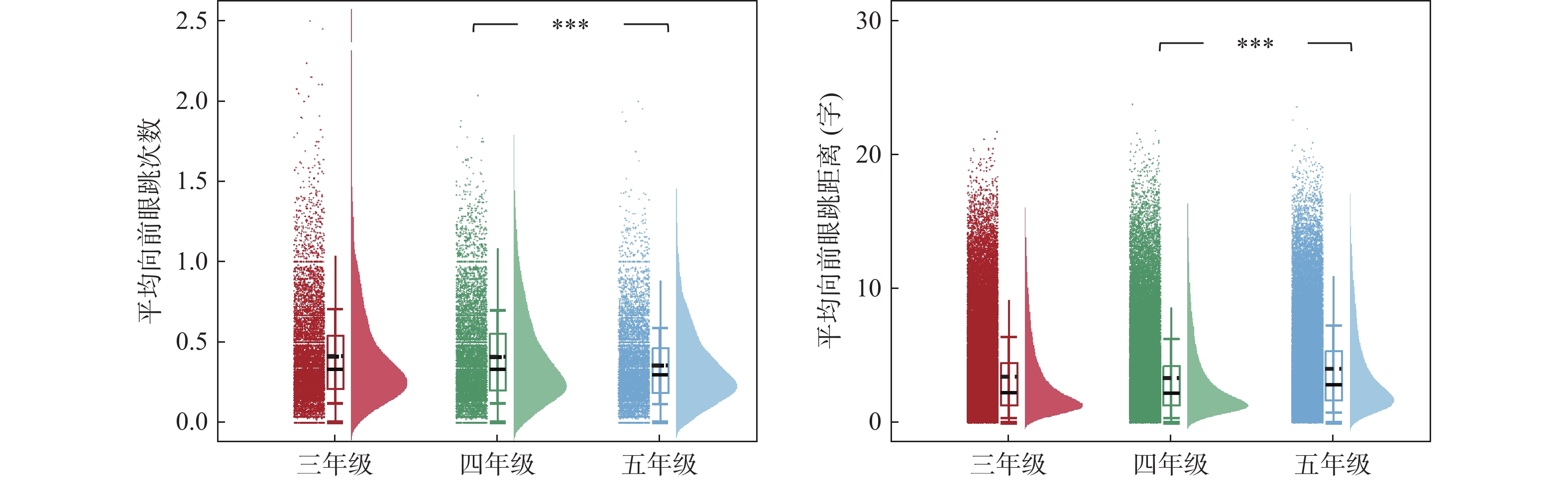
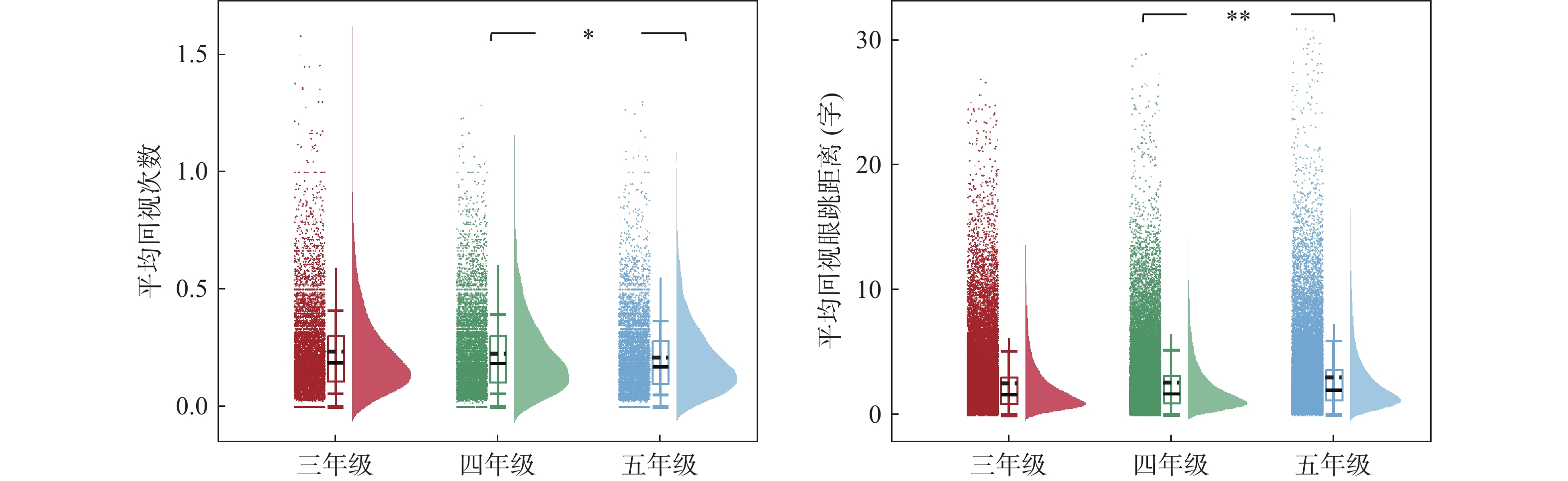
| 变量 | b | SE | t | 95%CI | |
| 平均注视时间 | 截距 | 5.45 | 0.01 | 615.10*** | [5.44, 5.47] |
| 三年级vs.四年级 | 0.01 | 0.02 | 0.33 | [–0.03, 0.04] | |
| 四年级vs.五年级 | –0.06 | 0.01 | –4.18*** | [–0.08, –0.03] | |
| 单字平均注视时间 | 截距 | 4.73 | 0.04 | 124.22*** | [4.66, 4.80] |
| 三年级vs.四年级 | –0.02 | 0.07 | –0.38 | [–0.15, 0.10] | |
| 四年级vs.五年级 | –0.19 | 0.05 | –3.93*** | [–0.29, –0.10] | |
| 单字平均注视次数 | 截距 | 0.61 | 0.02 | 31.30*** | [0.57, 0.65] |
| 三年级vs.四年级 | –0.01 | 0.04 | –0.32 | [–0.08, 0.06] | |
| 四年级vs.五年级 | –0.09 | 0.03 | –3.36*** | [–0.14, –0.04] | |
| 平均向前眼跳次数 | 截距 | 0.39 | 0.01 | 28.06*** | [0.36, 0.41] |
| 三年级vs.四年级 | –0.01 | 0.02 | –0.28 | [–0.05, 0.04] | |
| 四年级vs.五年级 | –0.06 | 0.02 | –3.73*** | [–0.10, –0.03] | |
| 平均向前眼跳距离 | 截距 | 4.11 | 0.08 | 48.55 | [3.94, 4.28] |
| 三年级vs.四年级 | –0.01 | 0.17 | –0.07 | [–0.35, 0.33] | |
| 四年级vs.五年级 | 0.47 | 0.09 | 5.05*** | [0.29, 0.66] | |
| 平均回视次数 | 截距 | 0.22 | 0.01 | 33.08*** | [0.21, 0.23] |
| 三年级vs.四年级 | –0.01 | 0.01 | –0.43 | [–0.03, 0.02] | |
| 四年级vs.五年级 | –0.02 | 0.01 | –2.14* | [–0.04, –0.002] | |
| 平均回视眼跳距离 | 截距 | 2.93 | 0.06 | 47.87*** | [2.81, 3.05] |
| 三年级vs.四年级 | 0.14 | 0.12 | 1.18 | [–0.09, 0.38] | |
| 四年级vs.五年级 | 0.30 | 0.10 | 3.04** | [0.11, 0.49] |
| 变量 | b | SE | t | 95%CI | |
| 平均注视时间 | 截距 | 5.45 | 0.01 | 615.10*** | [5.44, 5.47] |
| 三年级vs.四年级 | 0.01 | 0.02 | 0.33 | [–0.03, 0.04] | |
| 四年级vs.五年级 | –0.06 | 0.01 | –4.18*** | [–0.08, –0.03] | |
| 单字平均注视时间 | 截距 | 4.73 | 0.04 | 124.22*** | [4.66, 4.80] |
| 三年级vs.四年级 | –0.02 | 0.07 | –0.38 | [–0.15, 0.10] | |
| 四年级vs.五年级 | –0.19 | 0.05 | –3.93*** | [–0.29, –0.10] | |
| 单字平均注视次数 | 截距 | 0.61 | 0.02 | 31.30*** | [0.57, 0.65] |
| 三年级vs.四年级 | –0.01 | 0.04 | –0.32 | [–0.08, 0.06] | |
| 四年级vs.五年级 | –0.09 | 0.03 | –3.36*** | [–0.14, –0.04] | |
| 平均向前眼跳次数 | 截距 | 0.39 | 0.01 | 28.06*** | [0.36, 0.41] |
| 三年级vs.四年级 | –0.01 | 0.02 | –0.28 | [–0.05, 0.04] | |
| 四年级vs.五年级 | –0.06 | 0.02 | –3.73*** | [–0.10, –0.03] | |
| 平均向前眼跳距离 | 截距 | 4.11 | 0.08 | 48.55 | [3.94, 4.28] |
| 三年级vs.四年级 | –0.01 | 0.17 | –0.07 | [–0.35, 0.33] | |
| 四年级vs.五年级 | 0.47 | 0.09 | 5.05*** | [0.29, 0.66] | |
| 平均回视次数 | 截距 | 0.22 | 0.01 | 33.08*** | [0.21, 0.23] |
| 三年级vs.四年级 | –0.01 | 0.01 | –0.43 | [–0.03, 0.02] | |
| 四年级vs.五年级 | –0.02 | 0.01 | –2.14* | [–0.04, –0.002] | |
| 平均回视眼跳距离 | 截距 | 2.93 | 0.06 | 47.87*** | [2.81, 3.05] |
| 三年级vs.四年级 | 0.14 | 0.12 | 1.18 | [–0.09, 0.38] | |
| 四年级vs.五年级 | 0.30 | 0.10 | 3.04** | [0.11, 0.49] |
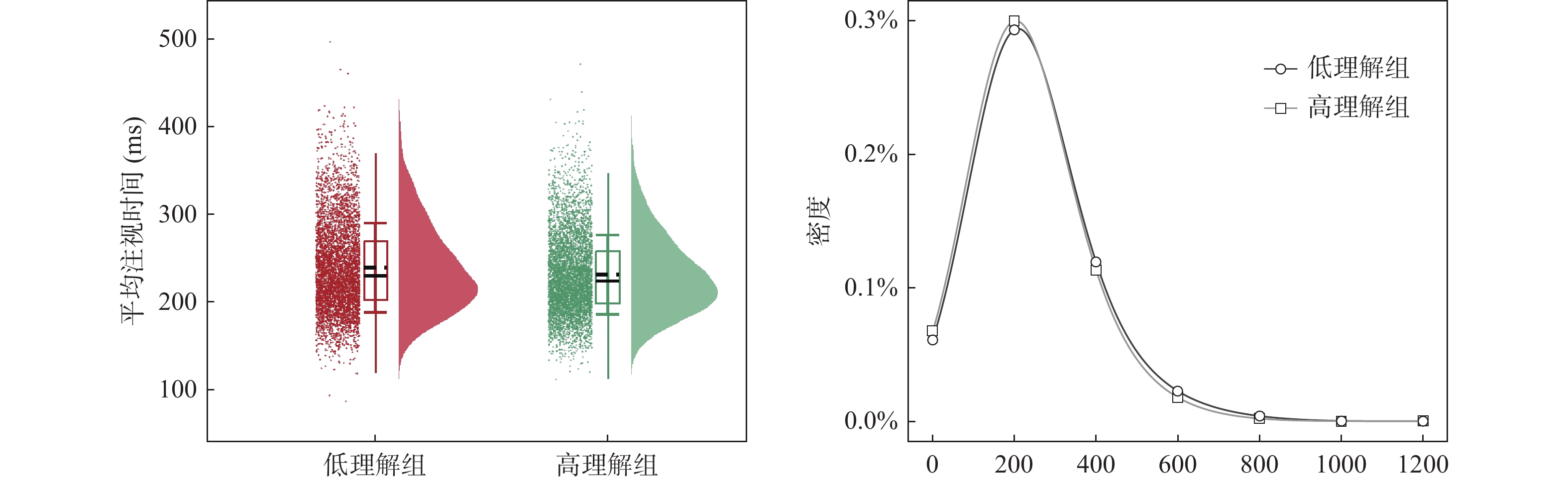
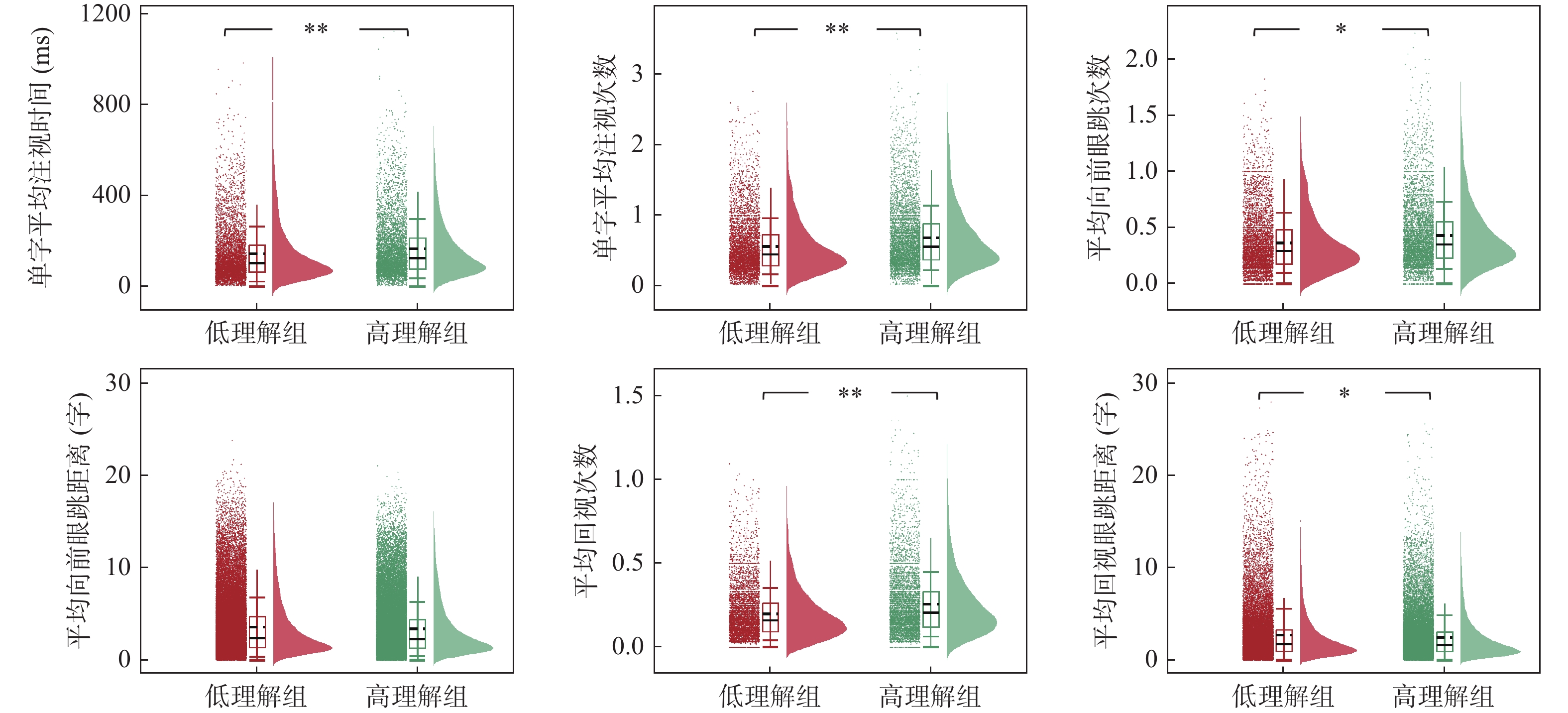
| 变量 | b | SE | t | 95%CI | |
| 平均注视时间 | 截距 | 5.44 | 0.01 | 461.81*** | [5.42, 5.47] |
| 高vs.低 | –0.02 | 0.02 | –1.04 | [–0.07, 0.02] | |
| 单字平均注视时间 | 截距 | 4.74 | 0.05 | 94.62*** | [4.64, 4.84] |
| 高vs.低 | 0.23 | 0.09 | 2.62** | [0.06, 0.39] | |
| 单字平均注视次数 | 截距 | 0.62 | 0.03 | 22.06*** | [0.57, 0.68] |
| 高vs.低 | 0.14 | 0.05 | 2.72** | [0.04, 0.24] | |
| 平均向前眼跳次数 | 截距 | 0.40 | 0.02 | 20.57*** | [0.36, 0.43] |
| 高vs.低 | 0.07 | 0.03 | 2.24* | [0.01, 0.14] | |
| 平均向前眼跳距离 | 截距 | 4.05 | 0.12 | 33.40*** | [3.81, 4.29] |
| 高vs.低 | –0.34 | 0.23 | –1.44 | [–0.80, 0.12] | |
| 平均回视次数 | 截距 | 0.23 | 0.01 | 22.40*** | [0.21, 0.25] |
| 高vs.低 | 0.06 | 0.02 | 3.35** | [0.03, 0.10] | |
| 平均回视眼跳距离 | 截距 | 2.82 | 0.08 | 36.30*** | [2.67, 2.98] |
| 高vs.低 | –0.28 | 0.14 | –1.97* | [–0.56, –0.001] |
| 变量 | b | SE | t | 95%CI | |
| 平均注视时间 | 截距 | 5.44 | 0.01 | 461.81*** | [5.42, 5.47] |
| 高vs.低 | –0.02 | 0.02 | –1.04 | [–0.07, 0.02] | |
| 单字平均注视时间 | 截距 | 4.74 | 0.05 | 94.62*** | [4.64, 4.84] |
| 高vs.低 | 0.23 | 0.09 | 2.62** | [0.06, 0.39] | |
| 单字平均注视次数 | 截距 | 0.62 | 0.03 | 22.06*** | [0.57, 0.68] |
| 高vs.低 | 0.14 | 0.05 | 2.72** | [0.04, 0.24] | |
| 平均向前眼跳次数 | 截距 | 0.40 | 0.02 | 20.57*** | [0.36, 0.43] |
| 高vs.低 | 0.07 | 0.03 | 2.24* | [0.01, 0.14] | |
| 平均向前眼跳距离 | 截距 | 4.05 | 0.12 | 33.40*** | [3.81, 4.29] |
| 高vs.低 | –0.34 | 0.23 | –1.44 | [–0.80, 0.12] | |
| 平均回视次数 | 截距 | 0.23 | 0.01 | 22.40*** | [0.21, 0.25] |
| 高vs.低 | 0.06 | 0.02 | 3.35** | [0.03, 0.10] | |
| 平均回视眼跳距离 | 截距 | 2.82 | 0.08 | 36.30*** | [2.67, 2.98] |
| 高vs.低 | –0.28 | 0.14 | –1.97* | [–0.56, –0.001] |
|
程亚华, 冯瑶, 李宜逊, 马嘉琪, 沈岚岚, 张文建, … 冯秋迪. 小学儿童口语词汇知识的发展轨迹及其对阅读能力的预测: 一个潜变量增长模型. 心理学报, 2023, 55 (7): 1074- 1086.
|
|
|
梁菲菲, 王永胜, 杨文, 白学军. 阅读水平调节儿童阅读眼动注视模式的发展: 基于9~11岁儿童的证据. 心理学报, 2017, 49 (4): 450- 459.
DOI |
|
|
巫金根, 李赛男, 袁小源, 王永胜, 闫国利. 小学生中文阅读知觉广度发展的阶段性: 从对称至不对称. 心理科学, 2025, 48 (2): 382- 392.
DOI |
|
|
向颖, 贺斐, 冯琳琳, 龙梦灵, 白学军, 梁菲菲. 中文阅读伴随词汇学习: 高效与低效组的认知加工策略比较. 心理学报, 2025, 57 (9): 1512- 1528.
DOI |
|
|
闫国利. (2020). 学生汉语阅读加工机制及阅读效率促进的眼动研究. 北京: 科学出版社.
|
|
|
闫国利, 巫金根, 臧传丽, 白学军. 阅读知觉广度眼动研究述评. 心理学探新, 2010, 30 (2): 23- 28.
DOI |
|
|
闫国利, 熊建萍, 臧传丽, 余莉莉, 崔磊, 白学军. 阅读研究中的主要眼动指标评述. 心理科学进展, 2013, 21 (4): 589- 605.
|
|
|
Bicknell, K., & Levy, R. (2011). Why readers regress to previous words: A statistical analysis. In Proceedings of the 33rd annual meeting of the cognitive science conference (pp. 931–936). Boston: Cognitive Science Society.
|
|
|
Cain, K., & Oakhill, J. (2007). Children’s comprehension problems in oral and written language: A cognitive perspective. New York: Guilford Press.
|
|
|
Chambrè, S. J., Ehri, L. C., & Ness, M. Phonological decoding enhances orthographic facilitation of vocabulary learning in first graders. Reading and Writing, 2020, 33 (5): 1133- 1162.
DOI |
|
|
Ehri, L. C. Learning to read words: Theory, findings, and issues. Scientific Studies of Reading, 2005, 9 (2): 167- 188.
DOI |
|
|
Eskenazi, M. A., Swischuk, N. K., Folk, J. R., & Abraham, A. N. (2018). Uninformative contexts support word learning for high-skill spellers. Journal of Experimental Psychology: Learning, Memory, and Cognition, 44(12), 2019–2025.
|
|
|
Feng, G., Miller, K., Shu, H., & Zhang, H. C. Orthography and the development of reading processes: An eye-movement study of Chinese and English. Child Development, 2009, 80 (3): 720- 735.
DOI |
|
|
Ferreira, F., Bailey, K. G. D., & Ferraro, V. Good-enough representations in language comprehension. Current Directions in Psychological Science, 2002, 11 (1): 11- 15.
DOI |
|
|
Häikiö, T., Bertram, R., Hyönä, J., & Niemi, P. Development of the letter identity span in reading: Evidence from the eye movement moving window paradigm. Journal of Experimental Child Psychology, 2009, 102 (2): 167- 181.
DOI |
|
|
Huestegge, L., Radach, R., Corbic, D., & Huestegge, S. M. Oculomotor and linguistic determinants of reading development: A longitudinal study. Vision Research, 2009, 49 (24): 2948- 2959.
DOI |
|
|
Inhoff, A. W., Gregg, J., & Radach, R. Eye movement programming and reading accuracy. Quarterly Journal of Experimental Psychology, 2018, 71 (1): 3- 10.
DOI |
|
|
Joseph, H. S. S. L., Liversedge, S. P., Blythe, H. I., White, S. J., & Rayner, K. Word length and landing position effects during reading in children and adults. Vision Research, 2009, 49 (16): 2078- 2086.
DOI |
|
|
Kintsch, W. (1998). Comprehension: A paradigm for cognition. New York: Cambridge University Press.
|
|
|
Kuperman, V., Matsuki, K., & Van Dyke, J. A. (2018). Contributions of reader- and text-level characteristics to eye-movement patterns during passage reading. Journal of Experimental Psychology: Learning, Memory, and Cognition, 44(11), 1687–1713.
|
|
|
Liang, F. F., Blythe, H. I., Zang, C. L., Bai, X. J., Yan, G. L., & Liversedge, S. P. Positional character frequency and word spacing facilitate the acquisition of novel words during Chinese children’s reading. Journal of Cognitive Psychology, 2015, 27 (5): 594- 608.
DOI |
|
|
Liversedge, S. P., Drieghe, D., Li, X., Yan, G. L., Bai, X. J., & Hyönä, J. Universality in eye movements and reading: A trilingual investigation. Cognition, 2016, 147, 1- 20.
DOI |
|
|
Parshina, O., Sekerina, I. A., Lopukhina, A., & von der Malsburg, T. Monolingual and bilingual reading processes in Russian: An exploratory scanpath analysis. Reading Research Quarterly, 2022, 57 (2): 469- 492.
DOI |
|
|
Perfetti, C. Reading ability: Lexical quality to comprehension. Scientific Studies of Reading, 2007, 11 (4): 357- 383.
DOI |
|
|
R Core Team. (2024). R: A language and environment for statistical computing. Vienna: R Foundation for Statistical Computing.
|
|
|
Rayner, K. Eye movements in reading and information processing: 20 years of research. Psychological Bulletin, 1998, 124 (3): 372- 422.
DOI |
|
|
Rayner, K. Eye movements in reading: Models and data. Journal of Eye Movement Research, 2008, 2 (5): 1- 10.
DOI |
|
|
Rayner, K. The 35th Sir Frederick Bartlett Lecture: Eye movements and attention in reading, scene perception, and visual search. Quarterly Journal of Experimental Psychology, 2009, 62 (8): 1457- 1506.
DOI |
|
|
Reichle, E. D., Liversedge, S. P., Drieghe, D., Blythe, H. I., Joseph, H. S. S. L., White, S. J., & Rayner, K. Using E-Z Reader to examine the concurrent development of eye-movement control and reading skill. Developmental Review, 2013, 33 (2): 110- 149.
DOI |
|
|
Taylor, J. N., & Perfetti, C. A. Eye movements reveal readers’ lexical quality and reading experience. Reading and Writing, 2016, 29 (6): 1069- 1103.
DOI |
|
|
Yan, G. L., Tian, H. J., Bai, X. J., & Rayner, K. The effect of word and character frequency on the eye movements of Chinese readers. British Journal of Psychology, 2006, 97 (2): 259- 268.
DOI |
|
|
Yan, M., Pan, J. E., & Kliegl, R. Eye movement control in Chinese reading: A cross-sectional study. Developmental Psychology, 2019, 55 (11): 2275- 2285.
DOI |
| [1] | Xiaoqian DING, Huayu LIU. The Dual-Path Mechanisms of Social Exclusion on Individuals’ Social Behaviors: The Roles of Negative Perfectionism and Attentional Bias [J]. Studies of Psychology and Behavior, 2026, 24(1): 51-59. |
| [2] | Zeqi LIU, Yuhua LI, Yan GAO, Jiaxin LIU, Mengmeng SU. Development and Validation of the Home Literacy Environment Scale for Chinese Children [J]. Studies of Psychology and Behavior, 2026, 24(1): 113-121. |
| [3] | Jiaxin CUI, Yuhan ZUO, Jiajia FENG, Zhanling CUI. Ideographic and Phonographic Languages Share a Common Cognitive Foundation: Evidence from Visual Form Perception [J]. Studies of Psychology and Behavior, 2025, 23(6): 766-773. |
| [4] | Wenjing LI, Wen SUN, Haidi ZHU. The Influence of Popular Background Music on Leisure Reading: Evidence from Eye Movements [J]. Studies of Psychology and Behavior, 2025, 23(4): 448-455. |
| [5] | Yufei DU, Zhichao ZHANG, Manman ZHANG, Chuanli ZANG. Semantics Takes Precedence over World Knowledge in Sentence Comprehension: Evidence from Eye Movements [J]. Studies of Psychology and Behavior, 2025, 23(2): 153-160. |
| [6] | Yongsheng WANG, Yang HAN, Xin LI, Liyuan HE. The Promotion of Inter-Word Space in Chinese Sentence Reading of Uyghur College Students with Different Text Presentation Directions [J]. Studies of Psychology and Behavior, 2025, 23(1): 41-48. |
| [7] | Min WU, Shuangyan LI, Wenqi SONG, Tianpeng ZHENG. Latent Transition Analysis of Children’s Sleep Quality and the Emotional Influence in Primary School Against the Background of “Double Reduction” Policy [J]. Studies of Psychology and Behavior, 2025, 23(1): 49-57. |
| [8] | Xiangwen CHEN, Longge WANG, Huilan HU, Zhichao ZHANG, Mengsi WANG, Qiang WANG, Manman ZHANG. The Neural Structural Basis of Individual Differences in Word Frequency Effect on Eye Movement Measures During Chinese Reading [J]. Studies of Psychology and Behavior, 2024, 22(6): 721-729. |
| [9] | Guang ZHAO, Jiahuan CHEN, Linxuan LI, Jichao ZHANG, Rongtao WU. The Dynamic Eye Movement Patterns in Contextual Cueing Effect: Evidence from the Hidden Markov Model [J]. Studies of Psychology and Behavior, 2024, 22(5): 594-601. |
| [10] | Yuqing JIA, Tongqi GAO, Guoli YAN. Eye Movements in Silent and Oral Sentence Reading Among Chinese First Graders [J]. Studies of Psychology and Behavior, 2024, 22(5): 633-641. |
| [11] | Yongsheng WANG, Na ZHANG, Xiaopu DU, Zilu GUO, Xin LI. The Role of Morphological Awareness in Reading of Chinese Second Language Learners [J]. Studies of Psychology and Behavior, 2024, 22(4): 450-456. |
| [12] | Jinkun ZHANG, Tingming LAI, Xiaoqi ZAN, Sha LI, Kunyu LIAN, Lijuan ZHANG. The Disfluency Effect in Multimedia Learning: Balancing Cues and Fluency [J]. Studies of Psychology and Behavior, 2024, 22(4): 545-552. |
| [13] | Wen ZHANG, Chao KAN, Limin GUO, Zhihe LIU, Yang LIU. A Study on the Cognitive Processing Characteristics of Perceptual Anticipation in Volleyball Players’ Reception of Smashes: Correlated Evidence from Eye Movements and fNIRS [J]. Studies of Psychology and Behavior, 2024, 22(4): 562-569. |
| [14] | Yingchao WANG, Sainan LI, Ziming SONG, Guoli YAN. The Influence of Reading Mode on Word Frequency Effect in Chinese Sentence Reading [J]. Studies of Psychology and Behavior, 2024, 22(2): 183-188, 226. |
| [15] | Jingjing CUI, Yang WANG, Xiao LI, Haibo YANG. Specificity of Impaired Attentional Inhibition of Problematic Social Media User Among College Students [J]. Studies of Psychology and Behavior, 2024, 22(2): 258-265. |
| Viewed | ||||||
|
Full text |
|
|||||
|
Abstract |
|
|||||
