
Studies of Psychology and Behavior ›› 2026, Vol. 24 ›› Issue (2): 204-211.DOI: 10.12139/j.1672-0628.2026.02.008
• ? • Previous Articles Next Articles
Jing ZHANG1,2, Gege LIU1, Tingmin LI3, Shuangzhu ZHOU4, Rixin TANG*,1( ), Ziying WANG1
Received:2024-08-07
Online:2026-03-20
Published:2026-03-20
Contact:
Rixin TANG
张璟1,2, 刘格格1, 李婷敏3, 周双珠4, 唐日新*,1(), 王子滢1
通讯作者:
唐日新
基金资助:Jing ZHANG, Gege LIU, Tingmin LI, Shuangzhu ZHOU, Rixin TANG, Ziying WANG. The Influence of Others’ Kindness Traits and Children’s Initial Beliefs on Selective Learning in Early Childhood[J]. Studies of Psychology and Behavior, 2026, 24(2): 204-211.
张璟, 刘格格, 李婷敏, 周双珠, 唐日新, 王子滢. 他人友善特质与自身初始信念对幼儿选择性学习的影响[J]. 心理与行为研究, 2026, 24(2): 204-211.
Add to citation manager EndNote|Ris|BibTeX
URL: https://psybeh.tjnu.edu.cn/EN/10.12139/j.1672-0628.2026.02.008
| 年龄 | 初始信念 | 对友善者赞同水平(M±SD) | t | d | 对不友善者赞同水平(M±SD) | t | d |
| 3岁 | 弱 | 0.79±0.36 | 4.49* | 0.81 | 0.66±0.40 | 2.27* | 0.41 |
| 强 | 0.65±0.43 | 1.87 | 0.52±0.46 | 0.20 | |||
| 4岁 | 弱 | 0.66±0.41 | 2.15* | 0.38 | 0.37±0.43 | −1.68 | |
| 强 | 0.27±0.42 | −3.15** | 0.56 | 0.15±0.35 | −5.71*** | 1.02 | |
| 5岁 | 弱 | 0.60±0.40 | 1.36 | 0.19±0.33 | −5.12*** | 0.92 | |
| 强 | 0.27±0.43 | −2.97** | 0.54 | 0.10±0.27 | −8.27*** | 1.49 |
| 年龄 | 初始信念 | 对友善者赞同水平(M±SD) | t | d | 对不友善者赞同水平(M±SD) | t | d |
| 3岁 | 弱 | 0.79±0.36 | 4.49* | 0.81 | 0.66±0.40 | 2.27* | 0.41 |
| 强 | 0.65±0.43 | 1.87 | 0.52±0.46 | 0.20 | |||
| 4岁 | 弱 | 0.66±0.41 | 2.15* | 0.38 | 0.37±0.43 | −1.68 | |
| 强 | 0.27±0.42 | −3.15** | 0.56 | 0.15±0.35 | −5.71*** | 1.02 | |
| 5岁 | 弱 | 0.60±0.40 | 1.36 | 0.19±0.33 | −5.12*** | 0.92 | |
| 强 | 0.27±0.43 | −2.97** | 0.54 | 0.10±0.27 | −8.27*** | 1.49 |
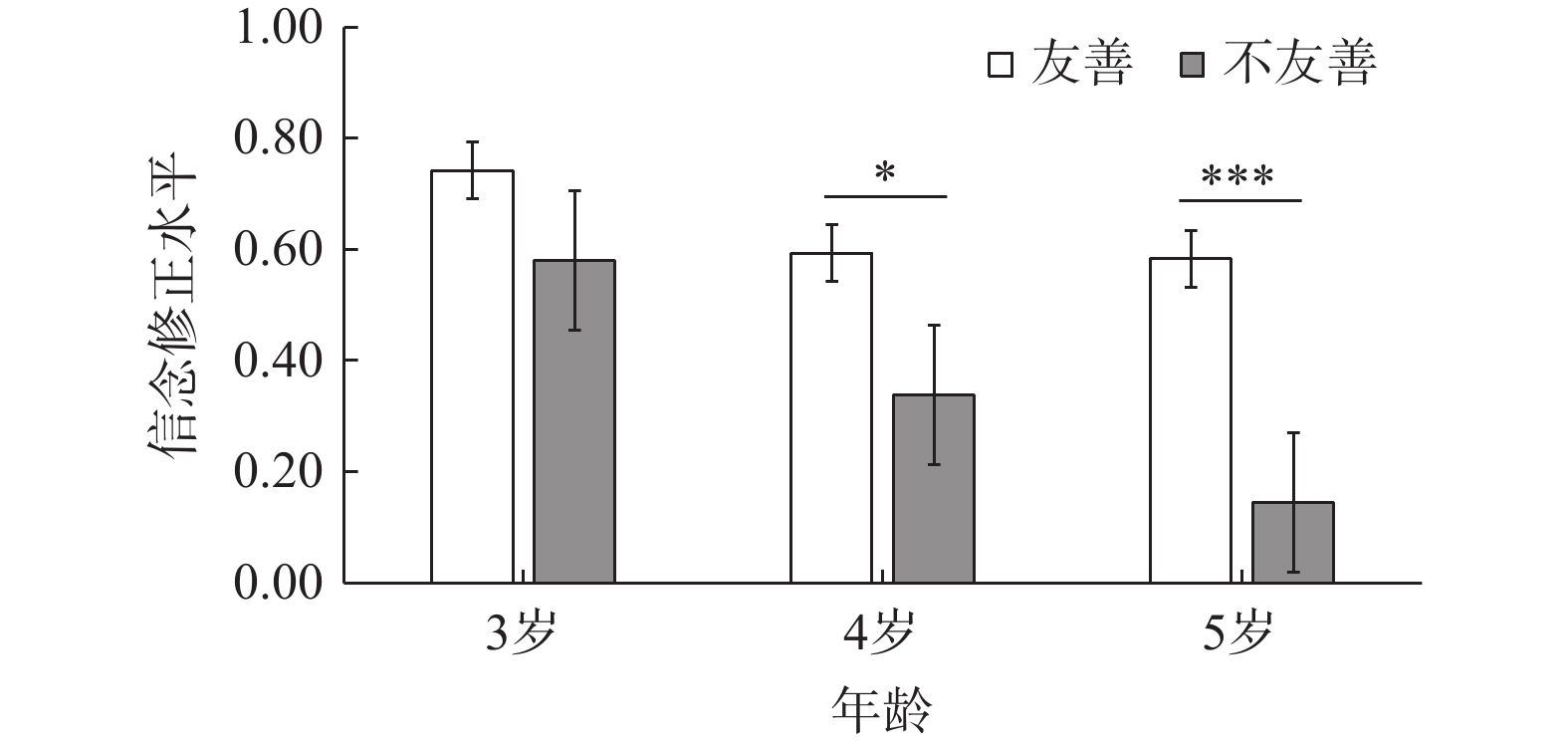
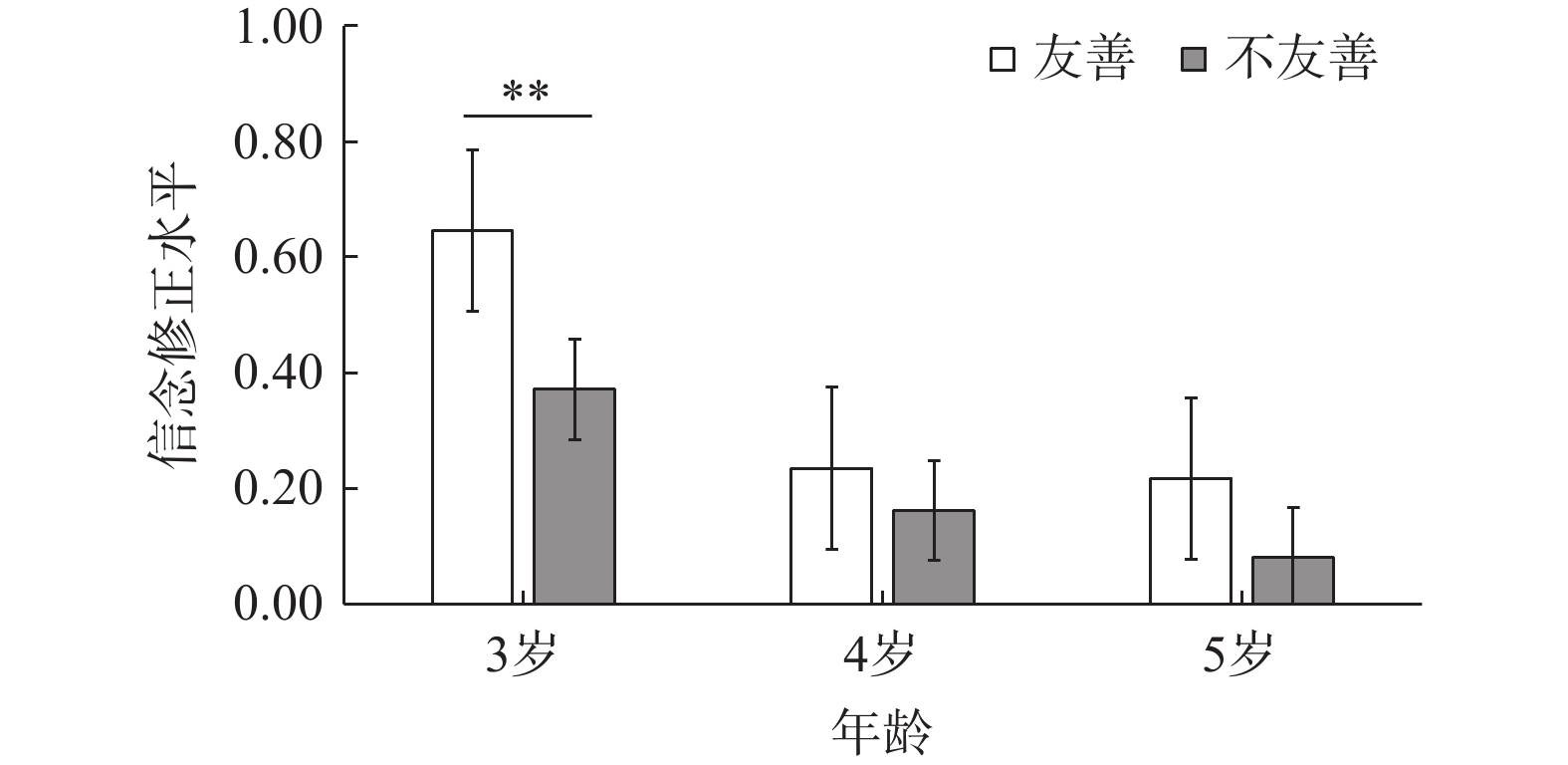
| 年龄 | 初始信念 | 面对友善者信念修正 (M±SD) | 面对不友善者信念修正 (M±SD) |
| 3岁 | 弱 | 0.74±0.36 | 0.58±0.43 |
| 强 | 0.65±0.41 | 0.37±0.41 | |
| 4岁 | 弱 | 0.59±0.41 | 0.34±0.42 |
| 强 | 0.23±0.40 | 0.16±0.35 | |
| 5岁 | 弱 | 0.58±0.40 | 0.15±0.29 |
| 强 | 0.22±0.39 | 0.08±0.26 |
| 年龄 | 初始信念 | 面对友善者信念修正 (M±SD) | 面对不友善者信念修正 (M±SD) |
| 3岁 | 弱 | 0.74±0.36 | 0.58±0.43 |
| 强 | 0.65±0.41 | 0.37±0.41 | |
| 4岁 | 弱 | 0.59±0.41 | 0.34±0.42 |
| 强 | 0.23±0.40 | 0.16±0.35 | |
| 5岁 | 弱 | 0.58±0.40 | 0.15±0.29 |
| 强 | 0.22±0.39 | 0.08±0.26 |
|
陈水平. 友善特质与信息准确性对3~5岁幼儿选择性信任的影响. 心理学探新, 2022, 42 (3): 233- 240.
|
|
|
李庆功, 徐芬, 周小梅. 3~4岁儿童基于可信度特质的信任判断: 特质间差异和年龄特点. 心理发展与教育, 2012, 28 (4): 345- 352.
|
|
|
李泉, 廖丽莉, 廉彬, 冯廷勇. 执行功能对4岁幼儿情绪胜任力的影响: 语言的中介作用. 心理与行为研究, 2019, 17 (3): 340- 347.
|
|
|
李婷玉, 刘黎, 李宜霖, 朱莉琪. 冲突情境下幼儿的选择性信任和信念修正. 心理学报, 2018, 50 (12): 1390- 1399.
|
|
|
皮亚杰. (1990). 皮亚杰教育论著选 (卢濬 译). 北京: 人民教育出版社.
|
|
|
沈佳鑫, 费广洪, 舒慧. 分心刺激条件下4~6岁儿童类比推理的发展及执行功能的影响. 心理学探新, 2025, 45 (5): 428- 434.
|
|
|
斯特兰∙奥尔松. (2017). 深层学习: 心智如何超越经验 (赵庆柏, 唐云, 陈石 等译). 北京: 机械工业出版社.
|
|
|
唐卫海, 钟汝波, 许晓旭, 刘希平. 面孔吸引力和信息正确性对幼儿选择性信任的影响. 心理学报, 2019, 51 (1): 71- 84.
|
|
|
王燕, 程艳, 李佳阳, 董圣鸿. 影响儿童选择性信任的社会性线索研究新进展. 心理学探新, 2015, 35 (6): 526- 533.
DOI |
|
|
张耀华, 朱莉琪. 认识性信任: 学龄前儿童的选择性学习. 心理科学进展, 2014, 22 (1): 86- 96.
|
|
|
Akhtar, N., & Jaswal, V. K. Deficit or difference? Interpreting diverse developmental paths: An introduction to the special section. Developmental Psychology, 2013, 49 (1): 1- 3.
DOI |
|
|
Bidell, T. R., & Fischer, K. W. (1992). Beyond the stage debate: Action, structure, and variability in Piagetian theory and research. In R. J. Sternberg & C. A. Berg (Eds.), Intellectual development (pp. 100–140). Cambridge, United Kingdom: Cambridge University Press.
|
|
|
Birch, S. A. J., Vauthier, S. A., & Bloom, P. Three- and four-year-olds spontaneously use others’ past performance to guide their learning. Cognition, 2008, 107 (3): 1018- 1034.
DOI |
|
|
Boseovski, J. J. Evidence for “Rose-colored glasses”: An examination of the positivity bias in young children’s personality judgments. Child Development Perspectives, 2010, 4 (3): 212- 218.
DOI |
|
|
Chouinard, M. M., & Imberi-Olivares, K. (2011). Getting information from other people: Who do children turn to? In M. Siegal & L. Surian (Eds.), Access to language and cognitive development (pp. 100–115). New York: Oxford University Press.
|
|
|
Colquitt, J. A., Scott, B. A., & LePine, J. A. Trust, trustworthiness, and trust propensity: A meta-analytic test of their unique relationships with risk taking and job performance. Journal of Applied Psychology, 2007, 92 (4): 909- 927.
DOI |
|
|
Corriveau, K. H., Harris, P. L., Meins, E., Fernyhough, C., Arnott, B., Elliott, L., … De Rosnay, M. Young children’s trust in their mother’s claims: Longitudinal links with attachment security in infancy. Child Development, 2009, 80 (3): 750- 761.
DOI |
|
|
Croce, R. C. & Boseovski, J. J. Trait or testimony? Children’s preferences for positive informants. Journal of Experimental Child Psychology, 2020, 190, 104726.
DOI |
|
|
Diamond, A. Executive functions. Annual Review of Psychology, 2013, 64 (1): 135- 168.
DOI |
|
|
Einav, S., & Robinson, E. J. When being right is not enough: Four-year-olds distinguish knowledgeable informants from merely accurate informants. Psychological Science, 2011, 22 (10): 1250- 1253.
DOI |
|
|
Farrell, S. Social influence benefits the wisdom of individuals in the crowd. Proceedings of the National Academy of Sciences of the United States of America, 2011, 108 (36): E625.
DOI |
|
|
Fiske, A., Mortimer, A., Collins-Jones, L., de Klerk, C. C. J. M., Gattas, S. U., Dvergsdal, H., … Holmboe, K. Inhibitory control development from infancy to early childhood: A longitudinal fNIRS study. Developmental Cognitive Neuroscience, 2025, 73, 101557.
DOI |
|
|
Guerrero, S., Cascado, C., Sausa, M., & Enesco, I. My teacher is wrong: Preschoolers’ opposition to non-conventional statements. Early Childhood Research Quarterly, 2017, 39, 1- 13.
DOI |
|
|
Harris, P. L. Trust. Developmental Science, 2007, 10 (1): 135- 138.
DOI |
|
|
Harris, P. L. (2012). Trusting what you’re told: How children learn from others. Cambridge, MA: Harvard University Press.
|
|
|
Harris, P. L., & Corriveau, K. H. (2011). Young children’s selective trust in informants. Philosophical Transactions of the Royal Society of London, Series B: Biological Sciences, 366(1567), 1179–1187.
|
|
|
Jaswal, V. K. Don’t believe everything you hear: Preschoolers’ sensitivity to speaker intent in category induction. Child Development, 2004, 75 (6): 1871- 1885.
DOI |
|
|
Jaswal, V. K., Croft, A. C., Setia, A. R., & Cole, C. A. Young children have a specific, highly robust bias to trust testimony. Psychological Science, 2010, 21 (10): 1541- 1547.
DOI |
|
|
Jaswal, V. K., & Malone, L. S. Turning believers into skeptics: 3-year-olds’ sensitivity to cues to speaker credibility. Journal of Cognition and Development, 2007, 8 (3): 263- 283.
DOI |
|
|
Koenig, M. A., & Harris, P. L. Preschoolers mistrust ignorant and inaccurate speakers. Child Development, 2005, 76 (6): 1261- 1277.
DOI |
|
|
Lane, J. D., Wellman, H. M., & Gelman, S. A. Informants’ traits weigh heavily in young children’s trust in testimony and in their epistemic inferences. Child Development, 2013, 84 (4): 1253- 1268.
DOI |
|
|
Li, X. Q., & Yow, W. Q. Willingness to revise own testimony: 3- and 4-year-olds’ selective trust in unexpected testimony from accurate and inaccurate informants. Journal of Experimental Child Psychology, 2018, 173, 1- 15.
DOI |
|
|
Liu, D., Vanderbilt, K. E., & Heyman, G. D. Selective trust: Children’s use of intention and outcome of past testimony. Developmental Psychology, 2013, 49 (3): 439- 445.
DOI |
|
|
Mascaro, O., & Sperber, D. The moral, epistemic, and mindreading components of children’s vigilance towards deception. Cognition, 2009, 112 (3): 367- 380.
DOI |
|
|
Schauble, L. Belief revision in children: The role of prior knowledge and strategies for generating evidence. Journal of Experimental Child Psychology, 1990, 49 (1): 31- 57.
DOI |
|
|
Tang, W. H., Du, Y. Q., Zhong, R. B., Qin, C. H., & Liu, X. P. The effects of teacher rewards and their types on preschool children’s selective trust. Behavioral Sciences, 2025, 15 (6): 804.
DOI |
|
|
Tong, Y., Wang, F. X. & Danovitch, J. The role of epistemic and social characteristics in children’s selective trust: Three meta-analyses. Developmental Science, 2020, 23 (2): e12895.
DOI |
|
|
Trope, Y., & Higgins, E. T. The what, when, and how of dispositional inference: New answers and new questions. Personality and Social Psychology Bulletin, 1993, 19 (5): 493- 500.
DOI |
|
|
Vanderbilt, K. E., Liu, D., & Heyman, G. D. The development of distrust. Child Development, 2011, 82 (5): 1372- 1380.
DOI |
|
|
Vosniadou, S., & Verschaffel, L. Extending the conceptual change approach to mathematics learning and teaching. Learning and Instruction, 2004, 14 (5): 445- 451.
DOI |
|
|
Wilkening, F., & Anderson, N. H. Comparison of two rule-assessment methodologies for studying cognitive development and knowledge structure. Psychological Bulletin, 1982, 92 (1): 215- 237.
DOI |
|
|
Xu, F. Towards a rational constructivist theory of cognitive development. Psychological Review, 2019, 126 (6): 841- 864.
DOI |
|
|
Ye, N. N., & Ding, X. P. Children infer intentions by assessing epistemic attitudes in interpersonal interactions. Journal of Cognition and Development, 2025, 26 (2): 299- 324.
DOI |
|
|
Young, A. G., Alibali, M. W., & Kalish, C. W. Disagreement and causal learning: Others’ hypotheses affect children’s evaluations of evidence. Developmental Psychology, 2012, 48 (5): 1242- 1253.
|
|
|
Zhao, L., Mao, H. Y., Harris, P. L., & Lee, K. Trusting young children to help causes them to cheat less. Nature Human Behaviour, 2024, 8 (4): 668- 678.
DOI |
| Viewed | ||||||
|
Full text |
|
|||||
|
Abstract |
|
|||||
