
心理与行为研究 ›› 2024, Vol. 22 ›› Issue (6): 854-860.DOI: 10.12139/j.1672-0628.2024.06.018
• 应用心理学 • 上一篇
肖飒1, 郭英*,2( ), 谭小宏3, 吴映雄4, 林群1
收稿日期:2024-08-08
出版日期:2024-11-20
发布日期:2024-11-20
通讯作者:
郭英
基金资助:
Sa XIAO1, Ying GUO*,2(), Xiaohong TAN3, Yingxiong WU4, Qun LIN1
Received:2024-08-08
Online:2024-11-20
Published:2024-11-20
Contact:
Ying GUO
摘要:
为探讨大学生公正世界信念对恶意创造力的影响及其作用机制,采用公正世界信念量表、相对剥夺感量表、愤怒反刍思维量表和恶意创造力行为量表对1333名大学生进行调查,结果发现:(1)大学生公正世界信念对恶意创造力具有负向预测作用;(2)相对剥夺感在大学生公正世界信念与恶意创造力的负向效应中起到中介作用;(3)愤怒反刍在大学生公正世界信念与恶意创造力的负向效应中起到中介作用;(4)相对剥夺感、愤怒反刍在大学生公正世界信念和恶意创造力之间起链式中介作用。本研究有助于厘清公正世界信念对恶意创造力的影响机制,为恶意创造力的预防和干预提供新的视角。
肖飒, 郭英, 谭小宏, 吴映雄, 林群. 大学生公正世界信念对恶意创造力的影响:相对剥夺感和愤怒反刍的链式中介作用[J]. 心理与行为研究, 2024, 22(6): 854-860.
Sa XIAO, Ying GUO, Xiaohong TAN, Yingxiong WU, Qun LIN. The Effect of Belief in a Just World on Malevolent Creativity of College Students: The Chain Mediating Roles of Relative Deprivation and Anger Rumination[J]. Studies of Psychology and Behavior, 2024, 22(6): 854-860.
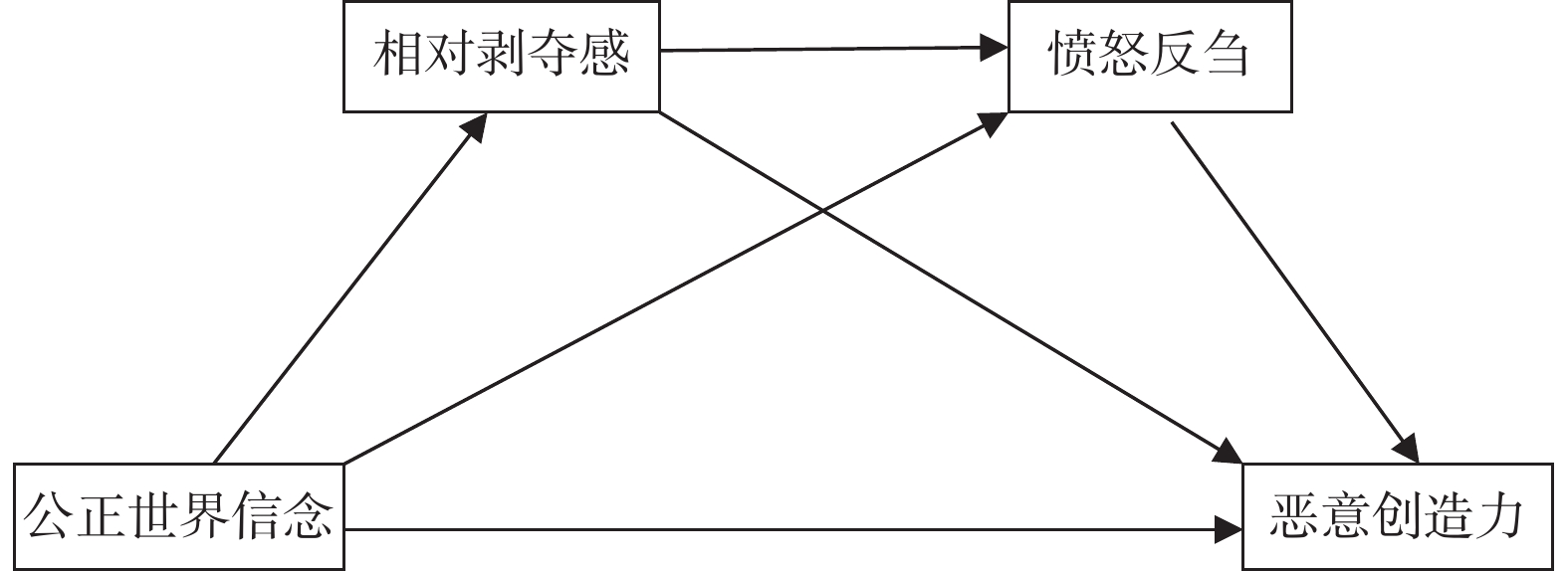
图1 假设模型
| M±SD | 1 | 2 | 3 | 4 | 5 | |
| 1.性别 | ||||||
| 2.年龄 | 19.73±1.25 | −0.09** | ||||
| 3.公正世界信念 | 35.53±8.39 | 0.08** | −0.05 | |||
| 4.相对剥夺感 | 11.19±3.40 | −0.09** | 0.03 | −0.34** | ||
| 5.愤怒反刍 | 36.21±9.41 | 0.05 | 0.01 | −0.39** | 0.50** | |
| 6.恶意创造力 | 22.53±8.58 | −0.21** | −0.01 | −0.33** | 0.43** | 0.56** |
表1 各变量的描述统计与相关分析(n=1333)
| M±SD | 1 | 2 | 3 | 4 | 5 | |
| 1.性别 | ||||||
| 2.年龄 | 19.73±1.25 | −0.09** | ||||
| 3.公正世界信念 | 35.53±8.39 | 0.08** | −0.05 | |||
| 4.相对剥夺感 | 11.19±3.40 | −0.09** | 0.03 | −0.34** | ||
| 5.愤怒反刍 | 36.21±9.41 | 0.05 | 0.01 | −0.39** | 0.50** | |
| 6.恶意创造力 | 22.53±8.58 | −0.21** | −0.01 | −0.33** | 0.43** | 0.56** |
| 结果变量 | 预测变量 | R | R2 | F | β | t |
| 恶意创造力 | 0.37 | 0.14 | 108.34*** | |||
| 性别 | −0.38 | −7.15*** | ||||
| 公正世界信念 | −0.31 | −12.23*** | ||||
| 相对剥夺感 | 0.34 | 0.12 | 88.04*** | |||
| 性别 | −0.12 | −2.24* | ||||
| 公正世界信念 | −0.33 | −12.85*** | ||||
| 愤怒反刍 | 0.56 | 0.32 | 206.74*** | |||
| 性别 | 0.22 | 4.74*** | ||||
| 公正世界信念 | −0.26 | −10.63*** | ||||
| 相对剥夺感 | 0.42 | 17.61*** | ||||
| 恶意创造力 | 0.63 | 0.40 | 218.90*** | |||
| 性别 | −0.44 | −9.84*** | ||||
| 公正世界信念 | −0.07 | −3.21** | ||||
| 相对剥夺感 | 0.15 | 6.10*** | ||||
| 愤怒反刍 | 0.47 | 18.07*** |
表2 链式中介模型中变量关系的回归分析
| 结果变量 | 预测变量 | R | R2 | F | β | t |
| 恶意创造力 | 0.37 | 0.14 | 108.34*** | |||
| 性别 | −0.38 | −7.15*** | ||||
| 公正世界信念 | −0.31 | −12.23*** | ||||
| 相对剥夺感 | 0.34 | 0.12 | 88.04*** | |||
| 性别 | −0.12 | −2.24* | ||||
| 公正世界信念 | −0.33 | −12.85*** | ||||
| 愤怒反刍 | 0.56 | 0.32 | 206.74*** | |||
| 性别 | 0.22 | 4.74*** | ||||
| 公正世界信念 | −0.26 | −10.63*** | ||||
| 相对剥夺感 | 0.42 | 17.61*** | ||||
| 恶意创造力 | 0.63 | 0.40 | 218.90*** | |||
| 性别 | −0.44 | −9.84*** | ||||
| 公正世界信念 | −0.07 | −3.21** | ||||
| 相对剥夺感 | 0.15 | 6.10*** | ||||
| 愤怒反刍 | 0.47 | 18.07*** |
| 效应 | 路径 | 效应值 | 效果量(%) | 95%置信区间 | |
| 下限 | 上限 | ||||
| 直接效应 | 公正世界信念→恶意创造力 | −0.07 | 22.58 | −0.12 | −0.03 |
| 中介效应 | 公正世界信念→相对剥夺感→恶意创造力 | −0.05 | 20.83 | −0.07 | −0.03 |
| 公正世界信念→愤怒反刍→恶意创造力 | −0.12 | 50.00 | −0.15 | −0.09 | |
| 公正世界信念→相对剥夺感→愤怒反刍→恶意创造力 | −0.07 | 29.17 | −0.08 | −0.05 | |
| 总中介效应 | −0.24 | 77.42 | −0.27 | −0.20 | |
| 总效应 | −0.31 | 100.00 | −0.36 | −0.26 | |
表3 中介效应检验结果
| 效应 | 路径 | 效应值 | 效果量(%) | 95%置信区间 | |
| 下限 | 上限 | ||||
| 直接效应 | 公正世界信念→恶意创造力 | −0.07 | 22.58 | −0.12 | −0.03 |
| 中介效应 | 公正世界信念→相对剥夺感→恶意创造力 | −0.05 | 20.83 | −0.07 | −0.03 |
| 公正世界信念→愤怒反刍→恶意创造力 | −0.12 | 50.00 | −0.15 | −0.09 | |
| 公正世界信念→相对剥夺感→愤怒反刍→恶意创造力 | −0.07 | 29.17 | −0.08 | −0.05 | |
| 总中介效应 | −0.24 | 77.42 | −0.27 | −0.20 | |
| 总效应 | −0.31 | 100.00 | −0.36 | −0.26 | |
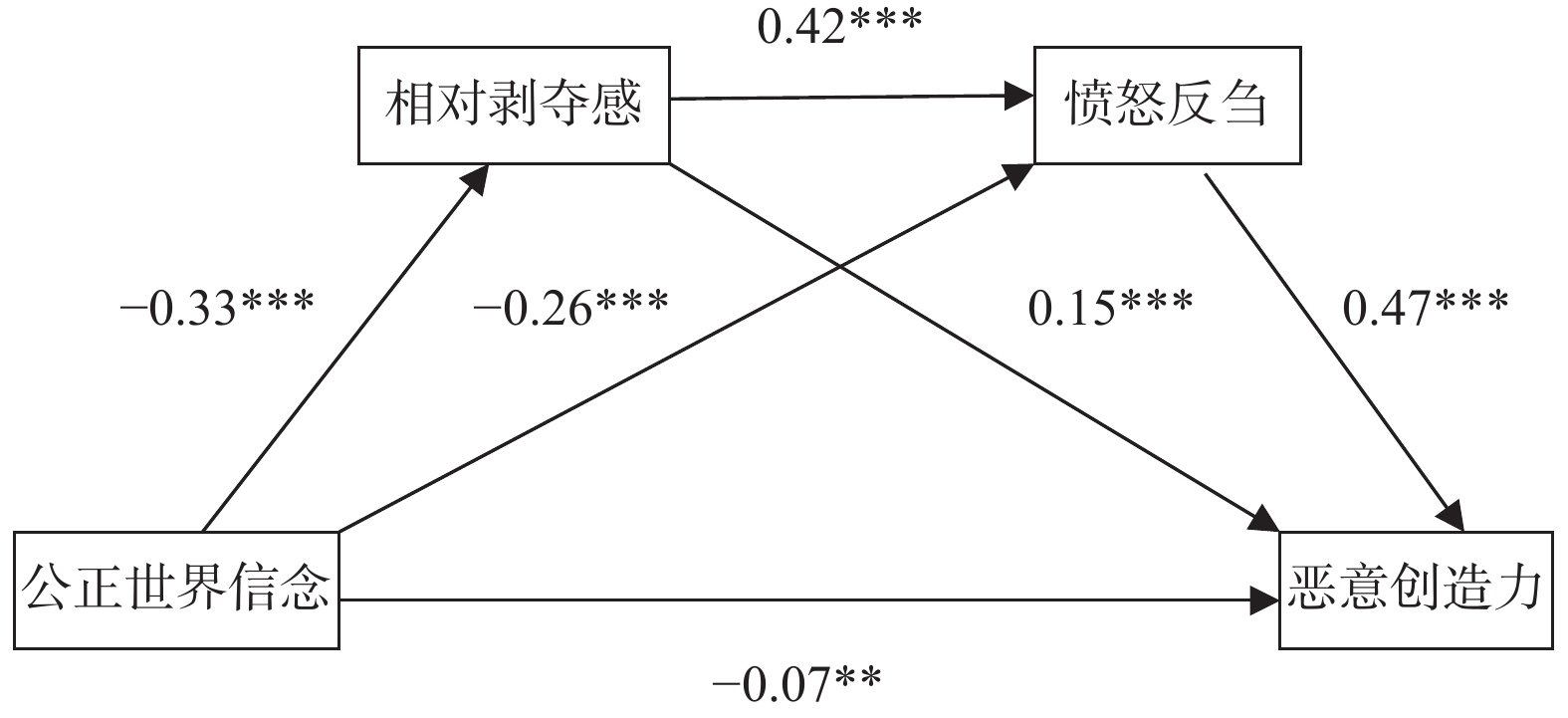
图2 链式中介效应模型
|
程瑞, 卢克龙, 郝宁. 愤怒情绪对恶意创造力的影响及调节策略. 心理学报, 2021, 53 (8): 847- 860.
|
|
|
贡喆, 刘昌. 恶意创造力: 概念、测量方法、影响因素以及研究展望. 心理科学, 2016, 39 (1): 63- 68.
|
|
|
郭永玉, 周春燕. 公正世界信念对低社会阶层的双重作用. 西南大学学报(社会科学版), 2014, 40 (1): 63- 67.
|
|
|
郝宁, 杨静. 创造力有其“阴暗面”. 心理科学, 2016, 39 (3): 761- 766.
|
|
|
黄泰霖, 林晓桃, 张丹敏, 杨子怡, 周海娃, 郑允佳. 公正世界信念与大学生志愿动机: 亲社会倾向的中介效应. 中国健康心理学杂志, 2021, 29 (11): 1742- 1746.
|
|
|
金星彤. 组织公正对员工创造力的垂滴效应——基于38家民营企业的调查. 技术经济, 2018, 37 (7): 63- 71.
DOI |
|
|
李娇娇, 刘晓冰, 裴丹丹, 徐碧波, 尹锡杨. 情绪智力对大学生恶意创造力的影响: 一个有调节的中介模型. 心理与行为研究, 2022, 20 (4): 563- 569.
DOI |
|
|
李娇娇, 徐碧波, 袁海龙, 尹锡杨. 社会排斥与大学生恶意创造力的关系: 应对方式和攻击性的链式中介作用. 心理发展与教育, 2024, 40 (5): 667- 674.
|
|
|
梁含雨, 肖娜, 周惠玲, 蒋怀滨, 滕洪昌, 刘平, 庹安写. 线下受欺负对网络攻击的影响: 相对剥夺感和愤怒反刍的链式中介作用. 中国健康心理学杂志, 2023, 31 (4): 624- 629.
|
|
|
罗亚莉, 刘云波. 愤怒反刍思维量表中文版大学生人群信效度检验. 中国临床心理学杂志, 2017, 25 (4): 667- 670.
|
|
|
马皑. 相对剥夺感与社会适应方式: 中介效应和调节效应. 心理学报, 2012, 44 (3): 377- 387.
|
|
|
邱梦茹, 孙露凝, 常雪萍, 沈槿楠, 李文福, 闫迎春. 童年期创伤与大学生恶意创造力的关系: 认知重评和心理资本的链式中介作用. 中国健康心理学杂志, 2023, 31 (10): 1552- 1557.
|
|
|
苏志强, 张大均, 王鑫强, 王金良. 大学生公正世界信念和亲社会倾向的关系研究. 中华行为医学与脑科学杂志, 2012, 21 (5): 433- 435.
DOI |
|
|
王博韬, 魏萍. 道德情绪: 探寻道德与创造力关系的新视角. 心理科学进展, 2021, 29 (2): 268- 275.
|
|
|
王丹, 王典慧, 陈文锋. 青少年心理韧性与恶意创造性行为倾向的关系. 心理学报, 2022, 54 (2): 154- 167.
|
|
|
王宇清, 龙立荣, 周浩. 消极情绪在程序和互动不公正感与员工偏离行为间的中介作用: 传统性的调节机制. 心理学报, 2012, 44 (12): 1663- 1676.
|
|
|
温忠麟, 叶宝娟. 有调节的中介模型检验方法: 竞争还是替补?. 心理学报, 2014, 46 (5): 714- 726.
|
|
|
伍嘉麒, 任枭, 贡喆. 攻击性对恶意创造力的影响: 有调节的中介模型. 心理科学, 2024, 47 (2): 367- 374.
|
|
|
武晓梅. 大学生相对剥夺感对人际信任的影响: 公正世界信念的中介与性别的调节. 阜阳职业技术学院学报, 2023, 34 (4): 23- 28.
DOI |
|
|
解志韬. 多源程序公平气氛影响个体创造力的跨层次效应. 科技进步与对策, 2021, 38 (19): 129- 136.
DOI |
|
|
熊猛, 叶一舵. 相对剥夺感: 概念、测量、影响因素及作用. 心理科学进展, 2016, 24 (3): 438- 453.
|
|
|
熊青. 社会不公平感与情绪状况. 中国健康心理学杂志, 2014, 22 (5): 695- 697.
|
|
|
张玲雁, 魏星, 谭成慧. 攻击行为的产生: 情绪对认知加工的影响. 教育生物学杂志, 2023, 11 (6): 498- 502.
DOI |
|
|
赵雨露, 张野, 付杨, 王凯. 现实排斥、网络排斥与青少年网络攻击行为的关系: 心理一致感与愤怒反刍的中介作用. 中国健康心理学杂志, 2024, 32 (1): 108- 113.
|
|
|
Berry, J. W., Worthington, E. L., Jr., O’Connor, L. E., Parrott, L., III, & Wade, N. G. Forgivingness, vengeful rumination, and affective traits. Journal of Personality, 2005, 73 (1): 183- 226.
DOI |
|
|
Clark, K., & James, K. Justice and positive and negative creativity. Creativity Research Journal, 1999, 12 (4): 311- 320.
DOI |
|
|
Cohen, D. J., Eckhardt, C. I., & Schagat, K. D. Attention allocation and habituation to anger-related stimuli during a visual search task. Aggressive Behavior, 1998, 24 (6): 399- 409.
DOI |
|
|
Cropley, D. H., Kaufman, J. C., & Cropley, A. J. Malevolent creativity: A functional model of creativity in terrorism and crime. Creativity Research Journal, 2008, 20 (2): 105- 115.
DOI |
|
|
Crosby, F. A model of egoistical relative deprivation. Psychological Review, 1976, 83 (2): 85- 113.
DOI |
|
|
De Dreu, C. K. W., Baas, M., & Nijstad, B. A. Hedonic tone and activation level in the mood-creativity link: Toward a dual pathway to creativity model. Journal of Personality and Social Psychology, 2008, 94 (5): 739- 756.
DOI |
|
|
Denson, T. F. The multiple systems model of angry rumination. Personality and Social Psychology Review, 2013, 17 (2): 103- 123.
DOI |
|
|
Folger, R., Rosenfield, D. D., & Robinson, T. Relative deprivation and procedural justifications. Journal of Personality and Social Psychology, 1983, 45 (2): 268- 273.
DOI |
|
|
Gaskell, G., & Smith, P. Relative deprivation in black and white youth: An empirical investigation. British Journal of Social Psychology, 1984, 23 (2): 121- 131.
DOI |
|
|
Gill, P., Horgan, J., Hunter, S. T., & D. Cushenbery, L. Malevolent creativity in terrorist organizations. The Journal of Creative Behavior, 2013, 47 (2): 125- 151.
DOI |
|
|
Gutworth, M. B., Cushenbery, L., & Hunter, S. T. Creativity for deliberate harm: Malevolent creativity and social information processing theory. The Journal of Creative Behavior, 2018, 52 (4): 305- 322.
DOI |
|
|
Hao, N., Qiao, X. N., Cheng, R., Lu, K. L., Tang, M. Y., & Runco, M. A. Approach motivational orientation enhances malevolent creativity. Acta Psychologica, 2020, 203, 102985.
DOI |
|
|
Hao, N., Tang, M. Y., Yang, J., Wang, Q. F., & Runco, M. A. A new tool to measure malevolent creativity: The Malevolent Creativity Behavior Scale. Frontiers in Psychology, 2016, 7, 682.
|
|
|
Hunter, S. T., Walters, K., Nguyen, T., Manning, C., & Miller, S. Malevolent creativity and malevolent innovation: A critical but tenuous linkage. Creativity Research Journal, 2022, 34 (2): 123- 144.
DOI |
|
|
James, K., Clark, K., & Cropanzano, R. Positive and negative creativity in groups, institutions, and organizations: A model and theoretical extension. Creativity Research Journal, 1999, 12 (3): 211- 226.
DOI |
|
|
Kapoor, H., & Kaufman, J. C. The evil within: The AMORAL model of dark creativity. Theory & Psychology, 2022, 32 (3): 467- 490.
|
|
|
Kawakami, K., & Dion, K. L. The impact of salient self-identities on relative deprivation and action intentions. European Journal of Social Psychology, 1993, 23 (5): 525- 540.
DOI |
|
|
Laurin, K., Fitzsimons, G. M., & Kay, A. C. Social disadvantage and the self-regulatory function of justice beliefs. Journal of Personality and Social Psychology, 2011, 100 (1): 149- 171.
DOI |
|
|
Lee, S. A., & Dow, G. T. Malevolent creativity: Does personality influence malicious divergent thinking. Creativity Research Journal, 2011, 23 (2): 73- 82.
DOI |
|
|
Lerner, M. J. Evaluation of performance as a function of performer's reward and attractiveness. Journal of Personality and Social Psychology, 1965, 1 (4): 355- 360.
DOI |
|
|
Miller, D. T. Altruism and threat to a belief in a just world. Journal of Experimental Social Psychology, 1977, 13 (2): 113- 124.
DOI |
|
|
Mishra, S., & Novakowski, D. Personal relative deprivation and risk: An examination of individual differences in personality, attitudes, and behavioral outcomes. Personality and Individual Differences, 2016, 90, 22- 26.
DOI |
|
|
Nolen-Hoeksema, S. Sex differences in unipolar depression: Evidence and theory. Psychological Bulletin, 1987, 101 (2): 259- 282.
DOI |
|
|
Osborne, D., & Sibley, C. G. Through rose-colored glasses: System-justifying beliefs dampen the effects of relative deprivation on well-being and political mobilization. Personality and Social Psychology Bulletin, 2013, 39 (8): 991- 1004.
DOI |
|
|
Smith, H. J., Pettigrew, T. F., Pippin, G. M., & Bialosiewicz, S. Relative deprivation: A theoretical and meta-analytic review. Personality and Social Psychology Review, 2012, 16 (3): 203- 232.
DOI |
|
|
Stiles, B. L., Liu, X. R., & Kaplan, H. B. Relative deprivation and deviant adaptations: The mediating effects of negative self-feelings. Journal of Research in Crime and Delinquency, 2000, 37 (1): 64- 90.
DOI |
|
|
Sukhodolsky, D. G., Golub, A., & Cromwell, E. N. Development and validation of the Anger Rumination Scale. Personality and Individual Differences, 2001, 31 (5): 689- 700.
DOI |
|
|
Sutton, R. M., & Winnard, E. J. Looking ahead through lenses of justice: The relevance of just-world beliefs to intentions and confidence in the future. British Journal of Social Psychology, 2007, 46 (3): 649- 666.
DOI |
|
|
Takebe, M., Takahashi, F., & Sato, H. Anger rumination as a risk factor for trait anger and anger-in: A longitudinal study. Personality and Individual Differences, 2016, 101, 451- 455.
DOI |
|
|
Walker, I., & Pettigrew, T. F. Relative deprivation theory: An overview and conceptual critique. British Journal of Social Psychology, 1984, 23 (4): 301- 310.
DOI |
|
|
Zoogah, D. B. Why should I be left behind? Employees’ perceived relative deprivation and participation in development activities. Journal of Applied Psychology, 2010, 95 (1): 159- 173.
DOI |
| [1] | 许航, 史新广, 段锦云, 卢红旭. 感恩对恶意创造力的影响[J]. 心理与行为研究, 2024, 22(4): 470-477. |
| [2] | 吕沐华, 熊昱可, 杨柳, 陈嘉慧, 王泉泉, 任萍. 受欺负对青少年主动性攻击及反应性攻击的影响:愤怒反刍和悲伤反刍的中介作用[J]. 心理与行为研究, 2023, 21(6): 799-806. |
| [3] | 陈姣, 熊猛. 相对剥夺感与大学生社交焦虑的关系:一个有调节的中介模型[J]. 心理与行为研究, 2023, 21(1): 65-71. |
| [4] | 李娇娇, 刘晓冰, 裴丹丹, 徐碧波, 尹锡杨. 情绪智力对大学生恶意创造力的影响:一个有调节的中介模型[J]. 心理与行为研究, 2022, 20(4): 563-569. |
| [5] | 田媛, 洪蕴哲, 牛更枫, 范翠英. 网络社会支持对中职生生活满意度的影响:公正世界信念和感恩的中介作用*[J]. 心理与行为研究, 2017, 15(2): 175-180. |
| [6] | 梁福成,周宇,王俊坤,唐卫海. 公正世界信念与跨情境动机效应[J]. 心理与行为研究, 2016, 14(3): 367-371. |
| 阅读次数 | ||||||
|
全文 |
|
|||||
|
摘要 |
|
|||||
